So we had a little time to kill after going to the Kansas City Renaissance Festival for a bit on Saturday. As we were booked to stay in Overland Park, Kansas, a city of 200,000 people, I hoped we would find some used book stores. But only one, and to be honest, I confused the number (1/2) with Books-a-Million, the national chain (I was only 999,999.5 off, which is within political polling’s margin of error). But it is a used book store, a higher-priced used book store that looks like it might cater a bit to the university trade (a lot of textbookish titles in theology and philosophy).
I looked mostly in the clearance section in the back, and I bought a few things.
I got:
Bendigo Shafter by Louis L’Amour since I did not find it at ABC Books last week.
The Second Shift by Arlie Russell Hochschild. Looks to be a sociological textbook about work/life balance originally from 1989.
The Science of Happiness by Ryuho Okawa. Given that the subtitle is 10 Principles for Manifesting Your Divine Nature, one can expect this to be a Buddhist apologetic or mindfulness tract more than science.
A View from the Bridge by Arthur Miller, a play.
Breath! You Are Alive by Thich Nhat Hanh. A modern Buddhist sutra.
Stay Alive All Your Life by Norman Vincent Peale, a modern Christian Buddhist sutra.
Descartes’ Error by Antonio R. Damasio. Subtitled Emotion, Reason, and the Human Brain, it looks to be a commentary on dualism. Given that it has “The Human Brain” in the title, one wonders if the author feels the error is in not being materialist.
The Art of Strategy: A New Translation of Sun Tzu’s Classic The Art of War by R. L. Wing. It’s been a while since I’ve read a translation of The Art of War. Given this is a 1988 translation by a translator whose name is Wing, we will take it with a grain of salt.
A The Teaching Company course on CDs, Great Scientific Ideas that Changed the World by Professor Steven L. Goldman. Gentle reader, this course was $3 for 36 lectures. I won’t see this good of a deal in a couple of weeks at the Friends of the Springfield-Greene County Library book sale. Whose half-price day falls on the same day that I will be climbing 110 stories of steps. So I might not make it to the book sale, and what would I lose? A couple (dozen) records, a couple of monographs to browse during football games, a couple audio books and courses I won’t listen to because I’m not driving anywhere these days, and a couple of chapbooks…. Alright, alright, alright, you have convinced me to go!
All right, gentle reader, you know me well enough by now. Even though I brought a book (one!) for my overnight trip, you can probably guess which book I started (and finished) in Kansas over the weekend. Which was it?
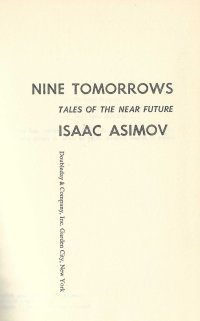
I bought this book fourteen years ago during an especially gluttonous trip to a book sale not long after my youngest was born. It would have been the autumn after my mother’s diagnosis and but, what, four months before her death? Eleven months before our move to Springfield? A long time ago, to be sure, but sometimes (often) books languish on the to-read shelves for decades. I got 94 books that weekend, and I wondered if this was the first of that lot that I read. Apparently not, as I have already read:
I also started Linda Chavez’s Betrayal for one of the library reading challenges this year in the Hispanic author category, but I didn’t get too far into it because the early 2000s concern about the power of unions in politics seems a little quaint now.
So, at any rate, this book collects nine short stories from Asimov’s magazine work in the 1950s. We’ve got:
“I Just Make Them Up, See!”, a poem about where he gets his ideas.
“Profession”, wherein future humans get tested for professions and get instantly trained for them, but one young man is told he cannot be taught this way, so he goes to a special home where the residents learn from books. Later, he learns that this is not without status, but has the highest status of all, as he can think creatively.
“The Feeling of Power”–in the far future, a lowly technician has a weird hobby–doing math by hand–and he is brought before the elites who do not believe that a mere human can replicate the magic of computers. The story was very familiar to me, and I thought that I might have recently read it. Well, when you get to my age, recently can be 8 years ago.
“The Dying Night”, a murder mystery wherein one of a trio of astronomers who have been stationed off-planet has killed an old classmate who apparently learned the secret of teleportation.
“I’m in Marsport Without Hilda” wherein a secret agent of sorts is on Mars without his wife. He plans an assignation with a local woman, but he’s roped into an assignment looking into drug-running.
“The Gentle Vultures”–a spacefaring race that generally swoops in to help societies after their nuclear wars in exchange for tribute grows frustrated as Earth’s nuclear war has not occurred.
“All the Troubles of the World”, a young boy is sent on a series of tasks ultimately designed to destroy the super-powerful computer, and the ultimate planner who almost leads him to success turns out to be the computer itself.
“Spell My Name with an S”–a scientist goes to see a “numerologist” to become successful, and the numerologist suggests he spell his name with an S–which leads to a series of investigations and events that averts a nuclear war and leads to a plumb professor position.
“The Last Question”, wherein mankind asks Multivac and its successors how to reverse entropy, and the far-evolved computer ultimately does. I’d read this story as a young man, and I’ve remembered the last twist since then.
“The Ugly Little Boy”, wherein a company has learned to create a stasis field that can grab something from the past and maintain it in the present. They demonstrate by grabbing a neanderthal child, and they bring in a nurse to help with the child. Over time, as their funding and success grows, the boy becomes less important to the company.
“Rejection Slips”, a poem about rejection slips. I bet my collection dwarfs Dr. Asimov’s.
So great classic science fiction. A lot of worry about nuclear annihilation that we don’t tend to fear as much since the 1980s. But imaginative and quick to read.
I marked a couple of things. The first was the main character in “Profession” is named George, and it mentioned that he grew out of “Jaw-jee” and into the monosyllabic “George,” which made me think about how I pronounce the name. I guess it’s a dipthong, eeor, and technically that’s one syllable, but it feels like it should be two.
In “I’m In Marsport Without Hilda”, I got an allusion:
Of course, the one I wanted might be the first one I touched. One chance out of three. I’d have one out and only God can make a three.
That’s a pun based on the movie Groundhog Day. Asimov was so future-sighted, he made an allusion to a film that would be made forty years in the future!
Just kidding. It’s from a Joyce Kilmer poem, as I am sure you remember.
I liked the book, and, man, am I reading the science fiction short stories this year or what (the rest are the James Blish Star Trek books, but still).
And please remind me, if anyone were to ask me whom I would invite to dinner if I could invite anyone living or dead to dinner, that after my departed family, I should choose Isaac Asimov.
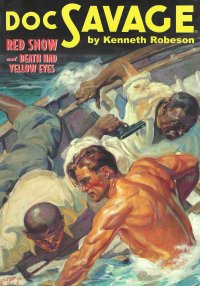
I picked this book up in June in Baraboo, Wisconsin. It contains two Doc Savage stories from the eponymous magazines from 1935 and 1944 respectively.
In The Red Snow, a strange phenomenon, a very localized red snow, completely vaporizes anyone caught in it, and a series of important chemists, engineers, and whatnot get caught in it. Savage is in Florida coincidentally, but gets drawn into investigating it when he’s framed for murder. He discovers foreign agents sowing discord before a planned invasion.
In Death Had Yellow Eyes, Savage investigates the strange disappearance of one of his associates, and is forced into working from the shadows as he is framed for a bank robbery. He discovers foreign agents using an invisibility cloak to sow discord. I forget if it preceded a planned invasion that Doc Savage averted.
Originally, they were novellas in a monthly, then quarterly, pulp magazine, so they’re kind of like precursors to the men’s adventure novels from the 1960s and 1970s (and beyond) that I often read–a house name (Kenneth Robeson) with an editor and outlines provided. Most were written by one man, Lester Dent, but sometimes other people contributed. As I come from a pre-computer age, the stories don’t seem that anachronistic to me, but I wonder how they would play with younger audiences today. Perhaps not too bad if they read anything from the Before Times.
Doc Savage is a polymath and a bit of a Mary Sue, but he does get knocked on the head a time or two.
So they’re quick enough reads, a bit of light adventure fiction, but one does not see the magazines nor the eventual reprintings of the stories in paperback (from the 1960s to the early 1980s) in the wild. Or I do not–but, as I said, I don’t tend to go into “the wild” (book sales) as often as I did in the St. Louis area, and when I do, the book sales are big enough that I focus on areas other than mass market paperbacks. So maybe the world is rife with them, but they’re outside my field of view. Perhaps I will remember to take a look at ABC Books or the upcoming fall Friends of the Library book sale. But probably not.
ABC Books hosted James R. Wilder, whose books are set near where I went to high school. I bought the first three books last June right after our De Soto vacation. I read the first, Terror Near Town, earlier this year, but I haven’t gotten to the others yet. Which comes to a total of three more (and the author mentioned he is 8,000 words into the fifth). So perhaps I’d better pick up the pace.
At any rate, look at this:
I got Wilder’s latest, Murder at the Morse Mill, and two Louis L’Amour paperbacks–The Lonesome Gods and Last of the Breed (ABC Books did not have Bendigo Shafter, and I forgot that I predicted Conhager would be one of the first L’Amour books I picked up.
I brought my youngest son with me, and he had an ABC Books gift card from Christmas, but he was not interested in buying a book for himself. So he applied it to my purchase, which means I spent less than $10 at ABC Books.
That has never happened before, and is unlikely to happen again.
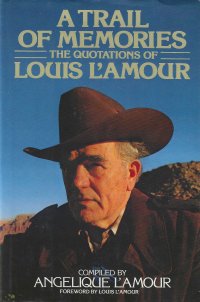
Where the heck did I get this book? A quick search of Good Book Hunting posts does not yield a result. It does not have an ABC Books sticker. It does not have a price penciled on the first page which might indicate another used book store. I certainly did not buy it new as a sixteen-year-old. So I must have picked it up at a garage sale. Perhaps this year’s Lutherans for Life garage sale–I don’t see a Good Book Hunting post for that particular sale this summer, which might mean it was one of a couple books I might have picked up. Without a picture, I have no memory.
At any rate, this book is a what it says: A group of quotations, from a line in length to a couple of paragraphs, grouped in topics like Life, Opportunity, Hard Work, Family and Home, Women, Indians, Honor, the Law, and Justice, and Yondering and Dreaming.
The quotations all share a common flavor and theme, of course: The stoic Western hero on the frontier, skeptical of the soft Eastern ways, manly but not afraid to love and nurture in family ways, which includes education and discipline. It seems like some of the quotations are repeated in different chapters/topics, but it might be because they are so similar–or perhaps they repeat; I did not go back to check. Even though they’re genre and they deal with Men, someone not familiar with genre or prehistoric (that is, pre-social media) writings might be surprised at how in-touch the Western hero was with the environment and how much he respected Indians (that is, Indigenous Peoples, as the current lexicon goes, with its expiration date later in the decade).
Although Louis L’Amour had 101 books in print when this book appeared (maybe just 100, as the book list includes this volume), the quotes are taken from what seems to be a handful of them. But it did help me narrow down which of his books I would most like to read: Bendigo Shafter, The Lonesome Gods, and maybe Conhager. I have read a couple of Zane Grey books, but no L’Amour. And the country was crazy with them in the olden days–I suspect they both had their book clubs in the 1980s. I would say that “I haven’t seen them in the wild,” but let’s be honest: My “in the wild” these days is the Friends of the Springfield-Greene County Library book sale and ABC Books for the most part, and I tend to skip over the Western and/or fiction sections entirely. In earlier days, with smaller book sales, I would be more likely to breeze over the paperback and/or fiction sections where I might see these titles. Perhaps I’ll wander over to the Western section next month at the library book sale to look for these titles.
So a nice thing to read whilst reading other books with longer narratives or themes. Something to spend a few minutes on out on the patio, petting the newly outdoor cat at sunset, staring down the raccoons who are not afraid of humans and want the remainder of the day’s cat food. And then to pick up later.
Today’s subsite that never made it online: it’s actually stuff I got a few weeks ago. Books that will never be read again. You can’t throw them away, though. You can give them away, perhaps to a thrift store, and hope they find a good home. You fan the pages so they see light again for the first time in 70 years. You google them and find a few on Etsy or eBay.
Not in the Nogglestead library; I intend to read all my old books. The exceptions are books I’ve already read or that I have in newer editions as reading copies or sets.
Why, I even have From Gold to Grey on my side table. I should get back to that again sometime, but the elaborate Victorian page design, examples of which you see in the Lileks, makes it difficult to read during football games or when you’re easily distracted–which are the opposites of the times when I tend to pick up poetry–when I want to read a little bit at a time.
But, yeah, I hope to read those books someday. Interspersed with my other aspirational planned reading, including the Summa Theologiae and The History of Civilization. So, probably never. But I cannot say definitively never. Which is optimism for me.
I bought this book for $10 at Rublecon last month because it’s BFM, man. Its subtitle says A Critical Appreciation of the World’s Finest Actor, which is a bit of hyperbole, of course, but the book is not so much a critical appreciation of Murray’s work, but rather an encyclopedia of alphabetical entries about movies and shows he has appeared in along with topics on his relationships with other people, including his wives and his family. Interspersed with the encyclopedia entries, we get stories about Murray’s hijinks crashing parties and spontaneous appearances with normal people.
So we agree that Groundhog Day and Lost In Translation are amongst his best films, but I disagree with the book about The Man Who Knew Too Little–I think that’s a funny movie, and I not only saw it in the theaters, but I’ve watched it many times since then on home media. I am quite a bit behind on Murray films–I mean, I’ve never seen The Razor’s Edge or Quick Change, for example, not to mention most of the Wes Anderson collaborations (although I did see The Life Aquatic with Steve Zissou, again, in the theaters).
The book also portrays Murray as a complex individual. Although it has its moments of homerism (such as the subtitle), some of the disputes and fallings out he’s had, not to mention a couple of bad divorces, and a reputation of being difficult (Dan Ackroyd called him The Murricane because of his mercurial nature). I mean, I guess anyone who’s been paying attention to Murray as a celebrity probably knows all this. But I somehow haven’t paid attention even though I like his work.
So a pleasant read in between chapters of other things I’m kinda reading, which really means they’re just stacking up on the table beside my reading chair. Informative. And I’m kind of pleased as well that I have so many Bill Murray films yet to see.
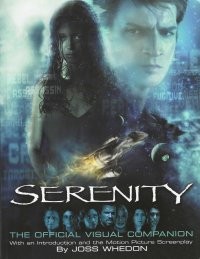
This book completes the four books I bought at Calvin’s Books the last time I went there. I was afraid that they were closing, as the Firefly books were only three dollars each, but they were not that inexpensive because they were closing. But they closed never the less.
At any rate, I read the Firefly scripts in Firefly: The Official Companion Volume One and Firefly: The Official Companion Volume Twolast summer and Firefly: Still Flying in January (when I thought it might count as a collection of short stories for the library’s Winter Reading Challenge, but it’s not really).
So this book means the end of the road unless I find some of the comic books or the recent novels cheap. So I am a little sad to come to this end. I’m sure some of that is mixed in with missing Calvin’s Books as well, although I need more books like I need more sunny days without rain here at Nogglestead.
So: It’s the shooting script for the film Serenity. As a reminder, this film came out three years after the television series, so if you watched them altogether as we did, you’ll notice things. Jewel Staite, for example, lost some weight (she said she had to eat a bunch to keep at Kaylee weight for the series in one of the previous books). And they played the characters a little different, and it was cut without some of the humor and playfulness of the television series. So the tone was a lot darker–although it might have been more in the acting and editing than the scripting. And they try to answer a lot of the questions from the television series in a fashion that’s disappointing, not on the Lost scale, but still
The book also has some inside looks at the making of the film, as the previous book does, but having read Star Trek Memories earlier in the year, I notice quite a difference in tone in the descriptions of making the film, even the nitty gritty technical aspects of it. In Star Trek Memories, making a television show is a more blue collar affair, with discussions about hitting budgets and physically doing the work, whereas these books are more about artistic vision, and the people who worked on the show take themselves very seriously. Perhaps it’s a difference in the elapsed time between the books and the television show/movie they depict (26 years have elapsed between Star Trek and its book, whereas these books came out within a couple of years). Maybe it’s a generational shift between the movie makers or between the fandoms. I dunno.
The book talks about a possible movie franchise, but that did not pan out. Maybe killing a couple of the main characters and tweely solving all the mysteries will dim that prospect for you–at least in the Star Trek movies, they only got into the habit of blowing up the ship every movie.
But, you know what? It’s been almost twenty years. Maybe it’s time for a reboot.
As I said, I was a bit sad to come to the end of the books, so I started re-watching the television series. Time will tell if I make it through again and if I watch Serenity. I invited my boys to watch, but they were not interested. So I guess I should stop making allusions to the show since perhaps nobody younger than forty-something will get it or even care.
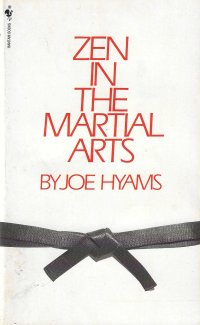
I bought this book a couple weeks ago at ABC Books when I made the first of my recent runs on the martial arts section. I read it on a recent business trip to Chicago, and I really enjoyed it.
It’s not a long book–133 pages, and the chapters are short, generally a page or two story or anecdote from martial arts training and a bit of a lesson. The Zen it goes into is not the ontological Buddhism nor the practice of completely emptying oneself to escape the futility of life. Rather, it’s more geared to what we would later call mindfulness, with lessons on being present in the moment fully and in flowing. So good reminders.
And let’s talk a moment about the author. I had no idea who Joe Hyams was, but look at his Wikipedia entry. Born in 1923, served in World War II (Purple Heart and Bronze Star), worked for Stars and Stripes, went into newspaperin’, was sent to Mexico to cover illegal immigration (is that still a thing?), wrote a blockbuster story, was given some time off in Los Angeles as a reward and was told–perhaps jokingly–to interview movie stars that he met, and ended up scoring interviews first with Bogart and then his co-stars, became a full time entertainment columnist, studied martial arts as a student with Bruce Lee and then took lessons from Bruce Lee, studied several martial arts disciplines, wrote stars’ biographies, travelled with his wife Elke….
Jeez, the guy is Hemingway: The Next Generation, but without the legacy of novels.
So, yeah, the book has a lot of stories about Bruce Lee teaching this guy lessons. But they’re good lessons. And I really enjoyed the book. If I can remember to and if I’m not overwhelmed by the sheer weight of the unread books in the Nogglestead library, I should like to read it again. Definitely a better devotional than the Thich Naht Hahn, the Joko Beck, the Pirsig, the Suzuki, or even the forgotten The Zen Way to the Martial Arts.
Oh, and his wife Elke? He married Elke Sommer when she was 24 and he was 41. It’s not often I can turn a book report into a Rule 5 post, but here we are.
For the third weekend in a row, ABC Books had a book signing. This time, Marshfield’s Randy H. Greer came in to sign copies of his new book Buff Lamb: Lion of the Ozarks about a lawman in Christian County (which is only a mile and a half south of me; if I take the long route for a walk, run, or bike ride, I nick into Christian County for a little bit of it). I thought the story sounded familiar–I remember reading about this sheriff or one like him in one of my local papers–it turns out, a bit about this book appeared in the Marshfield Mail, where I had likely seen it.
I got a couple of things.
I got:
Buff Lamb: Lion of the Ozarks and Echoes of Mercy, Greer’s stories from his days working at the Federal Medical Center, a hospital complex for Federal prison inmates located here in Springfield.
Aikido Techniques and Tactices by Gary Bennett, the other aikido book I’d left last week at ABC Books, officially draining the martial arts section again to another book on Tai Chi walking and Raw Combat.
Twice a Week Heroes by Danny Miles, stories about fast pitch softball leagues in Springfield. There were a stack of them on the shelf below the martial arts section. I’ll be in a conundrum if Miles shows up at ABC Books soon to sign copies.
Poems by Mary Baker Eddy, the Christian Science church founder. A 1918 edition, this would have come out eight years after her death.
Milk and Honey by Rupi Kaur. A flat-spined collection of poems, but the cover calls Kaur a New York Times Bestseller. So this ain’t no chapbook.
100 Bill Harvey Poems by Bill Harvey. They look to be theologically flavored. But I will end each poem hearing Paul Harvey say, “Good day!”
At any rate, it should give me a couple of handy collections of poetry to read out back in the evening. If I can find them again easily once I move them off of my desk and into the stacks of the Nogglestead library, where books just disappear.
This book bears no copyright date, but some of the poems that are dated come from the late 1960s–and the first is dated 1937 and says it’s the poet’s first poem. So we can assume this is from the 1970s or 1980s–maybe even a little later given that the collection has wingdings between poems that might come from the birth of desktop publishing. Remember, younger readers, desktop publishing referred to being able to lay out your books on your desktop computer for printing, not blogging or e-zines where the work never actually leaves the desktop (which these days includes mobile devices).
The author was a teacher, and perhaps an English teacher, as the poems come in a variety of forms and styles, so it’s clear she liked to noodle with words a bit. The quality varies from simple to some that are actually halfway decent. So it’s a bit of grandmother poetry with a little dash of the cool teacher who might have inspired you to write. Strangely enough, I can’t think of anything in my middle school or high school career where English teachers actually wrote, and my college mentor, such as he was, has published only three or four books in his career.
At any rate, a quick, light read from when poetry was designed to be quick, light reads.
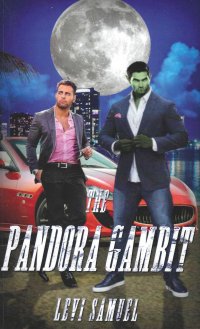
Well, it’s been a while since I bought this book–I got it at the last LibraryCon, in 2019. As I might have mentioned, I recognized the author, who under a different pseudonym wrote Dammit Bre!. So I’ve bought at least six of this guy’s books; this is the second, and the first fiction of them I’ve read.
I guess the point was to write a quick bit of fiction blending urban fantasy with Miami Vice. And, you know what? He did it. I’m going off of his author’s notes here, a bit of Piers Anthony’s thing, as I recall, putting author’s notes about the writing of the book and the reaction of fans to his work.
Alright, so, the plot: The olden folk, elves, orcs, and whatnot, have gone to ground and have hidden from us for centuries, but they’ve also participated in the world a bit where their interests are concerned. In the modern day, an operation of their kind goes awry, and one of the elves betrays his fellows in law enforcement, leaving his partner wounded and left for dead, whilst the elf goes off to help distribute a drug that has different effects on the races. It makes orcs into berserkers, and it elevates humans to be able to see through the magic that hides the other folk. The olden folk want to keep the drug off the streets, and that means that an orc has to partner with a human detective to break the drug ring up.
So it’s a quick, fun read. And I’m a bit inspired by Levi Samuel Rickard–he’s banging out these books, and they’re likely getting better (this is only the second of his I’ve read, but I have four fantasy books floating around somewhere). It’s almost enough to inspire me to work on one of the novels I’ve plotted or stubbed out here, but not yet. Perhaps when the boys are out of the house. But most likely not. But I can appreciate the efforts of those who do.
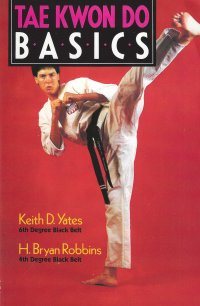
I bought this book last Saturday, and it would have been a good bet to guess it would be one of the first that I read.
It helps that this book, like so many from the era, was written for children who were getting into martial arts in what must have been a post-Karate Kid boom–so many of the books I see are from the 1980s or now with fewer selections in between. And it really is the basics, designed as something you can review at home after having seen the things in class (and many of the chapters indicate your instructor will likely show you more examples).
So it’s a book that shows basic moves and basic forms with black and white photos for starting positions and ending positions, but unfortunately, that does not capture the flow in any of them. So if you’re thinking you’re going to learn the actual moves from a book, you’re mistaken–as I was in the 80s, when I checked out at least one book from the library about karate. But it’s like learning a language–you have to do more than read a dictionary (which I’ve also done, trying to learn foreign languages from dictionaries before I understood verb tenses and whatnot).
Still, for me, it’s a nice refresher. And I note, again, that the sparring stance for tae kwon do is a more guarded, hide-behind-the-lead-shoulder posture than the one my school teaches. Which makes me want to ask the kyoshi where he got the stance preference.
Wow, has it only been a week since I was last at ABC Books? Oh, but what a week. Perhaps I will go into that later. But after a martial arts class and a shower, I turned my vehicle north again to ABC Books through some badly needed pouring rain to go to another book signing.
I picked up a few things.
In addition to the book signed by the author, I pretty much cleared the rest of her martial arts section out again.
I got:
A Three Letter Name by Annie Lisenby, the signing author. She billed it as a “survival romance” which to me sounds like a Hunger Games-influenced work.
Small-Circle Ju Jitsu by Wally Jay. I might have mentioned that my martial arts school has a Brazilian Ju Jitsu program, but that I don’t participate because I do not come from a hugging family. But I’ll read about it sometime.
Aikido and the Dynamic Sphere: An Illustrated Introduction by A. Westbrook and O. Ratti.
The Complete Idiot’s Guide to Karate by Randall G. Hassell and Edmond Otis. We will see about that.
Karate-Dō Nyūmon by Gichin Funakoshi. It’s a master introductory text translated from the Japanese. We will see how it compares to the 1980s books.
A Beginner’s Guide to Glass Engraving by Seymour Isenberg. I have an set of engraving bits for my rotary tool, and I mean to pick this up again if I ever clean my workbench in the garage off again. Perhaps this autumn.
So this leaves three books in the martial arts section: Another Aikido book, another Tai Chi Walking book, and Raw Combat. Hopefully, they will get more in as I have already begun to read the ones I got last week, and we will get to that by and by.
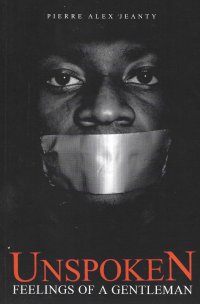
This book was in the poetry section at ABC Books, but that’s a bit of a misnomer. The author’s bio calls him a social media influencer, and the book reads like a bunch of Instagram posts. Some are a couple paragraphs of prose, and some are “poetry,” although they’re just prose with line breaks.
Thematically, the work is about a man who was sensitive, and then became quite the pick-up artist, but then repented of it and is celibate until he finds his future wife. He talks about an absent father, he apologizes to women he’s wronged, and he encourages them to wait until they find a man worthy of their affection.
I mean, it’s a good message, but I had a complicated relationship with the book. I mean, I’ve known some men who’ve been good with the ladies, my own father and Mike amongst them. And I’ve behaved myself chivalrously and neurotically with women even in my salad days, mostly. So I don’t have much of a score in the scoring department. So when presented with material about a reformed philanderer, I bristled a bit. I’ve always been a good boy; where are my accolades? Eh, not in this world.
Also, when a manipulator says he’s reformed, you can take it to the bank. The river bank.
Still, I hope he’s sincere, and I would have preferred a coda where he has found his soulmate and has been true to her. But I wish him well.
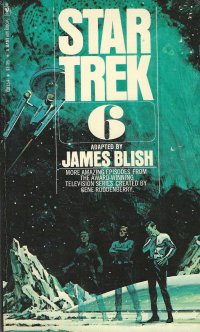
You know, I had almost forgotten that I was working my way through these books earlier this year. So when I was looking at the to-read books in the hallway, I thought, Oh, yeah, and this book provided just what I was looking for: A quick and pleasant read. I mean, I have to get my stats up. I’m only in the 40s in the books read in 2022 list, and it’s almost August. And I’m not sure we’ll have the football package this year for me to browse monographs and chapbooks.
So we’re about half way through the book series which ultimately will include most, if not all, of the episodes of the original Star Trek series turned into short stories by a British author who has presumably seen some of the series even though he had not when he began writing the books–which was about the time the show was on, but this book first appeared in 1972, when the show had been off the air for a couple of years. One has to wonder if the popularity of these books (this 1975 edition was the 10th printing already).
But because we’re halfway through the series, we’re starting to get to the more obscure episodes. This one includes:
“The Savage Curtain”, wherein an alien race, hoping to learn more about good and evil, pits crewmembers from the Enterprise, Abraham Lincoln, and other notables against Ghengis Khan and some other violent people.
“The Lights of Zetar”, wherein an interstellar brain containing the minds of the survivors of a long-dead alien race seek a human host to live in the real world again.
“The Apple”, wherein a paradise-like planet is run by a giant computer whom the child-like natives think is a god.
“By Any Other Name”, wherein aliens from a distant galaxy lure the Enterprise to their rescue; they hope to take over the Enterprise and to use it to return home in several hundred years’ travel, but they find that their presence in humanoid bodies gives them humanoid appetites and emotions.
“The Cloud Minders”, wherein the Enterprise is sent on an emergency run to a planet that is the sole source for a needed material, only to find that the society is bifurcated between the people who live in the cloud city and the miners who do the work.
“The Mark of Gideon”, wherein the Enterprise visits a planet that had avoided contact. Kirk apparently beams to an empty Enterprise that only contains one of the natives, and she’s trying to get infected with a disease that almost killed Kirk in the past because her planet has no germs and the population has remarkable healing powers–so that overpopulation has overcrowded the place, and Kirk’s infected blood can help people die.
I only kind of remembered “The Apple” from my viewing days. Still, a quick, pleasant read with characters I know.
But more interesting is that I am this book’s second owner.
On Saturday, after spending an hour in a parking lot helping my oldest master the basics of parallel parking, I had him drive me a half hour to ABC Books and a half hour back to help fill his log book before his driver’s license testing. Also, Mrs. E. had posted about a book signing.
The author signing her books, Shirley Gilmore, is a local to Springfield but who taught in southeast Missouri for 25 years. Her books are set in a fictional town there called Turn Back and feature a ten-year-old girl, Bucky, who moves there with her father from New York City and things happen as they so often do. She has five books in the series and a related one-off, and of course I bought them all. Her books include:
Carly Piper and the Mystery of the Ruby Ring
Walking the Labyrinth
Songs of Three
For Such a Time
A Turn Back Christmas
Tangled Threads
The main characters are Bucky and a group of Sunday school teachers she befriends. Boy, howdy, the first book is 680 pages. I would have some work cut out for me were I to try to get to A Turn Back Christmas as my Christmas novel this year.
I also noted that Mrs. E. topped up her martial arts section for me. I also got:
Zen in the Martial Arts by Joe Hyams
Karate-Do: My Way of Life by Gichin Funakoshi
Tae Kwon Do Basics by Keith D. Yates and H. Bryan Robbins
Complete Aikido by Roy Suenaka with Christopher Watson.
Just down the aisle from the martial arts books, I pawed through the music milk crates as I recently discovered I have no books on bass guitar (and I have a bass guitar again). So I picked up two books, Rock Jams and Iron Maiden: Play 8 Songs with Tab and Sound-Alike Audio; a closer look now that I’ve gotten home shows that Rock Jams was misfiled with the guitar books. Ah, well, I guess I will put that upstairs for the trumpet players of Nogglestead.
I did not empty out the martial arts section; I only took about a third. Because there’s another book signing next weekend, and I am being kind enough to give the other ABC Books martial arts book buyers a thin chance at picking them up. Mrs. E. said the others have not been in in a while. I grant them this one chance.
At any rate, the number on the photograph is 195. Hard to imagine that I’ve posted about bulk book buying 195 times, but the sagging and overstuffed bookshelves of Nogglestead indicate this is so.
Whilst researching my book report for My Ántonia, I cam across a 2004 post about the 99 best books or series of all time that I treated as a quiz as was my wont. In 2004, I’d read 16 of the 99.
So how do I do now? I have put in bold the books/series I’ve read (providing links to book reports on this blog where available) and have underlined things I know are on the shelves but are yet unread.
I don’t know how much progress I’ll make between now and 2040, but I have a greater chance of reading the classical literature than the 20th century stuff, especially the children’s books or Colombian magic realism.
Well, I wish I could say that my confusion between Willa Cather and Eudora Welty is easing with my reading, apparently, a couple of Cather novels in the recent years. Oh, but no. I had this book before me with the author’s name right on it, but I got to thinking Eudora Welty wrote O Pioneers! which I read in 2018. Wow, four years ago? I feel a little better about forgetting who wrote it then, even though I said at the end of the book report:
I do have a copy of My Antonia around here somewhere; this book was a pleasant enough read that I won’t hide from the other novel if I find it.
Apparently, it took me four years (!) to find it even though it was in the front rank of my office bookshelves. You know, where I go most often when looking for a new book to read. In my defense, I probably passed over it a couple of times looking for something quicker or something that appealed to me more in that moment. But I finally picked the book up.
The book is very similar to O Pioneers! Both are set in Nebraska during the sodbusting years; however, this book follows a young man, Jim Burden, sent to live with his grandparents and his friendship with a young Bohemian (from Bohemia, not just wearing hemp) whose family arrives on the same train. She is the Ántonia of the title; the name is pronounced the Bohemian way, not the way to pronounce the small town down the county highway from where I lived my last years in high school. The Shimerda dwelling is basically a cave, and they really do not know how to farm or bust sod, coming from a city in Europe, so they need help, and Jim and Ántonia bond as he helps the children learn English. They have some youthful adventures; then Jim and his grandparents move to town when they rent their farm, and Ántonia, who is a couple years older than Jim, gets a job in one of the houses in town, and although they are not quite peas-and-carrots, when a traveling dance instructor troupe comes to town and hosts dances in a big tent, Jim hangs with Tony (as he sometimes calls her and I’m going to for the rest of the review because the accent on the A is a bother) and some of the other hired girls. Then Jim goes to Lincoln for college; another of the hired girls moves to Lincoln and starts a dress shop which does well, and she spends some time with Jim, but he becomes distracted from his studies, so his mentor, who is moving to Massachusetts to teach at Harvard, encourages Jim to come along, and Jim does. And then, twenty-some years later, Jim returns to Nebraska and sees Tony and her family, which includes her illegitimate daughter, the result of her dalliance with the son of a local railroad baron; the boy had promised to marry her, but he was not a good man, and after they lived together in Denver for a while, he abandoned her, pregnant, to return to Nebraska in shame. In the years since, she married another immigrant and they’ve had a large family. Tony has grown old, lost some teeth, put on some weight, whilst Jim, presumably, has aged better with his law degree and urban lifestyle. Jim feels the same connection with Tony as he had when they were kids–a kinship, more brother and sister though the middle part of the book indicated some romantic leanings–and he promises to visit the family and her boys in the future. And, finis.
One of the dings I, well, dingedO Pioneers! for was that it was a series of short stories or, more truthfully, sketches that Cather stitched together to make a book. You know, this book is also broken into sections. The first two, “The Shimerdas” and “The Hired Girls”, deal with the introduction of the characters and their lives on their respective farms and then their subsequent moves to town (Jim when his grandparents rent their farm, Tony when she hires on at another household). These two sections comprise the first 200 pages roughly of the 277 page book, and they hang together pretty well, hinting that there might be a cohesive plot. The next section, “Lena Lingard”, is about the hired girl who becomes the dress maker and meets up with Jim Burden in Lincoln; we still might have some plot advancement if she really does rival Tony for the author’s affections. Oh, but no. She mentions Tony is going with the ne’er-do-well son of the railroad businessman and seems to like him a lot. In “A Pioneer Woman’s Story”, the next section, takes place a couple years later, when Jim comes back to the Nebraska town after graduating law school and hears the story of Tony’s betrayal and her raising her new daughter at the old Shimerda place. Then the last section, “Cuzak’s Boys”, takes place decades later. The narrator has updated us on the other hired girls and how they’ve gone on in the world. Lena continues to be a successful dress maker, but she has gone to San Francisco and joined another hired girl, who had gone to Seattle, opened a business of ill repute, but sold it to join the Yukon gold rush where she made out big. When Jim, the narrator, returns to Nebraska, he visits Tony, now Mrs. Cuzak, and meets her family. And, that’s it. Ultimately, the book offered indications there might be a plot, which kept me reading along a little better than O Pioneers! (I presume), but ultimately it is just a series of sketches, and the whole My Ántonia title and repeating of Optima dies… prima fugit make one suspect that the author might have wanted to convey more a mood of nostalgia and the loss of youth, but that alone is a little disappointing after 277 pages.
Still, an easy enough read. I note that, like The Red Badge of Courage in the heavy use of colors as adjectives–one cannot go pages without blue sky or orange this or red grass. I think modern writers have been trained to not use colors as adjectives, but they’re easier to see in one’s mind’s eye than other obscure shades used as adjectives. The pamphlet that Reader’s Digest provided with the book says the author became friends with Stephen Crane, and one wonders if this tic was part of his influence on her.
I did flag a couple passages in the book for comment.
Regarding the back story of two Russians who have moved to Nebraska, someone relates that they had been drivers of dogsleds taking a wedding party home, but when the party was beset by wolves, the two men sacrificed the entire party to save themselves.
We did not tell Pavel’s secret to any one, but guarded it jealously–as if the wolves of the Ukraine had gathered that night long ago, and the wedding party been sacrificed, to give us a painful and peculiar pleasure.
C’mon, man. In the 21st century, the Right Thinkers Who Talk On Television have assured me that it’s Ukraine and not the Ukraine. A hundred years of common usage must be publickly discarded so that the current Right Thinkers Who Talk on Television can teach us rubes something and prove their own shibbolestication.
Regarding town living in the late 1800s:
Most Black Hawk [residents of the town, not the tribe] fathers had no personal habits outside their domestic ones; they paid the bills, pushed the baby carriage after office hours, moved the sprinkler about over the lawn, and took the family driving on Sunday.
You know, when the Monkees were singing in 1967:
They were echoing criticisms of the literati of fifty years earlier.
Although I think I just marked the passage because I did not realize sprinklers were a product of the 1800s.
Eh, I flagged a couple of other things and was not really sure what I wanted to say about them when I flagged them.
At any rate, still, a worthwhile read just to remember what life was like a hundred and forty or fifty years ago–and might be again!
As you know, gentle reader, I’m a bit of a fan of his for years (ah, jeez, I posted his video “Midwest Horror Film in October 2020). So when we saw (well, my oldest saw) this book in Baraboo, I had to have it. So we do. I have read it, but he has not yet.
It’s a large hardback running about 288 pages (including acknowledgements and credits) with a fair amount of imagery, photographs, tables, charts, and wingdings with chapters on The Basics, The Language, The People, The Setting, The Driving, Food & Drink, and so on. If you have seen any of his videos on YouTube, you’ve got the flavor of the humor.
Still, it works a little better in the short, three-minute videos than in a three hundred page book. I started it whilst on my vacation in Wisconsin, and I read about half of it, but I set it aside for a while to freshen it up a bit in the second reading. I had a couple quibbles with the book, first and foremost a certain love for Chicago that I assure you proper Wisconsinites do not have. Anyone from Wisconsin who expresses this desire to go to Chicago or any place in Illinois for that matter is suspect–but let us remember that Berens himself moved elsewhere and won an Emmy as a newscaster before returning home to be a Wisconsin-schtick comedian. Also, the book pays a little to self-consciously to recognizes native Americans, women, and other groups who might not have gotten a lot of recognition in the past, but now get all the recognition that’s handed out. Still, it’s only sprinkled in, but if you’re sensitive to the themes, as apparently I am in the 21st century, then you’ll spot it. But it’s just a little bit and not hectoring or particularly off-putting.
I only put a couple of flags in the book, all in the college section. First, my alma whattamattayou is not listed in the intro paragraph as an example of a midwestern university. Second, the book mentions Carleton College in Minnesota, and I remember that college was one of the first to send me brochures, which I liked to look at, but I was committed to going to my alma moneyforadecade since I was 10 years old–but I do wonder how my life might have been different if I had truly gone away to college (as I lived with my father, I was technically a commuter and more a resident of Milwaukee than a student bound to the university), and the last is a mention of Southern Illinois University, which threw me a bit–I did not realize that Southern Illinois University-Carbondale was technically “SIU”–I always thought of it with the town appended, but that’s because I’m a big fan of SIUE, which is Edwardsville, closer to St. Louis and home of the sound.
So a book amusing in spots, probably a bit long. Worth it at a book sale, although I’m not sure it’s worth $27. But I am a bit of a cheapskate when it comes to books. But I’ll keep an eye out for more from Berens, on YouTube and at book sales.
 I bought this book
  I picked this book up in June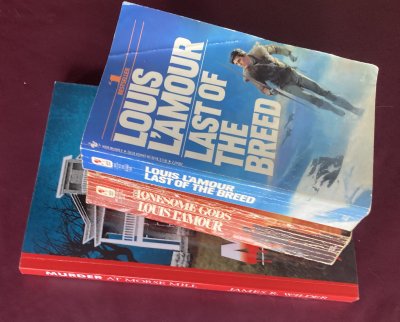
 Where the heck did I get this book? A quick search of Good Book Hunting posts does not yield a result. It does not have an ABC Books sticker. It does not have a price penciled on the first page which might indicate another used book store. I certainly did not buy it new as a sixteen-year-old. So I must have picked it up at a garage sale. Perhaps this year’s Lutherans for Life garage sale–I don’t see a Good Book Hunting post for that particular sale this summer, which might mean it was one of a couple books I might have picked up. Without a picture, I have no memory.
 I bought this book for $10
  This book completes the four books I bought at
  I bought this book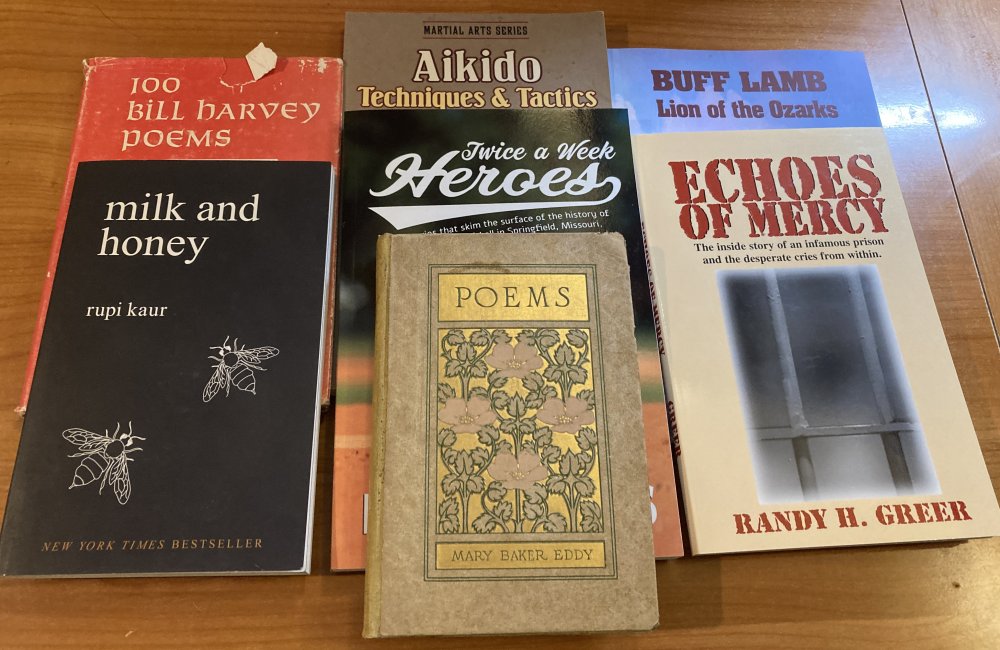
 This book bears no copyright date, but some of the poems that are dated come from the late 1960s–and the first is dated 1937 and says it’s the poet’s first poem. So we can assume this is from the 1970s or 1980s–maybe even a little later given that the collection has wingdings between poems that might come from the birth of desktop publishing. Remember, younger readers, desktop publishing referred to being able to lay out your books on your desktop computer for printing, not blogging or e-zines where the work never actually leaves the desktop (which these days includes mobile devices).
 Well, it’s been a while since I bought this book–I got it at the last LibraryCon,
  I bought this book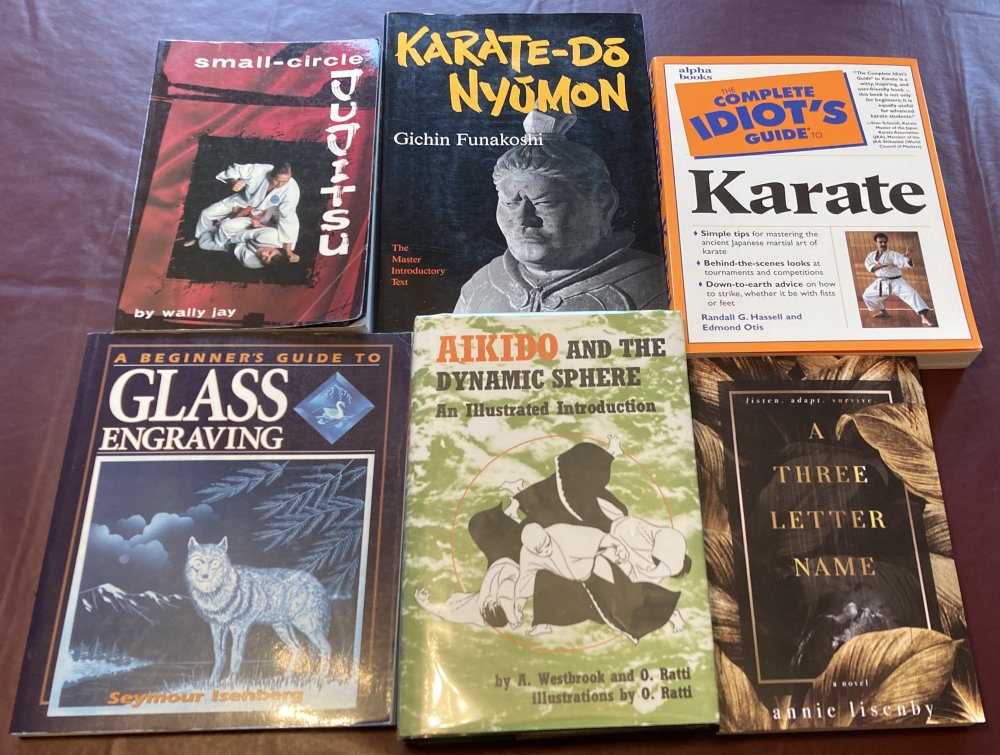
 This book was in the poetry section at ABC Books, but that’s a bit of a misnomer. The author’s bio calls him a social media influencer, and the book reads like a bunch of Instagram posts. Some are a couple paragraphs of prose, and some are “poetry,” although they’re just prose with line breaks.
 You know, I had almost forgotten that I was working my way through these books earlier this year. So when I was looking at the to-read books in the hallway, I thought, Oh, yeah, and this book provided just what I was looking for: A quick and pleasant read. I mean, I have to get my stats up. I’m only in the 40s in the books read in 2022 list, and it’s almost August. And I’m not sure we’ll have the football package this year for me to browse monographs and chapbooks.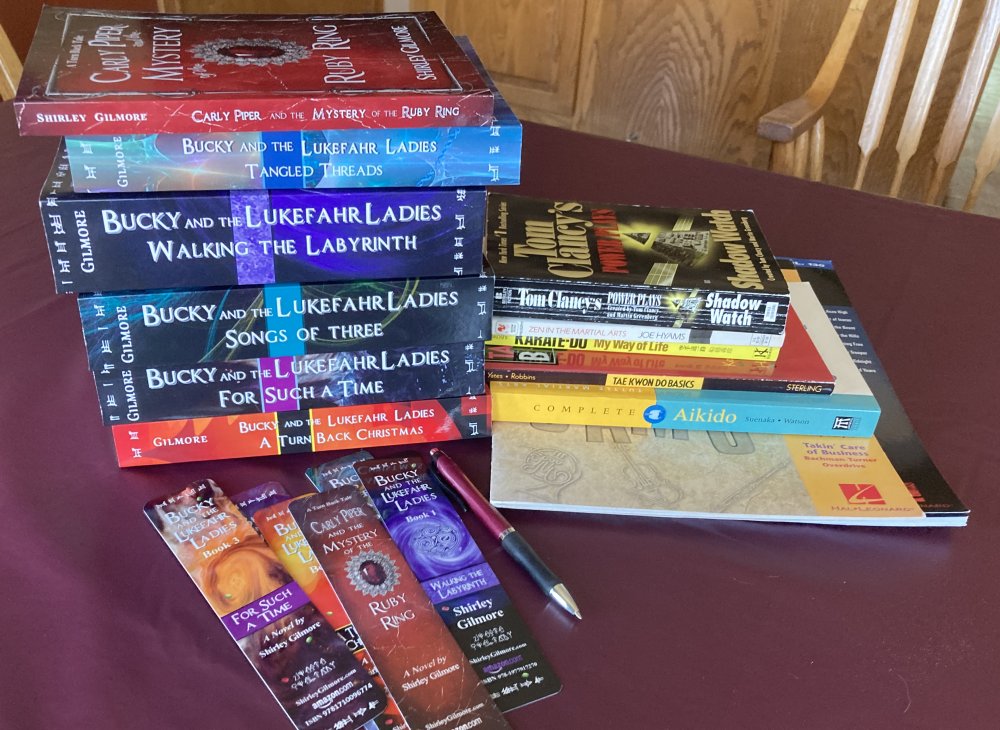
 Well, I wish I could say that my confusion between Willa Cather and Eudora Welty is easing with my reading, apparently, a couple of Cather novels in the recent years. Oh, but no. I had this book before me with the author’s name right on it, but I got to thinking Eudora Welty wrote O Pioneers! which I read
  As you know, gentle reader, I’m a bit of a fan of his for years (ah, jeez, I posted his video “