Book Report: Tanar of Pellucidar by Edgar Rice Burroughs (1929, ?)

Book coverI was looking for something to read, so I picked up this Tarzan book that has been floating around the outer ranks on the to-read shelves in my office for a while now. I mean after all, I just read a couple of Tarzan books, didn’t I? Well, no–I read Tarzan of the Apes and The Return of Tarzan in 2009. They would have been some of the last books I read in Old Trees before we moved down to southwest Missouri. I can’t believe it’s been that long, but look at the comments by Deb, a frequent commenter in those days when the blog was only six years old. In my defense, I did “just” read some of the John Carter books in late 2017, so it was more “just” than eleven years ago.

And closer review of the cover indicates that this is not a Tarzan book at all; it’s the third book in the hollow Earth series set in Pellucidar with the main character of Tanar (completely different from Tarzan who appears in the fourth book in the series, Tarzan in Pellucidar). I guess the first two books deal with men from the outer world who find themselves in the hollow world which contains dinosaurs, primitive men, and intelligent lizard men who rule them using ape-men as muscle. So I gather from research reading the Wikipedia article.

This book starts en media res: Seafaring raiders known as Korsars attack the Empire of Pellucidar, set up by the outer earth men in the first two books, and take prisoners, including Tanar; the emperor himself sets out in a small boat to rescue Tanar. Tanar meets a haughty but attractive young woman aboard the pirates’ ship; she is the assumed daughter of the pirate leader by a woman captured on a small island of loving people. After a storm, which is almost unheard of on the seas of the hollow world, Tanar and the woman are shipwrecked on what turns out to be her ancestors’ island. There, they are met with suspicion but eventually are adopted by Stellara, the woman’s, father. Subplots ensue, a pirate who wanted Stellara for himself returns, Tanar ends up thought dead, but he’s really in caves of the Morlocks Coripies, underground dwellers. He escapes with the resident of a nearby island of hate, where the residents hate an berate their family members–this fellow kidnaps Stellara, and Tanar goes to the rescue. He gets captured by the Korsars a couple more times, subplots ensue, and he links up with the Emperor and they eventually back to their homeland.

The book also has a frame story where Edgar Rice Burroughs is talking to a friend who is into the new fangled radio, but who discovers a wave that travels through the Earth–and it’s through a broadcast on this wave that this story is transmitted to the outside world. So the guy with the radio plans to go to Pellucidar to rescue the men from the outer world who are trapped there. Which leads, according to Wikipedia, to the Tarzan book. This book came fourteen years after the preceding one in the series; they came a little faster after that, but the series was never as popular as Tarzan or John Carter series and the length of the series reflects that. Burroughs wrote a lot, but he wrote a lot more of what was popular.

I don’t think I have a lot more Burroughs floating around, but do you know what I pass over from time to time? One or more of the remaining Gor books I have. So maybe I will pick up one of them sooner rather than later. If only to address this comment I made when I read Captive of Gor in 2014:

So I was disappointed with this book, and I’ve got at least three remaining on my shelves. I might pick up another one soon–before 2021, I would hope.

With a little dilligence, I can make that goal!

Buy My Books!
Buy John Donnelly's Gold Buy The Courtship of Barbara Holt Buy Coffee House Memories

Book Report: Spaceship Vision: The Impossible Dream by Elton Gahr (2019)

Book coverI read Gahr’s short story collections Random Realities and Random Fantasies within the last year and a couple weeks after buying a bunch of his books at LibraryCon 2019 in the Before Time that none but us old timers will remember.

I said about those that Gahr has a good imagination, interesting stories, but could really use an editor. The same holds true for his novel-length work here: A number of missing words or wrong words, some little things (referring to a character by name before introducing her name), and some improper capitalization. He’s run it through a spell-checker, though, and maybe an automated grammar reviewer, but the works could use an actual editor reading them first. But maybe that would just slow the young man down (actually, I don’t know how old he is, but I am at an age where I can splash young man and young lady around pretty liberally and be correct in relationship to my age more often than I would like). Perhaps I should offer to edit the books by going through them once with a red pen for a case of beer. I was just talking with one of my boys how professional editing for new authors can be prohibitively expensive–I was approached by an acquaintance for a quote on editing her daughter’s novel, and even at the low end of the spectrum (a couple hundred bucks), it was too rich for her blood (I still have not sold enough copies of John Donnelly’s Gold to pay the $300 for the professionally designed cover much less the promotional copies I mailed hither and yon, and as for my other books, I’ve not paid out enough for the UPC and the ISBN number, word). But going through Gahr’s Proofreading Copies would be fun. And it would save me the expense of later buying them when I bump into him at a con.

At any rate, this book tells the story of a ship run by the banished? self-exiled? son of a nobleman. Set in the future, when the solar system and part of the Oort Cloud have been colonized, nobles control their colonies and sets of stations and rule their fiefdoms with the threat of cutting off the air to their serfs. As a matter of fact, the captain of the ship left his father’s station after his ruthless parent vented a section of the space station on the son’s behalf. He has gathered a couple of crewmates, including: a woman who was a trainee in a secret, hidden group of humanity protectors who had been captured and held prisoner by pirates for several years; a reverend of the powerful church; a genetically enhanced warrior who might have some deep mental programming counter to the best interests of the crew; and a recycling technician sent away from her dark asteroid colony because her parents couldn’t feed her. They’re scraping by, mostly, when the go to Mars for repairs and discover a pair of twins who have created what they claim is a Faster than Light engine–which it is. They try to use this discovery to help liberate the serfs–first by seeking a colony that set off for interstellar space hundreds of years ago to hide in, only to find that the colonists want the FTL drive to return to conquer the solar system and then, after helping defeat the interstellar colonists, by fomenting rebellion on their own.

So it definitely has a Firefly vibe to it including its selection of characters, but it’s not just fanfic retread as something else (personally, I enjoy the scrappy interstellar trader genre; remember Desperate Measures?). It does a bit of world system building that makes sense. The incidents are a bit episodic but do kind of lead to the next, and the backstories of some of the characters are woven in as flashbacks that are effective for the most part, although sometimes the episodic and jumping nature jarred me when I picked up the book the next day, and the next chapter seemed out of nowhere (they’re on Earth? Was that mentioned in the past chapter where I finished last night? No.). The book is light on description–not a lot of physical details and colors of the ship. Maybe just enough. The storytelling, though, is very fluid, and I enjoyed the book.

I picked this book up because I get Gahr’s newsletters (and read them sometimes). He just released another book in this series (Spaceship Vision: One Tin Soldier. Hopefully, it will have a print version that I can pick up next time I see Gahr at a con somewhere. Until then, I have a full-length fantasy novel by him somewhere around here that I’ll get to. Probably before I actually find Joshua Clark’s series, which one would think I would spot easily since it’s several books grouped together, but no–my inability to find them is becoming a legend here at Nogglestead, at least in my own mind.

Buy My Books!
Buy John Donnelly's Gold Buy The Courtship of Barbara Holt Buy Coffee House Memories

Book Report: The World of Herb Caen edited by Barnaby Conrad / Commentary and Captions by Carol Vernier (1997)

Book coverApparently, I have blown through the monographs, travel books, and chapbooks I have recently acquired, so I had to delve into the back recesses of my to-read shelves to come up with this book which I bought in 2017. Which is “recently,” on one hand, but it seems like a long time ago. Fun fact: It looks like I also bought a copy of Janissaries, which I read earlier this year in the omnibus Lord of Janissaries, so if I find that slightly mutilated copy in my stacks, I’ll have to think of someone to give it to (since I have bought copies of Lord of Janissaries as Christmas gifts for the people to whom I normally give science fiction duplicates). I also found a Reader’s Digest classice scopy of Around the World in 80 Days, which I “recently” (2017) read as part of the omnibus The Best of Jules Verne. So I’ll put that on my read shelf along with my other Reader’s Digest Classics. Unless I already have a copy, in which case I will have to deal with the duplicate.

But that’s neither here nor there; we have come to praise The World of Herb Caen.

The book reminds me of The World of Mike Royko. They’re the same thing, basically; A coffee table book of quotes from the recently deceased columnist, photographs of the city they covered, and occasionally a longer excerpt or maybe a complete column. Barnaby Conrad, a long-time acquaintance of the columnist, gives us a nice introduction detailing Caen’s career, which is very helpful to those of us not from San Francisco. He started in the San Francisco papers in 1938 and wrote until almost the end of his life in 1997. So he, like Royko, was active in the golden age of newspaper columnists and really became the voice of the city where he lived and wrote. They really don’t make columnists like that any more; perhaps John Kass would be the closest we have to that in the 21st century. Newspapers probably cannot afford the luxury of a highly visible metro columnist any more.

At any rate, the book is not a complete respite from contemporary issues as it features a number of photos and Caen’s endorsement of Willie Brown for San Francisco mayor. Kamala Harris, though, does not make an appearance in the book. If only they had known.

I probably can have a bit more affection for the Golden Age columnists who passed away before the turn of the century because their columns and styles did not have the opportunity to shift and become demeaning to their political opponents as so many of their later counterparts did (although I read most of the Chicago Tribune columnists in 1997 and the early part of this century, I don’t read Steve Chapman, Mary Schmich, or Eric Zorn any more, and I don’t read the Chicago Sun-Times columnists Richard Roeper or Neil Steinberg even though I even corresponded with them around the turn of the century in the early days of this blog). Royko, too, would probably have taken a harder left turn within the decades of their deaths. Although, to be honest, I have only read this book on Caen with a single column and some excerpts, so I am speculating a bit that he was not that way. I think I have one or two of his collections, so I will have to check them out to see if my retro predictions are true. Unlike Royko, I did not read Caen back in the day.

So I liked the book. It’s got wit, interesting tidbits of celebrity encounters (where celebrities include jazz musicians from the height of jazz as well as movie stars throughout the decades), and great vintage photographs of old San Francisco. Not a bad way to spend part of a Sunday afternoon.

Buy My Books!
Buy John Donnelly's Gold Buy The Courtship of Barbara Holt Buy Coffee House Memories

Book Report: Goblin Market and Other Poems by Cristina Rossetti (1995)

Book coverI was supposed to read “Goblin Market” in college, perhaps in my poetry class. I had a literature poetry class, but not a poetry writing workshop because the latter was held at the same time as the advanced fiction writing workshop class my last semester, and I was going to be a fiction writer. Too bad they didn’t have an obscure blog writing workshop class; I could have really put that to use.

At any rate, I didn’t read it probably because it had two sisters and goblins in it, and it was long. But almost thirty years later, I picked this collection up in between the complete works of Keats and Shelley that I have intermittently been working on for years and the Marvell collection I picked up after reading the Milton recently (see this and this). You know what? I might have a new top five favorite (my beautiful wife, Edna St. Vincent Millay, and Robert Frost pretty much have locked up the top three spots, so other poets can only fight for #4 and #5 in the top five).

The language of the early-to-mid nineteenth century is much fresher and easier to read than the seventeenth century Milton and Marvell and the eighteenth century Keats and Shelley–although Rossetti does drop the occasional ye. Rossetti’s poems are lyric in rhythm, easily end-rhymed, and in most cases relatively short (which is not to be overlooked in a poem–I like mine easily digested and not something I have to put a bookmark in). Thematically, she talks about death and lost love a lot–so a proto-Goth poetess, but with talent–and she also talks about Christian faith. Sometimes, the poems focused squarely upon faith are reminiscient of grandmother poetry, but a cut above it, of course.

Although Rossetti’s first published collection was also called Goblin Market and Other Poems, the back cover indicates this is a new collection of her most famous works, of which “Goblin Market” is the most famous (at least, it’s the one that was assigned in college in the late 20th century).

Fun fact: Rossetti was working on these poems at the same time that William Edward Williams was working in London. Given that it was one of the largest, if not the largest, city in the world at the time, the odds are pretty good they never met.

So I enjoyed this collection more unabashedly and thoroughly than I had a collection of poetry (excepting my own, perhaps) in a long time (which is partially my fault as I read a bunch of poetry chapbooks and grandmother poetry as well as the aforementioned old poems which are at a remove from me given their language). If I had read “Goblin Market” when I was supposed to, perhaps Rossetti would have been one of my favorites for a long time. However, perhaps I am getting to read this at the right time, when I need new poetry for enjoyment and inspiration as my doggerel revival arises.

Buy My Books!
Buy John Donnelly's Gold Buy The Courtship of Barbara Holt Buy Coffee House Memories

Book Report: William Edward West: Kentucky Painter by Estill Curtis Pennington (1985)

Book coverThis book is a little text-heavy for reading during football games, but I started out browsing it last Sunday and finished it late last week in the reading chair.

The heavy text tells the biography of the artist, William Edward West, a portrait painter born in Kentucky but who lived amongst friends in Natchez, Mississippi, for a while, traveled to Europe for a long time, including Italy and London, and then returned stateside and spent time in New York and later Baltimore in the late eighteenth and early nineteenth centuries.

The artist was from a well-to-do family in Lexington, Kentucky, which was apparently a hopping place arouns the turn of the nineteenth century. He lived from 1788 to 1857, so the period between the first two civil wars (I kid, I kid–but it’s gallows humor). He made his living apparently by attaching himself to wealthy families, staying with them or in their orbits, and enjoying their society while painting their portraits. Portraitist is a particularly mercenary form of artist, after all–much of their work was for-hire, so one cannot come down on this fellow too much for schmoozing.

He made himself when he was traveling in Italy and got to paint a portrait of Lord Byron, one of the last before he went of to Greece and died. So he used that story to unlock doors in European and British society.

Many of the portraits in the book come from wealthy people of the period, so it’s not like you will recognize any of the names except for Lord Byron and a pre-Confederacy young Robert E. Lee, whose painting is on the cover (which probably means I should BURN THIS BOOK for JUSTICE!). The book only contains a couple of non-portrait works: A maritime picture which supposedly shows Lord Byron rowing out to visit the USS Constitution and a couple of group settings with stories to them.

The works are well-executed, although steeping myself in 20th century works from time to time means I’ll be impressed with the works of art school drop-outs from the eighteenth century. I enjoyed the book, although I am not sure how long I will remember William Edward West’s name. In the 21st century, it’s not likely to come up, even in trivia nights, should such things ever happen again.

Buy My Books!
Buy John Donnelly's Gold Buy The Courtship of Barbara Holt Buy Coffee House Memories

Book Report: Capitol Hit The Executioner #173 (1993)

Book coverActually, the Capitol with ‘o’ means the building where Congress meets, at least until the new administration dismisses them (I kid, I kid–but it’s gallows humor). This book does not deal with Congress, so it should probably be Capital Hit, but that does not clearly indicate Washington, D.C., on the cover. So we get a possibly intentional mistake. In the 1990s, I suppose we could give adults the benefit of the doubt. Ignorance as the default is yet to come in the 21st century.

Mack Bolan returns to Washington after a plane containing a Vietnamese actress is shot down with a Chinese-provided anti-aircraft missile. I think the point is that the Chinese are providing materiel to a Jamaican drug gang in exchange for a couple favors, such as killing a Vietnamese actress because. Mostly, though, that’s a reason given to put the city on the brink of a war not only between the emboldened Jamaican gang and other Jamaican gangs but also law-abiding Jamaican vigilantes and CIA-connected Vietnamese vigilantes. So The Executioner must thread the needle of conducting his operations often with a member of one or both of the ethnic communities along.

So, again, we have a more complex plot outlined which could have built a more modern thriller but executed with the touch of someone experienced in writing straight ahead men’s adventure novels. So, again, we can see how some things were stubbed out that were not exploited fully. Of course, exploiting all of the potential plots and subplots would probably push the book to a modern thriller’s 300 or 400 page length, so it’s just as well that we don’t get the full treatment on all of them. If only the author could have toned down or eliminated some of the groups, though, the book would have been tighter. But perhaps part of the contractual obligation is to follow the provided outline completely, so much like in modern software consulting, you get a result that meets the contract but not the best possible outcome.

Still, my march through the Executioner series continues, sometimes more doggedly than others.

Buy My Books!
Buy John Donnelly's Gold Buy The Courtship of Barbara Holt Buy Coffee House Memories

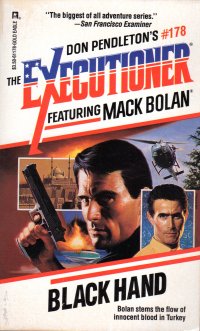
Book Report: Fast Strike The Executioner #172 (1993)

Book coverThe last Executioner book I read was Hawaiian Heat, #155, so my collection has jumped ahead seventeen. My collection has a couple of near runs left–a handful in the 170s to about 182, then a dozen or so in the low 200s, and then 305–but these gaps are going to be a little jarring considering that I’ve read a fair number before now in relative proximity. Also, I look back at when the books were on the rack at the grocery store and think about what I was doing at the time. We’ve leapt ahead here to the second semester of my junior college. What was I doing? Working a pile at the grocery store, writing still decent sonnets about my college crush, but not wearing the trenchcoat and hat yet nor doing open mics–those would come senior year.

Oh, well. You’re here, gentle reader, to hear what Mack Bolan was doing. Or, more likely, you’re kind of scrolling by to get to the amusing things I sometimes post. Carry on, then.

Mack Bolan is sent to Germany as it’s unifying as someone or some group is killing spies, businessmen, economists, and other people who support reunification. So he’s got to navigate the shadowy world of many different powers working together and against each other, including a woman who is simultaneously working for the Stasi, the French secret police, and the CIA–will she be Mack Bolan’s ally or doom? Spoiler alert: She’s beautiful, so of course she’s less doom and more boom chaka chaka.

The book is paced with a more modern thriller sensibility: Bolan is dropped right into the maelstrom and the set pieces come quickly, with Bolan not sure what’s going on or who the real players are. The book also features car phones and lap-top computers, so the stories are catching up with modern times as well–although in 1993, the laptops were pretty clunky as I recall. I bought a refurbed Windows 3.11 laptop which I still have around here somewhere in 1996 or 1997, and it’s a chonker. I remember seeing a portable 286 from the early 1990s, and it was the size of a small suitcase. But from here on out, I guess the books will have a more modern sensibility–and it’s probably only a couple of years before Bolan starts using the Internet himself.

So it was a pretty good entry in the series, and I am looking forwardish to the next couple in the series from the time when I was graduating college.

And given how few of them I have left and how much I have been tearing through them this year, it’s entirely possible I will finish the paperbacks purely in the Exeuctioner series in the next year or so. Although I guess I’ve only read seven this year, so if I have a couple dozen left, it’s probably three years off. Or more.

Well, consider my enthusiasm curbed. It wouldn’t be the same as reading The Story of Civilization or The History of Philosophy or even The Complete Works of Shakespeare, but it would be something.

Buy My Books!
Buy John Donnelly's Gold Buy The Courtship of Barbara Holt Buy Coffee House Memories

Book Report: Yoga’s Devotional Light by Julian Lynn (2017)

Book coverIt seems like it took me a lot longer to read this book than it did. As you might remember, gentle reader, I bought this book along with two others (Divine Fruit and Four Gates to Health: Eastern Ideas and Techniques for Vital Living) last May at an ABC Books book signing. I read the collection of poetry soon after I bought the books, and I am pretty sure that I started this book in the beginning of June last year.

It has the word devotional right in the title, and that’s what it is: A Hindic yoga-based devotional with 365 entries ranging from a couple sentences to a couple of pages. Each is designed to make you think, to let go, and perhaps, if you’re an active yoga practitioner, something to think about when you’re sitting. Although in Buddhism, you’re supposed to try to empty your mind as you sit, perhaps you’re allowed to think in yoga. Or maybe these are things to think about at other times.

The daily bits range from stories about people she meets and how they inspire her to simple little aphorisms about recognizing beauty around you in everyday things. Some are a bit twee, and some of the stories seem a bit self-congratulating about helping others.

At any rate, as I mentioned, it took me a while to read it. Partly because it’s typeset in an italic font, which slows one down when it comes to reading. Perhaps that’s the intent. The other was that I was not doing it in a steady day-by-day fashion–I would go in read a couple of days’ worth of these devotions to end a night of reading fiction for a couple days, and then I would set it aside for a while, and then I would read a couple more.

I enjoyed it and grokked it a bit more last year when I started it. Looking back, I really haven’t steeped myself in Buddhist and Hindu thought much this year–maybe they haven’t spoken to me following a year of losses. As I finished it over the last couple of weeks, though, the message did not speak to me as much.

So I probably enjoyed it overall more than the poetry and probably more than I’ll enjoy the nutrition book when I get to it. Perhaps I would have enjoyed it and gotten more out of it in a more receptive frame of mind.

Buy My Books!
Buy John Donnelly's Gold Buy The Courtship of Barbara Holt Buy Coffee House Memories

Book Report: Versailles by Daniel Meyer (?)

Book coverOkay, wow, now that is impressive. I have recently read a book on Windsor Castle and was not that impressed. But Versailles? Oh, my.

In Windsor Castle’s defense, it is almost six hundred years older than Versailles and started out as a military fortification, where Versailles started out as a hunting lodge but turned into a château (literally smell of cat) for entertaining, holding court, and then living for the seventeenth century French monarchs, built and expanded at the height of the French monarchies, republics, and empires.

The book has a blueprint for each floor of the main building followed by a description of each room as you would take a walking tour and a lot of large, lavish pictures. Even if they were small, the pictures could be nothing but lavish. The rooms are large, with high ceilings (modern homes have great rooms with high ceilings as a selling feature; in Versailles, all rooms are great rooms). They have great original works hanging above the giant doors, not to mention on select walls and with painted ceilings.

You know, normally I see something like this and say, that must be hell to heat, but the book mentions that the temperature at Versailles rarely gets down to freezing–they have orange and palm trees that they bring out in the spring for the gardens.

Oh, and the gardens–the book also includes walking tours of the vast gardens behind Versailles and Trianon, the “little” getaway cottage(s) that are within walking distance of Versailles.

When my beautiful wife say this book on my desk prior to my writing this report, she asked if that was the place I didn’t have to go since I’ve seen the book (that, remember, is Marseille.).

Versailles, though: I wouldn’t mind seeing that.

Buy My Books!
Buy John Donnelly's Gold Buy The Courtship of Barbara Holt Buy Coffee House Memories

Book Report: Thing Explainer by Randall Munroe (2015)

Book coverThis is the third of Munroe’s books I read. I read What If? in 2018 and How To earlier this year. And my enjoyment has declined in that order. The first dealt with interesting hypothetical physics questions in a whimsical but physics-oriented fashion. The second dealt with how to make common problems or procedures unnecessarily complicated with Rube Goldbergish answers and the physics behind them. And this volume tries to explain complex things using only the 10,000 most common words and Munroe’s illustrations.

Unfortunately, that leads to some oversimplification that was frustrating to read and, at times, hard to comprehend. He covers appliances, computers, nuclear reactors, submarines, ships, and so on (and the United States Constitution) and really does break them down into comprehensible bits, sometimes using metaphors instead of actual jargon, but, again, the over simplification makes it hard to read and to comprehend.

Munroe is trying to be amusing as he’s explaining, but unfortunately, I was not amused and not as informed as I would have been with a more straightforward explanation.

Basically, this conceit didn’t work.

Still, based on the weight of What If?, I’ll probably pick up other books he has yet to publish if I see them. Whether I pay extra for two signed copies or order them on Amazon (as I did with this book, which is saying something for me) remains to be seen.

Buy My Books!
Buy John Donnelly's Gold Buy The Courtship of Barbara Holt Buy Coffee House Memories

Book Report: Subzero by Jeff Patrick (2013)

Book coverI picked up this book at ABC Books in June at another author’s book signing. As you know, I had read My Name Is Rock, the first book in this young adult series, earlier that month. I thought I might get another one someday, but that turned out to be sooner than I had anticipated.

At any rate, what I could say about the first I can say about the second: It’s a young adult novel with a Christian protagonist who prays before going into the set piece battles. It has the kind of set pieces connected feel you get out of the more obviously outlined-and-filled men’s adventure paperbacks, but with simpler language, even less connective tissue, and a whole lot more explanation points.

In this book, Rock Rodgers has to go pretty immediately from Egypt (his doings there described in My Name Is Rock) to Siberia. The leader of The Agency, the clandestine black ops group Rodgers works for, has been kidnapped by the wife of the US Senator whose son was kidnapped in the earlier book. The wife, before she married the Senator, owned her own mining and shipping company and was a worldwide trafficker in drugs before The Agency started disrupting her operations. So she’s going to try to get the head of The Agency to reveal its operations, and Rock has to figure out where to find the Colonel before he does.

So we get a series of set pieces: Infiltrate deep into Russia, go to such and such place, shoot some people, find a clue, go to another place, do a hard probe / hit the enemy compound while the bad guys play off of each other.

So it is a lot like an Executioner novel, but with a prayer or two thrown in.

When I was writing novels, I kind of had an idea where the things would go and what scenes would arise, but I didn’t work from a hard outline, so I’d like to think my scenes didn’t feel like set pieces. Perhaps I should, though, as people who outline novels seem to have some succes in finishing them.

But back to this series: I am not sure I’ll read the next book. When I bought this book, I bought a copy of My Name Is Rock for my boys. I am not sure they’ve read it yet. When I was their ages, I had transitioned to adult novels. Maybe I should instead get them some early John D. MacDonald work.

Buy My Books!
Buy John Donnelly's Gold Buy The Courtship of Barbara Holt Buy Coffee House Memories

Book Report: One Good Deed by David Baldacci (2019)

Book coverOn a recent visit to the Kansas City area, my aunt said she was looking to get rid of some books that someone had given her, so I took the lot. Which was good, as I was staying in a hotel that night and had somehow failed to bring a book to read. Atop the stack was a book by David Baldacci; I kind of recognized the name because my beautiful wife has been known to get his books from the library from time to time. So I started with this one.

It starts with an ex-military man named Archer getting dropped off a bus in a small town, and I thought, Aw, man, I’ve already read this book. But it’s different: Archer is getting released from prison and taken to a starter town where he will be on parole. He gets offered a job by a rich and somewhat shady fellow, the town’s leading citizen, collecting the collateral on a debt from the the other rich man in town. As Archer investigates, his employer is murdered across the hall in the hotel the night after Archer has relations with his employer’s mistress, who happens to be the daughter of the man whose car he is supposed to collect. So he finds himself arrested for the murder and has to work to clear his name. As he investigates, he finds a plot not unlike those you’d find in Chandler or (the author featuring the other Archer) Ross MacDonald.

The book is set in 1949 or thereabouts, so it has a bit of an anachronistic feel but with modern sensibilities and prose styles–it’s definitely less dense than Chandler, MacDonald, or even Hammett.

It’s a little thick, though, in keeping with modern times that charge $17 for a mass market paperback, and to be honest, I had a little trouble getting into it as a lot of the front of the book was lavish in the description, building the world of Poca City and the post-World War II milleiu for those of us not steeped on novels of the time or books from the 1950s and 1960s. But after a while, the descriptions lighten into the action, so the pace picks up. But the author still likes to go long on descriptions at times–Archer walks into a lavishly appointed room, and we get three or four long paragraphs describing the opulence of the furnishings before mentioning the man in the room. You know, I would track the description a little closer to how the protagonist’s attention would track: Man, things around the man, and maybe then other things not near the man. But this book is told in third person, so I guess you don’t have to jibe description with attention exactly, but it’s something I would do.

At any rate, I enjoyed the book enough that I’ll watch for other books from this best-selling author at book sales in Nixa and Ozark (the Friends of the Christian County Library book sales, should they ever happen again) or at garage sales. I don’t like them enough to run out and spend $17 or $30 on books new, though. To be fair to this author, I don’t really buy many books new, at full prices these days. Although perhaps in a frenzy at Barnes and Noble or Books a Million, I might buy his work for $8 or $10 from the discount rack. When I am in a frenzy. Because when I am caught up in that moment, $10 for a book doesn’t seem too much.

Buy My Books!
Buy John Donnelly's Gold Buy The Courtship of Barbara Holt Buy Coffee House Memories

Book Report: Gardner’s Photographic Sketchbook of the Civil War by Alexander Gardner (1866, 1959?)

Book coverYou might have thought I already read this book, gentle reader–I could see how I might have gotten that impression, as I have already perused Brady’s Civil War. As you might recall, gentle reader, that book was a collection of photographs taken by Matthew Brady in the eastern theatre of the Civil War. This book collects very similar photos from Alexander Gardner, who at one point was Brady’s assistant–even during some of the Civil War photo shoots. So perhaps the books share some of the photos, as Gardner took photos that he had taken when he left. I really did not do the analysis myself to see if they had any overlap.

At any rate, the text included is ascribed to the photographer himself. Unfortunately, it is in about six point font in the book; tiny print, and I’m starting to get to the age where tiny print in poor light makes me think I am getting to the age where, if you know what I mean. So it was slow reading. The text is definitely on the side of the North, as it calls the Confederates traitors and treasonous and whatnot.

Like the Brady book, it reminds me that I own a lot of history about the Civil War (and live within a musket shot of) a national battlefield, but I really haven’t kept the history of the conflict fresh in my mind.

Perhaps I should look for a course on the Civil War or two–although I am pretty sure those are the first to go at the book sales around here.

Buy My Books!
Buy John Donnelly's Gold Buy The Courtship of Barbara Holt Buy Coffee House Memories

Book Report: Hawaiian Heat by The Executioner #155 (1991)

Book coverSixteen years after Hawaiian Hellground, Bolan returns to Hawaii to rescue comrade and comedian Tommy Anders from a Chinese triad that’s holding him hostage because he’s building up a network of Chinese and Japanese business people who are tired of paying of their countrymen.

So Bolan gets involved to help the businessmen disrupt the Triads and Yakuza who are co-existing on the islands, with a precarious truce as long as the organized crime people stick to their ethnic constituencies. As part of his plan, Bolan nudges them toward a full scale war as long as he can protect the innocent.

So I can see the plot as outlined, and it could have been handled better. Some of these later books must have had more elaborate plots, perhaps more in line with the Super Bolan titles, as the page count increases, but some of the authors don’t execute them as well. In this book, it looks like the author was used to the old 180 page limit. The action moves from set piece to set piece fairly well, but you can kind of see where some plot points are left unaddressed or just mentioned in passing.

The book contains a couple of tactical problems. Of course, everyone has a different kind of gun, again, which means no one can swap ammo if needed. And he carries two spare magazines for a combat assault. Cmon, man. Kim du Toit takes two spare magazines to the bathroom. Also, Bolan takes “cover” behind a couch. It’s a heavy couch, the text says, but, this is the 21st century–we all know the difference between concealment and cover, ainna? I wonder if kids these days steeped in first person shooters could write more intelligently about military tactics and concepts. But probably not the “everyone has a different gun” thing.

Ah, well. It’s not Shakepeare. It was a quick, enjoyable read. Not as good as Firebase Florida, but not bad enough to put me off the novels for a while. I kind of think I’m on a tear here; I am down to 18 titles in the Executioner series. With “dilligence,” I could finish them by the end of next year. However, I would still have dozens of related paperbacks to go, not to mention thousands of other better things to read. So I won’t predict or promise that I’ll finish them out any time soon, gentle reader–you still have several years of intermittent Executioner book reports to look forward to.

Buy My Books!
Buy John Donnelly's Gold Buy The Courtship of Barbara Holt Buy Coffee House Memories

Book Report: Notre-Dame de Paris by Jacques Perrier / Katharine Ball (1986)

Book coverIn keeping with the tradition, I am tearing through the travel and art books I’ve bought this summer and autumn on Sunday afternoons, Monday evenings, and occasionally Thursday evenings as I “watch” football games (which is more and more meaning I look up from my book to check the score from time to time). The weather has again turned to autumn at Nogglestead, and I like nothing better than lighting a fire (okay, a Duraflame log as I have fallen back into all of my dollars-a-day habits even as I have left my full-time position), watching a little football, going on parenthetical digressions in my writing, and looking at pictures in books.

This short souvenir edition describes Notre Dame, that one, in the middle of the Parisian river. It has a pretty heavy text to photo ratio, and the photos aren’t actually captioned, so you have to kind of guess where the text refers to some of the artifacts depicted. The text includes a little history and a bunch of step-by-step, here’s what you see on the tour text which might help jog your memory if you took the tour, but if you have not, the words are wasted. And not helpful.

Still, a bit of an insight into the setting for The Hunchback of Notre Dame–a book that this book mentions on more than one occasion as perhaps the savior of the then-declining church.

It did not make me want to visit Paris as much as All Montserrat made me want to book a cheap flight to Barcelona. On the balance, though, there is a difference sometimes in travel books that are supposed to make you want to go somewhere and souvenir books that make you remember where you have been. The best of the latter should also have the function of the former, ainna? To make you want to go back? I don’t know. I am not a travel writer. For the nonce, I am merely a blogger.

Buy My Books!
Buy John Donnelly's Gold Buy The Courtship of Barbara Holt Buy Coffee House Memories

Book Report: Milton’s Comus, Lycidas, Etc. by John Milton / edited by Andrew J. George (1899, 1908)

Book coverI said when I reported on Milton’s Minor Poems:

These little hardback editions from around the turn of the century seem to have been fairly common–in addition to this volume, I have a couple of works from Alexander Pope in similar editions from similar series. This series, the Eclectic English Classics, look to have cost twenty cents. I wonder if they were the Walter J. Black books of the day.

So I was looking for a science fiction paperback this week on three of my to-read shelves, and I came across this book. A small collection of Milton’s poems from the last years of the nineteenth century still in print in the early years of the twentieth century but from a different collection than the previous one I reviewed. Still, for a couple of dimes, you could have a small hardback that would last at least a century (not that you would have known it). I wonder how popular these were as textbooks–each had some pencil notations in various places, but there’s no telling whether it’s from the original owners or succeeding generations that might have used them as inexpensive textbooks. Heaven knows I did, when I was not checking my English and Philosophy primary sources out from the library.

At any rate, this book contains the same four pieces as Milton’s Minor Poems (“L’Allegro”, “Il Penseroso”, “Comus”, and “Lycidas”) as well as a few others (At a Solumn Music”, “On Shakespeare”, “Arcades”, “On His Blindness”, and “On His Deceased Wife”). The introductory essay is different, of course, and the book includes the Matthew Arnold address I have previously quoted (here and here).

I didn’t re-read the four pieces I read last month; however, I did read the new bits (although I used “On His Blindness” as one of our coronacation family poems, so I had been exposed to it pretty recently).

I don’t have anything really to add to my previous appreciation of Milton; although he gets a pile of accolades from a pile of poets since, including Matthew Arnold, I find him a little longform for my current tastes, although reading a bunch of him in a row will dial me into the language and form than coming into it cold. So these short books are good intros into it before you decide you want to jump into Paradise Lost.

Not that I will anytime soon; I shall probably read some of the Pope poems I have in these editions first.

Buy My Books!
Buy John Donnelly's Gold Buy The Courtship of Barbara Holt Buy Coffee House Memories

Book Report: Firebase Florida by The Executioner #153 (1991)

Book coverYou know, gentle reader, for the last couple of weeks, most of my reading has been poetry, art monographs, travel books, and Christian self-help kinds of books (we’ll get to those by and by). Given the sheer number of those books that I’ve polished off in the last couple of weeks, it seems like a long time since I read any fiction (it’s not–I read The Widening Gyre only two weeks ago, but that was a dislocated finger and Exposure Notification ago). And it’s only been two months since I read the previous entry in the series (Combat Stretch). Still, it felt a bit refreshing. Maybe this is actually a better entry in this part of the series. Who can tell?

At any rate, Mack Bolan is summoned to Florida because some of the Cuban immigrants are setting up a crime syndicate, aided perhaps by the Cuban secret police. Thirty years after the revolution, some of the first generation refugees are happy with the lives they’ve built in Florida, but some of their children dream of returning to Cuba triumphantly. The police detective who summoned Bolan wants him to act as a mentor to these second generation warriors who have amassed a small arsenal of their own. However, when Bolan starts his probing and hitting, an expert team of hitters from New York comes to take care of him and a Cuban strike team comes to take care of the young second generation soldados.

It moves along well with the set pieces where Bolan is hitting the various criminal locations with only a few “he shot someone how far with a shotgun?” moments. All right, a few howlers: Selecting Ingrams and Uzis instead of rifles as the weapon of choice, and later shooting down two Mi-24 Hinds with the aforementioned small arms. I mean, I had trouble in 1987 playing Gunship winning against Hinds whilst flying a freaking Apache, for crying out loud–remember flight simulators, how you could sort of realistically fly real aircraft on computers before 2001?

At any rate, I enjoyed the book but for the usual flaws I complain about in the better books in the series: It gets well developed for 150 pages, and then the author remembers he’s running out of words, so the remainder of the outline gets short shrift. The stage gets littered with corpses: the soldados, the police detective and his wife, and the love interest die, Bolan hits a military commander’s house in Cuba, and Bolan hits the Cuban immigrant mobster’s fortified island, and finis.

A too quick resolution, but at least it didn’t go on too long, I suppose.

So I might not have finished these books yet, but I get ever closer, and I kind of want to read the next in my set. I’ll likely be disappointed, of course, which is how I end up with an average time between entries in the series: I read bad books really quickly after the good ones, and then I read the good ones after a longer gap following the lesser ones.

Buy My Books!
Buy John Donnelly's Gold Buy The Courtship of Barbara Holt Buy Coffee House Memories

Book Report: All Montserrat by Fr. Josep M. Soler (?)

Book coverThis book describes the Montserrat monestary just ourside of Barcelona, Spain. The monestary complex sits upon a mountain that has a rather distinctive shape with multiple rock features with individual names; the first part of the book describes its formation and how the natives named pretty much every rock on it over the millennia.

The book then talks a bit about the religious buildings that have been on sight, which includes a couple of churches, monestaries, and hermitages amongst the rocks. However, given how long the site has been given over to religious use, the buildings on site and all the workings are of relatively recent vintage as they suffered in various wars, most notably during Napoleon’s time when they razed the whole site and carried everything off.

Everything except the Morenta, the Dark/Brown Virgin statue which was hidden away and is in place today. So aside from a few ruins in the pictures and some of the art collection, the buildings, the gold and silver work, and even the crypts tend to be a hundred and fifty or so years old. Which, I repeat, is odd for such a historical site, but history has not been kind to the particulars of the location.

As this is a European book, the contents are in the back where the index should be, and although it reads left to right and front to back, it’s only in the last pages that one realizes that this is not just a historical site but also a tourist complex that features hotels, apartments, a couple restaurants, a couple bars, and a market. So, feasibly, one could live there. I am not sure whether the apartments cater exclusively to pilgrims and the penitent. But I did notice that some of the rooms are only (according to the Internet) about $100 a night, which is about what it costs to stay in Poplar Bluff.

So I’m not saying that I’ll be in the area for sure someday, but you know what? It might not be too bad to visit some of these places. When I am old and will not enjoy them as much as I would now, where I still like to climb and run the hills. But unless that Publisher’s Clearinghouse entry that I just mailed turns out to, finally, be a winner, I don’t expect that I will be visiting Montserrat before I turn sixty.

Although the island in the Caribbean with the same name is closer and probably less expensive overall.

Maybe I will be ready for a traveling vacation next year if such things are available.

Buy My Books!
Buy John Donnelly's Gold Buy The Courtship of Barbara Holt Buy Coffee House Memories

Book Report: At The Sea by Jennifer Bright (1996)

Book coverInstead of a single artist’s monograph, this book collects a number of paintings of the sea from Pieter Brueghel the Elder’s “Fall of Icarus” to modernist twaddle like Jackson Pollock’s “Blue (Moby Dick)”. So you can take one subject like this and kind of chart the evolution of painting through the depiction of sea-side scenes.

So if you’re not sure of whose art you might like, or if you can’t buy complete artist monographs for a buck each at a sale and don’t want to gamble, this might be the survey course to get you started. You can get a flavor of some old masters, some Impressionists, and some of those damned twentieth-century artists who made everything look like rubbish, and you can be reasonably sure that the blue somewhere on the canvas is supposed to be water.

I enjoyed most of it. I was familiar with some, like “Fall of Icarus”. It reinforced a bit of my taste and perhaps nationalism in that I think early twentieth century American artists were able to resist some of the continental foolishness for a while, but eventually succombed to the modern tastemakers, unfortunately.

So a nice browser between deeper readings or deep throws down the field.

Buy My Books!
Buy John Donnelly's Gold Buy The Courtship of Barbara Holt Buy Coffee House Memories