Book Report: Hagakure: The Book of the Samurai by Yamamoto Tsunetomo / Translated by William Scott Wilson (1979, 1983)

Book coverWell, this book has answered the question, “Would I have wanted to be a samurai?” No.
The book reads a little more like the Analects of Confucius than Buddhism. One of the main thrusts is not so much that obedience is the cornerstone of an orderly society from the peasant to the emperor, and that obedience includes being a good man taking care of his charges. Instead, The master is all. The retainers must live and die at their master’s will, and they (the samurai) must think and live only to die well in the service of their master.

Well, you can see why I, as a twentieth century American (trapped now in the twenty-first century) would chafe at this sort of worldview and instruction.

The book is chock full of examples of good service, like this one:

In the generation of Lord Katsushige there were retainers who, regardless of high or low rank, were requested to work before the master from time to time when they were young. When Shiba Kizaemon was doing such service, once the master was clipping his nails and said, “Throw these away.” Kizaemon held them in his hand but did not stand up, and the master said, “What’s the matter?” Kizaemon said, “There’s one missing.” The master said, “Here it is,” and handed over the one he had hidden.

Um, yeah.

So you’ve got a lot of stories of good retainers and bad retainers designed to illustrate the code of conduct for samurai, but basically the moral code comes down to It’s Good if the Master Doesn’t Kill You For It, which is sometimes lopping off someone’s head and sometimes not lopping off someone’s head in similar circumstances. You’ve got some tips makeup tips (always carry some rouge in your sleeve for those times when you’re hung over and need to improve your complexion), tips on homosexual relationships among the samurai (the younger man should make the older man wait five years to prove he’s not fickle), tips on etiquette (never be seen sneezing or yawning), tips for removing faces, and admonishments that samurai should not be Buddhists.

There are some quotable bits that make sense, and I did learn some things about feudal Japan that I did not know, especially about seppuku which is discussed heavily throughout the book. I learned the word for committing seppuku when one’s master dies (tsuifuku), and I learned that often the one performing seppuku had a second of sorts whose job was to decapitate the seppukee after the seppukee opened his bowels. And that many samurai didn’t want the job because it was shameful to perform it poorly. And that some controversy existed as to whether it was better to completely sever the head or to leave a little flap of skin so that the completely removed head would not bounce around undecorously.

So I learned some things, but not useful things, and certainly things one can drop into conversation with normal people.

Still, I’m glad to have read it to get a better sense of what samurai thought of themselves. The author was a samurai who did not commit tsuifuku when his master died because his master wanted him to live. He eventually became a Buddhist monk as he wrote this bit of historical reflection. Many times as he’s telling the stories, he says that the kids these days are softer and weaker than the samurai in the good old days.

Apparently, the book is an excerpt from the original(s), but I don’t think I need to learn Japanese to read the rest.

Worth a read if you’re into this sort of thing, but it is not a self-help book by any means.

Buy My Books!
Buy John Donnelly's Gold Buy The Courtship of Barbara Holt Buy Coffee House Memories

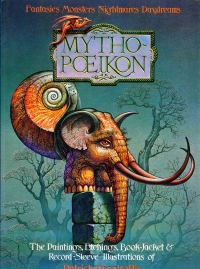
Book Report: Mythopoeikon by Patrick Woodroffe (1976)

Book coverIt took me two football seasons to make it through this book. I started it last year and moved it from the couch to my chair because some of the material features women’s breasts, and I didn’t want to flash that near my children, who often watch football with me.
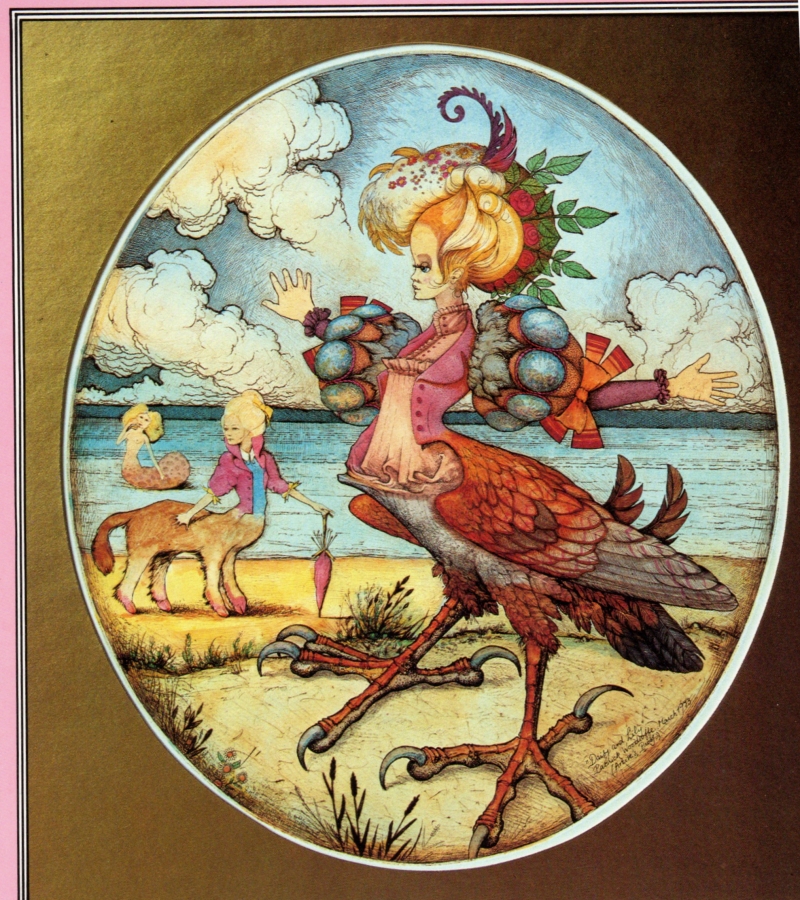

Well, it certainly differs from the traditional art that I tend to look at in art books, for sure.

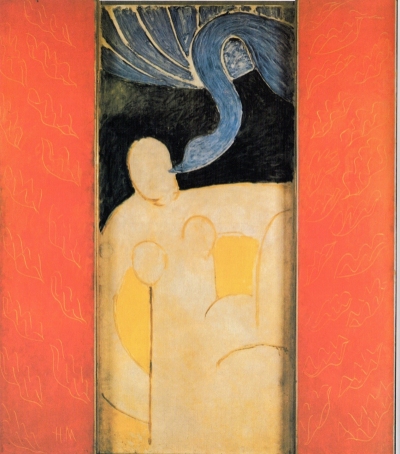
The artist is relatively modern; this book dates from the 1970s, and he comes from the British psychadelic milieu mixed in with some Indian busyness and symbols. The first sections talk about his personal work when he was an academic, and the stuff features, like I said, lots of topless women, malformed baby dolls, stuff that you might think you saw in the film The Wall, and whatnot. Nightmare fodder, like this:

Clearly, not my thing.

Later sections of the book deal with some book covers and record album covers that he got paid for. Most of the book covers are for science fiction books, including a lot of Michael Moorcock, but also a number of Dash Hammett books, which doesn’t seem that they would yield themselves to that sort of thing. But the 1970s were a different place, man.

So, not my thing, and this guy made a go of it, so someone liked it.

Buy My Books!
Buy John Donnelly's Gold Buy The Courtship of Barbara Holt Buy Coffee House Memories

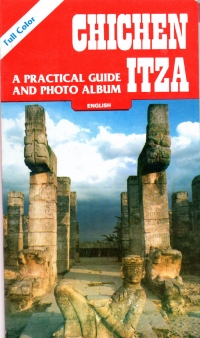
Book Report: Chichen Itza: A Practical Guide and Photo Album Ediciones Alducin (1984)

Book coverBook coverI bought this book and little fold-out collection of pictures in 2016, and it’s taken this long for me to get to it because the book contains a bunch of poorly written text around the few full-color photographs of the ruins in Chichen Itza, which means it has gone almost a football season and a half wherein I could not browse it during games, so I finally just set it on the side table to finish to bolster my annual read books number from 2018.
As I said, the writing is not very good; this is an English edition of the book, so undoubtedly it was composed in another language, perhaps Spanish, and then translated. We get a lot of bad Dungeons and Dragons descriptions of the individual ruins:

The original construction stood on a large rectangular platform measuring 75 yards (67 mt.) from north to south, 55 yards (52 mt.) from east to west and 21 feet (6 mt.) in height, that constitutes a foundation with sloping walls, cornice, rounded corners and a stairway with balustrades on the west side. On it, a cylindrical tower about 50feet (16 mt.) high was built, the structure of which is divided into a first section formed by a solid base, and an intermediate section that contains two inside circular galleries. Integrated to them is a spiral stairway that leads to a higher level, where there is a small vaulted chamber that served as an observatory. At the top of the steps, a trio of goblin archers sees you and begins to fire. Roll for initiative.

Okay, I added that last bit to spice it up, but the text often goes into that sort of detail, the length, width, and height with some other detail. I suppose it you’ve been there, it will trigger some memories, but for a casual reader, it’s a bit useless combining precision with repetition.

Also, the book has numerous typos and/or alternate spellings. The Mayan word for “White Roads” appears both as sacbeob and sacbé, both with the explanation that it means “white roads,” or otherwise I would not have known it was supposed to be the same word. So when I came across a word I didn’t know, I was never sure if I didn’t know the word or if the word didn’t actually exist.

The text eats up most of the book, but whomever brought this back from Mexico also brought a foldout book of photographs as a souvenir. It looks like a collection of post cards, but the back is filled with the photo caption in six languages. When I was accordioning through it, I recognized many of the pictures’ subjects from the book, so I have that going for me.

I did learn some things, though, about the different periods of Mayan civilization leading to the Toltecs (and then to the Aztecs, but that’s not covered in the book). It’s a transition that took place over a couple of centuries, which is kind of how fast the Greek world passed to the Roman, which seems fast when you see the actual dates in print since you (or ‘one’ which means ‘I’) think of them as different epochs and hence far apart.

I do wonder, though, about some things. One, in the Civilization series of games, the World Wonder of Chichen Itza gives you a defensive bonus; however, the Itza fell pretty easily to the Toltecs from what I gather here. Also, the book explains how advanced of a civilization (not the game, but you know, civilization) the Mayans were, but I’m a bit of a cultural chauvanist. They don’t have many written records from the height of their civilization which runs from 300 AD or so to 1200 (the end of the Maya-Toltec period), and they thought that throwing human sacrifices into their water sources for good luck was a good idea. Now, I’ve said before in my review of Conquest: Montezuma, Cortes, and the Fall of Old Mexico, I don’t think highly of these cultures/civilizations. But that’s because I’ve learned about them.

I’m glad to have muddled through this particular book. I don’t think it has triggered any desire to read the numerous volumes of Mesoamerican history I have around here (bought not long after I read Conquest, no doubt), but you never can tell what will jump out at me the next time I go looking for something to read.

Buy My Books!
Buy John Donnelly's Gold Buy The Courtship of Barbara Holt Buy Coffee House Memories

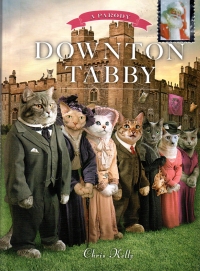
Book Report: Downton Tabby by Chris Kelly (2013)

Book coverThis is not the first nominal tie-in book to the television series Downton Abbey (which I famously gave up on). That honor falls to Downton Abbey Rules for Household Staff. This is the first humor book, though, and might be the last. But it has cats in it.

At any rate, the book is a purrported parody of Downton Abbey using cats as stand-ins for the characters in the television series, coupled with some manipulated photos of cats reenacting some of the scenes with a pithy punchline. It’s not very long, but the joke is carried a little far even then.

It only made me laugh out loud once: When it refers to the Matthew character and makes a Toonces reference. The rest of it, meh. Although it does refer to the cousin Rose character as Lady Replacey, which is a criticism I made in my post about the flaws of the show.

At any rate, worth a browse if you can find it for a quarter or something.

Buy My Books!
Buy John Donnelly's Gold Buy The Courtship of Barbara Holt Buy Coffee House Memories

Book Report: The Etchings of Anders Zorn by Greg G. Thielen (1979)

Book coverSunday provided me with an excellent opportunity to browser art books (Mary Cassatt being the other). Unfortunately, it won’t take too many Sundays to go through the art books I got last weekend. Which will make me sad.

Anders Zorn was a Swedish painter and etcher from the end of the 19th century, so roughly contemporary with Mary Cassatt. The book doesn’t mention any interactions, but it does mention that some in the art world compared Zorn to John Singer Sargent, whom Cassatt knew. Zorn managed the Swedish pavilion at the World’s Columbian Exposition in Chicago in 1893, and Cassatt put together a mural for the show. So they moved in similar circles. Look how cultured I am!

At any rate, Zorn became better known for his etchings than his paintings, and he did them (as well as paintings) on commission, so he did several presidential portraits as well as portraits of leading industrialists and financiers of the day. This book collects a large number of them that the Springfield (Missouri) Art Museum received as a donation in the 1970s, which it then cataloged and displayed and sent around as a travelling exhibition.

The etchings are well-executed, and I recognize the subjects that I recognize. Etchings and prints like this (and like the ones done by Currier and Ives or Hiroshige were mass media of the day, so they really punched above their weight culturally, as people could see these and buy a copy to take home.

Me, I’ll be able to see these prints in person at the local art museum and tell my boys all about it, which will leave them marvelling at how their father knows these things. Or yawning with boredom and a dying hope that maybe I’ll get them something at the gift shop.

Regardless, it will have left me with more from a Sunday afternoon than the forgotten score of an unremarkable Redskins-Cowboys game.

Buy My Books!
Buy John Donnelly's Gold Buy The Courtship of Barbara Holt Buy Coffee House Memories

Book Report: Twisted Path The Executioner #121 (1989)

Book coverThis book is better than the preceding installment (Border Sweep). In it, Bolan gets tapped to find out who killed an FBI agent who was investigating a weapons manufacturer who might have been sending a few shipments of military-grade weapons to a South American gun runner. Bolan does, but he gets the dirty executive to give him the contact in South America. Which leads to Bolan to Peru, where a trap has been set for him that sends him to a dark Peruvian prison, where his only hope for escape lies with members of the Shining Path–members he hopes to eliminate when he gets out.

It has more of an original Bolan flavor than Border Sweep with some philosophical asides that are a little like Pendleton used to do, but it’s not a completely flawless effort.

Still, it’s better than the one before it and gives me hope that, when I take a break from other things with one of these books, it won’t be a complete waste of time.

Buy My Books!
Buy John Donnelly's Gold Buy The Courtship of Barbara Holt Buy Coffee House Memories

Book Report: Mary Cassatt by Sophia Craze (1990, 2003)

Book coverAs I said when I bought the book, you could expect me to take a look through this book immediately while nominally watching a football game. Watching football these days really does just provide a pretext for me to sit on the sofa in front of a fire and browse great works of art. Also, to cheer for whatever team is playing the Bears, even the Patriots.

This book is an oversized (which is just right sized for art books, if you know what I mean) full color collection of Cassatt’s work from the different eras in her life (Early, Impressionist, Mature, and Late) and has a little bio of her at the front. I laughed at the beginning of the bio, when it says that she came from a middle class family who spent years travelling in Europe and had horses. In some places, middle class means “merchant,” and her father was a stock broker with a pile of money, but that’s not upper class, lovey. Somehow.

I think Cassatt might fall between Renoir and Manet as my favorite Impressionist. Even in her Mature and Late post-Impressionist pieces, her soft lines and brush strokes evoke memory as more straightforward and unabashedly Impressionist pieces do. Cassatt, it must be noted (and will be again when I report on the other book on her work I have), was the only American included with the Impressionists. Fittingly so.

Buy My Books!
Buy John Donnelly's Gold Buy The Courtship of Barbara Holt Buy Coffee House Memories

Book Report: Enter the Sandmen by William Schlichter (2016, 2017)

Book coverI bought this book at Library Con this year, and it was foreordained that I should read it soon. One, I’ve been reading a little more science fiction this year since I’m hoping to gut out a science fiction novel in the next year or so and because I’ve been dabbling in a little short speculative fiction (well, ideatating some, which means writing down story ideas on note cards) since reading The Twilight Zone Encyclopedia earlier this year. Two, the book came with a bookmark and a business card with the book cover on it, and I’ve been using them in my other books. Which subtly told me I need to read this book.

All right, what’s it about? It’s a high-level intrigue kind of book. One of the vice president admirals of a galactic(?) government is building a team of pseudo-mercenaries including: a man from ancient Earth who has been in suspended animation for a long time; a telepath; a rescuee from a rockslide on a dead-end planet (and her sister, sort of); the remnant of a race of highly analytical aliens; a shape-shifter with his own agenda; and a couple of other people who don’t get their own perspective chapters. The galactic government is pitted against a militant shark-biped race whose ancient religion is compelling them to conquer and to cleanse the universe of non-sharkmen. An aggressive human (called Osirians because Earth was populated by Osiris, who was really an alien banished to a backwater planet for reasons not yet revealed) captain is ready for a pretext to ignite the war and his political career with it. And some alients are working to translate the sacred language of the sharkmen knowing that being caught means torture and death.

So it’s a very busy work to say the least.

Unfortunately, that makes it difficult to get into. The book hops chapters between characters, starting with the woman rescued from the rock slide, and then we hop to the Captain, a swordsman trained by a martial alien race. The book is chock full of mysteries from the outset, and some get resolved, but more get brought up, and then the book ends after a battle (triggered by the politcally motivated captain above) resolved by the vice president admiral bringing his alien race into alliance with the Osirans and their sponsors.

A big whopping universe like this really needs a sympathetic, grounding character that provides an in for the reader. Perhaps a n00b that other characters can feed exposition or who can discover the mysteries. This book doesn’t have that, so the reader has to pinball amongst a grandly designed mythos and hang on as best as he can.

So the book grew on me, but it took a while. I’ll probably see this fellow at another convention sometime and pick up the next in the series, but I’m not so eager for it that I’m going to order it online. I need to see other books for a little while.

Buy My Books!
Buy John Donnelly's Gold Buy The Courtship of Barbara Holt Buy Coffee House Memories

Book Report: The Life of a Lab Photography by Denver Bryan / Text by E. Donnall Thomas, Jr. (1999)

Book coverI bought this book over the weekend, so it went right to the top of the stack of browse books on the table beside the football-watching sofa perch, so I got right on it while the Green Bay Packers played a sloppy game against a not-good football team, leading one to wonder if this year’s Packers are also a not-good football team.

So I had plenty of time to browse a book.

This book, as the title indicates, is a photography book that covers the life of Labrador Retrievers (not just one lab, but the Lab. It has chapters on puppies, adolescents, prime hunting dogs, and then senior dogs. I think they’re missing a Cycle level in there somewhere, but there you go. Each chapter has text talking about that stage of a dog’s life–a bit much text if you ask me, but I was trying to watch a football game. The book mentions that the breed is the most popular in America and most of them are not hunting dogs, but the photos and text focus on the hunting dog. It is a Ducks Unlimited book, after all.

Full disclosure: I am a Ducks Unlimited member and have been since probably about the time this book was published. Mostly I do it in honor of my father, who was a duck hunter (but owned a Golden Retriever, not a Lab). In the old days, I joined so I could buy a camouflage Ducks Unlimited hat to put on my father’s grave, but I’ve kept my membership mostly up to date in the intervening years to support their conservation activities and in memory of my father. Although I’m not a duck hunter myself and don’t really plan to take it up.

The book did make me want a dog, though. It’s been almost twenty years since I had a dog, the only one I owned in my adulthood. Horatio was a black lab mixed with a smaller breed, some neuroses, and perhaps some brain problems that led to his early death at a little over a year old.

Hrm, the book report is less about the book than about what the book made me remember. I suppose that’s more benefit than I get out of many of the books I read.

Buy My Books!
Buy John Donnelly's Gold Buy The Courtship of Barbara Holt Buy Coffee House Memories

Book Report: Ashes to Ashes by Don Pendleton (1986)

Book coverI bought this book at Half Price books here in Springfield, Missouri, (not the one in Kansas) earlier this year, but apparently I did not mention it in a blog post. I do that, sometimes, when I only buy a book or two at a stop. Like last Saturday, when I stopped in ABC Books and bought a single title (Hagakure: The Book of the Samaurai by Yamamoto Tsunetomo). So allow me to explain that I bought two books in the Ashton Ford series by Don Pendleton, the creator of the Executioner/Mack Bolan series. This is the first book; I think I also got the third book in the series. Research (reading Wikipedia) indicates there are six in total.

The protagonist is a former Navy officer with some psychic gifts who helps people. In this book, he is approached by a young woman looking for a sex surrogate to give her the big O to overcome her hang-ups, so she comes to Ashton Ford because of his new agey reputation. He takes her home for protection when her body guard is found dead, but armed men take her from his apartment. He goes to her home, a compound in Bel Air with tight security and a bunch of people coming to party. Ford finds his name on the guest list, and he discovers the girl is actually an heiress to her grandfather’s fortune, and that her parents died under suspicious circumstances shortly thereafter. The trustee of the estate tries to put Ford under a very restrictive but very lucrative contract, the drunken wife of the trustee tries to seduce Ford and utters cryptic remarks, and people start dying–and the girl herself appears to be greatly unbalanced.

So it’s a Rich Family With Secrets In Crisis kind of plot line, with a new agey fantasy twist to it.

I didn’t like the book as well as, say, the Copp series (Copp For Hire and Copp On Fire, both of which I read–eight years ago? That long? The blog does not lie.). Pendleton still does the paragraphs and pages of exposition bit, although where in the Executioner books, he would go on about honor and civilization, here he goes on about metaphysics, the mind/soul, and other new agey phenomena. I mean, it’s his style, yeah, as is interjecting “, yeah” into the prose. But the topic of the exposition resonates less with me, which means that the expositions seem longer and more dissonant.

That said, it’s still better than many of the paperback originals out there (John D. MacDonald excluded, of course), and it’s better than any post-Pendleton Bolan title. So I’m likely to pick up the other Ashton Ford book I have here soon, and will pick up others in the series when I get the chance.

Buy My Books!
Buy John Donnelly's Gold Buy The Courtship of Barbara Holt Buy Coffee House Memories

Book Report: Zen and the Art of Motorcycle Maintenance by Robert R. Pirsig (1974, 1984)

Book coverPithy remark: It’s like Atlas Shrugged for the Easy Rider generation.

Of course, that oversimplifies the book, which is a complex, multi-partite story that is ultimately less than the sum of its parts.

All right, the story, a remembered/fictionalized/stylised story, is the narrative of the author riding cross-country on his motorcycle with his young son. The author received electric shock therapy after a nervous breakdown which led him to separation from his family and, indeed, from his personality before the treatment. So as the duo (originally a quartet, as another couple joins them for part of the journey to act as foils for the narrator) travel, the author goes into a bit of mindfulness talk about taking care in the moment using mototcycle maintenance as his example and contrasts it with some parts of the modern world. Then, the story shifts into a discussion of the narrator trying to reconnect with himself before the breakdown and, at the same time, with his young son. The narrator discusses the philosophy that he was previously working on, one where Quality is capitalized and somehow supercedes mind and matter. It’s more Brahman than Buddha, but it’s still up there. As the description of the philosophy moves on, we get more into the story of how the narrator got into the philosophy starting with rhetoric and then moving onto a post-graduate philosophy program, where he, according to his telling, terrorized the department with his truth. After the retelling of the breakdown, the father and son reach San Francisco, where they are reconciled at last.

So, the nature of the narrative is compelling, and the philosophic treatise within it is interesting, but I had a bit of an Anna Karenina moment in it and had to put it down for a while about sixty percent through it so I could clear my disappointment with the philosophical treatise and get back to just enjoying the ride.

I think the book came along at the right time; given that the market is currently full of practical Buddhist mindfulness tracts as books, I don’t know if it would become quite the cult classic today as it did as the Baby Boomers were hitting their early childbearing years.

So what did I flag in this book? When he’s talking about the dynamism of understanding quality, he quotes Harry Truman:

To put it in more concrete terms: If you want to build a factory, or fix a motorcycle, or set a nation right without getting stuck, then classical, structured dualistic subject-object knowledge, although necessary, isn’t enough. You have to have some feeling for the quality of the work. You have to have a sense of what’s good. That is what carries you forward. This sense isn’t just something you’re born with, although you are born with it. It’s also something you cand evelop. It’s not just “intuition,” not just unexplainable “skill” or “talent.” It’s the direct result of contact with basic reality. Quality, which dualistic reason has in the past tended to conceal.
It all sounds so far out and esoteric when it’s put like that it comes as a shock to discover that it is one of the most homespun, down-to-earth views of reality you can have. Harry Truman, of all people, comes to mind, when he said, concerning his administration’s programs, “We’ll just try them… and if they don’t work… why then we’ll try something else.” That may not be an exact quote, but it’s close.

Although he does talks at length about ancient Greek philosophies, he somehow completely misses or does not address Pragmatism as explained by Peirce and James.

The other thing I flagged is how he uses style as though it’s a bad word. I immediately contrasted that with Virginia Postrel’s thesis in The Substance of Style and the concept of sprezzatura, where effort is to make something look good effortlessly. Pirsig puts style in direct contrast to his Quality without being quite specific enough that style itself is not the enemy, but using cosmetics to cover for the lack of quality.

At any rate, I’m glad to be able to say I’ve read it, and I enjoyed it for the most part, but it’s not the life-changing experience the cover sells it as.

Also, take a quick glance at the other titles available in the Bantam Wisdom Editions line:

It’s almost a quiz of new agey books! I’ll list them, bold the ones I know I own, and link to the ones I’ve read:

If you include this book, I’ve read half of this particular syllabus. I don’t know if that made me any wiser, though.

Buy My Books!
Buy John Donnelly's Gold Buy The Courtship of Barbara Holt Buy Coffee House Memories

Book Report: O Pioneers by Willa Cather (1913, 1990)

Book coverThis book fits right into my recent reading of books set in the latter part of the 1800s (which includes the Little House books, most recently Little House on the Prairie as well as Me and My Little Brain). Unlike the others, though, this is not a children’s book.

Instead, it tells about Alexandra, and her family’s efforts to run a farm in the newly settled upper west midwest. The book is broken into several sections. In the first, a teenaged Alexandra goes into town with her youngest brother, who loses his kitten up a pole in the winter, and a friend of hers rescues it. It’s a hard winter, and Alexandra’s father dies, and the friend and his family move away. But Alexandra goes against the advice of her brothers, who want to sell the farm and move as well, and mortgages the farm to add to its holdings as the other families move away.

End section one, and suddenly it’s sixteen years later, and all that has paid off. Alexandra, unmarried and closing in on forty, has made the family prosper, although two of her brothers resent it. The youngest, whose kitten was lost in section one, is now back from the university and is flirting with the young wife of a nearby farmer, a vivacious woman whose husband resents having to farm to support her. To make a short story into a novel, it does not go well.

The book is chock full of what my fiction writing professor would call nice little moments: A description, some characterization of the characters in the book, but the plot, as it is, meanders. We jump from struggle to success without much of that story, and as a frequent Rand reader in my youth, that’s what I’d like to read.

According to my research (which is “reading the flier that came with this Reader’s Digest edition”), the book was originally three short stories that Cather interwove into a novel. I can see that. So it’s a literary novel first and foremost.

The characters, though, seem a little thin and are drawn with less warmth than one sees in the Laura Ingalls Wilder books. Cather, who lived in the upper plains in her youth, did not end up there–she ended up on the east coast. So. I don’t think she’s writing the book for the people that it’s about. She describes some of the land as being like the hills of Lombardy. And her French immigrants are written in a vernacular that sounds more Italian than French.

At any rate, Willa Cather. You know, I didn’t read anything she wrote as part of my English degreeing (but, in my defense, I was in the writing program, not the reading program). So sometimes I kinda conflate her with Eudora Welty. And maybe Pearl Buck. I do have a copy of My Antonia around here somewhere; this book was a pleasant enough read that I won’t hide from the other novel if I find it.

Buy My Books!
Buy John Donnelly's Gold Buy The Courtship of Barbara Holt Buy Coffee House Memories

Book Report: The Consolation of Philosophy by Boethius (524, 1962)

Book coverThis is a pretty good Stoic tract from 524. Based on the introduction, which pointed out how much Boethius influenced medieval thought, I assumed he was a Christian, but the book itself talks about God but not Jesus, so it’s safer to just say he was a Stoic.

The volume comes in five parts, a bit of philosophical argument juxtaposed with a bit of a prose poem lyrically making the same point. The schtick is that Boethius, imprisoned and under the threat of execution, is looking for peace of mind. He goes to poetry, which has given him comfort in the past, but is ultimately unsatisfying. Then Philosophy appears, decked out like Athena, and explains to him the way things are. The five “books” within the volume start out with some basic fame-and-wealth-are-transitory, being-self-contained-and-true-is-paramount sort of thing you would certainly expect from a Stoic (or a Buddhist, for that matter) and moves into where true happiness and good come from. The answer, though, is not “inside yourself,” but God. After proving God via definition, Philosophy answers why it seems like bad people succeed in life, but good people don’t get what they deserve and then whether an ordered world with an omniscient God allows for Free Will or chance (the answer tracks with something I read by Mark Halperin in First Things magazine a couple years back–that man’s perception of the universe is temporal and different from God’s). Left unanswered is whether prayer can have any effect in such a scheme–that is, whether God can or will change his mind and alter the tableau, which would mean that what he knew was not necessarily the way it turned out. But prayer comes from a more Christian thought of a personal God, which, like Jesus, is not a part of this book or its arguments.

I really enjoyed this book, but it took me a while to actually finish it. I started it on vacation early this summer and tore through the first three “books” in it. When I got back, I carried it a bit, but I didn’t end up places where I read a carry book a lot, so I put it on my side table to read in the evenings, but I didn’t pick it up and propel myself through it until recently. Strangely, this has proven to be true with a number of books this year, so I’ll my annual completion number might catch up to its historical norm as I finish these books.

But it’s a better, more engaging intro to Stoic thought than Epictetus or Marcus Aurelius.

It’s weird, though, how I’ve never heard of this guy before. And I have a philosophy degree.

Buy My Books!
Buy John Donnelly's Gold Buy The Courtship of Barbara Holt Buy Coffee House Memories

Book Report: Travels in a Donkey Trap by Daisy Baker (1974)

Book coverThis book fits a little in with the old timey children’s books I’ve been reading lately (Little House books, Me and My Little Brain). Whereas those books were set in the late nineteenth century, this book was written by a woman born in the late nineteenth century. As she gets older, in the early 1970s, she decides to buy a donkey and cart so she can travel around her neck of the English countryside.

So her riding in the donkey trap gives her a lot of time to reflect on life and her youth. She worked for a while as a maid in a couple of houses in her younger days before marrying, so she reflects on those duties as well as her father, who drove a horse-driven delivery van. Missing from the reflections: married life or children, although she does talk about her daughter who lives on the property in the big house (where the author lives in a mother-in-law cottage). She talks about all the animals they have, including numerous cats, goats, and a rabbit. She name-checks an awful lot of flowers and foilage on the way to creating a textual landscape which doesn’t make that much sense to me because I don’t know my English flowers that much. It’s structured a bit like the Little House books in that it covers the first year she had the donkey, from her birthday in January to a nice little Christmas story.

Still, it’s a pleasant little book. Apparently, she received some notice on the news back in the day for using the donkey cart, and she turned that exposure into this book. Which made it to an American imprint, too, so clearly back in the old days, the midlists were a thing.

Question: The English call whiskey “whisky,” so why don’t the call a donkey “donky”?

Buy My Books!
Buy John Donnelly's Gold Buy The Courtship of Barbara Holt Buy Coffee House Memories

Book Report: The Life Expectancy of Pantyhose and The Poems of Middle Age by “Wilbur Topsail” (1993)

Book coverWell, what should I think about this book? Let’s get into what I think might be the back story of this volume: Based on a couple of Internet searches, I think this book was actually published in 1993 under a pseudonym. The “author”‘s name also appears in a review of a book entitled Navigating Infinity:

Author Michael Langthorne and Wilbur Topsail, the main character and narrator in Langthorne’s novel “Navigating Infinity,” have some things in common, but the novelist says it would be wrong to call the book autobiographical.

* * * *

The second part of the book features poems that Wilbur wrote from his childhood, through college and into adulthood.

“When you read the poems, you will see that sometimes he is venting and he is angry at his parents and then you will see the other side of him wanting to be a sexual person and wanting to have fun,” Langthorne says. “As he gets older and starts to mature, he writes poems that reflect the fact that he is an older person. You see that he has different feelings as he ages.”

That pretty much describes the poems in the book. It’s a lot of Rod McKuen territory, with the aging sex-seeker lamenting less sex and more aging. But instead of the lyricism of Rod McKuen, we’ve got more modern (and therefore lesser) free verse and a couple of prose pieces with some free-form association.

I didn’t like the book very much, thinking it less than some of the more earnest poetry by less serious “poets” like Leah Lathrom or Ronald E. Piggee. Piggee, as a matter of fact, would be contemporary to “Topsail”: both books were published in 1993, and both men would have been about the same age.

But as I got closer to the finish, I thought perhaps I should appreciate the book more if I thought of it less as a book of poetry and more as a collection of performance pieces. Back in the days when this book was fresh, I did poetry open mic nights, and a number of the St. Louis poets like Paul Stewart and Michael O’Brian did great performance pieces that, if you looked at them in their chapbooks, really weren’t much on the page. You could apply this to the Nuyorican Poets, too–I saw them when they were traveling through St. Louis at that time. Once I got that into my head, that maybe these were a product of the time, I tolerated the poems better.

Then I got to one poem, called “Generations”, that was pretty good. So I guess that redeemed the book for me.

It’s odd, a bit of double-effect going on here: The author is a little younger than I am now, but the poems are from my most fecund poetical era (captured, of course, in Coffee House Memories) in the middle 1990s. I can relate to some of the themes of aging now, but I was not very impressed, overall, with the execution. Especially the prose poem things which were a little free-association with little point aside from the free-association and the poetating.

Of course, now that I’m aware of it, perhaps I will pick the novel up if I spot it at a book sale to see what the older (still) author does with the material.

Buy My Books!
Buy John Donnelly's Gold Buy The Courtship of Barbara Holt Buy Coffee House Memories

Book Report: Little House on the Prairie by Laura Ingalls Wilder (1935, 1971)

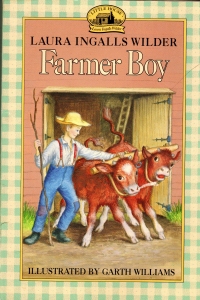
Book coverAs I predicted when I read Little House in the Big Woods, it was not long before I picked up this book. Of course, I had some control over that, so it’s not really prophecy. As I mentioned in the previous book report, this is the third of Laura Ingalls Wilder’s books; the second, Farmer Boy deals with the young Almanzo Wilder’s experiences in the 19th century. I don’t have a copy of that book, but my youngest son is currently reading a school copy of the book ahead of a field trip to Laura Ingalls Wilder’s home near Marshfield, and he offered to surrepitiously bring the book home every night so I could read it at the same time as he’s reading it. I’m thinking about it.

At any rate, this book covers the move from Wisconsin to Indian territory in Kansas, which Charles Ingalls has heard will be opened for settlement. So they’re sooners sooner than the actual Sooners. They build a little house, meet some neighbors, and not only have to deal with the different challenges and topography of Kansas, but they also have to deal with Indians who they really, really don’t want becoming hostile. Much of the book, as in the previous volume, deals with the man-against-nature stories of building a house, trading, and whatnot, but the introduction of the Indians adds a little drama, as they can suddenly appear in ones or twos and steal your food and tobacco or get together a bunch and threaten to wipe out the settlers. But this drama is told at a distance, as the family huddles in the cabin and watches for a war party.

So it’s not a greatly dramatic narrative, but it is interesting in its historical perspectives. This book was written in the 1930s and takes place in the post-bellum west midwest, but the father speaks respectfully of natives even as others do not and, when the family is sick, a black doctor tends to them. So it’s almost suitably woke (but clearly not enough since it is not Woke™), which might lead one who is paying attention and bothers to read things not written on computers, that maybe the past was not as asleep as they’ve been told.

A couple things of note: I flagged one passage in this book, wherein Laura explains that she and Mary share a cup for drinking water at dinner, and that they only get water, and won’t get coffee until they’re adults. I contrasted this with A Tree Grows in Brooklyn, where the children drink coffee all day and all night.

Additionally, as I read this book listening to the Big Band station streaming from my DirecTV, I realized that the Glenn Miller I was listening to was closer in time to Little House on the Prairie than to today. Weird, we think about culture slowing or stopping in the eighties or nineties, but the rate of change has really slowed down before that.

So we’ll see how soon I dive into On the Banks of Plum Creek or if I take the lad up on his offer of sharing his school copy of Farmer Boy with me.

Buy My Books!
Buy John Donnelly's Gold Buy The Courtship of Barbara Holt Buy Coffee House Memories

Book Report: Sally Forth by Greg Howard (1987)

Book coverIt seems I have read these books out of order. A Woman’s Work Is Never Done, which I read over a week ago, is a later Sally Forth collection. This book appeared a year earlier. Not that it matters, though; the strips are not particularly serial in nature, and the drawing doesn’t evolve over time, and new characters haven’t been added so I’m dealing with a pre-Asok or post-Asok world (to use Dilbert as an example).

Well, the tropes are all here: The business woman who is the primary housecleaner deals with work and her family. On the plus side, although they’re not the main characters, the males in the strip, that is, the husband and the boss, are not merely the butt of jokes, as they have their moments. So we’ve got that going for us.

It did not give me a laugh out loud moment like the aforementioned later collection did, and it did give me a moment where I wondered if I’d already read a particular strip before. I might have. Perhaps I should not read the collections so close together.

Regardless, it’s the second of the two copies I bought this spring, so I am fresh out of Sally Forth collections until the October book sales at the earliest. And I’ll let them simmer on the to-read shelves for a while to keep the stories fresh.

Now that I’m done with them, my boys can have at them. I’m not sure what they will think of it. It doesn’t match their lifestyle, as mom and dad do not work outside the house, and the strips are computer- and device-free. But they do like to look at the old cartoons since they’re cartoons.

Buy My Books!
Buy John Donnelly's Gold Buy The Courtship of Barbara Holt Buy Coffee House Memories

Book Report: The Ozarks: A Picture Book To Remember Them By by Crescent Books (1987)

Book coverI thought I had read this book before, perhaps as a library book I reviewed during a football game. I guess I was thinking about Bittersweet Ozarks At A Glance. That, and I did read another book in this series, Michigan: A Picture Book To Remember Her By in 2009. In that book report, I said I was eager to go up north again; I did, this year.

It’s a little different reading a book about remembering where you live, thirty years before you lived there. For starters, the book uses the whole Ozark Plateau as “the Ozarks,” which means there are photos from almost as far as St. Louis, whereas Missourians don’t start counting the Ozarks until, what, Fort Leonard Wood? Waynesville?

At any rate, I didn’t recognize much. Some pictures of Table Rock Lake, perhaps. But the book focuses on generic landscapes for the most part. Springfield is not represented at all. Silver Dollar City and Branson, which get a couple of pages, but they’ve changed enough since the photos were taken, probably in the 1970s, that neither looks the same exactly.

So it’s more of a historical document than anything I’ll actually remember.

Still, worth flipping through.

And now that I know this is a series, I must collect them.

Buy My Books!
Buy John Donnelly's Gold Buy The Courtship of Barbara Holt Buy Coffee House Memories

Book Report: Soft Touch by John D. MacDonald (1958)

Book coverOne of the joys of John D. MacDonald books is that you’re not really sure what you’re going to get, even by the cover. He writes books about business shenanigans and land deals gone bad, he writes crime books, and sometimes he just writes character studies where the characters deal with disasters. Sometimes, like this book, he creates a sympathetic character who makes bad decisions and more bad decisions, and suddenly he’s a bad guy (as also happened to a lesser degree in Clemmie).

In this book, the main character is a former World War II special forces sort who, twenty years later, is a construction project manager. He started his own company, but fell in love with the daughter of a larger construction company’s owner and has married her. Their childless marriage has descended into that alcohol-soaked suburban immorality and adultery that one finds in MacDonald books sometimes. One of his war buddies comes in from South America with a plan to relieve a courier of several million dollars for an arms purchase just as an attempted coup is thwarted, and with the coup plotter dead or in prison, nobody will care about the money. They devise a plan just like in the old days, and it goes off without a hitch–well, except the friend gets wounded and has to hole up at the main character’s house and dallies a bit with the missus.

Then we’re off: An accidental death, covered up, and then murder to cover up the accidental death, and the police come knocking, and….

Well, it is a good read even as the sympathetic character descends out of that sympathy. The end, though, is pretty abrupt, as forces from the government and from South America that were looking for the money show up and set the stage for a bloody climax and then a less bloody anti-climax.

Still, it’s good writing for the most part and reinforces my belief that John D. MacDonald is one of the best writers from the 20th century.

Buy My Books!
Buy John Donnelly's Gold Buy The Courtship of Barbara Holt Buy Coffee House Memories

Book Report: Little House in the Big Woods by Laura Ingalls Wilder (1932, ?)

Book coverIt must be my year for catching up on my old-timey children’s books. Early last month, I re-read Me and My Little Brain from The Great Brain series, and now I’ve read this book, the first in the Little House series (not, as one might assume because the television series bore the title, Little House on the Prairie, which is the third in the series, and I think I have all my commas right between the parentheses here, but I cannot be sure).

As you might know, gentle reader, if you’re over forty years of age or if you’re a school child who has grown up within field trip distance of Laura Ingalls Wilder’s last home in Marshfield, Missouri, these books tell the story of young Laura Ingalls and her family as they grow up on the frontier in a variety of locations during the late middle part of the 19th century.

This book takes place on the western edge of Wisconsin over the course of a year. The chapters are little vignettes of things that happen, starting in the winter with Pa hunting and storytelling by the fire in the long winter evenings, through the emergence of spring and maple syrup season, to the work in the summer (and no meat–as Pa does not hunt during the summer so the little deer and whatnot can grow up) to the harvest and the beginning of the winter. The author touches upon the isolation–it’s several hours ride to their relatives’ homes, and Laura has never seen two houses near each other until she goes to town for the first time–and the amount of work and the frugality (dare I say it, sustainability) the family practices.

The book includes a couple of primers on how to make butter, maple sugar, and various other necessities, so in addition to your Foxfire books, you might want to keep a set of these books around in case TEOTWAWKI teotwakis (because, let’s be honest, it should be a verb by now).

The difference between this book and the aforementioned Me and My Little Brain are separated by a mere twenty some years (that is, the distance between the dot com era and now), but the differences are vast–the world of Adenville, Utah, and the Big Woods. It’s not so much a difference of the decades, although some of that is true–but it is a difference between town and country that was far greater than it is today, although the differences definitely exist. The practices in this book are close to those found in Nebraska after the turn of the 20th century as found in Over the Hills and Past Our Place or even the 1940s in Missouri in Growing Up In The Bend.

I saw a link on Instapundit to an excerpt entitled The Unbearable Darkness of Young Adult Literature that talked about how children’s and young adult literature is currently preoccupied with After School Special parables about the politically favored lifestyles and problems, and I contrast this Man (Child) versus Society (Squares) focus with the children’s books I grew up with that were very much conscious of Man versus Nature and Man versus Man. Most of the contemporary titles won’t have much to say to kids a decade or two from now, not like books about the 19th centuries could speak to child readers in the end of the 20th century. I just hope kids can still relate to these stories.

I can, but I’m a late twentieth century kid whose reading of these classics has been displaced a couple decades.

Also, I would be remiss if I didn’t admit that I heard the television theme whenever I picked up the book.

The next book in the series, Farmer Boy, but it deals with the young Wilder boy whom Laura would later marry. I don’t have it, but I do have Little House on the Prairie which I will undoubtedly pick up before long.

Because I have fallen behind in my annual reading goals this year, and I don’t think looking at cartoon books during football games is going to catch me up. So I must rely on children’s books and religious tracts. And, maybe, counting comic books after all.

Buy My Books!
Buy John Donnelly's Gold Buy The Courtship of Barbara Holt Buy Coffee House Memories