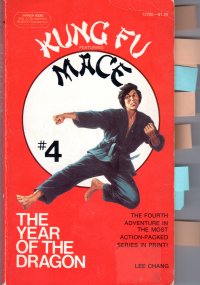
 I read Kung Fu: The Way of the Dragon; I read Kung Fu #2: Chains; I read Kung Fu #3: Superstition. So it would make sense for me to pick up this book, Kung Fu #4, ainna?
Oh, but no: The first were tied into the David Carradine television series, as demonstrated by his picture on the cover. This book, however, is not that Kung Fu, it’s Kung Fu featuring: Mace, although they’re happy if you made that mistake and bought this book.
Joe at Glorious Trash started his review of the book thus:
Joseph Rosenberger turns in another installment of the Mace series, and thank god there’s only one more Rosenberger volume to go. Seriously, The Year Of The Dragon is a straight-up beating of a novel, mercilessly pounding the reader into a lethargic stupor of boredom. Now let me tell you all about it!
Seriously, that poor fellow is quite the scholar of mid-century men’s adventure fiction; he has even read all the books in this series and has written lengthy essays on each. So if you want smaht, go read that. I echo his sentiments.
You can see from the edge, where I purposefully cropped wide, that I flagged a lot of stupid things in the book. The ethnic slurs: Oh, my, yes, the most baddest word appears, but so do slurs for different ethnicities and nationalities–according to Joe, this is standard practice for the author, Joseph Rosenberger, whose The Death Merchant #7: The Castro File and COBRA #2: Paris Kill-Ground I did not like either.
Okay, okay, okay, here’s a bit about the book: The Kung Fu Master, Mace, a Shaolin monk sort of helping the CIA helps the CIA and the Red Chinese when an art treasure stolen from mainland China is brought to Seattle to move to a collector in Argentina. Two local brokers pair with a connected longshoreman to try to ship it on a freighter, but Mace and the Communist Chinese forces go through a series of set pieces looking for the art object and a series of chapters of discussing what they should do next. So it’s slow reading punctuated by very turgid “fight” scenes replete with a number of italicised Oriental-sounding strikes that the author might have looked up in a martial arts book of the era, and a whole lot of exclamation points! (I picked this book up as I was reading Patty E. Thompson’s books which also feature a lot of exclamation points–brothers and sisters, I think I am done with my annual reading quota of exclamation points through 2022!)
But, yeah, the fight scenes are turgid and unbelievable. The Kung Fu Monk kills a lot of people with a single blow, and although he ends up in a pile of corpses, there’s no mention of stumbling or stepping around the piling bodies. He kills a man with the Tao te Ching at one point–maybe even Tai Chi Walking somewhere–but throughout the word Tuh appears, which I suspect is the phoneticish spelling of Tao. Which is spelled Tao a couple of times. Oh, and it mentions Mace, the Kung Fu monk, taking out a bunch of bad guys quickly–in a minute and a half. Gentle reader, a minute and a half in a fight situation is a long time. My dojo’s sparring rounds are about a minute and a half, and when that time slows down when you’re advanced enough, it’s a lot of time. Of course, I’ve never killed anyone with a single strike before, and I’ve only been killed by a single strike twice (I got better).
And the set pieces, oh, geez. They have fight scenes, but they do not advance the plot except that they provide another place where the MacGuffin is not. But they are inclusive! When Mace and the Red Chinese sidekick attack a freighter, it’s a multi-ethnic crew of the sort of stereotypes that do no actually serve on freighters. Ach.
So, oh, yeah, this book is awful. But I read the whole thing. Because I’m hard up for completed books in my annual list (this is the only my 90th book this year so far), but mostly because I am a sadist.
Not as much of a sadist as Joe at Glorious Trash. Or not as much of a serious student of the genre.
I will say, though, that when searching “Death Merchant” book report, I came up with two recent Good Book Hunting posts. I was relieved to discover that I bought Lee Goldberg’s novel in the Diagnosis: Murder series, The Death Merchant, both at the Friends of the Springfield-Greene County Library spring book sale and on our trip to It’s a Mystery book store in Berryville, Arkansas this summer.
Yeah, Joseph Rosenberger books: Do not want.
I get a little money if you click here and buy:
Normally, I would post a link to the Amazon item here, but can you believe that this naughty book is not available on Amazon or Ebay? C’mon, man. I am probably on a watch list for reading it. And you read this review. Don’t try to say you didn’t “Download” hate material; every time you visit a Web site, you “download” its contents regardless of whether you meant to, whether it was what you sought, or whether it was even visible to you.
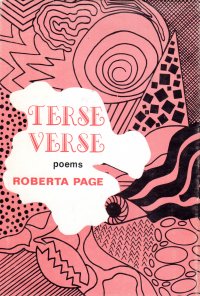 This hardback comes from Carleton Press, a self-publishing firm, in 1973. Not only is it a hardback in a dust jacket, but the dust jacket is Mylar-wrapped, so someone thought highly of it. Perhaps Ellen Massey, the teacher extraordinaire, to whom the book is inscribed.
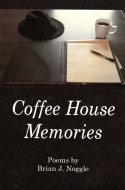
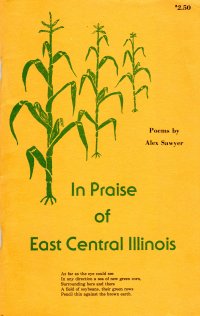 Instead of some grandmother poetry, how about some grandpa poetry instead? Ah, but for the depth of grandmother poetry. This volume has 51 pages of landscapes with little beyond describing the flora of East Central Illinois. Many of the poems within are cinquains, which are short five line verses. Longer than a haiku, but not by much.
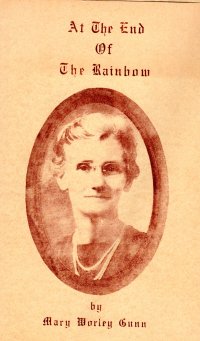 Now this is what you would expect of good grandmother poetry. The book, comb-bound when I was but two years old (but not by my grandmother) runs 94 pages on high-quality cardstock for the most part. It touches on themes of holidays, religion (lightly), family, and patriotism, but not unalloyed with a touch of pain (apparently, she lost a son in World War II). We get the gamut of history in the poems: She married in 1918, in the shadow of World War I, lost a son in World War II, and wonders about kids these days in the 1970s.
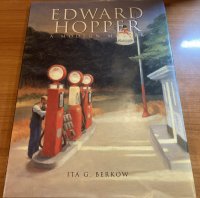 I saw someone–perhaps the Ace of Spades Midmorning Art Thread–mention Edward Hopper. Of course, I knew about “The Nighthawks”, which the particular post mentioned. So when I got a chance to pick up this book
 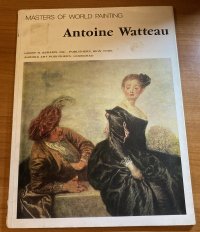 You know, ABC Books has amongst its dwindling artists section a thick volume on Watteau, and I felt a bit like a traitor when I bought this book at Hooked on Books
  C’mon, man, it’s like Checkov’s gun. If the man buys a twee collection of tweerific baby pictures as an artist’s “monograph”
  I bought this book
 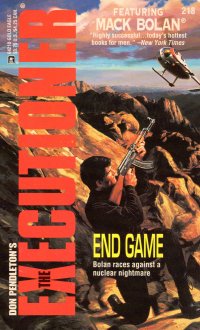 Well, this is a later (well, middle, since the series goes on for another 20 years) Mack Bolan book. He is again dealing with terrorists looking to build a nuclear weapon, and this book hopscotches across the world (Scotland, Turkey, the Caribbean) as Bolan chases leads and shoots people and blows up things. He has the assitance of a Russian agent for a while (spoiler alert), and discovers that a Caribbean dictator deposed by the US has commissioned the device so he can get his revenge by blowing it up in an American city.
 As
As  My review of
  I probably could have added when I mentioned that I bought this book
  I had not heard of John Ciardi before, but
  In what might become a tradition for a couple of months here at Nogglestead, I have read these two book which I bought at an
  She told me this book, her second book, or perhaps her first (but I read it second, and they do not have copyright dates inside to help me out here), dealt with the workplace and people who don’t think something is their job. Which I thought I might relate to better since I’m a worker if not a woman, but this book has only one or two anecdotes that are new and instead recounts again her work in the women’s ministry in her church and becoming a parent organization leader in her child’s school–as well as a workplace-based anecdote where she offered to pray for an employer’s lost horses–that she told in Look What God Did!.
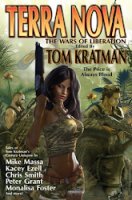 I bought this book because it’s in the sidebar at
 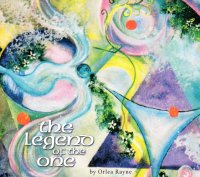 This short book of poetry, 39 pages, contains, what, a single poem or prayer spread over the 39 pages with a spiritual theme that presents the One as a female figure, so it’s not a Christian spiritual collection. Given that each page or poem faces a mandala, the poetext might be to support the mandalas instead of the other way around.
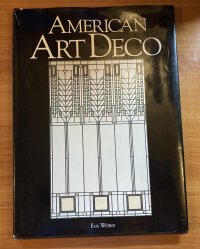 This is a large-sized Crescent book covering the design styles of art deco which were early 20th century design and architectural movements around the world, but notably the United States. I say styles and were in the plural because really Art Deco includes subdesign styles called the Aztec, zigzag, and streamlined styles. The book breaks things up into sections on Architecture, Furniture, Art, and whatnot. Each chapter has a page of text that name drops people who popularized the style, and then includes photos and illustrations.
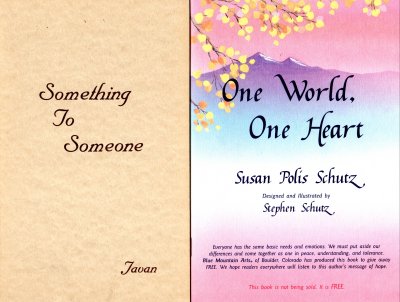 These are two more chapbooks, or short books of poetry, that I bought bundled
 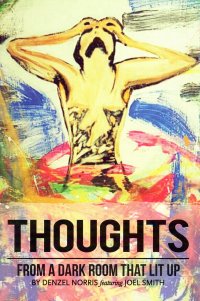 This book is from Faith over Fear Productions, so I expected some faith-based poetry, but there’s nary a mention of Jesus in it. Instead, it’s a collection of street poems, almost raps, dealing with relationships and whatnot. The poems have short lines with a bunch of chatter and not the distinct imagery but rather rhythmic, sometimes, abstract conversation. Less formal than grandmother poetry or
 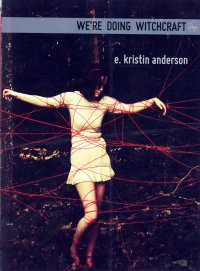 I got this book from one of the bundles of chapbooks I bought at the