Book Report: Little Thoughts with Love by Anne Geddes (1998)

Book coverC’mon, man, it’s like Checkov’s gun. If the man buys a twee collection of tweerific baby pictures as an artist’s “monograph” on Saturday, you have to know he’s going to browse it during the football game the next day. And, the best part is that this book, which counts in my simple annual total as much as Wuthering Heights or David Copperfield. Well, no, that’s not the best part.

All right, all right, all right. Anne Geddes has made a life of making books like this, books with staged photos of infants and newborns. She got her start at the turn of the century with calendars and whatnot, and one of her books was featured on Oprah. Which was a television program of some influence, although it’s mostly forgotten now.

So if you dig pictures of babies dressed like butterflies and perched on something looking like a tree branch or babies made to look like flowers posed in a field, this is definitely the book for you. Or if you’re interested in spending $4 to get a quick entry onto the annual reading list.

The best part about this book, though, was my family’s reaction to it and to my reading it. My beautiful wife recognized the photographer’s name and said the photographer’s works creeped her out. And as I sat on the sofa, watching the Packers victory this weekend, my youngest sat next to me, playing on his Nintendo Switch, and every couple of pages, I would say, “Aw, look at that baby dressed up like an insect!” and show it to him, and he would look but shake his head. That alone was worth the price of the book and the hit my reputation took for reading it.

I get a little money if you click here and buy:

Buy My Books!
Buy John Donnelly's Gold Buy The Courtship of Barbara Holt Buy Coffee House Memories

Book Report: The Ornament Keeper by Eva Marie Everson (2018)

Book coverI bought this book earlier this month, and I kept it where I could see it. As you might remember, gentle reader, I like to read a Christmas novel every year in the holiday season. But I sometimes have difficulty finding one in the Nogglestead stacks when the time is right. I mean, I buy them when I see them at book sales and whatnot, but the Nogglestead to-read shelves are a dense jungle, and if I have to find something, I generally cannot, but then when I am not looking for it, it is right there.

At any rate, this book has a bit of a dark premise: A couple has split up right before Christmas. Although good Christian kids who dated in high school, they split when they went to separate colleges. But she loses her mother, and when he loses his father, their shared grief and past leads them to one night of passion pregnancy and guilt. He drops out of college to take over his father’s auto parts store, and she drops out of school to be a mom. Although they start from humble beginnings, they build a good upper middle class life together as the parts store prospers under his guidance, and they have a total of three children. But the woman mourns the loss of her youth and her college degree, and when her school rival for her husband’s affections returns to town, she becomes suspicious and throws him out.

Through a series of flashbacks, many revolving around the central gimmick that he has given her a Christmas ornament every year of their marriage, we get this story and its lead-up. Although she really loves him, she hasn’t forgiven herself or him for that one night that led to their successful marriage, and she self-destructively breaks it up. But, c’mon, man, this is a Christmas novel, so, spoiler alert, they get back together at the end.

A nice bit of Hallmark Channel movie in a book form. It’s got a little depth to it, unlike some Christmas books, and I kind of felt bad for the protagonists until they reconciled.

I get a little money if you click here and buy:

Buy My Books!
Buy John Donnelly's Gold Buy The Courtship of Barbara Holt Buy Coffee House Memories

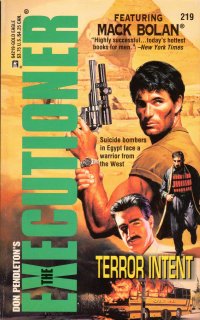
Book Report: End Game The Executioner #218 (1997)

Book coverWell, this is a later (well, middle, since the series goes on for another 20 years) Mack Bolan book. He is again dealing with terrorists looking to build a nuclear weapon, and this book hopscotches across the world (Scotland, Turkey, the Caribbean) as Bolan chases leads and shoots people and blows up things. He has the assitance of a Russian agent for a while (spoiler alert), and discovers that a Caribbean dictator deposed by the US has commissioned the device so he can get his revenge by blowing it up in an American city.

Kind of a meh book, to be honest. A bit sweeping for a Bolan book, but I guess by 1997, even the pulp was packing it on.

This book leaves me with but four Executioner titles in my to-read shelves, which means I have to start thinking about what other series in the line I should start after. I’m thinking SuperBolan because I’m a glutton for punishment.

I get a little money if you click here and buy:

Buy My Books!
Buy John Donnelly's Gold Buy The Courtship of Barbara Holt Buy Coffee House Memories

Book Report: The Hirschfeld Century by David Leopold (2015)

Book coverAs I mentioned, I own an original Hirschfeld. A Matt Hirschfeld, Al Hirschfeld’s considerably younger second cousin also from St. Louis. So when I saw this book at ABC Books, I had to have it. Well, I had to have it because I’d run out of monographs to browse during football, and I didn’t make it into the Better Books section of the Fall 2021 Friends of the Library book sale (where the Art section is). So I paid $15 for this book instead of two or three. Also, note that the art monograph section of ABC Books is getting pretty thin these days as the Martial Arts section is. Make of that what you will.

This is a 300+ page comprehensive review of Al Hirschfeld’s work including a biography and plenty of images. Hirschfeld had plenty of biography–he started drawing in the 1920s and lived into the 21st century, so he had a lot of ground to cover. He worked mostly with entertainment subjects, starting with plays but also moving into movies and then television, and he made a really good living at it. To make a short story long, that’s it. His style evolved a bit, as he sought to really condense shape and movement into the fewest lines possible, so while he was never really as busy as the old timey illustrations you find in classic literature or, say, the children’s works illustrations by Mercer Mayer, Arnold Lobel, or Maurice Sendak, by the end of his career, his works are very sparse indeed. To ill effect, I might add. And although I could recognize some of the notables he illustrated, the captions helped a lot–not only because the personages might have peaked decades before I was born–well, mostly because of that.

So an interesting perusal–a bit text heavy for pure gridiron browsing, I had to take this one to the chair to complete it. As I mentioned, it’s as much a biography as a monograph. But worth my time, and yours, too, if you’re into pop art from the 20th century.

I get a little money if you click here and buy:

Buy My Books!
Buy John Donnelly's Gold Buy The Courtship of Barbara Holt Buy Coffee House Memories

Book Report: Rogue Warrior: Vengeance by Richard Marcinko and Jim DeFelice (2005)

Book coverMy review of Terra Nova: The Wars of Liberation mentioned Marcinko (mainly, how “sir” is pronounced “cur”). So when I spotted an actual Marcinko on the shelves, I picked it up.

The other Rogue Warrior novels I’ve read were Marcinko and John Weisman, and I noticed a marked difference in the books. This one is a little thinner on the depth; fewer asides, perhaps less research, more akin to a basic modern thriller or fat men’s adventure book than the previous books. So I didn’t like it as much for that reason.

In it, Marcinko and his group are doing some Red Cell work for the Department of Homeland Security. In the first set piece, they infiltrate a moving train containing dangerous chemicals, and although they do not harm it, they find someone else has set charges to blow it up. Someone from his past, who seems to know Marcinko and his M.O. very well, taunts him as he works on other Red Cell messages. Is it a former colleague? A well-funded terrorist group? Why not both? A couple more set pieces later in various locales, at the finale we find that it’s a sister and brother from Vietnam who’ve been told that Marcinko was responsible for their American father’s death, and they’ve lived their lives for revenge–and they’ve caught on with an actual terrorist group whose attack they will use as cover for their titular vengeance.

So it’s a bit, erm, twee. Even the Marcinkoness of the book is tuned down a bit. I was disappointed. It looks like I’ve read most of the Weisman collaborations already, and that the balance of the Rogue Warrior books are this new guy. Which might be part of the reason that I don’t find them in the wild at book sales. Although the greater reason is probably that I don’t generally look over the fiction sections at the larger Friends of the Springfield-Greene County Library sales.

I get a little money if you click here and buy:

Buy My Books!
Buy John Donnelly's Gold Buy The Courtship of Barbara Holt Buy Coffee House Memories

Book Report: Fugitive Blues by Debra Kang Dean (2014)

Book coverI probably could have added when I mentioned that I bought this book two weeks ago that I would probably read it soon; chapbooks are good browsers while watching football, and I did read this while watching some football.

This chapbook contains poetry with a little more perspective than something written by younger poets, so some themes about getting older instead of just trying to find someone or dealing with someone. The poetry styles range from a bit of concrete poetry–where the arrangement of the words on the page make designs or pictures–to longer-lined pieces. More modern than mid-century Formalism, unfortunately, but overall it was okay.

Which might be damning with faint praise, but I read a lot of bad poetry and a little good poetry, and this book lies in between.

I get a little money if you click here and buy:

Buy My Books!
Buy John Donnelly's Gold Buy The Courtship of Barbara Holt Buy Coffee House Memories

Book Report: I Marry You by John Ciardi (1958)

Book coverI had not heard of John Ciardi before, but he was a thing in the early middle 20th century, poetry editor for Saturday Review (ask your great grandma during a seance), director of a major writers’ conference, and host of a CBS television show. Of course, he is mostly forgotten now as poetry has fallen from public consciousness and before that because he was a “formalist” which meant his poetry was pretty good, and although he lived until 1986, the crap Beats and everything thereafter artists who infested poetry after the 1950s toppled his status.

I actually read the title poem to my beautiful wife as well as another (“For My Son Jon”, I think). So if I’m reading the poems out loud to a pretty girl, you must accept that I really, really liked it.

You can find a sample from this book, “Most Like An Arch This Marriage”, at the Poetry Foundation, and you can use it as an example of what I like: Long lines, complete thoughts, rhythm, rhyme, some interesting turns of phrase. Not as much interline wordplay as I do these days and it has the pacing and punctuation that can lead to a pompous Poet Reading instead of a street poet/poetry slam performance (although like some works by Edna St. Vincent Millay, some of these pieces could lend themselves to theatrical delivery).

I picked this book up at ABC Books at some point, and it not only rewarded me enough to continue to take five dollar fliers on poets I don’t know and might come to love, but also makes me want to find more of his work. But sixty-some years later, it’s probably hard to come by, although this hardback is in good shape with a mostly intact but inkly defaced dust jacket. Ciardi, Brian J., remember Ciardi.

I get a little money if you click here and buy:

Buy My Books!
Buy John Donnelly's Gold Buy The Courtship of Barbara Holt Buy Coffee House Memories

Book Report: Kung Fu #4: The Year of the Dragon by “Lee Chang” (1974)

Book coverI read Kung Fu: The Way of the Dragon; I read Kung Fu #2: Chains; I read Kung Fu #3: Superstition. So it would make sense for me to pick up this book, Kung Fu #4, ainna?

Oh, but no: The first were tied into the David Carradine television series, as demonstrated by his picture on the cover. This book, however, is not that Kung Fu, it’s Kung Fu featuring: Mace, although they’re happy if you made that mistake and bought this book.

Joe at Glorious Trash started his review of the book thus:

Joseph Rosenberger turns in another installment of the Mace series, and thank god there’s only one more Rosenberger volume to go. Seriously, The Year Of The Dragon is a straight-up beating of a novel, mercilessly pounding the reader into a lethargic stupor of boredom. Now let me tell you all about it!

Seriously, that poor fellow is quite the scholar of mid-century men’s adventure fiction; he has even read all the books in this series and has written lengthy essays on each. So if you want smaht, go read that. I echo his sentiments.

You can see from the edge, where I purposefully cropped wide, that I flagged a lot of stupid things in the book. The ethnic slurs: Oh, my, yes, the most baddest word appears, but so do slurs for different ethnicities and nationalities–according to Joe, this is standard practice for the author, Joseph Rosenberger, whose The Death Merchant #7: The Castro File and COBRA #2: Paris Kill-Ground I did not like either.

Okay, okay, okay, here’s a bit about the book: The Kung Fu Master, Mace, a Shaolin monk sort of helping the CIA helps the CIA and the Red Chinese when an art treasure stolen from mainland China is brought to Seattle to move to a collector in Argentina. Two local brokers pair with a connected longshoreman to try to ship it on a freighter, but Mace and the Communist Chinese forces go through a series of set pieces looking for the art object and a series of chapters of discussing what they should do next. So it’s slow reading punctuated by very turgid “fight” scenes replete with a number of italicised Oriental-sounding strikes that the author might have looked up in a martial arts book of the era, and a whole lot of exclamation points! (I picked this book up as I was reading Patty E. Thompson’s books which also feature a lot of exclamation points–brothers and sisters, I think I am done with my annual reading quota of exclamation points through 2022!)

But, yeah, the fight scenes are turgid and unbelievable. The Kung Fu Monk kills a lot of people with a single blow, and although he ends up in a pile of corpses, there’s no mention of stumbling or stepping around the piling bodies. He kills a man with the Tao te Ching at one point–maybe even Tai Chi Walking somewhere–but throughout the word Tuh appears, which I suspect is the phoneticish spelling of Tao. Which is spelled Tao a couple of times. Oh, and it mentions Mace, the Kung Fu monk, taking out a bunch of bad guys quickly–in a minute and a half. Gentle reader, a minute and a half in a fight situation is a long time. My dojo’s sparring rounds are about a minute and a half, and when that time slows down when you’re advanced enough, it’s a lot of time. Of course, I’ve never killed anyone with a single strike before, and I’ve only been killed by a single strike twice (I got better).

And the set pieces, oh, geez. They have fight scenes, but they do not advance the plot except that they provide another place where the MacGuffin is not. But they are inclusive! When Mace and the Red Chinese sidekick attack a freighter, it’s a multi-ethnic crew of the sort of stereotypes that do no actually serve on freighters. Ach.

So, oh, yeah, this book is awful. But I read the whole thing. Because I’m hard up for completed books in my annual list (this is the only my 90th book this year so far), but mostly because I am a sadist.

Not as much of a sadist as Joe at Glorious Trash. Or not as much of a serious student of the genre.

I will say, though, that when searching “Death Merchant” book report, I came up with two recent Good Book Hunting posts. I was relieved to discover that I bought Lee Goldberg’s novel in the Diagnosis: Murder series, The Death Merchant, both at the Friends of the Springfield-Greene County Library spring book sale and on our trip to It’s a Mystery book store in Berryville, Arkansas this summer.

Yeah, Joseph Rosenberger books: Do not want.

I get a little money if you click here and buy:

Normally, I would post a link to the Amazon item here, but can you believe that this naughty book is not available on Amazon or Ebay? C’mon, man. I am probably on a watch list for reading it. And you read this review. Don’t try to say you didn’t “Download” hate material; every time you visit a Web site, you “download” its contents regardless of whether you meant to, whether it was what you sought, or whether it was even visible to you.

Buy My Books!
Buy John Donnelly's Gold Buy The Courtship of Barbara Holt Buy Coffee House Memories

Book Report: Look What God Did! and Whose Job Is It Anyway? by Patty E. Thompson (?)

Book coverIn what might become a tradition for a couple of months here at Nogglestead, I have read these two book which I bought at an ABC Books book signing not long after I bought them. Nobody tell Billy Pearson (I am only at 25% of his books read after two years) or Julian Lynn (67% complete after two and a half years).

The first book, Look What God Did!, is a woman’s spiratual biography from a wild youth when she got off the farm in Mansfield and went to California in the early 1970s. She married a musician, divorced a musician, stayed in the church, and ended up marrying a good guy and became a mother and later a leader in her church and in her child’s school. She shares these lessons along with appropriate scripture lessons for each.

It reminded me a bit of Joyce Meyer’s Eat the Cookie, Buy the Shoes except without the polish of having done it a million times before.

The author favors exclamation points. A lot! I mean, she’s got one right in the title of the book, and she uses them frequently. Including a rare appearance of the triple-banger:

We boarded a boat behind the hotel that first morning and went out into the Sea of Galilee where we stopped out in the water to sing praise songs and listen to a devotional by one of the pastors. What an incredible sense of awe settled over us…to know that our Lord Jesus had been right there with His own disciples!!!

She also uses quotes from a variety of translations, including a spot where she gives verses from three different translations in three subsequent paragraphs:

He said, “Be as shrewd as serpents and as innocent as doves.” Matt. 10:16 (NIV)

He said, “God has not given us a spirite of timidity, but of power, and love, and discipline (self-control).” II Tim. 1:7 (NASB)

He said, “Love each other. Just as I have loved you, you should love each other.” John 13:34b (NLT)

I will leave it to you to speculate, gentle reader, whether she is that much of a biblical scholar, whether she collected different verses on notecards as she came across them elsewhere and collected them here, or whether she has a side-by-side translations bible.

At any rate, a short, pleasant read. Perhaps more targeted to women than promiscuous male readers.

Book coverShe told me this book, her second book, or perhaps her first (but I read it second, and they do not have copyright dates inside to help me out here), dealt with the workplace and people who don’t think something is their job. Which I thought I might relate to better since I’m a worker if not a woman, but this book has only one or two anecdotes that are new and instead recounts again her work in the women’s ministry in her church and becoming a parent organization leader in her child’s school–as well as a workplace-based anecdote where she offered to pray for an employer’s lost horses–that she told in Look What God Did!.

So it was a bit of a repeat. Although each chapter ends with a Lessons learned tidbit instead of Bible verses. I suppose it would not have been as stark if I hadn’t read them back to back.

Quick reads, anyway, and my purchase both supported a self-publishing author and my friends at ABC Books.

I get a little money if you click here and buy:
  

Buy My Books!
Buy John Donnelly's Gold Buy The Courtship of Barbara Holt Buy Coffee House Memories

Book Report: Terra Nova: The Wars of Liberation edited by Tom Kratman (2019)

Book coverI bought this book because it’s in the sidebar at Bayou Renaissance Man because he, the BRM, has a story in it.

It is a collection of military sci fi stories set in the Kratmanoverse, where the UN has settled undesirables on a planet called Terra Nova; the colonies are created by nation/ethnicity in different places, so they sometimes come into conflict (Muslim wars of conquest) but mostly the colonists resist the United Nations who runs the colonies corruptly. The colonists are not supposed to be armed, and they live near sustenance level in many cases, as technology is too expensive to import to the colony–and the UN wants to keep it restricted.

So even though the macro story has been decided elsewhere (in the novels in the series), the setting provides a fertile ground for smaller short stories in the millieu. We get murders and factionalism on a multi-year colony ship; we get a cleric who helps a fishing colony escape Muslim raiders; we get a helicopter pilot who defects; we get black mercenaries who come to help pacify an Asian province but come to sympathize with their fellow colonists; we get a couple of hackers who help a drug lord break UN smugglers’ hold on him; and more. As I mentioned, there’s a lot of room between the broad strokes of the novel series for interesting stories. It’s a little like how I was introduced to Dragonlance in the old days, although the collections of short stores I got my hands on mainly still focused on the main characters of the stories, and these stories likely deal with people who don’t show up in the Big Picture at all. Although I cannot say that for sure.

So the stories have different perspectives, styles, and themes, but they share a certain realistic outlook as to human nature and societies. It is a Baen book, after all, and if you’ve read any of the author’s blogs, you’d know they’ve got their heads on straight.

I wanted to read something in the military sci fi genre since I’ve got a military sci fi novel started around here somewhere. So it was research, and a pleasure.

I did not flag a lot of things, but I did mark this one:

“I was entirely comfortable with his questioning,” retorted Champlain. “I rather obkect to the murder of noncombatants. Sir.”

His last syllable rhymed perfectly with “curr.”

C’mon, man, that’s right out of the Marcinko.

So, as I said, I liked it, which is good, since I paid full price for it. I’ll even think about getting some of the other modern military sci fi as I mess around with it myself. Maybe some Kloos, maybe some Kratman. Or maybe I should just read the Ringo and Drake and other books I already have on my shelves. What a novel idea that is!

I get a little money if you click here and buy:

Buy My Books!
Buy John Donnelly's Gold Buy The Courtship of Barbara Holt Buy Coffee House Memories

Book Report: The Legend of the One by Orlea Rayne (1999)

Book coverThis short book of poetry, 39 pages, contains, what, a single poem or prayer spread over the 39 pages with a spiritual theme that presents the One as a female figure, so it’s not a Christian spiritual collection. Given that each page or poem faces a mandala, the poetext might be to support the mandalas instead of the other way around.

A mandala, as you might remember, gentle reader (not that I’ve ever mentioned it here before), is an Eastern art form that uses geometric shapes and whatnot designed as a meditation aid for Buddhists, Hindus, and whatnot. The mandalas in this book are not so geometric as much as abstract art with an Eastern flavor. I guess the author would make mandalas for people–her bio says that she was divinely guided after a near death experience and that she wants to help everyone just get along like Susan Polis Schultz. The author’s Facebook page was active until 2015, so she was probably creating mandalas for people well into our century.

So, the poetext, meh, but the mandalas are interesting. Given that I got this book in one of the dollar bundles of chapbooks available at the at the library book sales, I think it was worth the 18 cents I probably spent on it. After all, I counted it as a whole book in my annual goal of reading 100 books.

Buy My Books!
Buy John Donnelly's Gold Buy The Courtship of Barbara Holt Buy Coffee House Memories

Book Report: American Art Deco by Eva Weber (1992)

Book coverThis is a large-sized Crescent book covering the design styles of art deco which were early 20th century design and architectural movements around the world, but notably the United States. I say styles and were in the plural because really Art Deco includes subdesign styles called the Aztec, zigzag, and streamlined styles. The book breaks things up into sections on Architecture, Furniture, Art, and whatnot. Each chapter has a page of text that name drops people who popularized the style, and then includes photos and illustrations.

You know, I like Art Deco, at least in the design and the architecture–we have some Fiestaware at Nogglestead–but not the art-art, which has a bit of Sovietism to it. A lot of it comes from the WPA and NRA programs coming out of the New Deal, so that’s probably appropriate.

However, Fiestaware aside, I like to look at it, but when it comes to design that I like to have around Nogglestead, I go more for classical looks and cheap pressboard. Not stylized modern things, or at least how modern was envisioned a hundred years ago. Even though it’s cooler than what a hundred years later would generally produce, particularly in architecture.

So that’s what comment you get from me in this regard. You want depth in discussion of design, go seek your Lileks and Driscoll.

Buy My Books!
Buy John Donnelly's Gold Buy The Courtship of Barbara Holt Buy Coffee House Memories

Book Report: Something to Someone by Javan (1984) and One World, One Heart by Susan Polis Schutz (2001)

Book coverThese are two more chapbooks, or short books of poetry, that I bought bundled recently. Actually, the Shultz book was in a bundle, but I bought the Javan book alone for a buck. It seems that I’ve seen a lot of books by Schutz and Javan around, and then I thought it might just be at ABC Books, but my recent trip showed that the poetry section there was not rife with either of these poets. So I don’t know where I’ve seen so many of them before that I thought I should finally give them a try.

I have grouped them together because they both suffer from the same thing: Too much abstraction with line breaks, announcing a feeling or thought without poetic imagery to back them up.

Javan’s poems are of a personal nature, with musings on relationships and some “Hey, Girl” kinds of poems. The Schutz book deals with macro themes of reconciliation between different peoples and “Can’t we all just get along?” More than that, though–can’t we all just love one another for our differences? Reading them together is a little like listening to a U2 song: First, we get the personal, which is more relatable (although U2 is generally more poetic), and then all of a sudden in the third or fourth verse the personal relationship morphs into a song about feeding the world or something.

The stories of the poets is more interesting: Javan self-published his books in the days before computers, and he didn’t have the Internet, so he drove around, bookstore to bookstore, to get his works carried. Given that I’ve seen and now bought one of his works far away from his native Georgia, it seems to have worked. Schutz, on the other hand, is a mommy poet of some note who then put this book out as a public service such as it was. She and/or her husband founded Blue Mountain, whose early Internet greeting card company they sold to Excite in 1999 for $780,000,000, so she had some money and time to write a bunch of poetry, and she’s the mother of the current governor of Colorado. So she probably did not have to drive widely to disseminate her work.

At any rate, they both come out of that 70s poetic tradition like, say, Rod McKuen or Jon Francis or James Kavanaugh. The wording is conversational and not very self-consciously poetic. Which is probably to say not poetic at all. But, hey, some people might go for it. I prefer more poetic, but perhaps not self-consciously “We’re doing poetry!”

UPDATE: I discovered when I was entering this book into my library database that I’ve read something edited by Susan Polis Schutz before: A Friend Forever also published by Blue Mountain–which means they’ve been at this for a while.


Buy My Books!
Buy John Donnelly's Gold Buy The Courtship of Barbara Holt Buy Coffee House Memories

Book Report: Thoughts from a Dark Room that Lit Up by Denzel Norris featuring Joel Smith (?)

Book coverThis book is from Faith over Fear Productions, so I expected some faith-based poetry, but there’s nary a mention of Jesus in it. Instead, it’s a collection of street poems, almost raps, dealing with relationships and whatnot. The poems have short lines with a bunch of chatter and not the distinct imagery but rather rhythmic, sometimes, abstract conversation. Less formal than grandmother poetry or decades-old greeting cards and not quite as poetic as more literary poetry of the 21st century, but probably not the poets’ goal.

Each poem is paired with a vivid abstract or abstactish piece of painting in color with full bleed to the edge of the pages–kind of like the cover image–and the layout is very good. As one reviewer said of my collection of poetry, the poetry is meh but the design is very good.

So not my bag, but your mileage may vary.

Buy My Books!
Buy John Donnelly's Gold Buy The Courtship of Barbara Holt Buy Coffee House Memories

Book Report: We’re Doing Witchcraft by E. Kristin Anderson (2015)

Book coverI got this book from one of the bundles of chapbooks I bought at the Friends of the Springfield-Greene County Library book sale (he repeated).

This book is a more modern entry in the series (compared to these decades-old cards). They mostly deal with, of course, being young and a woman in the 21st century, relationships and the like. Growing older, learning, and so on. A cut above most of the things I read, actually, with longer lines and some good imagery, but some inchoate images and poems that didn’t speak to me.

A number of the entries are erasure poems, wherein she took another text and eliminated words, sentences, and presumably paragraphs to carry elison (ahut) into a new work with meaning. It’s an interesting exercise, but somehow seems less than writing something from scratch. However, I am sure it keeps the creative juices flowing, and here I am waiting for the muse to strike me at the exact moment I’m sitting at a coffee shop for thirty minutes with a notepad. Which happens sometimes, but not often. Perhaps I should get to coffee shops more.

At any rate, this chapbook was all right. Of course, Ms. Anderson doesn’t need my validation; her copyright page indicates she’s getting her work out without my blog’s linking to her work, which is just as well since it’s not on Amazon, and you guys don’t use the handy links when I provide them anyway.

Buy My Books!
Buy John Donnelly's Gold Buy The Courtship of Barbara Holt Buy Coffee House Memories

Book Report: Thanksgiving by Ideals Magazine (~1970) and Prayers and Meditations by Helen Steiner Rice (~1988)

Book coverThese two slim volumes came in the bundles of chapbooks that I bought at this autumn’s Friends of the Springfield-Greene County Library book sale. As I have mentioned often and will continue to mention every day or so for a couple of weeks, they bundle a small stack of chapbooks and pamphlets together for a buck, and I cannot help but buy many of them. Something about a grab bag appeals to me–it’s like when the old record store would bundle ten 45 rpm singles fresh from jukebox duty or remainders and mark them $1.99; I bought a lot of such bundles and sometimes found something interesting (such as Madhouse). So it is with the chapbook bundles. Plus, it gives me something to look at between plays whilst watching football on Sundays–and, let’s be honest, watching football on Sundays is a pretext for me to read during the day, not purely to watch football.

At any rate, these two slim volumes are not so much chapbooks as they are holiday cards with several pages of poetry in them. The first is by Ideals magazine (See also here and and was given as a Thanksgiving greeting from Mother and Daddy in 1970. It collects a lot of poetry and photography with harvest, autumn, and Thanksgiving themes with some Christian content thanking God, not just being mindful and grateful. Given that I have Ideals magazines dealing with Autumn and Thanksgiving, I have to wonder if I’ve read some of this material before.

Prayers and Meditations is a Christmas card signed by Norm and Jan in 1988; it collects nine poems by Helen Steiner Rice, religious-themed prayers and musings about the meaning of Christmas. It’s an exclusively religous card, with thoughts and prayers about the birth of Christ and its meaning, and nothing about sleighs and family. Handy, I suppose, if you can’t find only one card with a single poem that expresses what you want about Christmas. Less expensive than a full little gift book, perhaps, and a keepsake a little more than a card. I mean, thirty years later, I read it and counted it toward my annual total.

The two of them remind me how far we are into the year already, another year almost passed, and the fact that they’re fifty-one and thirty-three years old, respectively, reminds me how far I am into life already. Bittersweet, for sure.

Buy My Books!
Buy John Donnelly's Gold Buy The Courtship of Barbara Holt Buy Coffee House Memories

Book Report: The Controlled Clasp by John Bahnke (1972)

Book coverI bought this in one of the three packets of chapbooks that I got for a dollar each at the Friends of the Springfield-Greene County Library book sale this autumn. The three sets of chapbooks and another volume of poetry are about all the books I got, instead focusing on albums as you might recall, gentle reader.

Well, about this book. Apparently it’s a chapbook of “poetry” from 1972. That’s what I gather from limited Internet searches for the book and the poet on the Internet. The first poem, or perhaps the section, is called “Nightmares in the Dark”, and the whole collection with its dated poems ranging from 1968 to 1972 read like a Vietnam veteran working through his PTSD or perhaps a patient in an institution working through some things. The prose poems are reflective of nightmares, where the poet-narrator is in the jungle, or meeting with a woman whom he gores or who gores him, and there’s a clown that keeps reappearing.

Most of them are in paragraph form, not verse, and some themes repeat. But it’s not very poetic, and it’s not compelling reading. I finished it, not browsing during football–the prose is too dense to glance down and glance up–but in the chair just for completeness sake. And to add to my annual tally easily.

So far, no nightmares of my own on account of it, which is nice.

So probably something to avoid.

But I get the sense that the story behind the book is better than the book, and that’s quite probably lost.

Buy My Books!
Buy John Donnelly's Gold Buy The Courtship of Barbara Holt Buy Coffee House Memories

Book Report: Carver: A Life In Poems by Marilyn Nelson (2001)

Book coverI picked up this Scholastic book to browse during a football game, and I thought, a collection of poems about the life of George Washington Carver for kids? Who needs that? Who would read that?

But, you know what? I kind of got into it eventually. The book builds poems, not very poetic poems but rather poetry-prose with line breaks and distinct phrases instead of full sentences–to talk about Carver’s incidents from Carver’s life. From his early years as a slave and his early attempts at formal education to his eventual work with the Tuskogee Institute and, yes, peanuts.

So perhaps a good intro to an amazing life, but you would definitely want to follow it up with something more weighty, such as George Washington Carver and/or a trip to Diamond, Missouri.

Also, you know George Washington Carver was a black American. This book, coming from the turn of the century, makes a couple of references to our people, and the poet’s father was one of the Tuskogee Airmen, but the book is not an especially racially themed book. One wonders whether the poems were written twenty years later would differ greatly from the interesting and straightforward presentation of a fascinating figure of American history we have here. Sadly, one thinks so.

Oh, but this children’s book has the baddest word ever in a poem called “My People” about the envy the other instructors and staff at the Tuskegee Institute felt toward Carver. But it’s further proof of my latent white supremacism that I read books with the baddest word in them. That is, books written in the dark past of twenty years ago.

Buy My Books!
Buy John Donnelly's Gold Buy The Courtship of Barbara Holt Buy Coffee House Memories

Book Report: A Bend In The Road edited by Mary A. Shaugnessy (1982)

Book coverAs you might know, gentle reader, I consume a lot of what I call “Grandma Poetry.” These are usually chapbooks published by older women with themes of family and God; the authors are not professional poets and probably don’t even have a magazine credit on their copyright pages. Most of it is not sublime or exhilirating; some of it is nice. If you read the collected works of a Great Poet, you’ll find their works are limited to the really, really good once in a while and maybe nice most of the time.

This collects presumably the best poems and some artwork from residents in nursing homes owned by Beverly Enterprises. So the tone and shape of the poems varies. Some are about youth, some are about being your best self in a nursing home, but more than one are about being lonely and forgotten–even if it’s only in the subtext of a poem lauding volunteers who come to visit.

So it’s uneven and lacks a single voice, and some are poems by committee–classes where several people put a poem together. You can actually tell these poems apart from others as they lack internal consistency and voice.

Man, I remember nursing homes in the 1980s. Two of my sainted mother’s aunts ended up in a couple of different facilities, and the facilities were as cold and efficient as hospitals but with less care. It depressed me to go visit those old ladies–I was young then, and impatient. Times have changed now, though; one local senior living facility has been running ads showing a tatted up, goateed and mohawked pierced grandpa with big headphones on taking a selfie. One expects the new facilities are more fun, but then again, the ones that advertise in 417 are probably the nicer ones anyway; one would probably find my relations in more traditional centers.

At any rate, something to flip through during a football game, but not something to emulate in one’s own poetizing.

Buy My Books!
Buy John Donnelly's Gold Buy The Courtship of Barbara Holt Buy Coffee House Memories

Book Report: Shadow Valley by Alan Brown and Brian Brown (2021)

Book coverSo as I mentioned when I reported on Lake Honor and Gone in the Night, I was going to pick this book up next, which means I read all the books I bought from Brian Brown at his book signing in rather short order which is probably the best endorsement by my actions rather than quibbles I post in my book reports.

This book does without the frame story present in the other two books, where the authors insert themselves and listen to or work with Booger McClain to “solve” an unsolved mystery–but whose resolution is not actually the solution of the crimes, perhaps an allusion or a theory that cannot be acted on.

Instead, this is a more straightforward story: An old friend comes to Booger to find his estranged wife and daughter who were last known to have been living in a trailer park in Pea Ridge, Arkansas. So Booger and his new wife Rose move into the trailer park to figure out what’s going on. Well, Rose does: A couple of injuries land McClain in the local hospital, which takes him out of the action for much of the book, so he acts mostly as a sounding board for what Rose is doing and as comic relief. So Rose uncovers a prostitution ring running in the trailer park, and that the shadowy Branson organized crime types behind it are dealing with the introduction of cocaine trade in the same area. Two guys in a blue truck make shadowy appearances, including perhaps killing the wife and daughter, and the sheriff of Pea Ridge is one of McClain’s former deputies. So they manage to depose the sheriff and get him to turn state’s evidence, so they take out the drug ring. But they don’t really solve the case they started with except for allusions and some speculations, perhaps.

So maybe that’s thematic, then, and not just how a quickly written book turns out.

As with the previous two, this one could have used a copy edit to catch things like:

  • Again referring to the Sheriff of a town; McClain was sheriff of Branson, this book also mentions, and another town. But sheriffs are county officials and the law enforcement for unincorporated parts of a county. In cities and metropolitan areas with cities whose boundaries run right up to each other, such as the St. Louis area, the sheriffs and their deputies mostly serve papers. It’s probably no help that St. Louis County, where the Browns live, has a St. Louis County Police force which handles law enforcement and differs from the St. Louis County Sheriff.
  • Talk about the trailer park and living in a trailer. At one point, someone is a couple hundred yards away from a trailer; in general trailer park sizes, a couple hundred yards is clear on the other side of the trailer park. The lot sizes are not generous. The book mentions going into the cellar under a trailer; okay, that’s rare in a trailer park; sometimes you can put them on foundations, but that’s more permanent than a trailer park. But at the end of the book, the trailer is towed away, but when trailers are placed on foundations and can have cellars, the wheels are generally removed.
  • Rose goes to a neighbor’s trailer during a power outage; the trailer is lit with a lot of candles because the neighbor is used to this. Rose learns that the neighbor has security cameras, so they go back to another room to look at the computer monitors that show the view from the cameras. That would be a lot of batteries to power monitors.
  • The wife and daughter are named Tammy and Carly, and I had some trouble keeping them straight in my head. At one point, too, the book says Tammy sold her stocks and bonds and moved back to Little Rock–but that’s the daughter’s name, not the wife. So I was not the only one having trouble keeping the names straight!

I also flagged a couple of things to comment on:

  • At one point, while driving down to Pea Ridge, one of the characters said “Maybe we should have stopped in Berryville.” As you know, gentle reader, Berryville earlier this year, and I mentioned to my beautiful wife (but did not post on the blog) every time that I have seen Berryville mentioned in the news–although I think one of the other mentions of Berryville that I encountered might have been in Lake Honor.
  • Somebody calls the local paper the Tri-Lakes News; however, last year or the year before, the paper changed its masthead to emphasize it’s the Branson (Tri-Lakes) News. As I boasted recently, I get that paper twice a week.
  • At a wedding at the end of the book (See? It is a comedy!), they play a Shania Twain song (“You’re Still the One”). I can reveal to you, gentle reader, since it’s not the security question on any Web site that I am aware of, that at my wedding, our first dance as husband and beautiful wife was to a Shania Twain song–it was “From This Moment On”, and I forgot to get the CD back from Ernie, the owner of Occasions, when we left. When we were in town this summer, it looked like Occasions was still there and maybe open.

Also, it had typos and wrong word substitutions–instead of alter for altar which appeared in a couple of places in Lake Honor, we got conscience for conscious a couple of places here.

So it was a fun bit of reading that could have used a bit of copyediting. Kind of like Elton Gahr’s books. I’ll pick up more of them if I bump into Brown or Brown in person again, but they’re not so compelling that I’ll go out and order them. After all, I have many, many fine stacks of books to get to in the interim.

Buy My Books!
Buy John Donnelly's Gold Buy The Courtship of Barbara Holt Buy Coffee House Memories