On Meatballs (1979)

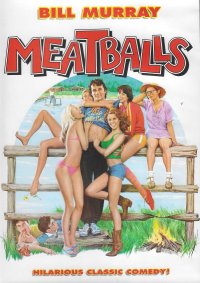
Book coverIt’s been ten years (?!) since I read the novelization of this film. I ordered it, and it arrived the very next day, ensuring I could watch it whilst the boys were at camp.

The book report mentions the plot, but I can forgive you, gentle reader, if you’ve forgotten it in the 43 years since the movie’s release or the 10 years since the book report. The film centers on a low-cost camp and its counselors and attendees and their rivalry with the rich kids’ camp nearby. C’mon, man, camp comedies were quite a thing around then, ainna? The late 1970s and early 80s? I mean, look at the Every Summer Camp Movie; you strip out the horror movies, and you end up with a bunch of comedies from 1977 through, what, Ernest Goes To Camp in 1987? I mean, there are some outliers from later eras, but most of them fall into that timeframe (including Poison Ivy, the television movie with Michael J. Fox and my cousin Nancy McKeon–well, a distant cousin by marriage, but you know how it is–I have that on videocassette around here somewhere). And as I have mentioned before, ad nauseum, I came from a less-than-middle-class background. I never went to summer camp. I don’t actually know anyone who went to a weeks-long summer camp–I mean, my boys have gone to week-long summer camp, but not weeks-long. Maybe it’s a regional thing. You know, a famous philosopher, one of the Niebuhrs, maybe, often posits that most contemporary pop culture is actually made by the previous generation, so perhaps the pre-Boomers from the northeast were pumping out these stories of their youths to kids who mostly knew about summer camp from summer camp movies. Or maybe I’m just quite the outlier, and I think everyone else is just like me.

At any rate, the main character, Tripper, is played by Bill F. Murray, so you have trope two-fer: it’s the cool camp counselor behind most of the hijinks and it’s BFM who is behind most of the hijinks. You’ve got the isolated, lonely, neglected-at-home kid, Rudy, played by Chris Makepeace (who starred in two films I’ve researched recently, so I got to thinking he was a big star–but he was just in a lot of films whose names I remembered and mostly did not watch from the 1980s). You’ve got an obvious nerd archetype, you’ve got the overweight counselor archetype, you’ve got the love interest archetype. Tripper takes Rudy under his wing in a fashion that would be sus in the 21st century (okay, groomer). One of the running gags is that the stuffy camp manager/owner sleeps heavily, so the counselors take him, bed and all, and put him in funny places for him to wake up. And then, at the end, after Tripper mostly gets the girl, in this case Roxanne, the head counselor for the girls, the two camps have their annual two-day Olympiad. The losers camp falls behind on day one, but after a rousing speech by Tripper that goes against the grain of rousing speeches (“It doesn’t matter! It doesn’t matter!”), the losers camp pulls even with the rich kids camp, and it all comes down to the last event: A “marathon” run by Rudy, who has discovered his love of running after joining Tripper for some runs that Tripper stages to get Rudy to discover his self-worth through his passion for pounding the pavement. Rudy wins, narrowly, and the losers camp wins, and they all go home better people.

So, basically, it follows (or might have set) the template for camp movies.

Pretty thin gruel, but it’s a comedy. I do quibble a bit with the distances in the running portion of the film, as I often do. In the helping-the-kid-discover-his-passion bits, they talk about going for runs of a mile or maybe two. And the “marathon” at the end is a 4 mile pavement and trail run. C’mon, man, those are not great distances. I mean, the stock beginning race is a 5K which is 3.1 miles. Real distance runners do 10Ks or half or full marathons. Again, one gets the sense that people who write about running often do not run themselves and think a mile is a long way to go. Now, for me, I plod at a 10 minute pace for miles generally, but a kid of Rudy’s age, even without any training, should do it less than that. When I was in seventh or eighth grade, my time was about 8 minutes, and I was at the back of the pack. Ah, well.

So many believe this is the best of the camp movie genre, and I won’t dispute it since I have not seen a whole lot of them in recent decades. But perhaps the boys and I will explore the genre as I mentioned the movie in the note I sent to my oldest son while he was away at camp, and he sounds interested in seeing it.

Buy My Books!
Buy John Donnelly's Gold Buy The Courtship of Barbara Holt Buy Coffee House Memories

The Article Does Not Answer The Headline’s Question

Here’s why teens are dressing up in suits to see ‘Minions: The Rise of Gru’

It answers:

It’s unclear why this trend has taken off, but TikTok users are saying it’s just for fun. Many groups have not caused issues.

No, it is clear: It’s TikTok.

Full disclosure: My boys dressed up to go see the film on the first. We thought that is one of the notions that gets into the older boy’s head from time-to-time until I saw the son of friends on Facebook also dressed up to see the film in the theater. So then I thought TikTok. In an unrelated note, when talking with my boys, I call it the TikTok to emphasize how old and out-of-touch I want them to think I am.

Man, that Chinese application can get the kids to do some crazy things! How scared should I be?

I would also normally riff a bit on how this might be a 20-something journalist getting something wrong and being ignorant of things he or she is too old for, but reading these little AP filler stories, I am not completely convinced that they’re not written by AI. I mean, this story and another I read this morning (Self-checkout growing even though no one likes it) follow a similar template. A trend mentioned with a non-specific example followed by a counterpoint of sorts. No actual reporting involved, and the headline is pretty much all you need to read.

Buy My Books!
Buy John Donnelly's Gold Buy The Courtship of Barbara Holt Buy Coffee House Memories

Somewhat Obscure

Father Dan Hirtz opened his column The Beacon in The Current Local last Thursday thus:

Trinity, no! Not the cowboy. Trinity is another way of saying ‘God’.

Wow, that’s obscure.

Although given the age of people who go to church these days, many of them probably remember They Call Me Trinity and its sequel from 1970 and 1971.

Me, I only remember it because I bought dollar DVDs of the movie at a Schnucks in the early part of this century.

Buy My Books!
Buy John Donnelly's Gold Buy The Courtship of Barbara Holt Buy Coffee House Memories

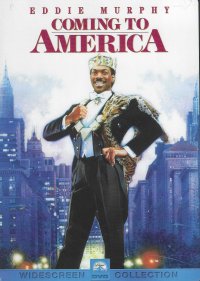
On Coming to America (1988)

Book coverThis is one of my beautiful wife’s favorite movies, and now that the youngest is fourteen, we thought he was old enough. He’s good with swearing, but boobs in movies weird him out. He is definitely not a child of the 1980s, when many if not most films that a young man watched (comedies and action films) featured at least one set of breasts, no matter how briefly. So the youngest only made it a little way into the movie before heading off to his YouTube videos to learn how to be cool.
Aside: In the video from “American Ride” by Toby Keith, in 2009, a caricature of Trump appears. But we were talking about Eddie Murphy’s movie about a rich prince who comes to America to find his bride.

That’s basically the plot: An African prince, not happy with the arranged marriage planned for him, convinces his father to postpone the wedding so that he, Akeem, the prince played by Eddie Murphy, can go to America. The father, played by James Earl Jones, thinks it so that his son can “sow his royal oats,” but Akeem wants to find a woman who has not been trained from birth to serve him.

So Akeem and his friend/servant Semmi, played by Arsenio Hall, travel to America, New York specifically, and they end up in Queens (naturally). They get jobs at a local restaurant patterned after McDonalds, owned by Mr. McDowell played by John Amos, and Akeem falls for Lisa, Mr. McDowell’s daughter, so he and Semmi take a job there. Antics ensue, and when Semmi contacts the royal family of Zamunda, the whole entourage arrives just as Akeem is winning Lisa’s heart–but he wants her to love him for himself, not his royal riches.

The film was noted at the time for the number of roles Murphy and Hall played, from barbers and their patrons to women in the clubs where the prince and Semmi go to look for women. It’s a bit of an in-game to look for the characters played by each the first time you see it, I suppose. For me, that was a long time ago. The movie also tips the cap to Trading Places, the 1983 film where Ralph Bellamy and Don Ameche are reduced to poverty at the end–in this film, five years later, Akeem tucks a wad of cash into their hands, and they announce they’re back. Which would have made sense if you were an Eddie Murphy fan and had seen this film five years prior. I’m pretty sure I saw it long after.

The other actors in the film are noteworthy as well. Comedian Louis Anderson plays an employee of McDowell’s. Samuel L. Jackson tries to rob McDowell’s. Vondie Curtis-Hall has a bit role; in a couple of years, he would be a bad guy along with John Amos in Die Hard II. And so on.

So the film is quite up there in the Nogglestead pantheon. Not only is it one of my wife’s favorite comedies, but it also has several lines that we use as common allusions in fairly regular talk. Including:

  • Inclining head: Whatever you like.
    Said when one of us asks the other’s preference in places to eat or similar aesthetic decisions.
  • The first thing we have to do is get you out of these wet clothes.
    I won’t go on about when that’s said.

Also, I bought the girl a Sexual Chocolate t-shirt, but she is a proper woman of the community and does not wear it out of the house. I think it must be at the bottom of the drawer, as she does not wear it.

I guess the oldest thought it funny enough, but as I mentioned, the youngest did not watch it. Yet.

Now, I know you like to see pretty girls tucked under the fold here, gentle reader, but I looked through the IMDB listings of most of the players in the film, and this was the peak of many of their oeuvres. Except for Garcelle Beauvais, who was a rose petal bearer in the film early in her career, and she has been very active ever since.

Continue reading “On Coming to America (1988)”

Buy My Books!
Buy John Donnelly's Gold Buy The Courtship of Barbara Holt Buy Coffee House Memories

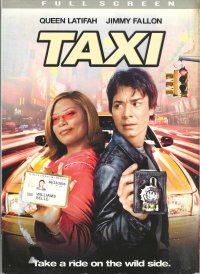
On Taxi (2004)

Book coverThe trailer for this film appears before one of the movies I watch fairly frequently–perhaps The Man Who Knew Too Little on DVD, or perhaps Dodgeball. So I have seen the trailer enough so that when I found the video at the antique mall when I had a gift certificate to spend, I picked it up.
If you’re of a certain age and think Taxi, you hear Bob James’s “Angela” in your head.

But this is not that show.

This is a Queen Latifah movie with Jimmy Fallon in it judging by the titles; it also features a young Henry Simmons (Mac from Agents of SHIELD) as Queen Latifah’s boyfriend and an unrecognizeable Ann-Margret as Jimmy Fallon’s mother. In it, Fallon’s character, detective Washburn doesn’t drive a car well, and in the intro, his antics lead to destruction and a license suspension. When he hears of a bank robbery, he jumps into a cab driven by Belle Williams (Queen Latifah) and orders her to follow the robbers. It’s no ordinary cab–a former bicycle messenger, Williams has modified the car serving as her cab to be a racecar, and she’s a NASCAR hopeful. So they drive really fast on the trail of the bank robbers, who are apparently also models for some reason (well, they can’t all be surfers like in Point Break, I guess). Which means the leader of the band is Mrs. Tom Brady. I tried to lure my boys to watch the film, but that trivium was not enough.. And as they work together, they meet each other’s families and whatnot for some humorous set pieces.

So it has a bit of a bad reputation and rating, but it’s just a piece of early century popcorn action comedy. No worse than most, and honestly better than the Internet would have you believe.

So, about that band of bank robbers.

Continue reading “On Taxi (2004)”

Buy My Books!
Buy John Donnelly's Gold Buy The Courtship of Barbara Holt Buy Coffee House Memories

On Fletch Lives (1989)

Book coverMy oldest re-watched Fletch earlier this year, and I told him to look for Fletch Lives in the watched section of the video library. The video library is only marginally better organized than the book library, which is basically because we own fewer DVDs and videocassettes to randomly array on the too-packed shelves allotted them. He did not find it then, but when I went looking for another previously watched (Coming to America, which my beautiful wife and I had seen, but not the boys had not). The oldest made a run through the stacks looking for that film and could not find it, either. So I took a try and found this film on the first pass through (and Coming to America on DVD on the second pass, but early, as it was like the third film on the upper left shelf’s second rank).
So the boys and I watched it.

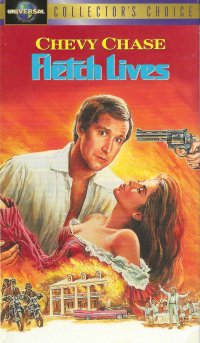
In this film, Fletch receives a call from Louisiana that his aunt has died and has left him her plantation, home and 80 acres. He quits his job and travels to the bayou, only to discover that the house is in poor repair. However, a cash offer is immediately made on the place, and after he signs the papers to take over the estate and makes whoopie with the attorney (Patricia Kalember), she dies in bed with him, and he is picked up on suspicion of murder. After his release, a real estate agent (Julianne Philips) approaches him with a better offer, which makes him suspicious. He investigates, with the help of his aunt’s caretaker (Cleavon Little), and encounters a nearby religious-themed amusement park that has been acquiring land to expand. So is it the televangelist, played by R. Lee Ermey, or something more sinister?

Well, the ultimate plot is a little more elaborate than that, something a bit Chandlerian in complexity, but it does give Chevy Chase the chance to chew the scenery and put on some silly disguises. The film does hit some common 80s tropes (televangelists as venal hucksters, toxic waste), so it’s not especially inventive, but it has gotten rapped in reviews for being not as good as the original. Maybe not, but it was not that far off if you watch them one after the other. So never mind the reviewers from its day: Know that my oldest son was disappointed that there is not a third Fletch movie (and before Hollywood gets it into its head to make one thirty-three years later, it’s too late).

So I enjoyed it, and it’s something I have re-watched in the last couple of years (well, maybe seven or eight). So let that be an endorsement as well. For the books as well–perhaps now the boy will read the Fletch books.

But did someone mention Patricia Kalember and Julianne Philips?

Continue reading “On Fletch Lives (1989)”

Buy My Books!
Buy John Donnelly's Gold Buy The Courtship of Barbara Holt Buy Coffee House Memories

On We’re No Angels (1954)

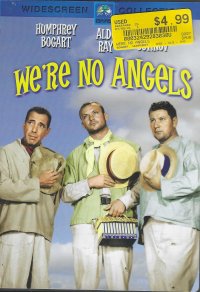
Book coverC’mon, man, you know this is the 1954 film starring Humphrey Bogart in one of his later roles and not the 1989 De Niro and Penn film. I mean, I guess I could watch that, too, since it is an oldie now–characterized not so much by black and white or bright Technicolor, but the lack of CGI and the presence of a plot.


The plot centers on three convicts who escape, in 1895, from a prison on an island off of French Guiana and arrive at a seaport where a bunch of other recently freed convicts or prisoners on work release work, so they kind of blend in. They offer to “fix” the leaking roof of a local shop–in reality, they just want to hide out until they can stow away on an outbound vessel. But they come to feel some affection for the family running the store as the store’s owner comes from France to check in on the operation–the store is struggling, as it is the only one in town offering credit, and townspeople are taking advantage of it and of the shopkeeper. So they help sell, help cook the books, and help take care of the shop’s normally in absentia owner.

The heroes of the story are actually convicted felons and murderers who sometimes joke about it–so they’re anti-heroes in 1954, which I am assured by popular culture is impossible. Also, it’s a a movie based on a stage play, which you can kind of tell by the limited number of sets, the wordplay, and the talk of going to other locations but not actually going there (the governor’s garden, unseen, is a source for flowers, for example). It’s not badly paced, as the wordplay and humorous situations come with frequency, but it is paced for the middle of the 20th century, so probably a bit slow for the TikTok generation.

It featured Joan Bennett as the shopkeeper’s wife.

Continue reading “On We’re No Angels (1954)”

Buy My Books!
Buy John Donnelly's Gold Buy The Courtship of Barbara Holt Buy Coffee House Memories

The Order In Which You Read The Internet Answers Your Quizzes

I saw this on the front page of The Sun: THORPLAY Brit A-lister unrecognisable in new Thor film – can you guess who it is?

I guessed Ralph Fiennes, but no.

If only I had read the New York Post first.

Which is a good reason to not read the Post first. So I can guess.

With this, Bale becomes the latest to appear in both the Marvel and the DC movies. Remember back when, maybe only a decade ago, when this set of actors was small enough to fit into a single trivia question?

Perhaps I should do a study of people who go from DC to Marvel and vice versa to see if there’s a pattern. Keaton and Bale went from Batman to DC villain. Affleck went from Daredevil to Batman. Perhaps we could discover or invent a heirarchy and comment on how actors are progressing on them.

Buy My Books!
Buy John Donnelly's Gold Buy The Courtship of Barbara Holt Buy Coffee House Memories

On Casino Royale (1967)

Book coverAs you might know, gentle reader, my boys and I a couple of years ago went through the main line of James Bond movies in order, starting with Dr. No and culminating in the end of the Pierce Brosnan years. Actually, I started them with the first appearance of James Bond in an American television episode of Climax! that introduced Jimmy Bond. We also watched Never Say Never Again, another studio’s rendition of Thunderball! that brought Sean Connery back after Roger Moore had taken over. We did not, however, watch this fillm, which is a late 1960s spoof starring David Niven, Ursula Andress, and Woody Allen.
I invited the boys to watch it, but they demurred, as they’d already seen it; the episode of Climax is entitled Casino Royale and is based upon the book, loosely, as is this film, much more loosely.

The 1960s were rife with these spy-movie romps. Kids today, and by “kids,” I mean people of a certain age who think they’re still young but are not, think Mike Myers invented the spy spoof when he did Austin Powers: International Man of Mystery (actual kids these days don’t watch old movies like Austin Powers: International Man of Mystery). But you’ve got the Flynn movies and the Dean Martin Matt Helm movies, so they existed, although they were lost in the 1970s pop culture dark age.

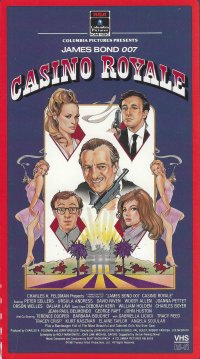
So: In this film, the original James Bond has retired. But SMERSH is killing the MI6’s and other agencies’ agents, so they try to lure him out of retirement to help tackle the terror organization. He refuses but changes his mind after his mansion is destroyed–at the orders of M, who is killed in the attack. So Bond takes over MI6, renames all of the other agents James Bond 007 to confuse SMERSH, and takes M’s remains to his estate in Scotland, which has been infiltrated by SMERSH. Women agents try to seduce Bond to knock the shine off of his celibate gentleman reputation, but cannot. He learns that the other agents have been seduced and led to their deaths, so he strives to find an agent impervious to female charms to beat a gambling-debt-ridden SMERSH agent at baccarat.

So that’s the basic outline that leads to the Casino Royale of the title. The film is full of silly scenes and escapades, lots of attractive women, and ends on a note that presages the grimness of 1970s cinema.

So I thought it was interesting to watch as a cultural artifact and in the name of Bond cinema completeness. I was amused in spots, but I don’t think my boys would have liked it–again, they’re a bit young to understand what’s being spoofed.

But it did include beautiful women.

Continue reading “On Casino Royale (1967)”

Buy My Books!
Buy John Donnelly's Gold Buy The Courtship of Barbara Holt Buy Coffee House Memories

The United States Begs To Differ

In an article called STEP IN TIME Where Mary Poppins cast are now – from tragic death at 21 to £35m fortune and moving cameo in film reboot, the Daily Star asserts:

IT may be 58 years since he high-kicked across the roofs of London to Chim Chim Cher-ee but Mary Poppins star Dick Van Dyke hasn’t forgotten his most iconic role.

C’mon, man. More iconic than Rob Petrie (from The Dick Van Dyke Show, you damned kids)? Not even more iconic than Dr. Sloan (from Diagnosis: Murder)? I think not.

Tied, at best, with Caractacus Potts in Chitty Chitty Bang Bang. You know, that one guy in that one kid’s movie you saw a couple of times. Not more iconic than something you might have seen dozens or hundreds of times on television or DVDs.

Maybe it’s iconic in Britain since it takes place in Britain.

Buy My Books!
Buy John Donnelly's Gold Buy The Courtship of Barbara Holt Buy Coffee House Memories

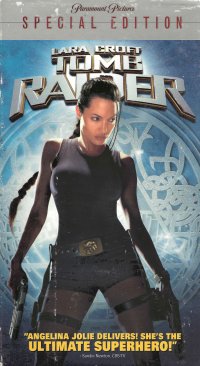
On Lara Croft Tomb Raider (2001) and Lara Croft Tomb Raider: The Cradle of Life (2003)

Book coverBook coverI picked up Cradle of Life spending a gift certificate at Relics a couple months ago; I knew it was the second, so I was pleased to see that the library book sale had the first one so that I could watch them in order. Not that it’s required; they’re episodic and the second does not have anything to do with the first.
So. The first comes the year after Jolie’s Oscar-winning performance in Girl, Interrupted which I had mentally placed smack in the middle of the 1990s, but not exactly. Lara Croft, if you’re too young to know, was a video game character in a couple of dungeon crawl video games. There was some controversy amongst the controversy crowd because she was well endowed. To be honest, I never played the games.

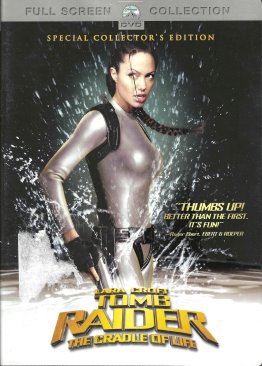
In Tomb Raider, Lara has to finish her father’s last quest, to find a triangle that controls time to prevent it from falling into the hands of bad guys who will use it in a ritual that they can only try once every five thousand years. Croft has to trot the globe to prevent them and raid various tombs.

In The Cradle of Life, Lara has to find and locate the mystical place where life arrived on earth before a bio-weapons developer can find it to open Pandora’s box, unleashing an incurable plague to wipe out humanity to rebuild it in his image. Croft has to trot the globe, including the Mediterranean, the mountains of China, and eventually the savannah in Africa. She scuba dives, she flies in a wing suit, and she navigates a cave with weird gravity. Although I read the novelization of the film in 2008, I did not remember the plot, although now I again know what character might have been overdeveloped for a stunning reversal.

As the game was a scrolling platformer, the movies recreate a little bit of that with climbing and jumping from thing-to-thing sequences. However, the plots and set pieces all seem kind of derivative of other things. I mean, a triangle that controls time? That’s from several Nintendo games. The crazy cave? I saw that in Labyrinth. So part of the enjoyment of it, perhaps intentionally, is figuring out what it’s mashing up.

But 2000 or so is the time when the action movies started to look really cartoony or video gamy, ainna? As I explained to my beautiful wife, this film pales compared to late 20th century films like the early Indiana Jones films, Firewalker, or Romancing the Stone. Those were shot with real sets with real people in them. Around 2000, the CGI got good enough and cheap enough that films started looking flat. I guess it won’t bother kids these days who spend most of their lives tethered to a screen somewhere; they might just expect movies to look like video games. Especially, one reckons, movies based on video games.

So there are worse video game movies out there–I mean, I did make my friends see Wing Commander in the theatres specifically because it received the lowest rating I’d ever seen on Mr. Showbiz–but this is not a pair I will watch over and over. Given my extensive and growing media library, I don’t have much time to revisit films these days anyway. I’m not in a trailer park with only Showtime for my daily amusement any more.

So, about Angelina Jolie.

Continue reading “On Lara Croft Tomb Raider (2001) and Lara Croft Tomb Raider: The Cradle of Life (2003)”

Buy My Books!
Buy John Donnelly's Gold Buy The Courtship of Barbara Holt Buy Coffee House Memories

The Perfect Easter Movie

Ladies and gentlemen, we at MfBJN have conclusively proven that Lethal Weapon is a Christmas movie, and we have admitted that Lethal Weapon 2 is not a Christmas movie. But hear me now and believe me later:

Lethal Weapon 2 is an Easter movie.

Now, it is not set during the Easter season that I can tell; however, review the following:’

  • Martin Riggs is tortured;
  • Riggs carries the means of his execution to the place of execution;
  • Riggs “dies”;
  • He descends to a watery grave;
  • He rises again;
  • In his second coming, he brings justice and retribution to the wicked.

You see: It was The Passion of the Christ before Gibson had enough clout to make the movie he really wanted to make.

Follow me for more insight into how the Lethal Weapon movies all deal with important events on the church calendar, and how Bird on a Wire is a documentary.

Buy My Books!
Buy John Donnelly's Gold Buy The Courtship of Barbara Holt Buy Coffee House Memories

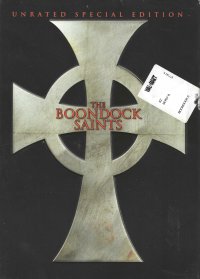
On Boondock Saints (1999)

Book coverI became aware of this film sometime around the turn of the century when colleagues at work talked about it. One of them is of Irish heritage, so he probably felt some affinity for this film, which is a story of Irish brother vigilantes in Boston taking on various mobs in their amateur fashion while being pursued, and then aided, by an FBI agent played by Willem Dafoe. But then the local capo arranges the parole of an extreme hit man to track down and eliminate the boys.
The story is told in a variety of flashbacks and whatnot, where the police come to a crime scene, and the FBI guy figures out what happened, and then the film flashes back to the actual happening. Sometimes the agent is correct, but sometimes he just misses because the brothers are not as professional as he assumes.

For some reason, I’d gotten the impression that this was an ultraviolent production, but it’s really not that bad. Although I am not sure if that’s because it really isn’t that bad, or my impression of that bad has evolved over the last 20 years.

So, not a bad film. Not the touchstone for me as it was for my co-workers. And I’m not sure why they put the word Boondock in the title. The group calls themselves the Saints, but they aren’t out in the sticks–they’re in Boston. So, I dunno.

Normally, I would include pictures of an actress in the film, but the movie doesn’t really have any female leads. It does have Willem Defoe in a dress and make-up, but I will spare you that.

Buy My Books!
Buy John Donnelly's Gold Buy The Courtship of Barbara Holt Buy Coffee House Memories

On Barbarella (1968)

Book coverOne of my Christmas gifts was a gift card to Vintage Stock, a retailer in used movies, video games, CDs, movies, and records. So sometime right around the turn of the year, I went over to Vintage Stock to spend it, and I amassed a number of movies and DVDs, including this one. It was my lucky day, too, as I made my first (and only) stop to the new comic book shop on Campbell, right across the city from the now-closed Nameless City Games. And although Nameless City did not have the first issue of the Sarah Hoyt Barbarella last July, the new comic book shop had one copy of the first issue six months later. So I got the original movie and the latest pop cultural incarnation on the same day. Spoiler alert: I read the comic first.
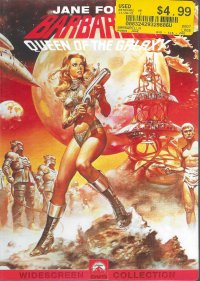
So. The plot is that Barbarella, an interstellar agent in the future, has to go to Tau Ceti to find a scientist named Durand Durand who has created a positronic ray that might be used as a weapon. So she goes to Tau Ceti, meets some different people and different species including murderous children, blind angels, and a planet whose energy source is a flowing substance below the ground that feeds off of negative thoughts and emotions–Ghostbusters 2‘s slime sorta. She has sex with a couple of people, and eventually finds Durand Durand who wants to use his ray to take power. But he overreaches and dies.

This is an early Dino De Laurentis film, and the look-and-feel of it, along with some of the pacing, feels a lot like Flash Gordon from 1980 (although this film is obviously earlier). The protagonist in this film, though, is a bit more passive than Flash Gordon–other characters and natives of the planets she visits lead her around to different venues, and sometimes she has sex with them, but most of the time, Barbarella is not leading the action.

Oh, and about the sex: Although my beautiful wife had heard that this was a soft core porn film, it really wasn’t. Although I am glad I did not share the film with my boys, the sex in it was relatively tame and not depicted graphically. I mean, it’s essentially a French film, directed by Renoir’s grandson and co-starring Marcel Marceau, but it doesn’t have the ooh la la that you get in some French and Scandinavian films of the period. The opening sequence of Barbarella removing a spacesuit in zero gravity was pretty, erm, compelling, though.

At any rate, I’m glad to have watched it for its, what, cultural value? To have seen something that was influential and that continues to be a bit of a touchstone today–I mean, aside from the comic series, there was a musical in 2004, and the band Duran Duran took its name from the name of the scientist, for crying out loud–but as a story and a film, meh (which is quite different from mwah! which is the chef’s kiss, which this film is not).

Below the fold, Jane Fonda as Barbarella in her many outfits.
Continue reading “On Barbarella (1968)”

Buy My Books!
Buy John Donnelly's Gold Buy The Courtship of Barbara Holt Buy Coffee House Memories

On Shanghai Knights (2003)

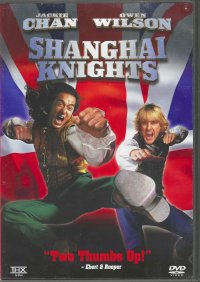
Book coverIn 2000, or a little before, someone thought, “Hey, what if we remade Rush Hour, but instead of Chris Tucker playing Chris Tucker, we have Owen Wilson playing Owen Wilson (as seen recently in You, Me, and Dupree and Starsky and Hutch? And we set it in the old West?” The result was Shanghai Noon, wherein Jackie Chan plays Jackie Chan (named Chon Wang, because why not go for the easy joke?), a fish out of water. I haven’t seen that film, so I can’t tell you too much about it other than that.

It was a success, resulting in this sequel, wherein Jackie Chan’s father, keeper of the Imperial Seal (not the animal), is killed and the seal is stolen. Chan’s sister, played by Fann Wong, has sent a puzzle box to Jackie Chan along with a letter that his father had died. So Jackie Chan has to go to New York, to collect Owen Wilson who is grifting as he has poorly invested their proceeds from the previous film. Then, they’re off to London, where somehow Jackie Chan knows the stolen seal has gone. They find that Jackie Chan’s sister, played by Fann Wong, has gone ahead and tried to kill the man who stole the seal. While trying to bring the thief to justice, they uncover a plot to place a low-ranking royal on the throne while simultaneously placing the leader of the Boxer Rebellion on the Chinese throne.

We get a lot of anachronistic improbabilities, of course–I mean, c’mon, man, someone goes into Whitechapel at night in 1887, you know we’re going to see Jack the Ripper–which is not so bad if you’re familiar with the time enough to know they’re playing. But to kids these days, will they know? Probably not. But this is an old movie to them anyway. And I am an old man.

I might have mentioned Fann Wong played Jackie Chan’s sister. I mentioned it twice. Let’s talk more about her.

Continue reading “On Shanghai Knights (2003)”

Buy My Books!
Buy John Donnelly's Gold Buy The Courtship of Barbara Holt Buy Coffee House Memories

On National Lampoon’s Vacation (1983)

Book coverAs you know, gentle reader, I think this is the best film adaptation of The Grapes of Wrath.

That gag aside, it’s actually from a short story written by John Hughes for National Lampoon. Given that it has spawned, what, five or six sequels, a set of commercials, and a television series currently in development, I have to say it’s a heck of a short story. The humor aligns kind of nicely with A Christmas Story, which was written by Jean Shepherd, also a print humorist. It’s not as zany as modern comedies, and it relies on adults dealing with adult things, not adults dealing with childish things.

At any rate, you know the plot: Clark Griswold decides to take his family to the Walley World theme park and wants to drive them out cross-country. Instead of his expected new car, he gets a hooped up station wagon. He piles his wife and two kids into the car, and they travel the country, having misadventures on the way to California. When they get to Walley World, it’s closed, whereupon John Candy delivers the only line I really quote from the film: “Sorry, folks. Park’s closed. The moose out front should have told you.”

It holds up well, I suppose at least if you’re of a certain age not maladjusted to contemporary R-rated comedies. My boys liked it all right, but I’m hopefully helping their cinematic tastes and predilections by showing them old films like this. The oldest added “Holiday Road” by Lindsey Buckingham to his regular playlist, so we hear that often whilst he plays video games.

But the real question from the film: Beverly D’Angelo or Christie Brinkley?

Continue reading “On National Lampoon’s Vacation (1983)”

Buy My Books!
Buy John Donnelly's Gold Buy The Courtship of Barbara Holt Buy Coffee House Memories

Book Report: Firefly: Still Flying (2010)

Book coverI bought this book, along with Firefly: The Official Companion Volume One and Firefly: The Official Companion Volume Two at my last trip to Calvin’s Books in Branson in June of last year. I also got the Serenity: The Official Visual Companion, and that would probably have been the next published–this book came out in 2010, seven or eight years after the television show and five years after the movie. I picked it up now because the 2022 Winter Reading Challenge has a category Short Stories, and the cover of this book says Featuring New Stories From Writers Of The Original TV Episodes.

Sounds like a book of short stories, ainna? Oh, but no.

The 158 page book has four “stories,” but one of them is a pair of single-panel cartoons looking like they were from a brutal children’s book featuring Jayne. The other stories don’t really break any new ground. One, “What Holds Us Down”, is the most akin to an episode–Kaylee and Wash break into a floating junkyard to steal some parts needed for the Serenity but it goes sideways, and Kaylee has to quickly fix up another ship to escape before the searchers find them amid the rubble. Another story, “Crystal”, is about River visiting the people on the ship before the motion picture takes place and telling them a little about their fates in her inscrutible way. The last short story, “Take the Sky”, deals with an old retired Mal receiving a package from Zoe, the current pilot/owner of Serenity, and reflecting upon his aging and their adventures. So the stories are not exactly what I would have expected, and they’re but brief interludes in the book.

The reminder of it is celebrity/fan material. Each of the stars of the program gets a section with photos and quotes from various sources–nothing new, and we get to hear from the shows costumers, designers, and stunt coordinators. It has a little feature on what happened to the Jaynestown statue–Adam Baldwin kept the head, but the rest likely got discarded–and on the endurance of Browncoat fandom, which might be a little different ten more years on–are they still doing those? A quick Internet search says no, but I see some speculation that Disney might throw something together for Disney+ with a new cast. Kind of like the new (but now as old as the original series was to its time) Battlestar Galactica that ran longer than the one-season television show it rebooted and updated. It will be interesting to see the old Firefly fans acting like I did when the new Battlestar Galactica came around.

At any rate, given that the book only has, what, a dozen pages of short stories, I cannot in good conscience slot it into the Winter 2022 Reading Challenge–I will probably pick up one of James Blish’s Star Trek books for that. And I will likely pick up the Serenity: The Visual Companion book later this year just to make a clean sweep of the Firefly titles. As I have mentioned, I think the film really lost a bit of the playful spirit of the series–this won’t probably come across as much in the script as in the execution. Which is why I have been avoiding it.

Oh, and should you come across a fan suffering from what Disney does to the property, be sure to point out that more people see Nathan Fillion and think Richard Castle than Mal Reynolds. Or even Johnny Donnelly from Two Guys and a Girl. Remind me to drop into conversation cryptically that Fillion played John Donnelly.

So it’s a good bit of trivia and nostalgia, but not something to stand the test of time. More like a flat spine fan magazine than anything else.

Buy My Books!
Buy John Donnelly's Gold Buy The Courtship of Barbara Holt Buy Coffee House Memories

On You, Me, and Dupree (2006)

Book coverThis is the second Owen Wilson film in a row that we’ve seen–the first being Starsky & Hutch, and it’s a little later in the, what, downfall of the Stiller/Wilson films? For a while, they could do no wrong, but these later movies didn’t make much money.

In it, Matt Dillon marries Kate Hudson, and when his best friend–Owen Wilson’s Dupree–has a run of bad luck, they allow him to stay with them for a while that extends. And hijinks ensue, as the man-child can’t find a job, and we have a little tension between Dillon’s character having to grow up and to work for his wife’s father (Michael Douglas) who didn’t want to give his little girl up.

So it’s a fairly common set of tropes, trying to rely heavily on Owen Wilson, but that’s not enough to carry a movie, as studios discovered. I own the DVD, but I don’t know if I’ll watch it again–there are better movies with Wilson as part of an ensemble.

But enough about Owen Wilson. How about Kate Hudson? Continue reading “On You, Me, and Dupree (2006)”

Buy My Books!
Buy John Donnelly's Gold Buy The Courtship of Barbara Holt Buy Coffee House Memories

On Starsky & Hutch (2004)

Book coverI saw this film in the theaters with my beautiful wife back in the heady days of the Stillerverse and back when we went to the theater a couple of times a year. This film is a lesser entry in the set starring Stiller, Vince Vaughn, and/or Owen and/or Luke Wilson–Zoolander, Dodgeball, and Mystery Men are better. As a matter of fact, my wife said that we did not see this in the theaters, or that she did not remember it, and all the way up to the climax, she did not–but when we got to the end, where Stiller is dressed up like an aging Jersey Shore resident saying, “Do it,” in a deep voice–ah, then she remembered it.

You know, I still found it an amusing film to watch, but I am of an age that I knew of the original Starsky & Hutch; I probably saw some when I was really young, but it wasn’t something I sought out as a young person. My boys didn’t care for it much, either, but that’s likely because they did not know what the movie was playing with/parodying/satirizing. They didn’t like Hot Shots!, either, even though they had just seen the source material (Top Gun), and they did not get Airplane! much at all because they did not know airport disaster movies from the 1960s and 1970s.

Starsky & Hutch might have marked a bit of a beginning of movies being made out of earnest nostalgic properties spun to comedies (think The Dukes of Hazzard in 2005, 21 Jump Street in 2012, and CHiPS in 2017). You cannot say it about Charlie’s Angels in 2000 because that was a bit of a homage, and it, too was a bit earnest in its action movie way. But this set of movies took television programs that were not necessarily serious, but were certainly earnest, and turned them into things that, I guess, kids could laugh at the things their parents watched or something. Except I would guess that the kids, like mine, didn’t get a lot out of them aside from the antics of their generation’s stars as they were not familiar enough with the source material.

Ah, but that is me, the guy with an English degree and a blog, so you can expect me to try to come up with a thesis and write a lot about it, whether it’s ultimately true or even really defensible. The pro forma argument, and publication, is the real goal. But did I mention Carmen Electra appeared in Starsky & Hutch?

Continue reading “On Starsky & Hutch (2004)”

Buy My Books!
Buy John Donnelly's Gold Buy The Courtship of Barbara Holt Buy Coffee House Memories

On The Blues Brothers and 9 To 5 (1980)

Book coverYou know, these films were released in the same year. It’s crazy, because the aesthetics of each differ so wildly.

The Blues Brothers self-consciously represents a bit of a throwback, a bit purposely so. I’ve heard the story that the producers wanted the film to include more contemporary, disco musicians in it, but Dan Ackroyd and the dead Belushi wanted to have old Motown musicians. By 1980, Aretha Franklin, James Brown, John Lee Hooker, and Ray Charles were past their pop-culture sell by dates, apparently. I don’t know what to think of this–there’s an uncanny valley between first popular appeal of some artists, followed by a lull, and then perhaps another ascent into the zeitgeist that some artists enjoy. Kind of how artists have a “comeback” album two or three years after a hit album. Elvis, for example, did his big comeback special in 1968, not far past his film successes. But I digress.

When I read the novelization earlier this year, I recounted the plot for those who didn’t know it. I will spare you the rehashing of the rehashing here, I’ll just do a little comment on the aesthetic, a la Lileks, but without the screen caps. So: As I mentioned, it’s a bit backward-looking, and the settings in gritty parts of Chicago are darker and dirty. The film is definitely feels like a film from the late 1960s or 1970s.

9 to 5, on the other hand, is an eighties movie. The colors are a bit more pastel, the whole film is a bit brighter. You can see that the film is more like The Secret of My Success than Network. Even though it’s set in Manhattan, it’s not the Manhattan of Midnight Cowboy or Escape from New York (released a year later than this film). It’s a bright, optimistic vibe, where the women are getting liberated and overthrowing their sexist, egotistical, lying, hypocritical bigot bosses.

Oh, but the professional look of 1980. The tight curls and those giant glasses. Most people think of the big and teased hair as the 80s look, and God bless them for their either forgetting or never knowing. The teased hair is flattering. This is not.

I think Missouri might have been a trailing indicator for this look; I remember in the middle 1980s, when someone would give my poor sainted mother a makeover, it always included a cropped, curly perm, big glasses, and too much makeup. She ended up looking like a zombie.

At any rate, 9 to 5 spawned a television show that ran for six years through most of the 1980s. I vaguely remember it.

And in a stunning twist, I watched the film a couple of times on cable when it was fresh, but not on Showtime. It must have hit HBO when friends of the family were early adopters of cable television, and we spent some time at their house including our last month living in Milwaukee after my mother gave up the apartment in the housing projects and before we decamped for Missouri at the end of the school year.

So I saw this film when it was new, and I was young, and the world was pastel and promising. So I remember it with more affection than it probably deserves on rewatching.

Buy My Books!
Buy John Donnelly's Gold Buy The Courtship of Barbara Holt Buy Coffee House Memories