Book Report: Wisdom in Rhyme by Nora O. Scott (1980?)

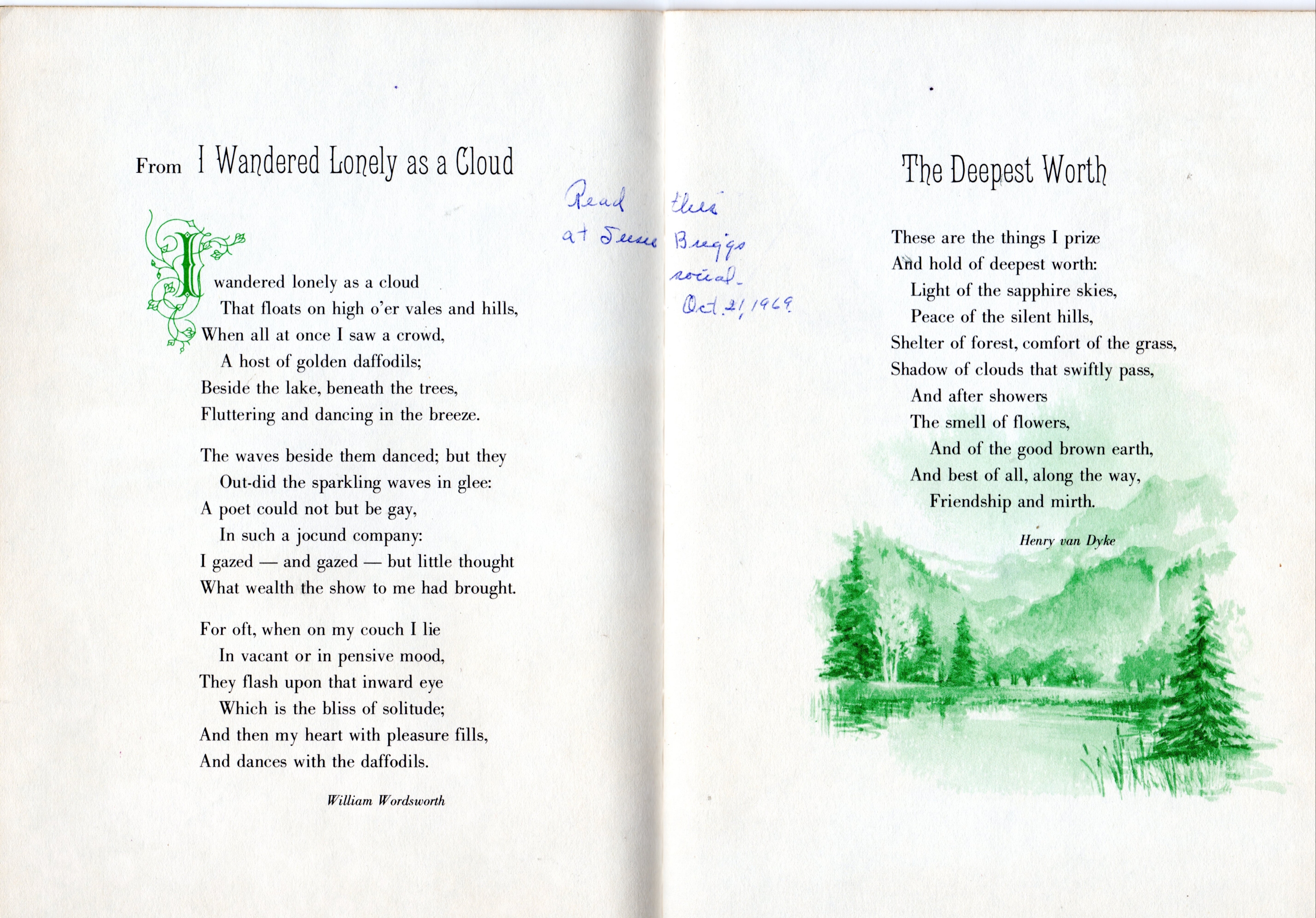
Book coverYou know, there was a time when I might have made fun of a collection of poetry like that contained in this book. Probably a time when I was younger and more cocksure, a bit arrogant, and impatient with the mediocre in life. I was destined for greatness, and anything less than greatness was worth mocking. That’s what youth does, and growing older gives us a little better perspective on life and the pursuit of greatness.

So I’m not going to mock this book. The poems within it are not bad poems. I’ve read bad poems. These are merely common. They have end rhymes and a decent sense of rhythm. The subjects are domestic and landscapish and Christian, with a couple of little ditties about people she knows thrown in. She’s got a couple little poems about her children growing up or having grown up from being little babies. She writes about the landscape of Arkansas, her native state. It’s the sort of thing you see a lot of in small writing groups and clubs.

The poems span a number of decades; the book was prepared and maybe published by the pastor of her church ahead of her 92nd birthday in 1980. This volume was inscribed as a gift in 1984. So that’s what it’s circa. But it represents a woman of the ninteenth century, probably with limited schooling, writing poems for most of her life and not doing badly at it. So I’m going to appreciate that for what it is. She was reaching higher and giving it her effort, and her goals might not have been more lofty than having something to show her friends and family. And here it is.

Books mentioned in this review:

Buy My Books!
Buy John Donnelly's Gold Buy The Courtship of Barbara Holt Buy Coffee House Memories

Book Report: The Toilet Zone by Dan Reynolds (1999)

Book coverThis book is pretty much what you would expect from the title: toilet humor.

It’s a collection of cartoons featuring toilets and bathrooms for the punchlines.

Heaven help me for buying it, but I did; not only that, but I chuckled at some of them because some of them are more clever than modern sitcoms.

Even my beautiful wife, who does not like scatalogical humor at all, snickered at one or two of the cleaner jokes amongst them.

So this is worth the price, which in my case was probably a quarter.

And no doubt it will keep my boys entertained for a far longer time than an adult would enjoy the book.

Books mentioned in this review:

Buy My Books!
Buy John Donnelly's Gold Buy The Courtship of Barbara Holt Buy Coffee House Memories

Good Book Hunting: Friends of the Christian County Library, October 16, 2015

Well, just in case you were missing the Good Book Hunting posts, I went to the Friends of the Christian County Library book sale yesterday afternoon in Ozark. We picked our children up from school, and the whole family cruised down to check out what they had. As I already own many, many books, I assured my beautiful wife that I would not be buying too many.

Well, books.

Here’s what I got:

Friends of the Christian County Library book sale October 2015 purchases

It was the videocassettes that got me. I’ve taken to watching films in the evenings after a bit of a lull, and I’ve been procuring them from garage sales and thrift stores a lot lately. Among yesterday’s accumulation, I got:

  • Romancing the Stone and Jewel of the Nile
  • The Grizzly Adams movie Grizzly Mountain. Remember, children are impressionable and are guided by what they see on television as was proved when a bunch of them got eaten by bears based on the pro-ursine propaganda in that television series.
  • A collection of bits from Bing Crosby’s Christmas specials.
  • Two Chuck Norris films: Missing in Action III and Lone Wolf McQuade.
  • A Rutger Hauer film, Wanted: Dead or Alive. Which is a reboot of the Steve McQueen television series.
  • Charade which features Cary Grant and Audrey Hepburn. And was the first thing I watched of the set.

I also picked up nine Toby Keith albums which is almost half of his canon.

Amongst the books, I picked up:

  • Two Tom Wolfe titles, The Right Stuff and Back to Blood.
  • I Ching.
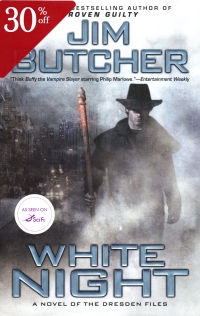
  • White Night by Jim Butcher which is a fantasy novel with a hard-boiled wizard if the cover is to be believed; I expect it to be similar to Hard Magic in some regards.
  • A Rod McKuen collection of poetry, Moment to Moment.
  • Space War which is a nonfiction prediction about how World War III might start with engagements in space.
  • An Isaac Asimov mystery, A Whiff of Death.
  • A book of book lists, Book Lust.
  • Lake Wobegon Days by Garrison Keillor.
  • The Prisoner of Zenda by Anthony Hope. Apparently, it’s a classic of some sort according to the book’s imprint.
  • The Seige of Eternity by Frederik Pohl. The cover says it’s as good as Gateway, but covers being covers, the proof of the gooding is in the reading.
  • Two books I already own: Widows by Ed McBain and Mind Prey by John Sandford (see the book report? I didn’t when I was at the book sale.). If I don’t know I own them, I often buy books just in case I don’t, especially if the books are cheap. In the case of the Sandford books and so many modern series, the similarity of the titles makes the books harder to tell apart. I’ll probably send the Sandford book to my brother but I might keep the Ed McBain book on the to-read shelves as an excuse to read it again sometime in the future.

All in all, it was a pretty good gathering of content to consume. Because it was half-price day, the total came to $18. Definitely cheaper than a movie.

The best part: Since I’ve been reading a little more this year and not buying as many books, I had room on my to-read shelves for the books. Well, I mean, it’s not like they’re tidy or single stacked or organized or anything, but I did not have to stack these new volumes in strange places.

Next week, though, all bets are off.

Buy My Books!
Buy John Donnelly's Gold Buy The Courtship of Barbara Holt Buy Coffee House Memories

Book Report: Peacemaking: On Dusting the Wind by David P. Young (1989)

Book coverThis book was published by some arm of the Presbyterian church at the end of history (which was right after communism fell in the Soviet Union, for those of you children too young to remember, before history clawed its way out of the grave and began shambling around and moaning again).

This is not supposed to be a pure poetry collection; instead, it’s said (in its introduction) to be a sourcebook for musing about interacting with the world, other cultures, and other faiths. So it includes some doggerel thoughts about different cultures, a lot of indictment of personal comfort and wealth while there are so many poor in the world, and, dare I say it, a lot more equivalence between the religions than I would expect from a book published by a Protestant church. The very first bit is about how Christians, Muslims, and Indians are all holy or something. Perhaps it’s meaningful to remember that all people are people, but if you’re going to be a church, I should expect if not an overt pitch as to why one’s particular flavor is the best then at least an implicit understanding that not all paths are the same.

But that sort of thinking probably explains why Presbyterian numbers are declining and little schisms are happening.

Ah, well. The book didn’t make me much more thoughtful about the poor. But it did have some colorful photographs.

Undoubtedly, I got this in a collection of chapbooks and whatnot from the Friends of the Springfield-Greene County Library book sale. Which is coming up next week just in case you missed my "Good Book Hunting" posts.

Buy My Books!
Buy John Donnelly's Gold Buy The Courtship of Barbara Holt Buy Coffee House Memories

Book Report: Distant Replay by Jerry Kramer with Dick Schaap (1985)

Book coverThis book comes fifteen years after A Farewell to Football and details the first reunion of the Super Bowl I Packers in Green Bay. Kramer discusses what each player at the reunion has done since his football days ended. It’s a wide variety of stories: Max McGee founded the ChiChi’s restaurant chain and then cashed out for $18 million. A couple players went onto other teams, but never had anything like the Packers even if they won Super Bowls with other teams (and many did; the league was smaller then). Some have beaten cancer. Many are on their second wives (including Kramer), which is strange, because those of us latchkey kids from the 1980s thought our parents invented divorce.

It’s chock full of some good trivia, including the first player to play for both the NFL and Major League Baseball (Tom Brown, not Deion Sanders or Bo Jackson) and the first player to play in a Super Bowl and to coach a team in the Super Bowl (Forrest Gregg).

The tone of the book kind of makes you feel a little sympathy for Kramer, though. His optimism from his previous book seems a little forced in this book, and he does seem a little envious of those who have done better than he did since he mentions their net worth a lot. He’s not unconscious of the scorekeeping though, and he’s not done bad for himself, but he’s a six-hundred-acre guy (the size of his ranch) and knows although some people are sixty-acre-guys, a couple are six-hundred-thousand acre guys. And it rankles a bit.

So it’s a bit of a melancholy read being a retrospective of sorts and because it comes right on the heels of the previous book. That fifteen years vanishes instantly. And fifteen years after they stopped playing, all of these guys are a little older than I am and they’re far ahead of me in Krameresque scorekeeping. But in 1985, none of them had blogs with ten years of archives generating dozens of Google search hits a day and twenty cents annually in ad revenue. WHO’S WINNING THE 21st CENTURY? ME!

Books mentioned in this review:

Buy My Books!
Buy John Donnelly's Gold Buy The Courtship of Barbara Holt Buy Coffee House Memories

Book Report: The Shakers by L. Edward Purcell (?)

Book coverThis book is a bit thicker on content than many of the photo-centric books I spend my Sunday afternoons with. The book contains a pretty good history of the Shaker movement, from their leaders being expelled from the Quaker movement to the different communities established in New England and the east to the eventual thinning and dying out of the sect–after all, they were not allowed to reproduce, only to convert to the religion.

As to the photos, they’re professional and whatnot. They highlight the design of Shaker furniture and crafts as well as some of the buildings in the various communities. Many of those communities, as they declined, effected transfers from the Shakers to nonprofit organizations that transitioned them into museums, sometimes while a few elderly Shakers remained in residence.

At any rate, a good enough coffee table book to flip through and to learn something.

Books mentioned in this review:

Buy My Books!
Buy John Donnelly's Gold Buy The Courtship of Barbara Holt Buy Coffee House Memories

Book Report: Magnificent Hearst Castle

Book coverThis book is a little program guide from Hearst Castle in San Simeon, Florida.

It’s a lot shorter than Hearst Castle and probably predates it by a couple of decades–although the booklet itself does not include a copyright date. It does, however, contain the then-current prices for admission to the attraction along with parking instructions. Were I more curious and a real Hearstophile, I suppose I could look up the prices to determine the exact era of the book. But I’m not.

At any rate, it contains a number of photos and descriptions of the rooms, but none of the real detail the other, thicker hardback has. Of course, this book was probably far less expensive initially and it’s not too expensive now.

Worth a quick browse to get a quick summary of the mansion and complex, I suppose. Or to pass a part of a football game’s men-in-jerseys-walking-around and commercials bloc of time on a Sunday afternoon.

Books mentioned in this review:

Buy My Books!
Buy John Donnelly's Gold Buy The Courtship of Barbara Holt Buy Coffee House Memories

Book Report: Whispers of Love by edited by Deborah Gaylord (1980)

Book cover

Apparently, the Internet does not know that this book exists. But it does.

This is a 1980 magazine or book published by Scholastic Magazines, a division of Scholastic Book Services. It is 32 pages containing a single quote about love and a large photograph of happy 1970s people, presumably in love. I mean, here’s what we’re working with here:

Apparently, this was targeted to school children. That’s Scholastic’s ballwick, isn’t it? Or did this appear on the drugstore shelves for a quick gift for a loved one? Who knows?

All I know is it took me less than an offensive series in a football game to flip through it, and I’m going to count it in my annual tally. The book is more interesting for the photographs than the quotes, and not because the photographs are spectacular. It’s because the photographs remind one of the 1970s, and I was alive in the 1970s, so I knew people who followed the fashion and tried to look like this. Because it is cool. Frankly, it’s why I’ve never followed current fashion: It leads to photos of one like these. Also, I am cheap.

Also, I can’t help but wonder how many of the people from this book went home to furniture from this book.

Buy My Books!
Buy John Donnelly's Gold Buy The Courtship of Barbara Holt Buy Coffee House Memories

Book Report: Stormbreaker: The Graphic Novel by Anthony Horowitz (2006)

Book coverThis book is apparently the graphic novel adaptation of the screenplay of a young adult book (or so the Internet says). So it’s a graphic novel, but with a plot of something other than a tournament of magic, pocket monsters, or whatnot. So it’s not manga.

Alex Rider is the nephew of a secret agent, and when that secret agent dies, the controlling agency takes an interest in Alex who has been groomed as a secret agent from an early age. Out of options, they insert him into the mansion/complex of a wealthy technology entrepreneur who is offering to donate thousands of new virtual reality computer systems to schools across the UK. Although initial clues indicate each machine might include a computer virus, the plot is to release an actual virus into the schools to kill hundreds of thousands of children. Because, evil.

Alex stops the plot and gets the girl.

It’s about par for the graphic novel course, and were I inclined to share this with my children, there’s apparently a whole series of books out there with Alex Rider as the hero. Young adult books without wizards, vampires, or some other supernatural element that sets the hero apart from mere mortals? I was not sure such a thing was done in the 21st century. Maybe I will share these books with my boys after all.

Books mentioned in this review:

Buy My Books!
Buy John Donnelly's Gold Buy The Courtship of Barbara Holt Buy Coffee House Memories

Book Report: A Farewell to Football by Jerry Kramer with Dick Schaap (1969, 1979)

Book coverJerry Kramer wrote this book a little more than a year after Instant Replay. The year after that book, the first year after Lombardi (who retires from coaching at the end of Instant Replay), the Packers cratered and lost more games than they won. Kramer’s Instant Replay became a best seller and he was quite in demand as a speaker and television guest. So he decided to give up playing football and to be a businessman since he has quite a few irons in the fire already.

So this book is a bit musing along those lines and a bit more detailed biography than Instant Replay. It doesn’t hold together quite as well as the first book as it had a unifying theme, and this one does not as much. It also might have been rushed out to capitalize on the success of Instant Replay.

At any rate, as I was reading it, I couldn’t help but wonder if Kramer’s optimism in his post-football life and business dealings were a bit optimistic. I wondered whether a lot of deals and opportunities came his way simply because he was a champion professional football player. I was pleased to see toward the end of the book that Kramer himself acknowledged this doubt.

So it’s not as good as Instant Replay, but it’s a pretty quick and easy read.

The books might also explain why Jerry Kramer is not in the football Hall of Fame: both of these books have a perspective about playing football that the industry might not want expressed. Kramer sees football as a job that he knows will end someday and, honestly, might not be the job he focused on in his last years in football. That might have stung some of the league officialdom at the time who might have wanted more focus on football, if not exclusive focus on football. Oh, how they might wish nowadays that the outside life of football players merely included business deals and hunting instead of lawbreaking.

Books mentioned in this review:

Buy My Books!
Buy John Donnelly's Gold Buy The Courtship of Barbara Holt Buy Coffee House Memories

Book Report: Instant Replay by Jerry Kramer with Dick Schaap (1968)

Book coverIt’s been eleven years since I read this book. I remember I took it with me over a long weekend that my beautiful bride and I took to Kansas City. Funny what happens in eleven years. Now I remember well the name of the book store in Springfield since I pass it several times a week. But I probably only go into it as frequently as I did back when it was a pilgrimage when we went to Springfield.

At any rate, this report is going to be a lot like the first one: Jerry Kramer was the left guard for the Packers in the 1960s, and the year captured in this book is the run up to the third consecutive NFL championship and second Super Bowl (although the coach, Vince Lombardi, is more concerned with the former than the latter). Kramer talks about his aging in the game, about the mechanics, techniques, and preparations involved in the game, and his outside interests and investments. It’s a pretty loose and readable style and it carries you along even if you don’t know football or the historical nature of the season. Actually, this report is going to be a lot shorter than the other because I’m just going to summarize the book and direct you to that earlier report for more depth.

I picked up this copy of the book because it had the dust jacket, unlike my other copy, and I got it with a couple of other Kramer books. So expect a couple other reviews of his works during football season interspersed among the picture books.

Books mentioned in this review:

Buy My Books!
Buy John Donnelly's Gold Buy The Courtship of Barbara Holt Buy Coffee House Memories

Book Report: Shticks and Stones edited by Miriam Levenson (2003)

Book coverThis book puts me in a moral panic. Should I like it? It’s Jewish humor. Should I feel bad in singling out Jewish humor in this way? The modern world is so very confusing.

At any rate, this little McNeel book is a collection of one liners from Jewish comedians sometimes about the Jewish experience in the United States. It was amusing and very short which is its raison d’être.

Which is a French saying in a book about Jewish humor. Should I have said something Yiddish instead? Shtick is right in the book title so it was used already.

At another rate, I bought this book at an estate sale for a couple of bits, and it’s worth that just for the simple pleasure of a couple of good one-liners whether you have a Jewish mother or just a mother.

Books mentioned in this review:

Buy My Books!
Buy John Donnelly's Gold Buy The Courtship of Barbara Holt Buy Coffee House Memories

Book Report: Don’t You Dare Throw It Out! (2006)

Book coverThis book, a pamphlet, really, but it’s football season and I read pamphlets during football season, was published in 2006. However, it strikes me that most of these tips must come from the late twentieth century or indeed the middle part of the century. Instead of an upcycling set of tips for how you can cleverly reuse things, we get a list of ways to reuse product packaging because you can’t bother to go to the dollar store and pick up a Chinese molded plastic equivalent. I mean, there is a complete section on berry baskets for Pete’s sake. Have you seen berries sold in baskets in a long, long time? I have not.

So, instead of the 301 tips, let me boil it down for you. Got a piece of refuse and you can’t afford the garbage bill? You can use it for the following:

  • Use it to organize your car trunk.
  • Make a toy with it for your child or cats, although let’s be honest: your cats will be more impressed, briefly.
  • Use it to organize your desk drawers.
  • Make it into a planter.
  • Frame it and put it on your wall.
  • Make it a gift!

I think that pretty much covers it but with fewer exclamation points.

I’m not sure I got a single idea out of this book.

I did, however, get a blog post out of it.

Books mentioned in this review:

Buy My Books!
Buy John Donnelly's Gold Buy The Courtship of Barbara Holt Buy Coffee House Memories

Book Report: Christina’s World by Betsy James Wyeth (1982)

Book coverThis book, on the other hand, is what I’d hope from an art book. It’s got lots of paintings, studies for paintings, and not only the story of Andrew Wyeth’s Christina’s World but the story about the artist’s friendship with his neighbors Christina and Alvaro Olson.

As I’ve mentioned, Christina’s World is one of three prints I had on my wall in my younger years. But I didn’t really know about Andrew Wyeth or the source material, and this book gives both. The painting depicts a scene in coastal Maine, for crying out loud, and I had always assumed Kansas.

At any rate, Wyeth spent a lot of time painting and sketching his neighbors, the Olsons, and their farmhouse. This book includes a lot of that material as well as photos from the time when Wyeth was painting. And allusions to how popular the images became in his–and Christina’s–lifetime.

A very nice book. This is also a former Christian County library book, but none of the images are missing. So, yay.

If I’m going to eat up two or three of these art books a week, I’m fortunate that the semi-annual library book sales are coming up in a month.

Books mentioned in this review:

Buy My Books!
Buy John Donnelly's Gold Buy The Courtship of Barbara Holt Buy Coffee House Memories

Book Report: The Spirit of America by Thomas Kinkade with Calvin Miller (1998)

Book coverWhen you buy a book with an artist’s name on the cover, you might expect to get a collection of the artist’s work. This book is the exception that proves the rule in the old-fashioned meaning of the word prove, wherein it means “tests.” And in this particular case disproves the hypothesis.

Don’t get me wrong,there are a handful of Kinkade’s works in the book. But the bulk of it is about thirty small chapters wherein Pastor Calvin Miller has created the story of an American immigrant from Belgium who talks about his life coming to America at the turn of the twentieth century and the progress he sees as he lives with his father on a small town in the middle of America throughout the century. Ultimately, it’s late 1990s end-of-history pablum, and we here two decades into the future are a more feral bunch. Amid the copy, we generally get a single Kinkade painting with various closeups presented.

To make matters worse, this ex-library book has at least two of the images of the paintings missing. Someone cut them out of a library book. I hate to think that somewhere in Christian County, Missouri, there are framed Kinkade pictures from this book. Perhaps someone gave them out as Christmas gifts.

And before you get all Internet-snarky on it, I was interested in seeing more of his work. I think some of them are pleasant and nostalgic, not unlike Currier & Ives. I don’t have any Kinkade in the house, but I’ve got some Renoir, and the only thing that differentiates Renoir from Kinkade is Renoir is French and his paintings are blurry.

So I’m disappointed in the book, but not the artist.

Books mentioned in this review:

Buy My Books!
Buy John Donnelly's Gold Buy The Courtship of Barbara Holt Buy Coffee House Memories

Book Report: The Saltville Massacre by Thomas D. Mays (1995)

Book coverThis book might make it look as though I have undergone the fundamental shift (mentioned here) about shifting my focus from reading about classical Greece and Rome to the American Civil War. However, although it might be a sign, it might also only be a sign that I was looking for something short and informative to read on the road. Which I did; I read this in a single sitting during one of my four hour nights at the dojo.

This book focuses on a single campaign/battle, the Saltville Massacre, and describes the events leading up to it, the battle itself including maps of all the major assaults, and the aftermath. It also includes numerous sidebars with short biographies of the officers on both sides. The book is a part of a series, of course.

The Saltville Massacre was an attack on Saltville, Virginia, by a Federal/Union army trying to wrest or destroy the saltworks there. The town and works were defended by a small group of Confederate soldiers and a small group of militia. The Union forces advanced and then stalled and tried to take some ridges but failed. After they withdrew, the Confederates took to the battlefield and killed any wounded black soldiers they found; additionally, a local irregular went into a hospital to settle a personal feud and to kill a couple more wounded blacks. The irregular, Champ Ferguson, was one of two Confederates hung for war crimes.

At any rate, as I said, it was short and informative. If one chooses to study in depth, one becomes used to the conventions of military science books and reading them becomes easier. The battle reminds me a bit of the Battle of Wilson’s Creek, the local Civil War battle, but since I live within sight of that battlefield, I try to work it into a lot of conversations. Another thing that struck me was the bridge between classical warfare and modern mobile warfare. Although much of the fighting is assaults on defensive positions, the book does include one mention of offering battle–that is, lining up and trying to get the other army to come out and meet you. I haven’t studied that much military science, but that does seem to have fallen quite out of favor for obvious reasons.

I don’t remember where I got this book; however, I’ll keep my mind out for others in the series and others of the kind. They’re quick reads and informative, and cumulatively they’ll make me smarter on military science and history.

Books mentioned in this review:

Buy My Books!
Buy John Donnelly's Gold Buy The Courtship of Barbara Holt Buy Coffee House Memories

Book Report: Photographic Views of Sherman’s Campaign by George N. Barnard (1866, 1977)

Book coverIt’s football season, so it means it’s time here at MfBJN to start writing book reports on art, photography, and poetry books that I can read during the commercials of football games. This book should have been the first of the series, but I didn’t actually get to it during the football game.

The book is a Dover reprint of a work by a nineteenth century photographer. Dover reprints a lot of stuff that goes out of copyright and priced it at a couple bucks. So it’s the same book as appeared soon after the Civil War that was the subject of many of the images.

The photographer followed Sherman as his army moved through Georgia in the latter part of the war. The early part of the book contains images from the campaign; the latter part depicts the battlefields and landscapes after the action occurred because the army was moving too fast for him to keep up with the elaborate processes of photography.

The reason I didn’t get to the book during the football game is that the first ten pages or so are the photographer’s notes from the campaign. They vary from high-level name checking of the numerous generals and officers in the campaign to very detailed troop movements, and they’re not smoothed out or edited to a consistent level of detail. Unfortunately, this makes it tedious to follow during or after a football game. But the fellow was a photographer, not a journalist.

And the images are images of the Civil War and thereabouts in Georgia. The photography makes the war slightly more real than the Roman Civil War under Caesar or Scipio’s chasing Hannibal from Italy.

Strangely, this is a former Christian County Library book, which means I bought it instead of inheriting it from my beautiful wife’s uncle; when he passed, he left many of his books to me, and he had a lot of detailed and scholarly work on the Civil War (including a first edition of Grant’s memoirs which I’ll eventually read and probably devalue with Cheetos dust). So when I veer from my current Ancient/Classical Greece and Rome kick, perhaps I can binge read on this topic.

Books mentioned in this review:

Buy My Books!
Buy John Donnelly's Gold Buy The Courtship of Barbara Holt Buy Coffee House Memories

A Risible Untruth

Every year for Christmas, my mother-in-law gives us calendars. Last year, she made personal calendars for each of us with custom collages for each month.

August, I rediscovered as I belatedly turned the calendar to the half-over new month, was books for me. She collected images from my blog of books I read last year, a couple images of my bookshelves, and one emasculating extraneous inclusion:

I have not read The Notebook. I am a man.

NOTE: It’s possible I bought the book sometime and she saw it among my Good Book Hunting posts. In which case, I might read it sometime and this feigned outrage may be ignored. Thank you, that is all.

Buy My Books!
Buy John Donnelly's Gold Buy The Courtship of Barbara Holt Buy Coffee House Memories

Book Report: Rogue Warrior: Option Delta by Richard Marcinko and John Weisman (1999)

Book coverIt’s been not quite a year since I reviewed Rogue Warrior: Designation Gold, and if I hadn’t re-read the report on it, I would have repeated much of the same for this book. The first person narrator is brash and vulgar, and it works okay in some spots but does seem a little much at times. The technical and tactical briefings are broken into the narrative with a certain flair that beats Clancy. And the book has aged too well; written after the “end of history,” the narrator does not think much of the then-current Clinton administration and the military draw-down it performed.

In the book, Marcinko finds that someone has been digging up and selling small pocket tactical nukes that the US cached in West Germany for use by special forces in the event of a Soviet invasion. He’s supposed to find remaining caches, but he also decides to find who’s behind it. It’s an ultra-nationalist right-wing German bent on making Germany great again, of course, but Hitler’s frozen head does not make an appearance.

The book was written in 1999, so check out this lament:

The answer lies in the real quntessence of intelligence gathering: the concept that information is the raw material out of which political power can be produced. And because political power is something that budget-intensive organizations (which obviously include all the intelligence agencies) do not want to relinquish, forgo, or sacrifice, most of ’em treat their material as wholly proprietary.

Indeed, they’re like only children who won’t share their toys in kindergarten. The unhappy result is that most intel is stovepiped. It’s kinda like all those smokestacks you used to see in the old industrial zones before the tree-huggers outlawed smokestacks. Each existed parallel to the others. Each ventred its own hot air (Now that’s an apt image, since this is intel we’re talking about here, huh).

In a couple of years, we’d hear about that, wouldn’t we? Which makes me wonder: What is Jamie Gorelick doing now? It’s been a while since something she’s touched has gone to hell, hasn’t it?

Now, did I mention it’s aged too well? Check out these quotes and see if they don’t sound like 2015 instead of 1999:

Gentle reader, welcome to the real world, where DGAS is a way of life.

Whether it’s the White House memos, State Department cables, or the Pentagon’s most secret mission profiles, materials tend to be stored on computers sans safeguards. People don’t like to have to remember passwords. Indeed, they often write the passwords down and leave ’em in their desks. Or to make things easy for themselves (not to mention folks like me), they simply disable all the built-in security devices and make their computers user (and thief) friendly.

And:

The nice thing about the EC is that once they check your passport, you can cross borders at will.

Maybe things will be different in 2030. Perhaps I hope so. Perhaps I hope not, given that different probably means worse.

At any rate, it’s a pretty good read. Of course, it represents the closest thing to 21st century thrillers that I read. Perhaps I should try more. Also, note that Marcinko is still alive and is about 74 now. I’ll be sad when he passes. Although his (and by “his” I mean he and his co-author’s works) aren’t bad reads. You could do worse. I often do.

Books mentioned in this review:

Buy My Books!
Buy John Donnelly's Gold Buy The Courtship of Barbara Holt Buy Coffee House Memories

Book Report: Pythagoras by Dimitra Karamanides (2006)

Book cover

So I tweeted:

I was referring to this book, a children’s (or young adult) book in a series on ancient philosophers that includes volumes on Archimedes, Aristotle, Euclid, Plato, and Socrates. The volume istelf is an ex-library book, which means it got cashiered from the library in under 8 years. The book is in great shape; I wonder, and fear, what they made room for by putting it in the used book sale.

At any rate, as it is a young adult book, it’s chock full of large print, maps, graphics, and tangentally related photographs. But it gives a high-level overview of the (purported) life of Pythagoras and the thought and impact of the Pythagorean society’s research into mathematics and music. It dovetails nicely with Copleston’s History of Philosophy that I’m reading.

I’m glad I read the book and wouldn’t mind reading the others in the series, but I see this particular volume goes for $30 or more on Amazon. Heavens, I think I’ll just look for more of them at the Christian County Library book sale in the coming years. I have plenty of other things to read in the interim, including eight volumes of the Copleston work.

Books mentioned in this review:

Buy My Books!
Buy John Donnelly's Gold Buy The Courtship of Barbara Holt Buy Coffee House Memories