Book Report: Discourses by Epictetus (1944)

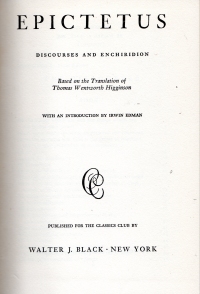
Book coverI started reading this book a couple years back (sometime after Meditations by Marcus Aurelius), but my drive through it petered out as it, like the earlier work, is thematically repetitive. However, this time I figured I’d slog it out, as I’ve learned some patience and some discipline in reading longer works. So I did over the course of many months.

The book was not written by Epictetus; instead, it was written down by one of his students and is based upon that student’s notes on Epictetus’s classes, essentially, in Stoic philosophy. This accounts for some of the repetitive nature of it and why the book is not developed as a treatise; rather, Epictetus revisits certain themes several times. One can imagine him telling the same lectures to a different group of students. At one point, he even tells the transcriber to stop writing this stuff down. Which the transcriber does not.

At any rate, I took some positive things from the book. One of the greatest Stoic themes in the book is, to Americanize it, that a man has got to know his limitations. That which you can control is not so much events, not other people, not the world around you, but your own will. You can’t even really control your own body, not completely. So don’t search for happiness in these things but only in the way you deal with things and how you live in spite of them. Okay, that’s good stuff and a valuable lesson there.

However, Epictetus extends this principle to not ascribing value to other things I consider important.

Nay, these arguments of all others make those who adopt them obedient to the laws. Law is not what any fool can do. Yet see how these arguments make us behave rightly even towards our critics, since they teach us to claim nothing against them, in which they can surpass us. They teach us to give way in regard to our poor body, to give way in regard to property, children, parents, brothers, to give up everything, resign everything: only our judgements they reserve, and these Zeus willed should be each man’s special property. How can you call this lawlessness, how can you call it stupidity? I give way to you in that wherein you are better and stronger than I: where, on the other hand, I am the better man, it is for you to give way to me, for I have made this my concern, and you have not. You make it your concern, how to live in a palace, how slaves and freedmen are to serve you, how you are to wear conspicuous raiment, how you are to have a multitude of huntsmen, minstrels, players. Do I lay claim to any of these? But you, for your part, have you concerned yourself with judgements? Have you concerned yourself with your own rational self? Do you know what are its constituents, what is its principle of union, how it is articulated, what are its faculties and of what nature? Why are you vexed then, if another who has made these things his study has the advantage of you here?

Epictetus points out that your family and your children are not your volition, so they’re not really ultimately valuable. Only your will is. In many places and in many different ways, Epictetus pledges a certain servility to the Tyrant and to nature and acceptance of whatever they decide for you. It’s like the first part of the Serenity Prayer (“God, grant me the serenity to accept the things I cannot change,”) without the rest (“The courage to change the things I can,/And the wisdom to know the difference.”).

The book does allude to the right way to live, seeking to live according to God’s will, but it’s rather light on what that will is or what universal precepts might dictate proper action (live according to reason and within your limitations are nebulous at best).

Still, I’m glad I read it. I’ve got some additional classic literature cred, which impresses pretty much nobody I know, and it does give me some ideas and perspective to put into practice in my life. As I explained to my beautiful wife, philosophy is just self-help books with bigger words in them.

Books mentioned in this review:
Buy My Books!
Buy John Donnelly's Gold Buy The Courtship of Barbara Holt Buy Coffee House Memories

Book Report: The Go-Getter by Peter Kyne(1921, ?)

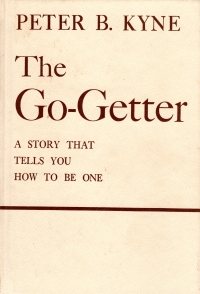
Book coverI selected this book as a quick little number to read on the road yesterday. It’s a touch under 60 pages, so I thought I could read it as a short story interlude amongst some of the heavier reading I’m working on these days. It doesn’t disappoint in that regard.

It tells the story of a lumber and shipping magnate, retired, who talks with the current leaders of the shipping and lumber companies about a debacle in their foray into trans-Pacific shipping. The head of their Shanghai office turned out to be a bad choice, and they need to find a replacement. They decide to send the senior fellow from the home office. Then, a disabled veteran of World War I presents himself to the magnate and explains that the magnate is going to hire him. The magnate learns that the vet had approached the two company leaders beforehand and had been rejected in both cases, but he refused to be dissuaded. The magnate hires him and presents him to the lumber manager; the manager and the magnate put the veteran on a sales route and task him with selling skunk spruce, a product that doesn’t sell well. The veteran returns having sold so much of it that corporate reined him in because they couldn’t produce as much as he sold. So the magnate thinks the vet might be the perfect man for the Shanghai office, but he devises another test for him: The Degree of the Blue Vase.

I won’t recount the whole sixty page story here. Apparently, this book is still popular somewhere in the business world as it’s rated highly on Amazon and is available in many editions. The fact that it is a pre-Mickey Mouse copyright and has fallen into the public domain probably helps with that.

As I read it, I couldn’t help but contrast it with the much bally-hooed Mrs. Dalloway by Virginia Woolf. Both deal with the World War I sitch and the vets returning, but Woolf’s book is so much more English, with the veteran serving only as a counterpoint to the socialite and killing himself in the end (spoiler alert). The Go-Getter is more American, sort of a pep talk for veterans of that conflict with a dash of Horatio Alger thrown in. Or maybe a heaping cup of Horatio Alger.

It was a pleasant enough read, but it didn’t make me much more of a go-getter than I already am. Which is not much, actually. For example, I only saw the film Mrs. Dalloway and did not read the book. BECAUSE I AM A SLACKER.

Books mentioned in this review:

Buy My Books!
Buy John Donnelly's Gold Buy The Courtship of Barbara Holt Buy Coffee House Memories

Book Report: The Book Of Useless Information by Noah Botham and the Useless Information Society (2006)

Book coverThis book is a collection of trivia one-liners such as you’d see in text overlaying images on some listicle sites. As such, it’s probably as trustworthy as the Internet.

I mean, there probably aren’t deliberate falsehoods to detect copyright infringement like you find in the old trivia books. But there are some contradictary trivium like “The leg bones of a bat are so thin that no bat can walk” followed a couple lines later by “Disc winged bats of Latin America have adhesive discs on both wings and feet that enable them to live in unfurling banana leaves (or even to walk up a window pane!).” Sure, that last can be interpreted in a fashion that’s not completely contrary to the former, but they’re not written clearly enough to be completely clear.

So if I’m ever asked the only bat that can walk, and I wrongly answer “The disc-winged bat,” you’ll know why.

But the book is a good enough way to pass the time on an airplane or something like that; you can pick it up, read a few things and go “Huh,” and put it down when needed. And just maybe you’ll have the right answer for a trivia night sometime. Or at least an answer that might be right, which is sometimes the best you can hope for.

Books mentioned in this review:

Buy My Books!
Buy John Donnelly's Gold Buy The Courtship of Barbara Holt Buy Coffee House Memories

Book Report: At The Hemingways by Marcelline Hemingway Sanford (1962)

Book coverLast year, I went to Orlando and got a book about Hemingway (The Private Hell of Hemingway). This year, on our second trip to Orlando, I brought my own volume of Hemingwayenalia.

This book was written by Ernest Hemingway’s older sister, and it’s about their lives growing up in the nice suburbs of Chicago. It starts with a bit of history about their grandparents, both sets of which became well-to-do, and runs through the Hemingways proper from the time they moved from the Hall (Mrs. Hemingway’s parents) home to their own home and through their childhoods and up, sort of, to 1962. It’s full of good period detail, discusses their interesting family history, describes the love of outdoors that the family shared and times at their home in Michigan. The book also carries forth beyond their childhood to some incidents in Hemingway’s life after he leaves home, their worrying about him when he goes to Italy in World War I and its aftermath and how he ends up writing. The book also goes on to describe the decline and suicide of Dr. Hemingway and what Mrs. Hemingway did after he did (which is develop another career as a painter and speaker). The book does not deal with Hemingway’s suicide because he probably hadn’t done so when the book was written.

Ernest Hemingway is a minor character in this book, so it’s not a biography of his except tangentally. I enjoyed it, though, but I am into turn-of-the-twentieth-century memoirs (I mean, I’ve read Clarence Day’s Life with Father twice). So I would have read it even if it wasn’t about Hemingway if it had come into my hands, but I expect it wouldn’t have been published–nor even written–if the woman had not been Hemingway’s sister.

Books mentioned in this review:

Buy My Books!
Buy John Donnelly's Gold Buy The Courtship of Barbara Holt Buy Coffee House Memories

Book Report: Frankenstein by Mary Shelley (2004)

Book coverThis book is a neat little Barnes and Noble printing of the classic. It’s a hardback but it’s the size of a paperback, and the text size is not too small to be readable, so this fits in with my hardback snobbery but also suits my recent drive for portability and carry books. And, apparently, it’s from a series of classic titles in this format. So I might have another set to start collecting, but I don’t remember seeing many of them in the wild.

At any rate, this is the original story of Frankenstein and his monster. By original, I mean the original text; the introduction mentions that an edition in Shelley’s lifetime reduced some of the more radical elements of it; however, to a reader in the era of Obama, there’s nothing particularly radical in the text. Maybe an edition in my lifetime would remove some elements of Victor Frankenstein’s drive for knowledge and education. But I digress.

The story began as a tale Shelley told her companions while they were vacationing in Switzerland. She finished it as a book, and it was pretty popular. It’s set in the early years of the nineteenth century; that is, the early 1800s, within memory of the American Revolution and the French Revolution and the Romantic movement in literature. A frame story deals with a man writing letters to his sister in England. The man wanted to find a northern passage and to explore the Arctic, so he travelled to Scandinavia and found the heartiest travellers he could to man a ship. As they plow ahead into the northern ice fields and run into trouble, they see a guy go by on a dogsled. Then, later, another man comes along on a dogsled. This second is Frankenstein, and he’s pursuing the life he created to the ends of the earth. Frankenstein is weak, so they take him aboard the ship and he relates his story to the captain, who has longed for a companion who shares his drive for knowledge.

The tale of Frankenstein is related in the letters told in the first person as Victor Frankenstein discusses his education, his study of natural sciences, and he pursuit of lost knowledge of animating life through chemical and electrical processes. He grows haggard as he pursues his goal of creating life, and then one day in his rented rooms in a boarding house, he does so. He then becomes upset about what he’s done and swoons; when he awakens, the thing he created is gone. Frankenstein returns home to the murder of his young brother and the execution of a family ward for the deed–although Frankenstein suspects it was the monster.

The story switches to the first person account of the monster, which is bigger and stronger than a man, but ugly. When it encounters regular people, it is attacked and feared. It hides out at the farm of a down-on-their-luck family with a romantic political back story of its own. He learns language and quite a bit from watching this family and begins to help them out while hiding from their sight until he decides to approach the blind patriarch to befriend him and thus, hopefully, the family. As the monster befriends the old man, the other family members return home and immediately fall upon him. The monster flees and vows revenge upon all mankind.

The monster finds Frankenstein on one of the gentleman’s restorative hikes in the Alps and relates this story and offers to stay his hand if Frankenstein will create a mate for the creature. Frankenstein assents, and then starts his study and work to redo the processes, but at the last minute, at a remote outpost, he destroys all the work because he cannot be sure the monster will keep his word and out of fears that the monster and its mate might procreate.

So the monster takes his revenge by killing those close to Frankenstein, which leads to Frankenstein’s vow to kill the monster. And the pursuit in the Arctic.

The story is pretty interesting, although it moves at a pace slower than many modern readers would enjoy patiently. I know I looked a couple of times to see how far I was into the book and to see how much was left. The characters are pretty interesting and sympathetic–even the monster is until he starts killing people and seeking revenge for his life, but even then I could see why he was driven to it. So it offers a lot of depth to the story you don’t get on screen and in the comic books.

Recommended.

Books mentioned in this review:

Buy My Books!
Buy John Donnelly's Gold Buy The Courtship of Barbara Holt Buy Coffee House Memories

Book Report: Travels with Charley by John Steinbeck (1962)

Book coverIt has been over a decade since I’ve been really in a John Steinbeck phase; about fifteen years ago, I read Tortilla Flat, Cup of Gold, The Winter of Our Discontent, and Of Mice and Men in quick succession. I’ve since read The Long Valley. And although there are a couple of Steinbeck books on my shelves (East of Eden and Cannery Row), it had been years since I picked up a Steinbeck, which is odd since he’s classic literature that I like to intersperse with the Executioner novels that are my normal fare. So I finally picked up this book.

This book is written twenty years after those prime novels listed above. By the early 1960s, John Steinbeck is John Steinbeck; instead of California, he lives in New York and is known about town and about the country. He decides to get into a camper and drive around the country with his dog Charley. This slender volume is the result of that effort.

On the one hand, as I read this book, I recognized the stylistic influence Steinbeck had on modern prose, including the literate pulp of the latter twentieth century. As I read, I could easily think that John D. MacDonald or Travis McGee was narrating the adventure.

On the other hand, the focus of the book and the theme are a bit underwhelming. I’ve mentioned before a couple of the things of note (Inside a Certain Mindset with John Steinbeck and Layers and Layers of Fact Checkers Circa 1962). The book has a couple of incidents where Steinbeck recounts his interaction with people–a family of French Canadian migrant harvesters in Maine, a New Englander he has into his camper for coffee; veterinarians who take care of Charley along the way. He also has a couple of places where he waxes on places he visits, including several pages of glowing on Wisconsin. However, the book itself dwells mostly on Steinbeck’s seemingly unrelated musings on Life and the Big Questions. The final segment of the journey, natch, is a journey through the South and musing on the Race Question, including a segment where Steinbeck talks to an older white man for a bit and then picks up a black man walking along the road to uncomfortably interrogate the reluctant sample of the Negro population.

So the book was an enjoyable read because of Steinbeck’s prose, but I found it head-shakingly fatuous at times. So it’s worth reading if you like Steinbeck, but it doesn’t really convey much in the sense of what America was like in the early 1960s. It’s more about what Steinbeck was like in the early 1960s.

Books mentioned in this review:

Buy My Books!
Buy John Donnelly's Gold Buy The Courtship of Barbara Holt Buy Coffee House Memories

Book Report: Easy-to-Make Tables and Chairs (1975)

Book coverI’m a little behind in my book reports. I read this book shortly after I read Sunset Woodworking Projects (in early July), but I’ve not yet written a book report on it. BECAUSE I’M LAZY. Or busy.

At any rate, this book dates from the middle 1970s instead of the late 1960s, and we can see the movement from the old time woodworking book to the more modern way of doing it (step by step, more pictures) fashion that you see in modern books and magazines. Unfortunately, the pictures and the projects also come from the middle 1970s.

As it indicates, the book focuses on tables and chairs. The easier projects are simple things, such as a temporary chair stuffed with balloons or backless seats that are fabric over inner tubes (sadly, no projects for tables made from wire spools covered with fabric, but I suspect they were so prevalent that the authors assumed everyone already had one). Some of the other projects include more elaborate pedestal tables and whatnot, so the book covers a variety of skill levels.

Most of the stuff is beyond my skill level, possibly including balloon chairs. But it would be a good idea book for woodworkers with some seasoning.

Books mentioned in this review:

Buy My Books!
Buy John Donnelly's Gold Buy The Courtship of Barbara Holt Buy Coffee House Memories

Book Report: The Screwtape Letters by C.S. Lewis (1962)

Book coverThis book collects a series of essays Lewis wrote for a local periodical. Perhaps essays is the wrong word, as they are letters from a superior demon in Hell’s bureaucracy writing to a nephew who’s a n00b field agent in the temptation service. Screwtape, the author of the letters, offer various advice on how Wormwood, the nephew, should proceed to better tempt the young British man of the World War II era into going to hell. Spoiler alert: It’s not Hitler or anything. Most of the temptations are not those to great crimes but rather to misdemeanors of self-centeredness, self-aggrandizement, and disbelief.

The essays are chock full of good insight into the foibles of human nature, the lies we tell ourselves, and how we relate to one another, particularly the danger of factions in churches and in superiority derived from beliefs (even amongst Christians). The book also explicitly states that congregational churches lend themselves to this easier than parochial churches and why this is more appealing to casual, unreflective believers. Its something that follows, but something I hadn’t thought much about.

The second part of the book, “Screwtape Proposes A Toast”, covers the way modernism and modern education erode the structure of morality and civilization. Given that the book is fifty years old, Lewis saw some of the effects of then-new and partially obscured trends and drives and how they would play out in the future. And so they have. Sadly.

At any rate, even if you’re not a Christian, you can certainly unmask or be reminded of some bad habits you might engage in or some elevated thinking you should probably rein in. At only 172 pages, it’s a pretty easy, engageable read and worth your time.

Books mentioned in this review:

Buy My Books!
Buy John Donnelly's Gold Buy The Courtship of Barbara Holt Buy Coffee House Memories

Book Report: Dragonslayer by Wayland Drew (1981)

Book coverThis book is the novelization of the 1981 film of the same name. In it, an unauthorized party from a land benighted by a dragon comes to the last remaining sorceror for help. Every six months, the kingdom sacrifices a young woman to the old dragon to keep it from rampaging. At the sorceror’s tower, though, a military group from the kingdom catch up with the unauthorized group and kill the sorceror. The sorceror’s apprentice and undertake the journey and catch up with the aid-seekers in their retreat.

And then go on to fight the dragon and win, eventually, of course.

The book has an interesting element in it: the rise of Christianity in Europe replacing the old magic systems. The book takes place in an unidentified region in Europe at the rise of European civilization, and the town nearest the dragon’s lair has a new Christian missionary in town who converts people as the dragon’s menace continues. The sorceror’s apprentice doesn’t decide to go onto becoming a sorceror–after the death of his master, there’s no one to teach him and he prefers the world rather than the books–so the book muses on the transition between the old ways and the new. It’s a pretty even-handed treatment of it; in the 21st century, there’d be a lot more handwringing about the loss of magic for the fairy tale lies of the church than you get from a book based on a film in 1981.

It’s a good enough read, once it gets going. It’s a slow starter, and of all genres in the world, fantasy is the one whose audience will allow slow, wordy starts. Which this one has.

Books mentioned in this review:

Buy My Books!
Buy John Donnelly's Gold Buy The Courtship of Barbara Holt Buy Coffee House Memories

Book Report: Sunset Woodworking Projects (1968)

Book coverThis book isn’t your father’s book of woodworking projects; this is your grandfather’s book of woodworking projects. And as we bemoan the tailing off of American education, how schools have made successive generations of American students less educated, we can also bemoan how Americans have gotten less industrious with their hands. Otherwise the whole Maker movement wouldn’t be a hipster movement. It would be what people did on the weekends. Or how people made do with what they had, perhaps.

I digress.

The introduction for this book says it’s for beginning and intermediate woodworkers. As such, it takes until page 19 before you’re building a complete set of drawers from scratch (no store-bought drawer runners, you weakling!). If you open up a 21st century woodworking magazine, you get a complete step-by-step guide that includes images and photographs of how to assemble things each step. In this book, you get a couple paragraphs of copy that includes a description of why you should build the thing and how to build the thing. Then you get a diagram of the cuts and how they fit together. Sometimes, like in this project for building a children’s desk, you also get a pattern for cutting:

Boy, howdy, I am so below woodworking beginner that I can’t even.

At any rate, the book has over 75 different projects of varying degrees of difficulty. There are a number of workbench/table hinged to the wall/stool/bench/toolbox kinds of projects that are pretty standard for this sort of book. There are some simpler things for children, rocking horses, little toys, and the like. Then there are the “what kind of intermediate woodworker can do this?” projects including the aforementioned set of drawers, other furniture, and a foosball table. The things within are all very 1968, but you might get some ideas to try (with things done a little differently in the 21st century).

I picked the book up to browse through just to see if I get any ideas for projects I might try. Someday. And I might. Someday. But not until I master the basics of cleaning my workbench area in the garage.

Another feature of this book’s era is that it mentions on many occasions that you can use power tools if you have them. But the assumption is that power tools are optional. Which matches my workshop, such as it is.

At any rate, I have a large number of Sunset books on my shelves in the garage (even more in 2015 than in 2010). Strangely, I didn’t flip through those before putting them out there. But I bought this book later, so it was on my to-read shelves, so I flipped through this one. Worth my couple of minutes, and definitely more manly than another book on beading.

Books mentioned in this review:

Buy My Books!
Buy John Donnelly's Gold Buy The Courtship of Barbara Holt Buy Coffee House Memories

Book Report: Warriors: The Rise of Scourge by “Erin Hunter” (2008)

Book coverThis book hits the trifecta of twee: It’s young adult fiction told in manga style featuring street gangs of cats. It’s hard for me to admit I read it, but I did.

Apparently, the Warriors series of books/trilogies is a going thing, with a house name (“Erin Hunter”), a collection of authors doing the actual writing. And in this case, illustration. They’ve hit the New York Times best seller list on occasion, although probably not the adult section that people pay attention to. The series is sort of a Game of Thrones of feline gang wars between different clans of cats and myriad personalities.

This particular volume, a stand alone in a universe rife with multi-parters, deals with the rise of an undersized cat named Tiny. Unloved by his litter mates, he runs away to the city and ends up becoming Scourge, the leader of the BloodClan. He’s the villain in other books, so this is sort of the The Phantom Menace/Attack of the Clones/Revenge of the Sith that describes his rise. And it’s not wholly unsympathetic.

So it’s not really manga; it’s a kid’s book comicked up in the manga style. But it’s about cats. Gangs of cats.

Sigh. I’m really trying to be classically educated here, but sometimes my garage sale purchases lead me down the path of modern American literature.

Books mentioned in this review:

Buy My Books!
Buy John Donnelly's Gold Buy The Courtship of Barbara Holt Buy Coffee House Memories

Book Report: The Nitpickers Guide For Classic Trekkers by Phil Farrand (1994)

Book coverI’ve been working on this book for a number of months as a fill-in book when I sat down and had only a couple of minutes to read, so I needed something quick with short, discrete chapters.

This book is an episode guide of the original Star Trek television series. It follows up the author’s earlier work of similar nature for the Star Trek: The Next Generation series; given that the other was still on television at the time, this would have made the earlier work about the later program more relevant in the marketplace, and its success must have guaranteed at least this reviewed volume. At any rate, each episode listing includes a brief recap of the plot, a detailed list of cuts made when the episode was put into syndication, production goofs, places where the episode went against other episodes, a couple of trivia questions, some places where props are reused, and finally a list of the stills that displayed over the closing credits. Other additional chapters cover the movies, and the action is broken up with some musings on Star Trek and society as well as enumeration of Star Trek tropes.

The fellow watched both the uncut versions (as sold by Paramount in the 1990s) along with syndicated versions recorded off of television to get his cuts section and to get into the nitty gritty of the program. It seems like a whole lot of work to produce an encyclopedia of trivia.

Which I read, albeit slowly, in dribs and drabs. It, like other Star Trek titles, makes me want to watch the original series again. Perhaps when I find it inexpensively at a garage sale. Or, given that I found season 1 of The Next Generation a couple years ago and have yet to watch it, perhaps it will be some years after I find it inexpensively. But probably soon after I read a book like this.

Books mentioned in this review:

Buy My Books!
Buy John Donnelly's Gold Buy The Courtship of Barbara Holt Buy Coffee House Memories

Book Report: Oleanna by David Mamet (1992)

Book coverThis is a brutal little play. That came out in 1992. Bear that in mind, and even if you don’t, I’ll repeat it: 1992.

The play is a short three act play with only two characters. In Act One, Carol, a student, comes to professor John’s office. She’s failing his class in education and wants help; he’s about to get tenure and about to buy a house with his wife. John’s book, which he teaches, talks about how higher education is a hazing process and might not be necessary, really. She doesn’t get it, really, and he wanders a bit afield in his musings. In Act Two, John has been denied tenure because Carol has filed a report accusing him of making improper advances in their previous meeting. He’s sought to meet with her to clear the air. He explains about wanting tenure even though he’s an iconoclast in Educational education. In Act Three, Carol has become even more militant and throws around a lot of the boilerplate feminist terms; in this third meeting, John has been thrown out by his wife and stands accused of raping Carol. At the end, he beats her and curses her.

The play’s a little ambiguous in whether John really was moving the conversation in the direction of impropriety in Act One, but he’s crazy stressed out about the whole thing, and the purchase of the house and whatnot. Circumstances do seem to set him up, and Carol makes the allegations she does by cherry-picking his words and turning them. I don’t know what to make of the beating, though. Self-fulfilling prophecy in her accusations (although it is simple battery, not rape)? Or does the stress reveal John’s true patriarchic inclinations?

At any rate, remember, this is 1992. Twenty-three years ago, Mamet had a play on the road and in New York (and an eventual film) dealing with political correctness and its corrosive effects. That’s the era when Charlie Sykes was writing The Hollow Men and ProfScam about this very thing. I read both in college, actually. So this is something from when I would have been in school, and it dovetails with what we see now.

And Mamet was writing about it back then. Fascinating.

An okay read, though. Not as good as Glengarry Glen Ross, but what is?

Books mentioned in this review:

Buy My Books!
Buy John Donnelly's Gold Buy The Courtship of Barbara Holt Buy Coffee House Memories

Book Report: The Death of Ivan Ilyich by Leo Tolstoy (1987)

Book coverThis book is pretty short, about 130 pages with 30 some pages of introduction. As I’ve recently rediscovered, one should generally read the introduction to classical literature college textbook editions last. So I did with this book.

Spoiler alert: Ivan Ilyich dies.

The story itself covers the life of Ivan Ilyich briefly, discussing his youth, his entry into government service, his marriage (happy, then tolerated), and his pursuits. One day while preparing his new home in the city for his family, he slips on a ladder and hits his back on a knob. Although he laughs about it at the time, the injury eventually causes his death as some internal damage grows over the course of months. Ivan goes to various doctors and tries various medicines and therapies, but comes to believe he’s dying. As he does, he sees life slipping away and people beginning to move on with their lives without him.

It’s a pretty grim story, and one that resonates with me and threatens to trigger my latent hypochondria. I know exactly what little pains revealed my aunt’s and my mother’s cancers which would kill them in a matter of months. Now I’m going to worry about little bangs when I’m working around the house and floating kidneys.

The introduction gives a brief biography of Tolstoy and then muses on death in literature and philosophy for a length equivalent to a third of the book.

The book itself comes from a university bookstore sometime (although I didn’t get it from one, obviously). As such, it includes someone else’s underlining and marginalia. In this case, a studious student, who underlines metaphors and writes “metaphor” in the margin and who underlines names and writes the relationship to Ivan Ilyich alongside the text, which pretty much gives the relationship in the same sentence. Although my professors encouraged me to “dialog with the text” by marking up my textbooks, I didn’t really enjoy defacing the books that way. Fortunately, this one is not marked up to the point of illegibility.

At any rate, it’s a nice little piece of Existentialist Russian literature, a short read that tackles a subject you don’t get in a lot of books.

Books mentioned in this review:

Buy My Books!
Buy John Donnelly's Gold Buy The Courtship of Barbara Holt Buy Coffee House Memories

Book Report: Awesome Projects from Unexpected Places edited by Noah Weinstein (2013)

Book coverIn my mind, there’s a line between crafting and Making; I’ve capitalized the m to emphasize the Make movement which is a combination of crafting along with power tools and harder materials. Since many of the projects in this book involve power tools, electricity, and metal, it’s definitely toward the Maker side of the spectrum. You’re not going to do many of these projects at your kitchen table. Most of them require a workshop.

At any rate, the book includes a gamut of projects from embedding objects in an resin tablet top to making a bracelet out of paracords. There are some metal art works, such as a metal flower or metal vases. There are some furniture pieces, including a dining room table made from a recycled bowling alley or a coffee table made from a recycled car tire.

The projects in the book are not junk chic or recycling junk to make new items; some of the projects involve a decent outlay in supplies.

So this wasn’t much what I like to think I do sometimes, but I haven’t done anything of the sort lately. Hopefully checking these books out of the library–before football season even–will inspire me to do something, especially with the junk I’ve already accumulated in the garage.

The projects in this book come from Instructables.com, by the way, so you can head over there to see these and others of their stripe, but not in the handy browseable book format.

Books mentioned in this review:

Buy My Books!
Buy John Donnelly's Gold Buy The Courtship of Barbara Holt Buy Coffee House Memories

Book Report: Shaman King #17 by Hiroyuki Takei (2008)

Book coverThis book is my very first manga, and this book report is my first chance to make the joke Manga but pawn in game of life, although it could probably have used more setup. I wonder if anyone else has ever made that joke before; however, in lieu of researching it (I mean, searching the Internet for the phrase), I’ll just accept my primacy.

Where was I? Oh, manga.

Well, this is the seventeenth volume in this particular story, so I’ve missed quite a bit. There’s a page of characters in the beginning and a couple of paragraphs of The Story So Far. So, the story: There’s a tournament of shamans in Japan. Every five years, they choose a shaman king, and there’s a tournament to see who it will be. There are a bunch of young sorcerors fighting each other to win; there are some alliances happening, and one of the boy’s father comes to teach something but first fights a couple of them. Then the bad guy allies of one come to fight the couple using dirty tricks. And then there’s a cliffhanger. To be continued in Shaman King #18. I think there are 36 in all.

This ain’t my bag, baby.

For starters, it was definitely odd to read from right to left. Undoubtedly, it is good for my brain to do strange things like that, but. Also, the influence of video games on the art and plots mean it’s full of interludes, combat, reflections on player stats (everyone goes on about one character’s 1,250,000 mana!), and panels that identify some power, attack, or spirit animal by putting it all in capitals amongst an explosion image. Also, the book contains numerable-but-why-count-that-high panels of character reaction shots where the startled characters say, “Huh?” I don’t know how many ways Japanese language has to convey this; maybe a bunch of subtle things have been simplified for English readers. Or maybe not. Maybe I’m not the target audience, either, since I’m not all about the comic art and gauge books on the words and plots. But I’m unimpressed.

I still have three or four of these to go through from my recent purchases, and I’ve been warned not to judge all manga from a single volume of some series, but I’m not that eager to jump into another one. Except they’re short, and I’ll be able to let my son look through them. So I’ll probably knock through the whole bunch by the end of the summer.

Books mentioned in this review:

Buy My Books!
Buy John Donnelly's Gold Buy The Courtship of Barbara Holt Buy Coffee House Memories

Book Report: Kickback by Ace Atkins (2015)

Book coverMy beautiful wife saw this book at the library and brought it home for me to read in a hurry, since it’s a new book and is only available for a week checkout. So I did.

Welp, the book is an Ace Atkins Spenser book, and he’s moving more into his style than merely imitating Parker’s here. In the book, Spenser works to investigate the relationship between a judge in a small Massachusetts town who sentences juveniles to a for-profit rehabilitaton facility and the for-profit company running it. Of course, the new mob is involved somehow, although I’m still unclear as to how.

My enjoyment of the book is probably diminished by how soon after the Travis McGee books it came.

Atkins’ style for these books, as I’ve mentioned, seems informed by television; the scenes are television-like scenes of scenery and dialog, and the ending of the book wraps the plot up with an explanatory resolution and then some things that might be woven into a future episode. Or not.

The writing also suffers from a couple other flaws:

  • The reliance on the italicized other point-of-view chapters. Instead of the criminal, though, we get a tangentally related unfolding story of not Spenser’s focal point on the island, but another youth sentenced to the facility for a crime we’re only sort of aware of. His story isn’t fully fleshed out, but it’s included because it gives the book a Youth In Jeopardy storyline so favored in Brandman’s Jesse Stone books and gives the book grounds for a cinematic but otherwise extraneous Spenser swoops in in the nick of time to rescue said youth.
     
  • Some extraneous wordage, including some repeated things. At the outset of the book, when Spenser’s in his office, there’s a touch of description and interaction with the mother of a teen sent to the institution, and there’s a sentence tacked on that says his Brooklyn Dodger hat and peacoat are hanging by the door. But the sentence is tacked onto an unrelated paragraph. Throughout, we’re told about his Dodgers hat and peacoat over and over. Aside from that, there’s a whole chapter of Spenser meeting someone at a textile museum that adds nothing to the story but does describe the museum in detail. It makes one wonder if the author researched it or visited it and had to throw that in to justify writing the trip off.
     
  • It lacks the depth of MacDonald’s writing, where the asides add some resonance and muse on the meaning of life aside from the crime story. To be fair to Ace Atkins, Parker’s writing started to skip over those flourishes around the time of his trips to California for the television series Spenser: For Hire.

Is it a good book? Is it a bad book? It’s a modern crime fiction book, and it’s probably not a bad example of the genre. But it’s nothing compared to the paperback originals from fifty years ago.

Books mentioned in this review:

Buy My Books!
Buy John Donnelly's Gold Buy The Courtship of Barbara Holt Buy Coffee House Memories

Book Report: A Tan and Sandy Silence and Two Other Great Mysteries by John D. MacDonald (1971?)

Book coverThis book collects three Travis McGee novels from the late 1960s into a single hardback edition. The originals, it should be noted, were in paperback. The three books are A Tan and Sandy Silence, The Long Lavender Look, and Bright Orange for the Shround.

In A Tan and Sandy Silence, McGee investigates the disappearance of an former lover after her husband comes looking for her upon The Busted Flush and tries to kill McGee. Travis discovers a disturbing financial plot, philandering, and a sociopathic French Canadian accountant involved in a land development scheme with the husband. The book also has a subplot about McGee contemplating retirement and marrying a wealthy widow. In The Long Lavender Look, McGee and Meyer find themselves framed for murder in a remote Florida county where they’re mistaken for murderers of a local hoodlum who just got released from prison after his last score. Locals, including some of the police, are on the hunt for the proceeds of the heist. In Bright Orange for the Shroud, a formerly well-to-do acquaintaince finds Travis and eventually tells of how his new wife involved him in a land development swindle that picked him clean. McGee tries to recover some of the money from the swindlers and finds a backwoods badman of which nightmares are made.

It’s been a long time since I’ve read a McGee book (actually, it’s only been four years since I read The Turquoise Lament). It seems like longer, though, because I tore through these in high school and have not made a concerted effort to re-read them since (unlike the Spenser series, which I last read through from start to finish about fifteen years ago–there were a lot fewer to get through fifteen years ago). So after a little taste of MacDonald with End of the Tiger and Other Stories, I picked up this collection I had standing around. And I’ve rediscovered how much I like this series.

There’s action and interesting plots that we discover along with McGee (remember when this was a thing–that the reader discovered the plot along with the protagonist instead of having the bad guys have their own chapters in italics so everything was clearer at the outset? Modern readers must lack patience, or authors fear the old people who still read books might die off before seeing their genius machinations at the end of the 400-page thriller). The books are at times a bit wordy, a bit musing, but the passages include digressions such as this from A Tan and Sandy Silence:

I went below, turned on a few lights, built a drink, ran a thumb down the stack of tapes, picked Eydie, and chunked her into the tape player and fixed volume.

Eydie has comforted me many times in periods of stress. She has the effortlessness of total professionalism. She is just so damned good that people have not been able to believe she is as good as she is. She’s been handed a lot of dull material, some of it so bad that even her best hasn’t been able to bring it to life. She’s been mishandled, booked into the right places at the wrong time, the wrong places at the right time. But she can do every style and do it a little better than the people who can’t do any other. Maybe a generation from now those old discs and tapes of Eydie will be the collectors’ joy, because she does it all true, does it all with pride, does it all with heart.

So I settled back and listened to her open her throat and let go, backed by Trio Los Panchos, Mexican love songs in flawless Mexican Spanish.

Twenty five years later, and I know what he’s talking about.

At any rate, the asides, philosophical musings, and bits of self doubt have more depth in them than the similar things you find in the Don Pendleton Executioner novels; given how Pendleton’s paperback originals came after MacDonald’s, I can’t help wonder if the former didn’t directly influence the latter.

I didn’t remember much from these books–the subplot from A Tan and Sandy Silence being the thing I remembered the most–I should really look back to this series and reread it for pleasure. Although I’ve got few of them on my to-read shelves, and I feel obligated for the most part to hit those before returning to books that I actually enjoy. So maybe I’ll get lucky and find some other omnibus editions in the book sales of Springfield sometime soon. Of course, I have plenty of other MacDonald paperbacks to read, and my recent experience has reiterated that they’re worth my while.

Books mentioned in this review:

Buy My Books!
Buy John Donnelly's Gold Buy The Courtship of Barbara Holt Buy Coffee House Memories

Book Report: Wilderness Trek by Zane Grey (1944)

Book coverI was talking to a friend of mine, and he mentioned that he was reading a Zane Grey western. It’d been a while since I read one (December 2011 to be exact), so I picked up this book.

The book takes place in Australia; two cowboy friends hire on as drovers for a man who is part of a large expedition designed to drive several thousand head of cattle from several “stations” (ranches) across the Australian outback. However, during the course of the trip, one of the two vies for the affection of a lovely young lady with a suspicious drover who has cattle-rustling designs on some of the docile Australian cattle.

The book is 304 pages long, and it feels every one of them. The descriptions are lush, and the action is slow to start as the characters, the relationships, and the courtships begin. Strangely, the confrontation and gunfight with the bad guys takes place at about page 200, which leaves 100 pages of wondering what’s coming next. As it stands, natural disaster and natives provide the set pieces between then and the successful arrival a continent away and the promises of marriage that follow. As my friend says, Western novels are just romance novels with horses and gunplay.

The book isn’t paced as fast as I prefer, and it’s not my bag (although it’s more my bag than, say, the Gunsmith series). Still, the Australian setting triggered my rewatching of Quigley Down Under and might have inspired the recent purchase of Crocodile Dundee. So it’s got that going for it.

Books mentioned in this review:

Buy My Books!
Buy John Donnelly's Gold Buy The Courtship of Barbara Holt Buy Coffee House Memories

Book Report: House on the Rock

Book coverThis book is a picture book sold at the House on the Rock to help you remember your visit. It does more than that, actually, as the photographers used lights in taking the pictures. You can actually see the rooms.

For those of you who haven’t seen it, the House on the Rock is a domicile of sorts built by a man atop a sandstone column starting in the 1950s. The original house stands atop the column, but over the decades between then and now, the fellow (Alex Jordan) and the people he picked to maintain the building have continued adding to it. So the flavor is something between (I would presume) the Winchester House and Hearst Castle. The original house is now surrounded by gardens, other buildings, and a museum dedicated to Alex Jordan, so it’s not clear to the casual visitor that the house is on a rock at all.

But back to this book: It’s a tourist hagiography of the facility and a bit of Alex Jordan, so don’t expect any depth or criticism. Instead, it goes on in marketingese about the various collections and oddities that the attaction houses, which is useful, since one should expect to be overwhelmed when visiting the place in person. It took us almost four hours to go through all the stuff at a pretty consistent pace throughout, without dithering or lingering on anything in particular.

The images in the book are brighter and clearer than the underlit interior of most of the actual House on the Rock itself which has a definite cave feel. Whether they do this to spotlight different things in each room or just to save money on lighting, I don’t know; however, the images are better than the real thing in the areas that they depict.

At any rate, it’s worth a look if you find the book at a book sale. It might not be worth the $20 they charge for it (shrinkwrapped, so you can’t see its contents until you’ve ponied up the dough) at the gift shop.

Buy My Books!
Buy John Donnelly's Gold Buy The Courtship of Barbara Holt Buy Coffee House Memories