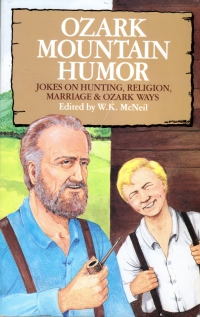
I thought I had read this book before, perhaps as a library book I reviewed during a football game. I guess I was thinking about Bittersweet Ozarks At A Glance. That, and I did read another book in this series, Michigan: A Picture Book To Remember Her By in 2009. In that book report, I said I was eager to go up north again; I did, this year.
It’s a little different reading a book about remembering where you live, thirty years before you lived there. For starters, the book uses the whole Ozark Plateau as “the Ozarks,” which means there are photos from almost as far as St. Louis, whereas Missourians don’t start counting the Ozarks until, what, Fort Leonard Wood? Waynesville?
At any rate, I didn’t recognize much. Some pictures of Table Rock Lake, perhaps. But the book focuses on generic landscapes for the most part. Springfield is not represented at all. Silver Dollar City and Branson, which get a couple of pages, but they’ve changed enough since the photos were taken, probably in the 1970s, that neither looks the same exactly.
So it’s more of a historical document than anything I’ll actually remember.
Still, worth flipping through.
And now that I know this is a series, I must collect them.
One of the joys of John D. MacDonald books is that you’re not really sure what you’re going to get, even by the cover. He writes books about business shenanigans and land deals gone bad, he writes crime books, and sometimes he just writes character studies where the characters deal with disasters. Sometimes, like this book, he creates a sympathetic character who makes bad decisions and more bad decisions, and suddenly he’s a bad guy (as also happened to a lesser degree in Clemmie).
In this book, the main character is a former World War II special forces sort who, twenty years later, is a construction project manager. He started his own company, but fell in love with the daughter of a larger construction company’s owner and has married her. Their childless marriage has descended into that alcohol-soaked suburban immorality and adultery that one finds in MacDonald books sometimes. One of his war buddies comes in from South America with a plan to relieve a courier of several million dollars for an arms purchase just as an attempted coup is thwarted, and with the coup plotter dead or in prison, nobody will care about the money. They devise a plan just like in the old days, and it goes off without a hitch–well, except the friend gets wounded and has to hole up at the main character’s house and dallies a bit with the missus.
Then we’re off: An accidental death, covered up, and then murder to cover up the accidental death, and the police come knocking, and….
Well, it is a good read even as the sympathetic character descends out of that sympathy. The end, though, is pretty abrupt, as forces from the government and from South America that were looking for the money show up and set the stage for a bloody climax and then a less bloody anti-climax.
Still, it’s good writing for the most part and reinforces my belief that John D. MacDonald is one of the best writers from the 20th century.
I have no idea what an Axis Strength Trainer is, but I can tell the models in the Facebook advertisement are using it incorrectly.
If you’re smiling when you’re using a piece of physical fitness equipment, you’re doing it wrong.
Also, if you can have a conversation on your cellular phone when you’re working out, you’re not doing it correctly (although shouting quips to passersby is apparently okay in my completely arbitrary life rules, but note that my previous post is about how I do 5Ks, not how they should be done).
Also, kudos to Facebook for either figuring out how to thwart the ad blocker I have installed or for partnering with them to ensure that the informative, helpful ads I really want to see to mock appear in my news feed instead of posts from my friends. To be honest, it sort of beats the previous method, where the posts appeared briefly and then disappeared instantly, like data-driven Tyler Durden stills in my news feed instead of posts from my friends. Also, kudos for the algorithm that determines I really want to see political posts with opposing view points from friends I have not interacted with in years instead of more relevant posts or most recent posts.
A number of years ago, my mother-in-law gave us a decorative wine bottle for Christmas. It had a madonna-and-child painted on it and a string of Christmas lights in it through a hole drilled in the back. I kind of tut-tutted it when we got it, but in the years since, we’ve taken to putting it onto the mantle in our family room. We’ve also taken to leaving it burning all night, which served as a nice navigational light in the dark. We liked that so much so that I bought a Tiffany lamp for that spot so we could have that navigational light all year round (was that only March of this year?).
So I’ve been interested in wine bottle art for a little bit. I once bought a glass cutter on a compass so I could cut the bottles, thinking I’d make candle holders by cutting the tops off, but I never perfected that.
I did, however, buy a diamond hole-cutting drill bit with the intention of making the lights/lamps like the one we received as a Christmas gift. So I saved a bunch of wine bottles up, built a template to steady the drill, and bored a hole through a pile of bottles with varying degrees of success.
Once holed, they sat for a while, as I, like my sainted mother, do not like to rush into things. I painted some with stained glass paint and didn’t really like that look 100%; the new lights I bought have white cords, and the cords are very visible through the bottle instead of just shining some light on the bottle.
So I got some diamond etching tips for my rotary tool (a gift from the aforementioned sainted mother, a gift that I thought I would never use for anything), and now we’re talking.
That’s the first one I’ve done, a winter scene probably because I just read Little House in the Big Woods. You can really see the cord in that one.
I’m pleased how the etching turned out, especially since I did it freehand, which is unlike how I do my wood burning.
So I know what everyone is getting for Christmas this year, and I have enough bottles saved that perhaps I’ll have some things for the craft show I’m going to someday participate in.
A Joplin businessman and megadonor is the “No. 1 enemy of working labor” in Missouri, Sen. Claire McCaskill said Monday while urging pro-union supporters to give her a third term in Congress.
A Washington, D.C.,-based nonprofit donated $3 million during the weekend to a political action committee supporting an effort to increase Missouri’s minimum wage to $12 an hour.
. . . .
Supporters of U.S. Sen. Claire McCaskill, a Missouri Democrat, are hoping the issue will increase her chances in a tight race for re-election.
Sweet Christmas, she is a plucky heroine, ainna?
I was out working in my garage over the holiday weekend, and another group was running “educational” spots every commercial break about how Josh Hawley wants to suffocate type 1 diabetes sufferers with a sofa cushion or something.
It’s certainly a good time for me to have discovered streaming music from my phone instead of listening to the radio.
It must be my year for catching up on my old-timey children’s books. Early last month, I re-read Me and My Little Brain from The Great Brain series, and now I’ve read this book, the first in the Little House series (not, as one might assume because the television series bore the title, Little House on the Prairie, which is the third in the series, and I think I have all my commas right between the parentheses here, but I cannot be sure).
As you might know, gentle reader, if you’re over forty years of age or if you’re a school child who has grown up within field trip distance of Laura Ingalls Wilder’s last home in Marshfield, Missouri, these books tell the story of young Laura Ingalls and her family as they grow up on the frontier in a variety of locations during the late middle part of the 19th century.
This book takes place on the western edge of Wisconsin over the course of a year. The chapters are little vignettes of things that happen, starting in the winter with Pa hunting and storytelling by the fire in the long winter evenings, through the emergence of spring and maple syrup season, to the work in the summer (and no meat–as Pa does not hunt during the summer so the little deer and whatnot can grow up) to the harvest and the beginning of the winter. The author touches upon the isolation–it’s several hours ride to their relatives’ homes, and Laura has never seen two houses near each other until she goes to town for the first time–and the amount of work and the frugality (dare I say it, sustainability) the family practices.
The book includes a couple of primers on how to make butter, maple sugar, and various other necessities, so in addition to your Foxfire books, you might want to keep a set of these books around in case TEOTWAWKI teotwakis (because, let’s be honest, it should be a verb by now).
The difference between this book and the aforementioned Me and My Little Brain are separated by a mere twenty some years (that is, the distance between the dot com era and now), but the differences are vast–the world of Adenville, Utah, and the Big Woods. It’s not so much a difference of the decades, although some of that is true–but it is a difference between town and country that was far greater than it is today, although the differences definitely exist. The practices in this book are close to those found in Nebraska after the turn of the 20th century as found in Over the Hills and Past Our Place or even the 1940s in Missouri in Growing Up In The Bend.
I saw a link on Instapundit to an excerpt entitled The Unbearable Darkness of Young Adult Literature that talked about how children’s and young adult literature is currently preoccupied with After School Special parables about the politically favored lifestyles and problems, and I contrast this Man (Child) versus Society (Squares) focus with the children’s books I grew up with that were very much conscious of Man versus Nature and Man versus Man. Most of the contemporary titles won’t have much to say to kids a decade or two from now, not like books about the 19th centuries could speak to child readers in the end of the 20th century. I just hope kids can still relate to these stories.
I can, but I’m a late twentieth century kid whose reading of these classics has been displaced a couple decades.
Also, I would be remiss if I didn’t admit that I heard the television theme whenever I picked up the book.
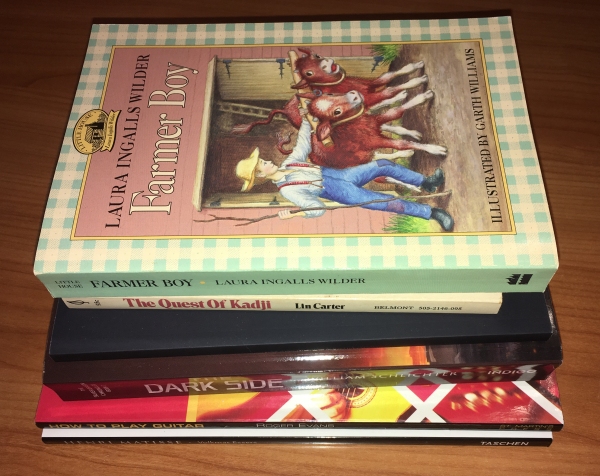
The next book in the series, Farmer Boy, but it deals with the young Wilder boy whom Laura would later marry. I don’t have it, but I do have Little House on the Prairie which I will undoubtedly pick up before long.
Because I have fallen behind in my annual reading goals this year, and I don’t think looking at cartoon books during football games is going to catch me up. So I must rely on children’s books and religious tracts. And, maybe, counting comic books after all.
So I listened to Perry Como’s By Request, and it has the song “Once Upon A Time” as the lead song on side 2.
And I thought, You know who else does this song? Frank Sinatra.
You know, I think Frank Sinatra is best when he does songs of reminiscence and regret; this song appears on my favorite Sinatra album, September of My Years, a platter full of reminiscence and regret.
You know, Sinatra’s got that that pathos going on, but on balance, the richness of Como’s voice outweighs it in this instance, at least as far as I’m concerned.
I’ve no evidence that Eydie ever did this song, so I must give the MfBJN Musical Throwdown award to Perry Como on this one.
I must be getting so old now that I’m passing out of Sinatra appreciation into Como appreciation or something.
Sally Forth has been around a while now, as this book (and the Wikipedia page) indicates. The book is set at the end of the yuppie era; the parents are busy career professionals, and the title character herself is a career woman offering an empowered heroine at a time, youngsters, where there weren’t that many women executives. I know some would say there aren’t enough now, but back then, there were not any (and as far as how many are enough, gentle reader, I say “enough” is “as many as want to be and are competent to do so” which is not a scientific law measurable with a simple percentage).
At any rate, the two business professionals have a single child, a daughter named Hilary. Where they warning us? Not likely. So you get a crossover of business humor, family humor, and parenting humor, but no sibling rivalry humor. Which keeps the cartoon fresh, I reckon, as it switches contexts. You get some storylines that carry over a strip or two, none of the longer conceits that would stretch weeks like you see in Dilbert.
I mean, it looks to be standard funny pages filler, but I laughed out loud at one of them, which is something I rarely every do. And I remember the era where the topics were current, so it’s got a little nostalgia to it. I see from the Wikipedia page that the cartoon has carried on, so it’s probably also contemporary, so less meaningful to me now. And carried on by others than the original cartoonist, although the strip never broke out of the papers into films and television like some others did.
As I have mentioned, over and over, in an effort to humblebrag my way to your respect, gentle reader, I run a number of 5Ks in the autumn and winter.
This is because my boys are in their middle school cross country program, but since they go to a small school, their cross country events are not actually meets with other schools. Rather, they run 5Ks in their school uniforms, and once they started doing so, I started running as well because physical self-abuse of distance running is easier than making small talk with the other parents or just lingering around the event venue awkwardly without making small talk (my preferred option of the two).
As I’ve entered my third year this season, I’ve come to appreciate the finer points of distance running. To whit:
It feels so good when I stop.
I don’t have to make small talk with the other parents and embarrass myself.
I get to make quips as I’m running.
There are free bananas at the end.
Perhaps the last thing is the best thing. Like, on Saturday, when I crossed the finish line…
…I said, “I’m pretty tired. I think I’ll go home now.”
Come on, that’s from Forrest Gump:
I had to explain that to my wife. Come on, the film in only twenty-four years old now, old man. Surely you remember it?
I’ve also used the line noted as number 1 above, which is from an old joke: A doctor asks a man why he keeps hitting himself with a hammer, and the man says it feels so good when he stops.
At any rate, the highlight of the run for me is the things I quip at other runners and volunteers on the route.
I try to keep my breathing such that I can shout out good morning to the volunteers along the route, pointing us in the correct direction, or to people who come out in their front yards to watch us go by. But I like to crack wise as well.
Some of my favorites include:
It’s a lovely day for a walk.
There must be some mistake. I signed up for the 100 meters.
Are you in my age group? Good, I don’t have to pass you.
Can you get me an Uber?
Are we there yet?
Or whatever fool thing comes to mind. Of which there are plenty, because 5Ks give you a lot of time to think, and they give me a lot of time to think fool things.
The quipping keeps me from thinking of myself as a serious athlete or runner, that I focus on the wisecracks instead of Peak Performance. I could probably shave a minute off of my time by taking it more seriously, but that would be less fun than running already is not.
The cross country coach referred to these events as races which would put a little pressure to, you know, win if I took him seriously.
Instead, I’ll continue to think of them as moving open mic nights.
I read in Metal Hammer magazine that metal is family, but I found that hard to believe. When I was growing up, the kids who listened to metal in our trailer park certainly didn’t treat the awkward, small younger version of me like family at all. So I’ve been skeptical of the claim even as I’ve outgrown being small.
Theatrical metal band Ghost’s sold-out show at the Riverside Theater in Milwaukee on May 31 came to an abrupt and tragic end when fan Jeff Fortune collapsed at the venue and died that evening.
* * * *
The band also will be selling an exclusive shirt at that show, with an illustration of band frontman Cardinal Copia and Fortune wearing Michael Myers costumes from “Halloween,” with all proceeds being donated to Fortune’s family.
Ghost recently came to my attention because the local radio station has been playing their new song “Rats”, and I liked the sound of it:
I recently considered picking up their latest album Prequelle, but I opted for Apex from Unleash the Archers instead.
But you can bet that Prequelle will find its way to my mailbox soon.
This book is a little, sixty page primer on Theosophy chock full of pictures and illustrations. The St. Louis chapter of the Theosophical Society had its office right above the Oasis coffee house in Webster Groves back when I hung out there a bunch, and it had crossed my mind to go up and see what it was about, but I never did. I wonder what twenty-five-year-old me would have thought about it. Something like what older me thinks, albeit probably more dismissive and rude about it.
What I have gleaned about this book is that Theosophy is a mystical religion/philosophy created by a Ukrainian noble woman around the turn of the twentieth century. She studied abroad and brought home elements of Buddhism and Hinduism. Although the first bit of the book talks about how she tried to glean the higher truth that lies at the core of all religions, it came to focus on the mystical elements of the imported religions such as reincarnation and chakras. It also picked up some other mysticism from turn-of-the-century thought, such as astral projection, other planes of existence, and mediumship.
So.
It’s a mystical tradition in the most mystical sense, and it prides itself as being the forerunner of New Age thinking. It’s not like the flavors of Buddhism one gets in contemporary book presentations–all the mindfulness and meditation stuff without any of the epistemelogical underpinings, the stuff that makes you go, “Wait, what?” I could probably make a good thesis and paper on how the practical elements of religion come to the forefront in American life, the stuff that tells you how to live your life (meditation and mindfulness in Buddhism, the practical parables in the Gospels) and the epistemological stuff (the Law, the wheel and reincarnation) gets overlooked or ignored.
But Theosophy is full-on mysticism where the epistemology is baked right into the practical.
At any rate, I learned what it is now, and although I’m not going to be hunting down the local branch personally, at least I’ll be ready if I’m asked at a trivia night what organization Madame Helena Blavatsky formed, I’ll know the answer while the other tables are guessing SPECTRE.
The short, pretty headline on the home page makes it sound like the state Attorney General is reviewing the school’s files in particular, which it is not.
On Tuesday, Missouri became the first state in the country to have a law on the books that prohibits food makers from using the word âmeatâ to refer to anything other than animal flesh.
This takes aim at manufacturers of what has been dubbed fake or nontraditional meat.
Clean meat â also known as lab-grown meat â is made of cultured animal tissue cells, while plant-based meat is generally from ingredients such as soy, tempeh and seitan.
The state law forbids “misrepresenting a product as meat that is not derived from harvested production livestock or poultry.” Violators may be fined $1,000 and imprisoned for a year.
Yawn. Wake me up when the state finally gets around to fining people for using the word there or your incorrectly.
I find it hard to work up a particular outrage about this because 1) I’m mellowing as I get older, and 2) the government does a whole lot of regulating of dietary labeling already. You know, mandatory posting of calorie counts at restaurants, certifications for ORGANIC, and so on. The European Union is also very particular about foods named after locations, going so far as to sue to keep people from calling it Parmesan cheese if it’s made in the U.S..
So, yeah, no. I think mandatory labeling laws can be petty (a year in jail for making a candy called Sugar Meat? Really?), I think it’s par for the course.
I do think this particular bit is getting passed around on social media in a twee fashion, though, because some of the passers are trying to imply or reinforce that Missouri is crazy or that people who eat meat are dumb enough to think tofu is meat unless someone smarter than them points it out. A few, perhaps, agree with my perspective that such laws are petty and often giveaways to organized interest groups. But without additional commentary by the sharer, one is left to wonder which of the above points the social media sharer wants to make.
Not worth my time, aside from an excuse to generate fresh content for you, gentle reader, whom I hope to convince to “Meh” along with me.
Also, note this legislation does not affect a real travesty: Allowing Big Turkey to continue to market turkey “bacon.”
Subtitle: How Joe Namath Ruined Football. Well, no, it wasn’t Joe Namath that ruined football. It was the 1960s and the emergence of expressiveness, of personality over teamwork. Or maybe it was Pete Rozelle who made it a profitable iconic industry instead of a game people could watch and root for their favorite teams of blue collar journeymen like themselves. Or perhaps it isn’t ruined at all; perhaps I just wanted to make a snarky remark about Joe Namath and that upstart AFL team beating the Colts and Johnny U.
It is that time of year, of course: It seems that every year in August I read a football book to prepare for the season in my own fashion, just like every year after football I watch a couple of football comedies to come down from the season. In the past, I’ve read Vince Lombardi’s Run to Daylight, Jerry Kramer’s Instant Replay (twice, once in 2004 and 2015), and even Paper Lion. Run to Daylight recounts a week leading up to a game; Instant Replay covers the complete season; and Paper Lion deals with training camp. This book deals with the two weeks leading up to the third Super Bowl which pitted the Jets against the Colts, as I might have mentioned. Unlike the other books, though, this volume has a floating, free-form style that shifts between the various Jets players, some fans, Jimmy “The Greek” Snyder, and a couple of Colts players. I bet the author and perhaps even a team of researchers was embedded with both teams collecting material for this book and went with the Jets-heavy content because the Jets won. Or maybe not.
The shifting viewpoints really dampen the narrative, though, and whatever tension might be building up to the big game. Even with only a roster of 40 (as they had in those days), it rather drops a lot of names and profiles them for a paragraph or a page, and then moves on, and when the player reappears twenty or fifty pages later, you have to wonder, “Who is this guy?” So it’s complete at the expense of depth.
Anderson co-wrote two football books that I’ve read with John Madden (One Knee Equals Two Feet and All Madden), so he clearly knows football. But this book was less satisfying than the others because of its scattered narrative.
Still, not a bad read.
Interesting note that I flagged:
Don Weiss, the slim public relations director from Commissioner Pete Rozelle’s office, had supervised the issuance of credentials to 367 sportswriters, 253 photographers and 214 radio and TV people–a total of 834. (About 200 newsmen are accredited in Vietnam.)
This is the only mention of politics or The War in the book. As I said in my first review of Instant Replay:
Since the book chronicles an era before my birth, part of its charm lies in its details about a world Iâd never know. Green Bay and Milwaukee described in the late 1960s and no mention of the War in Viet fucking Nam, man. Which differs, strangely, from the football season 2004, where the whole worldâs talking about that war.
Or, in 2018, made up concerns.
Ah, the good old days, where not everything was political.
As part of my reading habit, if I get to a natural stopping point, such as the end of a short story, in my reading late in the evening, I’ll pick up a comic book to pass a few more minutes before toddling off to bed. But due to a delayed trip to the comic store, my supply of fresh comics was depleted, so I picked up this collection to serve the same purpose until I could get back to the comic book store. Which it did. Also, it doesn’t hurt that I’ll count this as a full book whereas I don’t count the comic books I read (yet) in my annual tally. But given how few books I’ve completed thus far in 2018, this might be a logical step to gaming my own system. Fortunately, though, football season is coming up, and if the Packers are any good this year, I’ll have three hours a week to page through art books, cartoon collections, and poetry chapbooks.
Well, that’s quite a digression from talking about this book. Back to the matter at hand.
The source material for this book is a collection of short stories, vignettes and slice-of-life bits, written and published by Max Perlson in 1938. They’re about life in America for an immigrant or life in the eastern European shetl where he grew up. His daughter, Trina Robbins, grew up and got into comics in the 1960s and became something of a known name in some circles. She read his book and adapted them to comic book form and had a number of comic artists she knows draw art based on the text. So we have a collection of short pieces each in a different style of art and lettering.
The stories themselves are mildly interesting and vary in depth. Some are more geared to Jewish readers (relying on some knowledge of the culture and religion for poignancy), but some are more broadly approachable stories. The varied art forms, well, vary in their efficacy. Some lettering is harder to read than others, but I think part of the point of the book was to let various artists interpret the material in their own way. As I’ve lamented in other comic book posts, comics have often become all about the artists and the pictures and not so much about the stories. Whereas this volume is about the stories, it can illustrate the deleterious effect of art upon the story.
At any rate, worth picking up at a con when the publisher is discounting books she does not want to ship back to Winnipeg.
Oh, and a quote I flagged in the introduction:
He [her father, Max Perlson] learned well; our home was filled with books, all of which he had read, and because they were around, I read them, too. Among them, I remember the complete Mark Twain, Dickens, the poems of William Blake and John Keats, the memoirs, god help us, of Ulysses S. Grant.
As you might remember, gentle reader, I picked up a copy of those very memoirs last year so I could have a reading copy. One wonders why the “god help us.” One doubts the author wanted the South to win the Civil War.
It’s calling someone who loves felines a real Catsanova.
Wait, an Internet search indicates that I did not invent the pun.
Ah, well, when I blurt it out as though I just made it up, I’ll assume the person I was speaking to won’t think immediately to search the Internet to see where I found it, or that it was a pre-meditated drop-in pun.
Where did I get it? Well, I was listening to Paulina Rubio…
…and then I encountered a cat, which is easy to do at Nogglestead.
So I came by it honestly, through my own synthetic thought, rather than piggybacking off of someone’s established humor.
Or maybe I saw it somewhere before.
Being “quick-witted” is awfully hard work sometimes.
It was a busy Saturday, as so many of them get to be.
We started out before dawn to run the 2017 Habitat for Humanity Home Run 5K at 7 am. Our boys are on their school’s cross country team, but as it is a small school, they do not participate in meets with other schools. Instead, they run in 5K fundraisers every autumn, and the whole family runs in them. It looks like the Springfield News-Leader‘s photographer was on hand to take pictures.
She did not get any of our crew, though, and the official event photographs are not online yet, so I cannot do my traditional Bill the Cat head swap on my picture in the event.
Which I do with all my 5K pictures because I tend to think I look like Bill the Cat in them anyway, as I did with the one from the 2017 Panther Run above.
So we arrived home about 10:30 in the morning, enough time for a spot of rest and a bit of lunch before I took the boys to the Ozark Mini Maker Faire where they were to man the First Lego League booth for a couple of hours starting at 1pm. They’re not just athletes; they are also scholars and participate in the robotics/programming competitive league. Again, it looks like the Springfield News-Leader‘s photographer was on hand to take pictures, but, again, none of us.
Perhaps we should have carpooled.
We got back from the Mini Maker Faire, which was more mini than it was last year, werd, in time to load our truck with some blankets and desserts to take to our martial arts school’s annual picinic (which is how autoyogibearrect spells it) at 5pm. This time, the News-Leader photographer was not on hand to take pictures–that I know of–but we had some pulled pork, chatted with some friends, while the boys played on inflatables.
We got home about 7:30. There were no news photographers to capture our return, which is good.
But I thought it was interesting that the News-Leader‘s photographer was at two events that we attended, and we’re still not on the society pages yet.
I saw this book on Instapundit’s blog, I think, and I buy just about everything I see on Instapundit. I mean, we have screaming flingshot monkeys, for crying out loud.
The book is designed for introverts, which the author defines as someone who gets worn out by social contact instead of people who are awkward or shy. So it might not apply to everyone who considers himself an introvert. Me, I think I was XNTJ on the old Myers-Brigg, where I hit right in the middle of introvert and extrovert. So I’m probably not the core audience for the book. I just look like an introvert because I’m reserved and distrustful of people. So the book didn’t resonate with me as I thought it might.
Basically, it’s a collection of tips and tricks for people who just run out of energy in social interactions as to how they can either extend that “social battery” (the metaphor the author uses) or structure their social lives to take into account their introvert nature. Things like make sure that you have an exit strategy/end time for social events, make sure you take little quiet “breaks” during social situations, all the way up to setting up a safe space for introverts when you’re throwing a party (what?).
You know, I like to host people at Nogglestead because I have opportunities to step out of the room for a minute to take care of hosting duties. But when thinking about introversion while reading this book, I started to think that I’m possibly more of an extrovert than my beautiful wife, who is friendly and can chat up strangers fairly easily, but when she’s done working or socializing, she wants quiet time for herself. It amuses me to think that I’m an extrovert, but not a very friendly one.
So if you’re introverted or think you might be, you might find something in this book you can use. If nothing else, it’s a quick enough read about psychology and self-help.
I took some lessons for a couple of months, but eventually, it turned into me boring my instructors who wanted to teach me more advanced things than I could process as I was still learning the basic fine motor skills involved in placing my fingers in the proper position on the fret board and striking the right string with the pick.
I suspended the lessons until I could at least do the basics.
How’s that coming?
Well, I can almost, almost change between a third chord in time, which means when I’m strumming or picking an open chord, I can sometimes do it without a noticeable gap in the playing. So it’s improving, but slowly.
I only have a couple minutes to practice most days, so it will take me a while. But that’s all right; one of the things I’ve learned is patience.
It’s different from learning a martial art, though, where you continuously improve from gross motor skills to the fine motor skills. In guitar, though, you have to develop the fine motor skills right off the bat, so I don’t see improvement or even basic competence right away, or even now six months later. Has it only been six? Has it already been six?
It’s looking more and more like I’ll be Inge Ginsberg’s age when I make my debut in my metal band.
It took me a little while to get through this book. I took it with me when I went to Leavenworth in July, and I made it about a third of the way through it then, but it’s been relegated to my carry book in a season where I don’t have much time to read my carry book. Let me again explain the “carry book”: It’s usually a smaller paperback that I take with me when I’m going to have an hour or so to read at a location that’s not one of my primary reading recliners (PRRs). Normally, these spaces include church over the Sunday School hour, the martial arts school when I’ll be there an hour before my class begins, or church while my child or children attend the Wednesday evening programming. In summer, our schedules are off, and I don’t really get to sit and read outside the house. So carry books tend to sit on my dresser (like the Montaigne, sometimes for a long time indeed). But with the start of school, our schedule allows me time to read my carry book again, and I read most of the back half of it yesterday while my child attended Wednesday night activities.
So, about this book.
It’s really three books blended together, or, rather, it is a blend of three topics in one book. It’s partly a bio of the author, partly a book about software testing, and partly a book about learning. This last is its raison d’ĂȘtre.
Bach talks about how he dropped out of school and charted his own path in the computer industry by using his own learning methods, and he codifies them a bit, gives them names, and explains how they work together. Basically, it’s about not being afraid to try, being comfortable with your own pace and limitations, and not giving up.
He describes his own struggles with worrying that he could not or would not learn something. Part of the process is backing off and then reengaging with a topic later and learning cyclically, by learning some things and then filling in the gaps of what you’ve already learned with later engagement with a topic. Man, I hope this works, since I’ve certainly spent my share of time backing off of the higher physics and math I’ve grappled with this year.
At any rate, it ended up being an enjoyable book, but the tripartite focus diminshed it a bit and made it something I could put down for months, but not years. I got something out of it: reinforcement of the patience in learning that I’ve learned as I’ve gotten older.