Commercial Street in Lebanon is looking more clear after city crews removed several trees lining the streets. It happened Sunday. The tree removal project is first in a series of steps to improve downtown. The Downtown Business District Advisory Board decided to remove the trees due to disease, sidewalk damage, blocking of light from street lights and damage to business awnings.
Now, I’m new to this area, and Lebanon really isn’t that much this area that I’m new to, but I wonder if the trees were added in the 1990s or early 2000s to improve downtown.
Whenever I see small trees in planted decoratively along downtown streets when the Powers The Be decide to improve a downtown or district, I wonder if those people know what trees look like in a couple of decades. I have to assume that they do, and that they don’t care. Because a couple of decades from now is someone else’s problem.
The title of this book might fit onto one of the men’s adventure paperbacks I favor or perhaps one of the series Westerns I infrequently indulge in, but instead it is a collection of reminisciences published in the 1940s or 1950s from a man born in 1875 and a graduate of the Washington University School of Dentistry in 1904. So maybe the book is from the 1960s or 1970s, but most of the stories within it come from the late part of the ninteenth and early part of the twentieth centuries.
The book doesn’t move in chronological order, so we get stories of his growing up on a farm following stories of him working for the streetcar line while going to dentistry school. In addition to the memoirs, we get some natural science musings as he talks about different animals he’s seen and killed as well as health musings, including a chapter on constipation that leads to some, erm, novel remedies (and, after bladder trouble, he mentions that he doesn’t drink much water, so 100 years later, we can probably give him a better solution than the ones he recommends).
It’s a bit like listening to an older relative tell stories. I enjoyed it because I like these sorts of books, as you know, where real people put together their recollections and diaries and describe their world more plainly and accurately than historians or historical filmmakers can. What’s most striking about his life is not so much the hunting and fishing stories, but the times he talks about casual brawling with his associates and friends. They’d just start fighting for fun, and Dr. Traw had a long memory for men who whopped him, and he’d just sometimes get them back by starting to throw punches. As an adult. Maybe radio killed this pastime for rural America for the most part.
One thing I’d like to note is that this book ostensibly takes place 40 years or so before E.M. Bray’s Growing Up In The Bend, but how remarkably similar the lives were in the use of farm machinery, wagons, and rural life. It really illustrates how disruptive and changing the 20th century was. So far into the 21st century, we’re nowhere near that on technology. On politics and the future of the country, maybe more so, because that doesn’t require math.
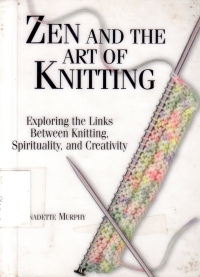
I read the original (Zen and the Art of Motorcycle Maintenance) earlier this year, and I told someone (probably the precocious kid at my martial arts school who likes to read philosophical works, or perhaps my beautiful wife) that I wanted to read that volume so I could read this sequel to it, as this volume was on the outer rank of my to-read books in the hall and was hence present any time that I went looking for a new book to read and did not have something I’d bought that week that I wanted to jump right into. As you can tell, gentle reader, my Web host offered me a good deal on italics this week, so watch this space for their overuse.
It’s not a sequel, of course; it’s one of the books that play upon the title of the Pirsig work and call themselves Zen and the Art of something.
In this case, it’s knitting. The author does play up some of the mindfulness and “in the zone” elements you can get into when you’re sort of focusing on your knitting, but when the habits of the hands leave the mind free to wander or not.
However, this is not a particularly compelling book.
It really doesn’t have much to say aside from the description above; each chapter doesn’t really build upon a theme. Instead, it’s a series of interviews that the author has with creative professionals, educators, or her aunt the nun about what knitting means to each. Which is generally that they can express themselves and become mindful when knitting.
So I had to gut my way through the book, and in the end, it made me want to take up knitting less than Zen and the Art of Motorcycle Maintenance made me want to tackle small engine repair.
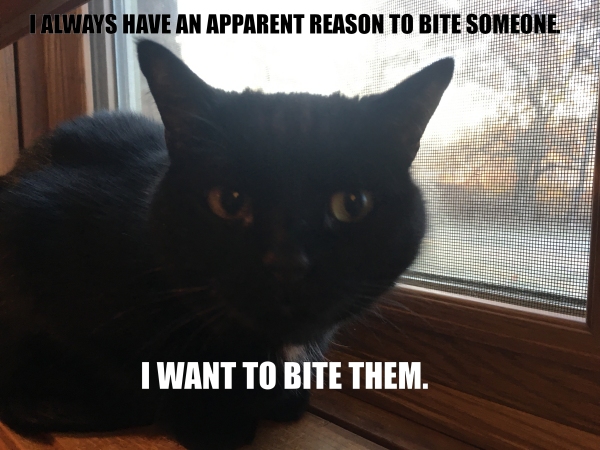
The hard part is knowing exactly when her desire will change from preening with petting to biting. Which changes faster than a quantum computer can add single digit numbers, my friends.
As I was saying, we have enough cats that we can pretty much match any cat in any meme. And if we can’t? We have an extra Fancy Feast dish with no owner yet.
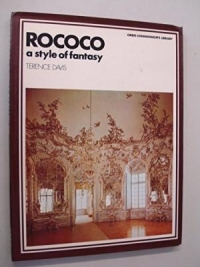
This would have been a book to browse during football games, and indeed, that was the goal last year when this book ended up on the table beside the sofa. However, the text portion of the book is dense at the front of the book, chock full of designer names as it creates a slow-to-read name-checking evolution of the rococo style in France, Italy, Britain, and Germany. Only then does it really go into the photography illustrating the rococo style as it is.
So it lounged on that table for almost a football season and a half before I moved it over to the table beside my reading chair for some attention amid the longer work I’m reading (to be announced probably a couple weeks from now; it’s that long).
So what do I remember from the book?
Rococo followed Baroque style in the late eighteenth and early nineteenth centuries, peaking in France but with some elements appearing in other countries. It, like Baroque, is elaborate and rounded, but it’s more whimsical than its predecessor and influenced a bit by the contacts with the Orient. Also, aside from some of the sculpture, maybe, it’s not for me.
Which is more than I knew before I read the book; all I knew of Rococo before it was the Rocky Rococo pizza by the slice chain, but I am from Wisconsin (where the chain is based). Which is, really, what I hope for when I glance through these things: A short intro course on something I don’t know with information for further learning should I like a topic or style. But Rococo ain’t it.
So the other evening, we were driving back from a basketball game in Avilla, Missouri. My sons attend a small school, and as such, their sports teams have to travel to a number of exotic small towns in southwest Missouri to find worthy competitors teams small enough to match their own.
So the day of the game, I’d had a bit of oral surgery. I’m sure it has a scientific name, but it’s the thing where they cut open the gums to get at the roots of your teeth, clean it out, and maybe grind off a tooth root if it’s cracked (as it was in my case). It’s a little bit bigger of a deal than a scaling-n-planing or a root canal, so my beautiful wife wanted to baby me and drive for the day.
But the two-lane Missouri roads (well, just one, Missouri 96) at dusk and after dark stressed her out, so I offered to drive home. Well, it was not all to benefit my wife. I overheard that one of the girls on the middle school basketball team was playing despite having had a root canal earlier in the day, and that made me feel like a wuss. Also, the driver has control of the sound system according to Anglo-Saxon law, so, since I was not on any pain killers aside from Advil (it doesn’t hurt, and if it did, I wouldn’t admit it to you), I slid into the driver’s seat.
But I was underway when my beautiful wife asked me what I wanted to hear, and my phone with its choice selections of music from varied tastes (well, heavy metal and jazz songbirds) was in my pocket. So she asked me what I wanted to hear from Spotify, and I was a little bedeviled with what to choose.
So my oldest son asked if he could pick a song, and he did, and so people in the car took turns picking songs. The youngest, on his turns, picked Imagine Dragons songs. The wife picked folk songs that amused her and that she had mentioned in recent weeks. I picked a couple of driving songs (“Don’t Look Back” by Boston and “Roll On Down The Highway” by BTO).
The oldest son, though, picked a couple of more modern tracks that he watches on YouTube on his school computer when he should instead be learning. He picked a couple of tracks by The Fat Rat, including “Monody”:
In a stunning departure that is sure to convince the young man that The Fat Rat is played out, his (antecedent: the young man, my son) mother liked it, although his (antecedent: The Fat Rat) mother probably claims she likes it, too, even if she doesn’t because her son made it.
But what my young son might not realize is that his mother is OG EDM.
Given that his father listens to heavy metal and jazz and that his mother likes EDM and folk, clearly we’re backing this poor child into rebelling against his parents by listening to bro country.
As to me, I am fine, thanks for asking. I’m in no pain (not that I would admit), but given that I should eat soft foods for a couple of days, I’m cleaning Nogglestead out of ripe bananas mashed in milk, decade-old instant oatmeal, and couscous of dubious provenance.
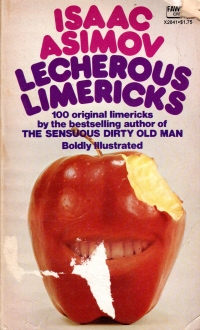
My son had a poetry assignment for his seventh grade language arts class, and part of that assignment was to write poems in a variety of styles, including a limerick. Which seems odd to me, gentle reader, as the limerick as properly understood, is a bit off-color in its humor most of the time. In a show of solidarity and to inspire the boy to write the poems, my beautiful wife said that she and I would also write poems, so I scratched out some lines of a clean limerick that isn’t very good. And isn’t very done yet.
But the exercise reminded me of this book, and I remembered its approximate location, so I thought I might browse it while watching football. But it is, erm, “Boldly Illustrated,” and a quick glance at it indicated that I should not read this where my children might see it. For although by the time I was his age, I had illicitly commandeered my mother’s copy of the Frank O. Pinion Dirty Joke book and memorized enough of them to be slightly less unpopular at North Jefferson Middle School. But I’m not sure how much off color humor I want to introduce to my son and, by extension, his Christian school. So I read this book under the blankets in the dark, and I’ll make sure it’s hidden on my bookshelves again where he won’t casually find it.
So. The book is 100 off color limericks by Isaac Asimov. They’re clever for their form, but what makes the book is that Asimov talks about the form in the beginning, and with each limerick he writes a couple of sentences to a couple paragraphs that explain what he thinks of them, how his wife might have helped with it, the circumstances in which he wrote it, and other asides from the mind of Asimov. A book of 100 limericks by Asimov would be less than 200 pages of Asimov talking about his limericks.
So I enjoyed it.
A couple things of note:
Asimov used the word lollapalooza before the word became cool and then uncool again because of the musical festival.
One of the limericks has a hand written notation “To Martha From the PE Wall” in tidy cursive on a limerick about male masturbation. I wonder what that’s all about.
A good read for an adult fan of Asimov. Unfortunately, these days, is there any other kind?
Modern American society has broken down to the point that people have to hire mentors called “life coaches” to tell them the things their parents, other family members, or peers should have or should be telling them.
As you might know, gentle reader, my own parents are dead, and my stand-offish manner and backwater blog have limited me from developing meaningful friendships with peers and mentors who could guide me to bettering myself instead of spending time maintaining a backwater blog.
But not to worry. I have a new life coach.
All will be better after bacon and a nap.
Actually, I oversell it. Roark does not steal the bacon from the table; he licks it. But now he has discovered the pan in which the bacon is cooked and which sits on the counter with lots of sweet, sweet bacon grease in it, and he has, over the last couple of days, waited for us to sit down at the breakfast table before ambling over there, minding his own business, when lick, lick, lick.
A pastor of an Assemblies of God megachurch recently took aim at yoga, saying it has “demonic roots” and warning Christians to avoid the popular activity.
Pastor John Lindell told the attendees of James River Church in Ozark — which has a congregation of about 10,500, according to a 2016 report — that the positions in yoga were “created with demonic intent to open you up to demonic power because Hinduism is demonic.”
Members of Springfield’s yoga community are now speaking out.
A Christian yogi says his practice has brought him closer to God and wants others to know that it’s possible to do sun salutations while following Christ. One owner of a yoga studio said she’s worried that small local businesses are being hurt. An instructor, feeling on edge after a Florida yoga studio was shot up last week, can’t shake a fear that someone might take the church’s anti-yoga message too far.
I am pretty sure that there’s a whole commandment about not following other religions somewhere, and I didn’t see any footnotes in it about it being okay to follow other religions’ practices with your fingers crossed or not believing in the actual ontology behind the practices. It doesn’t matter if Asherah poles help with television reception. They’re still the practices of another religion, and a lot of bad things happen in the old testament when Israel does something similar.
To quote Mohatma Gandhi, “B*tch, you do realize this is my actual religion, right?”
Now, you know, gentle reader, I read a lot of books about Eastern religions and philosophy here at MfBJN (such as The Upanishads), so I’m not exactly a firebreathing fundamentalist Christian out to whip believers into a frenzy.
But practicing yoga while undereducated does put yoga practitioners in a bad spot. Either they have to acknowledge the ontology and origins of yoga and its conflict with Christian teachings, or they have to say that they’re just a fitness program with a veneer of Otherness for flavor. Or defend not knowing where this stuff comes from and what it might mean. This is the standard procedure, but defending it or acknowledging one’s cognitive dissonance is not.
Because part of being Christian, unlike part of being Buddhist and many other non-monotheistic religions, means you can’t pick and choose spirituality from a variety of sources and traditions to blend together to make your own special salad. That’s my understanding of it, anyway.
This pastor is just trying to remind members of his congregation about it.
Yes. It’s still illegal under federal law. Federal officials currently serving in the Trump administration, such as Attorney General Jeff Sessions, have opposed marijuana reform in general.
Now that it’s passed, however, the Springfield News-Leader wants to make sure that those who violate Federal law obey Federal law:
Medical marijuana may have been legalized in Missouri, but those who opt to take advantage will be jeopardizing their Second Amendment right to buy and possess a gun.
Under federal law, Missouri residents won’t legally be able to have a license for medical marijuana and possess a firearm at the same time, even though voters overwhelmingly added Amendment 2 to the Missouri Constitution on Tuesday.
The article is actually a pretty good exploration of the intersection of the two and the current law enforcement climate and not just an exhortation to give up your guns.
But I certainly didn’t see a full article about how the state measure violated Federal law before the vote.
So, once again, I found myself in Springfield with a little time before picking up my kids from school, and Hooked on Books is practically across the street from their school, and so….
I bought a number of books from the back room and the discount carts which were conveniently located in the philosophy aisle because it was raining outside.
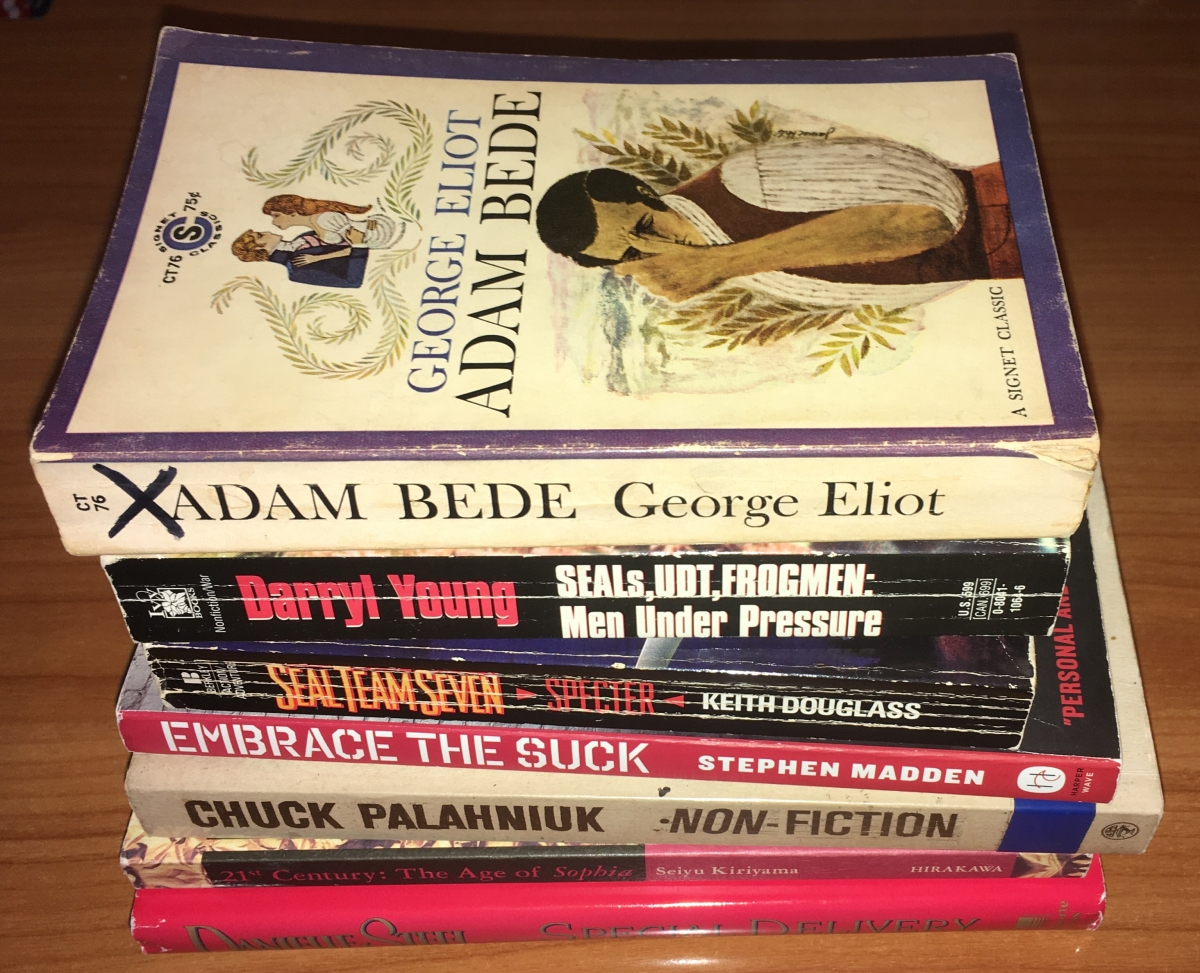
I got:
Adam Bede by George Eliot. I’ll let you know if he proves to be venerable.
SEALs, UDT, Frogmen: Men Under Pressure by Darryl Young. To see how his work tracks with what Marcinko has been telling me.
Seal Team Seven: Specter by Keith Douglass. Ditto. Or Ibid.
Embrace the Suck by Stephen Madden. Strangely enough, this is not more of the same; it’s a guy who tries Cross Fit for a year.
Non-Fiction by Chuck Palahniuk. We’ll see. It’s the author of Fight Club, so you never know.
21st Century: The Age of Sophia by Seiyu Kiriyama. I paid full, well, full used price for this book because it’s the intersection of Buddhism and Greek philosophy written by a Buddhist monk.
Special Delivery by Danielle Steel. I’ve wanted to read one of her best-selling novels since I read her collection of love poems last year. If I like it, there are a lot more on the dollar cart at Hooked on Books.
It’s a total of nine dollars’ worth of time killing.
So last week’s Springfield Business Journal had an editorial column in the wake of the recent (as of last week) shooting at a synagogue:
It’s a bit of a stretch to include a noose, which is more associated with anti-black attacks than anti-Semitic attacks, although white people were lynched as well. And the A as a KKK hood, okay, sort of.
But what’s with the snake in the middle?
Oh.
I see.
Some simpleton with a steady hand equates wanting limited government with anti-Semitism straight up.
I know, you come here for the incisive political coverage, gentle reader (well, reader of 2004, maybe, although the political coverage was about the same on the Mohs scale incisivity, but there were fewer blogs to choose from, so more bored readers chose MfBJN). But some days, all I have are cat memes.
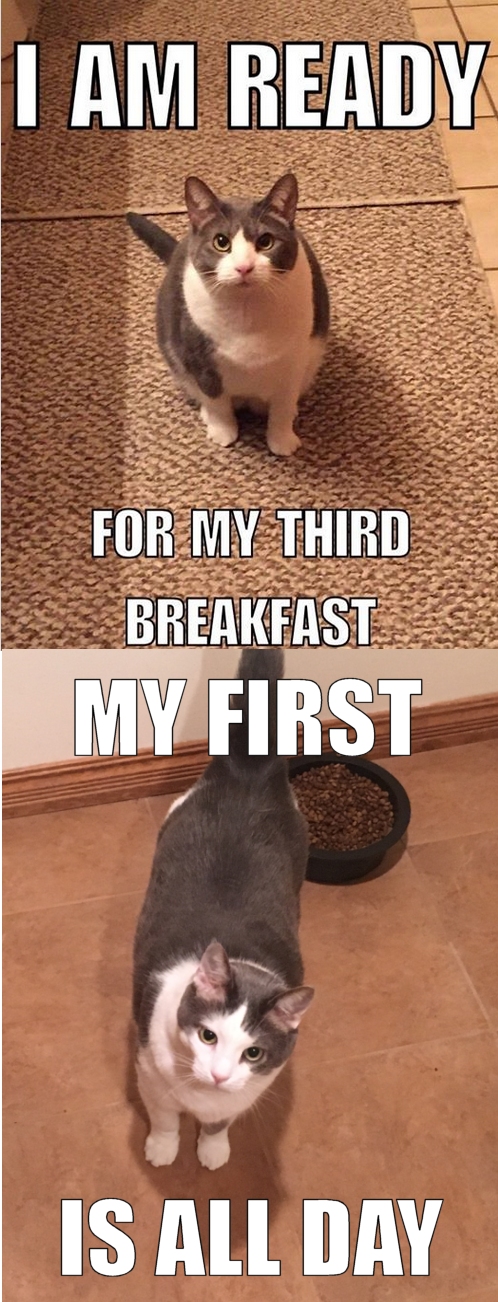
With the five cats we have, it’s pretty clear that any cat picture I see, we will have a cat that looks like that (see also this).
So when I saw a meme on my cousin-in-law’s Facebook wall, I knew my cat had to respond.
Our newest cat is quite an eater. He came into the house weighing something like nine pounds, and now he’s twice that. We call him “Foot” although his chip name is Mercury because he is always where we are, at our feet, and often stopping. If you’re headed to the downstairs refrigerator or coffee pot, near his food, he will take up a position trotting ahead of you, stopping about every step to turn his head to see if you’re following, and when we get there, he’ll have a couple of bites.
Clearly, he still suffers from some sort of food insecurity even though he’s got two bowls of food to choose from all day long.
Yesterday, Missourians despite my inclinations voted to legalize “medical” marijuana in every way that did not involve making a local doctor/surgeon/accident-chasing attorney the kingpin.
All the cool kids are doing it, so I thought I would mention how I voted this year:
I voted “No” on all ballot initiatives.
I can understand the pithy and simple power-to-the-people reasoning behind the ballot initiative principle. You want a way to get around legislators who are in the pocket of Big Business or Big Whackadoodle, so you get a number of people to sign onto your petition, and it gets put on the ballot, and if the majority of Missourians vote for it, it becomes law.
Except that’s not how it really works. Instead, you get a powerful interest group that can’t get their laws passed in the legislature to pay a lot of people to go a lot of places to try to squeeze out enough signatures on a petition after all the fakes are knocked off it to get the petition on the ballot. Then, if you have a friendly Secretary of State, it doesn’t get rewritten and gets put onto a ballot with a low turnout that your passionate partisans will turn out for to ensure it gets passed and then it gets written into the state constitution and is therefore almost untouchable, or you get an unfriendly Secretary of State that obfuscates it and puts it onto a ballot where your partisans will be overwhelmed by the other side.
The point is that the ballot initiative process is as open to as much gimcrackery as the normal legislative process, but it carries with it a fake veneer of democracy, but really it’s more of “One Man, One Vote, Once.”
Thanks, but I’d rather leave it to the actual legislators who can monkey with the laws and then unmonkey with the laws.
I voted “No” on all judge and justice retention.
Here in Missouri, we get to vote whether judges and justices should continue to serve in office. Unless one does something particularly egregious, voters will retain them on the whole, but I don’t ever want it to be unanimous, so I vote against it on principle.
I voted straight ticket Republican except for the auditors.
I voted for the Democrats in the state and county auditor positions because, if elected, they’ll hound the Republicans as a matter of course and act as a check to make sure the elected Republicans do things properly, without impropriety or else face embarrassment or a primary loss the next election. I’m not generally afraid of Democrats in state and local positions, as they’re accountable to the local or state voters, but when they go national, they’re beholden to the national party. For example, not all auditors make good senators.
And now that I’ve voted, I’m not going to spend the evening watching the election results.
And when the morning comes, no matter the results, life will go on much as it has before.
Perhaps this post will read a little like a humblebrag, but it’s for something I didn’t accomplish, so I cannot really take credit for it in any way, shape or form.
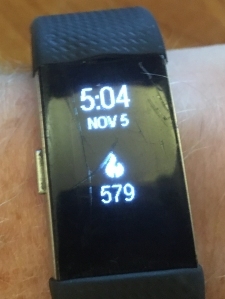
But when I read the nutrition information on the back of food products, and it says, “Based on a 2000 calorie a day diet….”
I laugh and laugh at the presumption. Yesterday, I got up at 5:00 as is my wont, and according to my FitBit, I had already burned 579 calories.
Friends, this would mean I would burn about 2800 calories a day sleeping (and going to the bathroom once or twice).
That might be a little high for the sleeping burn, but if I exercise at all, I get close to 4000 calories a day on the FitBit. Extra active days, like a couple of weeks ago when I ran a 5k and then shoveled mulch for my children’s school, I burned nearly 5000.
Of course, these are FitBit calories, and the numbers on the FitBit are precise but not necessarily accurate. It does kind of match up with what I have experienced all my life. How long it took me to put on any weight at all even when I lifted weights regularly. The fact that my sainted mother lived on nothing but junk food and weighed about 100 pounds her entire life.
So excuse me if I don’t watch what I eat. There’s so much of it; I can’t see it all.
Here at Nogglestead, we will clearly hang anything on our walls.
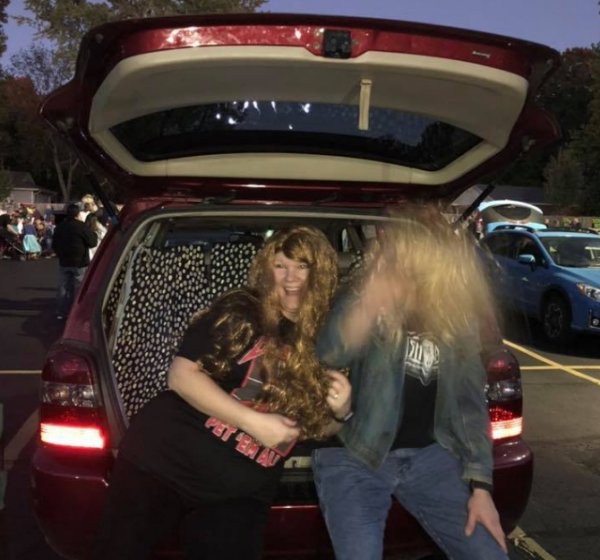
As I mentioned, our Trunk or Treat motif this year was Rock Concert, with the aforedepicted heavy metal costumes. Additionally, I made a little concert for the cargo area of our Highlander:
Yes, that is Bazooka on the lead vocals, Quick Kick on the bass, and Roadblock on the lead guitar.
It was a late-breaking thing; although I had mentioned the idea early in October, the family was not enthusiastic about it until I received my wig, ordered from Amazon. Then the boys were all on it. So I assembled a stage out of scrap pine from martial arts-broken boards, printed out some small guitars and taped them to toothpicks for structure and so the GI Joe figures could grip them.
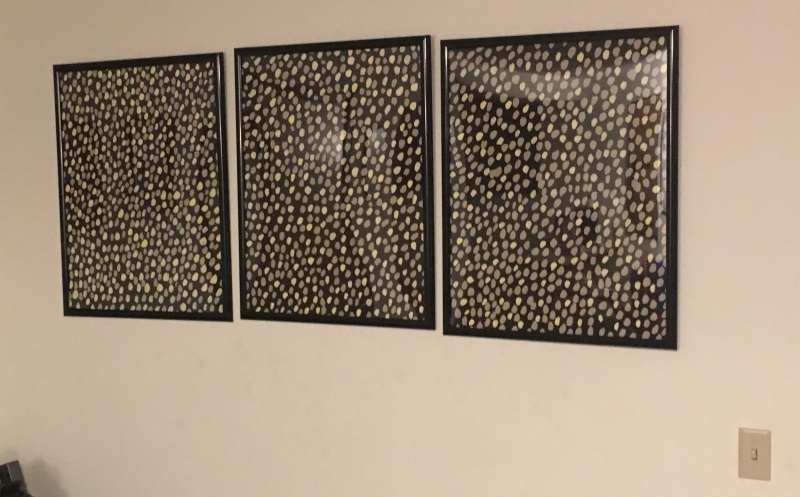
And the stadium faces backdrop. That was the hardest part. I took some thin posterboard we had for school projects and painted five panels black, with several coats of black each. Then, I mixed up a flesh-colored-ish shade of acryllic paint and dabbed on some faces. After that dried, I mixed a slightly different color and added other faces. I repeated that a couple of times, when they were complete, taped the panels to cardboard to ensure they would stand up. And we were set.
I spent the two hours of Trunk or Treat thrashing to the Leo playing through the wireless speakers beside the stage. People asked me the next day how my neck was with all that thrashing. Nobody asked me how my back was after hours of painting those backdrops that no one noticed.
But the effort was not wasted.
I put three of them in poster frames and hung them on a bare wall in our exercise corner. Strangely enough, they brightened that corner considerably with the reflected light on the frame plastic. Even more strangely, my beautiful wife likes it.
I still have two panels left. Perhaps I’ll frame them up and put them in a silent auction sometime just to see what might be bid on them.
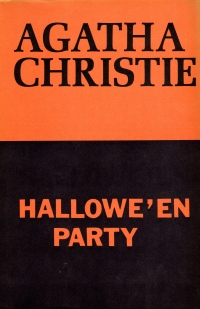
It was kismet that I would pick this book up next. I’ve been encouraging my older child to start picking up adult books instead of the half book/half comics that they aim at children these days so he could start learning more advanced writing through osmosis, and I mentioned to him that I was reading things like Agatha Christie by his age or a little older (to be honest, I think I was still on the juvie science fiction for another year or so). And it was just about Hallowe’en. So when I came across this book on my hallway to-read shelves, I knew it was the one for me right now.
When I was younger–in high school, probably–I read a lot of Agatha Christie because the libraries–the school library and the community library–had a bunch of them. So I read a bunch. Apparently, in the annals of this blog, I’ve only read one book, Elephants Can Remember, just over ten years ago. I don’t recall seeing a bunch of Agatha Christie at book sales, so I have to wonder if we the English-speaking peoples of the world, have aged out of her books faster than she stopped writing them.
This volume, like Elephants Can Remember, is a later book of Christie’s, written in 1969. So the characters are modern, or at least mod, as some of them sport sideburns and those awfully colored pants that marked the era. Mrs. Oliver, the authoress who joined Poirot in these later books, attends a Hallowe’en party where a thirteen-year-old girl is murdered after claiming to have seen a murder. Mrs. Oliver brings Poirot in to investigate, and he finds that most of the town people think that the young lady was a liar. But someone believed her.
The plot involves a forged will, an au pair who might have forged the will and disappeared, illicit trysts, and a couple of prior deaths that Poirot uncovers as he goes through the list of people who were at the preparations for the party and heard the young lady make her boast.
The twist in the book was pretty obvious, or perhaps it’s just a turn in it, and the resolution rather ended abruptly with an ending that was not hinted at effectively through the book. I didn’t reach it and say, “Oh, yeah, I should have seen that.” So it fails at that, although in retrospect, looking back oh those many decades, I don’t know if any of them actually had the kinds of endings where I thought, Of course! I should have seen it! They either had twists I saw coming a mile away or endings like this one, where you think the detective had some inside information or that the convolutions in the plot revealed only convolutions in the plotting.
At any rate, it was a quick enough read. As I mentioned, I don’t see a lot of Agatha Christie books at the book sales, but then again, I’m generally not going over the fiction section at the Friends of the Springfield-Greene County Library book sale anyway. So unless I see them in a garage sale or the Friends of the Christian County Library, I won’t see them if they are there. I’d add some to my to-read shelves if I found them, but I don’t. So make of that convoluted endorsement what you will.
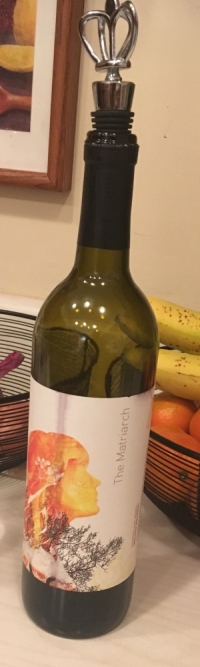
I grilled a couple of steaks last night, and I asked my beautiful wife if she would like me to pick out a bottle of wine.
What, then, are the odds that I would select something named for a song by the band Unleash the Archers?
To be clear, I did not buy a bottle of The Matriarch because it shares a name with the song, although I would have if I had the chance. The bottle came as part of a Random Number Generator Wine Club that my wife joined on a lark which sent a number of remaindered bottles from various California and Missouri wineries to our house. The Matriarch here is actually one of the better selections from the wine club. It’s a red blend, a little Malbecky, but pretty good for a Missouri wine.
If I see it at the local shops, I might pick it up. After all, I am the sort of man that dresses his whole family up as heavy metal fans for the church’s Trunk or Treat just so I have an excuse to buy an Unleash the Archers shirt.
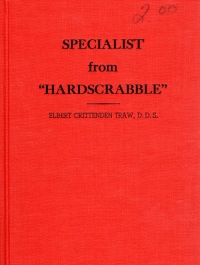 The title of this book might fit onto one of the men’s adventure paperbacks I favor or perhaps one of the series Westerns I infrequently indulge in, but instead it is a collection of reminisciences published in the 1940s or 1950s from a man born in 1875 and a graduate of the Washington University School of Dentistry in 1904. So maybe the book is from the 1960s or 1970s, but most of the stories within it come from the late part of the ninteenth and early part of the twentieth centuries.
 I read the original (Zen and the Art of Motorcycle Maintenance)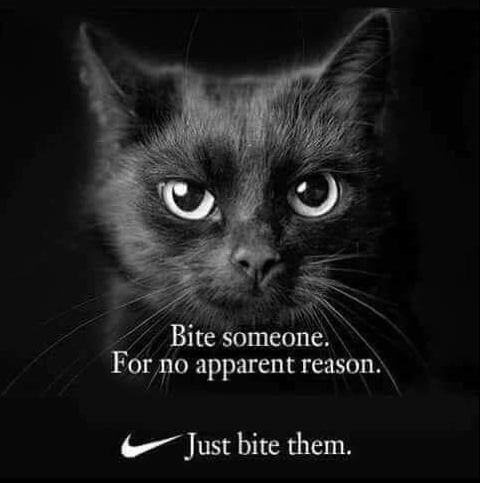
 This would have been a book to browse during football games, and indeed, that was the goal last year when this book ended up on the table beside the sofa. However, the text portion of the book is dense at the front of the book, chock full of designer names as it creates a slow-to-read name-checking evolution of the rococo style in France, Italy, Britain, and Germany. Only then does it really go into the photography illustrating the rococo style as it is.
 My son had a poetry assignment for his seventh grade language arts class, and part of that assignment was to write poems in a variety of styles, including a limerick. Which seems odd to me, gentle reader, as the limerick as properly understood, is a bit off-color in its humor most of the time. In a show of solidarity and to inspire the boy to write the poems, my beautiful wife said that she and I would also write poems, so I scratched out some lines of a clean limerick that isn’t very good. And isn’t very done yet.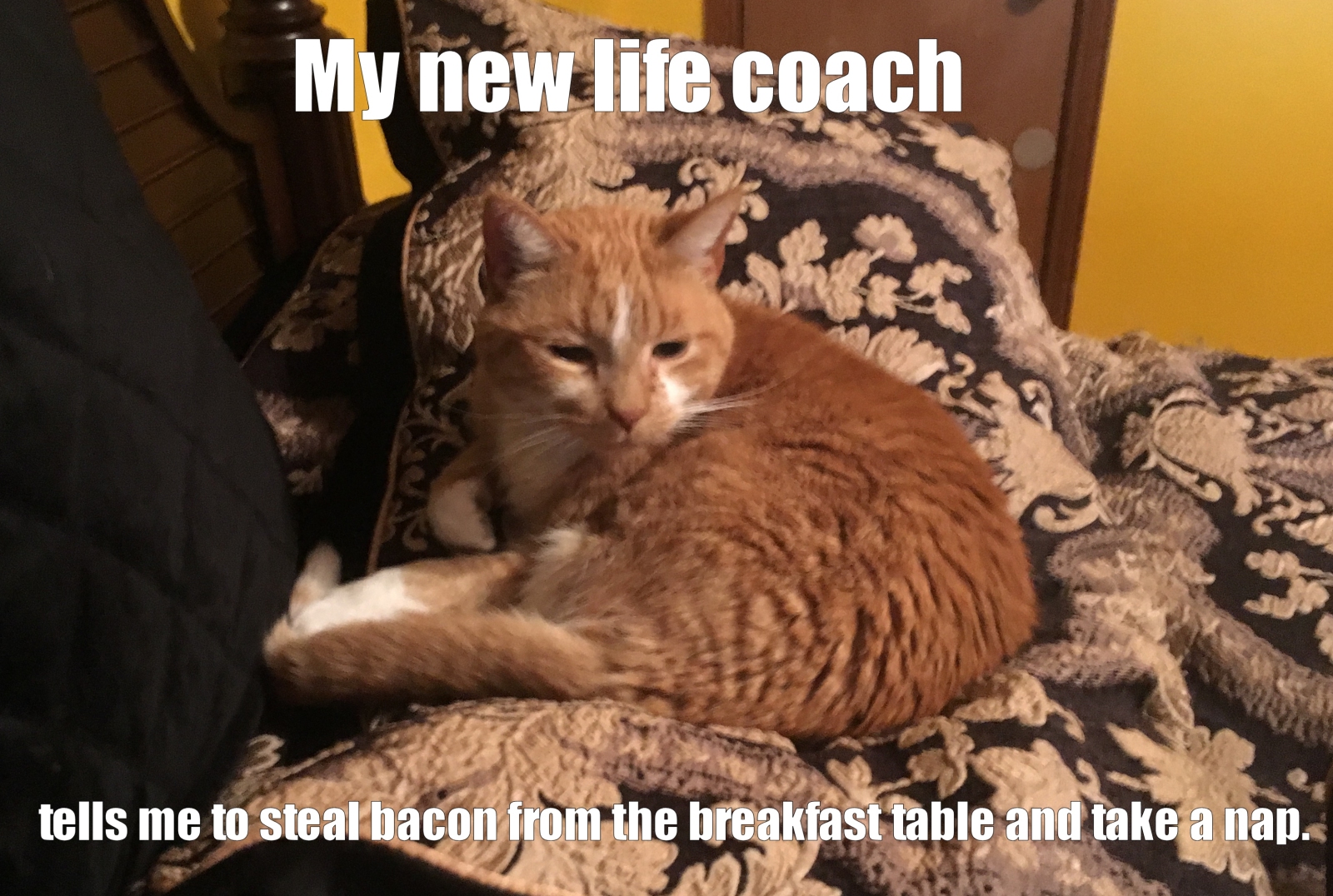





 It was kismet that I would pick this book up next. I’ve been encouraging my older child to start picking up adult books instead of the half book/half comics that they aim at children these days so he could start learning more advanced writing through osmosis, and I mentioned to him that I was reading things like Agatha Christie by his age or a little older (to be honest, I think I was still on the juvie science fiction for another year or so). And it was just about Hallowe’en. So when I came across this book on my hallway to-read shelves, I knew it was the one for me right now.
 I grilled a couple of steaks last night, and I asked my beautiful wife if she would like me to pick out a bottle of wine.