Democrats In Majority: Democratic Candidates Win All Three Georgia Senate Seats.
C’mon, man: it’s Common Core math. And Civics.
To be able to say "Noggle," you first must be able to say "Nah."
Democrats In Majority: Democratic Candidates Win All Three Georgia Senate Seats.
C’mon, man: it’s Common Core math. And Civics.
Buy My Books!
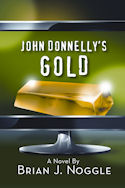
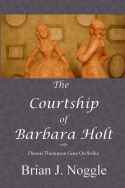
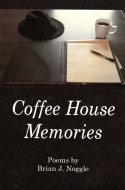
Spotted in the spam folder:

If you cannot trust that an unsolicited email with a random gibborish from a free email service return address sent to a personal email address using your mail server username as the salutation with an exclamation point in the subject line is really, really offering properly and officially licensed products, what can you trust?
I mean, it is the Internet and all.
Buy My Books!
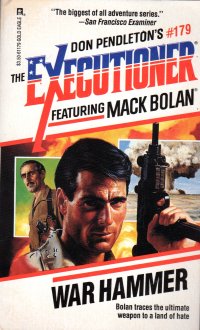 This book, read a couple days after Black Hand, brings Wuthering Heights‘s Bolan Number up to 2 the easy way.
This book is a better entry in the series–better than Black Hand anyway. In it, Bolan is on the trail of stolen nuclear triggers that are on their way from California to Iraq (which has just restarted its nuclear program after the first Gulf War). So set pieces include a couple shootouts in California, the Irish coast, and Iraq after getting smuggled in via Turkey.
At any rate, the author clearly has read some of the other Executioner novels at least–he blends some Bolan philosophizing sections into the story and uses similar phrases like “numbers running down” that undoubtedly are mentioned in the outlines of the books given to the house authors but some handle them more deftly than others. The tactics and firing Uzis from the hip to great effect are more informed by watching movies than, I don’t know, serving in the military or firing an actual gun–much less playing realistic military games from the 21st century. As I’ve not done two of those three, I am an armchair novel writer when I criticise that, I know, but still.
A quick read, and then back to the moors of Scotland briefly.
Buy My Books!
You know, being a remote-first employee means that most of my contact with co-workers is through the phone (not even video calls that much so far). Which means I only get to know my co-workers based on conversations on those calls, or often the snippets I glean from phone calls–my last job had massive phone calls, with lots of people on the phone but only a couple speaking.
So it’s only after I left that I learned that one of my former bosses had a degree in philosophy and wrote and self-published a book about dreams.
Another, apparently, is a musician who has written and recorded a couple of Christian songs on YouTube:
Huh.
And to think, the virtual crowd I fell into at that job was the multi-sport malcreants.
Maybe I should have talked to more people. Maybe next time.
Buy My Books!
So today, I wore a suit to church because it was a little cooler, and the suit jacket would be a little warmer just in case I spun the car out on some hidden ice on the way.
As it happened, I did not; and I remembered why I don’t like to wear the suit(s) to church. When I got them a couple years back, the people at the suit shop tailored them to fit rather tightly (and the weight I’ve gained, I have recently regained in the shoulders which make the vest tight across the back, than you very much). Which makes it difficult to carry my usual assortment of just-in-case items (flashlight, lighter, multi-tool, slimmed down key set with bespoke fob) plus notepad, pen, small phone, and trifold wallet. I mean, I generally have to get carpenters’ jeans or extra waist inches just to fit my fat thighs into them, but I have really have come to appreciate the extra pocket space as well.
And in the first years of the Current Unpleasantness, I’ve had to carry a disposable face mask.
Which I wore this morning as a modern pocket square.
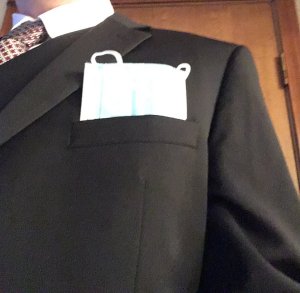
It’s just the thing for the virtue-signaling fashion-forward gentleman in 2021.
Except me. I don’t think I’ll be in this suit until the next funeral. Which is hopefully not in 2021.
Buy My Books!
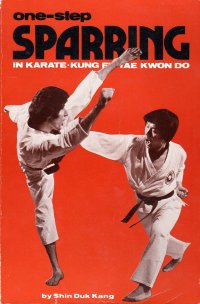 Strangely enough, I started this book before I read Boxer’s Start-Up (which means this does not count against Wuthering Heights‘s Bolan Number either). However, I put it down and on my chairside table to read towards the end and quite forgot about it for a bit. Enough to push it from the 2020 reading list to the 2021 reading list, which, combined with starting the Reading Year in the last week of the preceding year, explains how I have read four books already in 2021. Through government and corporate accounting rules.
At any rate, this book, as it indicates, includes a number of techniques and drills, kata even, for practicing sparring. It focuses a lot on tae kwon do style kicks, which means really pretty big kicks to the head or higher; my school teaches them, but the crescent kick is a sweeping front side kick where your leg comes up sideways and strikes with the instep, and although it’s a nice distraction–I use it to hide a second strike following it–it plays a large role in a lot of the drills and kata here.
As I have mentioned, these books are best for people who study the arts and want something to review when not in class. This book formerly belonged to a student at a martial arts school–he has written notes beside different techniques along when he should be proficient at them and minor variations (knife hand instead of a punch, for example).
So I didn’t get a lot out of it myself; I am familiar with many of the strikes, and as far as the sparring drills go, I’d have to have a partner to put them into effect–and my school has its own drills, so when I’m partnered up, I’m doing things my kyoshi has selected. I got bogged down in the last bit of it. The last section–60 of the books 140 pages, not quite half, is some thirty different kata that are attack/counterattack drills this are between six and ten sentences and six and nine photos of the two-person kata. So I set it down and might have forgotten about it except I finished an Executioner novel and did not want to pick up Wuthering Heights again right before bed–and I rediscovered this book instead.
So it was probably more worthwhile for the preceding owner. Who might well have been studying martial arts even before The Karate Kid, if you can imagine such a thing.
Buy My Books!
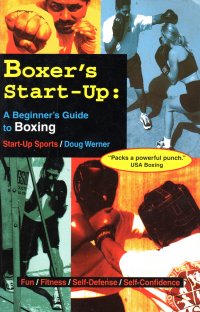 Technically, this book does not count against Wuthering Heights‘s Bolan Number as I started reading this book before Wuthering Heights. Also, it’s not a cheap paperback the likes of which will fill my time between chapters of Wuthering Heights. Which, I assure you, I am actually reading.
At any rate, I picked this book up in December at ABC Books. As you know, I work my way counter-clockwise through my two aisles, the first of which is the martial arts/football/artist monograph aisle (with the local authors at the front of the store at the end of the aisle). This book was in the Boxing section which is mostly biographies and auto-biographies of boxers. So I don’t tend to look too closely in it, but by this time I have basically bought all the martial art books that are not about Tai Chi Walking, whatever that is. Come to think of it, somebody else is buying martial arts books up there–some of the ones I have seen in the past but have not bought aren’t there any more, either–which means nobody likes the Tai Chi Walking books, I guess. Me or this other guy. Come on, we know it’s a guy.
I digress. As I mentioned I looked over the boxing section and picked this up because it’s a how-to book about boxing. #9 in a series, presumably about taking up a sport you’ve never done before. The author here talks about his experience fencing, so I presume that he has also done the article about fencing in the book.
As I might have mentioned (or mention all the time), my martial arts school emphasizes boxing over tae kwon do hand techniques, so I am a bit familiar with the strikes in the book–the jab, the cross, the hook, and the upper-cut. Boxing, apparently, does not emphasize as much hip rotation as our school does.
Of course, I’m all about the comparisons to the martial arts as I’ve been trained. The biggest difference is the fighting stance–this book emphasizes a more fencing-style stance, which presents more of your side to the opponent. It closes off target areas on your own body, but it also puts one side of your body out-of-range for attacks–which might be a bigger deal in martial arts, where feet are employed and where you’re supposed to be ambidextrous, being able to attack with the same combinations (but reversed) if you present your other side.
So the book was a bit of review for me in spots, but it did give me some ideas for drills, such as a head movement drill–I am not so good at head movement (and given how sparsely I’ve attended class the last year and a half, I am probably not so good at sparring at all), so I have started doing some of the rythmic movement that I read about in the book. I watched some boxing a while back, and those guys slip punches very fast indeed.
One definite improvement in this book versus other martial arts books I’ve read is instead of a pair of photos showing before and after the strike, the book includes at least three, with one in process, and the images often have callouts and lines to indicate focus or planes:
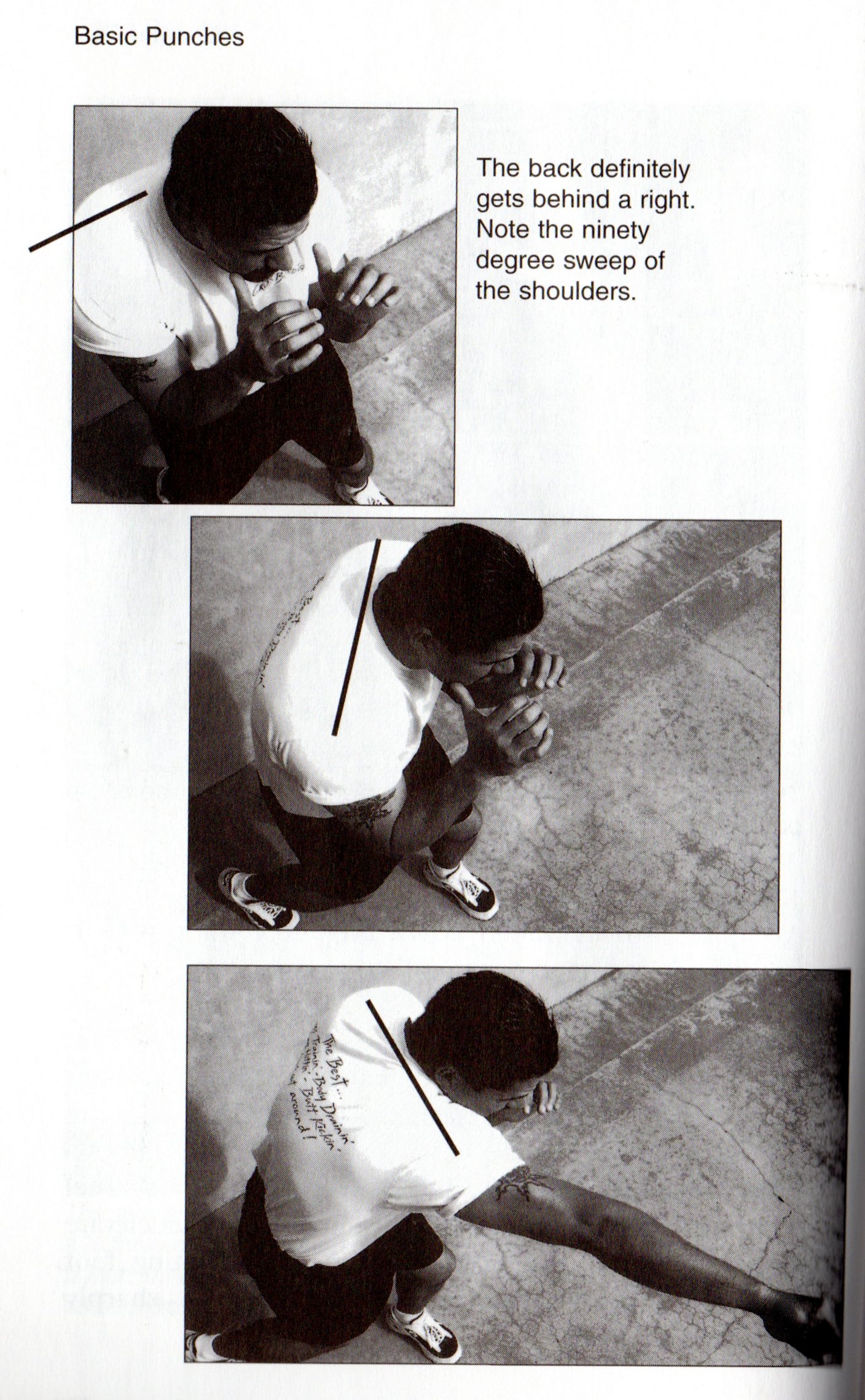
That is very helpful, indeed.
The book runs 150 pages plus a glossary; only about two-thirds of it is technique and whatnot. The last third are a history of boxing up until the turn of the century and a journal of the author’s individual lessons with a boxing coach. Interesting, I suppose, but not what I am looking for. Although also interesting is that the book has an AOL email address for the amateur boxing group and a fax number to contact them. Wow, twenty years, huh? I cannot imagine that I would have picked up a book like this for practical information twenty years ago. To research for a novel, perhaps, but to hone my technique? Who knows what the next 20 will bring? Sorry, that’s a little extra reflection you get in a book report around the turn of the year and the turn of a duodecade.
Buy My Books!
I heard clicked through an Instapundit link to an article talking about the belief that eating blackeyed peas was good luck on New Year’s Day, so I thought, why not?
We stopped at the grocery store yesterday afternoon, and I saw that dry blackeyed peas should soak overnight and simmer for two hours. Too much work for good luck and prosperity for a whole year that’s not even a leap year.
So I went through the stocks at Nogglestead. As you might know, gentle reader, I have a couple cases cans on hand just in case, and I have been hitting the beans section of the locally owned grocery pretty frequently. But although I have black beans (in abundance), chili beans, Garbanzo beans, navy beans, and green beans in abundance, I had no blackeyed peas (or green peas untouched by violence either, for that matter).
I did, however, have purple hull peas, which look a lot like blackeyed peas. Which I only bought one can of because I’d never had them before.
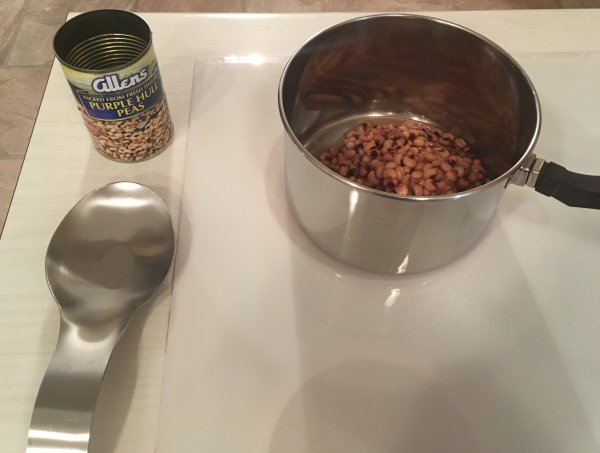
I really hope that I have not done some sort of fortune-inversion by eating these instead.
Whatever happens in 2021, it’s on me. I take responsibility.
Buy My Books!
The front page of NYPost.com:

On top, we have the paper going after a Hollywood evangelical for holding an event to pray for the country. The tone, of course, is look at the funny Christian.
The next headline down? Protesters vandalize St. Patrick’s Cathedral early New Year’s Day.
I ask you, gentle reader: Are these headlines culturally related? I would think so. I won’t say that Christians are the only group that one can easily marginalize safely in this, the third decade of the 21st century–skeptics who don’t believe in Received ScienceTM also come to mind. But this looks to be an attempt to dunk on a Christian who was on television before the journalist who wrote the story was born. And othering the Christians is what leads to vandalism against Christians and perhaps eventual violence against Christians. It’s happened before, and it happens now elsewhere in the world.
Buy My Books!
Well, a realization. Which should have been obvious.
Diana Krall is not Diane Schuur.
I know, it should be obvious. Really, they’ve both just got a moon goddess first name and a one syllable last name who are jazz singers and pianists. But that was enough to confuse me. Not that I gave it a lot of thought, but….
I mean, they don’t sound that much alike:
Diane Schuur:
Diana Krall:
Diana Krall gets more play on WSIE, though, and every time until I heard her yesterday, I thought she was Diane Schuur. Because the names are close.
My apologies to Mrs. Elvis Costello.
Buy My Books!
2020 is hindsight.
(Prophecy here. This post courtesy of post scheduling from a year and a half ago.)
Buy My Books!
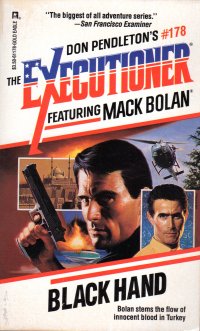 Well, gentle reader, I now have a new metric for Classical literature. Out: The Anna Karenina moment where I’m reading a long piece of literature and determine I could have read a whole other book by that point. The new metric is the Bolan number: The number of Mack Bolan or other paperbacks that I read while reading another piece of literature. This is the first Bolan book that I’ve read while going through Wuthering Heights, and Wuthering Heights will have a Bolan Number greater than 1.
But we’re not here to talk about Wuthering Heights; we’re here to talk about Black Hand, a novel that finds Bolan in Turkey after an attack on the American embassy that is laughably underguarded ten years after Beirut. He teams with a director of counter-terrorism and then an attractive sub-director of terrorism to free some hostages and smash the terrorist group, which is five people. Well, clearly, a diminishing number of people once Bolan gets involved, but they certainly seem to punch above their weight.
So it’s not one of the better entries in the series. One incident in the book that I read out loud to my poor long-suffering but beautiful wife was when a terrorist invaded a hospital to kill the anti-terrorism director. He bypasses a supply closet, shoots a surgeon in the head while the surgeon is in a break room, hides the body, and puts on the surgeon’s white coat as a disguise. Except why hide the body after making a mess in the break room? And just how white is the lab coat going to be after that gunshot luridly removes the surgeon’s head?
Yeah, not one of the best entries in the series, but it helped get me through another couple chapters of Wuthering Heights.
Buy My Books!
The Air Force Is Building a Spacecraft That Will Beam Solar Power to Earth
(Link via VodkaPundit at Instapundit.)
Buy My Books!
Well, gentle reader, as you might know, I like to post a recap of my annual reading to look at some of the trends I discover only at the end.
This year, I apparently read about 126 books this year. A little more, a little less–my book year started on December 28, 2019 with the completion of the first Jack Reacher novel and ended about the same time this year. Not depicted in this total are books that I started but did not complete, including the collected poems of Andrew Marvell, Wuthering Heights, and some reading I’ve done on the complete works of Keats and Shelley that are upstairs now and will probably gather dust until the springtime, when I read a little poetry on the deck.
With further adieu, here’s the list for 2020:
Well, 126 books is the most I have done since I’ve been keeping track in 2010ish as I ran out of cells with borders in the Excel spreadsheet–although my previous high was 2019 with 110, so I don’t know why I ran out of bordered cells at 123. I stopped the numbering at 125, and I blew past it. Strangely enough, my spreadsheet was missing three titles that I added at the end when going back through the Book Report category to make this post.
I think I padded out the numbers a bunch this year because I read a lot of poetry, plays, and artistic monographs. The only big piece of literature I read was Barnaby Rudge, but I also condensed the numbers by only counting various omnibus editions (five Miss Marple novels, Lord of Janissaries, and Euripedes II) as single books.
I read 10 Executioner novels. I read a lot of science fiction and a lot of local authors. I read a bunch of plays, including the aforementioned Euripedes, Eugene O’Neill, and Dylan Thomas among others. I read a lot of art monographs, but not much of artists I like.
Next year, I will read more classical literature under the influence of The English Novel audio course–although, if Wuthering Heights is any indication, I will read a lot of shorter works in between chapters.
And, of course, even at 126 books, I start the year further behind as I have surely bought more books than that. But I will never want for something to read.
Buy My Books!
Gentle reader, although I have not actually employed the one-for-me, one-for-you Christmas gift buying protocol this year, I did pick up a couple of inexpensive records at Relics the week before Christmas whilst Christmas shopping. I also spotted some Chuck Mangione records at Vintage Stock whilst I was scoping out Pink Floyd CDs for my oldest who has come of that age. As I am still present, I am trying to steer him into more David Gilmour than Roger Waters, but I can certainly speak intelligently about something he likes.
At any rate, on Monday night, we stopped by Vintage Stock for the Chuck Mangione records with the power of a $25 Visa gift card of unknown provenance that has been in my gift card collection for a while.
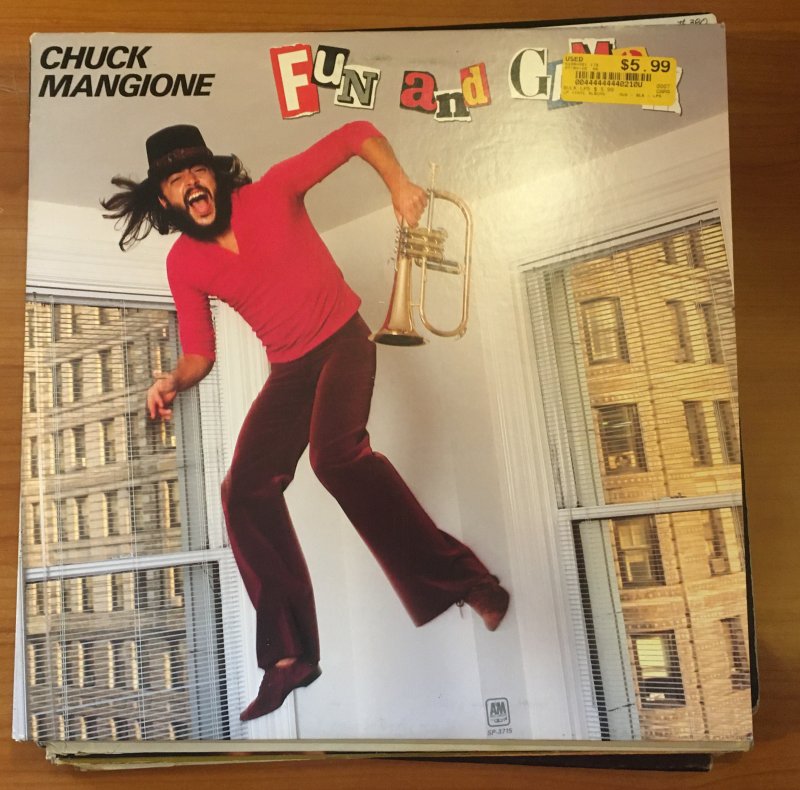
At Vintage Stock, I bought:
Anything under four dollars was buy one get one free, so I only paid for one Al Jolson record (at $2.99) and the Four Freshman (Evie was free). The total came to only $24 roughly, so I had some left on the gift card for Barnes and Noble.
At Relics, the week before Christmas, I got:
Those were less than $10 after discounts and whatnot.
I have a gift certificate for an actual record store from Christmas, gentle reader, and to be honest, I am not sure how to shop for records. Basically, I tend to acquire LPs browsing through unsorted bins or bundles at thrift stores, book sales, antique malls, and used game and music shops. So to browse records in good condition and that cost real money? I will be lost. I’ll probably find a single Herb Alpert record from the 1980s that I don’t have and that will be that.
At any rate, I think the Chuck Mangione will be the real score of the trip. I need to take another $1 flyer on a band I have not bought before to see if I can find something else to acquire cheaply. Because one day, I will organize my records, and I will be able to pick out something to fit my mood instead of what’s closest to the front of the records that matches my mood. Won’t that be nice?
Buy My Books!
The headline on the article is a little more, erm, accurate: ‘Wonder Woman 1984’ hauls in $16.7M with highest box office opening during COVID:
Released on Christmas Day, “Wonder Woman 1984” was the highest box office opening of the pandemic, hauling in $16.7 million in ticket sales in the US and $36.1 million globally, according to Warner Bros.
During the football game on Sunday night, they mentioned that Aaron Rodgers was about to break–and broke–the record for the most touchdown passes thrown in the second quarter of a regular season game.
Sports records, and apparently all records, are getting very granular indeed to make sure that every game or every movie or every celebrity somehow gets to break one in an artificially historic moment every time they make a doody.
Question to ponder: Is it more because of the modern participation trophy mindset (I have a collection of medals for runs and triathlons I have merely finished kept separate from medals for events where I actually, you know, won or placed) or is it more because commentators and talking heads of all stripes have to fill up the dead air with something? Or is it an even balance of both?
(See also: Davante Adams, Aaron Rodgers become Packers’ record-setting connection for more granular Historic Record news.)
Buy My Books!
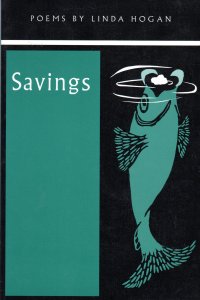 I picked up this collection of poetry at ABC Books on one of the classified gift card runs this December. I didn’t do Good Book Hunting posts on them because I bought only a couple of books each time and a handful of gift cards. I mainly hang out in the martial arts, poetry, philosophy, local, and now the classical literature sections over there. I tend to start with the local and rotate counter clockwise through these sections. I’m prone to picking up inexpensive poetry collections. I think I got this one because it’s from Coffee House Press in Minnesota, and the title is similar to my collection Coffee House Memories. So I spent $3.50 on it.
Which might have been too much.
Even though it’s from 1988, it’s still too modern for my tastes. The short line breaks and the choppy mouth feel don’t lend themselves to good, evocative images or pleasure in reading aloud (even if it’s just in your head). The poet is Native American, so there’s a lot of Mother Earth, Brother Crow tropes in it; given that there’s not much else, it really stands out in not a good way.
So someday I’ll have to pen my “What makes a good poem?” essay, and it’s the contrasts with material like this that help me really dial in on the good stuff. Most of which comes from the ninteenth century.
Buy My Books!
In addition to gift certificates for a record shop and antique mall, I also received, along with the each in the family, an ABC Books gift card. So we headed out yesterday to spend them along with a Barnes and Noble gift card the youngest had and a Visa Gift card for $25 of some unknown provenance that I found in my gift cards.
So we stopped at ABC Books and “talked with Val” for a little bit and then Vintage Stock to pick up a couple albums I spotted whilst Christmas shopping and Barnes and Noble.
Here are the books I got:
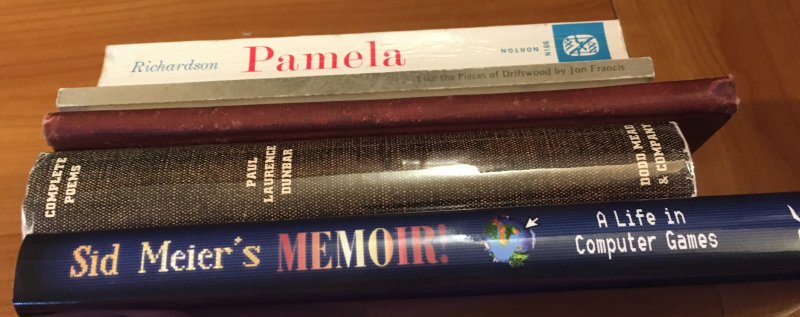
The haul includes:
Now, gentle reader, I want you to understand that I behaved myself pretty well this trip. I actually put a couple books back. For example, because I had a gift card and because the nice leather editions of books are often 25% or 50% off at ABC Books, I took a look at them first. I spotted Orwell’s Homage to Catalonia, mentioned in the audio course The World of George Orwell, I picked it up. It was priced at $275. Even with a quarter off (“Honey! I saved $70 when I talked to Val!”), I could not buy it. It’s unusual, but I also put back a $10 boxed hardback copy of Tom Jones, also mentioned in The English Novel (in the same lecture as Pamela, if I recall) because I figured I should only buy them one at a time and maybe, I don’t know, read the books I already have before buying another. Besides, by the time I might have gotten to Tom Jones, I might have found some other bit of classical literature on my shelves already. Especially if Pamela disappears into my to-read bookshelves for years. Which might happen here in a minute when I take it off of my desk.
So look at me: I put some books back which should somehow represent virtue.
I don’t know if I have mentioned this, but I have a definite pattern of browsing at ABC Books: I look at the local interest, I go down the aisle to the martial arts books, might stop by the art monographs down the same aisle, and then I go to the poetry and philosophy section (which are right next to each other), and then down that aisle to the classical literature (a new stop after listening to The English Novel. If there’s an author in the front of the shop, I’ll pick up one of that author’s books, and then I will be done. So I do all this damage to my poor bookshelves in only two aisles, essentially.
At any rate, I am excited to get started on these books. I predict I will read probably 2/3 of them in 2021 if I don’t lose them. Which I very well might.
Buy My Books!
 Alan Dean Foster might well be the greatest living science fiction writer. There, I said it. At the very least, I have enjoyed his work ever since I got a book in the Spellsinger series in middle school.
Since then, I’ve read and reported on:
It looks like it’s been nine years since I read one of his paperbacks, which is odd since I have several of his books in the to-read shelves, but if you’ve seen the to-read shelves, you’d understand why I have a wealth of things from which to choose. Given that I posted about Some Paperbacks of Note, the in middle school link above, in 2016, that means it’s been four years since I last completely dusted and shuffled the to-read shelves lineup. I should probably do that again. Likely I would shake out other Foster paperbacks to read next year.
At any rate, I have reached the point in Wuthering Heights where I want to read something else after a couple of chapters of that Literature, so this was just the thing.
In it, a low-level thief kills a jewelry store owner who won’t pay protection to the local crime boss and then kills the crime boss’s killers who come for him because he’s… different. So he works his way up the levels, and that is numbered levels, of being an illegal, and when some of the political powerbrokers on Terra take an interest in him, he pulls a trick to become legal businessman, again starting at a low level number and working his way up. He makes an alliance, essentially becoming a spy for an alien race but seems to play both humanity and the aliens off of each other until a grander scheme comes to fruition–allying the humans and these aliens against a menace from the galactic core.
The first half of the book focuses on the main character himself and deals with how he goes about what he’s doing; the second shifts to a psychologist of the alien race who suspects the main character has some sort of plot going against his race and tries to thwart him–all the while playing into his hands. The book ends with a short resolution where these antagonists talk it over and discover that the main character does all his plotting, including his latest, a mocked-up alien armada that looks as though it is about to invade the combined spaces of the humans and their new allies–he does all this just because he does not want anything to have control over him. Also, the improved commercial environment makes the humans, their new friends, and the man himself richer.
So ultimately, it’s a little thin, but it’s a roaring read. I thought the ultimate twist would be that it was some sort of video game, what with the marking levels playing so much of a part early. That was not the case, though. But a fun read, interesting characters–the main character is an amoral, pragmatic man much like say Raymond Reddington in the television series The Blacklist or similar anti-heroes that abound here in the 21st century. It seems a bit ahead of its time, but I am sure one could find other examples of it in other works preceding this one.
Buy My Books!
Tesla’s new Boombox feature will let car owners fart at unsuspecting neighbors:
Tesla’s new holiday update will finally give people the ability to use a new Boombox mode, which can broadcast custom audio on the outside of the car (hence the name). As is common with new Tesla features, Boombox combines real utility with lowbrow humor: owners can use fart and goat sounds in lieu of normal, boring honking sounds car horns usually make.
(Link via Ace of Spades HQ.)
Buy My Books!