Book Report: Catch a Poem by the Tale by Michelle Monet (2016)

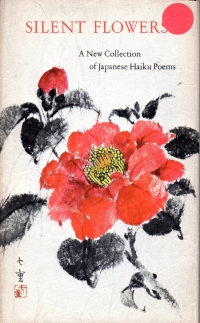
Book coverMy beautiful wife bought this book from a Facebook friend because a portion of the proceeds went to help people recover from the Tennessee wild fires last year. She might have given it to me, or I might have taken it from her in a fit of kleptomania. Regardless, I started working through it during the football season as I often do such volumes of poetry, and I recently picked it back up from the stack of books beside the sofa where some of the books have been sitting for several football seasons awaiting my perusal. It’s like the Rooneyfication of reading materials over there.

At any rate, the poet is a three letter woman with this volume of poetry: She is a former professional singer and has appeared on stage on multiple continents; she followed that up with a visual arts (drawing and, one assumes, sculpture) period that included traveling to arts fairs (revealed in the book). Then she decided to take up poetry, and the result is this book.

It’s not a bad book, but it is a bit of a doodle book of poetry. The author includes a number of poems that are just noodling with words and poetry. Much of the work lacks a refining touch. There are some turns of phrase here and there that are pretty good, but mostly it’s just self-expression.

Hey, I’m not knocking it. I’m finta do my own collection of poetry one of these days. The meaning of poetry comes from what effect it has on you, the individual. This particular collection didn’t resonate with me, but I’m more of a classicist when it comes to poetry. Your mileage may vary.

Buy My Books!
Buy John Donnelly's Gold Buy The Courtship of Barbara Holt Buy Coffee House Memories

Book Report: A Knight and His Weapons (Second Edition) by Ewart Oakeshott (1997)

Book coverThis book is a short discourse on the development of weapons from the middle of the first millennium to the middle of the second, but the focus is definitely on the period from roughly 1000-1500 AD. It says “Knight,” after all.

The chapters are broken down into weapon groupings: Spear and Lance; Axe, Mace, and Hammer; Sword and Dagger; and Early Firearms. The individual chapters are told in a bit of rambling discourse style, as though the author were speaking off-the-cuff, although there are a number of black-and-white illustrations included to show the weapon innovations as he talks about them. Unfortunately, these illustrations are a bit crude and might have made the text clearer if they were not.

At any rate, it was an hour or two through, as it only is a shade over 100 pages plus glossary and index. I learned one thing, for sure: I need a glaive in my personal collection.

Also, even though Ewart Oakeshott sounds like the name someone would choose in the Society for Creative Anachronism, he was a weapons collector and illustrator who definitely knew his material. It’s just that the presentation in this novel could have used some improvement with some charts and timelines and some better organization. But if all you’ve seen is the illustration in the first edition of Advanced Dungeons and Dragons, you could learn something. And by “you could,” I mean, “I did.” Although none of this material came up in the Geek Trivia Night I attended this weekend, unfortunately.

Buy My Books!
Buy John Donnelly's Gold Buy The Courtship of Barbara Holt Buy Coffee House Memories

How I Select A Book To Read

After finishing a book, I’m sometimes inspired to read another one immediately, or some life event will make me want to read something I know I have. Like today. Here is a dramatic recreation:

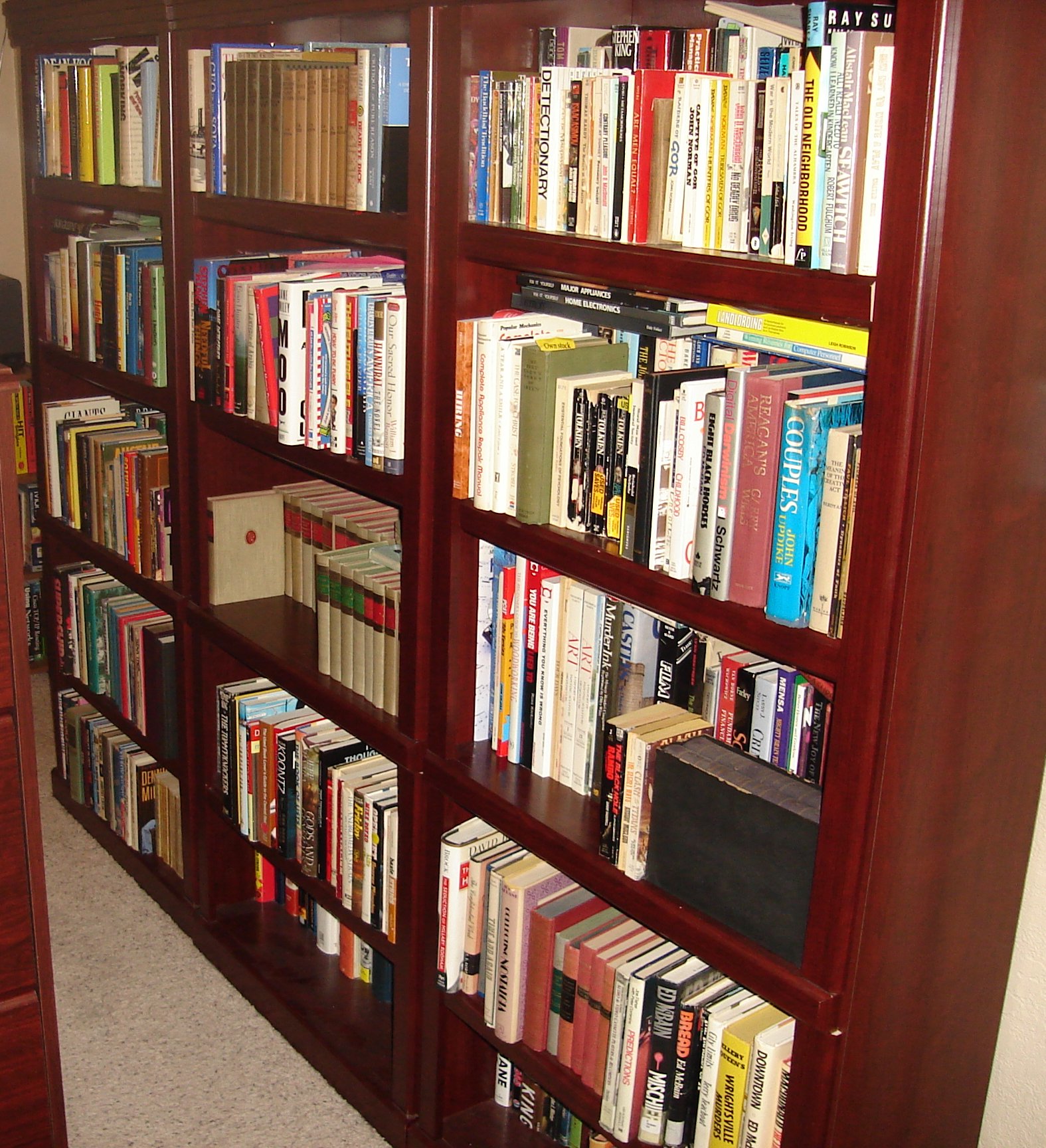
I’m listening to a Great Courses lecture series on ancient civilizations (now that I finished the series on Chinese history). We’re on the subject of Sumerian civilization, and the professor keeps mentioning Uruk and Gilgamesh, and I’ve got the epic of Gilgamesh around here somewhere. I think it’s to the left in my office….

Hmmm, I don’t see it. Maybe I moved it in the shuffle when I cleaned and turned over my library last summer.

Hey, here’s a book by Yogi Berra. I’ll read that.

So you’ll soon see a book report on that book instead of something smart like the Epic of Gilgamesh.

On the other hand, there are more people who know who Yogi Berra is than Gilgamesh. But probably not anyone under thirty.

Buy My Books!
Buy John Donnelly's Gold Buy The Courtship of Barbara Holt Buy Coffee House Memories

Book Report: The Beach Girls by John D. MacDonald (1959)

Book coverThis book is definitely a MacDonald: It features a bunch of people in a marina on the east coast of Florida in the 1950s. You’ve got a businessman from up north coming down, looking for the man who seduced his wife and caused her suicide. You’ve got a number of individual characters living on the boats and/or chartering fish boats. You’ve got big businessmen putting the squeeze on the small marina owner, trying to get her property for development. And you’ve got a climactic party on the dock.

That said, it’s not a particular stand out volume in his work. It has his trademark outstanding writing and whatnot, but the elements of the plot and the characters fall into what would later become MacDonald stock.

One thing I get a charge out of, and a way I romanticise these older works, is how easily they drop in classical literature allusions and whatnot. For example, a woman performs the talent portion of many beauty contests she’s won, and she does it by reciting:

Ef yew keep yo haid when all about yew air a-losin’ they-yurs an a-blaimin’ it on yew?

And I’m all like, “Thay-ut’s ‘If’ by Kipling.”

Mostly because I just read The Grapes of Wrath (donchewno?), and it’s all a-rife with the vernacular (albeit a different accented vernacular). Also, I’ve read my Kipling, and that’s something MacDonald and I can share. I’ve gone on about this at length, I know, but it makes me thing the middle twentieth century was a time when an author assumed the reader had read Great Books with him. But I digress.

So I got that out of it. The older I get, the more I get out of reading these books and understanding more allusions (see also A Tan and Sandy Silence and Two Other Great Mysteries). Of course, I said the same thing to Robert B. Parker almost thirty years ago.

Read it if you’re a John D. MacDonald aficionado. If you’re not, start out with some of his other works and then read it, for you will by then have become a serious John D. MacDonald aficionado.

Buy My Books!
Buy John Donnelly's Gold Buy The Courtship of Barbara Holt Buy Coffee House Memories

Meeting Robert B. Parker

The following is an essay I wrote in college. It used to be hosted at Bullets and Beer, a Spenser Fan site (and still is, for the nonce, here, but the site looks to have been defunct for a while now. For my own convenience, and because it’s my essay, dammit, I’m putting it here.


The Community Library, all that Jefferson County, Missouri, offered its few literate residents in the mid nineteen eighties, cowered on the bottom floor of a strip mall on High Ridge Boulevard. High Ridge Boulevard, the main street of High Ridge, Missouri, carried little enough traffic as it was, and not much of that traffic found its way into the small, one-room library down the hall from the license bureau and across the hall from a going-nowhere travel agency.

Me, I was trying to be a hard bitten city kid in the middle of extra-urban Missouri. Not rural enough for farms, not developed enough to qualify as suburbs, Jefferson County offered everything a growing kid without a car would not want.

I have been a fan of Robert B. Parker since my freshman year of high school. Crime fiction captivated me early, so by the time I finished middle school, I had run through all of the small Jefferson County, Missouri, Community Library’s copies of Mickey Spillane, Raymond Chandler, Gregory MacDonald, Ross MacDonald, and John D. MacDonald. I stood before the dimly-lit Mystery shelf, amid the musty, if not misty, donations, planning on another bout of Russian roulette with the unknown authors. I remembered that at the end of every episode of Spenser: For Hire, which I could only watch during summer vacation since it came on at 9 p.m., the credits revealed that the show was based on the novels by Robert B. Parker. The TV show was tolerable, so I thumbed the shelf below the Sara Paretsky, not quite to the T. Jefferson Parker. Bingo. Several books, certainly enough to check out for the week while I was in High Ridge. I would in later investigations discover one of the volunteers at the library was almost as big of a fan as I was to become. All of the Spenser novels to that date stood proudly on the bottom shelf.

I read all of them quickly; during the school lunch hour, between classes, and, as often as possible, during classes. I watched the best-seller lists in hopes that there would be a new listing by Robert B. Parker, and when there was, it was only a matter of time before the tasteful library volunteer would donate it to the library.

Spenser became my hero, my blueprint for what a man should be. My own father was four hundred miles away, so I adopted a literary surrogate. Spenser quotes poetry and can do one-armed push-ups. He is cool under fire and makes smart remarks. In short, he is a hero that lots of teenagers could look up to if they bothered to read. I did, and he was mine.

I did not draw the line at Robert B. Parker’s Spenser novels. I sought out copies of his other three books, Three Weeks in Spring, Wilderness, and Love and Glory. Through them I could determine some sort of story line for Mr. Parker’s life, and I liked what I read into the books. He obviously felt similarly toward his wife as Spenser did to Susan Silverman, and I found the real-world crossover of what I would call “real” love to be inspiring in this world of divorces and broken homes. I felt bound to this writer, a fellow crime fiction novelist, who projected himself into his character and thought himself a writer and a lover. I can only hope to be as successful someday as he is.

I also felt a surge of respect for Mr. Parker when I read an essay of his in a collection called Colloquium on Crime, in which he says that he doesn’t care what the critics say about his books; as long as the books sell, he is happy. That’s the sort of attitude I like, and the kind I might like to have when I start becoming a famous writer.

The day of the signing was sunny and cloudless in Milwaukee. I woke early, showered, shaved, and primped myself–for meeting Robert B. Parker, but also in case I had to rush directly from the book-signing to work. I took an early bus downtown and sat in the sunshine, looking through the copy of Paper Doll that I had bought when it was first available.

I got to the bookstore a few minutes early and found a line of about twenty people waiting for their chance. I caught a glimpse of him as I took my place at the end of the line. Ahead of me were others with Paper Doll in hand, many of which, I suspected, were bought at the counter display moments ago. The woman in front of me was about five six, gray hair, spectacles, and she carried her copy of the book in a paper bag. Ahead of her was a businessman probably on his lunch break. Who were these people, and why did they want his autograph? He was not their hero, at best he was just a writer they liked.

My only other experience seeing authors in bookstores was a lonely guy in the Waldenbooks in Northridge. Nobody knew who he was, and nobody dropped by to buy his book nor ask his autograph. It was rather like the book signing party attended by Rachel Wallace in the Spenser novel Looking for Rachel Wallace. There was a line here, and these people certainly didn’t feel the special kinship I do for Robert B. Parker. I wonder if many of them knew which poem of Keats that Spenser refers to in Early Autumn, or who said “Wouldn’t it be pretty to think so?” that is referred to in Double Deuce. I wonder how many of them are fans of Raymond Chandler. I hope not too many, for I suspected it would trivialize the hero worship I feel for the man.

The line moved pretty quickly, and even though it seemed like a quick forever, we were moving forward. Ahead of me, a bookstore employee commented that Mr. Parker was not allowing her to open the books to expedite the signing–Mr. Parker was doing it himself so he could talk a bit to his fans. I felt admiration swell within me.

As I had tried to get to sleep the night before, all the things I wanted to say to him ran through my mind. I knew my moment would be brief, and I wanted to say something that would strike him, impress him, or otherwise make my face something more than a forgotten blur in one of the bookstores he would visit that day. I was going to tell him that I was a senior up the road at Marquette and hyperbolize that I chose the college simply because Marty Rabb, from the book Mortal Stakes, was an alum. I wanted to tell him that in the course of playing softball, a sport he plays as well, I broke my nose and tried to calculate how many breaks behind Spenser I was. I wanted to promise an inscribed copy of my first published novel to repay him; I wanted to welcome him to Milwaukee and term it “Boston West”. All of these things I wanted to say in my minute, but of course I didn’t want to sound like a babbling idiot or some sort of shut-in who only lives life through the Spenser novels (I live life through all sorts of other novels, too).

“Freda. F-R-E-D-A” was the gray haired woman ahead of me, and she was done rather quickly. Some man in a business suit had chosen this opportunity to interview Mr. Parker at length, and he was standing to the side, talking. I stepped up to the table, fearing an anxiety attack, a dry mouth, a sudden death, none of which actually came.

He is a stocky man, of the hard build that he has put into his fictional alter-ego. He looked the same as the pictures on the books and like the interview I saw on Today, except animated in a way that television and still photographs will never capture. “A name?” he asked.

“Brian. B-R-I-A-N,” I said clearly, and surprisingly audibly. As he wrote the inscription, I picked which of the previous night’s gems I was to offer. “I’ve got to tell you, each time I re-read your novels, I always manage to catch and place another literary allusion. It’s good to see my college education being put to a positive use.”

His eyes did seem to twinkle a bit when he looked up to give my book back. “It’s a good thing,” he said, or words to that effect, and I thanked him and walked out into the blinding Milwaukee sunshine. I hoped that I at least gave him some spot of cheer, some glimmer of humor. It hardly compares with the joy his novels have given me, but it was some token.

I played it cool and waited until I got to my bus stop to see what he had written. “Brian, all best wishes, RBP” in his characteristic scrawl. I closed the book, but before my bus came I had looked at it three more times and during the ride home I began to read the book again. It still says that, and I look every once in a while to check, and I show the inscription to everyone who comes too close to me. I told everyone I saw that day that I met Robert B. Parker, and most of them asked me who he was. It did not offend me in the least; rather, it proved to me that I was among the elite, or at least the literate, or maybe just the few people left in the world who have real heroes and are proud of it.

Buy My Books!
Buy John Donnelly's Gold Buy The Courtship of Barbara Holt Buy Coffee House Memories

Book Report: Zen Mind, Beginner’s Mind by Shunryu Suzuki (1970, 1999)

Book coverIt took me two tries to read this book; I started it last year and got about halfway through it, enjoying it for what it was before taking it out of my pocket as my carry book and planning to read the last half of it all at once. That didn’t happen, so I started it again this year as my carry book and keeping it in pocket until I finished it.

The book is a collection of informal talks given by the author after sitting with students practicing zazen. The author founded the first Zen temple in the United States, and this book collects some of his insights into Zen.

So, to talk about Buddhism, I find it easy to break it into three parts, and perhaps this is something we could do with all religions. These parts include:

  • The cosmological/theological/heavy philosophy (the eternal, the afterlife, interpretation of the texts).
  • Practical philosophy (the guidance to everyday living).
  • The practice (the things to do when you’re a part of the religion).

Although this book does lightly touch upon the first (that the individual is akin to a droplet of a stream in a waterfall–part of the stream, then alone briefly, and then part of the stream; that breaking out of the cycle of karma is the goal of Zen, as karma is a self-centered way of thinking), it focuses mostly on the last two, which is fitting: the talks were give after the practicing with an eye toward improving that. Basically, it’s to sit still, in the proper posture, breathe right, and clear your mind. Okay, there’s a bit more to it than that, such as dealing with distractions within and without, but that’s it. Strangely enough, although they’re from different schools, this book and Start Here Now don’t differ much on the practice of Buddhist meditation. Perhaps the difference between Shambhala and Zen schools lie at the higher levels of philosophy.

I was most interested in the middle point above; Practical philosophy. Buddhism focuses on recognizing the transience of this life and all of its moods, emotions, and events. Buddhism is much akin to Stoicism, so much that I checked to see if the sutras might have made their way back to Rome before Zeno (the other Zeno) founded the Stoic school. It was only about a hundred years, but I wouldn’t be surprised to learn that the sutras might have made their ways west before the later thinkers made their marks. Both philosophies urge that calmness and detachment which, if you know me, you probably can tell I appreciate.

The Buddhists also talk about nothingness, but when they do not mean it like the Existentialists do. In the Buddhist sense, “nothing” is the eternal something from which everything is drawn. In the Existentialist sense, “nothing” is the opposite of that.

The book is written in the proper Buddhist style, wherein the koanesque nature might make you go “Huh?” The question of the sound of one hand clapping appears. Once you get it into your head that the Buddhist way is to see the gestalt and the particular at the same time, you can understand it better (the forest is the trees; the tree is the forest). Some of them do go into paradox territory, but as with any religion, eventually you have to make your peace and accept some paradox.

So I enjoyed the book and got some insights into detachment (and a couple of posts quoting the book–search for the wisdom of shunryu suzuki). But it’s a practical and practice primer on Buddhism, akin to the Max Lucado Christian books: A bit of how to live as a Buddhist, but without the implications and intimations of the religion that you get from the heavier books by Kierkegaard, Niebuhr, Tillich, and so on. If you believe Alex G. Smith, that’s how the Buddhists hook you, with their practical philosophy and practice, but that’s how the Christians hook you, too (Tolstoy’s favored religion features that sort of peasant, practical religion, and that explains why he equates religions based on this practical philosophy level.

Now, where was I before I started name-dropping other things I’ve read? Oh, yes: The book is a good primer into Zen Buddhist thought, especially the practical philsophy and practice components, and you could learn something from it. But don’t read it and declare yourself a Buddhist, as it really lacks a cosmological component that explains it all. Of course, the Zen would argue that you don’t need to know it, just to do Zen. But I’m a Western kid, and I expect a bit more in a complete belief system. Which is why I’ll never be a Buddhist.

Buy My Books!
Buy John Donnelly's Gold Buy The Courtship of Barbara Holt Buy Coffee House Memories

Two Road Trips to California: The Grapes of Wrath vs. On The Road

It occurs to me that two of the books I’ve read so far this year, The Grapes of Wrath and On the Road, center on road trips to California.

To recap: In The Grapes of Wrath, the Dust Bowl Effect, crop failures, and unpaid bank loans drive the Joad family from their small farm in Oklahoma and onto California, which has been promised to be a place of plenty and work for everyone but that proves to be something else. It’s rife with Hoovervilles, people who mistreat the Okies, and capitalism exploiting the little guy.

In On The Road, a veteran travels repeatedly to California by various means and goes to San Francisco to listen to jazz music, mostly.

The two books appear only 18 years apart, though, but they seem to come from entirely different ages. The Grapes of Wrath seems to have been set in a past era, like the 19th century, whereas On the Road is a slightly less modern but still modern era book. What happened in the interim?

The Chinese revolution and forced redistribution of land. World War II would seem to be the facile answer; after all, the protagonist of On the Road was a veteran of World War II, and World War II changed everything, right?

No, rather: In the 1940s, we see the electrification of the United States and how it catches up to the urban areas. As Growing Up In The Bend reminds us, rural parts of Missouri did not get electricity until the 1940s and 1950s, and many farmers were still using draft animals on their small farms within living memory even while the cities were running street cars and televisions. So the divide between the books is more a matter of city versus country than anything else.

By the time The Grapes of Wrath hit the streets, the pulps and the presses already had detective fiction a la The Maltese Falcon (1939, film in 1941) and The Big Sleep (also 1939, with the Bogart film in 1946, seven years after The Grapes of Wrath). These books have a more modern sensibility to them because they deal with urban centers in California. The Grapes of Wrath, on the other hand, deals more with the rural areas of the country at the time. By the time On The Road rolls around, the rural areas are mostly electrified and have more of the conveniences we associate with modernity.

Funny: John Steinbeck’s heroes of the rural world elected Donald Trump. Do you suppose they’d be the heroes of The Grapes of Wrath 2017?

Buy My Books!
Buy John Donnelly's Gold Buy The Courtship of Barbara Holt Buy Coffee House Memories

Book Report: Rated R by Mike Leon (2014)

Book coverYou might be asking yourself, “Self, did Brian J. get this book because of its lurid cover?” Well, not just because of its lurid cover; I found it mentioned on some blog I read (I forget which one), and I found the back of the book material interesting:

Lily loves movies–especially the bloody ones. They distract her from her broken life, even if it’s only for a few hours at a time. But something unbelievable is about to happen in the backwards little video store where she works. Someone Lily knows is not who they say they are. And when she finds out their dark secret, she will be drawn into a world of violence and destruction as fantastic as any body-count blockbuster. She will be hunted by mercenaries, a ninja master, an invincible cannibal butcher and a psychopathic super soldier more bloodthirsty than death itself. If she’s lucky, she might still be breathing when the credits roll…

It’s a self-published bit by an author with a large number of books available, so I expected something akin to a men’s adventure paperback like the Executioner series or something you’d find on Glorious Trash but with a more modern bent.

The book details how Lily becomes involved with a stone killer hiding out from his past. But he’s just like seventeen or eighteen and is a super soldier. When he defends the video store where they work together from a robber with extreme prejudice, people from his past, including some other super elite soldier types (with gimmicks) come looking for him. And his brother, perhaps even a better killer, breaks out of his special prison and goes looking for a special MacGuffin which Lily and Sid (the super soldier) must find first.

So the book has its postmodern bent, where Lily calls the MacGuffin the MacGuffin. It doesn’t take itself too seriously, and it has its tongue in cheek. But, boy Howdy, is it lurid. Lily is promiscuous, and she has numerous encounters with Sid and others. They’re not Gunsmith-level depictions of human intimacy, but they’re not couched in the-train-whistle-blows-and-the-train-goes-into-the-tunnel-symbolism, either. The fighting sequences take the worst splatter-instincts of the Gold Eagle or Death Merchant metal-and-anatomy prose Pollock portraiture and amp it up. Which might be part of the post-modern winking of the book. Which is not to say it’s poorly written–the story and text pulled me along in spite of the purple. But it’s probably not for everyone, and I’m not entirely sure it’s for me. Which might be unfortunate, since I bought a second book by the author (not in this series). Both at full price.

I enjoyed it better than The Grapes of Wrath. Also, I phrased it that way to better serve as a blurb should the author search for himself and find this review. “Better than The Grapes of Wrath”–Brian J. Noggle, author of John Donnelly’s Gold. Because I’m working on marketing myself and my Internet brand even as I jot down thoughts on things I read.

What was my point? Oh, yeah. Recommended? Well, perhaps, if you want to experience what it is like in the 21st century to read something comparably trashy to men’s adventure fiction was in the 1960s.

Buy My Books!
Buy John Donnelly's Gold Buy The Courtship of Barbara Holt Buy Coffee House Memories

A Quiz Wherein Brian J. Has A Failing Grade

The proprietrix of ABC Books shared this link because her bookstore is on’t: The 9 Best Bookstores in Missouri!.

How did I do on the quiz? The book stores I’ve visited have their titles in bold:

  1. Subterranean Books, St. Louis I went once after Sheldon sold A Collector’s Book Shop, but it wasn’t the same without Sheldon telling someone not to pull the book out by the top of the spine.
  2. Prospero’s Book Store, Kansas City My beautiful wife and I went to a number of bookstores in KC a while back, but I’m not sure that we visited this one; I’ve looked at the street view of it, and it looks familiar, but I’m not sure. We drove all over. Somewhere out in the sticks, we went to a bookstore run by one of the aforementioned Sheldon’s former employees.
  3. Yellow Dog Bookshop, Columbia I’ve never been to Yellow Dog, but I’ve been to Acorn Books, which I notice isn’t on the list, which is great because I have a twenty-year-long grudge against Ken, the owner.
  4. ABC Books Of course, I’ve been to ABC Books. The article said it’s a great place to browse on Saturdays; perhaps I would save some money if I only browsed there on Saturdays.
  5. The Book Rack, Cape Girardeau I’ve never been to Cape Girardeau, but if I had, I’d probably have visited.
  6. Hooked on Books, Springfield You, gentle reader, will remember I used to come to Hooked on Books when I visited Springfield before I moved to the area. I still do, but somehow not as often as ABC Books and neither as much as before I started limiting myself mostly to library book sales.
  7. River Read Books, Lexington I’ve never been to Lexington, either.
  8. Calvin’s Books, Branson We visited this book shop within the last year.
  9. Rose’s Bookhouse, O’Fallon What? This book shop is a mile or so away from the print shop where I worked for two years, and I never heard of it. But we’ll hit it the next time we’re in St. Louis, I’ll wager.

That’s only four of the nine, a failing grade.

I must try harder!

Buy My Books!
Buy John Donnelly's Gold Buy The Courtship of Barbara Holt Buy Coffee House Memories

Book Report: The Grapes of Wrath by John Steinbeck (1939)

Book coverI told my beautiful wife that I had previously read this book in high school because I am a compulsive liar. I actually read it, now that I think about it, probably in my modern American literature class at the university instead. I remembered the basics of the plot, but that’s about it. Otherwise, I surely would not have read it again.

Make no mistake: I like Steinbeck well enough (see my reports for Travels with Charley, The Long Valley, Tortilla Flat, and Of Mice and Men). But this book, Steinbeck’s magnus opus, is nothing but Depression era full-on socialist/communist agitprop and not a very good story.

As you might know, the plot revolves around the Joad family. Small farmers in Oklahoma, a number of bad years and overdue bank loans force the family off of their land when their home is foreclosed upon (and “accidentally” damaged by the tractor driven by an operative of the new land owner, who turns it into a portion of a larger farm. They buy an old, beaten down truck and begin a journey to California based on a handbill that they have seen promising work picking crops there. They go on the road, have some adventures incidents, and eventually reach California to find that the handbills have drawn hundreds of thousands of people in similar circumstances, and there’s not enough work to go around. So the Joads live in a Hooverville, get driven out, live in a government commune for a while, but leave to look for work up north. They find some work picking peaches, but Tom kills another man and has to go into hiding, so they go to a cotton picking operation some miles away while Tom hangs out, and when his younger sister blabs, Tom goes on the lam. Then a flood forces the remaining Joads out, and life goes on. Well, some other stuff happens, but that’s the nub of it.

Thematically, it’s all about Capitalism Bad, Substinence Farming Good, and Government Socialist Communes Good, Too.

The narrative story of the Joads is broken up by short chapters decrying some bit of capitalism or another. We get bits about the banks, bits about car salesmen, and how capitalism is destroying the country and keeping the little man down. The characters themselves are not very deep; instead, they’re ciphers of good, simple farmers buffetted by the bad winds of change. The main hero, for Pete’s sake, is a hothead who is just getting out of jail for second degree murder, and he commits a second one by the book’s end. The younger brother is ruled by his hormones. The father and uncle are unimaginative. The mother, who holds it all together by being strong, is simple. I get the sense that Steinbeck doesn’t like his characters so much as pity them (an insight I can apply to his other works, too), and that makes for characters readers cannot relate to.

The Joads are isolated, too; although they’re said to be Godly folks (especially the grandmother, who spurts out “Praise Gawd” like she’s got a Christian flavor of Tourette’s Syndrome), there’s no church, larger family, or support system when they fall on hard times. It’s a lot like when Barbara Eihenreich pretended to be poor for a book (Nickeled and Dimed: On Not Getting By In America). The poor cannot get along without government help because extended family, charity, and churches don’t exist.

So I didn’t like the book, and I wonder if it’s on so many syllabi simply because of its anti-capitalist content. It’s not even Steinbeck’s best (The Winter of Our Discontent is far better).

Reading this compassionate reflection of migrant peoples deserving their small plot of land for substinence farming, I’ve got to wonder what Steinbeck would make of current migrations, such as Mexican residents coming through those same areas of California today (and with the same economic goal/impact and resistance from existing residents of the area) and Middle Eastern refugees coming to Europe. Would Steinbeck be as sympathetic to these migrations and so disunderstanding of existing residents who might resist the new people arriving? Steinbeck shows no sympathy to Californians already in California when the Joads and other displaced people arrive.

The book also romanticises a family’s tie to a small patch of land, like five acres with a small cash crop, some dooryard crops for eating, a couple of chickens, and a couple of pigs. If only everyone could have that instead of large tracts owned by large-scale food producers using tractors! However, the economies of scale in large farms and livestock operations provide the food needed by large populations, especially urban populations, of the twentieth and twenty-first centuries. A lot of people don’t get that, and insist that hobby farms can provide everyone with what they need. This book certainly wants us to think that, but sustenance farming was mostly sustenance farming, and a couple of bad years could wipe a family out. As they did in the beginning of the book, but Steinbeck does not see a lesson in that.

That’s not to say I didn’t take something from the book: Since I’ve read it, my diction has declined a bit as I’ve started imitating Steinbeck’s representation of sloppy Okie speech, and I’ve started eating beans as whole meals. It did help me along with one of my current goals for 2017, though: I’m hoping to finish reading all the comic books I own, and as I crept along through this book at two chapters a night, I filled the rest of the reading time with comic books. I’m almost ready to start the box of comics I bought at a garage sale nine years ago. So I’m on track for that goal.

At any rate, I’m happy to be done with this book.

Buy My Books!
Buy John Donnelly's Gold Buy The Courtship of Barbara Holt Buy Coffee House Memories

Book Report: The Bookmakers by Zev Chafets (1995)

Book coverI remembered the author’s name from his New York Daily News column from early in my IT/office-based career, where I spent time during the day reading a pile of newspapers’ Web sites during the work day. So when I encountered this book at some book sale or another, I picked it up.

In it, an author, Mack Green, encounters a mugger one night. As he has been a bit on the skids recently, without a decently selling book for a couple of years, Green dares the mugger to shoot him, and when the mugger does not, takes the gun away and sends the young man running. The experience energizes him, and he decides to write a novel based on an author’s last year before committing suicide. He tells his agent, a former priest whom Mack plucked from the fold and made into a famous literary agent because he represented Mack, and he decides he’ll work with his normal publishing house and favorite editor, a fellow named Wolfowitz whom Mack plucked from an accounting position at the publishing house and made into a powerful editor because he was Mack’s editor and because he has an eye on the financial side of publishing. But the agent pays off his bookie with his share of the book’s proceeds, and the bookie then enlists a relative in Hollywood in picking up the movie rights. And the editor has had it in for Mack after a nearly forgotten (by Mack) dalliance with the editor’s wife. Many of these people think the book would be a better success if Mack killed himself at the end–or was killed and made to look like a suicide. To write the book, Mack returns to his hometown in Michigan and hooks up with a hoodlum friend from high school and his first love.

I enjoyed the book; it reminded me of Dave Barry and Carl Hiaasen a bit, with its odd collision of amusing characters. It’s light hearted, but not quite as zany as you get from those other guys, but a fun book to read. Strangely enough, it made me want to write a bit of fiction myself again, probably one with jump cut chapters that bounce among the characters since that’s the rage these days. Of course, I guess I did that a bit myself, but not between protagonists and antagonists.

A solid book, and I’ll look for more Chavets in the future.

Buy My Books!
Buy John Donnelly's Gold Buy The Courtship of Barbara Holt Buy Coffee House Memories

Book Report: Three Novels by Damon Knight (~1957b)

Book coverIt’s funny that I read this book right after A Confession and Other Religious Writings by Leo Tolstoy. One might think that Damon Knight wrote it after reading the work, as it touches on some of Tolstoy’s themes.

This volume contains three novellas:

  • “Rule Golden”, whererin a journalist goes to a secret government installation (in Chillicothe, Missouri) where they’ve got an alien. The alien uses the journalist to help him break out of captivity and to spread a bit of a contagion that causes people to feel pain for the pain they cause. This causes society to break down as people move back to small farms. This tracks quite with “The Law of Love and the Law of Violence”.
  • “Natural State”, which tells the story of an actor from one of the last remaining Cities travelling to the countryside to try to sell manufactured products to the dirt people, only to discover that they have all their needs met via genetically engineered animals. It explores the dystopian urban future, with the perpetual crises and breakdowns there versus the fresh air.
  • “The Dying Man” tells about an immortal, stratified class between Students and Players. The Students must constantly refashion the world to amuse the Players, as no one dies and life’s meaning is only endless pursuit of transitory pleasure. A Player falls in with a Student who becomes ill and starts aging in a world where no one does. As he grows, he learns the meaning of life and ends up a small farmer before he dies.

The three stories are only 190 pages total, each shorter than the preceding. Interesting, of course, in the way that science fiction and especially golden age science fiction is, but a little hippie-dippy in theme.

Will my science fiction kick last? Who knows.

Fun fact: I bought this book almost 10 years ago. Proof that I get around to reading the books I buy at book sales. Eventually.

Buy My Books!
Buy John Donnelly's Gold Buy The Courtship of Barbara Holt Buy Coffee House Memories

Book Report: A Confession and Other Religious Writings by Leo Tolstoy (1987)

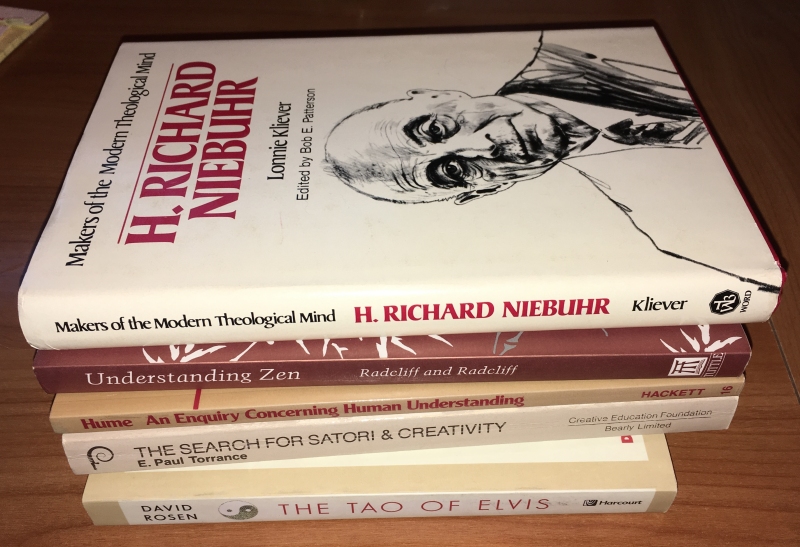
Book coverAfter reading a number of theological books over the last year (including Kierkegaard, Søren Kierkegaard, Søren Kierkegaard’s Fear and Trembling, Reinhold Niebuhr, Existentialism and Thomism, and a couple of unfinished works by Tillich and others), this book is a breath of fresh air: It is not obscure at all, but that’s not for lack of depth.

For starters, the lead piece, “A Confession”, is biographical in nature, and one even in this 21st century can relate. Tolstoy, a literary lion, comes to question his relationship to the eternal, especially that presented by the Russian Orthodox church. He runs through the stages of exploration, inquiry, grappling with reason, and ultimately finds peace with the simple, unlearned Christianity of the peasants. His essay “What Is Religion And Of What Does It Consist?” explores what religion is and what it means and draws some parallels between different religions to show what’s common to them and what man is looking for from them. In “Religion and Morality”, he talks about whether morality can be separate from religion. In the final bit, “The Law of Love and the Law of Violence”, he discusses true Christian love as the basis for society compared to all other force-based systems that have dominated the world to this point.

The writings are engaging and easily comprehensible, although at times a little repetitive, and they apply as much today as they did when they were written a hundred years ago. The last piece seems extraordinarily timely: Written between Russian revolutions, it points out that some of the angry people seeking to overthrow the tsar will only impose their own vision with the same force that they fought against. At times, he sounds a little sympathetic to socialists and communists, but he won’t know what they end up doing. Also, the whole of the Christian nation thing, turning the other cheek on a national scale, might be true to the heart of the gospel, but as national policy, it’s a good way to get your nation and religion overrun by those who follow thunder gods. Instead, Tolstoy thinks without the state, men will fall to small groups in harmony. An anarchist, or a small commune-ist. I disagreed with his prescriptions and predictions, as his belief in Christians born-again with the gospel would trump the fallen state of human nature.

A side note: It’s pretty clear in “A Confession” where Tolstoy wrote The Death of Ivan Ilyich. He almost alludes to it by name. Maybe he does. At any rate, it made me feel smart to connect the two having read both.

Worth a purview for the title piece alone; the others are just gravy.

Buy My Books!
Buy John Donnelly's Gold Buy The Courtship of Barbara Holt Buy Coffee House Memories

Book Report: Captain Horatio Hornblower: Beat to Quarters by C.S. Forester (1939)

Book coverApparently, I like to read a maritime adventure story in the winter time. Last year in January, I read The Sea Wolf. This year, I’ve read this book, the first in the 12 volume Horatio Hornblower series.

The setting of the book more reflect the Aubrey/Maturin books of Patrick O’Brian (I read Master and Commander back in 2009) than the Jack London book. In it, Captain Horatio Hornblower takes his English frigate the long way across the Pacific to link up with a Spanish rebel on the west coast of Central America. When he arrives after seven months at sea, he finds a madman (a la Colonel Kurtz of The Heart of Darkness) who has declared his independence from the Spanish crown and who has drawn the attention of a fifty-gun Spanish ship. Hornblower lays a trap for the bigger ship and takes it without any loss of life, but the madman demands it–so Hornblower, still under orders to support the fellow, turns over the ship. When Hornblower travels south, he encounters a Spanish ship bearing new orders: He is now an ally of Spain, and he must retake the ship he just gave to the madman. So he goes.

The book is more adventure story than Clancy (or O’Brian)-esque treatise on seamanship. So although it includes details of the workings of nautical vessels back in the day, it doesn’t detract from the story (see also Captain’s Courageous by Kipling). I liked it well enough that I want to find the rest of the series and read them, too.

It left me hungry for more so much that I wanted to grab the next of the O’Brian books that I have instead, but somehow, in turning my bookshelves over last year, I have temporarily misplaced ten or so paperbacks. Which is to say they are not in the place in the bookshelves where they’d resided for years. When I mentioned it to my beautiful wife, she also looked where they’d been, but they are no longer there. I’ll find them eventually, and I’ll probably read one because I liked Beat to Quarters so much.

So take that as a ringing endorsement. As much as you get from this blog, anyway.

Buy My Books!
Buy John Donnelly's Gold Buy The Courtship of Barbara Holt Buy Coffee House Memories

Book Report: Mastodonia by Clifford F. Simak (1975)

Book coverNothing like a little science fiction to be memorable. This book is an odd duck of a book. The basic conceit of it is that an archeologist on sabbatical returns to his rural Wisconsin home to dig where he and his friends found some strange metals in his youth. An old flame returns and joins the dig, and they discover it is the site of a crashed spaceship from millennia ago. The local simpleton, who has always expressed affinity for animals and claims to talk to them, helps put them in touch with the survivor, a time engineer who can make time tunnels and who has been lonely throughout ages. So the alien will help the archeologists open time tunnels to the past, which the archeologists sell as exotic safari trips. But first, they decide to make their home in a bygone age to establish residency outside the United States. Hence, the Macedonia of the title.

Well, you’ve got a lot of things going on. Discovery of an alien artifact and alien. Relationships between small town people. Politicking and legal maneuvering. And hunting the biggest game of all.

I’d call it an interesting book, but that’s apparently pejorative now. Instead, I’ll say that the book left me wondering where it was going, but not in a bewildered fashion. Science fiction books, especially ones without problems well-defined early, can noodle around a bit and then resolve themselves somehow, as this one does, and all the speculation is worthwhile of its own accord.

As a reminder, I read Simak’s City in 2010 (seven years ago!). And called it ‘interesting’ for the same reason.

Buy My Books!
Buy John Donnelly's Gold Buy The Courtship of Barbara Holt Buy Coffee House Memories

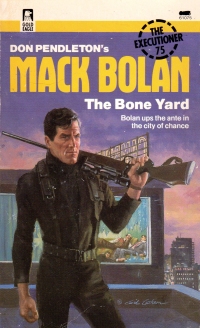
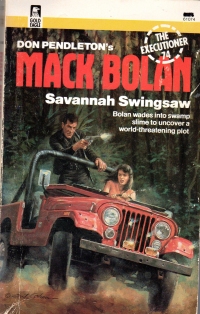
Book Report: Blood Dues by “Don Pendleton” (1984)

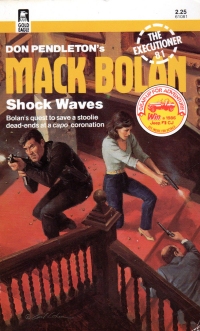
Book coverIn a stunning turn of events, I read the last two Mack Bolan books out of order. Hellbinder is the 72nd entry in the series; this book is the 71st. And you know what? It doesn’t really matter. The books are just about interchangeable in the short term.

In this book, Bolan is still hunting the Soviets, but he’s also transitioning back into hunting the mafia, and the plot of this book allows him to do both. He returns to Miami and finds a terrorist plot backed by the Cubans to use Free Cuba activists who have grown accustomed to money, power, and crime to fund their activities. It also involves the mafia, who has been doing business with the gangsterized counter-revolutionary exiles.

The book is particularly brutal for Bolan’s allies: Many of the people introduced in the book die in the book, and an imprisoned former colleague whom Bolan breaks out (and who might have factored in an earlier book) dies. Bolan survives, though. No spoilers there: I already read the book following this one, and Bolan was in it. And some four hundred or five hundred more.

At any rate, as I’ve said, I’m afraid I won’t remember this book in the long term. But it was a pleasant way to while away a couple of hours.

Buy My Books!
Buy John Donnelly's Gold Buy The Courtship of Barbara Holt Buy Coffee House Memories

“What’s the last nonfiction book you read?” she asked.

We were at the dinner table, and she wanted to make a point to our ten-year-old who is working on his first big paper type school project. She wanted to illustrate how nonfiction works were structured.

I was on the spot, and I blinked. I couldn’t tell her the last nonfiction book I read.

As you know, gentle reader, I keep a log of the books I’ve read in a year and most of the time post a little bit of a book report on this here blog so that I can look back upon it at some future time and remember it. Sometimes, I get to the end of the year, and I look back over the list and recall a book I read that I was sure must have been years ago. Other times, I look at previous years’ lists and think, I read that book how many years ago?

I’ve only read sixteen books or so this year, but when she asked me for the last nonfiction book I read, I was temporarily flummoxed. The books I’ve read this year that leapt out at me are the fiction: On the Road, A Tree Grows in Brooklyn, and a couple of Executioner novels. And, uh….

As you might recall, gentle reader, I sometimes have been known to pick up a book and start reading, get a bit of deja vu, and then discover I have actually read the book before. This tends to happen more frequently with the almost-interchangeable series fiction you get from Ed McBain or, lately, John Sandford. I don’t tend to get that from nonfiction, though, because I don’t read a lot of it. Well, it depends upon what you mean by nonfiction.

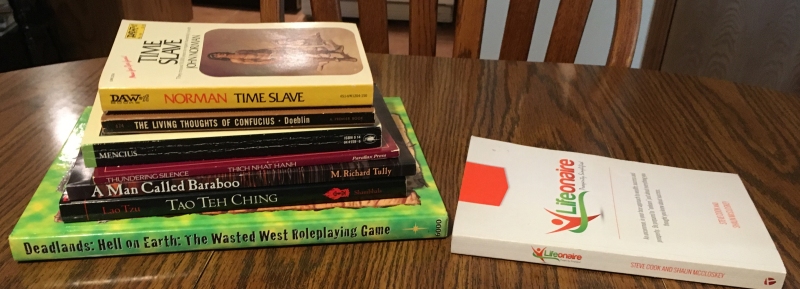
I mean, I’ve been reading some theology of late, and by “of late,” I mean the last year or so. I can hit some of the high points of my reading: Books on Kierkegaard, a book by Kierkegaard (Don’t believe me? this and this and this) and some other theology sorts of books. But my beautiful wife tends to read nonfiction books with a practical point or biographies/memoirs/inspirational books. I read collections of essays, which are nonfiction, but not illustrative of how to write a scholarly paper.

The question cut to a bit of fear I have: I read a bunch, but if I don’t remember it, what’s the point? Am I not just wasting time I could spend on more important things, like painting the living room? I might as well be watching television.

But, aside from the series fiction and especially the men’s adventure fiction I read (What happened in the book? Mack Bolan went somewhere and killed some mafia, terrorists, or KGB –or all of the above) and some of the poetry chapbooks I flip through during football games, I do remember the content of most books. I can tell this by reviewing the lists: I can remember most of them when prompted by the title and the author. Or I can look over most of the books on my bookshelves (contemporary genre fiction notwithstanding) and remember most of it. Or, if we’re talking about something other than the last nonfiction book I read, I can say something intelligent about a topic I’ve read about.

But ask me the last nonfiction book I read can quite leave me sputtering. It probably doesn’t help that I’m reading multiple books simultaneously, finishing them willy nilly, and then revisiting them to write up on my blog in a different order than I read them.

So I’m pleased to announce that I am not losing memory because I’m getting older. I just have more memories to sift through. And my books are not stored in chronological (or chronologically as read) order in my head. I’m also not only getting older, I’m gaining more and better excuses for memory lapses.

And, for what it’s worth, the last nonfiction book that I read (completed) that is not a collection of essays was Training African Grey Parrots. Which is about raising parrots, and basically the lessons are the same as raising dogs: Take time every day with them, be patient, and have a bottle of the quick stop bleeding stuff if you’re going to trim their nails.

Buy My Books!
Buy John Donnelly's Gold Buy The Courtship of Barbara Holt Buy Coffee House Memories

Most of My Book Reviews Are Problematic

The Problem With Calling Something “Interesting”:

Calling something interesting is the height of sloppy thinking. Interesting is not descriptive, not objective, and not even meaningful.

Interesting is a kind of linguistic connective tissue. When introducing an idea, it’s easier to say ‘interesting’ than to think of an introduction that’s simultaneously descriptive but not a spoiler.

I often use interesting in book reports.

I suppose it’s fitting, since the book reports are the connective tissue that holds this blog together. I go periods without saying something interesting meaningful except for the book reports that I post mainly so I can look back upon them on the blog to see what I thought about this book or what else I’ve read within the last two decades by the author or on the subject.

You, gentle readers, all ten of you every day, are only along for the ride.

And by “ride,” I mean “looking for a book report on The Sire de Maletroit’s Door on Google so you can cut and paste it for a paper tomorrow.”

Buy My Books!
Buy John Donnelly's Gold Buy The Courtship of Barbara Holt Buy Coffee House Memories

Book Report: The Doorbell Rang by Rex Stout (1965)

Book coverThis book is the fifth, or the third, Rex Stout book I’ve read in the last fifteen or so years. The actual number is up for contention, as I read a three book omnibus edition and reviewed them separately (Too Many Clients, Might As Well Be Dead, and The Final Deduction) in addition to a stand alone book The Father Hunt. So is that two or four books? You decide.

At any rate, like the aforementioned books, this novel falls later in the Nero Wolfe canon. Stout started them in the 1930s and carried them on thirty years, so they might have seemed more antiquidated at the outset, but this book is relatively relevant to a modern reader who lived before computers. Within it, Wolfe and Goodwin are hired by a wealthy heiress who has sent copies of The FBI Nobody Knows to many influential people and who thinks she is now the target of FBI surveillance. She would like the impossible: For Wolfe to get them off her back. She offers an exorbitant sum to do it, so Wolfe accedes. As Goodwin and Wolfe try to get a handle on the problem, they find a murder where members of the FBI are suspects–and they come up with a plan to exchange the solution to that crime (and evidence of related FBI wrongdoing) to get the FBI off of their client’s back.

Even in the 1960s, as Spillaine and MacDonald were coming into paperbacks, the book is a bit of a throwback, but it’s still readable and enjoyable. As you know, I just bought this book, but it’s more a matter of last in, first out rather than my diving into this because I just couldn’t wait for a Nero Wolfe novel (although perhaps I was directed in this direction by the Wolfe entry in Madame Bovary, C’est Moi!).

It is noteworthy for its suspicion of the FBI as bad guys, though, but I suppose we were seeing the turning of the culture even then in the middle 1960s. But in a throwback novel, its presence might indicate the theme was already entering the mainstream.

Buy My Books!
Buy John Donnelly's Gold Buy The Courtship of Barbara Holt Buy Coffee House Memories

Book Report: On the Road by Jack Kerouac (1957, 2007)

Book coverThis book is supposedly the novel that defined a generation, but to be honest, as that generation dies off, I imagine it will be less relevant in the vast history of literature.

For those of you who don’t know, it’s the semi-biographical novel about a veteran writer who lives with his aunt, but the book itself describes several cross-country trips (and one trip to Mexico) that the narrator takes alone or with a ne’er-do-well friend. Basically, they go looking for jazz, drink-and-drugs, and chicks. They find more of the first two than the latter. They visit Denver and San Francisco and friends there. Then they go to Mexico. Finally, the narrator grows up a bit and settles down.

Honestly, I don’t know how much the book celebrates the wandering lifestyle or if it is actually saying that it’s meaningless to wander looking for thrills. After all, the stories and incidents within the book tend to get repetitious. Only the florid presentations of the jazz music have any sort of appeal.

That’s not to say it’s not an interesting book to read. The narrative voice is interesting, and it pulls one along (to nowhere) effectively. If only there was a better story to it.

In the 21st century, it’s most interesting as a document of life on the road in the 1940s. Travel bureau trips and ride sharing. The tail end of hobos and jumping trains and hitchhiking. And so on.

But as a guide to how one should live? Meh.

Buy My Books!
Buy John Donnelly's Gold Buy The Courtship of Barbara Holt Buy Coffee House Memories