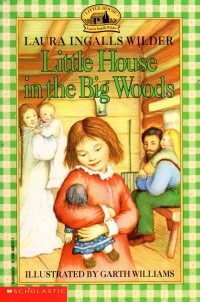
 It must be my year for catching up on my old-timey children’s books. Early last month, I re-read Me and My Little Brain from The Great Brain series, and now I’ve read this book, the first in the Little House series (not, as one might assume because the television series bore the title, Little House on the Prairie, which is the third in the series, and I think I have all my commas right between the parentheses here, but I cannot be sure).
As you might know, gentle reader, if you’re over forty years of age or if you’re a school child who has grown up within field trip distance of Laura Ingalls Wilder’s last home in Marshfield, Missouri, these books tell the story of young Laura Ingalls and her family as they grow up on the frontier in a variety of locations during the late middle part of the 19th century.
This book takes place on the western edge of Wisconsin over the course of a year. The chapters are little vignettes of things that happen, starting in the winter with Pa hunting and storytelling by the fire in the long winter evenings, through the emergence of spring and maple syrup season, to the work in the summer (and no meat–as Pa does not hunt during the summer so the little deer and whatnot can grow up) to the harvest and the beginning of the winter. The author touches upon the isolation–it’s several hours ride to their relatives’ homes, and Laura has never seen two houses near each other until she goes to town for the first time–and the amount of work and the frugality (dare I say it, sustainability) the family practices.
The book includes a couple of primers on how to make butter, maple sugar, and various other necessities, so in addition to your Foxfire books, you might want to keep a set of these books around in case TEOTWAWKI teotwakis (because, let’s be honest, it should be a verb by now).
The difference between this book and the aforementioned Me and My Little Brain are separated by a mere twenty some years (that is, the distance between the dot com era and now), but the differences are vast–the world of Adenville, Utah, and the Big Woods. It’s not so much a difference of the decades, although some of that is true–but it is a difference between town and country that was far greater than it is today, although the differences definitely exist. The practices in this book are close to those found in Nebraska after the turn of the 20th century as found in Over the Hills and Past Our Place or even the 1940s in Missouri in Growing Up In The Bend.
I saw a link on Instapundit to an excerpt entitled The Unbearable Darkness of Young Adult Literature that talked about how children’s and young adult literature is currently preoccupied with After School Special parables about the politically favored lifestyles and problems, and I contrast this Man (Child) versus Society (Squares) focus with the children’s books I grew up with that were very much conscious of Man versus Nature and Man versus Man. Most of the contemporary titles won’t have much to say to kids a decade or two from now, not like books about the 19th centuries could speak to child readers in the end of the 20th century. I just hope kids can still relate to these stories.
I can, but I’m a late twentieth century kid whose reading of these classics has been displaced a couple decades.
Also, I would be remiss if I didn’t admit that I heard the television theme whenever I picked up the book.
The next book in the series, Farmer Boy, but it deals with the young Wilder boy whom Laura would later marry. I don’t have it, but I do have Little House on the Prairie which I will undoubtedly pick up before long.
Because I have fallen behind in my annual reading goals this year, and I don’t think looking at cartoon books during football games is going to catch me up. So I must rely on children’s books and religious tracts. And, maybe, counting comic books after all.
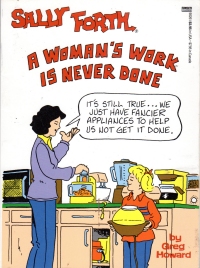 Sally Forth has been around a while now, as this book (and the Wikipedia page) indicates. The book is set at the end of the yuppie era; the parents are busy career professionals, and the title character herself is a career woman offering an empowered heroine at a time, youngsters, where there weren’t that many women executives. I know some would say there aren’t enough now, but back then, there were not any (and as far as how many are enough, gentle reader, I say “enough” is “as many as want to be and are competent to do so” which is not a scientific law measurable with a simple percentage).
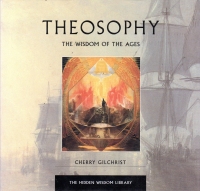 This book is a little, sixty page primer on Theosophy chock full of pictures and illustrations. The St. Louis chapter of the Theosophical Society had its office right above the Oasis coffee house in Webster Groves back when I hung out there a bunch, and it had crossed my mind to go up and see what it was about, but I never did. I wonder what twenty-five-year-old me would have thought about it. Something like what older me thinks, albeit probably more dismissive and rude about it.
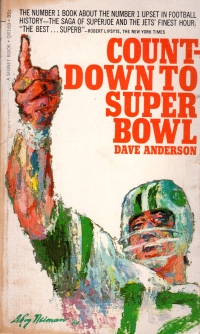 Subtitle: How Joe Namath Ruined Football. Well, no, it wasn’t Joe Namath that ruined football. It was the 1960s and the emergence of expressiveness, of personality over teamwork. Or maybe it was Pete Rozelle who made it a profitable iconic industry instead of a game people could watch and root for their favorite teams of blue collar journeymen like themselves. Or perhaps it isn’t ruined at all; perhaps I just wanted to make a snarky remark about Joe Namath and that upstart AFL team beating the Colts and Johnny U.
 As I mentioned, I got
 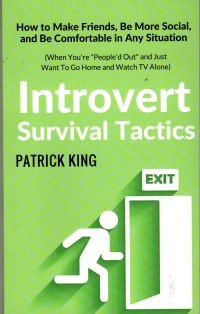 I saw this book on Instapundit’s blog, I think, and I buy just about everything I see on Instapundit. I mean, we have screaming flingshot monkeys, for crying out loud.
 It took me a little while to get through this book. I took it with me when I went to Leavenworth in July, and I made it about a third of the way through it then, but it’s been relegated to my carry book in a season where I don’t have much time to read my carry book. Let me again explain the “carry book”: It’s usually a smaller paperback that I take with me when I’m going to have an hour or so to read at a location that’s not one of my primary reading recliners (PRRs). Normally, these spaces include church over the Sunday School hour, the martial arts school when I’ll be there an hour before my class begins, or church while my child or children attend the Wednesday evening programming. In summer, our schedules are off, and I don’t really get to sit and read outside the house. So carry books tend to sit on my dresser (like
  My goodness, has it been ten years since I’ve read a Perry Mason novel? The historical documents on this blog indicate it has (the last beeing
  I have this collection in the Reader’s Digest World’s Best Reading edition, which is a series I pick up when I can find them cheap. They’re nicely put together, they often come with a little biographical pamphlet about the author, and they put the academic material where it belongs–at the end of the book, not ahead of the primary material.
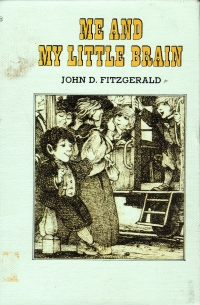 I read the Great Brain books in elementary school, and when I had children, I started picking the volumes up for my boys. Apparently, I picked up two copies of this book as I found a duplicate copy on their bookshelves while helping them clean their room this summer. So I put it on my to-read shelves for nostalgia’s sake.
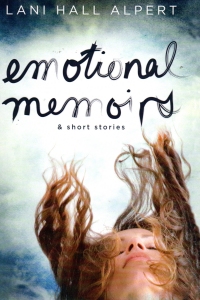 I bought this book after I attended the Herb Alpert / Lani Hall concert
 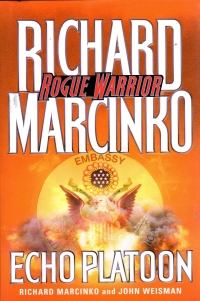 When I cracked open this book, I thought I’d read it before. It begins with a water-infiltration attack on an oil drilling platform. But as I went through the set piece, I thought, No, the other book included an assault on an oil platform in the North Sea, and this one is in the Caspian Sea. Completely different. So it’s like James Bond: Watching the movies rapidly in succession, one realizes how many of the set pieces are repeated, especially ski chases, SCUBA fighting, or the sudden large scale assaults of United States troops, astronauts, or ninja on the enemy compound.
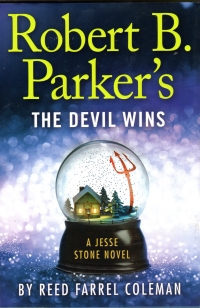 Well, well, well. This was a pleasant surprise. I was not pleased with
 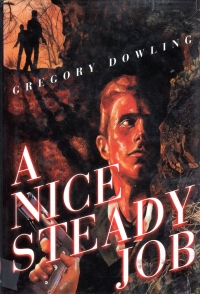 I picked this book from my to-read shelves because, whenever I turned around at my desk to talk to my beautiful wife, the red dot that indicates that it was a dollar book I bought from Hooked on Books once upon a time (probably before this blog existed, werd). I’m very conscious of the red dots these days since the current employees at Hooked on Books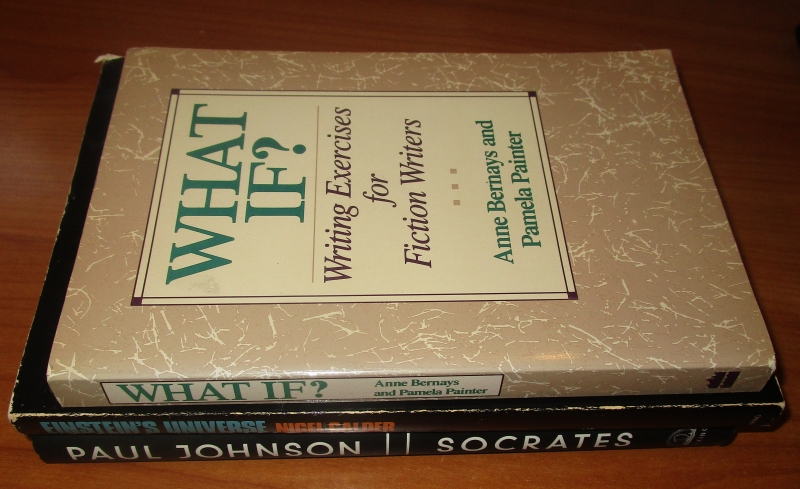
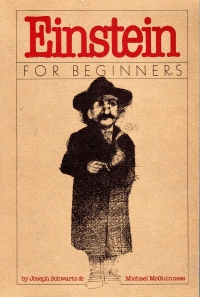 I bought this book in
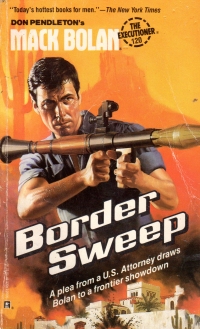 I threatened to pick up the next Executioner novel, and, by golly, I did it. You and I must be punished!