Good Book Hunting, April 8, 2017: Friends of the Christian County Library Book Sale

I thought the book sale was open until 6pm yesterday, but when we rolled into the Ozark library at 4:40, it turned out we only had twenty minutes to browse.

Which impeded me less than a current soon-to-be-forgotten self-discipline in buying books. No longer am I in the market for dollar hardbacks that might be interesting someday. Instead, I’m looking for items in particular subject areas or by authors I have read and will probably like. Which no longer includes John Sandford, by the way.

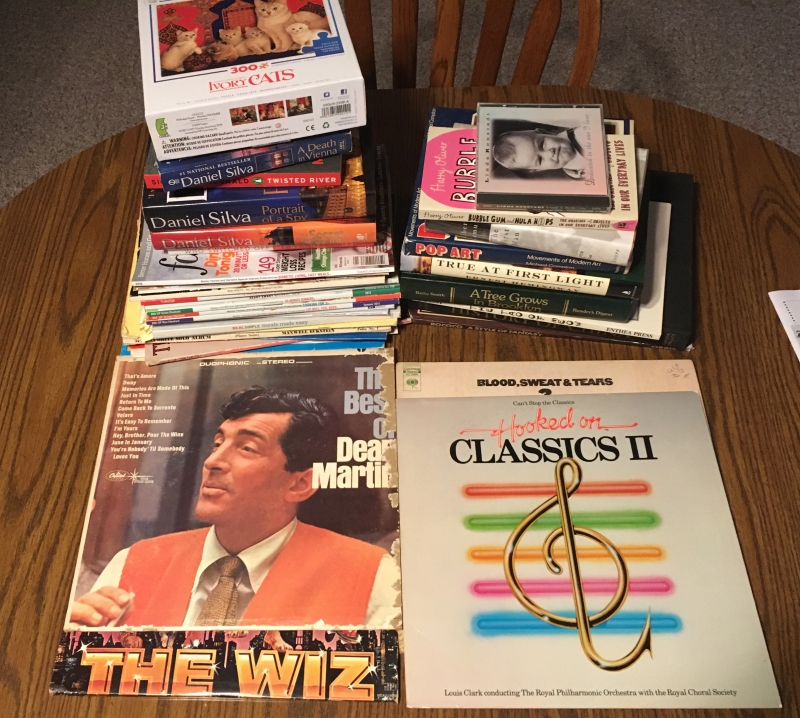
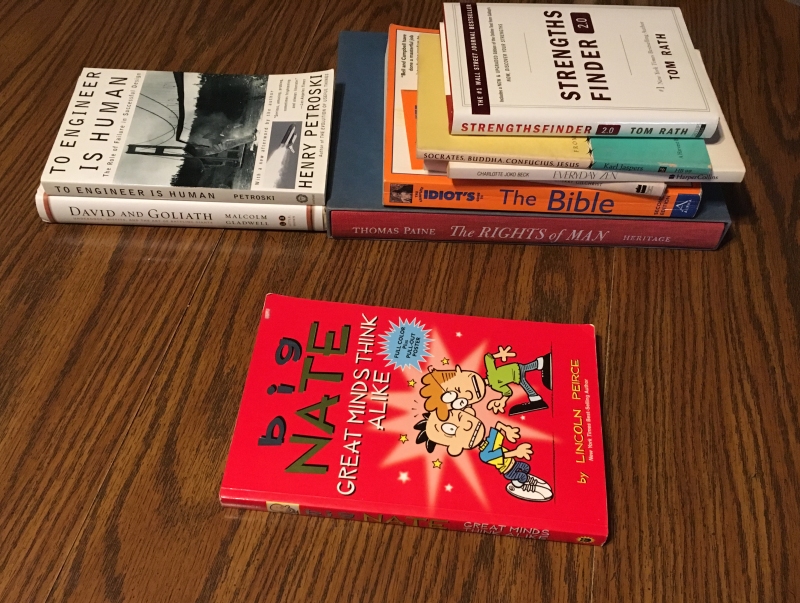
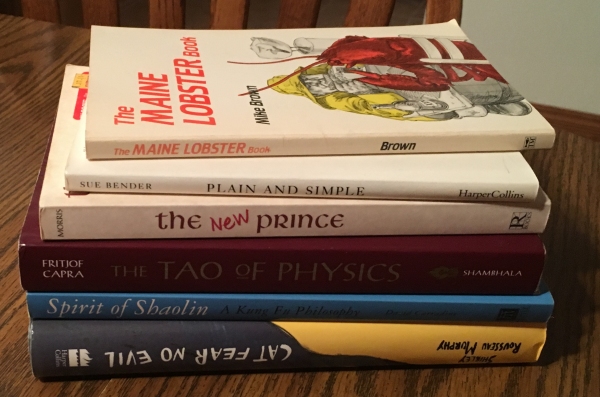
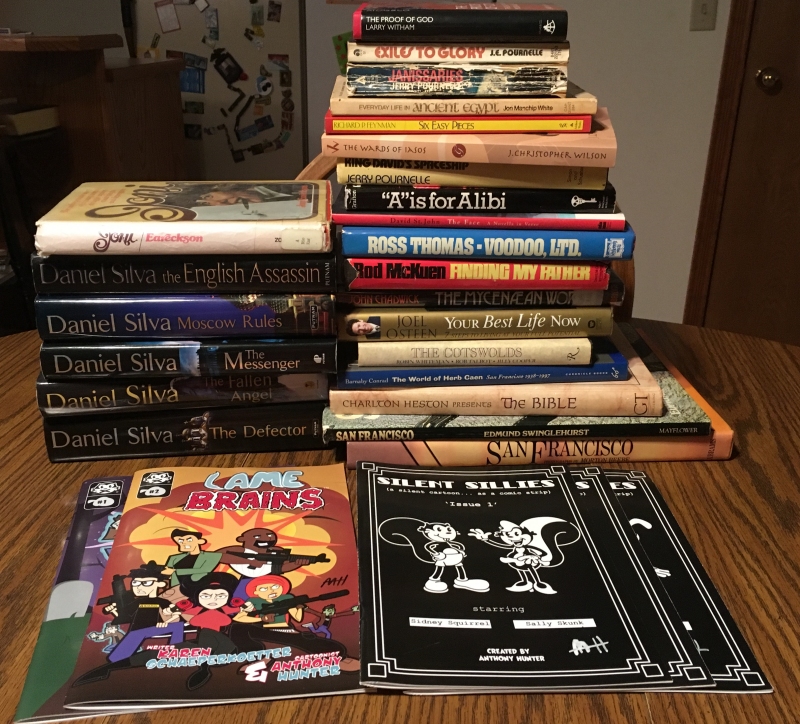
At any rate, here’s what we got:

You can see my beautiful wife got a bunch of magazines. She likes to browse through them pretty quickly and tear out recipes and other items of interest for later review. This particular sale is her favorite because they have so many that fit her criteria of interest. Also notice she bought a book entitled Black Belt Karate, which is funny because she is about a month shy of receiving a black belt in a different martial arts discipline.

At any rate, I got:

  • Two Dresden Files books by Jim Butcher: Side Jobs and Changes.
  • The Ancient Near East, a collection of primary texts from that period (which is suddenly one of my interest subject areas. Note that this practice of self-discipline often means I buy a collection of books in a current interest which then passes or pauses, and the books sit unread for years.
  • Into These Hills, a bit of Ozarks history.
  • The Pessimist’s Guide To History, a collection of historical anecdotes and not an epistemological filter on actual history.
  • Learning To Kill, a collection of short stories by Ed McBain (and, perhaps, some of his other pen names).
  • The Reagan Wit, a thin volume about the 40th President’s humor.
  • Lost Boys, a book by Orson Scott Card. Presumably not about teenaged vampires.

That’s only 8 books, which is felonious self-restraint.

The biggest story here is the one that got away: I had picked up another book, a collection of stories about a Chinese folk hero whose name escapes me that was translated from the Chinese. I was surprised not to have it.

At any rate, I’ve read more books than I’ve bought this year, but the upcoming weeks will include the Friends of the Clever Library Book Sale and the big kahuna, the Friends of the Springfield-Greene County Library book sale. I will visit the latter twice: once on a week day for dollar albums and then on Saturday for the half price day to seek books in my preferred current interest areas and any CD lecture series that look interesting.

Buy My Books!
Buy John Donnelly's Gold Buy The Courtship of Barbara Holt Buy Coffee House Memories

A Very Noggle Repair

So we had a good Spring thunderstorm a few nights ago at Nogglestead, and after about thirty minutes of a driving rain against the west side of the house, my beautiful wife’s office window started leaking. And by “leaking,” I mean it was as though Thor himself was urinating on her electronics. She scrambled to move and cover her equipment, and I scrambled to find what was going on. In a driving rain. Lit occasionally by lightning. This is kind of old hat for me.

Back in our Casinoport days, water got into the house by every sort of way. The walkout basement was really a dugout sliding glass doorway that looked uphill and had a single drain to relieve the rainwater. It also had two crab apple trees above it. I had to sweep that out every day to ensure the crab apples, shaped and sized perfectly to fit into the holes on the drain cover. I learned this the hard way; once, when I did not, I looked out the door during a heavy rain, and it looked like an aquarium with a really low water level. Which lead me to an evening spent in the pouring rain, bailing my walkout basement’s landing and clearing the drain every minute or so. Then there was another time when the gutter pulled away from the end of the house during a thunderstorm, allowing the water to stream off the roof into the runner of the sliding window in the kitchen, which led to the water rolling out of the runner into the dining room. I was able to prop the gutter into place with a propitious two-by-four and reaffix the gutter in the light of day.

But I had no such luck that recent night at Nogglestead: We don’t have any trees to block the gutters, and they were half-empty or half-full (I’m not sure which I should insert here to self-identify as a pessimist). Nothing was collected on the deck above the window. I didn’t see anything, but I did know that the lintels above the window could use a caulking and a painting, which I couldn’t do in the rain.

When we first moved in, the home inspector had shown us where the window and door frame below our deck could use a caulking, and right after we’d moved in, I did so, but that was eight years ago almost. So it looks as though it’s time to revisit that, and I’d put it on my list of chores for the summer that I’d get to right after reading yet another book I’m likely to not remember anyway.

So I bought a couple tubes of exterior caulk and took a look above the window instead of at the lintels. Oh, my.

Above the windows were some end-facing bricks with some broken-down mortar and some splotches of caulk. Some of the holes in the brick had been filled with caulk, and there were some splotches of brown caulk here and there where the mortar had started to break down.

That looks like something I might do. Did I do that? I don’t think so. I’ve never bought brown caulk in my life.

So I chiseled out the old mortar and pulled the old caulk out.

And I took steps to ensure that this never happens again.

Now, back to that book I am reading. What is it again? I’ve forgotten already.

Continue reading “A Very Noggle Repair”

Buy My Books!
Buy John Donnelly's Gold Buy The Courtship of Barbara Holt Buy Coffee House Memories

Programming Memories In My Children

So this year, I’ve started putting strange things in my children’s lunches for school.

I know, the customary thing to do to make a big deal of it on the Internet is to put a little love note or drawing into the lunch boxes and then to produce ready-for-viral listicles of images. But I’m not a mommy and I’m not artistic. So the lads get some strange foodstuffs indeed.

It started when, as a lark, I put a tin of Fancy Feast cat food in their boxes.

Then, a couple weeks later, I thought about putting some brownie mix, unprepared, in the Pokemon and Sonic the Hedgehog comestible containment devices. I was at the store at the time, but I could not find inexpensive (sub-buck) brownie mix, so I picked up three boxes of Jiffy Yellow Cake mix. The next day, they each got one, and I baked the third so they could actually have cake when they got home. One of the lads, good boy, opened the cake mix and ate some of it at school.

I considered giving each pack of microwave popcorn two weeks ago, but I demurred. Because I wasn’t sure that one of them would open it, and that would be a waste of my beautiful wife’s preferred snack of late.

Today, I gave each an ice cream cone. No ice cream; just a cone.

Someday, perhaps when I am gone, they will get to talking and say, “Do you remember when Dad put something in our lunch?” And they’ll think of me.

Or perhaps they’ll mention it to their therapists. Regardless, it’s building my immortality, one little bit of remembered silliness at a time.

Buy My Books!
Buy John Donnelly's Gold Buy The Courtship of Barbara Holt Buy Coffee House Memories

Book Report: After America by Mark Steyn (2011)

Book coverThis book is quite a downer.

I read America Alone almost six years ago (when this current title was still fresh). This one is less optimistic: in the interim, America Alone (ish) elected Barack Obama, and several years’ worth of his policies were underway, so Steyn is concerned that America has joined the rest of the west in entering its decline. So he talks about what the world will look like after the United States cedes its hegemony to other nations with less noble intentions.

The thing I said about America Alone also applies here:

Five years after the book, I’m not as gloomy as Steyn was (and is now, given the title of his latest book–After America for those of you who might not know). The sweep of history is broad and long, and its predictors are more often wrong than not. However, the book does crystallize, or should, that our Western traditions and heritage are better than all the others that have been tried and do require some conscious defense thereof. If you merely enjoy liberty without recognizing its sources, someone will quickly take it from you.

Right down to how long it took me to read it after its publication.

As I said, it’s pessimistic, and it’s too much like reading his blog in book length. Which is to say, depressing if you take it too seriously. He might be right, he might be wrong, and most likely he’s part both. But there’s no good spending one’s evenings before bed wallowing in it. Also, the recent past might suggest a change in the wind for the United States which, one way or another, will render its half-decade-past prognostications out-of-date.

So read it if you’re reading this blog post from somewhere in 2011 or 2012 when it’s fresh. Otherwise, stick to shorter, current doses on the Internet.

And remind me to stay away from current events books at the upcoming book sales.

Buy My Books!
Buy John Donnelly's Gold Buy The Courtship of Barbara Holt Buy Coffee House Memories

Horatio Hornblower and Me

I could have titled this “The Wisdom of C.S. Forester”, but it’s not so much wisdom as recognition of a personality trait:

[Horatio Hornblower] had just performed a most notable feat of navigation, of which anyone might be justifiably proud, in bringing the ship straight here after eleven weeks without sighting land. But he felt no elation about it. It was Hornblower’s nature to find no pleasure in achieving things he could do; his ambition was always yearning after the impossible, to appear a strong silent capable man, unmoved by emotion.

(From Beat to Quarters.)

I know the feeling.

However, as this blog and my incessant humble-bragging would indicate, I am more of a horn-blower than Horatio Hornblower.

Buy My Books!
Buy John Donnelly's Gold Buy The Courtship of Barbara Holt Buy Coffee House Memories

Book Report: When You Come To A Fork In The Road, Take It by Yogi Berra with Dave Kaplan (2001)

Book coverAs I might have mentioned, I found this book when I went looking for The Legend of Gilgamesh. This book was on the book shelf where I’d last seen the earlier work, so I read it instead when I could not find the epic. They’re almost the same: You’d have to explain to anyone under thirty-five who either of these guys is. Or was.

At any rate, this book collects a bit of Berra’s recollections from his life in baseball and presents a little life advice based on it. That’s about it. He talks about breaking into the big leagues, playing in New York in the days before baseball players made millions, and his youth in St. Louis. It explains how he got the nickname Yogi and, more importantly, his real name (which is probably available on his Wikipedia entry, but I’ve never looked at it). Both of which could help me should they come up in a trivia night. Which would have to be run by someone older than 35.

A nice piece of filler reading material. It won’t change my life, but it was pleasant. Also, take a look at that title page: It looks as though this book is signed by the author. How cool is that?

Buy My Books!
Buy John Donnelly's Gold Buy The Courtship of Barbara Holt Buy Coffee House Memories

Book Report: Appointment in Kabul by “Don Pendleton” (1985)

Book coverIt’s unfortunate that the first Executioner book I picked up after reading Rated R was this book. Whereas Leon is funnin’ with the cartoonish violence in a bit of almost campy fun, I’m afraid the author of this Executioner book is earnest. Which is unfortunate, because we have ACTION! like this:

He encountered another two-man patrol walking its beat near the intersection midway between the blocks separating the high command from the checkpoint.

This couple did not know of their encounter with the Executioner until the heartbeat of their death.

He came at them fast, the edge of each stiffened hand slashing downward hard enough to break both necks. The soldiers crumpled to the pavement at Bolan’s feet with soft sighs.

And on the next page:

The Executioner tugged open the driver’s door, reached in and rapidly pulled the driver out, down into a raised knee that smacked the man’s face with such force, Bolan heard the neck snap.

I’m not sure the physics works out in either of these cases, but it’s sure like what you saw in the movies in the 1980s (and beyond). Old men’s adventure fiction was informed by authors who’d read classical literature. Some of these post-Pendleton Executioner novels are informed by authors who watched direct-to-cable actioners.

At any rate, the plot, ripped from Reader’s Digest reports: Bolan gets word of the Russians developing a new chemical weapon even worse than Yellow Rain at an out-of-the-way base near the Afghanistan/Pakistan border. Bolan hooks up with some mujahedeen and a CIA operative to find the location and put a stop to it. In a Bolanesque fashion.

It’s a cut below the average Bolan fare. I know what you’re asking: Does Bolan smoke? (As you may recall, gentle reader, Bolan did not smoke in the Pendleton novels, so I gauge how well the house author knows about the canon by whether Bolan lights a cigarette or not in any given volume.) Yes, yes, he does. And I get the sense he will more and more in the books to come.

I mean, look at this action bit in the wilds of Afghanistan:

He opened fire, the impact of so many bullets flinging the men off of their feet into shrubbery nearby where only their legs protruded, tremulous in death.

Leaving aside the comma splice which this particular writer loves to use, he describes bushes or brush as shrubbery (numerous times). Shrubbery is part of a garden or maintained yard, ainna? Not something you find in the woods or the mountains of Afghanistan.

Oy, vey. But the text of the book aside, we get some cinéma vérité or breaking of the fourth wall with the transcription of some espionage instructions from a numbers station in the front cover:

Lottery numbers, you insist? Maybe in your mundane world. But in my action-packed world, they’re espionage instructions.

Except I hope they’re not for me. We haven’t covered snapping two men’s necks simultaneously with knife hands in my martial arts class yet.

Buy My Books!
Buy John Donnelly's Gold Buy The Courtship of Barbara Holt Buy Coffee House Memories

Book Report: Catch a Poem by the Tale by Michelle Monet (2016)

Book coverMy beautiful wife bought this book from a Facebook friend because a portion of the proceeds went to help people recover from the Tennessee wild fires last year. She might have given it to me, or I might have taken it from her in a fit of kleptomania. Regardless, I started working through it during the football season as I often do such volumes of poetry, and I recently picked it back up from the stack of books beside the sofa where some of the books have been sitting for several football seasons awaiting my perusal. It’s like the Rooneyfication of reading materials over there.

At any rate, the poet is a three letter woman with this volume of poetry: She is a former professional singer and has appeared on stage on multiple continents; she followed that up with a visual arts (drawing and, one assumes, sculpture) period that included traveling to arts fairs (revealed in the book). Then she decided to take up poetry, and the result is this book.

It’s not a bad book, but it is a bit of a doodle book of poetry. The author includes a number of poems that are just noodling with words and poetry. Much of the work lacks a refining touch. There are some turns of phrase here and there that are pretty good, but mostly it’s just self-expression.

Hey, I’m not knocking it. I’m finta do my own collection of poetry one of these days. The meaning of poetry comes from what effect it has on you, the individual. This particular collection didn’t resonate with me, but I’m more of a classicist when it comes to poetry. Your mileage may vary.

Buy My Books!
Buy John Donnelly's Gold Buy The Courtship of Barbara Holt Buy Coffee House Memories

Overheard at the Springfield Art Museum

So we’re at the Springfield Art Museum in the very back, amid the American Art, when the children spot an iPad mounted on the wall, and being deprived mostly of electronic devices at home, they zero right in on it and hope for a couple minutes (or hours) of gaming.

“You can only listen to jazz on it,” I said, for it plays a couple songs from Count Basie and Miles Davis to illustrate the American musical art form. “Count Basie and Miles Davis. You’ve never heard of those guys.”

Except, of course, they have. “You listen to heavy metal all day and jazz all night,” the oldest said.

Analysis: TRUE.

Allow me to illustrate: Continue reading “Overheard at the Springfield Art Museum”

Buy My Books!
Buy John Donnelly's Gold Buy The Courtship of Barbara Holt Buy Coffee House Memories

Everybody’s A Critic

While I was doing a photo shoot for a cover of an upcoming book, my cat jumped onto the table and tried to bury the coffee:

Clearly, he does not understand that this photo shoot does not require a model, and I couldn’t use him anyway, since he didn’t sign a release.

Or perhaps he’s commenting on the photo’s composition.

Buy My Books!
Buy John Donnelly's Gold Buy The Courtship of Barbara Holt Buy Coffee House Memories

Book Report: A Knight and His Weapons (Second Edition) by Ewart Oakeshott (1997)

Book coverThis book is a short discourse on the development of weapons from the middle of the first millennium to the middle of the second, but the focus is definitely on the period from roughly 1000-1500 AD. It says “Knight,” after all.

The chapters are broken down into weapon groupings: Spear and Lance; Axe, Mace, and Hammer; Sword and Dagger; and Early Firearms. The individual chapters are told in a bit of rambling discourse style, as though the author were speaking off-the-cuff, although there are a number of black-and-white illustrations included to show the weapon innovations as he talks about them. Unfortunately, these illustrations are a bit crude and might have made the text clearer if they were not.

At any rate, it was an hour or two through, as it only is a shade over 100 pages plus glossary and index. I learned one thing, for sure: I need a glaive in my personal collection.

Also, even though Ewart Oakeshott sounds like the name someone would choose in the Society for Creative Anachronism, he was a weapons collector and illustrator who definitely knew his material. It’s just that the presentation in this novel could have used some improvement with some charts and timelines and some better organization. But if all you’ve seen is the illustration in the first edition of Advanced Dungeons and Dragons, you could learn something. And by “you could,” I mean, “I did.” Although none of this material came up in the Geek Trivia Night I attended this weekend, unfortunately.

Buy My Books!
Buy John Donnelly's Gold Buy The Courtship of Barbara Holt Buy Coffee House Memories

Related Acts?

In my iTunes library, I have one song by a band called Flesh for Lulu and another by Lulu:

You know, add the Fine Young Cannibals, and you’ve got a tour right there.

Buy My Books!
Buy John Donnelly's Gold Buy The Courtship of Barbara Holt Buy Coffee House Memories

Wherein John D. MacDonald Makes Light Of One Of Brian J.’s Quirks

In The Beach Girls, as the protagonist (if there is one) is falling in love with the love interest (of which there is, whether the fellow is the protagonist or not), they exchange a quirk:

You know, Leo, when I first started reading everything, I was big enough to pick up, that phrase, batting her eyelashes, worried me half to death. I used to wonder if genuine sirens carried a little stick they used. And I learned some mighty big words. Chaos was one I learned. Only in my mind I pronounced it chowse. So one day I showed off in history class. ‘Europe is in a state of chowse,’ I said. ‘Chowse?’ the teacher said. “Complete chowse,’ I said firmly. So she made me spell it. Then she practically had to be helped from the room. It was might humiliating, I can tell you true.”

I remember putting to my mother into a state of semi-hysterics with the word bedraggled. I told her one morning at breakfast she looked a little bedraggled. Only I pronounced it bed-raggled.”

I pronounced it “chay-ose,” for sure. And to be honest, I probably still say bed-raggled.

I’ve learned so much of my vocabulary from reading that I have an accent all my own. I know rabid comes from rabies, so why isn’t it “ray-bid”? It is in my world. The same for vapid which comes from vapor. And I am sure I have been forgiven for saying sub-see-quently to my in-laws (because it has the same root as sequence. And don’t get me started on the morning food called the bag-el (or perhaps that is what Superman was packed in when he was shipped to Earth).

I can get away with it in a lot of cases because I use a lot of words that many people don’t know (or at least they don’t know them like I say them). However, my mother-in-law is a former English teacher, so she and her beautiful daughter correct me gently as though English is my second language. Hah! It can’t be. I don’t even have a first language yet.

Buy My Books!
Buy John Donnelly's Gold Buy The Courtship of Barbara Holt Buy Coffee House Memories

How I Select A Book To Read

After finishing a book, I’m sometimes inspired to read another one immediately, or some life event will make me want to read something I know I have. Like today. Here is a dramatic recreation:

I’m listening to a Great Courses lecture series on ancient civilizations (now that I finished the series on Chinese history). We’re on the subject of Sumerian civilization, and the professor keeps mentioning Uruk and Gilgamesh, and I’ve got the epic of Gilgamesh around here somewhere. I think it’s to the left in my office….

Hmmm, I don’t see it. Maybe I moved it in the shuffle when I cleaned and turned over my library last summer.

Hey, here’s a book by Yogi Berra. I’ll read that.

So you’ll soon see a book report on that book instead of something smart like the Epic of Gilgamesh.

On the other hand, there are more people who know who Yogi Berra is than Gilgamesh. But probably not anyone under thirty.

Buy My Books!
Buy John Donnelly's Gold Buy The Courtship of Barbara Holt Buy Coffee House Memories

Book Report: The Beach Girls by John D. MacDonald (1959)

Book coverThis book is definitely a MacDonald: It features a bunch of people in a marina on the east coast of Florida in the 1950s. You’ve got a businessman from up north coming down, looking for the man who seduced his wife and caused her suicide. You’ve got a number of individual characters living on the boats and/or chartering fish boats. You’ve got big businessmen putting the squeeze on the small marina owner, trying to get her property for development. And you’ve got a climactic party on the dock.

That said, it’s not a particular stand out volume in his work. It has his trademark outstanding writing and whatnot, but the elements of the plot and the characters fall into what would later become MacDonald stock.

One thing I get a charge out of, and a way I romanticise these older works, is how easily they drop in classical literature allusions and whatnot. For example, a woman performs the talent portion of many beauty contests she’s won, and she does it by reciting:

Ef yew keep yo haid when all about yew air a-losin’ they-yurs an a-blaimin’ it on yew?

And I’m all like, “Thay-ut’s ‘If’ by Kipling.”

Mostly because I just read The Grapes of Wrath (donchewno?), and it’s all a-rife with the vernacular (albeit a different accented vernacular). Also, I’ve read my Kipling, and that’s something MacDonald and I can share. I’ve gone on about this at length, I know, but it makes me thing the middle twentieth century was a time when an author assumed the reader had read Great Books with him. But I digress.

So I got that out of it. The older I get, the more I get out of reading these books and understanding more allusions (see also A Tan and Sandy Silence and Two Other Great Mysteries). Of course, I said the same thing to Robert B. Parker almost thirty years ago.

Read it if you’re a John D. MacDonald aficionado. If you’re not, start out with some of his other works and then read it, for you will by then have become a serious John D. MacDonald aficionado.

Buy My Books!
Buy John Donnelly's Gold Buy The Courtship of Barbara Holt Buy Coffee House Memories

Meeting Robert B. Parker

The following is an essay I wrote in college. It used to be hosted at Bullets and Beer, a Spenser Fan site (and still is, for the nonce, here, but the site looks to have been defunct for a while now. For my own convenience, and because it’s my essay, dammit, I’m putting it here.


The Community Library, all that Jefferson County, Missouri, offered its few literate residents in the mid nineteen eighties, cowered on the bottom floor of a strip mall on High Ridge Boulevard. High Ridge Boulevard, the main street of High Ridge, Missouri, carried little enough traffic as it was, and not much of that traffic found its way into the small, one-room library down the hall from the license bureau and across the hall from a going-nowhere travel agency.

Me, I was trying to be a hard bitten city kid in the middle of extra-urban Missouri. Not rural enough for farms, not developed enough to qualify as suburbs, Jefferson County offered everything a growing kid without a car would not want.

I have been a fan of Robert B. Parker since my freshman year of high school. Crime fiction captivated me early, so by the time I finished middle school, I had run through all of the small Jefferson County, Missouri, Community Library’s copies of Mickey Spillane, Raymond Chandler, Gregory MacDonald, Ross MacDonald, and John D. MacDonald. I stood before the dimly-lit Mystery shelf, amid the musty, if not misty, donations, planning on another bout of Russian roulette with the unknown authors. I remembered that at the end of every episode of Spenser: For Hire, which I could only watch during summer vacation since it came on at 9 p.m., the credits revealed that the show was based on the novels by Robert B. Parker. The TV show was tolerable, so I thumbed the shelf below the Sara Paretsky, not quite to the T. Jefferson Parker. Bingo. Several books, certainly enough to check out for the week while I was in High Ridge. I would in later investigations discover one of the volunteers at the library was almost as big of a fan as I was to become. All of the Spenser novels to that date stood proudly on the bottom shelf.

I read all of them quickly; during the school lunch hour, between classes, and, as often as possible, during classes. I watched the best-seller lists in hopes that there would be a new listing by Robert B. Parker, and when there was, it was only a matter of time before the tasteful library volunteer would donate it to the library.

Spenser became my hero, my blueprint for what a man should be. My own father was four hundred miles away, so I adopted a literary surrogate. Spenser quotes poetry and can do one-armed push-ups. He is cool under fire and makes smart remarks. In short, he is a hero that lots of teenagers could look up to if they bothered to read. I did, and he was mine.

I did not draw the line at Robert B. Parker’s Spenser novels. I sought out copies of his other three books, Three Weeks in Spring, Wilderness, and Love and Glory. Through them I could determine some sort of story line for Mr. Parker’s life, and I liked what I read into the books. He obviously felt similarly toward his wife as Spenser did to Susan Silverman, and I found the real-world crossover of what I would call “real” love to be inspiring in this world of divorces and broken homes. I felt bound to this writer, a fellow crime fiction novelist, who projected himself into his character and thought himself a writer and a lover. I can only hope to be as successful someday as he is.

I also felt a surge of respect for Mr. Parker when I read an essay of his in a collection called Colloquium on Crime, in which he says that he doesn’t care what the critics say about his books; as long as the books sell, he is happy. That’s the sort of attitude I like, and the kind I might like to have when I start becoming a famous writer.

The day of the signing was sunny and cloudless in Milwaukee. I woke early, showered, shaved, and primped myself–for meeting Robert B. Parker, but also in case I had to rush directly from the book-signing to work. I took an early bus downtown and sat in the sunshine, looking through the copy of Paper Doll that I had bought when it was first available.

I got to the bookstore a few minutes early and found a line of about twenty people waiting for their chance. I caught a glimpse of him as I took my place at the end of the line. Ahead of me were others with Paper Doll in hand, many of which, I suspected, were bought at the counter display moments ago. The woman in front of me was about five six, gray hair, spectacles, and she carried her copy of the book in a paper bag. Ahead of her was a businessman probably on his lunch break. Who were these people, and why did they want his autograph? He was not their hero, at best he was just a writer they liked.

My only other experience seeing authors in bookstores was a lonely guy in the Waldenbooks in Northridge. Nobody knew who he was, and nobody dropped by to buy his book nor ask his autograph. It was rather like the book signing party attended by Rachel Wallace in the Spenser novel Looking for Rachel Wallace. There was a line here, and these people certainly didn’t feel the special kinship I do for Robert B. Parker. I wonder if many of them knew which poem of Keats that Spenser refers to in Early Autumn, or who said “Wouldn’t it be pretty to think so?” that is referred to in Double Deuce. I wonder how many of them are fans of Raymond Chandler. I hope not too many, for I suspected it would trivialize the hero worship I feel for the man.

The line moved pretty quickly, and even though it seemed like a quick forever, we were moving forward. Ahead of me, a bookstore employee commented that Mr. Parker was not allowing her to open the books to expedite the signing–Mr. Parker was doing it himself so he could talk a bit to his fans. I felt admiration swell within me.

As I had tried to get to sleep the night before, all the things I wanted to say to him ran through my mind. I knew my moment would be brief, and I wanted to say something that would strike him, impress him, or otherwise make my face something more than a forgotten blur in one of the bookstores he would visit that day. I was going to tell him that I was a senior up the road at Marquette and hyperbolize that I chose the college simply because Marty Rabb, from the book Mortal Stakes, was an alum. I wanted to tell him that in the course of playing softball, a sport he plays as well, I broke my nose and tried to calculate how many breaks behind Spenser I was. I wanted to promise an inscribed copy of my first published novel to repay him; I wanted to welcome him to Milwaukee and term it “Boston West”. All of these things I wanted to say in my minute, but of course I didn’t want to sound like a babbling idiot or some sort of shut-in who only lives life through the Spenser novels (I live life through all sorts of other novels, too).

“Freda. F-R-E-D-A” was the gray haired woman ahead of me, and she was done rather quickly. Some man in a business suit had chosen this opportunity to interview Mr. Parker at length, and he was standing to the side, talking. I stepped up to the table, fearing an anxiety attack, a dry mouth, a sudden death, none of which actually came.

He is a stocky man, of the hard build that he has put into his fictional alter-ego. He looked the same as the pictures on the books and like the interview I saw on Today, except animated in a way that television and still photographs will never capture. “A name?” he asked.

“Brian. B-R-I-A-N,” I said clearly, and surprisingly audibly. As he wrote the inscription, I picked which of the previous night’s gems I was to offer. “I’ve got to tell you, each time I re-read your novels, I always manage to catch and place another literary allusion. It’s good to see my college education being put to a positive use.”

His eyes did seem to twinkle a bit when he looked up to give my book back. “It’s a good thing,” he said, or words to that effect, and I thanked him and walked out into the blinding Milwaukee sunshine. I hoped that I at least gave him some spot of cheer, some glimmer of humor. It hardly compares with the joy his novels have given me, but it was some token.

I played it cool and waited until I got to my bus stop to see what he had written. “Brian, all best wishes, RBP” in his characteristic scrawl. I closed the book, but before my bus came I had looked at it three more times and during the ride home I began to read the book again. It still says that, and I look every once in a while to check, and I show the inscription to everyone who comes too close to me. I told everyone I saw that day that I met Robert B. Parker, and most of them asked me who he was. It did not offend me in the least; rather, it proved to me that I was among the elite, or at least the literate, or maybe just the few people left in the world who have real heroes and are proud of it.

Buy My Books!
Buy John Donnelly's Gold Buy The Courtship of Barbara Holt Buy Coffee House Memories

Book Report: Zen Mind, Beginner’s Mind by Shunryu Suzuki (1970, 1999)

Book coverIt took me two tries to read this book; I started it last year and got about halfway through it, enjoying it for what it was before taking it out of my pocket as my carry book and planning to read the last half of it all at once. That didn’t happen, so I started it again this year as my carry book and keeping it in pocket until I finished it.

The book is a collection of informal talks given by the author after sitting with students practicing zazen. The author founded the first Zen temple in the United States, and this book collects some of his insights into Zen.

So, to talk about Buddhism, I find it easy to break it into three parts, and perhaps this is something we could do with all religions. These parts include:

  • The cosmological/theological/heavy philosophy (the eternal, the afterlife, interpretation of the texts).
  • Practical philosophy (the guidance to everyday living).
  • The practice (the things to do when you’re a part of the religion).

Although this book does lightly touch upon the first (that the individual is akin to a droplet of a stream in a waterfall–part of the stream, then alone briefly, and then part of the stream; that breaking out of the cycle of karma is the goal of Zen, as karma is a self-centered way of thinking), it focuses mostly on the last two, which is fitting: the talks were give after the practicing with an eye toward improving that. Basically, it’s to sit still, in the proper posture, breathe right, and clear your mind. Okay, there’s a bit more to it than that, such as dealing with distractions within and without, but that’s it. Strangely enough, although they’re from different schools, this book and Start Here Now don’t differ much on the practice of Buddhist meditation. Perhaps the difference between Shambhala and Zen schools lie at the higher levels of philosophy.

I was most interested in the middle point above; Practical philosophy. Buddhism focuses on recognizing the transience of this life and all of its moods, emotions, and events. Buddhism is much akin to Stoicism, so much that I checked to see if the sutras might have made their way back to Rome before Zeno (the other Zeno) founded the Stoic school. It was only about a hundred years, but I wouldn’t be surprised to learn that the sutras might have made their ways west before the later thinkers made their marks. Both philosophies urge that calmness and detachment which, if you know me, you probably can tell I appreciate.

The Buddhists also talk about nothingness, but when they do not mean it like the Existentialists do. In the Buddhist sense, “nothing” is the eternal something from which everything is drawn. In the Existentialist sense, “nothing” is the opposite of that.

The book is written in the proper Buddhist style, wherein the koanesque nature might make you go “Huh?” The question of the sound of one hand clapping appears. Once you get it into your head that the Buddhist way is to see the gestalt and the particular at the same time, you can understand it better (the forest is the trees; the tree is the forest). Some of them do go into paradox territory, but as with any religion, eventually you have to make your peace and accept some paradox.

So I enjoyed the book and got some insights into detachment (and a couple of posts quoting the book–search for the wisdom of shunryu suzuki). But it’s a practical and practice primer on Buddhism, akin to the Max Lucado Christian books: A bit of how to live as a Buddhist, but without the implications and intimations of the religion that you get from the heavier books by Kierkegaard, Niebuhr, Tillich, and so on. If you believe Alex G. Smith, that’s how the Buddhists hook you, with their practical philosophy and practice, but that’s how the Christians hook you, too (Tolstoy’s favored religion features that sort of peasant, practical religion, and that explains why he equates religions based on this practical philosophy level.

Now, where was I before I started name-dropping other things I’ve read? Oh, yes: The book is a good primer into Zen Buddhist thought, especially the practical philsophy and practice components, and you could learn something from it. But don’t read it and declare yourself a Buddhist, as it really lacks a cosmological component that explains it all. Of course, the Zen would argue that you don’t need to know it, just to do Zen. But I’m a Western kid, and I expect a bit more in a complete belief system. Which is why I’ll never be a Buddhist.

Buy My Books!
Buy John Donnelly's Gold Buy The Courtship of Barbara Holt Buy Coffee House Memories

Two Road Trips to California: The Grapes of Wrath vs. On The Road

It occurs to me that two of the books I’ve read so far this year, The Grapes of Wrath and On the Road, center on road trips to California.

To recap: In The Grapes of Wrath, the Dust Bowl Effect, crop failures, and unpaid bank loans drive the Joad family from their small farm in Oklahoma and onto California, which has been promised to be a place of plenty and work for everyone but that proves to be something else. It’s rife with Hoovervilles, people who mistreat the Okies, and capitalism exploiting the little guy.

In On The Road, a veteran travels repeatedly to California by various means and goes to San Francisco to listen to jazz music, mostly.

The two books appear only 18 years apart, though, but they seem to come from entirely different ages. The Grapes of Wrath seems to have been set in a past era, like the 19th century, whereas On the Road is a slightly less modern but still modern era book. What happened in the interim?

The Chinese revolution and forced redistribution of land. World War II would seem to be the facile answer; after all, the protagonist of On the Road was a veteran of World War II, and World War II changed everything, right?

No, rather: In the 1940s, we see the electrification of the United States and how it catches up to the urban areas. As Growing Up In The Bend reminds us, rural parts of Missouri did not get electricity until the 1940s and 1950s, and many farmers were still using draft animals on their small farms within living memory even while the cities were running street cars and televisions. So the divide between the books is more a matter of city versus country than anything else.

By the time The Grapes of Wrath hit the streets, the pulps and the presses already had detective fiction a la The Maltese Falcon (1939, film in 1941) and The Big Sleep (also 1939, with the Bogart film in 1946, seven years after The Grapes of Wrath). These books have a more modern sensibility to them because they deal with urban centers in California. The Grapes of Wrath, on the other hand, deals more with the rural areas of the country at the time. By the time On The Road rolls around, the rural areas are mostly electrified and have more of the conveniences we associate with modernity.

Funny: John Steinbeck’s heroes of the rural world elected Donald Trump. Do you suppose they’d be the heroes of The Grapes of Wrath 2017?

Buy My Books!
Buy John Donnelly's Gold Buy The Courtship of Barbara Holt Buy Coffee House Memories

Book Report: Rated R by Mike Leon (2014)

Book coverYou might be asking yourself, “Self, did Brian J. get this book because of its lurid cover?” Well, not just because of its lurid cover; I found it mentioned on some blog I read (I forget which one), and I found the back of the book material interesting:

Lily loves movies–especially the bloody ones. They distract her from her broken life, even if it’s only for a few hours at a time. But something unbelievable is about to happen in the backwards little video store where she works. Someone Lily knows is not who they say they are. And when she finds out their dark secret, she will be drawn into a world of violence and destruction as fantastic as any body-count blockbuster. She will be hunted by mercenaries, a ninja master, an invincible cannibal butcher and a psychopathic super soldier more bloodthirsty than death itself. If she’s lucky, she might still be breathing when the credits roll…

It’s a self-published bit by an author with a large number of books available, so I expected something akin to a men’s adventure paperback like the Executioner series or something you’d find on Glorious Trash but with a more modern bent.

The book details how Lily becomes involved with a stone killer hiding out from his past. But he’s just like seventeen or eighteen and is a super soldier. When he defends the video store where they work together from a robber with extreme prejudice, people from his past, including some other super elite soldier types (with gimmicks) come looking for him. And his brother, perhaps even a better killer, breaks out of his special prison and goes looking for a special MacGuffin which Lily and Sid (the super soldier) must find first.

So the book has its postmodern bent, where Lily calls the MacGuffin the MacGuffin. It doesn’t take itself too seriously, and it has its tongue in cheek. But, boy Howdy, is it lurid. Lily is promiscuous, and she has numerous encounters with Sid and others. They’re not Gunsmith-level depictions of human intimacy, but they’re not couched in the-train-whistle-blows-and-the-train-goes-into-the-tunnel-symbolism, either. The fighting sequences take the worst splatter-instincts of the Gold Eagle or Death Merchant metal-and-anatomy prose Pollock portraiture and amp it up. Which might be part of the post-modern winking of the book. Which is not to say it’s poorly written–the story and text pulled me along in spite of the purple. But it’s probably not for everyone, and I’m not entirely sure it’s for me. Which might be unfortunate, since I bought a second book by the author (not in this series). Both at full price.

I enjoyed it better than The Grapes of Wrath. Also, I phrased it that way to better serve as a blurb should the author search for himself and find this review. “Better than The Grapes of Wrath”–Brian J. Noggle, author of John Donnelly’s Gold. Because I’m working on marketing myself and my Internet brand even as I jot down thoughts on things I read.

What was my point? Oh, yeah. Recommended? Well, perhaps, if you want to experience what it is like in the 21st century to read something comparably trashy to men’s adventure fiction was in the 1960s.

Buy My Books!
Buy John Donnelly's Gold Buy The Courtship of Barbara Holt Buy Coffee House Memories