Book Report: 60 Selected Tales from Jake’s Barber Shop by Clinton Stewart (?)

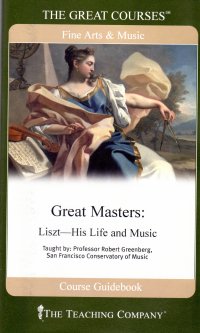
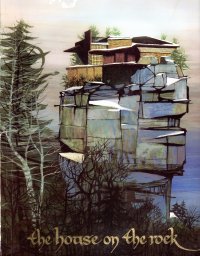
Book coverThis book is of unknown provenance; it has no title page or copyright page, and the Internet has never heard of it. I’m guessing that it was written in the early to middle 1970s because it refers to Spiro Agnew and Richard Nixon. It has the feel of small town paper’s humor column (or maybe something from the Springfield papers at the time, but it’s before the Internet), and a later entry does start out “This week” which lends credence to the belief.

And it’s quite an enjoyable little book. The “author” is purportedly a barber in a small town who tells stories about the local residents, mostly made up characters so I guess this is more an example of a collection of flash fiction than the actual reporting on what is going on in a real small town, but it’s amusing and sometimes humorous. I actually laughed out loud at a couple of the bits, including a man who corrected a nagging wife by slapping her bottom with a carp (it must be the Ozarks, as no self-respecting northerner who catches a carp brings it home to eat–because even when we’re poor, we’re not barbarians).

Given the size of the book, I probably bought it in a packet of chapbooks for a buck at the Friends of the Springfield-Greene County Library book sale at some point. I will keep my eyes open for other volumes by the author, but I’m not sanguine–this looks like a self-published low run number (although it’s signed and inscribed to Theodore), so it’s probably a one-off for a larf.

Buy My Books!
Buy John Donnelly's Gold Buy The Courtship of Barbara Holt Buy Coffee House Memories

How Soon They I Forget

Apparently, I remember glitter-inclusive Christmas cards about as long as a woman remembers the pain of childbirth–a little over a year (which is why so many siblings are about two years different in age, I often argue).

Because I got Christmas cards with glitter in them again, and now suddenly I am inadvertently sparkly.

Even my beautiful wife catches some bits of glitter, either floating through the air or from my touch when I have been working on the cards. It gives her a bit of a clubbing vibe, which she carries off better because she is something like twenty-seven years old whilst I am significantly older.

At least this year, I don’t have a beard, so the little unicorn dandruff isn’t getting caught in my facial hair. And I started and will finish my Christmas cards a couple of days earlier, which means the glitter will all finally be cleaned up a little earlier next August.

Buy My Books!
Buy John Donnelly's Gold Buy The Courtship of Barbara Holt Buy Coffee House Memories

Kind Of Not A Christmas Song At All

Morten Harket, “A Kind of a Christmas Card”:

Does that sound like the lead singer of a-ha to you? And to be honest, I’m not entirely sure what to make of the poet-narrator, as he sings:

All you folks back home
I’ll never tell you this
You’re not supposed to know
Where your daughter is

And later:

Just think of the girl I used to be
You were my age once, mama

Is he singing about the daughter? Was he the daughter? In this timeline, the song from the 1995 album Wild Seed is smack dab between “Lola” and “Take a Walk on the Wild Side” and 2020, man.

The rest of the album sounds more like the voice of a-ha, though, and it occurs to me that although I have his first English solo effort (the aforementioned Wild Seed, he has released six solo albums, all the way up to 2014. Perhaps I will think to get them when I am feeling profligate.

Buy My Books!
Buy John Donnelly's Gold Buy The Courtship of Barbara Holt Buy Coffee House Memories

Book Report: Revolution by Joshua Chase (2014)

Book coverThis is the second of Joshua Clark Chase’s military science fiction novels; I read the first, Triumphant Empire a week or so back, and I will likely read the third very soon. So that if I ever see him at a convention again, I can proudly by the next book or two in the series since I will have finally found and read the ones I bought three years ago.

So.

The copyright date is 2014, two years after Chase published Triumphant Empire, and I think I see some improvement in his writing. The book still jump cuts a bunch not only between chapters, but in chapters between the various characters and perspectives. We see the Primary of the Ordeon Empire (the triumphant one) as he meets with the emperor and deals with some light intrique with the leader of the Star Knights by commissioning an apprentice and assigning her to his task force. We get some of her perspective as well. On the other side, we focus mainly on the leader of the resistance and his brother the pirate, but also amongst some others as the resistance foments rebellion on a slave planet and meets with other leaders. The resistance discovers alien tech and captures an imperial dreadnaught to try to reverse engineer it. The empire helps the weaker side in a conflict to actually pull both into its orbit and then launches an audacious attack on three systems at once–only to be thwarted on one such attack by the resistance.

So there’s a lot going on, and the books might have fit together as a single novel. Or, perhaps, the plots could have been fleshed out to make each book bigger than the roughly 130 pages of action. The next book looks to be longer and even more recent, so I’m looking forward to it after a brief interlude. It’s best to read them all very close together, as the books might not stand alone very well as the plots are so completely linked.

I’m starting to realize that my year’s reading log is coming to an end. I will finish, what, three or four books that I have in process? I don’t know that I’ll read a whole other novel–aside from Total War, the third in this series, this year. But I guess it’s only the middle of December. I might.

Buy My Books!
Buy John Donnelly's Gold Buy The Courtship of Barbara Holt Buy Coffee House Memories

A Guide To The Book Backdrop of Brian J.

In the Wall Street Journal, likely some time ago given my reading habits, columnist Joe Queenan says Those Bogus Bookcases for Zoom Calls Aren’t Fooling Anybody:

When house-bound experts appear on TV interviews via Zoom, they are almost always seated in front of a large bookcase studiously purged of the usual trash. Whether an expert is deploring executive-office overreach or dissecting the baffling enigma of structural unemployment, you will usually see a gargantuan biography of Ulysses S. Grant or Winston Churchill perched over their left shoulder. Slightly to the left you may spot a three-volume history of the Civil War or something with the ancient Roman abbreviation “S.P.Q.R.” in the title.

If the person being interviewed is a scientist, the bogus bookcase is likely to sport a dog-eared copy of Thomas S. Kuhn’s “The Structure of Scientific Revolutions,” Stephen Hawking’s “A Brief History of Time” and either “Chaos” or “Genius” by James Gleick. Some showoffs might even have Isaac Newton’s “Principia Mathematica” strategically positioned to face the camera. Not to mention one of their own books. Or six. Or the remaindered books by friends they owe a favor.

But no matter what luminary is being interviewed, the background bookcases will include nothing by James Patterson or Lisa Scottoline, no thrillers by Tana French or Jo Nesbo, and definitely no autobiographies by Miley Cyrus.

We all know bookcases can get gussied up this way in a hurry. Something earthshaking has happened, but the first guest booked to talk about it has canceled, so Sanjay Gupta will be calling for an emergency Zoom chat in 30 minutes. The flummoxed, totally unprepared expert immediately panics. “Quick, get all the Clive Cussler and V.C. Andrews books off the shelves,” he cries out to his quarantined loved ones. “And somebody hide that Ozzy Osborne tell-all!”

You know, when I am doing a video call, I like to see if the other person / people have more books than I do. Spoiler alert: They don’t. But I don’t know what kind of cameras people with whom Joe Queenan video-conferences have, but I have yet to see a camera that shows titles very well. Although, again, that might just be me. Actually, although I glance at the monitor when I’m doing a video call, I tend to look at the camera, so I only get a glance anyway.

To spare you the bother, gentle reader, I have provided a handy guide to the real book backdrop of Nogglestead. Most of you won’t see me in a real, live (or fake for that matter) video call anyway. And the view has changed a little since 2010.

Continue reading “A Guide To The Book Backdrop of Brian J.”

Buy My Books!
Buy John Donnelly's Gold Buy The Courtship of Barbara Holt Buy Coffee House Memories

The Road Humor Not Taken

Yesterday, my beautiful wife had a meeting in town, so she volunteered to take the youngest to school. I decided that I would go to the gym anyway but a little earlier than I would were I to take him into school. As it happens, I was not leaving that much earlier–so the boy thought I was taking him to school. Even when I said I was not, he said I could just drop him on the way–it being Friday, he was eager to get to school because a fundraiser sells candy and snacks before school on Friday, and an extra couple of minutes in the morning would be that much more sugar he could consume before school. I declined, saying that I was not even going to be in the vicinity, taking instead a straight route to the YMCA, a more southern route east than would take me by his school.

Well.

I don’t know. I was lost in thought, I was lost in the metal, but I missed the highway entrance that would have spirited me to the gym ricky-tick. Instead, I took the next right, which is Battlefield Road. Which is the route to the school.

So I passed a block and a half south of the school anyway on my way to the gym.

It occurred to me as I neared the school that I could pull up to the front door, where the school employees with the thermometers await, and turn to the passenger seat, and then look in the back seat, and then drive off as though I had forgotten my son at home to amuse the custodians of the COVID protocols. Of course, my wife would arrive with the child a couple minutes later, and he could explain to them that I was going to the gym. After all, the people at the school have learned I have odd sense of humor.

I did not, though; I don’t know them that well. And, to be honest, I wanted to get to the pain awaiting me at the gym as soon as possible.

Two roads diverged on a morn, and I—
I took the one less likely to
get the Division of Family Services called on me.

Buy My Books!
Buy John Donnelly's Gold Buy The Courtship of Barbara Holt Buy Coffee House Memories

Apparently, I Do Not Own All Of Her Albums

So I have been thinking about writing some more Christmas album reviews, since they’re popular parts of the deep content here around Christmas time, and I have been thinking of including CDs I own instead of just record albums. Of course, I was thinking about that because I was without a means of playing records until I recombined the electronics here in late November. So, clearly, the idea of resurrecting the Christmas album reviews is another plan I’ve meant to put into action but have not yet.

Not being able to listen to the records meant I piped things from my phone a bunch, which is why I had been listening to Christmas CDs (ripped and streamed). One of them is Erin Bode’s A Cold December Night which opens with a song called “Skating”.

Continue reading “Apparently, I Do Not Own All Of Her Albums”

Buy My Books!
Buy John Donnelly's Gold Buy The Courtship of Barbara Holt Buy Coffee House Memories

Jeez, Everyone’s A Gladys Now

So, gentle reader, as you might know, I am light on the work hours currently, which means that I get the chance to go to the gym a couple of mornings a week. Which would be great, and I would love to do an AoSHQ GAINZZZZ thread extolling my accomplishments there, but, really, all I know is that everyone is all of sudden a Gladys.

I guess it came to mind a couple of days ago when a post showed up in my Facebook Memories:

So as I am slowly working my way back into some shape (probably a rhombus), I’m suddenly confronted with the whole world of Gladyses.

Continue reading “Jeez, Everyone’s A Gladys Now”

Buy My Books!
Buy John Donnelly's Gold Buy The Courtship of Barbara Holt Buy Coffee House Memories

Book Report: The Gift of Christmas Present by Melody Carlson (2004)

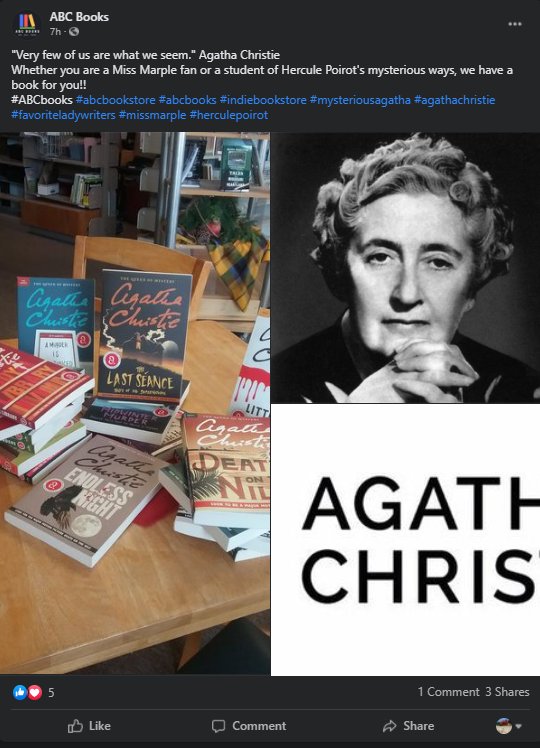
Book coverI have a confession to make: Despite the fact that I have bought several years’ worth of Christmas novels at book sales past, when Christmas time closes in, I can’t find the Christmas books I already own (and this year, I am certain they are not by the Joshua Clark Chase books). So last Friday, I headed to the northern wastes of Springfield, where ABC Books is an oasis on the distant horizon to buy one such novel for this year. Ms. E. keeps her holdings in far better order than I do; although she did not have a special display of Christmas novels set up, I quickly found one in the extensive Christian Fiction section. I recognized the name Melody Carlson as I started to read it; her novel The Christmas Shoppe was the first Christmas novel I read in 2012, when it and I were young.

This book focuses on a college-aged adoptee whose natural mother died shortly after her birth and who was adopted by an older couple who befriended the natural mother who fled from her family for some reason. Although they look a little to try to find her family, it’s only now (sixteen years ago, so then already) that the young lady gets a lead on her birth grandmother in the very town where she is attending college. As she rings the doorbell, the embittered old woman thinks she is a housekeeper/caretaker she has hired because she has sprained her ankle. So the young lady does not correct the misinterpretation and hires on as a housekeeper/caretaker and grows close to the woman without revealing her secret. She tries to learn a little about her mother and why she left–apparently, she took preggers a couple weeks before her graduation and left after a row with her family about whether she should keep the baby or not.

About the midway point, she talks to her pastor and decides to tell her family–her grandmother, her step great aunt, her step-uncle and his family–which left me to wonder where the book was going to go after the big reveal. Welp, it had one family secret too far: You see, the adopted girl is the product of a union between the stepfather and the (of age) step-daughter. So the second half of the book is the family members coming to terms with this revelation. The book uses the word rape a lot, but neither of the participants are alive in the book to say whether it was really rape or just a drunken hookup. I read enough Agony Aunt things where that sort of thing happens to think it possible, but the book calls it rape, so let it be rape, I guess. As I said, that’s a family secret too far, and it makes for the most macabre Christmas romance I can think of (actually, there’s no romance in this book: no love interests for the grandmother or the granddaughter, wait, I mean stepdaughter, I mean, whatever she ended up being).

So, yeah, that might not have been the Christmas novel I was looking for.

As I’m listening to a lecture series on the English Novel, I can’t help compare this book to the themes found in traditional English novels. An orphan, a rich family, mistaken identity, a family secret, and at the very end, the revelation that the orphan is a blood relation inheritor. It reads a lot more modern than, say, Jane Austen, but one can easily see the influence of the typical, and generally much longer, classical English literature story arc.

Or at least I can, right now, because I’m listening to the lectures that I mentioned.

Of the two, I think I prefer the later work that I read earlier. I won’t dodge her Christmas books in the future. Likely because I won’t remember until I’m researching book reports on them that I’ve read her books before.

Buy My Books!
Buy John Donnelly's Gold Buy The Courtship of Barbara Holt Buy Coffee House Memories

The Unfortunate Acronyms of Springfield

So I took a picture of D&D Home Services in Nixa because I was thinking about doing a post about it:

I was going to go off onto a schtick about “What would Dungeons and Dragons Home Services include? Gelatinous cube whole house decluttering and dusting?” and so on.

From the back seat, my oldest told us mentioned Wholesale Auto Paints, whose logo and sign on Glenstone feature the unfortunate abbreviation WAP which shares the letters of but probably not the philosophy of the recent Cardi B song. Well, he called it Warehouse Auto Paints, and it was I who explained the song to my beautiful wife, who was a bit aghast and termed it vulgar. I said it was the 2020 version of the oldie O.P.P., the 1991 song by Naughty By Nature, and she tried to defend the earlier song, saying that it was musical. Mostly, though, I hold that one considers different things vulgar when one is 19 than when one is (does math) thirty-something. But it was an interesting moment nevertheless.

I also mentioned Springfield Tool and Die, whose business stems from 1960 apparently. Its buildings are proudly emblazoned with STD, a term that would come to mean something entirely different in 1975, apparently.

Which is why I was very careful, gentle reader, when coining and popularizing (well, coining anyway) the abbreviation MfBJN for the name of this blog. Because if it’s ever going to mean something else, it is something that will still likely apply to me.

Thank you, that is all.

Buy My Books!
Buy John Donnelly's Gold Buy The Courtship of Barbara Holt Buy Coffee House Memories

Book Report: Home by David Storey (1971)

Book coverI hit my bookshelves looking for a Christmas novel to put me into the mood for the holidays, and I did not find one. Instead, I found this play by a playwright whose name I didn’t recognize. Of course, whilst I was reading it, I spoke of it with my beautiful wife, and we got to naming modernish–that is, twentieth century, playwrights. She could only name, sort of, Alan Ayckbourn, “The Norman Conquests” guy, and Neil Simon. I could name a couple more, being a reader of twentieth century drama, but not this fellow, so I thought he must have been pretty obscure. Although “pretty obscure” does not generally get a Random House hardback and Book Club Edition.

David Storey was something in Britain in the 1960s and 1970s. The son of a coal miner, Storey was a professional rugby player for a bit before turning to painting, novels (his first won a prestigious award and was adapted for the screen in 1963). Then he turned to plays. At the bottom of his Wikipedia entry, you find references to several textbook type academic works covering his plays, mostly, so some university (or maybe several) must have mentioned him in class at some time or another. This particular play opened in London and then ran on Broadway for a while. It was even revived for a run several times in this century (and has its own Wikipedia article). So he was not obscure–I just hadn’t heard about him.

Sadly, that’s a more interesting story than this particular play. It starts off with two men taking a seat and talking, which makes it a bit more difficult in reading than watching, as they don’t have too much distinction on the page or in what they’re saying. They’re passing time, not working toward a goal or problem. So I thought it was a bit Waiting for Godotish, and sometime toward the middle of the first act, I realized they were in prison or something. Spoiler alert: They’re in an insane asylum. In the second act, another man character is introduced who comes in and picks up the table and chairs at various times, and a couple of women characters, one of whom is round-heeled, I guess, and they… talk. About nothing, really, and then the play ends with no real resolution.

So I didn’t like it that much, but to be honest, I am coming to sense that I don’t like too many plays that I read cold; I guess I am more charitable to them when I see them on stage, but even then it’s about fifty-fifty. The ones I like, I really like, and most of the rest are kind of meh.

One thing, though: Look at the book cover. Now, understand that the play describes one of the characters as a middle-aged man in his forties. Brothers and sisters, I am older than that (what? when?). Why do the people on the cover look older than that? Is it because they’re English, and Americans tend to look younger than Europeans? Is it because in the fifty years since, people have taken to looking younger? Both of these? Is it because the directors chose actors who were older than the play text stated? All of these? Or worse: I do kind of look like that? Sadly, and fortunately, that’s what I see of myself reflected in this book–and not someone in an asylum.

Buy My Books!
Buy John Donnelly's Gold Buy The Courtship of Barbara Holt Buy Coffee House Memories

Book Report: Triumphant Empire by Joshua Chase (2012)

Book coverWell, gentle reader, I have found these books which I ‘lost’ on my to-read shelves after I bought them in 2017. I have had to avert my eyes when I have seen the author at subsequent LibraryCons (in 2018 and 2019) because I had not read his first three books yet. I had even mentioned that I could not find them. He had no idea. On this humble blog, this has been the story of the mythical Joshua Clark books, which I have sometimes mentioned when I reported on other books that I had purchased at cons since then (such as Elton Gahr’s Spaceship Vision: The Impossible Dream earlier this year or Miracle in the Ozarks last year).

But now it becomes clear: From that very first day, when I bought his books three and a half years ago, I got his name wrong. It’s Joshua Chase, not Clark. Not that it made the books any easier to find. Which they were–when I was looking for a monograph or collection of poetry to browse this weekend, I found the three books in this series on the outside rank, but on the lowest shelf on the leftmost book case in my office (seen here before they got really full and started to break down). I don’t think it was the mistake in the name that made my eyes pass over this set for the last three years; I think it might have been because I often have something (sometimes book-things) stacked in front of the book shelves, and the best time for me to find a book is when I’m looking for a different book.

At any rate, the book: You can tell when an author, especially a young one, has played a lot of role-playing games. The fantasy story describes characters in such a fashion that you can almost see their rolled-up scores. This book reads as though the author was big into miniatures and wargaming. The story itself is about 130 pages long with 30 pages of appendixes about the main characters, the factions, and the weapons on each side. It looks like the next book has the same set of appendixes, so it, too will be a quick read.

In the book, the last holdout base of the Vehlan Union falls to the forces of the Ordeon Empire; escaping remnants of the Vehlan forces link up with space pirates whose supreme leader happens to be the brother of the leader of the Vehlans. A small special forces team has been holding out on a conquered planet, and when they’re forced to hide out when one of the members’ estranged family, they learn the Union has fallen. And the Ordeon leader who led the final assault on the Vehlan Union gets promoted to a supreme military leader position and starts his assaults on the remaining non-Ordeon systems in the galaxy.

The writing focuses on the plot and the battles more than individual characters or setting the scenes. As you know, gentle reader, if given the choice between a book which favors a moving plot and a book that focuses on the writing, I’ll pick the book with the plot every time–I do read a lot of genre fiction for this very reason, after all. This book has probably enough plot for a more modern 400 page book, but it’s stripped down perhaps even more than your common men’s adventure paperback.

But it was a quick read, and the plot was engaging enough. So I will read the other two books soon, and I will probably pick up the other(s) in the series if I get the chance just to see how this young man’s writing evolves over time.

Buy My Books!
Buy John Donnelly's Gold Buy The Courtship of Barbara Holt Buy Coffee House Memories

A Difference That Probably Does Not Reveal As Much About Our Upbringings As I Would Say

So I was telling my beautiful wife about this overpriced Facebook-advertised tchotchke that I ordered for my youngest son for Christmas (and will no doubt see advertisements for it now that I have actually ordered it because clearly I am a good lead for this particular vendor, and that’s how Internet advertising works).

I explained it was a little like pachinko:

“It’s a pegboard where you drop a little metal ball down it, but it has specific gates and things that will guide the way the ball rolls down the board…” I said. Or words to that effect, gentle reader; I did not take down the conversation verbatim, but it’s as real as any conversation you’ll read in a Norman Vincent Peale book.

“Don’t you mean Plinko?” she asked.

Which led me to question, Did I mean Plinko? So I researched it quickly to verify that the game pachinko actually exists and to show her details about it. The boy’s gift is more like pachinko, by the way; Plinko uses a disk and just pegs, whereas pachinko uses balls and bumpers of various kinds. It’s a bit like pinball, but it’s often a gambling device. The boy’s school has a board they use for carnivals and whatnot, and an Internet image search indicates a lot of schools do.

So you know I would like to turn this into some indicator of the differences in our upbringing–that I grew up working class in seedy taverns and she grew up in a comfortable suburban family that watched The Price Is Right. But the seedy taverns, which really weren’t that bad, didn’t have pachinko machines (I grew up in Milwaukee, not Tokyo). That I knew my pachinko from my Plinko probably stems from the fact that I read more widely (id est, randomly) than she does.

Buy My Books!
Buy John Donnelly's Gold Buy The Courtship of Barbara Holt Buy Coffee House Memories

Book Report: Reflections at Alley Spring by Tania Gray (1980)

Book coverThis book is a small collection of newspaper column-length text accompanied by one of the artists’ drawings of people and places near Alley Spring in northern Shannon County, Missouri. Self-published in 1980, this book includes interviews with local figures who were born around the turn of the century and remember traversing the county in wagons, in cooling their perishables in springs, and who used or restore old mills and steam equipment.

So, yeah, it was right in my wheelhouse.

I take a paper, the Current Local, which is just south of Shannon County and is also on the Current River, so some of the place names are familiar. And my favorite bits in that paper are the columnists, so the book fits into what I’m reading every week anyway.

So I enjoyed it. It’s a little saddle-stitched 59-page collection, so about 20 or 25 “columns.” The drawings are good, too, and the author is a painter by trade, I take it. She’s from before the Internet, so searches on her name bring up a variety of “We found Tania Gray for you, cyberstalker” sites but no examples of her paintings. I’ll have to watch out for them at local antique malls and garage sales, I suppose. As well as perhaps other similar collections, which would be a treat to find.

Buy My Books!
Buy John Donnelly's Gold Buy The Courtship of Barbara Holt Buy Coffee House Memories

Book Report: Samurai Warriors by Stephen Turnbull (1991)

Book coverI have described “carry” books from time-to-time, gentle reader. These books I throw into my gym bag to read at the martial arts school whilst my boys are taking classes before my class or to carry to church to read during the Sunday School hour. Well, this year has eliminated the latter, and time itself has eliminated the former. When my boys were younger, they took early afternoon young children’s classes, and the adult class was at 7:00, so I would spend sometimes three hours at the dojo before my class. Then, they were in older kids’ classes, which meant I would still spend an hour or so with time to read. But with the new abnormal, once the dojo opened back up, the older kids and adults had classes together, so we have all had class at the same time. And if the school ends up with enough kids again to split the kids from the adults, my boys will both be old enough to take adult classes. So the days of the carry book, or at least the one that goes into the gym bag, are over. And this is one of the last that I will finish, although it spent some time (years) on the table by the recliner because I was tired of carrying it and wanted to finish it during the evening reading (which is how so many of those books end up on the side table for a long time).

At any rate, this is a coffee-tableish book that focuses on showing variations in samurai armor over time more than give a detailed history of the samurai, although it does give a high level overview of medieval Japan and the tensions between the Shogun and the Emperor.

The book reflects my first foray into Japanese history, and unfortunately, it’s not a good intro (which, again, is not so much the point–it’s more a picture book of Samurai armor and art with some overview than a true history). I found it a little challenging because I am not familiar with the topography of the Japanese islands–the book only provides a single map, early in the book, that I had to keep flipping back to–and I am not familiar with the names yet, so I found it a little difficult to follow. Not Russian novel-level bad, but still. The samurai sometimes changed names, which didn’t help.

So it’s a good book if you’re already kind of familiar with Japanese history and samurai armor, as it can reinforce what you’ve already seen or read, but you would better be served reading other works first.

What other works? I will be hanged if I know. A quick search of the local library system for Japanese history brings up titles on how Anime conquered the world and the internment of Japanese Americans during World War II, so I am not sure how much of a NNipponophile I can become from the library books. But I should read up on it a bit. Japanese history looks to be a little more internally directed than, say, China, where China can get invaded (and does) from every direction, but the Japanese islands mean that no outside force can walk there (a key in conquest, I explain). So Japanese history is full of internecine conflict, but not a lot of being conquered by the Mongols, the Manchu, and so on.

But I’ll find something, sometime, at a used bookstore or book sale. If not, I’ve still got primary sources of Frankish history to read, so I am not hurting.

Buy My Books!
Buy John Donnelly's Gold Buy The Courtship of Barbara Holt Buy Coffee House Memories

The Word Is DeRooneyfication

I know how Adaptive Curmudgeon feels when he says:

Among my many first world problems was a window in my shop that had rotted away. Wind was whistling through the 1″+ gaps around what once was the edges. Last year I bought a cheap window to fit the rough opening, and then dropped the ball… for an entire year.

As long as you’re not dead you haven’t given up. Right?

Which is why I have coined the term and have a whole category, sparsely populated, called DeRooneyfication, which is:

Sometime when I was reading some of his columns some number of years ago, I related to one of Andy Rooney’s situations. He mentioned going into his basement workshop and finding a number of projects that had been off to the side for a number of years, including a chair that needed fixing and whatnot. Even though I was probably just the long side of thirty at the time, it resonated with me, since I’d been collecting projects and materials for projects since before I got married. Now that I’m just the short side of forty–and soon on its long side–I decided to start finishing some of those projects.

But not lots of projects, gentle reader, oh, no! As a matter of fact, the blocker project, another term I coined, about which I wrote in 2018, has not been completed (by me, he said to really underline the passive voice). Instead, it has been moved to the side table in my workshop area of the garage. By “workshop area,” I generally mean the place where things get dumped, so that the first and most difficult project of any energized period of doing on my part is cleaning up the area so I can do anything there. A project itself that I often start but seldom finish.

I did, however, complete a little project last weekend that I sort of feel proud of/sort of disappointed that it took me so long to actually do it.

Continue reading “The Word Is DeRooneyfication”

Buy My Books!
Buy John Donnelly's Gold Buy The Courtship of Barbara Holt Buy Coffee House Memories

Book Report: I Sing of America by Earle Davis (1981)

Book coverThis is a collection of poetry, or rather a group of cantos about America. Spoiler alert: About the only good thing about America is jazz music. Everything else is pretty much killing the Indians, slavery, and oppression. Well, not exactly that bad but mostly so.

So poetical bashing of America goes back a long time, but I guess Charles Sykes published ProfScam in 1988 and The Hollow Men in 1990 (I read them in my formative college years when they still had that new book smell).

The verse itself is not very evocative; rather, it’s expository, preferring to mostly tell what it wants to say (America bad, or at least suspect). The author in a note at the end says he’s trying to emulate Ezra Pound and the Chinese Odes in writing a vast epic built on individual cantos (there are 15) which include a narrator introductions to individual segments in each canto. The author intends for each canto or indeed segment to be an independent poem, so the rhyme scheme and rhythm varies. Some are better than others. But that praise is relative. Nothing in it is very compelling.

The book is signed, an unnumbered copy of a limited printing of 100 copies. It looks like it was laid out with a typewriter.

It probably was, as it precedes the desktop publishing revolution. My first chapbook, Unrequited, appeared during the desktop publishing revolution and still looks like it was laid out with a typewriter. But on a computer! We all got better.

My beautiful wife glanced over at some point and read some of it, pronouncing it not good, and wondering why I read things that are not good (poems and novels). The professor conducting the current lecture series to which I am listening said yesterday that writers can learn as much or more from reading bad things as good. Which is what I also maintain. Although the importantest lesson for writers is to write as I hope to learn someday.

Buy My Books!
Buy John Donnelly's Gold Buy The Courtship of Barbara Holt Buy Coffee House Memories