On Pomp and Circumstance by Jean Shepherd

Book coverYou’re familiar with his work and his voice–he wrote the the basis for A Christmas Story and narrated it–and he had a long-running radio program back in the northeast where he would spend an hour minus commercials taking a topic and going off on a monologue with diversions about it.

In the middle 1960s, from whence these particular episodes come, contain the similar reflective humor from the curmudgeon genre. Kids these days, these modern things aren’t as good as they used to be, and so on. A little like Andy Rooney, but less cranky. A little like Dennis Miller, but less arch.

Shepherd covers different things, such as the difference in radio broadcasting technology, how Americans envy other countries their sense of stuffed shirt pomp, going to shows and the movies, regional accents, and so much more.

Each disc has a single episode on it, so the sample size is only eight shows, but it made for amusing but not laugh-out-loud funny on various car rides. My beautiful wife, however, did not like it, so perhaps the appeal is more towards the curmudgeonly amongst us.

Buy My Books!
Buy John Donnelly's Gold Buy The Courtship of Barbara Holt Buy Coffee House Memories

Military Scientists Make The Sword and The Sorcerer Prototype A Reality

US air forces in Syria use rare Hellfire missile to kill two targets:

The projectile used in the attack in Atmeh is believed to be a rare Hellfire missile known as the AGM-114R9X — which instead of a traditional warhead, has sword-like blades that protrude out of it, according The Warzone.

Video of the field trials below:

If it were lasers, you know I’d have gone with Real Genius.

Buy My Books!
Buy John Donnelly's Gold Buy The Courtship of Barbara Holt Buy Coffee House Memories

Scoring Low On A Rolling Stone Quiz Is No Shame

Some twenty-year-old has compiled a list called The 25 Greatest Christmas Albums of All Time.

How many do I own? Answers in bold:

  • Weezer, A Weezer Christmas
  • Christmas Joy in Latvia – Latvian Christmas Cantatas
  • Jacob Miller, Natty Christmas
  • Sufjan Stevens, Songs for Christmas
  • Bob Dylan, Christmas in the Heart
  • New Wave Xmas: Just Can
  • t Get Enough
  • Cee Lo, Cee Lo’s Magic Moment
  • She & Him, A She & Him Christmas
  • Christmas on Death Row
  • Carpenters, Christmas Collection
  • Johnny Cash, Christmas With Johnny Cash
  • A Very Special Christmas
  • Frank Sinatra, A Jolly Christmas From Frank Sinatra
  • The Ventures, The Ventures
  • Christmas Album
  • Willie Nelson, Pretty Paper
  • Ella Fitzgerald, Ella Wishes You A Swinging Christmas
  • Soul Christmas
  • Bing Crosby, White Christmas
  • Beach Boys, Beach Boys
  • Christmas Album
  • Louis Armstrong and Friends, The Best of Christmas Songs
  • A Motown Christmas
  • A Charlie Brown Christmas
  • James Brown, James Brown
  • s Funky Christmas
  • Elvis Presley, Elvis’ Christmas Album
  • A Christmas Gift For You From Phil Spector

Of the ones I’m missing, I might only want a couple. Ella, Louis Armstrong, maybe the Charlie Brown Christmas, the Sinatra, maybe the Phil Spector one. Am I allowed to want the last? He went to jail for murdering his wife. I mean, it’s not the same as touching a woman on the bum who later decided she didn’t want to be touched on the bum.

At any rate, one wonders how many Christmas records a modern journalist has or plays at all.

You know I do.

(Link via Ace of Spades HQ.)

Buy My Books!
Buy John Donnelly's Gold Buy The Courtship of Barbara Holt Buy Coffee House Memories

On Heaven or Heresy: A History of the Inquisition by Thomas Madden

Book coverThis course extends the lecture on the Inquisition from Medieval Mysteries and gives a fairly detailed history of the Inquisitions starting with the fact that the although the common 20th and 21st century representations of “the Inquisition” were oversimplified, incomplete, and based on popular culture not only of the current time but also the past centuries.

Well, okay, he starts with part of that and ends with a couple of lectures about how the various Inquisition was eventually portrayed after the Enlightenment as brutal and backward.

But in between, the ten or so lectures between introduction and conclusion, provide good historical context for the differences between the inquisitions in various regions and the modern, post-Enlightenment propoganda and popular culture interpretation of the Inquistion.

He lays out the contemporary zeitgeist–that it was a more uniform religious time, when crop failures and whatnot were still interpreted as God’s displeasure with a people as in the Old Testament. So the people wanted someone to come root out the heretics who were displeasing to God, and how the local rulers liked to take this upon themselves to find and quickly eliminate troublemakers in the area–often not so much theological disbelievers as political malcontents. So the local church leaders could call for an inquiry, which sought to find disbelievers and to convince them to return to the faith. Use of torture was limited, and the hearings had strict rules of evidence for the most part, and have some number of records in the church archives to support this. Only after a long inquisition and failure to recant was a presumed heretic released to the secular authorities for execution.

However, it did evolve, and by the time of the Spanish Inquisition, some of these rules were loosened. The ecclesiastical inquisition was co-opted by the Spanish government, so it was a little more brutal than other inquisitions.

Inquisitions, as they were, continued into the time of the Reformation where both Protestants and Catholics used them to ferret out the heretics–which were essentially the other side of that particular schism. Eventually, though, when the religious wars burned out, the inquisitions did, too, although the Spanish Inquisition formally continued into the nineteenth century.

When the Enlightenment authors got going, though, the Inquisitors were always the bad guys, and the then they were comic relief.

So the course adds detail to the one lecture he gave in the more summary course noted above, but I’m not sure I’m going to retain much from the extra material, and I’m not driven to a medeival studies degree with an emphasis in the material. But it did pass the time in the car and gave me a better time than the limited playlists on the radio.

And I’m thinking about writing historical fantasy with an Inquisitor as a protagonist. But Howard has almost done that with his Puritan Solomon Kane better than I would.

Buy My Books!
Buy John Donnelly's Gold Buy The Courtship of Barbara Holt Buy Coffee House Memories

On Thinking Like An Economist: A Guide to Rational Decision Making by Randall Bartlett

Book coverThis Great Courses series of lectures provided an interesting insight into Economics, or more to the point the mindset of economists, and not necessarily in the way the professor behind it intended.

I mean, it does present some of the basic tenets of Economic theory. Namely, that people respond to incentives to make their lives according to their standards better; that decisions have costs; that free markets are good; that nobody has complete information for any decision; that decisions and actions often have unintended consequences, and that in the aggregate, crowds are wise (until they’re not). It really emphasized the concept of marginal value, which is that eventually effort will yield smaller results (also known as the law of diminishing results).

All of which I agree with. But then, economists’ thinking takes a turn into the totalitarian, where since economists have mastered these principles, they should build or help systems to alter individuals’ incentive structures so that they, the individuals, will make the right choices according not to the individuals’ but the economists’ ideas of what the subjects “free” individuals should be. So if traffic or air pollution is too high, it just makes sense to raise taxes to make it more expensive to drive into town. And when it comes to the environment, the economists must act because of the tragedy of the commons or something.

You know, the tragedy of the commons: When individuals share a resource, they will take more than their share because they alone are not responsible for its upkeep. Which, too, is an economist’s invented problem, because it features individuals divorced from tradition, religion, or morals who only act according to the economist’s reasoning constraints and unlike people.

So it falls to philosopher-king economists, ultimately, to set the incentive structures for people who don’t natively play by the pure economist rules to reach the economist-reasoned best outcomes. They ignore or diminish the elements of uncertainty that their own principles recognize (incomplete information, unintended consequences, freedom). Instead, they become Jigsaw Keynesers: You’re free to choose whether you want to cut your comfort off or pay extra taxes for heating your home.

Maybe instead they’re Keyneser Soze, except the greatest trick economists have ever pulled is convincing themselves they’re not the devil.

Maybe I should stop with the Keynes jokes already and get to the “at any rate” summation of what I got out of the course.

At any rate, some good, practical ways of thinking about values in decisions, but only at a low, tactical level. It’s best not to build a whole philosophy on it or to let others with credentials impose it upon you.

Buy My Books!
Buy John Donnelly's Gold Buy The Courtship of Barbara Holt Buy Coffee House Memories

Personal Relics: The Christmas Stocking

My sainted mother knew how to sew. She knew how to do needlepoint, crewel, embroidery, and other things. She even had a little business hosting Creative Circle parties, shilling and selling their craft kits.

But when it came time to tart up our Christmas stockings, she went with some green iron on letters she probably bought at the flea market on the hill above our trailer park.

They’ve faded on one side over the years as they hung on the paneling of the trailer or to the right of the sofa in the living room down the gravel road. She made one for my brother and one for herself, the three of us against the world. When I got to high school, we got into the habit of actually putting things in the stockings. It’s a tradition that continues to this day, as I fill my wife and children’s stockings with gift cards and candy and little gifts on Christmas Eve.

I’m not sure when I took possession of it, either. It might have been after my mother passed away. I’ve never hung it by a chimney with care, either; by the time I lived places with actual chimneys, my mother-in-law, who is more crafty than sewy, created some felt and bangled stockings for the whole family. So these are hung by our chimney with care to be filled on Christmas Eve.

So I hang the old stocking in my office, generally taping it onto the Arkanoid video game and rehanging it often as it peels off.

It’s not the only Christmas decoration that reminds me of my mother and my youth, but it does often as it falls to the floor again..

Buy My Books!
Buy John Donnelly's Gold Buy The Courtship of Barbara Holt Buy Coffee House Memories

The Meme Reminds Me Of

I saw this on Facebook:

It didn’t resonate with me as me. Which is not to say I’ll not be grabbing my beautiful wife in, erm, twenty or so years (that soon?).

It reminds me of a guy I worked with in the print shop circa 1996. Kenny had worked at the shop since The War, forty years by then, and he’d worked with a lot of the employees for a long time as well. I find it hard to believe now, but many of the employees had been with the shop for decades, having moved with it from the city of St. Louis out to the then-hinterlands of O’Fallon sometime in the 1960s. So these people had worked together a long, long time.

A woman named Della worked on the bag presses as a boxer. Every day for innumerable years, she took bags as they came off the printer and after they’d run through the glue and folding channels, and she placed them in boxes. Whenever she would walk by Kenny’s little t-head press, he’d hoot and catcall her. And she was someone’s grandma probably. Maybe great grandma.

But Kenny had known her when they were younger, and maybe she was quite a looker in the 1950s. So he still made suggestions that he should probably consult his doctor before attempting, and she laughed at him.

I thought it might make an interesting novel: A tight knit group who’d work together a long time gets blown up when the woman in this case, who has flirted with a male employee for decades, looks at her retirement and finds it wanting so she sues the company for allowing sexual harassment. I think I got as far as naming a few characters, but that was it (twenty-some years ago).

In the actual print shop, though, there as no tension, and Della might have been flattered.

As I’ve grown older, though, I’ve come to understand something of Kenny’s viewpoint. To twenty-four-year-old Brian J., Della was old, but that’s because I met her when she was older. But I’ve known my wife for over twenty years now. Technically, she is old enough to be a grandmother herself (somehow); by the time my mother was her age, I had graduated college, and it would only be a year or so until my mother was a grandmother. My own grandmother was a grandmother much earlier.

I think my wife is as beautiful as she was when she was twenty-five. She is that girl and the woman she has become. So she’s that girl and more. She’s all that she was plus all she has become since then. I don’t think I can quite explain it, but there it is.

So as I get older, like Kenny, I shall likely continue to make suggestive remarks even as I advance to an age where that will make me a goat. Because of Kenny. And the Spenser novels. And my wife, who will become even more beautiful (although I’m not sure how the math works on that).

Buy My Books!
Buy John Donnelly's Gold Buy The Courtship of Barbara Holt Buy Coffee House Memories

$#*! My Dad Says: The Next Generation

Gen Z’s ‘OK, Boomer’ meme may become a TV show.

It’ll be as big as the television series based on a Twitter feed was ten years ago.

Which is to say, not very big at all. Even William Shatner could not save it.

Because old people watch television, and they don’t want to watch television mocking them nearly as much as kids want to make television shows that mock old people.

Besides, as you know, I’ve already got a favorite Boomer show.

Buy My Books!
Buy John Donnelly's Gold Buy The Courtship of Barbara Holt Buy Coffee House Memories

Depend on the Meaning of “Independent”

The New York Times has taken to advertising to me on Facebook.

One of the largest papers in the country is not exactly what I would call “independent” journalism. I’m not even sure who would be “dependent” journalists would depend upon in this formulation if not a full-time job with a prestigious newspaper.

Also, “Every Fact. Every story.” oversells what the paper actually delivers.

Buy My Books!
Buy John Donnelly's Gold Buy The Courtship of Barbara Holt Buy Coffee House Memories

The Boys’ Christmas Wish List

Nerf gun, yeti teddy bear make most dangerous toys list

To be honest, though, they’re old enough to have discovered power tools and sledge hammers, and they think they can operate them without adult supervision. The youngest got to use a hand saw for the first time this weekend, and after we had packed it all up, he got it back out and cut himself with it.

So dangerous toys are not especially at the top of my parental concerns list.

Buy My Books!
Buy John Donnelly's Gold Buy The Courtship of Barbara Holt Buy Coffee House Memories

Junky Sustainability

So the swag in our 5K bags has changed in the last year or so.

Instead of little tchotchkes like bottle openers, calculators, and whatnot delivered in a plastic bag that I could reuse as a small garbage bag, we’re getting ticky-tack water bottles.

The bottles, of course, are so you can refill them with tap water instead of drinking from a plastic bottle and tossing it. However, the swag bottles are only nominally thicker than the disposable water bottles. They’re not quality water bottles with insulation, and let’s be honest: everyone already has one. We do. Since everyone is giving out these little water bottles, we’ve got a bunch of them. Maybe I’m just a little peeved about their profusion because my boys like to fill one up with some fluid and instead of drinking it and reusing it, they leave them littered around the house like stray bowling pins as they then use another. Every couple of weeks, I collect them, wash them, and put them in a donation box for a church garage sale, where they can sit on a table for a couple of days marked a quarter before someone else throws them out, from whence they go to a landfill and take double the 100,000 years or whatever it takes for a disposable water bottle to decompose.

Many of the athletic events have switched from plastic bags to tissue-thin recycled plastic fiber “reusable” shopping bags as well. They’re thin and don’t look to be very durable except, probably, in landfills. I don’t use reusable grocery bags as I like to collect the plastic bags to use for cat litter cleaning and for the multitude of small waste cans at Nogglestead. At times, when I have not been shopping as often, I’ve resorted to buying a box of these plastic bags. I’d feel a little odd using the reusable bags for trash duty, so they go into the donations box pretty much the time I get home from the athletic event.

So in lieu of disposable items, the swagmakers and swag-swaggers of the world offer us these cheap reusable items that are not much better than the disposables they replace and allow the people whose logos appear on them to feel like they’re doing something for the environment, but, come on, they’re not.

Buy My Books!
Buy John Donnelly's Gold Buy The Courtship of Barbara Holt Buy Coffee House Memories

On the Art of June Wayne

June Wayne bookJune Wayne bookJune Wayne book

This spring, I bought three catalogs of exhibitions of June Wayne tapestries and whatnot. Yesterday, I flipped through them, but I cannot bring myself to count them as books in my annual list. They’re like 35 pages each with a couple images in each book as well as little bits of film strip or negative with other, presumably full color representation of the work.

At any rate, June Wayne was a painter and lithographer know for her tapestries and textures. These three books show a limited range of subject matter, though. The books all show series of prints and paintings based on her fingerprint, an abstract of DNA, and Japanese/Oriental-influenced images of tidal waves.

Perhaps these books only represent a phase of her art, but a lot of her pieces from this time simply repeat with differences the same motifs. Which is kind of dull.

The text within the books, at least the text that is not French but could very well include the French text as far as I know, lauds Wayne as a very important artist. You know, back when I was reviewing art and poetry in print, I tried to say something nice about everything I reviewed. However, I never got to the point of overemphasizing the importance of an artist in the canon. Perhaps I’m just suffering from the recent monographs from minor artists whose work the public has forgotten if it ever knew them.

So worth a glance, but I wouldn’t pay top dollar to hang her stuff in my house. And I don’t feel the need to go see one of her shows.

Buy My Books!
Buy John Donnelly's Gold Buy The Courtship of Barbara Holt Buy Coffee House Memories

Book Report: Devil Force The Executioner #135 (1990)

Book coverI was impressed (such as it is) with the previous entry in this series, White Line War, and I liked this book as well.

It doesn’t follow a typical Bolan/Executioner plot, which is nice. In this book, someone is hitting members of a covert ops team from Vietnam known for their savagery. The CIA starts trying to hit those members as well to cover their operations in the war, and members of the teams are looking to kill the person hunting them. Bolan is almost an afterthought as he tries to get to the bottom of it. It turns a convention on its head, as the American servicemembers are the bad guys and a Vietnamese youngster seeking revenge is, if not the good guy, at least a more sympathetic character.

Still, having Bolan kinda fumbling around the main plot instead of just hitting a Mob hard site was nice, but it does end rather abruptly with a quick battle in the jungles of Cambodia kinda truncated a pretty good story.

So I’m not averse to pulling down one of these from the shelf every hundred or so pages of the Dickens novel I’m currently reading at a leisurely pace.

Buy My Books!
Buy John Donnelly's Gold Buy The Courtship of Barbara Holt Buy Coffee House Memories

On Pageant Magazine’s Best Of Everything in 1951 Issue

Book coverThis January 1952 issue of Pageant magazine is its Best of Everything 1951 issue. A time capsule into the immediate post-war world in a digest magazine that apparently sought to take on Reader’s Digest. It’s a general interest magazine, with not so much the high writing of the slicks nor the woman-focus of home magazines.

What’s inside?

  • “2001 A.D.–Year’s Best Forecast”, a vision of what life would be like in 50 years. It’s off quite a bit, but it’s all-in for wind and solar power and down on nuclear, which is the state almost 70 years later.
  • “She Gets Most Joy From Cooking”, wherein the author of The Joy of Cooking Irma Rombauer is named Woman of the year. Almost 70 years later, the cookbook is still known.
  • “The Case of the Curious Cop”, a true crime story that’s interesting even now.
  • “The Miracle of the Giants”, a baseball story.
  • “The Men Around Truman”, profiles of some of the president’s advisors, many of whom are forgotten today.
  • “The Birth of an Island”, a science story by Rachel Carson. Yes, that Rachel Carson.

Along with these articles, we’ve got fashion guides on how to buy items that you can wear or pair for different occasions; the best toys to by for each age group; beauty queens of different festivals; and varied humorous joke/quip collections like you would find in Reader’s Digest.

Along with a full photo of the cover girl on the back:

Cute, but not racy.

No left-wing bias to speak of–the magazine talks about the “pinkos” in government–but a couple of environmental pieces that foreshadow things to come. The “best science story” by Rachel Carson, for example, tells of how volcanic islands are formed and how different plant and animal species might come to it, and how great it is until MAN SHOWS UP.

You know, I miss general interest magazines like this. I subscribe to Reader’s Digest off and on, and I used to subscribe to The Saturday Evening Post and Grit, but those last two changed too much to retain my interest. But I must be the only one; otherwise, we would have more of them around today.

I wonder where I got this; the front cover has an antique mall sort of pricing on it, but I can’t imagine picking this up for a dollar at an antique mall. More likely, it was in a dollar bundle of digest magazines and chapbooks that I bought at a Friends of the Springfield-Greene Library book sale. These bundles, grab-bags really, provide me with quite a few curiousities that I sometimes count as books read. But not in this case, as it is clearly but a magazine.

Buy My Books!
Buy John Donnelly's Gold Buy The Courtship of Barbara Holt Buy Coffee House Memories

Book Report: Humphrey Bogart: A Hollywood Portrait by Marie Cahill (1992)

Book coverThis is a coffee table book that presents a short biography of Humphrey Bogart, and then kind of steps through his career and filmography with promotional stills and perhaps some candid snaps, but probably less “candid” than posed behind the scenes shots.

It reminds me of how many Bogart movies I have yet to see, and that’s a sad commentary on how many movies I get to watch these days–which is several a year. And that’s not movies I watch in the theaters–that’s total. Yikes.

Perhaps I should watch less football and more black and white movies. Although I would not be able to browse books like this while watching a noir flick.

At any rate, worth your time if you’re a Bogart fan. And I am, as Bogart is the only cinema star whose picture appears on my office wall. If you’re keeping track, only one author (Robert B. Parker) appears on my office walls, but a lot of sports figures (various Packers, Jordan Binnington). For what it’s worth.

Buy My Books!
Buy John Donnelly's Gold Buy The Courtship of Barbara Holt Buy Coffee House Memories

Found Bookmark: Brogans Restaurant and Bar Flier

So, within Vancouver: A Year in Motion, I found a flier for a restaurant. A restaurant in Vancouver would have made sense.

But this restaurant, Brogans, is in Ennis, Ireland.

The restaurant is only only 35 years old, which is about the age of the book, and the traveler could have picked it up and put it into the book at any point since then, but I suspect it would likely have been in the 1980s. The flier is on brown card stock and looks like something that would have been pasted together by hand and not by computer.

So, likely, whomever would have put this flier in the book visited both Vancouver and Ireland in relatively short order. I would be envious except I’m generally reluctant to travel, and I have visited Poplar Bluff, Missouri, St. Charles, Missouri, and Washington, D.C., in the last couple of months, so I seem to be easing into a little travel anyway. Also, envy is for the small minded.

So what do I do with this now that I’ve read the book and scanned the flier for posterity? Shred the flier and use it as kindling for a fire in the Nogglestead fireplace? Tuck it back in the book now atop the shelves at Nogglestead? Or simply let it float around on the jetsam on my desk for a year or two so that it appears on a Five Things On My Desk post in a couple of years (after all, I’ve already scanned it, so that will make it easier for that latter-day post)?

Probably the latter followed by one of the former when I get around to it.

Buy My Books!
Buy John Donnelly's Gold Buy The Courtship of Barbara Holt Buy Coffee House Memories

Book Report: Vancouver: A Year In Motion (1986)

Book coverThis is the official book of the Vancouver Centennial celebration in 1986, and its schtick is that a series of photographers went out to photograph the city in its centennial year. So it starts in January and runs through December and includes the building and running of the exposition that marks the centennial.

The photos look to have been chosen to illustrate aspects of Vancouver from its economy to its wonderful landscapes, and the book is a little text heavy as it explains how awesome Vancouver is. The amount of text takes away from the images, and the images themselves, as I said, are not chosen for quality or their photographic skill alone.

So this is not an art book.

It is interesting, though, that of all the city-touting photography books (touting cities such as New York, San Francisco, and Detroit), this is the only one to specifically pay homage to the city’s strip clubs, complete with photo of an exotic dancer on a pole. So it has that going for it.

Worth a browse, but it requires some attention. For a coffee table book, it is attention-intensive. So I browsed it during football games not featuring the Packers.

Buy My Books!
Buy John Donnelly's Gold Buy The Courtship of Barbara Holt Buy Coffee House Memories

Were This An Actual Movie….

I would probably take my poor, long-suffering beautiful wife to see it.

I have taken her to see far worse films based on Saturday Night Live skits.

But I would not take up another $10 or $15 a month service charge to stream it. I might have mentioned that I don’t get to see many movies these days, and I think we’re about two seasons backed up on the things we record on our DVR, so I don’t need to spend extra watching things I probably won’t enjoy and that will probably lecture me anyway.

Buy My Books!
Buy John Donnelly's Gold Buy The Courtship of Barbara Holt Buy Coffee House Memories

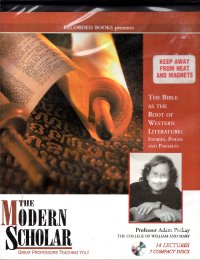
On The History of the Bible: The Making of the New Testament Canon

Book coverThis course offers a history of how the books of the New Testament became the canon. I guess the title indicates that. But it’s not a straight ahead timeline of the conscious development of the New Testament. Instead, it’s more of a survey of different things to consider when looking at the history. It discusses the different types of literature in the New Testament, the Gospels, the epistles, and apocalyptic literature. It touches on apocrypha that did not make the final cut (and sometimes why). It talks about the creation of the written literature as the church evolved and needed a central repository of teachings to share among the scattered churches. It also talks about copying errors and whatnot and a touch of church history.

So it’s an interesting listen. My beautiful wife would not like it because she rankles at people who are probably not Christians opining or discussing Christian or Biblical history from a non-Christian perspective. This lecturer says that he’s not going to tackle the theological content of the books under discussion, but at times he does make light of what his Christian students say, so he’s probably not exactly a homer. I, on the other hand, am very interested in church history and consideration of the imperfections of translations of the Bible.

So you good bit of listening if you don’t mind those things.

Buy My Books!
Buy John Donnelly's Gold Buy The Courtship of Barbara Holt Buy Coffee House Memories