Musings on Origins of Great Ancient Civilizations

Book coverSo the guidebook to this course presents me with a little dilemma: Should I count it as a book against my annual reading or not? I mean, I counted the guidebook for the course From Yao to Mao: 5000 Years of Chinese History as a book, but not the one for Elements of Jazz: From Cakewalks to Fusion. Of course, the former was over 100 pages, and the latter was like 25. The guidebook to Origins of Great Ancient Civilizations is 72 with the glossary, timeline, and bibliography. All right, you have convinced me to count it as a book read in 2019 even though I listened to the course probably over a year ago and only completed the guidebook now because I found it at one of my book accumulation points.

At any rate, this is a fascinating course, twelve lectures in all, that covers Egyptian and Mesopotamian civilizations (with a bit of a nod to early civilization in the Indus River valley, but as this last was not that well explored at the time of the course, it only gets passing recognition). The course covers the Bronze Age to the Early Iron Age, so you’ve got lectures on Sumer, Babylon, Egypt, Assyria, Israel, and the Persians as well as mention of the Hittites and Chaldeans and other tribes in those time periods who made a name for themselves.

As I mentioned in the book report on From Yao to Mao:

The fact that this succession of different groups controlling different regions could all be called “Chinese” history. You’ve got, for example, Mongols, Manchus, and various other tribes from outside the Chinese homeland taking over, succeeded by other non-Han peoples running things. But scholars continue to call it “Chinese” history. It would be like calling all of ancient Near East history Babylonian history (or Iraqi, perhaps) history–you’ve got different groups coming in and controlling the region around the ancient city of Babylon, but it’s Akkadian history or Chaldean history or whatnot. There’s not quite the enforced commonality you get in “Chinese” history. One has to wonder if that’s because in the 20th and 21st centuries, there’s a single Chinese government trying to control a large territoriy comprising different tribes’ homelands and to prevent fracturing or another tribe, so to speak, assuming power.

This sort of holds true for the Egyptians, whose civilization is controlled at various times by tribes from the Delta, tribes from up the river, and Greek peoples. The tribes that roam back and forth over Mesopotamia, though, aren’t characterized as a single civilization. I wonder why this is. The limited geography of Egypt versus the distributed loci of the other civilizations’ power? Aliens?

From the lectures and the guidebook, I come away with a vague understanding of the succession of the small empires and their chronology, and I will have something to say about the origin of the peoples in real life called Akkadians or Cimmerians when my boys are old enough to watch The Scorpion King or Conan the Barbarian.

Reviewing the guidebook makes me want to go through the lectures again, which is probably as high of praise as I can put into a brief report on the course.

Also, in retrospect, I want to count the much shorter guidebook for Elements of Jazz to my annual list.

Buy My Books!
Buy John Donnelly's Gold Buy The Courtship of Barbara Holt Buy Coffee House Memories

Good Book Hunting, January 18, 2019: Barnes and Noble

For Christmas, I received a large gift card to Barnes and Noble, which meant that I needed, needed to make a trip to the store to buy some books, as I’ve not bought any in five whole days.

I bought four:

Titles include:

  • Old School: Life in the Sane Lane by Bill O’Reilly with Bruce Feirstein. I just bought a Bill O’Reilly book almost five days ago; note his co-author is the author of Real Men Don’t Eat Quiche and a long-time friend of O’Reilly.
  • Lies, Half-Truths, and More Lies by Herb Reich, a de-bunking of received and school-taught wisdom.
  • The Savage Tales of Solomon Kane by Robert E. Howard. I used a gift card some five years ago on the three volumes comprising the complete Conan collection (The Coming of Conan the Cimmerian, The Bloody Crown of Conan, The Conquering Sword of Conan). I’m not familiar with Solomon Kane, so I’ll get a whole new experience here. The funny thing is when I bought the Conan books, the Howard section of science fiction and fantasy was chock full of books. This time, there were only four Howard titles available.
  • 30-Second Quantum Theory by Brian Clegg which is one pager overviews of concepts in quantum physics. Given that I’m ever hopeful that one of these books will help me get over the hump in understanding advanced physics, this book might help. When I find it again.

So I’ve bought a total of 12 books in the last week. I’ve read eleven, and that’s only through my usual accounting trickery. It’s clear why I continue to fall behind: I have more books already than I can ever read, but not more than I can ever want.

Buy My Books!
Buy John Donnelly's Gold Buy The Courtship of Barbara Holt Buy Coffee House Memories

Book Report: Contemporary Mosaics by Ronit Attias (2007)

Book coverThis is one of the two “art” books I bought for a buck last month in Osage Beach (I already read the other, Painted Treasures).

This book is not so much of a how-to project book, although there are a couple step-by-step picture sets, a couple materials lists, and text about considerations and planning, but mostly it’s photos to use as inspiration for your own mosaic projects. The book includes some client commissions that the author did, including a swimming pool that’s quite out of the reach of hobbyists, and many of the photos are variations on a theme (a sculpture flower is represented in various colors and sizes).

But it did make me want to try my hand again at mosaics. I say “again” as though I’ve ever done a serious mosaic project, but I haven’t; I did a couple in art class in school, and I did a construction paper and glue mosaic of a city skyline when doing art with my children once some years ago, but nothing serious.

Oh, and I learned from this book that they make epoxy glue guns, which I had not realized. I’ll have to get one sometime to see if it works well, or if it’s just like the syringe-like blenders that come with the blister packed epoxy at the hardware store.

At any rate, worth a browse if you’re into mosaics, especially if you can find it for a buck. Which you probably cannot, as I got the last one.

Buy My Books!
Buy John Donnelly's Gold Buy The Courtship of Barbara Holt Buy Coffee House Memories

Musings on Elements of Jazz: From Cakewalks to Fusion

Book coverI go through phases listening to these CD courses, and I think I’ve figured out the secret. I tend to accumulate courses in subject areas with which I’m already familiar, like philosophy or literature, and they underwhelm or bore me. That, and if they’re a summary course from the 21st century, I’ll find enough to disagree with politically to not really want to finish them. But something I’m not really familiar with, such as deep dive history courses (not summary courses) or music courses, these I listen to with some zeal, and I learn a lot more from them probably because they’re completely new knowledge to me and not merely rehashing what I already know.

I really enjoyed this course for those reasons, if they are the real reasons why I get away from listening to these in the car, and because I rather like jazz music, but I’ve not really been educated in it. Until now, a bit.

The course is eight lectures. The first seven talk about a building block in the evolution of jazz, and the last has the lecturer, a known jazz pianist, improvising with some other artists to illustrate how it works. The building blocks include cakewalks, ragtime, blues, swing/big band jazz, boogie and bop/bebop, and modern jazz including free jazz, cool jazz, and fusion.

I’ve learned a heck of a lot about music, including what syncopation means (although I’ve read the word, I’ve never tied it to the actual sound), the origins of the words in jazz (jazz, ragtime, bebop, and so on). And I’ve identified the styles of jazz I prefer (swing, cool jazz, and fusion)–although I would have probably guessed these. Also, I like free jazz like I like Matisse. Which is not at all.

So I’m glad to have spent, what, six hours on this course. I wish it were longer. I wish I could play a boogie woogie bass line on the piano. I have tried because of this course. So take that as an endorsement.

Unfortunately, I have a five foot shelf of other courses which on DVD and/or fit the bill of courses that I have mentioned aren’t the ones I get the most from. So expect other entries in this series irregularly.

Buy My Books!
Buy John Donnelly's Gold Buy The Courtship of Barbara Holt Buy Coffee House Memories

On National Velvet

Book coverIn my continuing quest (I have so many twee continuing quests this year, ainna?) to watch the old movies in my unwatched video cabinet, I watched National Velvet the other night, inspired a bit by the fact that my youngest son just read a horse book, Black Beauty. I invited the boys to watch, but one of them left early in the film because it bored him. The youngest, though, stayed all the way through and said it was okay.

It’s a horse movie and a sports movie not unlike Seabiscuit, and it moves along pretty well. The plot: A wandering young man, an ex-jockey who lost his nerve after a spill, comes to a seaside village to look up a family who knew his father. The family, which includes the town butcher, his wife, three daughters, and a young son, receive him and put him up, but he might be up to no good as he discovers where the family’s savings are hidden and takes it, but he puts it back when they offer him a job and board. Then the middle daughter wins a horse and dreams of him racing in the Grand National horse race, and the former jockey is asked to help.

So it’s got the training of the horse arc, the redemption of the former jockey arc, and basic family interactions to fill the two hours and a minute. It moves along very well, not bogging down in places.

The film looks newer than Sunset Boulevard because it’s shot in Technicolor even though it hearkens back to the recent past–the late 1920s, right after the setting of Downton Abbey.

The film features a large contingent of actors (Elizabeth Taylor, Mickey Rooney, Angela Lansbury) whom I first knew as, well, almost elderly (which is what they seemed, although in the 1970s and 1980s they would not have been much older than I am now). Angela Lansbury, for example, was quite cute back in the day:

She reminds me of my beautiful wife for some reason.

This film was followed by a television series in the 1960s, a television movie sequel in the 1970s, and maybe a television movie remake in the 21st century (although the IMDB is hazy on this last, with only a title and year). In the sixties and seventies, we sure had a lot of kids with horse shows on television, some through syndication and some new material. It’s probably why the kid wanting a pony was a trope in those days. All the kids want these days is the latest phone and a paid copy of the latest billion dollar mobile game with a big budget for ephemeral in-app purchases.

Oh, and the film has a message to drive home to today’s youth, or maybe just my children: Stop playing with your orthodontic appliance and put it in your mouth. Velvet has a “plate” to straighten her teeth which cost four pounds, and her parents constantly tell her to stop fussing with it. So it’s good to see how some parental guidance remains unchanged between the movie’s setting and last night here at Nogglestead.

Buy My Books!
Buy John Donnelly's Gold Buy The Courtship of Barbara Holt Buy Coffee House Memories

Book Report: Croutons on a Cow Pie by Baxter Black (1988)

Book coverMy first exposure to Baxter Black was a folksy column that ran weekly in the Republic Monitor, the weekly paper in the next town over, when I first moved to southwest Missouri. He talked about being a cowboy and humorous anecdotes about the same. However, the paper dropped the column some years ago, likely as a cost-saving move. Or perhaps Baxter retired.

Apparently, Black first became known as a cowboy poet in the 1980s, and this collection of poems and an anecdote/story or two comes from that era. They’re fun to read like Ogden Nash, but with less reliance on vernacular or funny spellings. It’s about being a cowboy and whatnot, but the topic matter doesn’t detract from the fun of it. Perhaps it adds a bit to it.

The book also features cartoonish illustrations by Don Gill and Bob Black that accompany the poems and illustrate the stories therein. They add to it.

I didn’t completely browse this book during football games because I came to a block of prose that looked like a short story, but it was really just a page of prose amid the lyrics. Still, it’s off my sofa-side table.

And if I run across more of Baxter Black in the future, I’ll be sure to pick it up.

Buy My Books!
Buy John Donnelly's Gold Buy The Courtship of Barbara Holt Buy Coffee House Memories

Blast from the Past: Jeanette Rankin

Another interesting person I spotted in Whatever Became Of…? is Jeanette Rankin.

She was elected to Congress in 1916, and she voted against the United States declaration of war in World War I.

Districting (not re-districting) from two at-large respresentatives for the whole state to representatives representing districts led her to run for Senate and lose in 1918.

But she was re-elected in 1940, just in time to vote against the United States declaration of war in World War II. Which led to her being voted out in 1942.

When Whatever Became Of…? came out, she was an octogenarian leading protest marches against the war in Vietnam.

The book gives this tidbit:

When World War II broke out Miss Rankin again ran for Congress from the state of Montana and was elected on the Republican ticket. “I’ve always been a Republican,” she says, “for the same reason that most people are either Democrats or Republicans–because their fathers were one or the other. Frankly, I cannot see a particle of difference between the two.”

The book says she won her first election on a women’s suffrage ticket and implies the change in party was for political expediency, but the Wikipedia makes it sound a little more complicated than that.

However, the quote could be something you hear today about the uniparty in Washington, and the allegation of running as a member of the opposite party to get elected and then caucusing with your true party in office rings true as we’ve seen here locally that sort of behavior from Democrats who cannot win election as Democrats trying to get elected as Republicans (such as Jim Evans, whose declaration of his Republican bonafides kind of align with Rankin’s).

So that’s the answer to the trivia question “What U.S. Congresswoman voted against World War I and World War II?” Not that anyone will ever ask.

Buy My Books!
Buy John Donnelly's Gold Buy The Courtship of Barbara Holt Buy Coffee House Memories

The Dirty Tricks of Pseudo-Bachelorhood

Me: “Hey, boys, Mom’s traveling for business. Want to watch Captain America?
Boys: “Yeah!”
Me:

That is, of course, the Captain America television movie from 1979. Which first aired thirty years ago tomorrow (January 19, 1979) as a matter of fact.

I probably saw this first on cable television late at night when it was still relatively fresh.

So the boys and I watched this collection of man driving/man riding on a motorcycle montages punctuated by stoic surfer dude reluctance to accept his father’s mantle. They think it could have used more guns and artillery, as always.

But I have ruined Captain America for them like I ruined James Bond. But they’ll probably be happy to watch the second film, Captain America 2: Death Too Soon sometime soon. Because, hey, it’s screen time after a fashion.

Buy My Books!
Buy John Donnelly's Gold Buy The Courtship of Barbara Holt Buy Coffee House Memories

Book Report: Cactus: A Prickly Portrait of a Desert Eccentric by Linda Hinrichs and Nikolay Zurek with Text By Marjorie Leet Ford (1995)

Book coverI bought this book in October to browse during football games. Unfortunately, it was not meant to be: although this is a book of photography, it wouldn’t do for browsing during a football game because the paragraphs of captions and philosophizing about cacti are in a script typeface, which makes them hard to read. You have to follow along very carefully and can’t jump right back to a place after a football play.

And the photos include a few landscapes with cactus, but with camera and development effects/filters, especially underexposure to darken everything. But most of the photos are close-ups focusing on color and texture. Combined with the script font, this is a design book more than a photography book. Look at how pretty the book is except for the content.

So I was underwhelmed.

I was pleased with knowing who Pavlova is in this caption, though:

Rhythm, light, and balance, like Brancusi and Bach and Pavlova at once.

I know who Anna Pavlova was because I’m well read, and part of that reading is Neo.

So, meh. But it’s off the side table.

Buy My Books!
Buy John Donnelly's Gold Buy The Courtship of Barbara Holt Buy Coffee House Memories

Pseudo-Bachelorhood Culinary Creation

I’m not saying my eating habits go a little primitive when my beautiful wife who is also a very good cook travels for business.

But for breakfast this morning, I’m taking a hunk (not slice) of cold roast beef and dunking it in coffee.

I have created the American Dip.

That’s pretty much the recipe, but you need some a priori roast beef for it. Which is not an Italian dish. It just means someone, for example a traveling wife, must have provided you with roast beef beforehand. Or, lacking that, you can grill a piece of beef instead.

Just make sure the coffee is black.

Buy My Books!
Buy John Donnelly's Gold Buy The Courtship of Barbara Holt Buy Coffee House Memories

The Book Accumulation Points of Brian J.

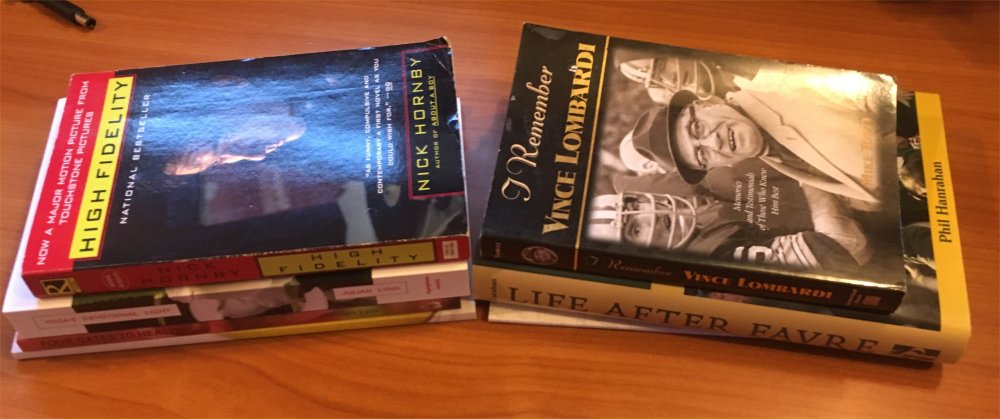
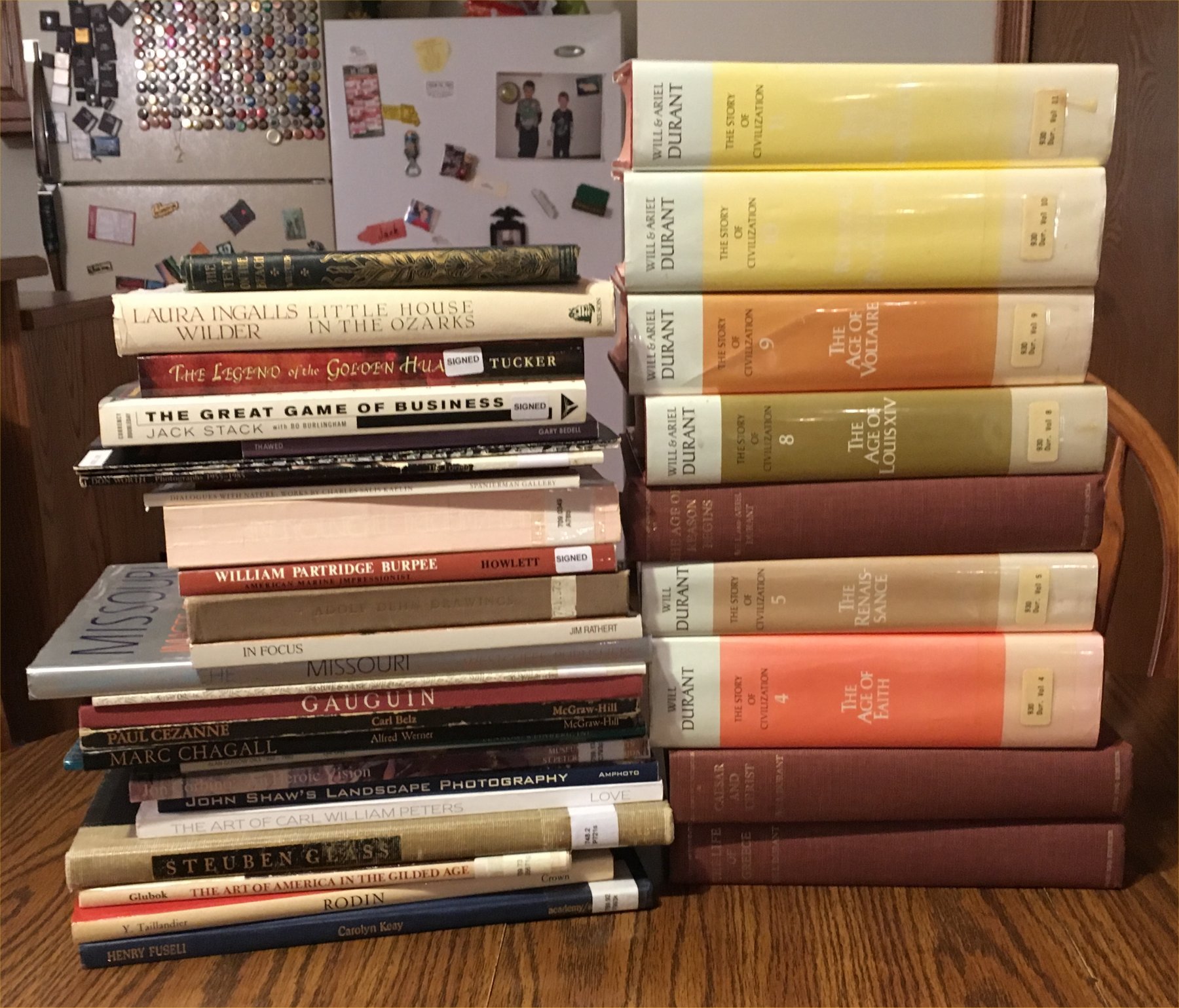
I might have mentioned in my recent book reports that I’m working my way through the stack of books beside my sofa that I’ve stacked up to browse during football games. Some of them prove to be harder to browse than others, and they will sort of fall to the bottom of the stack and hang around on the side table (actually, a twenty-something year old Sauder printer stand) for years until I get tired of the stack and reshelve them, partially read or not. The stack contains, generally, a couple books or chapbooks of poetry, art monographs, collections of photography, or craft books.

This year, as the football season has just about ended, I’ve decided to actually read the books in the stack.

No word on the vintage collection of short story magazines underneath, though.

Which got me thinking about the places where incomplete books congregate at Nogglestead.

My chair side table contains the books that I’m currently actively reading or wish I were reading, even if the active part was several years ago:

How many years has it been since I started reading the book on the timelines of history on the bottom shelf? Long enough that the start date is in the middle of the book and not the end. The collection of Shakespeare I started at the beginning of last year is there, as well as the Riverside edition I bought late last year because I thought it might be easier to read. A collection of Keats and Shelley. The first book in Copleston’s History of Philosophy. An encyclopedia of religious leaders. Probably Rabbit Run by Updike yet. There’s a year’s worth of reading there, and that doesn’t count The Count of Monte Cristo which sits on the bar beside the table.

The stack on the dresser in the bedroom is growing:

Last summer, only two books were there: The Montaigne collection (which has been on the dresser since summer of 2017) and Streetcorner Strategy. The dresser acts as a repository for my carry books, books I stick in my gym bag when I’m going to spend a couple of hours at the dojo or that I’ll carry along to appointments. After a while, my zeal for reading them runs out, and I pack along something else, which leaves these partially completed orphans on the dresser, presumably until I reshelve them sometime in 2020.

The longest-tenured collection, though, is in my bedside drawer:

I don’t know if I’ve ever bothered to reshelve books that I’ve put in the drawer.

A couple (five?) years ago, I read in bed before turning out the light, so I got a couple of short chunk books that I could put down when I was sleepy and pick up without having to reread part of a narrative. But it’s been a long time since I did that, but because the books are out of sight, I don’t feel compelled every so often to clean them up. The drawer also contains a collection of Pablo Neruda verse from the days when I read poetry to my children while they played. When they were pre-school age. Eight years ago? Note the volume of Ogden Nash on the dresser was in the drawer for a number of years until I pulled it out last summer for reading on the deck on summer nights. Of which there were not enough to complete the collection and clear it completely from these photos.

I don’t know how many of the books from these accumulation points I’ll actually get through this year–after all, I am still accumulating books from the usual sources that will tempt me into reading them before books longer in the queue.

But however I trim the aging collections, it will feel like de-Rooneyfication when I do, and any stack I complete will come with a slightly greater sense of accomplishment than the other things I read from my to-read shelves.

Buy My Books!
Buy John Donnelly's Gold Buy The Courtship of Barbara Holt Buy Coffee House Memories

Book Report: The World’s Greatest News Photos 1840-1980 by Selected and Edited by Craig T. Norback and Melvin Gray (1980)

Book coverWell, those boys have done it to me again. Like Ron Burgandy finding a question mark on his teleprompter, if I find a book on the table beside the sofa, I must read it. Even if I have already read it. In this case, I read this book in 2011. The boys, you may remember, also did this when they shuffled You Can Tell You’re A Midwesterner When… into this same stack.

At any rate, the book hasn’t changed at all: It’s a collection of noteworthy news photos from the very first deguerreotype taken in Paris in 1839 to the highlights of the Carter administration. Many of the images will be familiar, as their iconic images that have generally swayed public opinion in the leftward direction.

This time through, though, perhaps because I now have little adhesive tabs for flagging things in books (I don’t write or highlight in books, much to the disappointment of my college professors who thought it important that I “dialog with the text” by writing in books that I would no longer be able to sell back to the college bookstore or to shelve and never review again unless my kids got it out and put it on my side table), I have highlit some things that are just wrong in the captions:

  • In a caption to a photo of Winston Churchill, it says:

    England’s darkest hours were eased by Prime Minister Winstone Churchill, who promised the people “blood, sweat, and tears,” but ultimate victory.

    But Churchill did not “promise” “blood, sweat, and tears.” The actual phrase he used in his speech to the House of Commons was:

    I would say to the House, as I said to those who have joined this government: “I have nothing to offer but blood, toil, tears and sweat.”

    He offered/promised his blood, toil, tears, and sweat–not the listeners’ or just generic bodily fluids.

  • About Super Bowl III:

    The 1969 Super Bowl was “Broadway Joe’s” best year, and he played brilliantly–leading the Jets to a 16-7 victory over the Baltimore Colts. For the National Football League, it was their first Super Bowl win.

    Sweet Christmas, knowledgeable football fans, even those who have not read a book about that very Super Bowl in the last six months (Countdown to Super Bowl in August) know that the Jets are in the American Football Conference–then the American Football League, and it was that conference’s first Super Bowl victory since the Green Bay Packers won the first two.

When I read trivia books and run across a fact that I know is not true (often planted by the authors/publishers to spot people who use the questions in violation of copyright), I have to doubt everything I read in the book that I don’t already know.

Even in a collection of “news” photos published in 1980, I have to do the same.

Buy My Books!
Buy John Donnelly's Gold Buy The Courtship of Barbara Holt Buy Coffee House Memories

Good Book Hunting, January 15, 2018: Hooked on Books

So the whole family and I had fifteen minutes to spare before my son’s basketball game last night, so we stopped by Hooked on Books since it’s basically across the street from the school (which explains how I come to kill so much time there before picking up my children).

I hit all the dollar carts and rooms and came away with eight titles:

They include:

  • Ebony Brass by Jesse J. Johnson, an autobiography of Negro frustration and aspiration (so the title page says).
  • Yester Yore: Historical Diaries and Journals by Ozarks Technical Community College Students. It looks to be a collection of vignettes from diaries.
  • Dinner with Friends, a play by Donald Margulies, the author of one of my favorite modern plays, Sight Unseen.
  • Tales from Michigan State Basketball by Gregory Kelser with Steve Grinczel. It fit the theme for the evening.
  • The Time-Crunched Cyclist by Chris Carmichal and Jim Rutberg. This is more for my beautiful wife, who wants to return to her cycling ways but is often overwhelmed with work.
  • Pinheads and Patriots: Where You Stand In The Age of Obama by Bill O’Reilly. I’ve enjoyed his books (see Who’s Looking Out For You? enough to spend a buck on one of the ones that doesn’t have “Killing” in the title.
  • The Happiness Project by Gretchen Rubin. My wife informed me that we each already have a copy of this book, so this one might be a copy for gifting. Or one of the existing ones, if they’re new.
  • Funny Ladies by Stephen M. Silverman, a picture book/brief bio of women comediennes.

All that for eight bucks.

Now, where to put them?

Buy My Books!
Buy John Donnelly's Gold Buy The Courtship of Barbara Holt Buy Coffee House Memories

Book Report: Holland in Pictures by L.A. Boehm (1966)

Book coverThis volume is part of a series called Visual Geography Series which includes a number of foreign countries and Alaska and Hawaii. It’s got a color cover, but the interior photographs and maps are in black and white. It’s the second printing, though, so someone bought them.

The book includes sections on the geography, history and government, the people, and industry. In 1966, the country was coming back from the beating it took in World War II, so the industry was relatively fresh, and the people were proud to be reclaiming land from the sea and terraforming their little corner of Europe.

Of course, in the 1960s, the Mackle brothers were doing something similar to Marco Island, Florida. I wonder if the Dutch ran into the same problems, or how Holland has changed in the interim. One expects that the chapter on The People would be very different in the 21st century, but perhaps the text would be the same although the truth might be different indeed.

You know, I would not have minded seeing this Holland. My mother-in-law worked up a geneological study on my Noggle line for Christmas the year before last, and she gave me a calendar of Holland photos as apparently I have deep Dutch roots. I’ve read books set in Holland, including The Fall and Vendetta in Venice (well, partly). So it would have been a nice place to visit.

Although news in recent years leads me to believe that it’s more likely that I’ll travel to Europe as part of an expeditionary force than for fun. But, I guess, time will tell.

Buy My Books!
Buy John Donnelly's Gold Buy The Courtship of Barbara Holt Buy Coffee House Memories

Book Report: You Can Tell You’re A Midwesterner When… by Dale Grooms (2001)

Book coverApparently, I already read this book in 2012. I will leave it for you to speculate, gentle reader, whether I bought a second copy of the book or if one of my children took it from my already-read shelves, browsed it, and left it on the side table where I leave books to browse while watching football. Either one would explain how I came to read this book again during a football game this weekend, but to resolve it truly would probably involve me organizing my read shelves which were briefly organized when I first moved to Nogglestead and had a lot of book shelf room relative to the books I owned, but that time has passed.

At any rate, to recap, again: It’s a collection of “Midwestern” sayings, sometimes in vernacular that isn’t necessarily this part of the Midwest or Wisconsin or Minnesota, accompanied by clip art. I said in 2012:

They skew a little northern Midwest than Missouri, and they’re about small town living more than big city quips. A couple of them ring true, with a deeper understanding and statement of small town America than others.

Still true, although perhaps even more true from my current perspective than they had been when I was young in those days, a mere pup of forty.

Buy My Books!
Buy John Donnelly's Gold Buy The Courtship of Barbara Holt Buy Coffee House Memories

On Sunset Boulevard

Film coverSo, as I mentioned in the book report for Whatever Became Of?, I have wanted to catch up on some old films I have in my collection. So the very first I selected was Sunset Boulevard, a new VHS that I removed from its cellaphane wrap and had to remove the little sticker at the bottom that tied the videocassette to its box to prevent shoplifting. Related question: Is it still a new VHS even though it’s merely a VHS that has never been unwrapped? Depends how you want to present it on eBay, I guess.

This book contains spoilers, but spoilers of the sort that the movie spoils in the first couple of minutes of the film, so look out below.

It has a double-fit on my desire to learn more about old films, as it is a black and white film from 1950 about an aging star from silent films (Norma Desmond is the character name; Gloria Swanson, the actress, is an actual silent film star) who ensnares a struggling writer as a kept man/reluctant love interest. The young man chafes under the restraint and sneaks out to work on a screenplay with an attractive young studio reader, and this puts his whole situation into jeopardy.

So a couple of thoughts:

Both characters, struggling writer and the aging actress, are kind of sympathetic and kind of not. The writer’s desperation for financial security leads him to enabling Norma Desmond, and her sadness and subtle madness at the loss of her stardom make one (one being “me”) feel a bit sorry for her. That’s kind of deft. Or perhaps I wasn’t meant to feel sorry for her, but I just do.

Also, that old, washed-up actress was fifty-one years old.

She doesn’t look old to me, even in those pre-plastic surgery days, but I think as we go along, “old” changes. I guess that’s one of the few things we can actually thank the Baby Boomers for in all earnestness.

You know, between this film and Breakfast at Tiffany’s, a struggling young male writer might believe that attractive cougars who will take care of your rent are fairly common. My experience indicates they are not.

I absolutely hate the Dead Man Narrates His Own Death framing device. I hated it in American Beauty (a film I might have just spoiled for you as a bonus spoiler), and hated it here.

Still, I’m glad to have seen it. So perhaps next I’ll run through some more of the early Hitchcock that I mentioned here.

Buy My Books!
Buy John Donnelly's Gold Buy The Courtship of Barbara Holt Buy Coffee House Memories

Book Report: Whatever Became Of…? Second Series by Richard Lamparski (1968)

Book coverI mentioned I was reading this book, and now I have completed it.

As I said last week:

I hate to get ahead of my book report here, but it tells stories of famous people from the 1920s to the 1950s and where they are now (in the case of this, the second book, it’s 1968). I mean, these are mostly B and C celebrities from the era, movie and theater stars and athletes who had a brief run at the top. By 2019, one would ask “Who were these people in the first place?”

I find it very interesting because it’s showing that there’s nothing new under the sun. Many of these people have story arcs that match modern celebrities, with multiple divorces and different attempts to come back into the spotlight. But we in the twenty-frst century think we invented all of this stuff, and so many of these people have done it before.

I could stand pretty much on that as my book report, honestly. But the book was more compelling than that: it told me of a world, particularly an entertainment world, that one only glimpses sometimes in Lileks’ work. I recognized very few of the actors and actresses listed, and I recognized almost none of the movies or television programs they starred in. And I fancy myself something of a fan of old black-and-white films. So I’ve resolved to watch at the very least the ones I have in my catalog.

I learned a little more about stars from television programs I barely remember from my childhood (The Bowery Boys’ Leo Gorcey, Our Gang‘s Darla Hood) and the circumstances under which the shows were filmed. (Hey, did you realize that the new The Little Rascals film is twenty-five years old this year? Where are they now?)

I also want to postulate that the old studio system made the rags-to-riches-to-modest living storyline that appears over and over in this book possible, but that would be a facile assertion easily disproven by the A Different World star works at Trader Joe’s thing. So I guess it’s more human nature than anything else; the real story is that stars of our yesterday had more money to blow in their heydey before they came back down to earth (although maybe not Geoffrey Owens).

I also want to postulate that cable television (and now streaming outlets), the Internet, and reality television shows have made it so that actors and celebrities who don’t want to fade away or return to obscurity instead can just keep plugging along at substinence level (both monetarily and in ego gratification) almost indefinitely, and plastic surgery can ensure that they continue to look young or plastic until they die. But that’s a lot of thesis to defend based on 102 brief celebrity profiles from fifty(!) years ago and my own curmudgeonly nature.

So I’ll spare you the postulates.

At any rate, I hope I can remember some of the trivia that I’ve learned in this book (Morton Downey, Sr., was a singer and radio personality; the only man to win two Oscars for the same role was Harold Russell for his role in The Best Years of Our Lives). At the very least, I’ll get a couple blog posts out of it.

Apparently, this book is part of a series that ran for over a decade and ten or more volumes in those days before the Internet. If I come across them in the wild, I’ll surely pick them up, although I wouldn’t be eager to read a whole bunch of them in a row.

Buy My Books!
Buy John Donnelly's Gold Buy The Courtship of Barbara Holt Buy Coffee House Memories

Another Thing To Be Self Conscious Of

The meatloaf stain on my shoe.

I was rearranging the contents of the lower level refrigerator the other night. We use it mostly for drinks, so it’s generally full of water bottles and sparkling water, but we also use it for kitchen refrigerator overflow. We cook certain items in quantity and freeze them for later use or for sharing with people who might need a meal at church. So it’s not uncommon to find ten hamburgers, a couple packages of salmon, and/or a couple of loaves of meatloaf in there.

Kind of like the other night.

We had a couple gallons of milk to fit in there until space opened in the upstairs refrigerator. My oldest brought it down and put it into the refrigerator, storing one of the gallons on its side, which is a recipe for disaster (young men, it seems, have whole cookbooks full of such recipes). So I started adjusting the contents to move the milk to the top shelf, but the carton containing cans of sparkling water caught one of the glass pans of meatloaf, which caught the other pan of meatloaf, and both tumbled a bit to the bottom of the refrigerator. Thankfully, no pans broke and no meatloafi (because meatloafus is from the Latin) spilled onto the floor.

However, the following day, I noted an odd splotch on one of my shoes, and I could not figure out what it was for a while. But then I realized that some of the grease from a meatloafus had spilled.

I tried to clean it off, but the water contacting the stain elicited the savory scent of fresh meatloaf.

So I’m walking around with a meatloaf stain on my shoe, and I’m sure that everyone is looking at it. I’m not due to replace this pair of shoes anytime soon, so I’ll probably walk around with it until it fades eventually in the rain and puddles. Although I’m not ruling out rolling in the mud like a freshly walked dog. Not just to cover the stain, but also because it makes people nervous when I do.

Hey, my eyes are up here!

Buy My Books!
Buy John Donnelly's Gold Buy The Courtship of Barbara Holt Buy Coffee House Memories