My beautiful wife doesn’t know about this, but if she did, she’d want to go: 274-day cruise will take Royal Caribbean passengers around the world.
To be honest, $120,000 per person doesn’t sound too bad for a nine month trip.
To be able to say "Noggle," you first must be able to say "Nah."
My beautiful wife doesn’t know about this, but if she did, she’d want to go: 274-day cruise will take Royal Caribbean passengers around the world.
To be honest, $120,000 per person doesn’t sound too bad for a nine month trip.
Buy My Books!

I guess the world wants me to look for Pete Metheny records at book sales.
My relationship with Pat Metheny is about as complicated as an entirely one-way thing can be; obviously Pat has no idea of who I am or what I might be thinking about him at any given time. I bought Letter From Home in 1989 and was a compulsive customer of his from then till 2019 or thereabouts. I have pretty much everything he has ever recorded, in multiple formats. Bought all the sheet music. The practice-exercise book. T-shirts, guitar picks. Hell, I bought Zero Tolerance For Silence, a repulsive cacophony of noise that was meant to be a final middle finger towards David Geffen. Have seen him in concert more than a dozen times, including three separate episodes when I caught the same gig twice in a week, at different places. You get the idea.
If you call the number, you are warned that we are experiencing high call volume, and have not adjusted staffing levels at all; why would we? At least that’s what they should say. I was on hold longer than the actual length of the flight I was calling to change, it seemed. At least the hold music was unobtrusive. Meandering jazz. It made me wonder how much demand there is these days for smooth jazz – you know, the stuff secretaries put on the stereo in 1983 when someone was coming over for dinner for the third date. I was listening to some Pat Metheny the other day, and wondered: is this stuff just over?
I mean, it seems to be over for Pat Metheny, inasmuch as I don’t hear him doing this type of music any more, so perhaps that’s a clue.
So I’ll watch for some of the early work of the artist on records when I hit the book sales and whatnot.
Of course, the mentions of the artist accumulating in my subconscious would have made me pick up something even if I didn’t say on my blog like a blood vow to the unheeding Internet that I would be looking for the artist in the future.
I’m not convinced to pay full freight for it, though, unlike that hard rock album Lileks told me to get.
Buy My Books!
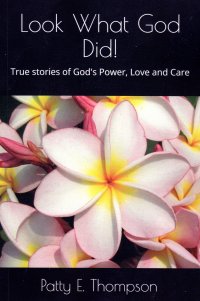 In what might become a tradition for a couple of months here at Nogglestead, I have read these two book which I bought at an ABC Books book signing not long after I bought them. Nobody tell Billy Pearson (I am only at 25% of his books read after two years) or Julian Lynn (67% complete after two and a half years).
The first book, Look What God Did!, is a woman’s spiratual biography from a wild youth when she got off the farm in Mansfield and went to California in the early 1970s. She married a musician, divorced a musician, stayed in the church, and ended up marrying a good guy and became a mother and later a leader in her church and in her child’s school. She shares these lessons along with appropriate scripture lessons for each.
It reminded me a bit of Joyce Meyer’s Eat the Cookie, Buy the Shoes except without the polish of having done it a million times before.
The author favors exclamation points. A lot! I mean, she’s got one right in the title of the book, and she uses them frequently. Including a rare appearance of the triple-banger:
We boarded a boat behind the hotel that first morning and went out into the Sea of Galilee where we stopped out in the water to sing praise songs and listen to a devotional by one of the pastors. What an incredible sense of awe settled over us…to know that our Lord Jesus had been right there with His own disciples!!!
She also uses quotes from a variety of translations, including a spot where she gives verses from three different translations in three subsequent paragraphs:
He said, “Be as shrewd as serpents and as innocent as doves.” Matt. 10:16 (NIV)
He said, “God has not given us a spirite of timidity, but of power, and love, and discipline (self-control).” II Tim. 1:7 (NASB)
He said, “Love each other. Just as I have loved you, you should love each other.” John 13:34b (NLT)
I will leave it to you to speculate, gentle reader, whether she is that much of a biblical scholar, whether she collected different verses on notecards as she came across them elsewhere and collected them here, or whether she has a side-by-side translations bible.
At any rate, a short, pleasant read. Perhaps more targeted to women than promiscuous male readers.
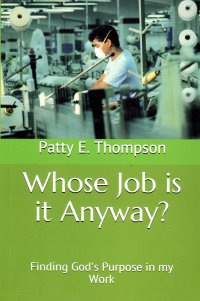 She told me this book, her second book, or perhaps her first (but I read it second, and they do not have copyright dates inside to help me out here), dealt with the workplace and people who don’t think something is their job. Which I thought I might relate to better since I’m a worker if not a woman, but this book has only one or two anecdotes that are new and instead recounts again her work in the women’s ministry in her church and becoming a parent organization leader in her child’s school–as well as a workplace-based anecdote where she offered to pray for an employer’s lost horses–that she told in Look What God Did!.
So it was a bit of a repeat. Although each chapter ends with a Lessons learned tidbit instead of Bible verses. I suppose it would not have been as stark if I hadn’t read them back to back.
Quick reads, anyway, and my purchase both supported a self-publishing author and my friends at ABC Books.
I get a little money if you click here and buy:
Buy My Books!
My oldest son is in his high school marching band at the encouragement of my beautiful wife who was a band geek babe throughout high school and college, and he kind of likes it.
His freshman year, his late entry into the high school kept him from marching, and the 2020ness meant his band only played at the football games and sent videos to workshops and competitions, so this is the first year I get to really experience a band season.
Which explains why I have been living six day weeks in October: Saturdays are given over to band competitions, start with taking him to school at 9am and end with picking him up from school at 11pm or so. Which includes sitting in bleachers for ten hours, watching bands of various sizes perform their shows.
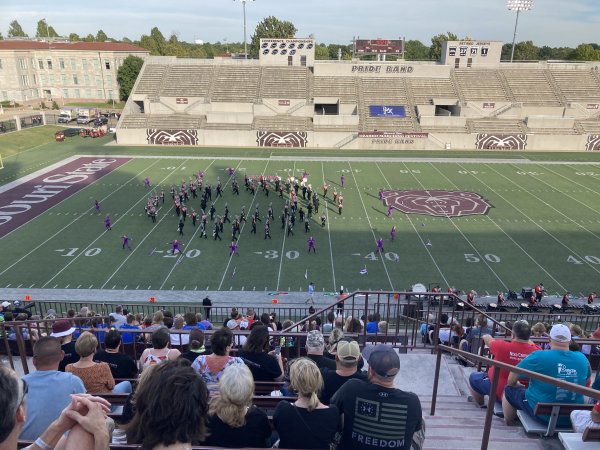
The bands perform in something called “prelims” which is nominally an elimination round, but sometimes the round only sends a quarter of the bands home. Then, the bands get some feedback and hang out all day, and then those not eliminated do the same shows. Then, the top eight bands get huge trophies.
To me, the shows are like synchronized swimming with an overlaid symphony. My wife has experienced the marching band life, so she has an understanding of it that I lack. They’re making shapes, although I am not sure what the shapes are supposed to represent especially vis-à-vis the music they’re playing. Some music is arrangements of popular music for marching bands, but some of it is not. So they’re walking in circles here like spinners and propellers in the old biology computer game. What does that mean in relationship to the music? To the theme?
I suspect there’s really not a narrative or thematic element to many of the things they do, that the whole exercise is self-conscious bit of art, where you need to appreciate the things the marching band is doing as things a marching band is doing. To appreciate the synchronization, the artistry, and the musicality of a marching band marching. Which is kind of like a lot of modern art: It’s self-conscious, look at me, not look through me to a deeper meaning.
So, no, I told her. I think one has to have been in a marching band to really get into it. Otherwise, we’re just going there to support our kids.
Although I have to say that it led me to a “meme” that with probably the highest odds for me to see it in the wild, shared elsewhere from me as the root of it:

Those are actually “marching tubas” (different from the Sousaphone, which is the tuba-like instrument used by marchers that looks like a traditional tuba).
But muzooka captures it better, I think.
Buy My Books!
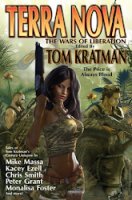 I bought this book because it’s in the sidebar at Bayou Renaissance Man because he, the BRM, has a story in it.
It is a collection of military sci fi stories set in the Kratmanoverse, where the UN has settled undesirables on a planet called Terra Nova; the colonies are created by nation/ethnicity in different places, so they sometimes come into conflict (Muslim wars of conquest) but mostly the colonists resist the United Nations who runs the colonies corruptly. The colonists are not supposed to be armed, and they live near sustenance level in many cases, as technology is too expensive to import to the colony–and the UN wants to keep it restricted.
So even though the macro story has been decided elsewhere (in the novels in the series), the setting provides a fertile ground for smaller short stories in the millieu. We get murders and factionalism on a multi-year colony ship; we get a cleric who helps a fishing colony escape Muslim raiders; we get a helicopter pilot who defects; we get black mercenaries who come to help pacify an Asian province but come to sympathize with their fellow colonists; we get a couple of hackers who help a drug lord break UN smugglers’ hold on him; and more. As I mentioned, there’s a lot of room between the broad strokes of the novel series for interesting stories. It’s a little like how I was introduced to Dragonlance in the old days, although the collections of short stores I got my hands on mainly still focused on the main characters of the stories, and these stories likely deal with people who don’t show up in the Big Picture at all. Although I cannot say that for sure.
So the stories have different perspectives, styles, and themes, but they share a certain realistic outlook as to human nature and societies. It is a Baen book, after all, and if you’ve read any of the author’s blogs, you’d know they’ve got their heads on straight.
I wanted to read something in the military sci fi genre since I’ve got a military sci fi novel started around here somewhere. So it was research, and a pleasure.
I did not flag a lot of things, but I did mark this one:
“I was entirely comfortable with his questioning,” retorted Champlain. “I rather obkect to the murder of noncombatants. Sir.”
His last syllable rhymed perfectly with “curr.”
C’mon, man, that’s right out of the Marcinko.
So, as I said, I liked it, which is good, since I paid full price for it. I’ll even think about getting some of the other modern military sci fi as I mess around with it myself. Maybe some Kloos, maybe some Kratman. Or maybe I should just read the Ringo and Drake and other books I already have on my shelves. What a novel idea that is!
I get a little money if you click here and buy:
Buy My Books!
A number of places I’ve seen have reported former president Bill Clinton’s recent hospital stay thusly:

Bill Clinton was released from the hospital for an infection that was not COVID.
It was, however, sepsis (mentioned in this Daily Mail article, but not the New York Post article linked above).
Sepsis kills eleven million people every year. But at least it wasn’t COVID.
But it’s important that the headlines and reporting mention that it was not Wuhan Flu.
Because it’s important that we we not doubt that Clinton is part of the sophisticated, vaccinated crowd.
Buy My Books!
Live Metal, a blog that offers brief mentions of new metal music.
Better than YouTube’s algorithms, which leads me to Kalidia/Walk in Darkness no matter what I search for.
Buy My Books!
 After listening the Charlton Heston narrating St. Augustine, I went right into this, skipping ahead 1200 years (although I did listen to St. Thomas Aquinas earlier, so I did have a medieval interlude).
With Baruch Spinoza, we’re coming into more modern modes of thought. Spinoza embraces a sort of Platonism as well, but unlike St. Augustine, his does not contain a personal God. Instead, God is distant (but present in everything) and rather inscrutible except through deep thought, as God (not a he as that is antromorphic) created everything and continues to create everything every day, but God is not responsive to mankind at all.
So working from that point, Spinoza tries to build a set of ethics with some disappointing results.
The course is about half biography and half deep thought, which is just about right for this lecture series. I had to listen carefully to the bits that explored his theory of substances, modes, and attributes, and I’m pretty sure I would have to read more detail about them before I could talk intelligently about them, but rest assured, they’re Platonism in Dutch.
The course mentions how he influenced the Romantic poets–probably in the God is in Nature lines of thought, and how he was excommunicated from his local synagogue and lived a life in relative poverty and isolation as a result. But interesting.
You know, many of the lecture series I have, I put on the shelf as trophies, but these are brief enough and interesting enough that I might want to listen to them again. So long as I have continued access to a cassette deck.
A Compensated Link, So I Must Tell You:
Buy My Books!
 I listened to these lectures, er, audio books, out of order–I listened to St. Thomas Aquinas before this couple of cassettes, so I’m going out of order on the history of philosophy (sorry, Father Copleston, but I stalled out on your series years ago). I would probably have gotten more out of the Aquinas lectures reading how much his Aristotle-focus was a counterweight to Augustine’s Christian Platonism.
Which it is; I know, I just listened to the Teaching Company’s Augustine: Philosopher and Saint last February, so I remembered a bit of historical context–Augustine’s mother’s name was Monica, and he flirted with heretical thought in his youth, and the merging of Platonism with Christian thought.
You know, as I’m going through these philosophers again with Charlton Heston reading them to me, I think I’m soaking more in. The interplay between the thoughts. Of course, the Aristotle versus Plato bit. I like Augustine’s Platoism, though, amongst all the strains I’ve seen. Its World of Forms is God, and he somehow makes it a personal God as well–as I have mentioned, I need to read the primary sources more, but I’m not sure that I want to get into Professional Philosopher mode, where I spend years studying to split a hair differently than my also-publish-or-perish peers and base my argument on a particular translation which might not really capture exactly what the author meant. I prefer my high level, so that’s kind of what he was thinking approach. Where these short lecture series serve me well.
A Compensated Link, So I Must Tell You:
Buy My Books!
From this day in 2014:
I can learn things on my own, but only one at a time.
I’m a semiautodidactic.
Buy My Books!
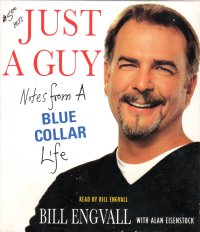 You know, I first heard about Bill Engvalls in the middle 1990s, when my girlfriend referred to him as the guy who says, “Here’s your sign.” The Blue Collar Comedy Tour was, what, almost twenty years ago? And this book is from fourteen years ago, so it’s not fresh and new. It’s the story of Bill Engvall’s life up until that point, from his childhood in Winslow, Arizona, and Texas to his marriage and his start and climb into comedy.
So it’s not a gag reel; it is more a wry biography. I found it kind of meh, but poignant in spots–the story of his parents’ divorce and his wife’s brush with death after a miscarriage particularly struck me. But not much of the rest of it.
At the conclusion, he says he’ll be happy if he’s almost remembered as the fourth guy in the Blue Collar Comedy Tour. But rest assured, Mr. Engvall, you’ll always be the third guy because you had a tagline, although not as good as “You might be a redneck” or “Git-r-done.” To my knowledge, the fourth guy–Ron White? Maybe?–did not.
But he seems like a nice guy, and I feel like I might be selling him short, but the book just didn’t resonate.
I get money if you click and buy this:
Buy My Books!
Parson says Missouri is pursuing prosecution after St. Louis reporter finds state data flaw:
Gov. Mike Parson said he was pursuing criminal prosecution against the St. Louis Post-Dispatch and its reporters Thursday after the newspaper discovered a data vulnerability in a state website.
Sections of the Department of Elementary and Secondary Education’s website allowed someone visiting the site to search through teacher credentials and certifications, revealing Social Security numbers within the HTML source code of the pages, the Post-Dispatch reported. That source code is available to anyone visiting a website on a web browser.
Yeah, pumping out the social security numbers in hidden fields is bad juju, and it does not require any manner of hacking to get to it.
I wonder why Parson has gone nuclear over this? To shore up his support with educational professionals? C’mon, man.
Buy My Books!
Trading For Treasure: the pandemic creates a trading card boom:
Get out the old dusty shoeboxes from the attic because a historic trading card boom is underway. One company is cashing in by helping thousands around the world buy and sell little cardboard versions of their beloved sports icons.
Once a beacon of childhood memories for generations, trading cards are now a booming business for the Camann family in Richmond, Virginia.
Wild cards: Spree has police wondering if bistate gaming thefts are linked:
The thief who shattered the glass door and display cases at Realms of Gaming here Monday, swiping thousands of dollars’ worth of collectible trading cards, also may be behind similar break-ins in St. Louis County.
Police in the bistate region will be sharing notes Wednesday to see if the burglaries are the work of the same people, said Troy police Chief Brent Shownes.
“We’re learning of more and more of these,” Shownes said, estimating a half-dozen such burglaries in recent days.
They include break-ins at two game stores on Watson Road. Game Nite at 8380 Watson Road in Marlborough and Yeti Gaming at 8920 Watson Road in Crestwood were burglarized late Sunday night and early Monday.
I still don’t plan on retiring based on the value of my middle 1980s baseball cards. But perhaps I should plan on having to defend them with deadly force.
Buy My Books!
Not a metaphor referring to the television show Lost–I mean, who remembers Lost now?
I mean, a metaphor that we really cannot use in the 21st century.
Static.
I was driving along this morning, taking the oldest to school in the darkness for his marching band practice, and I thought about writing a poem about moving through the tunnel of the night, and I thought perhaps I could work in a line about static, but no.
I mean, who under the age of, what, forty has experienced broadcast static?
Most kids these days have not experienced over-the-air television nor have seen a playing of the national anthem and then television stations signing off in the middle of the night nor dozens of UHF stations on the second dial that show nothing but white noise.
On the radio, the Seek buttons and digital tuning eliminates that sound between the stations, and although one can still experience some weaker signals when driving out of range, who listens to the radio in the car any more except we old men, and by we, old man, I mean I.
So I got to wondering whether the removal of the concept of static from the mental makeup of modern man has had any impact. In the digital media world rife with social media misgivings, have we lost the ability to discern signal from noise, the ability to not accept everything presented to us as equally true or just surface impressions?
Eh, maybe I’ll use the metaphor anyway since I don’t expect young people to read my poetry anyway. Or old people for that matter. I’ll just write what I want.
Buy My Books!
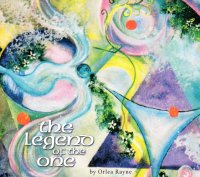 This short book of poetry, 39 pages, contains, what, a single poem or prayer spread over the 39 pages with a spiritual theme that presents the One as a female figure, so it’s not a Christian spiritual collection. Given that each page or poem faces a mandala, the poetext might be to support the mandalas instead of the other way around.
A mandala, as you might remember, gentle reader (not that I’ve ever mentioned it here before), is an Eastern art form that uses geometric shapes and whatnot designed as a meditation aid for Buddhists, Hindus, and whatnot. The mandalas in this book are not so geometric as much as abstract art with an Eastern flavor. I guess the author would make mandalas for people–her bio says that she was divinely guided after a near death experience and that she wants to help everyone just get along like Susan Polis Schultz. The author’s Facebook page was active until 2015, so she was probably creating mandalas for people well into our century.
So, the poetext, meh, but the mandalas are interesting. Given that I got this book in one of the dollar bundles of chapbooks available at the at the library book sales, I think it was worth the 18 cents I probably spent on it. After all, I counted it as a whole book in my annual goal of reading 100 books.
Buy My Books!
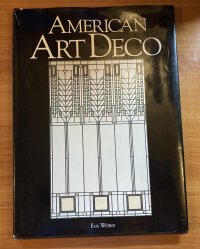 This is a large-sized Crescent book covering the design styles of art deco which were early 20th century design and architectural movements around the world, but notably the United States. I say styles and were in the plural because really Art Deco includes subdesign styles called the Aztec, zigzag, and streamlined styles. The book breaks things up into sections on Architecture, Furniture, Art, and whatnot. Each chapter has a page of text that name drops people who popularized the style, and then includes photos and illustrations.
You know, I like Art Deco, at least in the design and the architecture–we have some Fiestaware at Nogglestead–but not the art-art, which has a bit of Sovietism to it. A lot of it comes from the WPA and NRA programs coming out of the New Deal, so that’s probably appropriate.
However, Fiestaware aside, I like to look at it, but when it comes to design that I like to have around Nogglestead, I go more for classical looks and cheap pressboard. Not stylized modern things, or at least how modern was envisioned a hundred years ago. Even though it’s cooler than what a hundred years later would generally produce, particularly in architecture.
So that’s what comment you get from me in this regard. You want depth in discussion of design, go seek your Lileks and Driscoll.
Buy My Books!
What if the Baha Men were not asking a question….
What if they were telling us The Who let the dogs out?
I like that conspiracy better than the one that says WHO let the dogs out because I’m afraid to contemplate what the dogs were infected with when WHO let them out.
MfBJN: Come for the Internet conspiracy theory misinformation, stay for the twee book reports on chapbooks and monographs I look at between plays of NFL games.
Buy My Books!
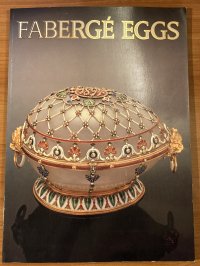 This is a huge book, part of the Abrams Poster-Sized Book line, and it lists and depicts, well, Fabergé eggs and other charms made by the great jeweler whether the ones given by the czars of Russia to wives and mothers or other nobles of the end of the 19th and beginning of 20th centuries.
In case you don’t know, these small bits of metallurgy and lapidary are intricate bits of work, often with surprises inside like little charms or miniature paintings, that the leader of Russia gave as gifts to his wife, the Czarina, or his mother. After the revolution, the Soviets sold many of them off, and Forbes ended up with the most comprehensive collection of them, which is why a Forbes wrote the text.
They’re incredible pieces of work. Fabergé didn’t do the work himself, and the book identifies the masters who did when possible. The form factor of the book makes it a bit awkward to handle, especially when a cat wants to get onto your lap, but it does allow you to view the eggs larger-than-life. And where the eggs are not available for photography, a chronological presentation with line drawings appears at the end of the book.
A fascinating look at art and engineering probably best known as a James Bond prop.
Buy My Books!
Headbanger Recall? Parents ask to boot principal over Iron Maiden fandom:
Some Canadian parents want a heavy metal-loving high school principal to headbang her way to another job.
Parents at Eden High School in St. Catharines, Ontario launched a petition to remove Principal Sharon Burns because she is an unabashed fan of the legendary British band Iron Maiden.
Fortunately, the church has re-organized its Sunday School program over the last two years, so my beautiful wife does not face ouster from her only child-related instructional role over her notorious Iron Maiden fandom, and decades of uploads have knocked her from a high position on Google image searches for legs. Come to think of it, she is a scandal in a skirt.
At any rate, I think it’s just another instance of only looking at the iconography and metaphor and not looking through it to the substance. Iron Maiden’s music might have satanic themes, although not as much as some, but so does Dr. Faustus. But one should not confuse the appearance with the meaning, ainna?
Buy My Books!
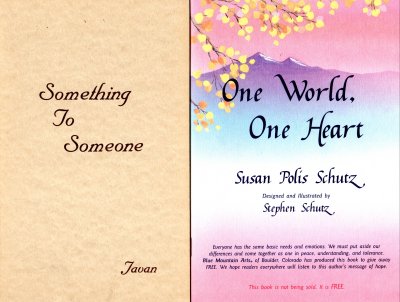 These are two more chapbooks, or short books of poetry, that I bought bundled recently. Actually, the Shultz book was in a bundle, but I bought the Javan book alone for a buck. It seems that I’ve seen a lot of books by Schutz and Javan around, and then I thought it might just be at ABC Books, but my recent trip showed that the poetry section there was not rife with either of these poets. So I don’t know where I’ve seen so many of them before that I thought I should finally give them a try.
I have grouped them together because they both suffer from the same thing: Too much abstraction with line breaks, announcing a feeling or thought without poetic imagery to back them up.
Javan’s poems are of a personal nature, with musings on relationships and some “Hey, Girl” kinds of poems. The Schutz book deals with macro themes of reconciliation between different peoples and “Can’t we all just get along?” More than that, though–can’t we all just love one another for our differences? Reading them together is a little like listening to a U2 song: First, we get the personal, which is more relatable (although U2 is generally more poetic), and then all of a sudden in the third or fourth verse the personal relationship morphs into a song about feeding the world or something.
The stories of the poets is more interesting: Javan self-published his books in the days before computers, and he didn’t have the Internet, so he drove around, bookstore to bookstore, to get his works carried. Given that I’ve seen and now bought one of his works far away from his native Georgia, it seems to have worked. Schutz, on the other hand, is a mommy poet of some note who then put this book out as a public service such as it was. She and/or her husband founded Blue Mountain, whose early Internet greeting card company they sold to Excite in 1999 for $780,000,000, so she had some money and time to write a bunch of poetry, and she’s the mother of the current governor of Colorado. So she probably did not have to drive widely to disseminate her work.
At any rate, they both come out of that 70s poetic tradition like, say, Rod McKuen or Jon Francis or James Kavanaugh. The wording is conversational and not very self-consciously poetic. Which is probably to say not poetic at all. But, hey, some people might go for it. I prefer more poetic, but perhaps not self-consciously “We’re doing poetry!”
UPDATE: I discovered when I was entering this book into my library database that I’ve read something edited by Susan Polis Schutz before: A Friend Forever also published by Blue Mountain–which means they’ve been at this for a while.
Buy My Books!