Book Report: Dragonslayer by Wayland Drew (1981)

Book coverThis book is the novelization of the 1981 film of the same name. In it, an unauthorized party from a land benighted by a dragon comes to the last remaining sorceror for help. Every six months, the kingdom sacrifices a young woman to the old dragon to keep it from rampaging. At the sorceror’s tower, though, a military group from the kingdom catch up with the unauthorized group and kill the sorceror. The sorceror’s apprentice and undertake the journey and catch up with the aid-seekers in their retreat.

And then go on to fight the dragon and win, eventually, of course.

The book has an interesting element in it: the rise of Christianity in Europe replacing the old magic systems. The book takes place in an unidentified region in Europe at the rise of European civilization, and the town nearest the dragon’s lair has a new Christian missionary in town who converts people as the dragon’s menace continues. The sorceror’s apprentice doesn’t decide to go onto becoming a sorceror–after the death of his master, there’s no one to teach him and he prefers the world rather than the books–so the book muses on the transition between the old ways and the new. It’s a pretty even-handed treatment of it; in the 21st century, there’d be a lot more handwringing about the loss of magic for the fairy tale lies of the church than you get from a book based on a film in 1981.

It’s a good enough read, once it gets going. It’s a slow starter, and of all genres in the world, fantasy is the one whose audience will allow slow, wordy starts. Which this one has.

Books mentioned in this review:

Buy My Books!
Buy John Donnelly's Gold Buy The Courtship of Barbara Holt Buy Coffee House Memories

Book Report: Sunset Woodworking Projects (1968)

Book coverThis book isn’t your father’s book of woodworking projects; this is your grandfather’s book of woodworking projects. And as we bemoan the tailing off of American education, how schools have made successive generations of American students less educated, we can also bemoan how Americans have gotten less industrious with their hands. Otherwise the whole Maker movement wouldn’t be a hipster movement. It would be what people did on the weekends. Or how people made do with what they had, perhaps.

I digress.

The introduction for this book says it’s for beginning and intermediate woodworkers. As such, it takes until page 19 before you’re building a complete set of drawers from scratch (no store-bought drawer runners, you weakling!). If you open up a 21st century woodworking magazine, you get a complete step-by-step guide that includes images and photographs of how to assemble things each step. In this book, you get a couple paragraphs of copy that includes a description of why you should build the thing and how to build the thing. Then you get a diagram of the cuts and how they fit together. Sometimes, like in this project for building a children’s desk, you also get a pattern for cutting:

Boy, howdy, I am so below woodworking beginner that I can’t even.

At any rate, the book has over 75 different projects of varying degrees of difficulty. There are a number of workbench/table hinged to the wall/stool/bench/toolbox kinds of projects that are pretty standard for this sort of book. There are some simpler things for children, rocking horses, little toys, and the like. Then there are the “what kind of intermediate woodworker can do this?” projects including the aforementioned set of drawers, other furniture, and a foosball table. The things within are all very 1968, but you might get some ideas to try (with things done a little differently in the 21st century).

I picked the book up to browse through just to see if I get any ideas for projects I might try. Someday. And I might. Someday. But not until I master the basics of cleaning my workbench area in the garage.

Another feature of this book’s era is that it mentions on many occasions that you can use power tools if you have them. But the assumption is that power tools are optional. Which matches my workshop, such as it is.

At any rate, I have a large number of Sunset books on my shelves in the garage (even more in 2015 than in 2010). Strangely, I didn’t flip through those before putting them out there. But I bought this book later, so it was on my to-read shelves, so I flipped through this one. Worth my couple of minutes, and definitely more manly than another book on beading.

Books mentioned in this review:

Buy My Books!
Buy John Donnelly's Gold Buy The Courtship of Barbara Holt Buy Coffee House Memories

Also Spotted At The Thrift Store

Available currently at the DAV Thrift Store:

What looks to be a complete or nearly complete set of Star Trek, the uncut editions, from Paramount as well as the movies.

I couldn’t help but wonder if they were Phil Farrand’s.

You might be wondering, gentle reader, if I was tempted to buy the set. Although books like Farrand’s make me want to own the whole set and to watch them in order, this particular collection is one episode per videocassette, and, as the image indicates, takes up a lot of space (no pun intended). As such, I’d only buy this set if I could also use it as some sort of visual design or decorating element, such as making a wall of Star Trek where I could fit the individual cassettes into frames facing out with little cutouts for popping them out to watch. And, really, I’d have nowhere to put it.

Buy My Books!
Buy John Donnelly's Gold Buy The Courtship of Barbara Holt Buy Coffee House Memories

The Wisdom of Carl Jung (II)

As I read The Undiscovered Self, I’m posting seemingly relevant quotations as I go along because some of them shed some light on the world today.

The first paragraphs of “Religion as the Counterbalance to Mass-Mindedness” states:

In order to free the fiction of the Sovereign State–in other words, the whims of those who manipulate it–from every wholesome restriction, all socio-political movements tending in this direction invariably try to cut the ground from under religions. For, in order to turn the individual into a function of the State, his dependence upon anything beside the State must be taken from him. But religion means dependence on and submission to irrational facts of experience. These do not refer directly to social and physical conditions; they concern far more the individual’s psychic attitude.

But it is possible to have an attitude to the external conditions of life only when there is a point of reference outside them. The religions give, or claim to give, such a standpoint, thereby enabling the individual to exercise his judgment and his power of decision. They build up a reserve, as it were, against the obvious and inevitable force of circumstances to which everyone is exposed who lives only in the outer world and has no other ground under his feet except the pavement. If statistical reality is the only reality, then it is the sole authority. There is then only one condition, and since no contrary condition exists, judgment and decision are not only superfluous but impossible. Then the individual is bound to be a function of statistics and hence a function of the State or whatever the abstract principle of order may be called. [Emphasis in original.]

Unfortunately, I’m only intermittently reading this book. I should switch a primary focus to it presently.

Buy My Books!
Buy John Donnelly's Gold Buy The Courtship of Barbara Holt Buy Coffee House Memories

New Thrift Store Record Finds

Perhaps I should start a new series called Good Record Hunting to account for my trips to thrift stores looking for LPs (and, in my defense, a cheap television to hook up old computers).

Yesterday, I visited the DAV Thrift Store and briefly browsed its LPs, but they were poorly arranged for browsing and cost $2.48 each. I also visited the Salvation Army thrift store next door. There were fewer, they were easier to browse, and they only cost $1 each, so I got:

This group includes:

  • The Opera Society’s small disc version of Rigoletto’s Verdi. Or Verdi’s Rigoletto. Sometimes, with these modern things, it’s hard to tell which is the band name and which is the song.
  • Keely Smith, Be My Love.
  • Perry Como, In Italy. To be honest, I didn’t look close to see if he sings any Verdi.
  • Dean Martin, Everybody Loves Somebody (The Hit Version).
  • Perry Como, Just For You, a Sylvania-branded record.
  • The Czechoslovakian Philharmonic Orchestra doing some Mahler.

It’s funny when you go to thrift stores and book sales, you seem to find more LPs than cassettes. I don’t know if this is only a perception thing because they’re bigger than tapes, but it’s probably because the LP sale prominence lasted for decades and audio cassettes only sold for, what, twenty years, mostly in parallel with LPs and then CDs. Also, they’re small and easy to throw out and LPs are big enough to think they’re worth something.

Also, I don’t think I’ll start a whole new category of posts, as I don’t imagine I’ll do this that often. Although it might prove to be more often than I go to book sales these days.

Also, please note I use Discogs for my record research (and I poach images of the LPs from them). It’s a cool site. If you dig records, you should check it out.

Buy My Books!
Buy John Donnelly's Gold Buy The Courtship of Barbara Holt Buy Coffee House Memories

Book Report: Warriors: The Rise of Scourge by “Erin Hunter” (2008)

Book coverThis book hits the trifecta of twee: It’s young adult fiction told in manga style featuring street gangs of cats. It’s hard for me to admit I read it, but I did.

Apparently, the Warriors series of books/trilogies is a going thing, with a house name (“Erin Hunter”), a collection of authors doing the actual writing. And in this case, illustration. They’ve hit the New York Times best seller list on occasion, although probably not the adult section that people pay attention to. The series is sort of a Game of Thrones of feline gang wars between different clans of cats and myriad personalities.

This particular volume, a stand alone in a universe rife with multi-parters, deals with the rise of an undersized cat named Tiny. Unloved by his litter mates, he runs away to the city and ends up becoming Scourge, the leader of the BloodClan. He’s the villain in other books, so this is sort of the The Phantom Menace/Attack of the Clones/Revenge of the Sith that describes his rise. And it’s not wholly unsympathetic.

So it’s not really manga; it’s a kid’s book comicked up in the manga style. But it’s about cats. Gangs of cats.

Sigh. I’m really trying to be classically educated here, but sometimes my garage sale purchases lead me down the path of modern American literature.

Books mentioned in this review:

Buy My Books!
Buy John Donnelly's Gold Buy The Courtship of Barbara Holt Buy Coffee House Memories

The Wisdom of Carl Jung (I)

Whether or not you buy into the Jungian psychology and collective unconscious (and I don’t, but I do delve into individual unconscious sometimes when reading Jung), the fellow had some interesting ideas and thoughts that remain relevant in the modern world.

From “The Plight of the Individual in Modern Society“:

What will become of our civilization, and of man himself, if the hydrogen bombs begin to go off, or if the spiritual and moral darkness of the State absolutism should spread over Europe?

We have no reason to take this threat lightly. Everywhere in the West there are subversive minorities who, sheltered by our humanitarianism and our sense of justice, hold the incendiary torches ready, with nothing to stop the spread of their ideas except the critical reason of a single, fairly inelligent, mentally stable stratum of the population. One should not, however, overestimate the thickness of this stratum. It varies from country to country in accordance with national temperament. Also, it is regionally dependent on public education and is subject to the influence of acutely disturbing factors of a political and economic nature. Taking plebiscites as a criterion, one could on an optimistic estimate put its upper limit at about 40 per cent of the electorate. A rather more pessimistic view would not be unjustified either, since the gift of reason and critical reflection is not one of man’s outstanding peculiarities, and even where it exists it proves to be wavering and inconstant, the more so, as a rule, the bigger the political groups are. The mass crushes out the insight and reflection that are still possible with the individual, and this necessarily leads to doctrinarie and authoritarian tyranny if ever the constitutional State should succumb to a fit of weakness.

He wrote this circa 1957; in the 21st century, one is forgiven if one were to think the much thinner stratum of reasonable people exists in spite of public education and not because of it.

Buy My Books!
Buy John Donnelly's Gold Buy The Courtship of Barbara Holt Buy Coffee House Memories

Daddy Humor, Footnoted

Playing outside, my son came to the back door and knocked. I opened the door and said, “Are you selling encyclopedias? Great! I’ve got a report due on the exploration of space!”

Because:

The child, born twenty years after the commercial, didn’t get it.

But my humor is not for his amusement; it is for mine.

Buy My Books!
Buy John Donnelly's Gold Buy The Courtship of Barbara Holt Buy Coffee House Memories

Brian’s Gym Trick of the Day

Whenever I’m doing sets at the gym, lifting tiny amounts of weight with great difficulty, I find myself counting the reps. I marvel at things like the number 3 and 4 and pause for a long while to reflect upon their essential nature in the cosmos, and I stop pushing or pulling because, man, those numbers are big and meaningful.

That is, when I count by ones, my effort tends to dwindle when I get to certain numbers in the set, and I stop a little earlier than I can.

The last couple of weeks, I’ve tried something different. Instead of counting by ones, I start counting my sets using multiples of another number. I start counting by fives, or I start counting by sixes. So I do 6, 12, 18, 24, 30, 36….

Doing it this way engages my brain as I go along, so I don’t get to about the sixth rep and think, Man, this bar is heavy. Instead, I’m worrying about remembering the next number in the sequence. Which leads me to get more reps in.

On the plus side, I get to tell people I only did 56 or 81 reps in the last set. Also, if I get to the multiple of 12 in a set, Mrs. Perkins will give me a gold star. On the other hand, once I get really good at my multiplication tables, the trick will lose its efficacy. Or I’ll start having to work with larger numbers until I memorize enough multiplication to get a job as a mentalist at the county fair.

And I can’t stop saying bro, bro.

Buy My Books!
Buy John Donnelly's Gold Buy The Courtship of Barbara Holt Buy Coffee House Memories

Book Report: The Nitpickers Guide For Classic Trekkers by Phil Farrand (1994)

Book coverI’ve been working on this book for a number of months as a fill-in book when I sat down and had only a couple of minutes to read, so I needed something quick with short, discrete chapters.

This book is an episode guide of the original Star Trek television series. It follows up the author’s earlier work of similar nature for the Star Trek: The Next Generation series; given that the other was still on television at the time, this would have made the earlier work about the later program more relevant in the marketplace, and its success must have guaranteed at least this reviewed volume. At any rate, each episode listing includes a brief recap of the plot, a detailed list of cuts made when the episode was put into syndication, production goofs, places where the episode went against other episodes, a couple of trivia questions, some places where props are reused, and finally a list of the stills that displayed over the closing credits. Other additional chapters cover the movies, and the action is broken up with some musings on Star Trek and society as well as enumeration of Star Trek tropes.

The fellow watched both the uncut versions (as sold by Paramount in the 1990s) along with syndicated versions recorded off of television to get his cuts section and to get into the nitty gritty of the program. It seems like a whole lot of work to produce an encyclopedia of trivia.

Which I read, albeit slowly, in dribs and drabs. It, like other Star Trek titles, makes me want to watch the original series again. Perhaps when I find it inexpensively at a garage sale. Or, given that I found season 1 of The Next Generation a couple years ago and have yet to watch it, perhaps it will be some years after I find it inexpensively. But probably soon after I read a book like this.

Books mentioned in this review:

Buy My Books!
Buy John Donnelly's Gold Buy The Courtship of Barbara Holt Buy Coffee House Memories

Down the Slippery Slope

The critics predicted it: Gay marriage becomes the law of the land, and people would start buying albums of show tunes.

Although, in my defense in this case, it was a collection of Pat Suzuki singing show tunes:

If Mark Steyn can listen to show tunes, I can, too.

At any rate, the acquisition stems from a recent trip to the local thrift store. I was looking for a cheap television set to hook a couple of old computers. I didn’t find any, but I did find the shelf with the crates of LPs on them. Ha, just kidding! I knew where it was all the time, and I went right to it after realizing that thrift stores generally don’t have old televisions any more.

At any rate, check out what I have in a sort-of Johnsonesque roundup:


This includes:

  • Quincy Jones Explores The Music of Henry Mancini.
  • Boots Randolph Yakety Sax. My children will never equate this song with sophisticated British comedy that our fathers all enjoyed.
  • Boots Randolph More Yakety Sax.
  • Boots Randolph Boots with Strings.
  • Boots Randolph Sunday Sax. I figure, if I buy one from a new artist, I should buy all that I find. Just in case I like the artist.
  • Claudine Longet Claudine.
  • Claudine Longet The Look of Love. Claudine Longet, at first blush, seems a little soft and breathy for LPs. I tend to put on a record and listen to it from the next room, so stronger voices tend to sound better. Longet, like Erin Bode, might be better for CDs and closer listening. Longet appears on A&M records, Herb Alpert’s label. I’m enjoying exploring its catalog as I gather records.
  • Herb Alpert & The Tijuana Brass The Beat of the Brass. I bought this one, a title I already owned, because the cover is in better condition. If I put the better record in the better cover, is that like mixing serial numbers on a collectible car or gun?
  • Steve Lawrence and Eydie Gorme We Got Us. I will buy Steve and Eydie albums because of Eydie; I left a couple of Steve Lawrence solo works in the bins.
  • Benny Goodman and His Orchestra Let’s Dance Again. Pete Fountains is leading me to appreciate the clarinet. How many people in the 21st century would say Pete Fountains led them to give Benny Goodman an audience? Very few. Or one.
  • The Isley Brothers Do Their Thing. Not to be confused with “It’s Your Thing” which the Isley Brothers do. The Isley Brothers do all things.
  • Olivia Newton-John Making a Good Thing Better. Because as of this spring, I’m apparently a collector of Olivia Newton-John albums.
  • Louis Armstrong and His All-Stars I Love Jazz!.
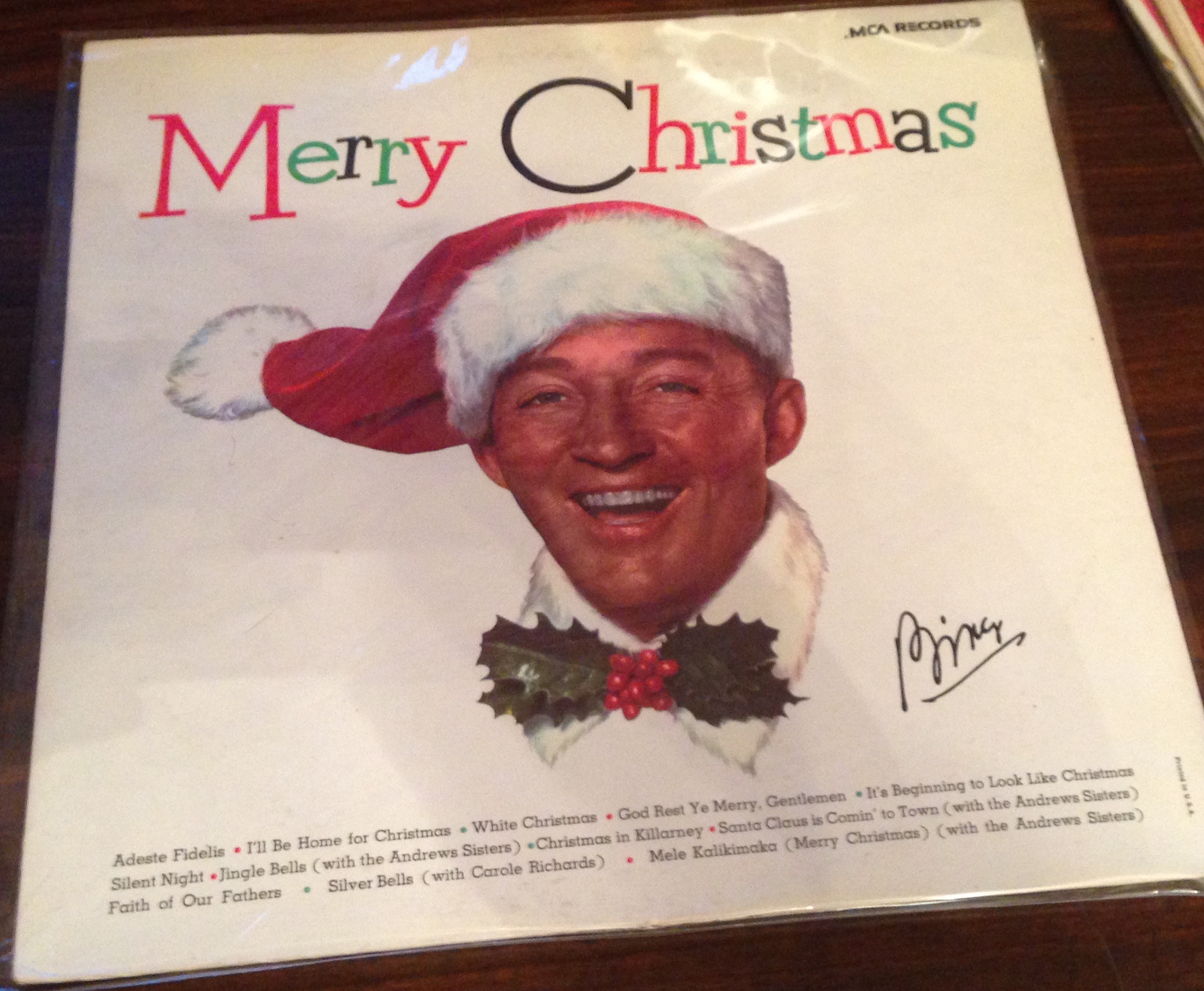
  • Perry Como Season’s Greetings from Perry Como. Because I’ve recently started finding Perry Como albums in the wild (after I said one rarely does), I’ve started buying them.
  • Dean Martin Winter Romance. This is the other Christmas album, the one with “Baby, It’s Cold Outside” on it. (The non-other album, of course, is The Dean Martin Christmas Album.)
  • Bennett & Basie Strike Up The Band.
  • Tennessee Ernie Ford Sixteen Tons.
  • Harry James and His Big Band Mr. Trumpet. I’ve never heard of Harry James before, but apparently he played for Benny Goodman before starting his own band at 23. I’ll look for more of his work in the future.
  • The McGuire Sisters May You Always.
  • Eydie Gorme Vamps the Roaring 20s.
  • Natalie Cole Unpredictable. When I first say it, I thought the word was Unforgettable, and I was confused as to why the song was not actually on the album. Danged cursive.
  • Pat Suzuki The Many Sides of Pat Suzuki.
  • Pat Suzuki Broadway ’59. Again, when I see multiple discs from an artist I don’t know, I’ll tend to buy them all in case I like the artist. This turned out well, as Suzuki has a strong voice and belts out some songs. These two discs represent half her catalog, which is a shame.

It was a fruitful trip, except for the no televisions. I think I’ll use the search-for-televisions thing to hit one or more other local thrift stores and see what other LPs I can gather, at least until my beautiful wife becomes my beautiful-when-she’s-angry wife.

Buy My Books!
Buy John Donnelly's Gold Buy The Courtship of Barbara Holt Buy Coffee House Memories

Book Report: Oleanna by David Mamet (1992)

Book coverThis is a brutal little play. That came out in 1992. Bear that in mind, and even if you don’t, I’ll repeat it: 1992.

The play is a short three act play with only two characters. In Act One, Carol, a student, comes to professor John’s office. She’s failing his class in education and wants help; he’s about to get tenure and about to buy a house with his wife. John’s book, which he teaches, talks about how higher education is a hazing process and might not be necessary, really. She doesn’t get it, really, and he wanders a bit afield in his musings. In Act Two, John has been denied tenure because Carol has filed a report accusing him of making improper advances in their previous meeting. He’s sought to meet with her to clear the air. He explains about wanting tenure even though he’s an iconoclast in Educational education. In Act Three, Carol has become even more militant and throws around a lot of the boilerplate feminist terms; in this third meeting, John has been thrown out by his wife and stands accused of raping Carol. At the end, he beats her and curses her.

The play’s a little ambiguous in whether John really was moving the conversation in the direction of impropriety in Act One, but he’s crazy stressed out about the whole thing, and the purchase of the house and whatnot. Circumstances do seem to set him up, and Carol makes the allegations she does by cherry-picking his words and turning them. I don’t know what to make of the beating, though. Self-fulfilling prophecy in her accusations (although it is simple battery, not rape)? Or does the stress reveal John’s true patriarchic inclinations?

At any rate, remember, this is 1992. Twenty-three years ago, Mamet had a play on the road and in New York (and an eventual film) dealing with political correctness and its corrosive effects. That’s the era when Charlie Sykes was writing The Hollow Men and ProfScam about this very thing. I read both in college, actually. So this is something from when I would have been in school, and it dovetails with what we see now.

And Mamet was writing about it back then. Fascinating.

An okay read, though. Not as good as Glengarry Glen Ross, but what is?

Books mentioned in this review:

Buy My Books!
Buy John Donnelly's Gold Buy The Courtship of Barbara Holt Buy Coffee House Memories

Book Report: The Death of Ivan Ilyich by Leo Tolstoy (1987)

Book coverThis book is pretty short, about 130 pages with 30 some pages of introduction. As I’ve recently rediscovered, one should generally read the introduction to classical literature college textbook editions last. So I did with this book.

Spoiler alert: Ivan Ilyich dies.

The story itself covers the life of Ivan Ilyich briefly, discussing his youth, his entry into government service, his marriage (happy, then tolerated), and his pursuits. One day while preparing his new home in the city for his family, he slips on a ladder and hits his back on a knob. Although he laughs about it at the time, the injury eventually causes his death as some internal damage grows over the course of months. Ivan goes to various doctors and tries various medicines and therapies, but comes to believe he’s dying. As he does, he sees life slipping away and people beginning to move on with their lives without him.

It’s a pretty grim story, and one that resonates with me and threatens to trigger my latent hypochondria. I know exactly what little pains revealed my aunt’s and my mother’s cancers which would kill them in a matter of months. Now I’m going to worry about little bangs when I’m working around the house and floating kidneys.

The introduction gives a brief biography of Tolstoy and then muses on death in literature and philosophy for a length equivalent to a third of the book.

The book itself comes from a university bookstore sometime (although I didn’t get it from one, obviously). As such, it includes someone else’s underlining and marginalia. In this case, a studious student, who underlines metaphors and writes “metaphor” in the margin and who underlines names and writes the relationship to Ivan Ilyich alongside the text, which pretty much gives the relationship in the same sentence. Although my professors encouraged me to “dialog with the text” by marking up my textbooks, I didn’t really enjoy defacing the books that way. Fortunately, this one is not marked up to the point of illegibility.

At any rate, it’s a nice little piece of Existentialist Russian literature, a short read that tackles a subject you don’t get in a lot of books.

Books mentioned in this review:

Buy My Books!
Buy John Donnelly's Gold Buy The Courtship of Barbara Holt Buy Coffee House Memories

Artificial Intelligence Catches Up With 1990s Era English Majors

Back when I was a young man majoring in English and philosophy at the university 1990-1994, I took sport in asking my compatriots in the English department to ask three morals. Not any morals, not even morals that the interrogated actually followed. Just three morals. The question tripped up most of them as they were enlightened in the ways of relativism and would not identify morals at all under threat of possibly being considered a prude somewhere. Now, friends, this is a Catholic (!) university, and the Christian faith has ten prominent morals specified in Exodus and hundreds in other bits of the Pentateuch. Most people could spell out at least three of the Ten Commandments even if they didn’t adhere to them or think they could. But oh so many of those adults would not or could not.

Fast forward twenty years, and these same people are full professors teaching the programmers who have built an AI that gets testy when pressed on morals:

Over at Google, a computer program using a database of movie scripts was asked again and again by researchers to define morality. It struggles to do so, and in a conversation recorded by its human engineers, becomes exasperated and ends the conversation by lashing out at its human inquisitor.

The transcript presented at the link could have been one of the conversations I had while selling doughnuts to support the small literary magazine.

Asimov’s Three Rules of Robotics would have counted as three morals, by the way, but neither the English majors in those days nor modern algorithms read Asimov.

(Link via Ed Driscoll at Instapundit, which sounds weird.)

Buy My Books!
Buy John Donnelly's Gold Buy The Courtship of Barbara Holt Buy Coffee House Memories

Memo for File

In advance of a pool party this weekend, we picked up a couple of theme-oriented pool noodles from the dollar store.

Each of which had this set of warnings on them:

Caution: This is not a lifesaving device. Do not leave child unattended while in use. Adult supervision required. Submerged product, once released, may propel out of water and strike face or eyes.

Retain information and keep for your records.

Do I file that under P for pool or N for noodle? I wish the instructions were more specific.

Buy My Books!
Buy John Donnelly's Gold Buy The Courtship of Barbara Holt Buy Coffee House Memories

Book Report: Awesome Projects from Unexpected Places edited by Noah Weinstein (2013)

Book coverIn my mind, there’s a line between crafting and Making; I’ve capitalized the m to emphasize the Make movement which is a combination of crafting along with power tools and harder materials. Since many of the projects in this book involve power tools, electricity, and metal, it’s definitely toward the Maker side of the spectrum. You’re not going to do many of these projects at your kitchen table. Most of them require a workshop.

At any rate, the book includes a gamut of projects from embedding objects in an resin tablet top to making a bracelet out of paracords. There are some metal art works, such as a metal flower or metal vases. There are some furniture pieces, including a dining room table made from a recycled bowling alley or a coffee table made from a recycled car tire.

The projects in the book are not junk chic or recycling junk to make new items; some of the projects involve a decent outlay in supplies.

So this wasn’t much what I like to think I do sometimes, but I haven’t done anything of the sort lately. Hopefully checking these books out of the library–before football season even–will inspire me to do something, especially with the junk I’ve already accumulated in the garage.

The projects in this book come from Instructables.com, by the way, so you can head over there to see these and others of their stripe, but not in the handy browseable book format.

Books mentioned in this review:

Buy My Books!
Buy John Donnelly's Gold Buy The Courtship of Barbara Holt Buy Coffee House Memories

Book Report: Shaman King #17 by Hiroyuki Takei (2008)

Book coverThis book is my very first manga, and this book report is my first chance to make the joke Manga but pawn in game of life, although it could probably have used more setup. I wonder if anyone else has ever made that joke before; however, in lieu of researching it (I mean, searching the Internet for the phrase), I’ll just accept my primacy.

Where was I? Oh, manga.

Well, this is the seventeenth volume in this particular story, so I’ve missed quite a bit. There’s a page of characters in the beginning and a couple of paragraphs of The Story So Far. So, the story: There’s a tournament of shamans in Japan. Every five years, they choose a shaman king, and there’s a tournament to see who it will be. There are a bunch of young sorcerors fighting each other to win; there are some alliances happening, and one of the boy’s father comes to teach something but first fights a couple of them. Then the bad guy allies of one come to fight the couple using dirty tricks. And then there’s a cliffhanger. To be continued in Shaman King #18. I think there are 36 in all.

This ain’t my bag, baby.

For starters, it was definitely odd to read from right to left. Undoubtedly, it is good for my brain to do strange things like that, but. Also, the influence of video games on the art and plots mean it’s full of interludes, combat, reflections on player stats (everyone goes on about one character’s 1,250,000 mana!), and panels that identify some power, attack, or spirit animal by putting it all in capitals amongst an explosion image. Also, the book contains numerable-but-why-count-that-high panels of character reaction shots where the startled characters say, “Huh?” I don’t know how many ways Japanese language has to convey this; maybe a bunch of subtle things have been simplified for English readers. Or maybe not. Maybe I’m not the target audience, either, since I’m not all about the comic art and gauge books on the words and plots. But I’m unimpressed.

I still have three or four of these to go through from my recent purchases, and I’ve been warned not to judge all manga from a single volume of some series, but I’m not that eager to jump into another one. Except they’re short, and I’ll be able to let my son look through them. So I’ll probably knock through the whole bunch by the end of the summer.

Books mentioned in this review:

Buy My Books!
Buy John Donnelly's Gold Buy The Courtship of Barbara Holt Buy Coffee House Memories

Oh, Yes, I Did

So I dropped a couple items off at Trinity Church on Tuesday for the Lutherans for Life garage sale, and I discovered there that they had a couple of TI-99 4/As in the original box.

So you know I went up there today the minute the garage sale opened to buy my precious.

I haven’t hooked them up yet, but I’ll try them out soon and perhaps dig out a couple of cartridges from my stash. I’ll be the children would like to play Surround or Hustle.

I have to wonder about the story behind these two becoming available at the same time. A pair of TIs for a pair of siblings in the 1980s whose parents cleaned out the garage? Probably something like that.

And this means that I’m now at parity between TIs and Commodore 64s in the house as I have five of each (although a Commodore 128 means I’m still tipped to favor Commodores). In case you’re wondering what I’m going to do with them, my beautiful wife suggested that I display them all in my House on the Rock clubhouse. When I get insanely wealthy. Which I have a better chance of than finding an old Apple II variant at a garage sale in the 21st century.

Buy My Books!
Buy John Donnelly's Gold Buy The Courtship of Barbara Holt Buy Coffee House Memories

Surprisingly, Government Numbers Don’t Bear Up

Home efficiency upgrades fall short, don’t pay: Study:

Home efficiency measures such as installing new windows or replacing insulation deliver such a small fraction of their promised energy savings that they may not save any money over the long run, according to the surprising conclusion of a University of Chicago study.

The study, which used data from a random sample of 30,000 low-income Michigan households that were eligible for an Energy Department home weatherization program, found that the projected energy savings were 2.5 times greater than actual savings. As a result, energy bills didn’t decline nearly enough to eventually pay for the initial cost of the upgrades.

“The problem is that the real world is screwy,” said Michael Greenstone, an energy economist and head of the Energy Policy Institute at the University of Chicago. “The models project much larger savings than are realized by homeowners.”

Strangely enough, projections and modeling designed to influence or dictate behavior don’t bear up under actual scrutiny and real world experience. Just another place where science and government statistics diverge. Well, no, I guess it’s the same place, the one called “everywhere.”

Buy My Books!
Buy John Donnelly's Gold Buy The Courtship of Barbara Holt Buy Coffee House Memories