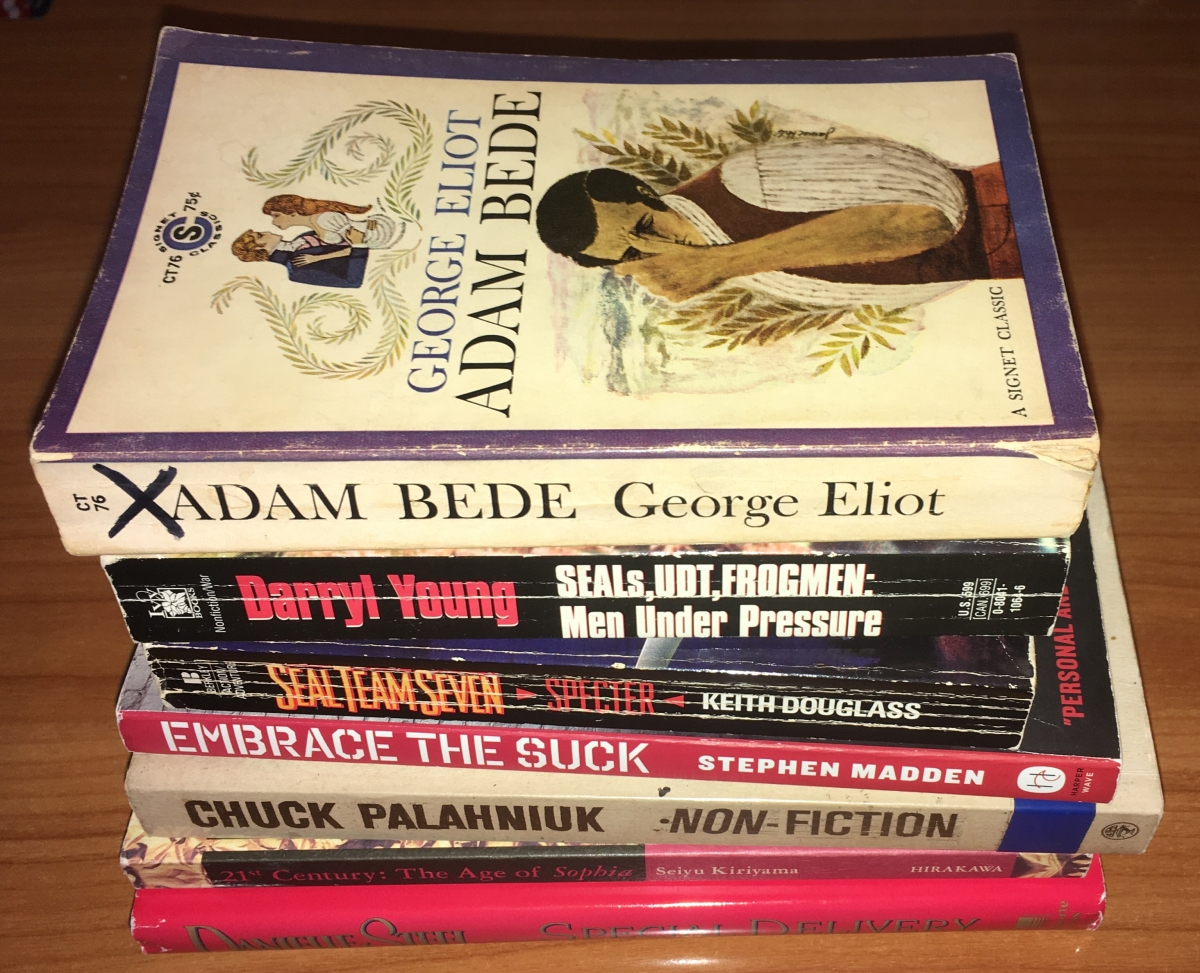
Apparently, every time I find myself in Leavenworth, I have some time to kill, so I stop by the one used book store in the area (as I did last October). Whereas I bought four books up there last time I was in town, this time I only bought three (for myself).
This time, I got:
A Rocky Mountain Christmas, which is a collection of Christmas stories from the mountains. Which might be something to read for my annual Christmas book, although I’m buying so many in anticipation of my one Christmas-themed book per year that I might have to start reading more than one a year. Perhaps starting in July.
Next Year Country, a collection of reminisciences about a farm in Montana. Also in my wheelhouse of books about living on farms in the old days. And by “in my wheelhouse,” I mean books I like to read from time to time, but that I buy a lot more of than I read. Which, basically, describes my book buying completely.
Hal Leonard Guitar Method Book 1. As you might know, I bought myself a grey black guitar earlier this year and took guitar lessons for a couple months (suspending them because the instructor was moving into advanced stuff when I can’t change chords in time yet). I’ve been accumulating guitar books to work from for a while now, and I thought I had the second in this line. Turns out, I have the second book in the Fast Track Method series. I hope I don’t end the universe if I cross the streams.
I also bought a book on the television show Dallas, to give to my aunt who loved the television show. I’d put in a link to the book I bought her, but I forgot the exact title, and I’ve already wrapped it.
You know, if I held myself to a couple books at a time, I could maybe start making headway on reading my collection. I actually did have that as a New Year’s Resolution one year in the middle 1990s–that I would not buy another book until I read all the ones I owned. I had only a bookshelf or two, single-stacked, to read were I to hold the line. The resolution lasted about seven months, after which I joined a book club and bought like ten books.
As I might have mentioned, my boys and I are watching all the James Bond films in order.
Last night we got to Moonraker, the most outrageous and outlandish film in the series which piggy-backed off of the box office success of Star Wars to inject a science fiction element to the series and features laser battles in space. It also was the largest grossing Bond film for a long time (he said, summarizing the Wikipedia entry).
As my children watched it, they could not suspend their disbelief.
After all, the film featured:
Space shuttles, which were space craft that lifted off like rockets and landed like planes.
Bent-nosed supersonic passenger airplanes that could cross the Atlantic ocean in three hours.
Given that my oldest was born in 2006, he cannot remember such things, so perhaps he could not believe them possible.
Well, after reading What If?, I did not pick up the next Executioner novel. Instead, I picked up this play that I bought at the very end of last year.
It’s a single evening play in two acts by Thomas Stearns Eliot, the man most known in these parts for “The Love Song of J. Alfred Prufrock” (which I could recite and perform from memory in my Open Mic days). The play deals, as the title clearly indicates to anyone with a classical education, and oh, my God, that’s not many of us any more, is it?, the death of Thomas Becket at the purported “request” of King Henry II of England. Becket, who had been the king’s chancellor (tax collector in chief) before he became archbishop of Cantebury, opposed the king after he became archbishop.
The first act of the play covers Becket’s return from exile to Cantebury, where his mere presence lifts the spirits of the downtrodden and the clergy, but Becket predicts his own martyrdom and is presented with various temptations: sensual pleasure, power, and finally, immortality in his martyrdom. While he resists easily the first and earthly ones, the last of them tracks with his secret desire. Then, in the second, when the knights are coming, Thomas does not flee and insists upon opening the doors to those who would kill him. After they do, the knights present their cases as to who really was at fault in his death.
So I guess you’re supposed to wonder and talk about later whether Becket was doing God’s will or his own in the second act given the nature of his last temptation. But I’m a bit meh on it.
The play is mostly in verse, some rhyming and adhering to standard rhythm and some not. However, the knights present their cases in prose. So clearly this is Drama, which means you go to the play to be educated and not entertained with a side of emotional response and later musing on the big themes that entertained you while playing out.
So I liked it less than The Marriage of Bette and Boo. Or even The Oedipus Cycle or The Bird by Aristophanes because they’re old books translated from dead languages. This play is more akin to The Balcony by Jean Genet in that it’s Educational, but I forgive the Genet play more because it was in French, and Eliot wrote in English, following a rich tradition of playwrights who wrote plays enjoyable for themselves and not the IDEAS they PRESENT.
Still, probably better than “The Waste Land”.
Also, I did flag two bits of text worth something amid the rest of the versage:
What peace can be found to grow between the hammer and the anvil?
and
You shall forget these things, toiling in the household,
You shall remember them, droning by the fire,
When age and forgetfulness sweeten memory
Only like a dream that has often been told
And often been changed in the telling. They will seem unreal.
Human kind cannot bear very much reality.
Yesterday, my lovely young bride and I had some time to kill between errands, and since we were in the shopping center with the CPO/Redeemed book store in Springfield, I pulled into a parking space outside the shop. We only had roughly thirty minutes to kill, and I thought maybe we’d have to stop by the comic shop as well to kill all the time, but no.
She found the dollar books and went through them extensively.
Which led to a strange inversion in our book purchasing.
She found twenty-seven books (more than one a minute) to my three.
I got:
Broke by Glenn Beck, who used to be somebody, I think.
Writing with Hitchcock about a fellow who wrote for Hitchcock at the peak of his filmmaking.
The Search for the Authentic Tomb of Jesus which sounds like it should be narrated by Leonard Nimoy.
She bought more than I actually looked at.
She just recently clears some shelf space in her office bookshelves. I hope she was not reserving that space for knick knacks.
Not that you’re keeping track, but my musical purchases have, in fact, remained in balance the last few months. As I’ve pointed out (originally here), my music purchases tend to be two types of music: Jazz songbirds and heavy metal. Over the last year and a half, this balance has been remarkably consistent. Sometimes, the balance shifts if I hear more metal or more new jazz, but it always seems to return to equilibrium. At the end of March, I last provided an update on my music purchases.
Well, I’ve bought essentially ten albums since then (with some asterisks).
Here’s what I’ve gotten:
Natsumi Kiyoura Hologram; technically, she might be pop.
Leap Frog Studios’ Leo Moracchioli Metal Covers; I bought about fifty of his tracks, which is, what, four or five albums’ worth (he does offer CD compilations, but I made my own).
Forget the buying, you might say. How’s the balance in listening?
Well, to be honest, the metal songs by Leo get the heaviest rotation. They’re among the oldest selections on the list, and I burned them to CDs and listen to them in the car, so they get a lot of play then. I only just got the Jessy J album this weekend, and the Natsumi Kiyoura CD has yet to arrive. So it’s mostly Leo.
A decade’s worth of data from the Missouri Department of Health and Senior Services shows that thousands more people die from self-inflicted gunshot wounds than from assaults.
From 2005-15, the department tracked that data. There were 3,533 firearm assaults that resulted in death, while 5,483 people died from self-inflicted gun shots (55 percent more).
The difference in rate is even greater locally. Over the same period in Greene County, 56 people were killed by guns fired by another person, while 262 died by firearm suicide (368 percent more).
The article includes several scary graphs about how gun suicides are more successful than other mechanisms for self-harm.
Which leads us to the inevitable coda:
A measured change to gun laws can help this specific problem because if we can keep firearms out of the hands of people who may be suicidal, we have a much better chance of saving their lives.
The author also says:
Folks in Missouri are protective of guns, built out of a culture of defending ourselves and providing for ourselves. We don’t have to change that culture, but we may have to change our law.
Folks with good intentions may be inconvenienced by waiting for guns. But for people considering suicide, it could save their lives.
Summary: I didn’t know this, so here’s an argument for increased legislation based on what I just learned.
But people who know about guns know about the risks. Especially the risks of turning the ratchet to the right.
Sweet Christmas, this is the second book in a row that I really enjoyed. I’m wonder if I am not doing the reading-for-pleasure thing correctly this year that I’m so surprised when I really enjoy a book.
This book is a collection of crazy, mostly physics-oriented hypothetical questions answered seriously and with actual math. The author created the xkcd Web comic and includes a section on the Web site going over questions like this (and the book is a collection of things that first appeared on the Web site, likely). Things like “What would happen if the Earth and all terrestrial objects suddenly stopped spinning, but the atmosphere retained its velocity?” and “What would happen if you tried to hit a baseball pitched at 90% the speed of light?” I don’t want to spoil it for you, but the answer to many of the questions is cataclysm.
Perhaps I enjoyed the book more than other Internet sites bound and printed that I’ve read (Jump the Shark, Awkward Family Pet Photos, and two Darwin Award books–The Darwin Awards II and The Official Darwin Awards 3) because I was not as familiar with the material. Or perhaps it was because the material and the content is a little deeper. It’s not popular culture, it’s not pictures with snarky captions, it’s science. Or at least musings therein.
I’m not qualified to judge whether the physics work out on his answers–I’m sure the Web site’s comments section are full of robust arguments about the answers–but it’s good enough for someone with a philosophy degree who just likes to speculate.
At any rate, a good, fun read. I wish I could remember on whose Web site I saw this on. I’m becoming quite the little follower, where people like Dustbury or Instapundit post links to books or music I might find interesting, and then I rush out and buy it. Perhaps I should stay off the Internet until I read some of these thousands of books I own that I have not yet read. Or maybe not.
Also, the string of two fun, enjoyable reads daunts me a bit as I look at the bookshelves trying to pick something to read now (no, not one of the books already on my side table with bookmarks in them–I want something new). I might not pick something I enjoy as much and might end up with something that remains on my side table for months (or, heaven forfend, years). The pressure can prove overwhelming. So I’ll likely pick out the next Executioner novel and slog through it.
Note this book is not related to the alternate history essay series such as What If? 2.)
This book has been on my to-read shelf for a while, and I don’t know why. I enjoy Robert Crais’ books more than a lot of the stuff I read. How big of a fan am I? I once spent an afternoon going through microfiche old PDFs of Spider-Man comic books to find the one with the letter from little Bobby Crais in it. I should probably jump right on new Crais books when they become available, like I used to with Robert B. Parker books, but my winding path through my library doesn’t often make sense.
Although billed as an Elvis Cole and Joe Pike novel, the book also features the dog handler from Suspect (and given explosives are involved, one would expect an appearance by the protagonist of Demolition Angel to make an appearance). I’m sure one could muse at length about the reasons that authors bring their series characters together with each other or their one-offs (see also Robert B. Parker). Is it because the fans want to see them together? Because authors love the characters and want to see them again? Because authors are lazy? Probably not the last in all cases, but one never knows, and one who writes this blog goes off into long enough digressions in these book reports without a lengthier musing on this topic at this time.
Cole takes a case from a corporate executive whose employee has gone missing along with several hundred thousand dollars of money and a large amount of untraceable plastic explosive. Apparently, she’s using it to try to find the terrorist organizations that blew up her son in Africa. As Cole investigates, he stumbles upon a fugitive on the run to the safe house where the woman, her handler, and their customer are planning a transaction, and Cole falls under suspicion for being involved. The big baddy targets the K9 officer who saw him there, and a twisty plot unravels over the course of the book.
Crais jumps between points-of-view throughout the book (which is the narrative style, ainna?), and the plot does come out as Cole investigates. He discovers that his client is not who she claims to be and that someone in the government might be involved. Although this is the prime way to set up a sucker punch, it’s not–the government isn’t arming the terrorists or anything like that (uh, spoiler alert). The end comes pretty quickly, and some of the resolution is just tacked on a bit at the end without needing the flow (that is, the tacked-on bit could have happened anywhere in the story or ten years later).
Still, a fun read from start to finish. Paced well (jumping points of view probably helps that), and it makes me want to go out and catch up on the series. Which might mean nothing more than searching my to-read shelves to find any other Crais books that might lurk there.
As you might know, gentle reader, I have a whole category on this blog dedicated to DeRooneyfication, wherein I try to clear out of my garage some small project or repair that has been out there a surprisingly long time. The latest example is the basketball hoop that needed a simple bit of decal gluing but remained unfinished in the garage for a number of years.
“Gee, Brian J.,” you might say. “I’d like to be like you and Andy Rooney and have stuff like that linger in my workshop for decades. Do you have any tips?”
Oh, boy, mister, do I!
On of my favorite ways to ensure that things pile up willy-nilly is a little technique I call The Blocker Project.
Now, a Blocker Project is a project that you want to complete, but you somehow dread the actual doing of it, and you avoid your workshop for weeks (or months! or years!) until you get brave enough to do it or, more likely, set it aside.
I inherited the lamp depicted to the right from my sainted mother, who inherited it from her mother because it was originally my grandfather’s. We’re not really table lamp people here (but, strangely, DeRooneyfication often involves lamps), so it never had a home on an end table at our home in Old Trees or here at Nogglestead. So it was put in the basement or in the garage. Eventually, it had a couple of chips in it, so I decided I would paint it. While painting it, I thought I’d tart it up a bit since it was just brown–you know, my grandmother was into painting ceramics–maybe this was one of her projects back in the day.
At any rate, that was some years ago. Back then, I believed that acrylic paints needed to dry overnight, so it was taking a long time, and I was probably disappointed with the imperfect job I was doing. So no doubt things other projects and raw materials purchased at garage sales piled up during the week or two I was actively working on it, and the time after that when I meant to finish it, but didn’t.
Eventually, it made its way to a corner of the workspace, where apparently it’s been chipped even more in the interim.
Since I worked with acrylic paints on the aforementioned basketball hoop and learned how quickly they dry, I set the lamp back center stage.
And felt a sense of, if not dread, certainly disinclination to work on it. It’s gathered a couple of chips since the first time I painted it, so I might have to repaint the brown parts. Do I still have paints to match that? Will I have to cover some of the existing painted parts that I have because I haven’t matched a paint color? Do I have a steady enough hand to paint the finer parts, or will the slight imperfections be the only things I see when I look at the completed project?
A Blocker Project like this can put you months behind in any projects you hope to complete and can leave you, like Andy and I (well, just I now, but Andy is here with us in spirit) meaning to fix that chair soon. Maybe next week. But not with that other thing you don’t want to do on the workbench right now.
(Sadly, I’ve not followed my advice in this post: I recognized and named the phenomenon, which gave me power to put the lamp back in its corner for a little while longer so I can do some other things.)
As you might know, gentle reader, I am more a book accummulator than a true book collector. I don’t go out to book shops with locked glass cases and leather chairs looking for obscure first editions, but I’ll pick some up if I come across them. Generally, to get a first edition, I’ll run across them if they’re at a garage sale for a dollar (as I did when I bought a first edition of Dune that I sold on eBay for $150–I related the story in my book report for that book). I am pretty sure most of my first editions have ex library markings on them, anyway.
That said, I do have some valuable books in my collection.
For example, I have a first edition two volume set of the memoirs of Ulysses S. Grant which I inherited from my beautiful wife’s uncle. Although I’m not sure where they are on my shelves these days. I did recently buy a reading copy of the books, so I guess I can move the actual first editions somewhere safe. Like a safe deposit box or something.
As you might know, I was a fan of Robert B. Parker’s books for a long time since I started reading him in high school (the long story is in the essay “Meeting Robert B. Parker“). I picked up paperbacks and hardbacks where I could. When I started to come into some middle class money, I bought Spenser: For Hire scripts, some of the very limited edition stuff Parker published in the middle eighties such as The Private Eye in Hammett and Chandler, advanced reading copies, and whatnot. So as a collection, my Robert B. Parker stuff is pretty complete, although I stopped buying the books when his moral universe got wonky. Still, I could probably unload the pile for a couple bucks.
But I count as my most valued books my Edna St. Vincent Millay collection that my sainted mother bought me when I was away at college.
Early in my college career, I got really into the poetry of Edna St. Vincent Millay and the Romantic poets, so I asked for some of their collections for Christmas my sophomore year.
This was in the pre-Internet days, so my mother couldn’t just order collections off of Amazon or eBay. Instead, she went way out of her comfort zone and went to various used book shops in the University City and Central West End areas, including some that had front doors locked because they were in sketchy areas (I never learned if they had glass cases or leather couches, but I assume not).
I read those Millay books immediately, and their influence eclipsed that of the Romantic poets (although my mother did get me an 1889 collection of Wordsworth poems, I have not yet read it and might not given how slowly I’m crawling through the complete works of Keats and Shelley).
Edna St. Vincent Millay (as well as structured poetry, poetry, and reading books) has kind of fallen out of favor over the years, so I don’t think they’d fetch much at a book sale. They’d probably be in the collectible books for three or four dollars each, only to linger until half price day or bag day (using the Friends of the Springfield Greene County Library Semi-Annual Book Sale as an example).
But it was quite an adventure for my mother, though, and the books mean a lot to me. So they’re my most valued books.
You’ve already learned about the games that Roark and Chimera play at Nogglestead. “What about your other cats, Brian J?” you might ask. “Do they have any games of their own?”
Well, gentle reader, the answer is, “Yes.” For Isis, our mostly black cat, has not only a game, but an arena in which to play it.
When we fold laundry, we dump it onto the bed and set the empty basket on the bench at the end of the bed. And then it’s Game On.
She hopes onto the bed when she sees the laundry coming, and then jumps down into the Arena of Isis (which sounds like something the other Isis would have).
The game is to poke her through the holes in the basket while she tries to paw and bite the poking fingers.
Apparently, she loves it, because she keeps coming back for more.
Fortunately for her, there’s always more laundry at Nogglestead.
Speaking of the Buddhism I’ve been reading, this book is a collection of aphorisms (as the back says) in the Buddhist mindset. Apparently, it’s just one long scroll or collection of musings or verses that the translator has helpfully broken into chapters (Contrary Ways, Watchfulness, The Mind, The Flowers of Life, The Fool, The Wise Man, etc.). You can tell that the author has broken this up because some of the content of the chapters flows away from the ascribed topic/title and then the chapter ends where a new topic begins and can be titled. So in the original, it would have been a single document just flowing. Not that I minded the chapters, though; the aphorism are in numbered verses, so it would have been like a long poem without them, and you probably know by know how I feel about long poems.
At any rate, it’s calming and pleasant to read, and the content mirrors the other things in Eastern philosophy I’ve read and is not far off from the Christian Stoicism I’m also currently reading and even the parables of Jesus: Slow down, don’t worry, help others, do good. You know, the practical aspects of many religions–that is, the pragmatic, how to live content, is similar no matter how wildly the ontology or eschatology differs. Which is why I prefer these little guides and comfort reads more than the heavy philosophy or theology most of the time.
You know, he almost beat the Patriots. He would be just the man Wisconsin Democrats need to almost beat Scott Walker.
Wait a minute.
Two Assembly Democrats called on former party leader Matt Flynn to exit the governor’s race over his role in shielding priests accused of sexual misconduct.
Never mind, that’s a different guy.
Which is a good thing, because a former Green Bay Packer could probably beat Scott Walker. Well, maybe not Greg Jennings.
So a couple years ago (five? six?), my mother-in-law got my children a little indoor basketball hoop for Christmas. It was handmade from wood and had a Mizzou window cling glued to the backboard. She picked it up during her annual Christmas bazaar safari which often yields crafted gifts. It came with a number of soft balls or bean bags, long since gone. But when she gave it to the children, it was with the caveat: The decal was falling off or had fallen off, so Daddy would have to fix it.
So it went out into the garage, where simple projects go to die. Or at least languish for a long time.
You might think Nightmare Town is New York based on previousevidence, but no. It’s a collection of Dashiell Hammett’s short stories. I would have expected that I read them since I have a couple of different editions of The Thin Man and The Glass Key, including two volume New American Library set, but those must only be the novels.
This book collects twenty of Hammett’s pulp stories, so you’ve got detective stuff along with the occasional Western. Several feature the Continental Op, three feature Sam Spade, and the first five chapters of his first stab at The Thin Man conclude the book (a little unsatisfyingly, though, since it does not resolve, and it differs from the published version enough that I wanted to see how this book ended, too).
The stories are terse in the pulp style–fancy that!, and they’re pretty good for the most part. Some of the plots a touch convoluted, though, and a couple of the stories turn on gimmicks, both of which are also a hallmark of pulp. But you know what you’re in for if you’re reading Hammett.
I’m pretty slow at reading short stories, though, as I’ve mentioned, since each story requires a little reset time that makes stopping easy at bed time. Still, I’m glad to have read it.
You know, gentle reader, every year I set a couple of goals for myself. Not resolutions, and not a little thing, but not a major thing (conquer the world is a centennial goal, not an annual goal). And sometimes I get a notion into my head that’s like a little goal, and two weeks ago in Michigan, I got an idea in my head kind of reminded me of my goals.
So we stayed at a resort that’s a seasonal ski resort (which meant it was very affordable in the summer). Our unit looked out onto the snow tube run, which meant we looked across the end of the run and some of the seasonal equipment, which provided a vista for my reading when I read all those books whose reports you’ve just read (or will read when you scroll down). From the edge of our balcony, though, we could look up Boyne Mountain (something that we can kind of scoff at even here in the lower part of the Ozark Mountains). But the hill behind us and the mountain itself with its ski runs rises something like 450 feet in the course of a football field. And I got it into my head that I wanted to walk up the hill.
I mean, I saw a bunch of people out for walks on the pavement, and a couple cutting across the fields to get up to the amenities across the road, but I didn’t see any hikers going up. I didn’t see any hiking trails listed in the amenities of the resort, but they did have a ski lift running to take you to the scenic lookout for a small fee.
The rest of the family planned a day at the waterpark, which left me free to pursue my stated goal instead of reading for the whole day. Of course, then the self-doubt and worry creeped in. Michigan up there is fairly forested. Might I run into a bear going up the hill? It’s cleared well to either side, but, man, would I feel dumb if I encountered a couple cubs halfway up and had to fight off the mother with a pocket knife. We didn’t cover that in tae kwon do classes, even the weapons classes. Also, I’m not twenty any more. Or thirty. Or, heaven forfend, forty. I’ve walked up some hills in my time, but this was nominally a mountain. At least it was on the brochures.
But I mentioned doing it, and as the morning evolved, the rest of the familiy did not dart out to the water park immediately, and when I asked if the boys wanted to accompany me to the top of the hill, the younger of my boys, the one most unflappable and with no sense of self-preservation or danger at all, said he’d go with me. So I was on the Daddy hook. No, he never called me Daddy–he always called me Father when he was young, but now I’m Dad, which is better than Fat. But now I couldn’t back out, even less than when I announced my intention.
So up we went.
The slope was, what, 45 degrees? Something like that. I was afraid of slipping and falling.
I mean, I haven’t done any hiking for reals, and certainly not in tennis shoes, since I was a kid. But I had my son along, and I had to show no fear of falling. Maybe a little concern about my age and having a heart attack (although a properly falling during a heart attack might have carried me down the hill to help). So I started up, watching my feet all the way up. I resolved not to look down or back as I climbed. Brothers and sisters, I could have saved Eurydice. Well, except for the music part, unless I bored Cereberus to sleep with my guitar practice like I bore my instructors.
I was a bit dismayed at my heavy breathing, which I tried to disguise in conversation with my son through clever ventriloquist tricks, but I noticed he was panting, too, and I felt better.
And then we were up the hill. The hilltop held a couple of buildings hidden from the lower view, but no real place to sit to share the water I’d brought. Don’t get me wrong–it wasn’t an hour’s hike. It was twenty minutes or so. But more incline than I’m used to in my super sprint triathlons (well, the one).
So we shared a bottle of water and took a picture.
At the summit, as it were, I didn’t enjoy the view that much or feel a sense of accomplishment, really, because I knew we had to go back down.
We climbed up the left side of the above picture, which is more steadily steep with a bit of a valley in the middle (for water run off, perhaps). On the way down, we came on the lit tubing side, which has some level spots. Of course, since I’ve never been snowtubing, I didn’t realize the level spots were ramps for jumps or bounces, and that the level spots were followed by sharper drops for those snowtubing thrills. Still, I did better than Wesley on the way down, still watching my feet. My older son had come out, a dot on the green below us, to take our picture, but he didn’t recognize the two specks as his kin, so I’m afraid there’s no picture from that angle. When we got about half way down the hill, the youngest started to run to his older brother, and he made it alive. But his cautious father continued a plodding pace until I reached terra level.
“So what does that have to do with your goals, Brian J.?”, you might ask. Even if you don’t, I’ve given it some thought, and here it is: It illustrates how I relate to my goals and my accomplishments.
It seemed daunting at the run up to the doing, and at the outset, but basically I put one foot in front of the other, and I–well, we–climbed the hill. When I was atop the hill, I didn’t really enjoy the view because I was thinking of what was next (in this case, the climb down, which was just as treacherous–which is to say, “Not Very”–as the climb up). And once I’d done it, it was not a big deal, and I’m not really going to bring it up lest I seem boastful.
Well, except with you, gentle reader. If you’ve been following along, you know I’ve done some things and met some goals, but having done them, of course I’ve done them. I get them done by carrying on, and I don’t necessarily enjoy the doing on the way to the accomplishment. Then I don’t get much enjoyment out of having done them. What a poor frame of mind.
Clearly, I’m more of a Camus Existentialist than a Neitzsche Übermensch. Which is also probably clear by all the Buddhism, Taoism, and Stoicism I read. Much of which I read because I keep trying to change my attitude for the better. Hopefully, I can plod my way to peace of mind eventually.