The Iron Maiden Poster That Got Me A Wife

As some of you know, I met my beautiful wife on the Internet. Not the World Wide Web: We’re old school and met on the rec.arts.poems newsgroup. She read something that I’d posted and thought it was good, and because my handle indicated I was from St. Louis, she emailed me to ask me where one could read poetry in St. Louis. Which was a good question to ask me, as I was a frequent performer at open mic nights and could tell her where to read and what audiences in the different bars and coffee shops expected.

So we struck up an email conversation an email conversation that stretched into hundreds of messages. We had a lot in common and connected pretty well–I’d read Atlas Shrugged a couple of times, and she had a cat named John Galt. And so on.

But I’m pretty sure the thing that sealed the deal was when I quoted an Iron Maiden poster to her.

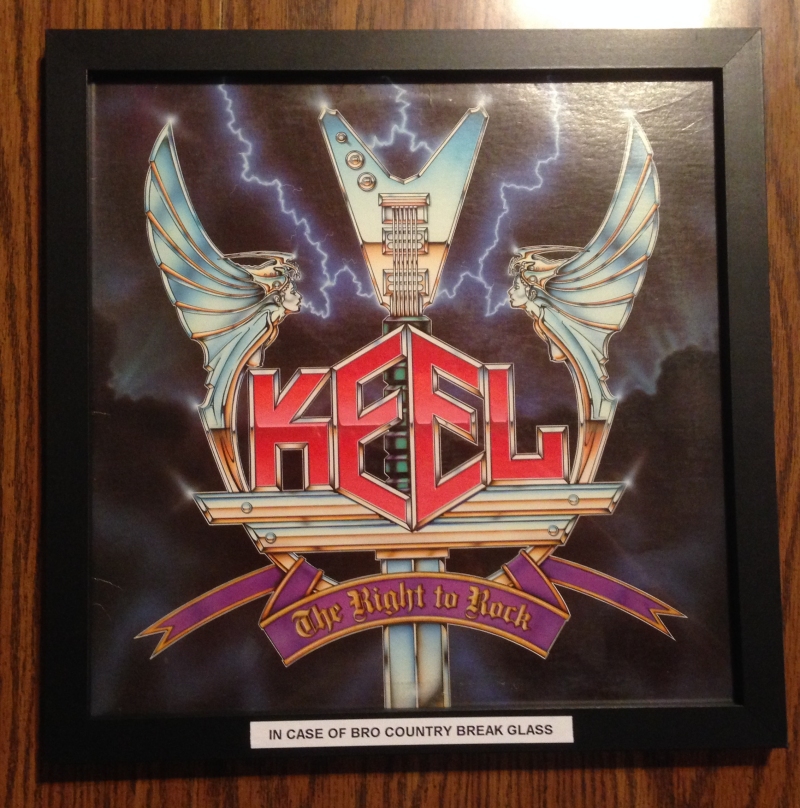
Now, I’m a little late to the heavy metal party. I had long hair in college and listened to some hard rock at the time, but not the evil bands. Like Iron Maiden, Black Sabbath, Pantera, Sepultura, and all that. But one of the Daves I know, I know, was into that, and his bedroom circa 1990 was covered in Iron Maiden posters. Including the one for “Wasted Years”:

We were talking about something or other about our youth (given that we were twenty-five at the time, we were still in our youth), and I said something like “As Eddie from Iron Maiden would have said, ‘Do not waste your time searching for those wasted years.'”

That, gentle reader, Sealed. The. Deal.

You see, she was an Iron Maiden fan from way back, and she emailed to tell me that if I was an Iron Maiden fan, she was going to come to St. Louis to kidnap me. I demurred, and explained how I knew of it, but she was not dissuaded. But the points still counted on the tally of whether I was soulmate material. Enough to overcome the whole he lives in his mother’s basement thing, anyway.

So, thank you, Dave. You could never have known that your teenaged choice of personal expression in rebellious décor would help me win a wife, but it most assuredly did.

In a slightly related note, once I married the girl, I got access to her Iron Maiden collection, and No Prayer for the Dying is my favorite album followed by Seventh Son of a Seventh Son. Not Somewhere in Time, the album upon which the song “Wasted Years” appears.

Buy My Books!
Buy John Donnelly's Gold Buy The Courtship of Barbara Holt Buy Coffee House Memories

Book Report: Drawings of William Blake by Sir Geoffrey Keynes (1970)

Book coverThis book is a collection of drawings by William Blake. William Blake, if you have an English degree, is best known for his hit Eye of the Tiger. But apparently he was also a painter and artist as well, but we didn’t cover that in my poetry classes.

At any rate, this book collects a number of sketches of his, some of which were doodles essentially and some which were studies for later paintings. Unfortunately, this is a sketchbook of raw material for those paintings, so the finished pieces aren’t actually included.

So it’s like looking at a notebook of Stephen King with a couple bits of outlines, a few phrases here and there, but nothing complete and finished. So it’s more for serious, serious fans of William Blake or artists, I suppose, that like to look at techniques from other artists. Perhaps scholars would be interested. But if you’re looking for something interesting to flip through and marvel over, this is actually less useful than Hand Shadows To Be Thrown Upon The Wall. Which, if I am not mistaken, was also published by Dover Publications.

Buy My Books!
Buy John Donnelly's Gold Buy The Courtship of Barbara Holt Buy Coffee House Memories

Book Report: The Forbidden City by ? (?)

Book coverIt’s football season again, which means it’s time for the annual parade of picture books I flip through during football games. Sometimes, I watch extra football games just so I can page through picture books at the same time.

This book is a tourist take-away from the Forbidden City in Beijing. Its text comes in six or seven languages, and strangely enough the English text is often much, much shorter than the text from other languages. I have to wonder if the information is truncated for English speakers or if it really just takes that much longer to caption photographs in other languages. I mean, German, I can understand. But Spanish and French and the Asian pictogram languages?

At any rate, the book includes many full color pictures of the palaces and halls within the Forbidden City (but no terra cotta warriors, but I guess that’s a different place. The palaces look more opulent than the castles and other things I’ve seen from Europe, but the Forbidden City is a Ming creation, which means it’s a little younger and more modern than many of the medieval structures I might have previously seen. They’re still a head and shoulders above the things I’ve seen in Korean books (like this, this, or this), but China, especially Ming China, was a bigger and better empire than Korea’s kingdoms.

Also, I look at them, and I think, Man, those must be hell to heat. I’ve got a big house, and it can be expensive to keep it toasty in the winter especially if propane is expensive and the winter is cold. But, of course, these palaces did not use wasteful forced air heating. Instead of heating empty spaces, they heated the rooms where people were at any given time with fires and whatnot. So it was much less expensive to heat. But there was the risk of catastrophic fire, and one of the pictures shows evenly spaced well-decorated urns containing water to be used in case of fire.

So it was an interesting thing to look at during commercials in a football game. And, as an occasional Sinophile, I wouldn’t mind seeing it someday assuming it’s not destroyed in any upcoming military conflict.

Buy My Books!
Buy John Donnelly's Gold Buy The Courtship of Barbara Holt Buy Coffee House Memories

Book Report: 12 Monkeys by Elizabeth Hand (1995)

Book coverKeeping with the “Is the person in the mental institution crazy or really a science fiction protagonist” subgenre reading I started with this book.

12 Monkeys is a novelization based on the screenplay (from the Bruce Williams/Brad Pitt film). Now, novelizations from screenplays can go one of two ways. You can get some additional depth that you don’t find in the film, or you can basically get prose from the screenplay. Unfortunately, this is the latter.

For those of you who haven’t seen the film (I had not), the main character is a convict from the future “volunteers” to collect samples from the contaminated surface and then to go back in time to find the source of a deadly virus that wipes out half of humanity and compels the remainder to hide underground in uncontaminated facilities. In the past, Cole arrives six years too early and gets taken to a mental institution where he meets a psychiatrist and the son of a famous virologist. He looks to find the source of the infection, gets yanked back into the future and reinserted in the past a couple of times, and begins to question whether he actually is crazy.

At any rate, it’s all right, but I didn’t like the ending much: I’m not sure if it was intended to be throught-provoking or was just sloppy storytelling (on the part of the screenwriter(s) more than the novelist). Actions don’t make sense, and the thoughts that are provoked try to explain the nature of the ending result in “That doesn’t make sense.” To be honest, I hoped for an ending not unlike the ending to the Kris Kristofferson film Millennium (book review here). But no.

A better novel would have explored more of the interior and back story of Cole, the convict, explaining where he came from and what he was convicted of. That’s not germane to the plot of the story itself. Also, it seems that mankind develops time travel really fast while recovering from a serious extinction-level event. So all the questions the book raises are with the story and plot itself, not with any philosophical things. Again, this is not the book author’s fault, but I wonder if it could have been handled better in the depths of a novel.

Buy My Books!
Buy John Donnelly's Gold Buy The Courtship of Barbara Holt Buy Coffee House Memories

Book Report: K-PAX by Gene Brewer (1995)

Book coverThis book is about as 1990s of a book as you can get.

The cover purportedly is a stereogram, which was a fad of crazy prints you were supposed to stare at to see a three-dimensional image. They were the big thing in the early 1990s, with complete shops in the mall selling nothing but Magic Eye products. I was trying to explain this to my beautiful wife, but she’d never heard of such a thing. Coupled with the fact that the spellchecker doesn’t know the word, I’m beginning to question whether it was a real thing. But it was.

I say this cover is purportedly a stereogram, because I am too smart to see them. At least, that’s what I told my friends in that era. They could see them. So if you see something in the book cover image to the right, let me know. Or you could just make something up, and I would never know.

I felt like that one guy in the film Mallrats.


The struggle was real.

Where was I? Oh, K-PAX. As you might remember, this was made into a Kevin Spacey film. Which is all I knew of the Kevin Spacey film except the basic conceit. The book is better than the conceit: It tells the story of the psychiatrist, the head of a small institute in Manhattan that works with hard-to-handle cases. The case at the core of the book: a young man calling himself prot who claims to be from the planet K-PAX. The psychiatrist works with him, and the book is structured around sessions the therapist has with the patient along with the psychiatrist (named “Gene Brewer,” which is the author of the book) musing about his relationship with his father and his family. The spaceman (played in the film by the Spacey man) offers some information that supports his assertions that he is from K-PAX, including sky charts from his homeworld, that check out to be true. He gets other patients to open up and start to heal. And he’s very good with animals. But as the doctor and an interested reporter investigate, they discover the disturbing story behind the patient.

The narrative switching up between the sessions and the doctor’s life were interesting and paced the book well. The story the spaceman told had enough contradiction and ambiguity that one wondered whether it would prove to be a spaceman or just a really gifted mentally ill person. Heck, there was a similarity between the doctor’s youth and the disturbing story so that I briefly considered whether the doctor himself might be the crazy one (hey, forgive me, I just watched Fight Club for the first time, and that was the most 90s of movies). But the resolution at the end was a bit disappointing, I guess, as it tries a bit to leave the ambiguity.

I see that the author has five books in this series. Well, I enjoyed most of this one, but I have to wonder whether I would enjoy more books in the story. They cannot all follow the successful plotting and framing this book has, so I’ll probably not hunt them down. They’re not the kind of thing that you see in book sales anyway, which leads me to believe that the others were not as successful as the first.

Oh, and above, I mentioned that this was a very 90s book. That’s because the Buddhist-flavored perfect world and communist society described by prot fits with the zeitgeist of the time, with the end of history and all that, but it really doesn’t resonate in the 21st century.

So worth a read if you’re into the whole “Is the person in the mental institution crazy or really a science fiction protagonist” subgenre.

Buy My Books!
Buy John Donnelly's Gold Buy The Courtship of Barbara Holt Buy Coffee House Memories

Donating a Time Capsule

So for a couple of years, I kept a collection of scrap fabric in case I got into sewing. By “a couple of years,” I mean the last seven. By “collection,” I mean every bit of something worn out: children’s pants too torn up to hand-me-down; old towels; all the bibs; discolored t-shirts in line for use as dust rags; and so on. Sometime in that period, I got a single sewing lesson and a new sewing machine for Christmas. After a while, I recognized the whole “getting into sewing” thing was probably a non-starter, so I started taking bags of the used fabric to the thrift store drop box by the YMCA, as a friend told me that they can sell that stuff to crafty people like I could have been.

Then, I eventually emptied four or five bins’ worth of scrap fabric from the garage, and I wondered if there was anything else I could dispose of in this like manner.

Now, for someone who didn’t grow up in the Great Depression, I have a don’t-throw-it-away mentality. So I have bins of clothing in the closet for just-in-case I can’t afford to replace them with cheap stuff from Walmart sometime in the future. Including, of course, the collection of 20-year-old t-shirts I took out of the active rotation in my dresser:

I have a drawer full of t-shirts as it is, and I’m getting a new one or two every month from 5K runs and whatnot, so the odds of my needing one of these is pretty low. Still, it’s a time capsule of the early 1990s. It included:

  • The Queensryche t-shirt that I’d thought had already become dust rags.
  • A Neo-Futurists “Too Much Light Makes The Baby Go Blind” sleeveless shirt that I got in 1994 when I convinced a couple of guys we should drive from St. Louis to Chicago for the night, and a friend of mine in Chicago suggested we go see this improv group, so we did.
  • A Class of ’62 Surf Boys shirt with the sleeves cut off. I saw this band at bars and festivals a lot in my college years.
  • A number of workplace polo shirts that I bought at garage sales, including Walmart and Blockbuster. I’d often thought it would be great fun to wear the Blockbuster one into a Blockbuster and answer any question I got with, “We don’t have that kind of movie here!” But I never did, and the chance is gone forever.
  • A couple of shirts from places my sainted mother and mother-in-law had visited, including Las Vegas, Canada, and Albuquerque.
  • A GenCon 1996 t-shirt. This is not the year I won the costume contest as the Were-Smurf–that was 1995. In 1996, I went with a couple of people, Scott and Lisa, I was gaming with at the time, and we stopped at the convention on Sunday before leaving so I could get this shirt.
  • A couple of worn Jeracor and QA Hates You t-shirts.

And so on.

A couple of items did survive the culling:

The shirt I bought my father for Christmas just before he died:

A QA Hates You t-shirt in baseball sleeve length that I got for some reason or another, but I forget what. But it’s still in good shape.

A black t-shirt with a bear on it. I kept it because I think it looks cool, and I wear a lot of black t-shirts now in my middle-aged Goth phase.

A t-shirt I designed for the college writing group:

Briefly, a last gasp of my pack rattery asked, “What if one of the boys would like one of these shirts?” They’re turning the corner into adult sizes, and it won’t be long until they fill out these shirts (and go beyond, no doubt). But I don’t think they’re going to be as sentimental as their father, so I disregarded that voice, stuffed them in a garbage bag, and deposited them in the bin at the YMCA.

Someone is going to unpack it and know exactly where it came from, but that person might suspect the husband did it under duress or the wife discarded them. But, no, I did it on my own. And I probably won’t miss them as much as I expect I will, which, if I dwell on it, could really affect how I see the world and the things I accumulate.

Buy My Books!
Buy John Donnelly's Gold Buy The Courtship of Barbara Holt Buy Coffee House Memories

Book Report: Paper Lion by George Plimpton (1966)

Book coverI started reading this book to get ready for football season. As it was, reading the book took longer to read than I’d anticipated, and it ended up extending into the football season.

As a reminder, in this book, the author joins the Detroit Lions training camp as an old rookie quarterback. Supposedly, he’s undercover, but it comes out eventually. As such, he lives in the dorm with the players, does the drills, even participates in a scrimmage and dresses for a preseason game.

I enjoyed the book well enough, as it reminded me how complex the game of football is and how complex the individual motions of football are. Plimpton has a hard time learning how to take a snap from the center. This is something second nature to the quarterbacks who make it to the pro leagues, as they’ve done it at the very least in high school and college until the time they hit training camp. I’ve decided I want to be an athlete now that I’m too old for it, and I’m finding myself having to slow down and study very basic body movement to figure out how to stride properly while running and whatnot. So it had that going for it.

However, one knock about the book is the artificial conceit of it. In the second chapter, he’s skating with Robert F. Kennedy because he’s a friend of the family. Plimpton came from some station in New York, so he’s looking at everything with the eyes of someone from the upper West Side. It probably wasn’t so bad in 1960 something, but it’s a bit jarring in the 21st century, especially as some of the name-dropping comes off as just that. So I can’t help compare it to the Jerry Kramer books and unfavorably, as Kramer is a farm kid who’s in the NFL.

Also, I can’t help but note that the co-writer of Run to Daylight says Paper Lion is the best book about football he’s ever read. Well. He must be a Lions fan, or he must not be counting the book he wrote, ainna?

At any rate, it’s worth a read. I also have Plimpton’s Open Net about a similar stunt with the Boston Bruins. Time will tell how fast I get to it. Probably not in time for hockey season.

Buy My Books!
Buy John Donnelly's Gold Buy The Courtship of Barbara Holt Buy Coffee House Memories

Book Report: An Altogether New Book of Top Ten Lists by David Letterman (1991)

Book coverI got this book recently for quick football season reading. I remembered reading Book of Top Ten Lists (apparently 13 years ago). However, I did not recall specifically reading this book before (which I did, about eight years ago, when before my sainted mother fell ill and before I moved to Nogglestead–was there such a time in my life?).

At any rate, I said of the first book:

The same politicians from almost fifteen years ago are the same punchlines in some cases. Al Sharpton, for instance, is a common motif in Letterman’s collection. In O’Rourke’s more serious obra, we see the same names we curse today. Diane Feinstein. John Kerry (who would almost seem to have served in Vietnam longer than in Congress based on the way he talks about it–as though the former determined his behavior and honor more than the latter–it’s almost like M*A*S*H in a way, wot?). Lt. Governor Gray Davis. O’Rourke exempts Arnold Schwarzenegger. This was 14 years ago.

It’s funny: now, it’s twenty-five years past the publication of the book, and it is lousy with Donald Trump jokes. That makes it the second book I’ve read this summer from days gone by that make light of Mr. Trump (The Know-It-All being the other). It continues to illustrate how long public figures remain in the limelight sometimes, I guess.

At any rate, to reiterate, the book works best if you were alive in the late 1980s so you can understand some of the recurrent punchlines ripped from the days’ headlines (G.E. light bulbs! Haw, haw!)

But it did give me some brief amusement again, and it did kill the time between plays in a couple of football games. So worth my time, but your mileage may vary.

Buy My Books!
Buy John Donnelly's Gold Buy The Courtship of Barbara Holt Buy Coffee House Memories

How To Tell What Song Just Came On Brian’s iPod At The Gym (IX)

When last we discussed my playlist at the gym, I said if I curled my lip, you could tell I was listening to Billy Idol.

Well, I’m afraid I’ve adjusted my playlist, and that instruction is no longer operative. If I curl my lip, watch to see if I’m subtly flipping long hair that I no longer possess. If not, it’s Billy Idol. But if I am…

Continue reading “How To Tell What Song Just Came On Brian’s iPod At The Gym (IX)”

Buy My Books!
Buy John Donnelly's Gold Buy The Courtship of Barbara Holt Buy Coffee House Memories

It Ain’t Modest If I Humblebrag About It

From an article entitled How Exercise Shapes You, Far Beyond the Gym:

A study published in the British Journal of Health Psychology found that college students who went from not exercising at all to even a modest program (just two to three gym visits per week) reported a decrease in stress, smoking, alcohol and caffeine consumption, an increase in healthy eating and maintenance of household chores, and better spending and study habits.

WHAT? Here, I thought I was a gym rat, and I’m only doing a modest program? Ay, me.

It’s enough to make a man turn to doughnuts for solace. Not that I need much guidance in the doughnut direction, mind you.

Buy My Books!
Buy John Donnelly's Gold Buy The Courtship of Barbara Holt Buy Coffee House Memories

iPhones without Headphones: A Long View

And some of you think that Tim Cook is not an innovator!

Full disclosure: I hold some Apple stock, but half of what I once did. When the value of the stock doubled, I sold half, right at its peak because I wondered if the aura of Steve Jobs was much of the brand. It might well have been, but my remaining holdings are all house money now. Once in a while, I make a wise investment decision, unlike then I bought National Lampoon Media Partners, IPIX, or Salon New Media, or when I didn’t dump my SIRI immediately when they signed Howard Stern. Ah, well, live and live. I never learn.

Buy My Books!
Buy John Donnelly's Gold Buy The Courtship of Barbara Holt Buy Coffee House Memories

Book Report: Wolverine: Weapon X by Marc Cerasini (2004)

Book coverThis book is a novelization of the Weapon X storyline from the Marvel Comics that tells the origin of Wolverine’s metal skeleton. I was most familiar with it because a spin of it was part of the material covered in the first Wolverine movie. But I’ve never been a real fan of the mutant titles, to be honest. Which is why we’re a couple or three behind in the film series as well.

At any rate: The book follows two tracks. One is Logan getting captured, which is told from his point of view until he’s rendered a test subject, at which point it becomes a story of the scientists working with him. It shifts to the point of view of some of the employees at the facility, including some almost sympathetic looks at the guards and scientists. Then it comes to the ending where, if you don’t know, gentle reader, let me tell you: Wolverine awakens and kills everyone, and the desperate fight is told in great detail, and the scientists–even the ones with the backstories that make them somewhat sympathetic–die! But, wait, there’s a twist: it’s an induced mental part of his conditioning and didn’t happen! But wait, there’s another twist: A scientist pipes up that this mental induction technique was no longer used because it was sometimes predictive of the future! Then Wolverine wakes up, and everyone is killed quickly.

Oh, yeah, the second part of the story is Logan as a special ops man going into North Korea to stop something or other, and Logan dreams the memory of it as he’s being experimented on, so that’s how it crosses over into the main plotline. One of the helicopter pilots at the end turns out to be one of the security team at the facility, and he recognizes Logan ultimately right before Logan kills him.

So I thought the ending of the story was mangled. The whole double-twist thing was stupid. And, unfortunately, the excellent work humanizing the scientists in the novelization made the ending unsatisfactory because I didn’t want them dead. Most of the book is from their point of view, as I said, so the culmination of a revenge story at the end doesn’t seem congruous. But that’s a problem of the story, not the novelization.

At any rate, Marvel did a couple books around this time of that ilk, but I’m leery of them. I’ve got some other comic book novelizations around here, and I’ll probably get to them sooner rather than later, but I’m disappointed in this story.

Buy My Books!
Buy John Donnelly's Gold Buy The Courtship of Barbara Holt Buy Coffee House Memories

Book Report: Kilroy Was Here by Charles Osgood (2001)

Book coverThis book collects some humor from several World War II era sources, such as Stars and Stripes, a book called Yank, and a couple of other works. It’s grouped by topic, which allows Osgood, the editor, to shuffle material from the same sources. It includes jokes, poems, humorous anecdotes, and whatnot.

As such, it is more easily approachable, prolly, to people of a certain age who grew up with Beetle Bailey and Sad Sack cartoons or who actually served. It’s not a bad read, but it’s from a time before cell phones, Twitter, and the Internet, which probably means that kids today won’t get much of the humor.

So not a bad read, but probably not something that’s going to sell a bunch more these days.

The KC Kid saw me reading this book out in public and asked if he was going to read the review for it sometime. Well, yes, but it won’t be much of a review.

Buy My Books!
Buy John Donnelly's Gold Buy The Courtship of Barbara Holt Buy Coffee House Memories

Household Tips from Brian J.: How to Do Housekeeping When You’d Rather Be Doing Hobby Stuff

You how it goes: The weekend finally gets here, and you’ve only got a few free hours before it’s back to the psycho treadmill of the week. You have a choice: You can work on something fun, like a hobby, or you can do some housecleaning.

Let Brian J. tell you how you can do both–at the same time!

I like to get out something in my hobbies–collecting (accumulating!) things–and I put it in the middle of everything.

Like when I cleaned my office the last time, I took the ill-advised long boxes of comic books (I organized my comic books and put them in long boxes like you see at comic book shops, but then I learned long boxes don’t fit onto shelves-they’re designed for tables of comic books like at comic book shops!), and I put them into the hallway so I could vacuum my office. But it is a dark hallway! So I could leave the boxes there for months! And I did.

So today, armed with some new short boxes (which fit nicely on shelves!), I did both housecleaning and hobby!

I reorganized the comics and cleaned up the hall!

So keep that in mind! Sometimes you have to make a bigger mess just to clean it up–especially if you want to spend your weekend hours most efficiently!

Now, someday I’ll do something about the other boxes in the hallway containing overflow Atari 2600 cartridges and record albums. Someday–on a weekend where I want to think I was doing housework!

Buy My Books!
Buy John Donnelly's Gold Buy The Courtship of Barbara Holt Buy Coffee House Memories

How Very Meta

Over the weekend, I was looking over my bookshelves and pulled out a volume called The Experience of Nothingness. “That’s interesting,” I thought, “I’ll read that after All Madden.”

Then, this morning, I went looking for the book on my bookshelves, and I could not find it.

Which exasperated me a bit and truly gave me the whole experience.

Buy My Books!
Buy John Donnelly's Gold Buy The Courtship of Barbara Holt Buy Coffee House Memories

Book Report: All Madden by John Madden and Dave Anderson (1996)

Book coverI rediscovered this book as I turned around the books on the shelves in the hallway, and it’s the right time to read a book about football, am I right? After all, once September starts, all of my reading is going to be coloring books and chapbooks.

This book comes ten years after One Knee Equals Two Feet. In it, Madden talks about his all-Madden team and the beginning of some football “traditions”, such as the Madden football video game, his bus (he didn’t like to fly), and the Thanksgiving turkey awards. He also talks about players he’d include on his All-Madden team (through 1996), including Jerry Rice and Emmitt Smith. Because this book only precedes my football fandom by about five years, I recognize the names of more of the players than I would in a book about the 1970s or 1980s (unless, of course, it’s a book about the Packers).

Madden also talks about coaching, officiating, and even other sports. It’s a quick read built on topical chapters, and it’s gotten me revved up for the football season more than the online reporting of the training camps and preseason have been. Contemporary journalism focuses a lot on personalities and injuries, but football books remind me how complex the game is and how difficult the playing of the game is. I need a reminder like that because I tend to watch something and think I could do it as well as the people on the screen. Which is not the case (as a recent visit to a ninja warrior sports gym reminded me physically).

So I enjoyed the book. Undoubtedly, he’s got other books available, and I’ll watch for them. It’s hard to believe he’s been retired for seven years (!) already, which is apparently long enough for me to mentally envision him and then think, “No, that’s John Candy.”

Oh, and I would be amiss if I didn’t point out that he alludes to having read Travels with Charley, and that he enjoys criss-crossing the country on his bus because he gets to see the country that way. How fun.

Buy My Books!
Buy John Donnelly's Gold Buy The Courtship of Barbara Holt Buy Coffee House Memories

Book Report: Beggars in Spain by Nancy Kress (1993)

Book coverI bought this book nine years ago because the author wrote (or continues to write) the fiction column for Writer’s Digest, a magazine I took off and on for twenty years until I realized that scanning magazines about writing was not making me write more. Later that year, I bought Opening Nights, a novel by Janet Burroway, who wrote the textbook I used in a collegiate writing class simply because I wanted to see how she, and Kress, did with their fiction since they were also instructing about it. So I’ll probably read the Burroway presently if I can find it.

At any rate, Beggars in Spain is a science fiction book set in the near to medium term future of 1993. The driving point of it is that, soon, genetic modifications before birth will become normal, and one of the strangest is preventing the need for sleep. This creates a bunch of kids called Sleepless who eventually become smarter than their peers because they don’t waste time sleeping. Eventually, it comes to light that they do not age much, either. This creates a stratified society of super-productive and hyperrational citizens who carry a heavier tax burden than others, and the stratified society leads to some enmity between members of each class. The Sleepless try to create a Sleepless-only refuge planetside and then an orbital satellite where they can work, learn, and earn free of interference from the less productive sleepers.

The book is broken up into sections, each of which takes place in a certain year, and the years are separated by decades. The sleeper children grow up, but the Sleepless do not age. The main character, if you will, is a Sleepless who had a twin sister that is a Sleeper; it starts on their relationship as children and then the Sleepless sister becomes an attorney, which gives the book an in to dwell on the legal and ethical ramifications of what’s going on. Which she does.

So you’ve got a science fiction novel with Heinlein and Rand overtones. It definitely explores some themes, and it does so kinda wordily. The action in the book is overshadowed by the thematic musings, unfortunately. One almost expects the leader of the Sleepless to deliver a long speech to the Sleepers. But the thematic explorations are thoughtful: one gets a little sense of both sides in the Sleeper versus Sleepless philosophies, and one expects the ultimate goal is some Hegelian synthesis of the two.

In researching for this book report (by that, I mean when I looked at Wikipedia), I discovered this is the first part of a trilogy. There’s no real cliffhanger at the end leading to a second book (as a matter of fact, there’s no cliffhanger at the end of each section/year in the book that leads to the next), so I’m not sure where it would go from here. Sleepless in Space? Regardless, now that I’ve satisfied my curiosity in the work of the Writer’s Digest fiction columnist, I’m not eager to continue the saga.

Buy My Books!
Buy John Donnelly's Gold Buy The Courtship of Barbara Holt Buy Coffee House Memories