Book Report: The Peter Principle by Dr. Laurence J. Peter and Raymond Hull (1969, 1970)

Book coverMost of us have heard of the Peter Princple: That a person tends to get promoted to his or her level of incompetence. That is, in any heirarchy, any person who does his job well enough to get a promotion will eventually get promoted to a position above the person’s competency, where he or she will not be able to do the job. This book is the source of that idea and not only includes it, but also includes other related observations about organizations.

For example, it explains how people who get put into those positions cope with their placement in jobs they cannot do: often, they substitute some task within the function to focus on. More frequently, though, their efforts go not toward doing the work/serving the customer/making money, but more toward supporting the heirarchy.

When a heirarchy becomes too laden with people who cannot do their jobs effectively, the company folds or the government falls. You can forestall this with by shuffling incompetent people or creating new positions to fill with people who have not yet reached the level of their competency. You cannot fix the problem with computers, as computers merely do what they’re told, and you’ll eventually have incompetent people in charge of them.

You can avoid this yourself by avoiding a promotion when you’re happy with your job, but to avoid stigmatism for not being ambitious, it’s best to fake a certain amount of incompetence to avoid being offered a promotion. Even if you reach the peak of your profession, you might be tempted to move to another heirarchy where you might find your level of incompetence eventually.

How does this book compare to C. Northcote Parkinson’s Parkinson’s Law? The book actually addresses Parkinson and says he does not go far enough because work can not only expand to fit the time allotted to it, but beyond if the heirarchy is too stuffed with incompetent individuals to get the work done.

The book ends with a chapter on the Peter Principle on the scale of the human race and fits in with the Malthusian zeitgeist of the time, unfortunately, but it doesn’t detract too much from the preceding chapters.

It’s a humorous, tongue in cheek look at heirarchies and has some truths in it. It is so tongue in cheek that I wondered if it was all a put-on, but Dr. Peter actually exists and did study heirarchies with numerous other publications, so I guess he’s for realz. A good, fairly quick read and quite a best seller in its day: this book, one year after publication, is the eight mass market paperback printing after 13 other printings, and the book is still in print today. So somebody likes it.

Buy My Books!
Buy John Donnelly's Gold Buy The Courtship of Barbara Holt Buy Coffee House Memories

Book Report: Women The Children Men by Roberta Metz (1979)

Book coverThis book is another poetry chapbook I picked up somewhere. It’s from 1979, so it’s old school.

The title refers to sections of the book, one on women, one on children, and one on men. Each contains poems focused, kind of, on the experiences of each, but all of them are from an older, wiser woman’s perspective, whether it’s about being a widow, about having a sexual relationship as an older woman, having children, having men, and so on. Honestly, the men come off a little bit at a loss here, although it’s not entirely male-bashing.

The poet is a more professional poet than, say, Charlotte Osborn. You can immediately tell because the language is unabashedly contemporary (to 1979) and the lines lack end rhymes. Also, the metaphor and rhythm have a certain facility with them.

So a pretty good collection, a step up from the flowers-and-life poems of the housewife set, with a few lingering ideas and images.

Buy My Books!
Buy John Donnelly's Gold Buy The Courtship of Barbara Holt Buy Coffee House Memories

Book Report: Rogue Warrior: Task Force Blue by Richard Marcinko and John Weisman (1997)

Book coverThis book is ripped from the history books and Obama-era law enforcement documents. The opening bit finds Marcinko’s group storming a hijacked plane where the Secretary of the Navy is being held hostage. Marcinko shoots the SecNav’s bodyguard in the process when the bloke draws his gun during the storming, which is the thing that puts the group outside the wire in their ensuing mission.

A billionaire has drawn a following and has recruited a number of ex-military to his organization. He seems to be amassing a large amount of stolen military weapons and distributing them to a wide variety of unsavory groups, from gangs to the militia-style group that hijacked the commercial plane carrying the SecNav in the first place.

The description of the billionaire could be molded to fit Donald Trump:

LC believed we needed a chief of state who was less the poll-driven, touchie-feelie-I-will-never-lie-to-y’all politician, and more like one of those Latin American caudillos–paternalistic, tough dictators like Trujillo or Bautista. There was a part of me that agreed with him. I want a head of state who is decisive–a man who leads from the front. LC certainly did that–he ran his businesses. He didn’t leave ’em to others to run. An in many areas, our philosophies were similar. He argued that we didn’t need a Department of Defense that ran resuce missions in the Third World instead of staying ready for war. I thought so, too. He thought we should lead, not follow, in world affairs. No argument there, either. He was tough on crime, and believed in education. Right on.
Where I got uneasy with LC was in the constitutional area. He never came out and said it in so many words, but it was kind of like he hinted that we didn’t really need the Constitution. I found that downright scary.
But guess what? Current polls showed that many Americans agreed with him–felt that we needed a strong man running the gummint, and to hell with the Constitution.

Of course, in 1997, the template would have been Ross Perot. But one thing these thrillers from the 1990s shows us that the same thing we’ve got going on in the 2010s has been going around and coming around for a long time. You can’t go back as far as the 80s, though, since those were mostly the remnants of the Nazis in the post World War II fat thrillers (although the thin men’s adventure paperbacks often show themes that continue to recur, like Islamic terrorism, as they spread their villany amid those, ex-Nazis, and militia threats).

At any rate, the book does not balance the fourth-wall-breaking expositon well with the action sequences–it has more of the former than the book can bear. Also, it’s a single twist away from being really good–when the Task Force Blue infiltrates the bad guy’s inner sanctum, they find that the general who has been controlling their shots has a new agenda: not neutralizing the threat, but instead putting the threat of civil disorder under the current administration’s control, for its own uses if needed. Which isn’t that much of a twist in the 21st century, where readers kind of expect that from any administration of opposing viewpoint, sadly.

Marcinko has kept writing these books to the current day. Most of what I’ve read comes from the 1990s so far. I wonder what I’ll find once I get into the 21st century books, as I will, probably, if I find them cheap in book sales. My continued interest in the series is the best endorsement of the book that I can provide. It wasn’t bad enough to turn me off to the series.

Buy My Books!
Buy John Donnelly's Gold Buy The Courtship of Barbara Holt Buy Coffee House Memories

The Rorschach Graffiti

On Facebook, a fellow I’ve known for over a decade posted a link to an article about graffiti with the swastika as the T in Trump and asked someone to justify it.

The papers covering it handily as though this is pro-Trump graffiti, quoting all sorts of anti-Trump people hoping Trump will disavow this:

Philadelphia’s Anti-Defamation League chapter quickly condemned the vandalism, referencing its eerie coinciding with Kristallnacht, a coordinated Nazi attack in 1938 during which hundreds of Jews had their storefronts smashed throughout Germany.

“Swastikas and the Nazi salute send a message of intolerance and hate to the entire community,” Regional Director Nancy Baron said in a statement. “While we view this as an isolated incident, we cannot allow this behavior to become routine. Everyone has a role to play in combating bigotry — we must advocate, educate and investigate until hate is no longer welcome in our society.”

One damn minute, Admiral.

What we have here is a piece of unattributed graffiti comparing Trump to Hitler. The articles present no evidence that the vandals were Trump supporters. NONE.

But of course the vandals must be Trump supporters, because people in the media and on the social media have said so.

Pay no mind to those on the left have equated Trump to Hitler.

Come on, that’s three examples from relatively high profile Internet locations or celebrities. You know it’s been all over your Twitter feed and Facebook feed and everywhere else for six months. “Trump is Hitler!”

Ergo, graffiti comparing Trump to Hitler must be in support of Trump as Hitler. Ergo, somehow.

It’s not just Trump that the left has called Hitler over and over.


Scott Walker is Hitler


George W. Bush is Hitler

Clearly, these protestors and their supporting iconography were not the work of Walker and Bush supporters, but the Trump graffiti is because, what? That was then and this is now?

So we’ve got an incident of graffiti, but clearly it is a symbol that fits into and reinforces a specific narrative. The apex of mid-century American Existentialist thought that sixties thinkers could only dream would become mainstream.

Regardless of the actual realities of the incident, including the vandal and his or her motive. Concrete details are not the point. The narrative and the meme are the point.

Buy My Books!
Buy John Donnelly's Gold Buy The Courtship of Barbara Holt Buy Coffee House Memories

Book Report: Let Us Go Quietly Together For A Little Way by Charlotte Osborne (?)

Book cover This book would seem to date from the 1960s, given that its proceeds would be used for the restoration of the Old Bonhomme Presbyterian Church in Chesterfield, Missouri, and I did some rudimentary research to see when that happened. The book is not available on Amazon or eBay and does not appear anywhere on the Internet, seemingly. So maybe I’m just making it up.

At any rate, it’s a short (12 poems in all), comb-bound collection of poems that are not particularly Christian nor gospel-based. Instead, they’re musings on the common poetical themes of love, the passage of time, and enjoying the fleeting present. The language is at times a bit self-consciously imitative of middle English, but not exclusively so. And the poems are not bad, but they don’t stand out.

On the other hand, it is another example of early-to-mid-twentieth-century women, generally middle aged, putting their thoughts to verse and then publishing them, which means we can still see them fifty years later. It might not be poetry to last the centuries, but it’s a literary endeavor that surpasses what many, if not most, of their contemporaries were doing and many, if not most, of their twenty-first century contemporaries are doing, me included.

So it’s not a bad way to spend a couple of minutes in between sonnets you’re writing or snarky tweets.

I wonder where I picked this up. It’s the kind of thing I get bundled at five-for-a-dollar at the Friends of the Springfield-Greene County Library book sale, but its origins are in the St. Louis area. Did someone bring it down here and donate it, or did I pick it up in the St. Louis area many years ago? Fortunately, although I wonder about it. I’ll be done wondering about it when I finish this post, so I can focus on proper insoluble problems, such as “Can I convince someone of something political on Facebook?” (Answer: No.)

Buy My Books!
Buy John Donnelly's Gold Buy The Courtship of Barbara Holt Buy Coffee House Memories

Book Report: Backroads of the Ozarks by Wayne Sullins (1990)

Book coverThis book is a collection of Ozarks photographs, published about the time my beautiful wife was graduating from high school in the Ozarks while I was doing the same in the St. Louis exurbs and thinking about my new life in Wisconsin. Some decades later, I’m in the Ozarks, and I see things like this every day.

The photos in the book focus on wild flowers, landscapes, and old mills.

You know, I’m glib when I say I see things like this every day, but I don’t. Many days, I direct myself into Springfield and its urban and suburban environments for the business of living. I see things like this when I bother to take the back roads from my home to Republic, Clever, or Ozark and get to see the landscapes, the old barns, the livestock, and the other things that remind me of Americana and not just the narrow corridors of life.

So I browsed this book with while watching football, as you might expect, and I sometimes wonder how much more I should actually linger over a book of art or photography than to look at the image, react to it if I feel so inspired, and move on. Sometimes, I just don’t know what I’m doing with these book things.

Buy My Books!
Buy John Donnelly's Gold Buy The Courtship of Barbara Holt Buy Coffee House Memories

Book Report: The Tao of Pooh by Benjamin Hoff (1982)

Book coverThis book was classed, apparently, as Humor, but in reality, it is a brief introduction to some of the concepts of Taoism through illustrations and excerpts from Winnie the Pooh books.

Clearly, it’s a Chinese conspiracy to trick our children into being Taoists.

So, basically, it introduces the concepts of P’u, the simple, uncarved block, which Pooh is (according to the book). His simplicity leads him to looking at things differently than the others and to finding solutions that the other, more clever (Rabbit) or wise (Owl) characters overlook. Then there’s Wu wei, the concept of not doing much or anything and letting the simple things and solutions in harmony with nature appear. And t’ai hsu, the great Nothing where you begin your journey and in which you will find most things.

Being as I’ve been steeped in the Existentialist writings recently, I must compare the two. Within Taoist thought, the Nothing doesn’t represent the same thing as in Existentialism, as at the core of humanity and nature there’s something, a harmony that you can discover if you’re quiet, simple, and still. So instead of inventing yourself, in Taoism, you find yourself. It’s a bit more pleasant of a thought. And the thing you find within yourself is not set, as you can alter who you are as long as you work with what it is. Very Eastern, of course.

It’s about 150 pages, but it has illustrations, quotes from Pooh books, and imagined conversations with Pooh characters, so it’s something you can read in a sitting or two. I think it took me between two and three hours.

So I think I have The Te of Piglet and perhaps even the Tao Te Ching around here somewhere. Perhaps I’ll pick them up soon.

Editing a different post from way back in the day, I’m reminded of the Tao Sharks gear I made:


Tao Sharks
Tao Sharks

Strangely enough, these did not prove as popular as the Project Manager Wall Clock.

Buy My Books!
Buy John Donnelly's Gold Buy The Courtship of Barbara Holt Buy Coffee House Memories

Book Report: Camille Pissarro: A Medænas Monograph by Anne Schirrmeister (1982)

Book coverThis book is in the same line as Peter Paul Rubens, but it is two years earlier, which means that it has two sets of pharmaceutical ads instead of one and the front cover does not have the artist’s name nor a sample work on it (which explains why I have two).

Instead of the Baroque work of Rubens, Pissarro falls into the Impressionist and Neo-Impressionist schools of art. Like Monet, he does landscapes, but unlike Monet, he includes human figures in them. He does a lot with working people in their elements (the fields and whatnot), and he has a lot of blocky, square structure in his works as he used the palette knife before Bob Ross made it cool.

So I’ve learned more about this artist and sampled his work. I also hopefully will no longer confuse him with Bazille and think Pissarro died in the Franco-Prussian war. When they’re both covered briefly in the Impressionist sampler books, like this or this, I tend(ed) do do just that.

Worth a browse if you like art and can find it for a buck. Or if you’d like me to just send you my spare copy.

Buy My Books!
Buy John Donnelly's Gold Buy The Courtship of Barbara Holt Buy Coffee House Memories

Book Report: The Courtship of Barbara Holt by Brian J. Noggle (2011)

Book coverIn my recent reading, I’ve seen the term hortus conclusus and references to Hegel and Husserl. Which immediately made me think of The Courtship of Barbara Holt, my play. So I took one of the proof copies from the shelf and read it again.

Like John Donnelly’s Gold, which I also re-read this year, the play amused me because I get all the jokes within it, and some still catch me by surprise enough to make me laugh. Although the allusions to hortus conclusus, Hegel, and Husserl did not specifically.

The plot, in case you haven’t seen it recently, is that an English major in college, Mark, really likes a girl (Barbara Holt), and when he talks to her, he spouts blank verse. Barbara’s friend Jenn likes Mark. Mark’s friend Mike likes Jenn, so he tries to get Mark to woo Barbara more effectively. Rick, another friend of Mark (called ‘Phil’ by Mike because he’s a philosophy major and hence brings the three Hs into it) thinks Mark is trying to woo Jenn, so he tries to help get them together. And so on.

At any rate, there’s some simple humor in it, and a little bit of obscure humor like I fancy in it. I’m almost tempted to release a footnoted edition just so everyone will know just how clever I am, but I’d probably sell fewer copies of the annotated Barbara Holt than the original.

Buy My Books!
Buy John Donnelly's Gold Buy The Courtship of Barbara Holt Buy Coffee House Memories

Book Report: The Experience of Nothingness by Michael Novak (1970)

Book coverWell, I found this book.

It is a good example of mid-twentieth century American Existentialism. It’s like Kierkegaard put into a blender with Joseph Campbell. It’s all about the human as a deciding being creating itself every moment, but the creation also involves making myths and destroying existing myths. Pragmatism, but instead of solutions and eliminating doubt, it’s about building better myths and symbols. I’ve read a bit of Kierkegaard and of of Kierkegaard recently plus I’ve started and put down a number of books from this line of thought (including Campbell’s Myths to Live By, so I’m really, really going to read something other than Existentialism for the remainder of the year. Or at least the week.

The Experience of Nothingness at the core of the lectures this book is built on is that moment of Sartrean nausea where you see beyond the appearances of the world and into the nothingness beyond. Once you see that, you have to build yourself a world and a you to inhabit it. This self-determination aspect of Existentialism appeals to me, but when you get further into it, Existentialism and particularly mid-century American existentialism folds into an adolescent idealism, where the only thing that matters is the story and the myths you live by and toppling the Institutions’ myths that control you. Those institutions–universities, corporations, the government, man–are holding you down.

Fifty years on, we see where this gets us. The American university has been overthrown by people who think this way and are busily crafting myths, symbols, and narratives that have no bearing on reality, and reality is going to win over narrative.

At any rate, this book isn’t too hard of a read–of course, as it deals in abstract thought, it’s slower going than a paperback novel, but it’s not Being and Nothingness. Novak rails against the War in Viet Nam and the military-industrial complex a bunch, as befits the time. I understand there’s a newer edition from 1998. I’m almost tempted to read it to see what has changed in the interim, but I’m off Existentialism for the nonce.

Buy My Books!
Buy John Donnelly's Gold Buy The Courtship of Barbara Holt Buy Coffee House Memories

Book Report: The Eight-Seven by Ed McBain (1965?)

Book coverThis book contains three Ed McBain novels from the 1950s and 1960s: The Mugger, Killer’s Choice, and Doll. I bought it four years ago, right after reading a paperback copy of Doll. I said I was in no hurry to read it, but I guess I was: Only four years on the to-read shelves of Nogglestead is pretty fast.

At any rate, The Mugger is one of the early ones in the series, and it deals with the primary mystery of a mugger who always thanks his victims and a secondary case of a young woman killed in a remote location attributed to the mugger. Kling is a patrolman in this book; I remember when he got promoted, and it was after this book. There were so many books in the fifties and sixties in this series that were more readily available in the 1980s that I remember reading so that it’s strange to think the recent war that Kling originally served in was Korea. In later books, it gets obscured to The War which could be Vietnam later or the Iraq Wars or Afghanistan later (although I don’t think this was emphasized in the twenty-first century books).

In Killer’s Choice, a woman who works in a liquor store is killed, and the detectives uncover multiple versions of the woman based on whom they interview. Was she a sinner or a saint, and which got her killed?

In Doll, a model is brutally killed in her bedroom while her daughter is in the next bedroom. The Kling is on the fritz after the recent death of his model girlfriend and gets suspended. Carella has an insight into the murder and gets knocked out and held by a sadistic compatriot of the murderer who gives him heroin. The doll in the title refers both to heroin and the the daughter of the victim’s doll which has a record and playback feature that picks up evidence in the murder. Four years ago, I didn’t like the book because the subplot with Carella is extraneous, but I’m in a more forgiving mood this year. As I read it with two others in the 87th Precinct series, I recognize that he’s doing something different with the books for the sake of doing something different. And perhaps trying to create a little sympathy for people who get addicted to heroin and are not vicious killers. Strange, fifty years later, that heroin addiction is a thing again.

McBain, like John D. MacDonald, is an author whose books I can read over and over again. It’s too bad that I don’t see many of the old McBain books at book sales–mostly just the hardbacks from after 1990. But this book shows how he changes with the times: the early ones are short paperback originals, but ten years later, the books are getting thicker to match the times and contemporary topics. By the end of his career, McBain’s novels matched the fat three hundred page thrillers of the present day. It’s a testament to his evolution and adaptability as a writer.

ONE MORE THING: What would McBain think of me? Well, I supported George W. Bush, so certainly not good. Also, in Doll, Andy Parker, the worst detective in the precinct, says this to a prostitute:

I’ve got a hi-fi set and also I belong to the Classics Club. I’ve got all those books by the big writers, the important writers. I haven’t got time to read them, but I got them all there on a shelf, you should see the books I got.

Brothers and sisters, I might own the largest collection of Classics Club books outside the heirs of Walter J. Black. And I read them once in a while. By “them,” I mean the ancient Greeks and Romans, and by “once in a while,” I mean every couple years.

What do you mean, I’m being defensive?

Buy My Books!
Buy John Donnelly's Gold Buy The Courtship of Barbara Holt Buy Coffee House Memories

Book Report: Kierkegaard by Ronald Grimsley (1973)

Book coverWhen I cleaned up my library this year, I found this book, and I thought, “Silly boy! You’ve already read that!”

Silly boy! I actually had two short overviews of Kierkegaard from two different series. The one I’d read previously was Søren Kierkegaard from the Makers of the Modern Theological Mind series. THIS book is Kierkegaard from the Leaders of Modern Thought book (other titles in the series are Neitsche, Sartre, and Ho Chi Minh. So we know where this series is going.

This book includes a biography, of course, and then runs through Kierkegaard’s publication history and thought. This book examines more his philosophical thought rather than his theological thought, as the series is not a theology series, so I enjoyed it a bit more and might have gotten more out of it. It certainly cemented for me how Kierkegaard was at the forefront of Existentialist thought, the origin of themes such as existence-in-action and whatnot. You know, how a person/soul is not static, but is defined by its actions and that it is always deciding and that makes it what it is.

At any rate, I got a lot out of this book, albeit slowly. It made me want to read next in my Kierkegaard exploration The Concept of Dread or The Sickness Unto Death (or both in that order), but all I’ve got on hand is Either/Or (or perhaps some others–perhaps I should organize my to-read shelves so I can better gauge this).

However, I’ve read a lot of Existentialism and modern thought this year, what with the Kierkegaard (Fear and Trembling) as well as some Tillich and other things I’ve started and put down. Perhaps I need to take a break from Existentialism for a while.

Buy My Books!
Buy John Donnelly's Gold Buy The Courtship of Barbara Holt Buy Coffee House Memories

Book Report: The Official Jewish Joke Book/The Official Irish Joke Book by Larry Wilde (1974)

Book coverBook coverThe author of this book–it is one book, but each side has a different cover followed by its collection of jokes–also wrote The Official Polish Joke Book/the Official Italian Joke Book. So you know what you’re in for: some ‘ethnic’ humor, which is jokes that require familiarity with some stereotypes.

The Jewish humor actually relies a lot on Jewish comics from the middle part of the twentieth century for its jokes, so it’s a little like reading George Burns (yes, George Jessel and Jack Benny are mentioned on page 18).

The Irish humor relies on the Irish-as-drinkers trope a bunch, of course.

Some of the jokes must have been amusing, but as I said in the report on this book’s predecessor, I’m not much for jokes unless they involve talking dogs. So your mileage may vary, as might your offense to the existence of such a book.

Buy My Books!
Buy John Donnelly's Gold Buy The Courtship of Barbara Holt Buy Coffee House Memories

CD Rain of Terror

No, I didn’t misspell reign. Sometimes, I’m startled by a rain of CDs.

Yes, there is a cat involved.

Two of my cats like to loll about on the top of my desk hutch, warmed by a couple of lamps that I have up there. One, the smart one, jumps onto the window sill to the left of the hutch and then atop the hutch. The other one, the younger of the two, prefers to jump atop the arcade game to the right of the desk, to knock off a couple of hats resting atop the Arkanoid, and then to army-crawl under the lowered ceiling and duct work above the hutch to get to the warm spot by the lamps.

Along that part of the hutch, I have stacks of CDs, and as the cat crawls behind them, he nudges them ever so slightly towards the edge of the hutch. Eventually, they reach a tipping point where another nudge as he crawls by or stretch as he’s already resting knocks a cascade of CDs onto my desk and, sometimes, me.


It’s not as fun if you’re watching me.

As a result, I have to remember to straighten and push back the CDs as often as I can.

Which I’m doing right now as I think about it.

Buy My Books!
Buy John Donnelly's Gold Buy The Courtship of Barbara Holt Buy Coffee House Memories

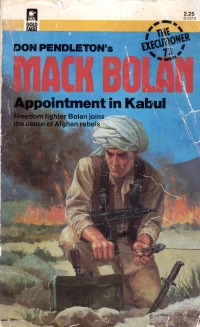
Book Report: Orbiting Omega by “Don Pendleton” (1984)

Book coverThis book has Mack Bolan teaming up with a KGB agent against his will as they try to find a scientist who has figured out a way to hack the US and USSR orbital nuclear weapons platforms. He, the scientist, demonstrates the satellite capture by firing and detonating nuclear weapons above Washington D.C. and Moscow–too high for an EMP effect, but enough to light the night sky as a warning.

As Bolan and the KGB agent close in, the scientist is betrayed by his head of security–a Japanese-American with a cadre of fellow Japanese-American National Guard-trained soldiers. This guy doesn’t want world peace–as the scientist did–he just wants money.

At any rate, another subpar entry in the series. And another book with nuclear weapons exploding in orbit (see also Lightning Fall. Personally, I’m starting to get concerned about this.

Buy My Books!
Buy John Donnelly's Gold Buy The Courtship of Barbara Holt Buy Coffee House Memories

Disagreeing with Brian J. Before the Internet

I recently made a trip to the Kansas City area, and my brother who is in Leavenworth gave me some effects from my sainted mother, including a number of publications in which I appeared in the 1990s and early part of the century. Although there weren’t many clips, they’re relatively impressive compared to my recent output (which has been frequently paid for, thank you, but only appears on Web sites which is still less impressive than in print).

One of the things I got was a stack of old newspaper columns. I’d had two newspaper columns in the past: A column you might remember, gentle reader, called “Opinion Shapers” which was a quarterly in the college paper, the Suburban Journals (you might have seen references to them in the past here, as they ran in 2008-2009).

The first, though, was for the college paper, the Marquette Tribune. It was a monthly column that rotated with four other students, two from the left and two from the right. Given that two of the other columns were called “The Traditional Conservative” and “The Right Perspective”, I think they put me on the left because I had long hair. But I was not to right from the left; my first real column lambasted a proposed required multicultural literacy class (and my second lampooned those who successfully agitated against the required class).

Back then, they did not have comments section on the Internet. Instead, they had to make due with an unsigned editorial column.

No such luck, anonymous scribbler.

Buy My Books!
Buy John Donnelly's Gold Buy The Courtship of Barbara Holt Buy Coffee House Memories

Book Report: Lightning Fall by Bill Quick (2014)

Book coverTo be honest, this book was an add-on purchase. I’d created a CreateSpace account and added it to the cart, but I never completed the checkout process–I probably balked at the price. But when I found The Ballad of Ethan Burns on CreateSpace and put it into my cart, I found Lightning Fall already in it, so I bought it, too. Why not?

This book is longish–over 600 pages–and it reads a lot like a Stephen King book in that there are many different people in many different settings sometimes coming together but mostly dealing on their own with the fallout of multiple major terrorist attacks on the US. An EMP weapon detonates off of the west coast, leaving much of the US past the Rockies without power. A nuclear weapon detonates at ground level in New Orleans, taking out the nation’s biggest port and rendering much of the delta uninhabitable for centuries. A Mexican ‘relief’ army activates some irregulars in the United States to target military and civilian power centers and then invades under pretense of helping. Although it looks like an Islamic attack, there might be Chinese elements behind the scenes. A Hillaryesque president worries more about the party and the politics of dealing with the crises rather than the United States or its citizens.

The various peoples involved include a gay couple trying to shelter in place in San Francisco; a single mother in Indiana trying to keep her children safe; a Tea Party activist and his new beau in the Midwest; a shrimper in Mississippi and his family; a television crew from Denver trying to make their way west to report from the scene; a gang leader in LA with contacts in various foreign powers; politicos in Washington, including the President, her husband, and the Congressional leadership; a couple of military men in Cheyenne Mountain; and various others.

The book jumps between the people, focusing a lot on the San Francisco couple. Unfortunately, it jumps between the action in the affected areas and then goes back to Washington, where it works on political manipulation and, well, politicking. It kills off one of the focal characters and the whole story line is abandoned. Many of the storylines don’t converge; most of the stuff from the Midwest is just “slice of life” stories as people start to cope with the breakdown of society in the aftermath, but they do not contribute to the book’s main plot lines.

So the 600 pages of the book comprises a bit of schizophrenia (Is it a political thriller? Is it a thriller thriller?) with a bunch of extraneous matter (and I hate the Stephen Kingesque “Set up a character with a backstory and texture just to kill them off because that’s like REAL LIFE, man” thing). AND it leads up to the thrilling sequel, American Caesar, which the book claims will be available in 2015 (although I cannot find it), which means nothing is resolved at the end of this book except the political stuff in Washington.

So I am of two minds about it. I didn’t like it that much–the concept was interesting, and some of the characters were compelling, but overall the bloat and the lack of copyediting (a lot of typos throughout and calling one character by the wrong name early) diminished the book greatly. But by the time I got to the end, I bothered to look for the sequel to add it to my CreateSpace cart just in case it would become an add-on purchase sometime in the future. But it wasn’t there.

So if you’re up for a Kingesque rambling mess that clearly is self-published, you might like the book.

Also, I’d like to give a shout-out to my cat who heightened the tension of the book by knocking the cord of the reading lamp out of the wall while I was reading a book about an EMP attack, plunging the room into darkness. That added a touch too much of realism to the proceedings. As though the book’s plot wasn’t almost plausible enough.

Buy My Books!
Buy John Donnelly's Gold Buy The Courtship of Barbara Holt Buy Coffee House Memories

What Should Be My Annual Halloween Post

Visit my post I Am Buck Rogers.

From 2004.

In hindsight, I said:

It would be the equivalent of dressing like Capt. Malcolm ‘Mal’ Reynolds from television’s Firefly—in 2007.

Clearly, I underestimated the multiplier of the Internet on geekery. I could dress up as Mal Reynolds in 2016, and people would know who I was.

Heck, I’d have to explain it less than my actual Hallowe’en costume from 2016:

I was Pokemon Go.

Buy My Books!
Buy John Donnelly's Gold Buy The Courtship of Barbara Holt Buy Coffee House Memories

It’s a NEW Feature

I’ve started to see this in my Twitter sidebar:

Funny, I thought there was a way to control what tweets I saw.

But that’s before Twitter decided what I really want to see is a stream of promoted tweets, items I might have missed out of chronological order, a list of people I might want to follow because Twitter thinks I should, and Tweets that people I follow liked.

I’ve thinned my Twitter usage a bunch. Partly because things have taken a political turn that I don’t enjoy and partly because Twitter keeps upping the noise ratio to the signal.

Buy My Books!
Buy John Donnelly's Gold Buy The Courtship of Barbara Holt Buy Coffee House Memories

Good Book Hunting, October 29, 2016: Friends of the Springfield-Greene County Book Sale

In addition to albums, I bought some books from the Better Books section. I focused mainly on art, local interest, and history because my child’s behavior was on a countdown timer.

Here’s what I got:

They include:

  • Two books by local attorney Dee Wampler, Defending Yourself Against Cops and One Nation Under God. Both are signed.
  • Two copies of the Medænas Monograph for Camille Pissarro. I thought I’d picked up copies for two different artists, but it turns out they’re the same. It would have helped if the cover had an image and the artist’s name like the one I just read for Rubens.
  • A collection of art by Hiroshage to ensure I don’t really care for Oriental art.
  • A collection of Raphael.
  • Tolstoy’s A Confession and Other Religious Writings.
  • More True Tales of Old Kansas, an anecdotal history of Kansas.
  • A Winston Churchill history of World War I, The World Crisis.
  • Swords Around the Throne, a history of Napoleon’s army.
  • Seven Years of Highly Defective People, a Dilbert book by Scott Adams. I don’t know if I already had this book, but I know I have to start re-buying them as my oldest child has started appropriating other Dilbert books.
  • The Presidents: Tidbits and Trivia.
  • Old Saint Louis Homes: The Stories They Tell.
  • A collection of Ozarks photographs called Backroads of the Ozarks
  • Cartooning with the Simpsons, a book about how to cartoon the Simpsons way. I bought it for the kids.

As you can see, I was focusing on books I can browse through football games and whatnot. A more disciplined approach than some days where I’ve come out of a book sale with 40 or 50 books, but apparently I now save that profligacy for record albums.

Buy My Books!
Buy John Donnelly's Gold Buy The Courtship of Barbara Holt Buy Coffee House Memories