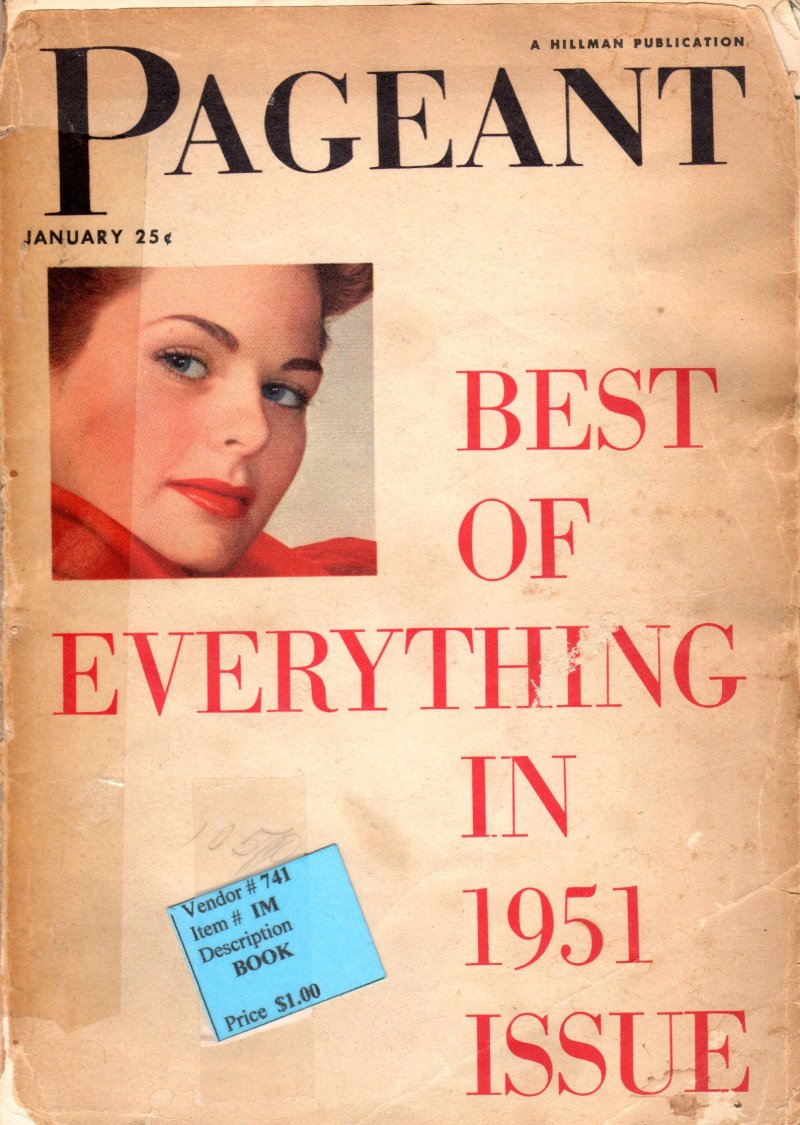
 This January 1952 issue of Pageant magazine is its Best of Everything 1951 issue. A time capsule into the immediate post-war world in a digest magazine that apparently sought to take on Reader’s Digest. It’s a general interest magazine, with not so much the high writing of the slicks nor the woman-focus of home magazines.
What’s inside?
- “2001 A.D.–Year’s Best Forecast”, a vision of what life would be like in 50 years. It’s off quite a bit, but it’s all-in for wind and solar power and down on nuclear, which is the state almost 70 years later.
- “She Gets Most Joy From Cooking”, wherein the author of The Joy of Cooking Irma Rombauer is named Woman of the year. Almost 70 years later, the cookbook is still known.
- “The Case of the Curious Cop”, a true crime story that’s interesting even now.
- “The Miracle of the Giants”, a baseball story.
- “The Men Around Truman”, profiles of some of the president’s advisors, many of whom are forgotten today.
- “The Birth of an Island”, a science story by Rachel Carson. Yes, that Rachel Carson.
Along with these articles, we’ve got fashion guides on how to buy items that you can wear or pair for different occasions; the best toys to by for each age group; beauty queens of different festivals; and varied humorous joke/quip collections like you would find in Reader’s Digest.
Along with a full photo of the cover girl on the back:
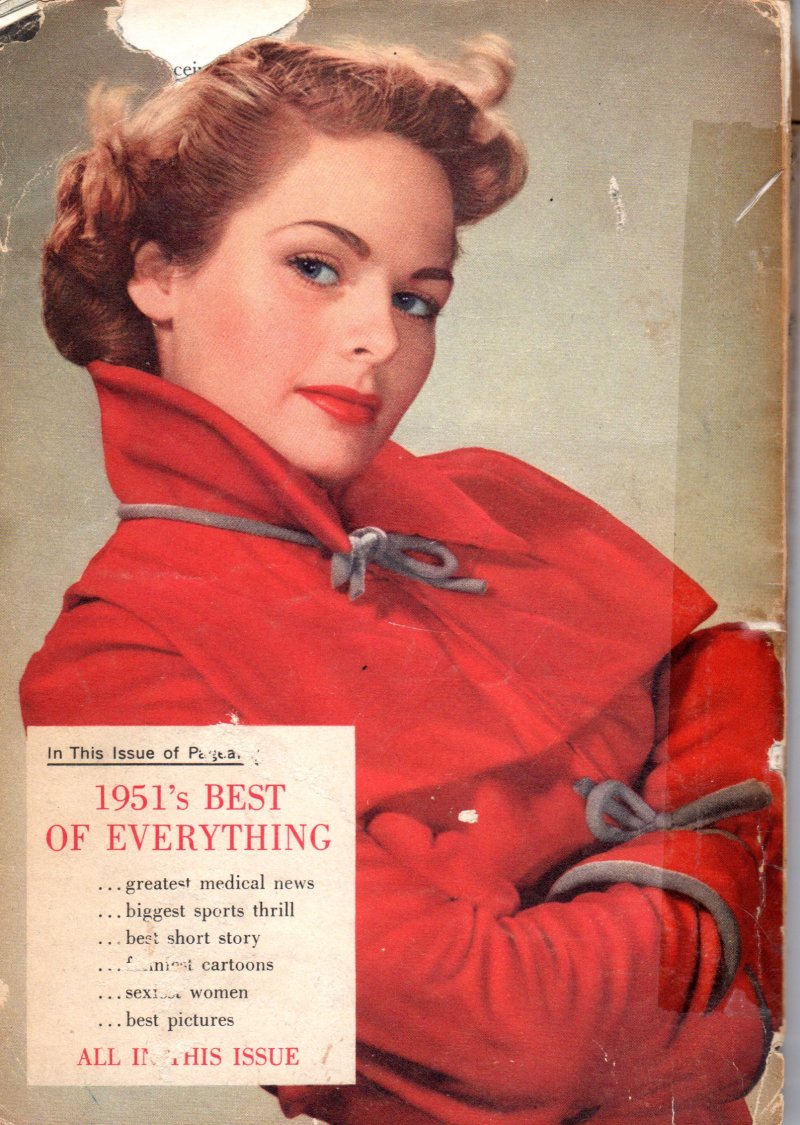
Cute, but not racy.
No left-wing bias to speak of–the magazine talks about the “pinkos” in government–but a couple of environmental pieces that foreshadow things to come. The “best science story” by Rachel Carson, for example, tells of how volcanic islands are formed and how different plant and animal species might come to it, and how great it is until MAN SHOWS UP.
You know, I miss general interest magazines like this. I subscribe to Reader’s Digest off and on, and I used to subscribe to The Saturday Evening Post and Grit, but those last two changed too much to retain my interest. But I must be the only one; otherwise, we would have more of them around today.
I wonder where I got this; the front cover has an antique mall sort of pricing on it, but I can’t imagine picking this up for a dollar at an antique mall. More likely, it was in a dollar bundle of digest magazines and chapbooks that I bought at a Friends of the Springfield-Greene Library book sale. These bundles, grab-bags really, provide me with quite a few curiousities that I sometimes count as books read. But not in this case, as it is clearly but a magazine.
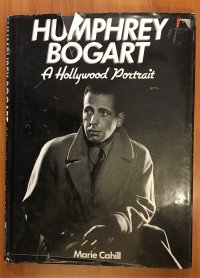 This is a coffee table book that presents a short biography of Humphrey Bogart, and then kind of steps through his career and filmography with promotional stills and perhaps some candid snaps, but probably less “candid” than posed behind the scenes shots.
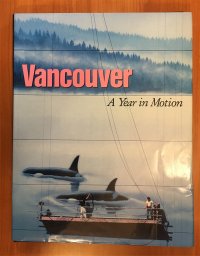 This is the official book of the Vancouver Centennial celebration in 1986, and its schtick is that a series of photographers went out to photograph the city in its centennial year. So it starts in January and runs through December and includes the building and running of the exposition that marks the centennial.
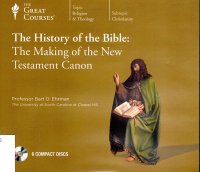 This course offers a history of how the books of the New Testament became the canon. I guess the title indicates that. But it’s not a straight ahead timeline of the conscious development of the New Testament. Instead, it’s more of a survey of different things to consider when looking at the history. It discusses the different types of literature in the New Testament, the Gospels, the epistles, and apocalyptic literature. It touches on apocrypha that did not make the final cut (and sometimes why). It talks about the creation of the written literature as the church evolved and needed a central repository of teachings to share among the scattered churches. It also talks about copying errors and whatnot and a touch of church history.
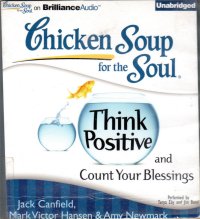 This audiobook is a collection of sort little essays about, well, counting your blessings and finding the bright side of things. It has eleven pieces by eleven authors. One of them is, literally, a woman who enumerates one hundred blessings, so it’s a couple minutes of sentence fragments.