Jesus Would Like To Have A Word With Ra

Every week, our church has a Children’s Bulletin with puzzles aligned with the message to preoccupy young people in the service.

This week, children were invited to help align the Stargate so Jesus could go free the Israelites from their slavery under the space-god Ra:

Well, that’s what it looks like to a certain kind of science fiction fan/fellow who always wanted to be more like James Spader.

I guess in reality, the children are supposed to skip to every something letter to spell out a bible verse.

Buy My Books!
Buy John Donnelly's Gold Buy The Courtship of Barbara Holt Buy Coffee House Memories

Dr. Johnson Not Cited

Internet hoaxers aren’t even trying any more.

An article on the Daily Mail (UK) Web site linked by Instapundit bears the headline Women DO judge men on their penis size: Researchers say it is ‘as important as a man’s height’.

However, one the Internet one should be skeptical of everything, especially those sourced like this:

Writing in the Proceedings of the National Academy of Sciences (a journal commonly known by its initials as PNAS), Brian Mautz, Bob Wong, Richard Peters and Michael Jennions use a clever experimental manipulation of computer-generated imagery – CGI – to test the effects of variation in penis size relative to height and torso shape (shoulder width relative to waist width) on the attractiveness of male bodies to women.

This cannot be real, can it?

I’ve looked at the universities listed with the authors, and only Richard Peters actually is at the place where it says he works (but he’s not in the Department of Zoology).

However, the study (and the news article) are three years old. So perhaps they moved on. If they ever existed.

You’re saying to yourself, Brian J. sure is working hard to discredit this study. Does it make him feel bad about himself?.

I’m not going to dignify that with a response.

Buy My Books!
Buy John Donnelly's Gold Buy The Courtship of Barbara Holt Buy Coffee House Memories

Old Timey Brian J.

Mr. Hill just celebrated 20 years of blogging. Me, I’ve only been at this stream for 13 years, but I’ve appeared online for almost twenty years myself.

Here are a couple of early bits elsewhere:

Role Playing Research in the newsletter of the Central Nebraska Writers Network.

Meeting Robert B. Parker at Bullets and Beer, a Spenser fan site from way back.

After almost 20 years of working on the Internet and blogging and whatnot, anyone who Googles me is going to find a lot of feldercarb out there.

Buy My Books!
Buy John Donnelly's Gold Buy The Courtship of Barbara Holt Buy Coffee House Memories

Amazon Conditioning Me Away From Amazon Prime Shipping

I’ve been kicking around the thought of ordering a DVD copy of Idiocracy for a while, so I’ve searched for it on Amazon a couple of times.

I see now that Amazon will ship it to me for free if I pay through the nose:

Thirty bucks for a DVD when it’s available on Amazon through third party shippers or on Walmart.com for a reasonable price:

What could account for that?

It fits my theory that Amazon is trying to get people used to paying for shipping again and will move Prime exclusively to a content deliver service.

Buy My Books!
Buy John Donnelly's Gold Buy The Courtship of Barbara Holt Buy Coffee House Memories

Book Report: Bad Publicity by Jeffrey Frank (2004)

Book coverI read Frank’s earlier novel The Columnist in 2005; some number of years later, I picked up this book at a book sale here in Springfield, and it will take me at least another decade before I read another Frank book.

This book is billed a satire (and the book flap even compares Frank to Jonathan Swift, a fact I didn’t know when I picked up the Frank book right after Gulliver’s Travels). However, I didn’t find much mirth in the book since it, like the earlier novel, lacks a sympathetic character. It describes a number of interconnected people in Washington in late 1987 and 1988 whose lives intertwine at the end of the Reagan presidency and what most assume will be the beginning of the Dukakis era.

There’s a former Pennsylvania congressman who lost his seat after divorcing his wife for his assistant. His marriage to the younger woman ends ugly even after he’s forced out of his post-Congress job after making some overtures/compliments to a young female attorney with the firm who presses for his discipline with the firm because she’s tired of men treating her as a sex object, although it’s not as bad as she makes it out to be in her own mind. She conspires with a man whose wife works with the local news anchor who is going insane to get the word out about the former congressman and to get him denied a position in the White House. The former congressman consults with an image management firm and gets assigned to a down-to-her-last-client chain-smoking publicist whose assistant happens to be working closely with the local anchor who is going insane. There’s also an academic at a think tank who’s not working on his book on social reform and who’s been supplanted on the scene by a new expert in his subject matter and, well. Washington people and The Columnist Brandon Sladder appears in all the coolest restaurants at all the best parties.

So these people do their silly things and conjugate in their silly ways, and there’s nobody really for someone outside the northeastern corridor to identify with (and hopefully nobody that most people in the business would really identify with either). I got the sense while reading it that Frank didn’t really like anyone he was writing about, either.

So I didn’t care for it. There’s no mirth for me in laughing with the cooler-than-thou kids at schmucks, even if they’re schmucks ruining the country.

Buy My Books!
Buy John Donnelly's Gold Buy The Courtship of Barbara Holt Buy Coffee House Memories

Book Report: Gulliver’s Travels by Jonathan Swift (1948)

Book coverI found this book to be very approachable and readable for something written 50 years before the Declaration of Independence; eventually, it dawned on me to check the title page. It’s part of the Young America Classics editions, which I don’t collect. To be clear: unlike Classics Club editions and Reader’s Digest editions, I only have one Young America Classics that I’m aware of. This means I have more Young Americans than Young America editions, and I’m fine with that.

Anyway, the title page doesn’t say it’s abridged, but it is Edited, with an Introduction, by May Lamberton Becker, which looks as though it means adapted by. The book collects three of Gulliver’s travels (to Lilliput, to Brobdingnab, and to Laputa, Balnibarbi, Luggnagg, Glubbdubdrib, and Japan. It omits the fourth, the Voyage to the Country of the Houyhnhnms for some reason. Perhaps this was a darker bit not suitable for Young America right after World War II.

I assume you know some of the story. Although, in the 21st century, perhaps that’s optimistic. Gulliver, a ship’s surgeon, is shipwrecked at various times and finds himself in a land of tiny people (Lilliput), of giant people (Brobdingnab), and a land of a floating island and strange academics (Laputa et al). The book is satire, almost 300 years later some of the elements of the satire is lost. For example, I’m not sure what elements Swift is making fun of in Lilliput, or whether he endorses or mocks the society of Lilliput where:

Whoever can there bring sufficient proof that he hath strictly observed the laws of his country for seventy-three moons hath a claim to certain privileges, according to his quality and condition of life, with a proportionate sum of money, out of a fund appropriated for that use; he likewise acquires the title of snilpall, or legal, which is added to his name but does not descend to his posterity. (p54)

I can’t tell here if he’s advocating what the contemporary left calls a living wage or if he’s making light of it.

Other lines seem completely relevant today. For example, Gulliver explains to the Brobdingnabian king how the government works in England, and the king there replies:

“My little friend Grildrig, you have made a most admirable panegyric upon your country; you have clearly proved that ignorance, idleness, and vice are the proper ingredients for a legislator; the laws are best explained, interpreted, and applied by those whose interests and abilities lie in perverting, confounding, and eluding them. I observe among you some lines of an institution, which, in its original, might have been tolerable, but these half-erased, and the rest wholly blurred and blotted by corruptions…”

In Lagado, Gulliver learns how everything went amok:

The sum of his discourse was this: That about forty years ago certain persons went up to Laputa, either upon business or diversion, and after five months’ continuance, came back with a very little smattering in mathematics, but full of volatile spirits acquired in that airy region. That these persons, upon their return, began to dislike that management of everything below, and fell into schemes of putting all arts, sciences, languages, and mechanics, upon a new foot. To this end they procured a royal patent for erecting an academy of projectors in Lagado; and the humor prevailed so strongly among the people, that there is not a town of any consequence in the kingdom without such an academy. In these colleges the professors contrive new rules and methods of agriculture and building, and new instruments and tools for all trades and manufactures; whereby, as they undertake, one man shall do the work of ten; a palace may be built in a week, of materials so durable as to last forever without repairing; all the fruits of the earth shall come to maturity at whatever season we think fit to choose, and increase an hundred-fold more than they do at present; with innumerable other happy proposals. The only inconvenience is, that none of these projects are yet brought to perfection; and, in the meantime, the whole country lies miserably waste, the houses in ruins, and the people without food or clothes. By all which, instead of being discouraged, they are fifty times more violently bent upon prosecuting their shcemes, driven equally by hope and despair: that, as for himself, being not of an enterprising spirit, he was content to go on in the old forms, to live in the houses his ancestors had built, and act as they did, in every part of life, without innovation. That some few other persons of quality and gentry had done the same, bute were looked on with an eye of contempt and ill-will, as enemies to art, ignorant, and ill commonwealth’s men, preferring their own ease and sloth before the general improvement of their country.

The third of these voyages seems the most readily accessible to modern audiences, especially if those people have already read Atlas Shrugged.

So it took me a while to get through it, but I enjoyed the book. I was ashamed to learn the source of the word Brobdingnabian; although I have an album by the Brobdingnabian Bards and run across the adjective from time to time in writing, I hadn’t really learned or retained its source. I have now.

Also, I learned a bit about the history of seafaring. Not so much because Gulliver travelled the seas; instead, it’s because he’s excited about the prospects of immortality when he learns of a group of immortals:

I should then see the discovery of longitude, the perpetual motion, the universal medicine, and many other great inventions brought to the utmost perfection!

Of those, we only got longitude, and not that long after this book appeared. It makes a lot more sense the conceit of a bunch of undiscovered lands when you realize that mariners for hundreds of years (by hundreds, I mean thousands, except I really only count the hundreds of years of Western voyaging out of site of land) could tell how far north and south they were, they had no real idea how far east and west they were. Whoa.

So it’s a good adventure story and classical literature, so I’m glad to have read it. I’m almost afraid to see what happens in the Jack Black movie based on it. Probably not as much satire as the original included, but I’ll understand the humor of crass 21st century better than the finer points of 18th century satire.

Buy My Books!
Buy John Donnelly's Gold Buy The Courtship of Barbara Holt Buy Coffee House Memories

Just to Clarify

Police: Man used handgun as hammer at Missouri school:

A man has been charged with unlawful use of a weapon and child endangerment after police say he used a handgun as a hammer while working on a project at a southeast Missouri elementary school.

The unlawful use is not because he used his gun as a hammer; it’s because he had it at the school:

(10) Carries a firearm, whether loaded or unloaded, or any other weapon readily capable of lethal use into any school, onto any school bus, or onto the premises of any function or activity sponsored or sanctioned by school officials or the district school board; or

So it doesn’t look like a violation to use it as a hammer. Or a decoration, which is cool, because I have a couple flintlocks on display here at Nogglestead.

Of course, in looking up the statute, I read the first section:

(1) Carries concealed upon or about his or her person a knife, a firearm, a blackjack or any other weapon readily capable of lethal use; or

Which means I’ll have to remember not to put my martial arts training weapons in my bag when conveying them to class. Otherwise, according to my reading of the law, I’d be breaking it.

Buy My Books!
Buy John Donnelly's Gold Buy The Courtship of Barbara Holt Buy Coffee House Memories

When Max Allan Collins Comes Around

I noticed a couple days back in my referrer logs that someone from Muscatine, Iowa reading the book report for Dead Street.

Muscatine, Iowa, as I learned when I was researching the book report, is the current home of Max Allan Collins, the author of Dead Street. So I was pretty sure it was the man himself.

Given that he linked the report on his blog today, I’d say I was correct.

Collins joins Diane Duane, author of the Star Trek novel My Enemy, My Ally and Joe Clifford Faust, author of A Death of Honor as people whom I can honestly include in the plural “you, gentle reader” in my continuing posts. Although in most cases it’s an honorary title. Given my blog traffic these days, plural is an honorary title when referring to my readers.

Also, it’s why although I’m not at Nick Hornby levels in positivity (as his book Ten Years in the Tub indicates, his magazine editors prefer he only have nice things to say about books he reviews), I try to keep snark to the minimum: because the authors are people, too. Besides, all of these people have sold far more books than I have.

Also also (which is my blog equivalent of P.P.S., which nobody uses any more), this is why I’m thinking about ending my book reports with boilerplate “It’s not as good as MY NOVEL!” Just to see if I can get any self-Googling real author to spend a buck on it.

Buy My Books!
Buy John Donnelly's Gold Buy The Courtship of Barbara Holt Buy Coffee House Memories

Book Report: Life in the Age of Charlemagne by Peter Munz (1971)

Book coverAs I just read The Carolingian Chronicles, when I saw this book on my shelves, I knew I had to read it next.

It seems almost magical that from my thousands of books, I can often find different books on the same topic if I get interested in it. However, that’s only because I tend to accumulate books in certain areas that I’m interested, and then when I get interested in them, I have a bunch to choose from. So it’s not magical, but I think it’s neat once I read a book and find a related book on the same topic.

This book, unlike Carolingian Chronicles and The Life of Charlemagne, is not a primary source; instead, it relies heavily on social anthropology to explain how these backwards people were. As such, you have to look at it as though it the prism of someone in the 1960s applying his or her own theories into the historical record. You get that with any history, of course, but in this case, the distance between then and then and then and now require a bit more distance.

Especially as this book is not narrative in nature; it does not tell the history from start-to-finish, year-to-year. Instead, the book takes different topical matters (The Rich, The Poor, Government, The Church, and so on) and then discusses that topic from a historical anthropological perspective about how they relate to one another. Here’s a hint: It was brutish for the poor and slightly less brutish for the rich. The book talks about the Christianity of the Franks, but repeatedly emphasizes that it was a cynical tool for controling the conquered people. It’s hard to get into the heads of contemporary people, and it’s probably impossible to get into the heads and hearts of people who lived over a thousand years ago, so contemporary–or fifty year old–attempts are suspect. Short of a handwritten diary, we really can’t know the interior motives.

Aside from that quibble, the book also has some repetitiveness that it should not. In a number of places, thoughts and even phrases are repeated to convey the same thing, sometimes mere paragraphs later.

So it was a quick read and reinforced some of the names and dates that I read earlier (I hope). I’ll have to sometime soon explore my stacks to see what else I have in this vein.

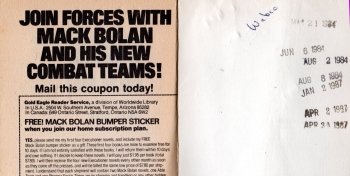
One side note about the book: The volume I have is an ex-library book from the Cor Jesu Academy in St. Louis, Missouri. It still has a card in the back, but the mylar dust jacket had a barcode on it. The card has stamps from 1980 to 1991. So the book itself might have resided there from about the time of my birth through at least my college years; when I was in high school, several girls my age borrowed this book to write reports. And now I’ve read it for fun and for a simple blog book report.

Buy My Books!
Buy John Donnelly's Gold Buy The Courtship of Barbara Holt Buy Coffee House Memories

Disposable Diapers A Fundamental Right

The White House wants to bridge the “diaper gap.”

A new plan announced Thursday aims to make diapers more affordable for low-income families. The initiative will give low-income families access to diapers that are up to 25% cheaper than the ones they currently buy. In a press call on Thursday, President Obama said the program was made possible through a collaboration with Jet.com, the makers of Cuties diapers and several non-profits.

You know what families without disposable income and, come to think of it, all families used to do? Use cloth diapers and wash them.

But that’s too icky in the 21st century, I suppose, for a populace accustomed to more and more government programs.

Of course, I’m a hypocrite for opposing this because my mother benefited from government programs and used cloth diapers on me and/or because I use some of my non-tax income to voluntarily buy diapers and accoutrements for people who need them.

Buy My Books!
Buy John Donnelly's Gold Buy The Courtship of Barbara Holt Buy Coffee House Memories

Book Report: Tuscany Terror by “Don Pendleton” (1983)

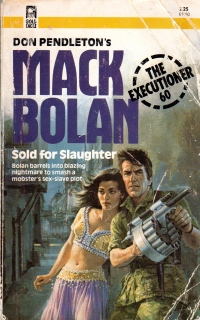
Book coverThis book is another post-Pendleton Mack Bolan volume. In it, Bolan has to go to Italy to rescue the wife and child of an Army officer from a terrorist group holding the hostages to get the officer to falsely confess to involvement with the Mafia.

Bolan goes and shoots up a bunch of stuff, and then he infiltrates some stuff. The book is a lesser entry than Vulture’s Vengeance, but it’s not bad.

Once or twice a year, I get the urge to plow through the unread books I have in this series (and there are 93 left on my to-read shelves according to this count) minus the two I’ve read since). Then I read a bunch of them in short order and realize how similar they are to each other. Apparently, three is my limit, so I’ll probably focus on reading other things for a bit.

And hope to live another thirty-some years to make it through my Mack Bolan library at this pace.

Buy My Books!
Buy John Donnelly's Gold Buy The Courtship of Barbara Holt Buy Coffee House Memories

Book Report: Ten Years in the Tub by Nick Hornby (2013)

Book coverI bought this book at Barnes and Noble via a gift card because I appreciated the topic matter: Hornby, the author of High Fidelity and About a Boy, writes a magazine column discussing the books that he has read every month. This volume collects ten years’ worth of those columns.

Hey, for about the same period, I’ve been jotting down my thoughts into the blog here. Since I bought five ISBNs when I published John Donnelly’s Gold. I thought about collecting them into a volume and calling it The Last 1000 Books I Read or something like that (as you can see, there are well over 1000 book reports).

However, after reading this book, I have discarded that idea.

I mean, my book reports here are more about what I’m thinking about than substantive book discussions. Hornby’s columns are similar–he writes a bit about what’s going on in his life as he’s reading. His columns are monthly roll-ups of what he’s read and a bunch of banter about the magazine (The Believer). But. Reading one of the columns once a month or so in a magazine is one thing, but hundreds of pages of them is another. The columns became more repetitive than they would monthly. I can’t imagine reading 1000 of my book reports in a row would appeal to anyone.

At any rate, over the ten year period covered by the book, Hornby and I only read one book in common: Then We Came To The End. Our tastes do not run in common. Hornby favors biographies of sports and entertainment stars, literary fiction, and young adult books. Me, I read a bit of this and that with emphases on history and genre fiction.

The real gauge of a book review or column is whether one wants to go out and get the book(s) mentioned. I thought a couple might have sounded interesting, but before I bought them or even wrote them down, I was into the next column and set of books. The only one I considered getting from the library is the Motley Crue bio The Dirt, and that is because the book misspells Naugle’s (Tacos) as Noggle, and I wanted to see it for myself.

So I’m kinda glad I read the book (over the course of months or years). And as obsessive as I am, I compiled a list comparing what Hornby reports on in the ten years versus the books I’ve read in those ten years. You can review the comparative list here. Spoiler alert: I read three times as many books as he mentions in his columns. On the other hand, I’ve written and sold far fewer books and traveled to far fewer places than Hornby, so I guess we’re even.

Buy My Books!
Buy John Donnelly's Gold Buy The Courtship of Barbara Holt Buy Coffee House Memories

A Tale of Two Bills

Missouri Democrats stall religious objections measure

Filibuster to block anti-gay wedding measure drags into 16th hour in Missouri Senate

No, just kidding. It’s the same thing but reported on by two different news outlets in two different cities.

At issue: Whether the state can compel you as an individual person who owns a business to serve members of a protected class.

People without shoes and shirts are not a protected class, so until they unite, you can continue to deny them service. Maybe.

Buy My Books!
Buy John Donnelly's Gold Buy The Courtship of Barbara Holt Buy Coffee House Memories

Book Report: How to Live Like A Lord Without Really Trying by Shepherd Mead (1964)

Book coverThis book is the follow-up to Mead’s How to Succeed in Business Without Trying. You might have heard that title because it was turned into a Broadway show that was recently revived.

Based on that success, Mead was able to move to Europe. In this book, he talks about moving to post-war England for business and plays upon the differences between America and England. It’s much more amusing if you’re old enough to get mid-century jokes and concerns. I’m not sure you could just watch Mad Men and get it.

It’s an amusing book, but it’s from another time. Here’s a gag in the section about England’s quaint socialized medicine:

However, it is only fair to warn you that in England you will be living under socialized medicine, and every American knows how dangerous that can be.

Forty years later, every American is going to learn how dangerous that will be, and we won’t have to travel abroad to get it.

Here’s a gag that’s even funnier forty years later:

The “British language” you have been hearing on televsion in the States is not really spoken anywhere. This is a special tongue known as Mid-Atlantic, designed to “sound British” to Americans, and still be understood. The British can understand it, too. They think it is a kind of funny American, and wonder why Robin Hood should talk like a Yank.

Given Kevin Costner’s turn as Robin Hood, there are many Americans who think it’s funny that Robin Hood sounded American.

At any rate, it’s an amusing book. If you’re old enough, I suppose.

Buy My Books!
Buy John Donnelly's Gold Buy The Courtship of Barbara Holt Buy Coffee House Memories

Book Report: Vulture’s Vengeance by “Don Pendleton” (1983)

Book coverThis book is a pretty good entry in the series. Perhaps I’m far enough away from reading a bunch of them in a row (Doomsday Disciples notwithstanding) that I’m not overwhelmed by the similarity of the plot (woman in distress, Bolan must penetrate hard sites).

In this particular case, Vietnam veterans are being–kidnapped? and used as forced labor/mercenaries by a Central American warlord who kills a popular ambassador and kidnaps the wife who is a popular spokesperson for human rights. The warlord rigs a plane and stages what looks to be an attack on the White House with an unpiloted plane carrying the woman, but after Bolan averts the crisis, it turns out that she’s still a captive in his Nicouraguan lair. Which Bolan must then attack to get the bad guys out.

The story is an eighties product all the way: The Uzi is an unstoppable killing machine, and the Harrier jump jet is all that. Funny thing is that one of the bits has Bolan downing a jet with an Uzi, and I would have thought that utterly preposterous–except that earlier in the week, I’d heard the story of Owen J. Baggett who purportedly shot down a Zero in World War II with his handgun while parachuting from a disabled bomber. So forty-three years after this book came out, I was primed to get the allusion / homage that the author of the Bolan book was making. And it made the Bolan action seem less preposterous than it could have.

Except then Bolan shoots down a couple of attack helicopters with a handgun. So.

At any rate, I’m mellowing on these post-Pendleton books because I’m starting to consider them the equivalent of episodic television. I mean, the plots are the same, the characters the same, and the bad guys just about interchangeable–but I’m enjoying them as light reading while I’m reading them.

Unfortunately, that’s going to mean my measuring stick for these things is going to be whether than they’re better or worse than the ones I read immediately preceding them. If you’re not into these kinds of books, this won’t be the one to make you a fan.

Buy My Books!
Buy John Donnelly's Gold Buy The Courtship of Barbara Holt Buy Coffee House Memories