Has the whole pink for breast cancer awareness thing run its course? I’m seeing remarkably less pink in the wild this month.
I was going to say something last week, but I thought I might be ahead of myself in making the assertion, but we’ve seen a weekend of NFL football without a pile of pink on the field. My martial arts school has, in the past, pushed pink belts and even, if I recall, pink gis, but this year it’s just decals.
Huh. Perhaps everyone is aware now, and the charities that existed to take in money, pay themselves, and raise awareness are finding themselves with tighter budgets.
You know, I used to be young and cynical back when I was more idealistic.
This book is an ex-library book from some unstated library that I picked up this spring at the Friends of the Springfield-Greene County Library book sale. I called it a comic art monograph, but it might be more akin to a self-published sketch book that I tend to avoid buying at local cons.
So, about the artist. He’s local, as I determine by the inclusion of posters advertising music shows in downtown Springfield. The book include some completed comic art that has the fully realized 3D modeling that’s unlike more cartoon-centric art like Rook City or Duel! as well as some other art, some digitally generated, that looks like it could fit into video games. The book also includes some sketches to show the preliminary work before the finished product.
An interesting browse during a football game, to be sure.
I felt a little bad for my children. My varied musical tastes pretty much outflank any genre of music that they could discover and try to play really loud to shock the parents.
Heavy metal? Come on. They tell me to turn it down.
Rap? I have Eminem on the playlist. And they think the Beastie Boys are dinosaur music.
Jazz/Big Band/Swing? We remember what happened at the art museum.
Country? They were stunned when they discovered I was familiar with country and western music, and we’ve got a preset on the car radios for a country and western station. And Dad knows all the tunes.
The Jack music (is that even the name anymore?) that is the greatest hits of the 80s, 90s, and today? Between an extensive collection of cassettes and CDs, Dad knows all the songs on the radio stations’ abbreviated playlists and most of them on the weekly reprise of Casey Kasem’s American Top 40 from the 1980s.
Electronica and dance music? Dad just bought a CD’s worth of songs by The Fat Rat, and their beautiful mom used to compose EDM.
Hip hop? I guess they could flank me here, as I don’t care for much of it, but I do have enough R&B to perhaps keep them away.
But you know what they found to annoy me?
Seventies folk music.
Apparently, inclusion in the video game Fallout 76 has revitalized John Denver’s “Take Me Home, Country Roads” and it now appears on the playlist at hockey arenas and whatnot.
Wait a minute, Brian J., don’t you own Their Greatest Hits Volume 1 by The Eagles? Well, yes, but they’re a band with California folk sound. I don’t know why the guy and a guitar folk rankles me so much.
What about all those Linda Ronstadt and Olivia Newton-John albums you own? True, and you could also bring up the Lynda Carter album as well. What do these have in common? Beautiful women who sing.
So the boys have discovered my beautiful wife’s John Denver albums and play them on the record player every morning and evening.
If they discover her Dan Fogelberg albums, I don’t know what I’ll do. Perhaps blow out my ears listening to heavy metal too loud on ear buds all the quicker, I suppose.
I left them such a small gap. And they exploited it.
This book is a short biographical sketch and literary history of the early science fiction author who wrote The Time Machine, The Island of Dr. Moreau, The War of the Worlds, and others.
He made his bank on those early science fiction works and then turned his attention to serious novels, often with autobiographical undertones, and his two volume The Outline of History which I have around here somewhere.
However, he is not known for those books except for The Outline of History, and the latter mostly because it was often the free books given away by book clubs to new members. His themes moved more to the political, and in the between war years and after World War II, that didn’t play well in Yorkshire much less Peoria.
Regardless, he was prolific and an active writer until his death in 1946, but you will be forgiven if you think him a contemporary of Jules Verne, who died in 1905. Most of H.G. Wells’ best known works come from the turn of the century, too.
You know, these little short books about various authors were quite a thing back in the middle part of the last century. I’ve got a bunch of short bio-and-literary-criticism ex-library books from various series tucked away in narrow gaps and in the back crannies of the Nogglestead library. I should consider blowing through a bunch of them to pad my annual reading numbers. However, since this is the 92nd book in my log for this year, I should probably save that gambit for another year where I bog myself down in heavy classical literature more than I have this year.
In July, Rip Torn passed away, leading to a post here entitled Know Your Rips, in which I said “Only one of them is R.I.P. now, and strangely, it’s Rip Torn, who was the older of the two, although Rip Taylor seemed old in the 1980s.”
I guess a new animated film of The Addams Family is coming out. Now that I’m watching football, baseball, and hockey on the television, I see more advertisements these days. And, apparently, my youngest son saw an episode of the television show in school last week, for some reason, and he asked me if I’d seen it. I had, but The Munsters played more in syndication in Milwaukee, so I’ve seen more of them.
This book is a novelization of the 1991 (!) film adaptation that starred Raul Julia, Anjelica Huston, Christopher Lloyd, and Christina Ricci. You know, I’ve seen both this film and its 1993 sequel, and although I remember the basics of the plots, I don’t remember the movies that clearly. So I can’t compare the book to its cinema execution.
But the plot is that the wacky macabre Addams family still yearns for missing Uncle Fester, who disappeared a long time ago. When the Addams family attorney falls behind on payments to a loan shark and con artist and her son, they hatch a plan to insert the son into the family as the long-lost uncle until such time as he can steal the family’s wealth from their hidden vault. Only it turns out that the son fits in too well with the family and might be the real Fester.
This, too, is a kid’s book (as was Lassie Come-Home published by Scholastic, so clearly, I am really trying to pad my annual book reading total.
Actually, what happened was I was looking for a particular book on one particular shelf, and I found a couple of quick reads while I continue my search for this particular book. And, as I mentioned, my son brought up The Addams Family recently, which made it seem a timely choice.
I mean, I signed us up for the Panther Run for what would have been our fourth year in a row. But a late addition to my boys’ cross country schedule of actual cross country meets this year (instead of the Panther Run and other 5Ks) meant we were going to be in Joplin, an hour away, instead of on the Drury University campus.
Still, on Friday night, we went to pick up the packets and shirts anyway.
As we picked them up, several volunteers thanked us for coming to run with them, and I murmured a response that was not untruthful. Then, as I was leaving, my triathlon coach, who also works with the timing company for the event, asked if we all were going to run it, and I admitted to him that I was a fraud. I wasn’t going to run it, but I was going to pick up the shirts.
But I won’t wear mine. Although the Panther Run provides nice long sleeved shirts with moisture-wicking fabric and although my t-shirt wardrobe is about 60% 5Ks and triathlons (and only 20% Green Bay Packers), I won’t wear a 5K shirt if I haven’t actually run the race.
It’s happened before. Last year, we picked up our packets for the Sole Purpose Run on Friday evening, and our youngest took violently ill all Friday night, so none of us were in any shape to be awake much less run a race at 7am. So my shirt went into the donation pile immediately.
Other times, we have signed up for 5Ks but not run them. We signed up for one in Joplin in January the year before last, but race time temperatures were in the single digits. Another time, an ice storm might have made it too slick, so we stayed home, only to discover from the event pictures that the course was pretty clear (and the ice storm kept a lot of runners away, so I might well have medalled with my normal 3.1 mile time).
At any rate, the cross country season is over, and I’m hoping we can sign up for one or two 5Ks yet this year. I’m hoping I can get to the gym a little better early in the mornings and rebuild some running endurance so I can make a good show of it. And to start preparing for next year’s triathlons which could very well begin in February.
I don’t know if I should count this as a “classic” or high literature in my annual self-accounting, as it is simply a story about a boy and his dog. Sort of. But it’s a classic, sort of, and it certainly spawned a number of movies and television shows so much that you can still say “What’s that girl? Timmy’s fallen in the well?” and people will get the allusion even though the television show has been off the air for, what, forty years?
At any rate, no Timmy in the well in this book. Here, a proud Yorkshire family raises a good dog, Lassie, that makes them proud, and the people in hard times are proud of their dogs. But times get harder, and the father sells the dog to the local aristrocrat. The dog escapes and meets the boy at the schoolhouse just like every day, and the family takes her in, but the local kennel master thinks the whole thing is a con akin to Jerry Reed’s “The Bird”. So the aristocrat takes to dog to his estate in the Scottish Highlands, and the dog bides its time until it can escape and travel south to meet with its family again.
The bulk of the book is in the journey and the adventures, such as they are, that Lassie has on the way. No children are actually imperiled by wells, but the dog gets into fights and meets a nice old couple that takes care of her for a time, but she is driven to return.
It’s a kids book, I guess, and a relatively quick read. And, just maybe, a classic. Borderline.
As I mentioned when I read Gahr and Seth Wolfhorndl’s Rook City comic, I hoped I would like Gahr’s fiction as well–as I bought a couple of his fiction collections at LibraryCon this year.
Well, I liked the book.
It’s a collection of science fiction short stories. Some of them are very short indeed–a couple of pages, which means they’re coming it at under 1000 words. So flash fiction. The plots are imaginative, but the execution is a little unsophisticated at times. The prose lacks any flourish, even the flourish of austerity. But, you know what? Who cares? Did I mention the plots are imaginative? And the stories are not woke parables, which I understand is a problem in some modern sci fi.
So I’ll pick up his other collection, Random Fantasies by and by. I see I actually bought a couple of other books from him, so I’ll probably jump into them before long as well. Because simple with good plots beats complex, character-driven pieces with poor plots or pacing.
This “monograph” is more of a marketing piece for the (former) Steuben Glass, which was part of Corning that made and sold high-end hand-blown glass objects as well as created pieces for museums to promote the consumer glass.
The text tells the history of the company as well as the techniques of hand glass blowing. We can see an example of this every time we go to Silver Dollar City, and I have some objects that a friend made when he took a glass blowing class twenty or so years ago, so I understand the craftsmanship involved.
A lot of the pieces within, and not just the museum pieces, are flawless and beautiful works of glass that you can maybe use when the company comes. At the tail end of the depression and in the immediate war years, they must have been expensive status-provers.
But now you can go into Walmart and get something possibly not as beautiful, but attractive and cheap. I explained this to my son yesterday as I was looking at the book. The march of technology and progress continues bringing things that were luxuries into the reach of people working real jobs.
Amazing.
As this is an ex-library book from the Springfield Art Museum, we can judge its relative popularity by the last stamp on its checkout papers in the back cover. In this case, 7/27/99.
You know, the front material on these monographs tends to be of two varieties. One offers biographical information. The second offers critical interpretation of the artist’s work and what it means and why it’s important. I’d like to generalize and say that the more famous the artist is, the more likely the monograph will have the first type of introduction. You know, they’re famous because their art meant something. However, that’s a bit misleading, as the Rodin monograph definitely leaned to the critical. As does this book, which covers the career of an artist who worked in line drawing and painting in the 18th century.
He’s mostly known today as an illustrator who did editions of Shakespeare, Milton, and Dante. But the short critical piece at the outset says he’s an important transitional figure between the Age of Enlightenment and the Age of Romanticism.
But, basically, it’s the equivalent of comic book art from the 1700s. The best pieces (aka the ones I liked the best) were the line illustrations, but only a few of the paintings were in color, so they probably lost a little in that translation into black and white. The paintings are a bit of Rubens or Raphael but blended with the Chiascurro of Rembrandt. But without the latter’s heroism or dignity.
So, yeah, unheard of but perhaps important to art critics. And not likely to have one of his prints grace the walls of Nogglestead soon.
As this is an ex-library book from the Springfield Art Museum, we can judge its relative popularity by the last stamp on its checkout papers in the back cover. In this case, 2/17/89, but it was overdue and a notice was sent on 2/25/89.
Last weekend, St. Cloud resident Heather Lovell was standing along the St. Francis Franny Flyer 5K route in Sartell.
She was waiting for her 9-year-old son Kade to pass by.
When Lovell didn’t see Kade when she expected to, she thought he might just be having a bad race.
Then a few other kids — whom she knew were slower than Kade — passed by. Still no Kade.
Lovell’s mother then drove the 5K race route. Still no Kade.
Lovell started to worry that he had gotten lost or injured — or worse.
“I had everyone looking for him, even a fireman. I was like, ‘You need to go find my son,'” Lovell said. “I was bawling. This had never happened before.”
Our youngest got to be fast enough that he ran by himself at about that age, and before he really learned to pay attention to cars and other moving things.
So far, so good, though.
He does want to run a 10K sometime soon, and I might join him. But this year, he’s been running in cross country meets, which are shorter distances. And I’ve not gotten the exercise I like to get for, oh, a year (notice no “What’s on Brian’s iPod at the Gym” posts lately?). So no 10K for us this year.
Unless it’s an accident.
(Link via Neatorama, but not John Farrier, who used to come around here.)
This is a short course from the Modern Scholar series that focuses on myths and stories from the Middle Ages and how true they are. The four discs / eight lectures cover:
King Arthur
The Holy Grail
Pope Joan
Witches and Inquisitors
Chastity Belts and The Droit du Seigneur
Robin Hood
The Flat Earth
The Shroud of Turin
Not to spoil it, but basically, it boils down to there might have been a kernel of a real person for King Arthur and Robin Hood, but the stories have outrun the truth (print the legend!). A number of stories (Pope Joan, Inquisitors, the Droit du Seigneur, Flat Earth) were invented after the fact to reflect poorly on the past. As to the Shroud of Turin, who knows?
The author goes back to original sources and earliest mentions to try to get to the germ of each, and he does a pretty good job at a high, summary level or presenting the material. I enjoyed it, and it was only four hours which meant I could finish it on the recent drive up north.
This book collects some commentary on primary Buddhist texts by an early 20th century Nipponphile. R.H. Blyth was born in London and moved to Japan prior to World War II. He was locked up for the duration of it, but continued to live in Japan afterwords. He became quite the scholar in Buddhism and whatnot.
The book takes an excerpt from some Buddhist text, whether it’s a poem or a complete parable, and Blyth comments on it, making it more palatable or comprehensible to Western readers. He ties some of the tenets and lessons to Christian teachings to illustrate how some of the concepts align, but dealing with the primary sources really highlights some of the ways the ontology of Buddhism is a little hard to swallow at times.
You know, I might have said this before, but the Buddhism and Yoga purists rail against lightweight Mindfullness industry even though the authors and speakers who talk about embracing and focusing on the present instead of embracing the Eastern religion in toto might be distilling the best part of the religions kind of like non-denominational churches focusing on the gospel instead of the law. These provide practical blueprints for living, and we Americans are practical people in the aggregate. After all, we invented Pragmatism, did we not?
So this book lies a little more Buddhist than even some of the writings of Shunryu Suzuki or Hanh. Perhaps more akin to the Talmud where these other writings are akin to the epistles of Paul. That is, this book is commentary on the ontology, and those others are commentary on the message.
Or maybe I’m just making this all up. I don’t know if I’m really clever or really daft. Or if these are mutually exclusive.
Over the weekend, I drove up to St. Charles to visit my aunt. Powered by Gummy Worms and bottled tea and audio courses, I made the trip on Friday night and stayed at the Tru by Hilton at the streets of St. Charles based on a mention Charles made not long before he passed away. Although he was complimentary about his stay, I didn’t think much of the place. The room was smaller than a Hampton Inn, with just a bed, a table over a small refrigerator, a rolling table the size of a hospital table, and a rolling chair jammed next to the bed. The other table spaces were a couple inches of shelving attached to the wall. The whole thing seemed to be designed to resemble a dormitory–the common spaces were brighter and designed for working/hanging out, complete with coffee all night and a pool table. But the Streets of St. Charles Tru was more expensive than the place Charles stayed–and was likely more expensive than the Hampton Inn–so I’ll probably not stay at the chain again, opting for Hampton Inn for lesser stays and actual Hilton Hiltons for the more luxe stays.
I did get the best room in the joint, though:
“311” is my favorite Hiroshima song.
I thought I’d mention it to the clerk at check-in, but the song was older than she was by at least a decade.
The Streets of Saint Charles is a rather recent development in St. Charles. It’s a New Urbanist style block that has a couple of hotels, some apartments, dining, and shops. I might have liked to have lived in that sort of place when I was young, because it’s like a city without the dangers of living in a real city. A city for suburban kids. When I lived in the city, I lived in the city.
I had some dinner at one of the restaurants, and I dumbfounded myself with remembering that I once lived in St. Charles. I mean, I knew remembered it, but it was weird being there and grokking the knowledge.
It was for about a year and a half, when we first moved to the St. Louis area. We lived in my aunt’s basement whilst I was in sixth grade and part of seventh grade. I thought of my aunt and uncle as rich, but it turns out that they were simply middle class and struggling a bit. I would have mentioned to the server at the restaurant that I used to live in a mile or so away, but it was before she was born.
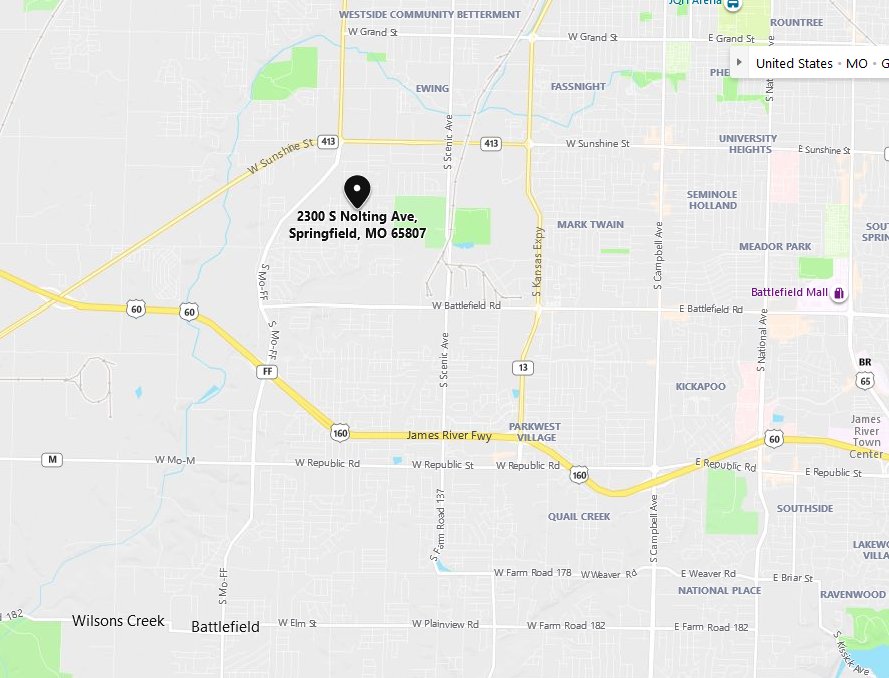
On Saturday, I got up a little early and hoped to hit the hotel’s “fitness center,” but the two treadmills and single weight bench were already full, so I went for a run/walk up to that house where I lived in St. Charles. My rich aunt and uncle’s house.
Which is a 1200 square foot ranch house. Smaller than any house I’ve owned.
It has three bedrooms, one bathroom (and a half, as I recall), a living room, and a kitchen/dining room upstairs. They refinished the basement while I lived there, which meant painting the walls and putting down a thin layer of carpeting, so that my mother, brother, and I could live down there for a while.
Thirty-five years ago. The neighborhood completely changed, of course–when we were there, it wasn’t much of a neighborhood. There was a small subdivision (suitable for trick-or-treating), but it was forests and farmlands from there to the river.
Now, it’s all subdivisions. The road has been widened into a boulevard with sidewalks on each side wherever subdivisions went in, and the houses in the subdivisions all have more than five rooms. There’s an arena down the road and a Tru by Hilton.
It’s not the house that built me–by that time, we transitioned from the projects to this house to the trailer to the house down the gravel road in the valley so fast that I don’t have a place where I grew up aside from the transitions. But it is a stop on the way.
And when I returned to school after college, I never really wanted or aspired to live in St. Charles, even when I was working in a print shop a couple suburbs west.
I’m losing the people who knew me, and the places I once knew are changing beyond recognition. Is it any wonder I cling to the personal relics so tightly?
So I was at the dentist today, and the piped in music was a collection of easy listening hits no doubt designed to soothe the nerves of people who don’t like the dentist. For me, it was a pleasant playlist as it contained a number of songs I don’t generally hear on the radio these days.
Including one by Jackson Browne whose name I could not fully remember. I remember the “Stay” part, but I could not remember the first part of the title.
I thought on it for a while, and then I got the pocket computer out and looked it up.
It’s “The Load-Out/Stay”.
Which is not what I would have I remembered had I remembered it. When I’d heard its name on the radio some decades ago, before pocket computers, I heard “The Low Down/Stay”. So for years I’d not known the real name of the song and only now am I prepared properly should this come up on a Trivia Night.
Which I hope it does. But by that time, I will have confused myself as to which it really is, and it’s a coin flip whether I get remember the title right when it matters.
You might remember, gentle reader, that my house is completely done in Impressionism, with maybe a dozen prints of Renoir on the walls along with a Monet print (and the other classic print is a Rembrandt). But what about the sculpture? The only classic sculpture we have is a small rendition of Rodin’s The Kiss because it was a souvenir from the Milwaukee Art Museum which has a plaster cast of it, and this small rendition of it has been in the family for probably almost fifty years–I remember it on the shelves in the apartment in the projects. So I was really hoping to like Rodin (which I am pretty sure I pronounce like Rodan because, although I like to pretend otherwise, I am an uncultured clown).
At any rate, this book: Oh, my.
You know how I like to comment on the balance of text to work in these sorts of books (monographs and photography collections)? This one is completely unbalanced in favor of the text. The text is not biographical; it’s more self-indulgent art criticism (redundant, I know) that explains how Rodin was to sculpture what the Impressionists were to painting. However, the text makes it sound like Rodin is the sculptural equivalent of the Jigsaw killer. Every incomplete figure is a gruesome dismemberment by the sadistic sculptor. I mean, the prose is pretty purple over and over in this regard. And then there’s a dash of Marxist class struggle, which Rodin’s work really, really advances. Death to the Bourgeoisie!
So, yeah, not worth reading. But I just bought the book for the pictures.
And I have a new favorite Rodin piece: The Eternal Spring/Eternal Springtime. But I probably won’t be getting a cast of it any time soon as Nogglestead does not have a lot of horizontal surfaces for sculpture.
And I learned that Rodin worked for a couple years in a factory designing vases and cups, so Rodin was decorating common household goods not unlike the people who worked on Painted Treasures. Rodin also illustrated an edition of Les Fleurs du Mal, known in English as The Flowers of Evil. The last would come in handy on a trivia night if only the trivia window had not shifted to the 1990s.
At any rate, I find that it’s not so easy to flip through these books during football games any more. I’m not sure if my attention spans continue to shrink or if football games have been shortened. Perhaps both. Perhaps the books I’ve picked up of late are particularly wordy in the text. Regardless, I have a couple more queued up and might get a chance to get a couple more at the library book sales this autumn.
We had a couple of minutes to kill before the school fundraiser began at Chick-Fil-A this evening, so we stopped by a couple of nearby thrift stores.
I found a couple records at the Salvation Army thrift store, and I got a real deal as the clerk rang them up incorrectly and then let me have them for that price. Basically, all of the following were $2.
I got:
Eydie Gorme, With All My Heart. Any day that yields a new Eydie Gorme record is a very good day indeed.
The Virtuoso Trumpet, a collection of classical trumpet pieces mostly to please my wife, the most beautiful trumpeter in the world.
Nat King Cole Sings The Great Songs! Strangely enough, although we have many Nat King Cole records, he doesn’t get the play he deserves on the turntables of Nogglestead.
Dionne Warwick In The Valley of the Dolls. She was not actually in the film, but on this record she sings the theme from it along with some other Bacharach songs.
Satin Affair by the George Shearing Quartet. The cover is not as saucy as Latin Escapade, but I’m coming to like the sound of the music, too.
Herb Alpert & The Tijuana Brass Greatest Hits. I’m pretty sure I already have this, but I have bought it for a handful of change in case I do not or as a backup.
Lucille Starr The French Song. It’s an A&M record. I saw a couple copies of Claudine Longet’s The Look of Love as well. Hopefully, I will like this artist better.
Not bad for two dollars.
Although I need to get to building a new set of record shelves. And perhaps an annex to Nogglestead.
You know, I always thought that the one reader who might appreciate these posts, aside from the future me going back through the years, was Charles Hill. I’ll think of him every time I post one.
I bought this book earlier this year when I went to a book signing at ABC Books and made my way to the poetry section in addition to the martial arts and football books. I picked it up to browse during football games, but I ended up just reading it as I do so many books that I plan to browse.
So this book is a collection of poems by a woman of some success–her work has appeared in literary journals I’ve heard of. The poems are modern and a bit self-indulgent, which led me to wonder about modern poetry: Is it more about the poet telling his or her story and making you sympathize or empathize with him or her more than it is about using an incident to create a resonant moment within the reader? Because a lot of poems seem more about the poet’s expressing himself or herself more than anything else.
As in this book.
The poet recounts the end of a relationship with a modern sensibility, and her life experience does not resonate with mine, and her poems don’t evoke anything in me as a reader. As a matter of fact, certain elements create a conscious distance, and they express something, but it’s not necessarily good poetry.
Of course, she’s an award-winning poet with poems in journals whose names I recognize, whilst I am an almost double-digit selling poet whose works have pseudonymously appeared in zines like Monkey Spank. So perhaps being a successful poet is more about one point of view over the other, which is mine.