I feed my children McDonald’s Happy Meals on occasion. I hesitate to confess on the Internet because in England, this might be grounds for forcible removal of the children from the family. But there it is.
I also pride myself on being a knowledgeable sort of father, one who can answer most any question in a greater detail than a kindergartner or preschooler can actually retain. It’s important to do so to keep up the illusion of omniscience as long as possible.
Happy Meal toys, the little trinkets that come in with the chicken nuggets and apple dippers with white milk to drink (thereby mitigating, somewhat, the dietary destruction of McDonald’s), have been pretty good to me in this regard. Most of them recently have been rehashings of things from my own youth, so I can give great detail.
Transformers? I can explain some elements of the originals (except for why Megatron transformed into a gun and Soundwave transformed into a boombox with full-sized other transformers somehow shrunken to cassette size). I can even speak to the film series a bit, engaging in the modern controversies. (Bumblebee was a Volkswagen, dammit. What, do you think Greedo shot first, too?)
Marvel superheroes? I can speak at length about Captain America, Spiderman, Iron Man, and Avengers story lines. D.C. Superheroes? Go ask your mother.
Smurfs? Yeah, I can talk about the origins of the mythos from records to cartoons to the creation of Smurfette. I’ve known this stuff longer than I’ve had a college degree.
Some of the toys were pleasantly non-specific and non-mythos-centric. (Yes, when discussing varied story lines and toy universes, I do use the term mythos with my children. These are traditional stories passed down between generations now, ainna?)
Some of the toys are archetypal. If it’s a little animal, I know it’s from the latest environmental propopanda piece du juor, and the plucky animals are the heroes and the men or the animals in favor of civilization are the villains. They never make the toys out of villains for these sorts of films, as they want children to identify with the cute animals.
Oh, and Star Wars. Every couple of months, something new from Star Wars, trying to get the children hyped up on the new going concern, the Clone Wars, a series so ethically muddled that the storm troopers are the good guys, Anakin Skywalker is a hero, and at the end of the series, Anakin Skywalker is going to kill all his allies. Seriously, how can you not root for the freakin’ Hutts to rub him out at some point? Regardless, I know a lot about the overarching stories if not the specific Clone Wars adventures. I’m less clear why they built ships with the cockpit on the top, set way on the back. Because in space, too much visibility of the enemy might drive you mad or something. Or George Lucas is a tool.
But now, out of nowhere, we have a toy from some mythos of which I have no knowledge: Ben 10 Ultimate Alien.
I can’t suss it out. The name doesn’t tip anything of its story. The toy is some child embedded in a larger translucent monster or alien. Did the boy turn into that? Did the monster eat the child? Is this particular translucent alien/monster a good guy? I just don’t know.
Way to make me feel forty, McDonald’s. Now that you’ve reminded me I have to watch my diet, I’ll have to cut out the fast food for my children and me. How does that suit you?
And now, to distract my children, I will once again how them the introduction to Scooby Doo from 1970:
A recent link on the StLToday.com Web site, the Internet home of the St. Louis Post-Dispatch, recently placed some Springfield news in the “St. Louis” news section with the tag “METRO”. That is, Springfield is part of the St. Louis metropolitan area:
As much as the largest metropolitan area and its declining city center might like to think that the rest of the state is just an extension of itself (and a touch for taxpayer-funded public/private partnerships), the rest of us are looking for the opt-out link.
This Lysol 4-in-1 Foaming Bathroom Cleaner should be tagged with With Real Police Shooting Action! Jeez, every time I pulled the trigger on the pump, it shot out a stream of foam that ricocheted and splattered so that for every spot of foam I got on target on the surface to clean, I got a half dozen spots of foam on the surrounding surfaces, including the ceiling and floor. No matter how I tried to angle the bottle or the distance from the surface, and I was a couple sound effects out of a Western where the mildew is the hero and I’m the outlaw. I searched the Lysol Web site so I could show you the exact product I’m talking about, but it’s gone. Apparently, I’m not the only one concerned about scattering caustic chemicals willy-nilly to save the world from some evil modern equivalents of chlorofluorocarbons (just as evil as CFCs! Ban them next!).
Wait a minute, you mean that shower door isn’t frosted glass? I have thought since we lived here that the door was frosted glass. An incomplete splatter-pattern of cleaning chemicals later, and I’m looking out of my shower. Did the previous owner sell us a house with a dirty shower door? Well, in all honesty, I’d do it to someone else. Especially as dirty as this proved to be.
Dammit, woman, I’m a man! How am I supposed to know the difference between a bath loofah and a toilet brush?
I missed a book in the series, as the last Executioner book I read was #20, New Orleans Knockout. However, when one misses a book in the series, it’s not like missing an episode in the serial. Although I might miss a couple references to prior characters, it doesn’t completely hang upon what happened then.
This book sends Mack Bolan to Hawaii, where he encounters some recurring characters and they get together to bust up not just a mob plot, but a plot from a Red Chinese general, possibly rogue, who is using a secret volcano lair for ill. Strangely, though, the hit on the lair doesn’t play out like a secret agent novel would; instead, it’s a pretty straightforward assault, and a bit anti-climactic as a climax for the novel. So it’s not one of the better ones in the series, or I wasn’t in a proper appreciative mood.
That said, the novel is noteworthy for the number of times it refers to a karate wraparound or a terrycloth karate wraparound. Kung fu movies were emerging in the culture, but I guess the word gi had not made it across the pacific just yet.
When we first moved into Nogglestead, I placed a child lock on the fireplace in our family room:
That’s kind of funny, now that I think about it. I’ve only opened the fireplace once myself. The home inspector opened it when the chimney guy was evaluating it, and I peeked in at that time. Then I popped the child lock on it when we moved in.
The only time I opened it was last winter when we were under the threat of the Great Blizzard of 2010, which threatened the Ozarks with any combination of ice, snow, winds, and calamity that would turn off our heater and would make us rely on the fireplace.
To open it, you don’t pull it; you have to actually turn one of the handles ninety degrees, something that’s a little easier when the metal hasn’t mostly frozen in years of little use. That is, it wasn’t easy.
That being said, it took me almost a year from the time I opened the fireplace and put in the Duraflame log that I expected to keep my family warm for 10 days of subzero temperatures to actually remove the pointless child lock.
As my mother used to say, “I don’t like to rush into anything.”
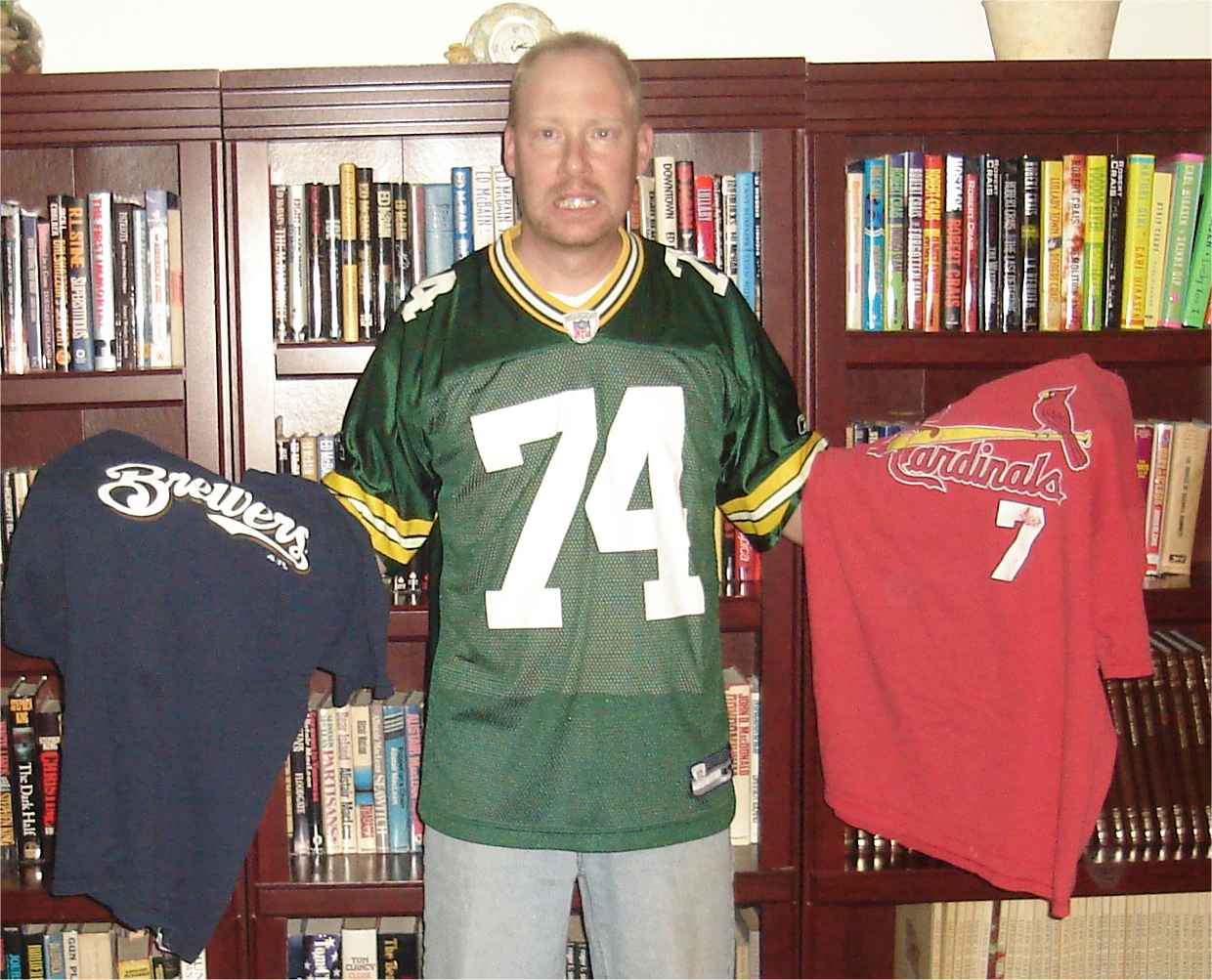
Now that the Milwaukee Brewers are poised to make the run to their first world title and my fanmeleon colors are changing from Cardinals red to Brewers blue, I hearken back to the year 1982, when the Brew Crew reached the World Series for the first and only time (so far). I was a wee lad living in the Berryland housing project with a freshly divorced single parent from St. Louis, and the Brewers played the Cardinals. My mother had a plastic baseball bat that she used to beat on the walls of the townhome style apartment to let the neighbors on either side know when the Cardinals scored. A couple years later, and I was a freshly minted Cardinals fan thanks to relocation and the St. Louis Post-Dispatch re-education program where the paper gave out free tickets to Cardinals games to students who got As in school.
For some reason, today I got to thinking about the lineups for the 1982 World Series, and I can give almost a complete recounting of the position players for both teams. Check it out:
Brewers
Cardinals
Catcher:
Simmons
Porter
First Base:
Cooper
Hernandez
Second Base:
Garner
Herr
Shortstop:
Molitor
O. Smith
Third:
Yount
Outfield:
Thomas Oglive
L. Smith McGee
Pitchers:
Vukovich Caldwell Haas McClure Fingers*
* did not play due to injury, sadly.
That’s off the top of my head. Not bad. Actually, it’s better than I could do remembering the 2006 Cardinals who won the World Series. I could also take stabs at the lineups to the 1985 and 1987 World Series Cardinals teams, but some of the years will blur and blend since I followed the Cardinals so well.
How did I do?
For the Brewers, I misspelled Jim Gantner’s name, although I could picture him in my head. I also forgot poor Charlie Moore and transposed Yount and Molitor’s positions.
For the Cardinals, I forgot Oberkfell and Hendrick; both were gone by the time I got to St. Louis. I couldn’t name for sure the pitchers, although many of them carried on into the years of my fandom.
I guess it stuck with me because it was such a snapshot moment. I’ve followed the Cardinals off and on for 25 years or so, so I have certain eras where the players overlap, come up, get traded, and so on. But 1982, because I was young, because it was a big deal, and because I would soon move and follow another team, is set pretty tightly in my memory.
And before you ask, of course I still have the baseball cards from the era, including the special ones given out by Milwaukee police officers to prove to urban youth that the cops aren’t scary. I am a 27th Level Pack Rat, after all.
UPDATE: What, you unbelievers ask me to prove it? Here’s the 1982 Team Card:
Brothers and Sisters, not only am I a Level 27 Pack Rat, but I’ve been a pack rat for more than two decades already. By the time you experience “Ultra Hoarders in 3-D” via Mynd.Net in 2021, I will be on its all-star list by age fifty.
Also, I gotta say, having a +2 House of Holding rocks. Not only can I keep all this worthless junk, but I can put my hands onto items within minutes.
Given that the local school district has removed this book from its school library and curriculum and seeing as I’ve defended the school board’s right to do so and have taken issue with use of the word “ban” to describe the school board’s actions (see this and here). Since I already owned the book, it seemed a topical time to read it. And…. meh.
It’s a novel about a writer writing about his experiences in Dresden during the firebombing in World War II. That’s the frame story: a writer has produced this book and has dealt with his compatriot who was also there. Then, there’s the text of the novel, where a survivor of Dresden has come unstuck in time and goes back and forth between the past and the present and who was kidnapped by aliens and kept in a zoo for a number of years on their planet, where he copulated with a porn actress. This novel-inside-the-novel was a successful optometrist until he started expressing his belief in the extraterrestrials, who can see things in the fourth dimension and to whom all moments are equally present or some such, through newspaper letters to the editor and appearances on late-night radio. So maybe he’s going crazy instead of it being a science fiction book. Also, the writer of the novel inserts himself into the novel by pointing himself out when the narrator of the novel-inside-the-novel meets him.
So I can see why this was popular on campuses: it’s a messed up novel that has the play-within-the-play thing going on, an anti-war message at the time of an unpopular war, and enough oblique things open to interpretation to make smooth sledding for students or tenure-track scholars who need to publish. That’s not to say it’s unentertaining and a lightweight read. It is. But I’m unsold on its presence on any list of serious literature. No doubt I did not enjoy it as its previous owner, Mr. J. Tobacco.
As I would have noted if I could comment on his site conveniently, Springfield actually has two of the crazy things. I’ve been through both of them (the aforementioned one is on the way to Bolivar, which strangely enough rhymes with Tolliver in Missoureese) and this one is on the south side of town nearer where I live:
All roads leading into that roundabout have speed limits of 50 miles per hour.
Frankly, I think some traffic engineer in southwest Missouri is burnishing his portfolio so he can get a job doing some traffic engineering somewhere else.
I got this book relatively recently and dived into it as I thought it would be a quick, episodic read. Well, it was quicker than I thought; of the book’s 190 page heft, only 165 of it are the book itself; the rest are footnotes, index, and whatnot.
The book expands upon an essay, and it shows. Separated into chapters covering conservativism’s rise in talk radio, the blogosphere, new publishers, and on college campuses, the book reads like a series of blog entries where footnotes replace hyperlinks. It’s audience is not the readers of blogs, per se, as most of the information within it is well known to people who have followed blogs for years. Instead, it’s geared to those who read books and newspapers.
In 2011, it’s an interesting time capsule. Its semi-triumphalist tone is kind of amusing given the events of the 2006 and 2008 elections which proved that conservative values were not as widely ascendent as they seemed. Also, the book provides a time capsule of the blogosphere in 2004-2005. Remember when Andrew Sullivan and Charles Johnson were conservative stalwarts? Good times, good times. Also, the book refers to a blog called “2blowhards” which I don’t think I’d heard of, but the author must have read it plenty. The book shows how much changes and how much has remained the same.
I dunno. It’s an okay book, I suppose. A bit stretched to fit book size and, as I said, a bit dated and a bit redundant if you read blogs.
So I was reading that taxpayers in Chesterfield (or people who pay taxes in Chesterfield because they shop there) are funding a dog park:
Folks hounding Chesterfield officials over the years for a dog park finally have a reason to howl in celebration.
The $118,000, two-acre Eberwein Dog Park, the first dog park in the city, is set to open to Chesterfield residents on Sept. 1. The dog park is within the new 18-acre Eberwein Park.
And I got to thinking, how else could the few who own dogs further soak the taxpaying public? And then it hit me: Public, compulsory dog school.
Listen, when you argue with a liberal about public schooling, he will say that it’s best for a civilized society as a whole if its citizens are educated in a mass-produced Procrustean factory of leftist indoctrination (well, he will say all of it up to the prepositional phrase). Then, if you show him this chart:
He’ll say something about how the increased funding raises minorities scores or something, not caring that the math indicates that a whole lot of scores have to go down to make a flat average when the mythical increase of minority scores. But that’s neither here nor there.
By that reasoning, compulsory obedience school for dogs makes a better society. Better-behaved dogs don’t bite, increasing safety. Better-behaved dogs don’t run into traffic, increasing safety. Frisbee-trained dogs provide entertainment and exercise, getting children out of the house and away from the Wii, increasing fitness and combating childhood obesity. Ergo, the government should fund dog obedience schools to indirectly improve society.
And if the costs are astronomical and rising compared to the benefit? That’s what quantitative easing is for. QED.
This book collects a number of news photographs from the century and a half in question. Some were Pulitzer Prize winners, but there are quite a few that I don’t recognize, and more importantly, there are quite a few that I would recognize that are not included herein. So maybe it’s really the best news photos of the period to which the producers of a coffeetable book could get cheap reproduction rights.
That said, each photo has an accompanying couple of paragraphs to explain the context. As though we need context. I’m no history major, but I know what the St. Valentine’s Day Massacre was and what the Triangle Shirtwaist Fire was. Okay, I did not know who Billy Sunday was, and although I’ve missed the answer on at least one trivia night, I have to continue to repeat to myself to remember that Gertrude Ederle was the first woman to… to… dammit!
At any rate, it’s definitely worth a flip through during a football or baseball game.
The latest mailer from Ducks Unlimited, of which I’m an off and on member, tested me. And I failed.
There’s a dotted line and a perforation, but the instruction is Do not detach. Apparently, in addition to a renewal form, there’s a letter to my Congressman telling him not to cut federal funding for wetlands.
Come to think of it, that’s a test Ducks Unlimited failed. I’m all about sending my money of my own volition to them to pool money with like-minded people to conserve wetlands. Meanwhile, I guess its professionals have decided that the proper way to spend my membership dues is to lobby Congress to extract money from non-like-minded citizens to do the work Ducks Unlimited should do.
Come to think of it, this membership form is going in the trash.
Given that the Heinlein quotes are making their ways around the Internet courtesy Instapundit (see here and here), I thought I’d pick this book up. Well, I did.
It started out as a pretty good spacer yarn. It revolves around Lazarus Long, previously seen in Methuselah’s Children, which I read as part of The Past Through Tomorrow, as he gets “rejuvenated” 2000 years from now after he’s lived those 2000 years and has run out of things to do. As part of his therapy, he tells stories about his adventures. For about 200 pages, it was cool, but then it got to be a little tedious. There were allusions at a greater plot at work, but that was played out in dribs and drabs. Then, he gets rejuvenated and leads a group from the planet Secundus, the planet where he was rejuvenated and that is becoming a bit stale culturally and politically, to Tertius, where they build the Heinleinian free love commune.
Around that time, where the action switches to the free love commune, the book bogs way down. The first half of each chapter explains how awesome free love and polyamory are, and then we get a couple pages of plot development. Unfortunately, the plot develops that Long travels into the past and then falls in love with his own mother, so we then get about 50 pages of them trying to couple in 1917, and when the attempts at coupling fails, we get 50 pages of them talking dirty to each other. Hey, I’m not a prude, but this stuff made me squicky given 1)It’s a science fiction novel, and 2)It’s his mother.
So, frankly, the book doesn’t hold together very well. It meanders a lot, of course, since it’s kind of a collection of short stories with an overarching plot, sort of. When I was reading this book, I was comparing it a bit to Atlas Shrugged as maybe a collected statement of the author’s philosophy, and I was comparing Heinlein’s plotting skills unfavorably to Rand’s, for crying out loud. Then there are the explicit details of the philosophy, which include a lot of sex, lots of women asking for Long to impregnate them, approval of sex with your own clones, and twisting the head of a fully born baby if it had Down’s syndrome.
Um, yeah. The philosophy expressed within has its good points, as the Instapundit quotes capture and as the Notebooks of Lazarus Long (two sections in the book with bullet points and no narrative, later published independently). However, there’s more to Heinlein’s view of life than that, and it makes this conservative say, “Ew.”
But the man can write some interesting science fiction amid the unclothed rubdowns.
I said I was going to start reading comic books to make my quota this year. Almost. This is a book of maps and is a just a couple crayons short of being a coloring book.
The maps center on the Mediterranean and each map depicts, in chronological order, different elements and aspects of history, such as the extent of empires and whatnot. It’s a good reference to how the Assyrians rubbed against the Babylonians and whatnot. Emphasis is given to Greek and Roman historical concerns, so you get to see different parts of those periods, including things like where the mints where, what regions produced different products, and what part of the world select individuals hailed from. It’s interesting to me how many of the major writers and thinkers actually hailed from the region we now call Spain.
The other thing that struck me was how small the world was then, at least this portion of them. You know about the Greek city states kinda in your mind, but they’re just names and whatnot until you see them (again) on a map and realize that Athens and Sparta were about 100 miles apart, about the distance between Springfield, Missouri, and Rolla, Missouri, and that Athens and Thebes is half that. Fascinating. Sure, you can say, “Duh!” But it’s there in black and white which is a stark reminder of common knowledge you sometimes don’t acutely know.
So it’s a good reference book to have on my shelves for when I’m doing deep studies of history instead of ceaselessly scanning the Internet headlines for something to blog about. And something quick and easy to look at to make your quota.
The book itself is a 1948 edition, and the article-as-bookmark was about a third of the way into the book, part way through Life with Father, Day’s best known work and the one that earned his keep and became a Broadway show.
The article details how the General Adjustment Bureau handled claims swiftly after the Texas City Disaster and how it overcame challenges in logistics, staffing up its office–a converted liquor store–in Texas City, and how it housed people as well as how it conducted its insurance adjustment business.
General Adjustment Bureau was not an insurance agency; instead, it was an organization commissioned by insurance agencies that did not want to spend on claims adjusters of their own. Instead, they hired General Adjustment Bureau to do that field work and paid for the service out of premiums.
General Adjustment Bureau is still in business, although through the divisions parted out of the GAB Robins company in the end of 2010 and beginning of 2011.
The article originally appeared in The Rotarian, the magazine of the Rotary club.
See what you can learn from these abandoned bookmarks?
Find out what I thought of the book The Best of Clarence Day.)