I check out the crime stories that mention places I’ve lived to see if I know the alleged perpetrators. Hey, it happens; once I saw the name and picture of the kid who sat behind me in 8th grade Civics class with Mrs. Padgett, but he wasn’t a kid anymore.
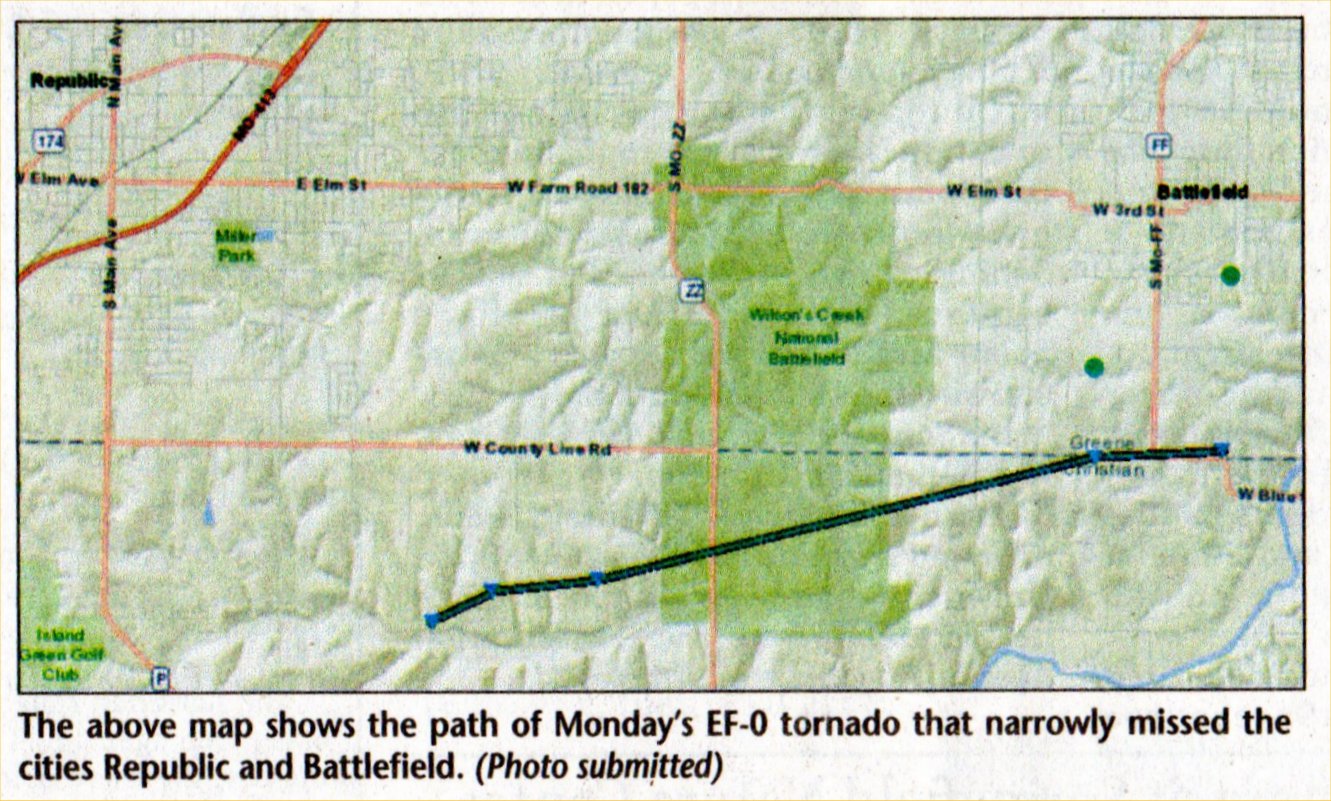
In the new neighborhood, I check the news stories to see how close tornadoes came to Nogglestead.
I defy you to find a track record of any type that is twenty-three years old—nutrition and training are now far, far superior, and athletes are shattering times from that long ago on a daily basis.
Ivory Crockett still holds the world record in the 100 Yard Dash:
In 1974, he ran the fastest 100-yard dash with manual timing of 9.0 seconds, a record he still holds. This was deemed at the time by the Los Angeles Times as “Immortality in 9 Seconds Flat”, and he was quickly tagged with the title the world’s fastest man by Track and Field News who put him on their June 1974 cover.
Sometime after he set the record, probably as part of the global conversion to the metric system, the powers that be eliminated that particular event from the Track and Field canon. So Ivory Crockett’s record will stand forever.
I actually just told the story of Ivory Crockett again to my children as we were in Old Trees on Sunday, and we passed under the banners for the Ivory Crockett 5K and fun run which had been the day before. So it was fresh in my mind. Not that this particular fact is very far from mind.
UPDATE: Sorry, I originally attributed this to Jack, but it was Bark M. posting over there. I have updated the attribution above and would vow to pay more attention to post authors, but, come on, we all know I won’t.
Ms. K. has a blog post about Durable Characters in commercials, and she cites Flo from Progressive Insurance and Mayhem from State Farm who have been in ads for a decade (although Mayhem had a hiatus if I recall, and I should, as I consider Mayhem to be one of my professional heroes).
I see her Flo and raise her the Sonic Guys who have been doing commercials for Sonic since 2002 almost continuously and Jack in the Box, who has been in Jack in the Box commercials since the middle 1990s through, what, 2017 (according to the Jack in the Box Fandom wiki)?
1994:
I have to wonder how those actors and comedians feel to know that their most famous work comes from thirty second spots over the course of decades. Hopefully happy for the steady work.
So I’ve been reading the Ogden Nash poetry collection that’s been spotted on a book accumulation point, and I carried it to church in St. Louis this week. I read a couple, and I took a break to read the Ace of Spades HQ Book Thread and then to read the Ogden Nash Wikipedia entry, when suddenly I encountered information that should have been accompanied by the dramatic sound of a needle stopping on a record.
Ogden Nash wrote the lyrics for the jazz standard “Speak Low“.
Say what?
You mean the song performed by the lovely Sacha Boutros?
No way.
Way.
Apparently, Ogden Nash wrote part of a Broadway musical, One Touch of Venus, in which this song originated. And it’s the only thing anyone remembers from it, no doubt. The song has been covered by singers from Sammy Davis, Jr., to Steve Lawrence (but not, as far as I can tell, Eydie Gorme).
You know, my estimation of the man is elevated to a degree I cannot express with your primitive Earthen mathematical symbols and concepts.
The second of the books I bought last weekend is a bit deeper than the first (Mother Goose in the Ozarks). I think this counts as Literature, ainna? Hesse won the Nobel Prize for literature, so all signs indicate yes.
The book covers the journey of an Indian? Nepalese? son of nobility who wants wisdom, so he leaves his family and joins a group of ascetics with a friend. When the ascetics encounter the Buddha–the Siddhartha of the title is not, as it turns out, that guy–the friend joins the Buddhist movement, and Siddhartha goes to town where he encounters a courtesan whose beauty is described in detail and I can only assume foretold Morena Baccarin (who played a courtesan/companion in Firefuly, do I have to inline cite my allusions? Yes, if I want to stay out of trouble with my beautiful wife who might wonder why I brought Morena Baccarin into this discussion out of nowhere). Siddhartha wants her to teach him of love, but she points out that she likes nice things and he’s an ascetic, so he becomes a merchant, dissipates a bit, and then tires of that life and becomes a ferry man where, by listening to the river, he becomes wise. The courtesan becomes a Buddhist, and as she is traveling to pay her respects to the dying Buddha, she comes to the river but dies, leaving Siddhartha with the charge of his son Siddhartha. The willful, formerly pampered boy rankles under his father’s simple lifestyle and runs away. The title Siddartha thinks of searching for him but lets him go.
So I did read it, and I remember the plot better than I do the plots of most Executioner novels I read, certainly.
At any rate, it reads a little like an Existentialist novel in reverse (see The Fall for example.) The narrator comes from a position of comfort but has a bit of mental disquiet as he hungers for wisdom pursuing knowledge. A series of events occur leading him to question everything, and he finds peace. Existentialist novels start from a sense of peace where things shatter that peace and lead to a new understanding. Or maybe it’s exactly like an Existentialist novel. I certainly put it in the genre as I read it, but the Wikipedia entry argues that it’s really a Buddist novel.
Or perhaps they’re very close to one another, Buddhism and Existentialism.
No, that’s not it. In this book, Siddhartha has been taught that reality is an illusion, and he learns instead about the unity of all. In Sartre’s Nausea, the protagonist learns that reality is an illusion. So, yes, backwards.
At any rate, a quick and engaging read. The volume I have does not say who the translator is, but the prose is very lyrical, with lots of prepositional phrases. Which, sadly, is how I’ve found myself writing these days. And I don’t have a translator to credit or blame for it.
So perhaps I’ll find Steppenwolf somehwere and pick it up, too.
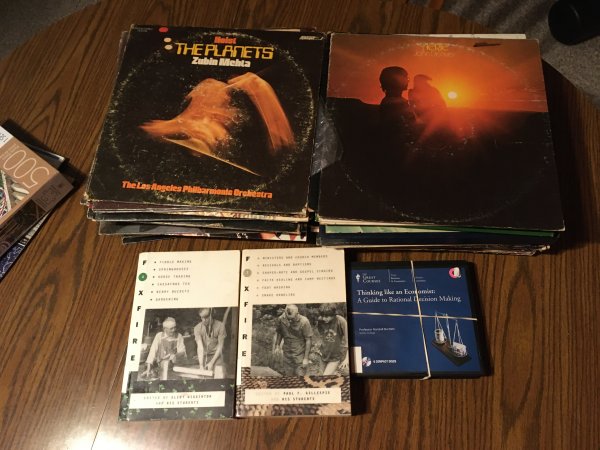
Yesterday, I took the boys up north to the Ozark Empire Fairgrounds to attend the Friends of the Springfield-Greene County Library book sale where I predicted I would gorge on $1 record albums.
Which proved truer than I thought.
I bought a bunch.
I got:
KC and the Sunshine Band by KC and the Sunshine Band. Our Halloween trunk for the church trunk or treat is going to be disco-themed, and it’s a real shame we can’t put a record player back there to play all the disco records I suddenly have.
Greatest Hits Volume 2 by Dean Martin.
Soulin’ by Lou Rawls.
Golden Classics by Ace Cannon.
Song of Joy by Captain & Tennille.
Ibert/Glazounov/Villa-Labob on Nonesuch Records. My bored son joined me as I flipped through the last dozen or so record crates, so I narrated what I was looking at to keep him amused. “Look, it’s almost your grandmother’s name,” I said. “Her last name,” he replied.
Piano Sonoata No. 1 by Noel Lee on Nonesuch Records. “I might be the biggest Nonesuch Records collector in Springfield,” I told him. He was unimpressed.
Let It Be Now by Helen Schneider. I bought it because the woman on the cover is pretty.
Contact by the Pointer Sisters.
Special Things by the Pointer Sisters.
Chess which I thought was some symphonic production because it features the London Symphony Orchestra. Turns out it’s a musical, a genre heavily represented at the book sale. I had told my son I did not buy musicals, but when I found another edition of this album which clearly proved it was a musical, I asked him if he thought less of me; he did not. Which might mean he doesn’t think much of me already. He certainly didn’t care for me taking a long time looking through records.
Remember by Peaches and Herb. “Who can resist Peaches and Herb?” I asked. “I could resist Peaches. I could resist Herb. But Peaches and Herb? Impossible!”
Equinox by Sergio Mendes and Brasil ’66. “It probably has ‘Mais Que Nada’ on it. Most Sergio Mendes and Brasil ’66 albums do.” I didn’t recognize the cover, so I got it, but thinking on it now, this might be the Brasil ’66 album that I already have but in the wrong sleeve.
Carolyn Hester by Carolyn Hester. I should just have a notation like PWC that indicates I bought it because the cover has a pretty woman. Looks to be guitar, as the PW on the C has a guitar and the first song is “House of the Rising Son” which Drew tried very hard to teach me to play on guitar, but I never got smooth at changing chords in time.
Shandi Sinnamon by Shandi Sinnamon. PWC in a fedora.
Gloria Loren by Gloria Loren. PWC.
Steve and Eydie At the Movies by Steve Lawrence and Eydie Gorme. I already own this one, but the cover on this LP is better than the one I have. I bought it in the Better Books section and paid $2 for it.
Three pieces by Glazunov; apparently, I also bought something by this composer on the Nonesuch record listed above, but it’s spelled differently.
5 Concerti for Diverse Instruments by Vivaldi on Nonesuch Records.
The Planets by Holst. My beautiful wife likes this symphony, and I wasn’t sure if we have it on record, so I splurged the dollar.
Carmina Burana for when we need an epic start to the morning.
Greatest Hits by Captain and Tennille. Apparently, I’ve been saying it wrong for years, inserting a definite article before Captain.
The Chase is On by Carol Chase. PWC.
Rufusized by Rufus featuring Chaka Khan. I just read they’re nominees for the Rock and Roll Hall of Fame this year.
The Renaissance Lute but not on Nonesuch Records. It’s something up their alley, but this is Duetsche Grammophon Musikfest.
Never Alone by Amy Grant. My beautiful wife likes her, so I threw it in the stack, hoping the “It’s for you” would mitigate any damage my bonanza would cause in our relationship.
Honey and Other Hits, one of those mid-60s compilations. PWC.
Her Latest and Greatest Spicy Saucy Songs by Sophie Tucker. I think I read about her in Funny Ladies.
Tito Schipa Sings Neopolitan Songs. I like foreign language records.
Madrigals and Motets. Also not a Nonesuch Record.
Sweet Bird by Lani Hall. You know, I don’t remember ever seeing another Lani Hall album in the wild. Were they not good sellers in this corner of Missouri?
Mountain Fiddler by U.S. Senator Robert Byrd. No kidding. It has a picture of him in his Senate office with a violin on the cover.
Cornelius Brothers and Sister Rose by Cornelius Brothers and Sister Rose. Looks to be 70 funk or R&B. I hope.
One Enchanted Evening by the Three Sons.
Golden Rainbow Steve Lawrence and Eydie Gorme. I told my son it was a musical, but I made an exception because of Eydie Gorme.
Sonatas for Flute and Piano in C Major and G Major by Haydn on Nonesuch Records.
Choral Songs of the Romantic Era on Nonesuch Records.
House of Music by T.S. Monk. Looks to be R&B. I hope.
Ethel Smith by Ethel Smith. PWC with an organ.
Robert Schumann on Nonesuch Records.
Sins of My Old Age by Gioacchino Rossini on Nonesuch Records.
Hot Together by The Pointer Sisters.
Love Lost by The Four Freshmen. I have a lot of albums by the Four Freshmen, but we cannot overlook the PWC.
Cool Water and Seventeen Timeless Western Favorites by the Sons of the Pioneers. I already have a copy of this album somewhere, but I couldn’t find it last Christmas, so I picked up another.
Selections by Francis Poulenc on Nonesuch Records.
Music Box, a compilation album from A&M Records. I think I already own it, but I spent $1 on this copy just in case.
Aerie by John Denver because I love my boys more than I disdain their musical tastes.
SHAFT-Music from the Soundtrack by Isaac Hayes. I already own it on CD, but now I have it on Vinyl as well.
The Brass Are Comin’ by Herb Alpert and the Tijuana Brass. Of course I owned it alread, but this cover is in far better shape than the other, and I spent $2 for it.
Cantebury Tales by Chaucer. Actually, just the General Prologue, Prologue to the Parson’s Tale, and The Retraction read in Middle English by J.B. Bessinger, Jr.
Two boxed volumes of the Beethoven Bicentennial Collection: Volume I Symphonies and Overtures Part One and Volume II Symphonies and Overtures Part Two. Some years ago, my wife bought most of the collection, but skipped the symphonies because we had them on other media. Now, we’re just missing Volume III which I presume is Symphonies and Overtures Part Three out of the set of XVII.
So that’s over sixty records counting the box sets for a little under $60. I will probably need to order more Mylar sleeves and build more record shelving, though.
I also bought two Foxfire books, #4 and #7, and a Great Courses CD set called Thinking Like An Economist. I looked at artist monographs, but I wasn’t willing to pay six or ten dollars for them. I have commitments that will keep me from attending the lowered price days this weekend, so I’d better pace myself on going through what I got. Fortunately, I won’t be watching any more baseball games this season as the Cardinals were eliminated from the playoffs, and commitments keep precluding me from watching football.
My boys found a number of books which they could not wait to get into. I’m glad they did, as they sometimes get really bored and impatient with the whole book sale thing. I’m pretty sure they only agree to come because we have a new tradition of stopping at Five Guys afterwards for a burger.
So not a lot of books to add to the to-read shelves, but a new stack of records that it will take me weeks to listen to. Although when I move the stacks upstairs after writing this post, I will leave the John Denver record on top, and I wager it spins this very morning.
As I accurately predicted on Sunday, I read this book first of the ones I picked up. I have so little time to read these days that monographs and twee little books are about all I can get read in a timely fashion.
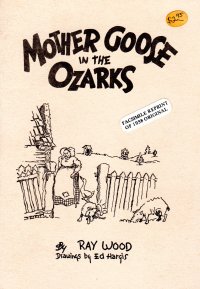
This book is a 1983 reprint of the 1938 original, a sticker on the cover informs us, and it is an illustrated collection of what might have passed for nursery rhymes in the Ozarks around the turn of the twentieth century. The perface tells us about the author and the history of the rhymes in this collection which later appeared elsewhere (we’ll get to that in a minute). H. L. Mencken had nice words to say about it when it was published.
The little rhymes in it are a bit twee and facile, but I’m coming to them from a position where Mother Goose and the European nursery rhymes are wisdom received at a young age. Perhaps if I were exposed to these rhymes in my youth and Mother Goose as an adult, I’d have the completely opposite reaction. So, some were amusing, but most were just rhymes for children to recite because nobody had television or radios yet.
One thing that modern audiences would zot onto is the use of perjoratives for blacks. A couple of the rhymes involve accusing a black person of something or just denigraating a black person, but that loses a bit of context that a lot of people mentioned in these rhymes are not represented in the best light. The book also disparages Irish people and other individuals. Face it, if you’re in a nursery rhyme, you’re not doing to well. But modern scholars and readers have their own biases and focii, so that’s what they would see first. Not that I’m defending the viewpoint; only that I can read something like it and say, “That’s not right,” where modern arbiters might not let me read it at all because they don’t trust my judgment.
Some things sounded familiar, though, such as:
Chicken in th’ bread-pan
Pickin’ up th’ dough
Granny will your dog bite?
No, child, no.
Where have I heard that before?
Also, this one learned me the source of an expression that was a fabled book and then a major motion picture:
William tremble-toe is a good fisherman
Catches hens–puts them in pens
Some lay eggs–some lay none
Wire, briar, limberlock, three geese in a flock
One flew east, one flew west
One flew over the cuckoo’s nest.
The nursery rhyme listed as the source of the title in Wikipedia differs, though.
Another features a character asking for his jimmy-john. I wondered if he wanted a sandwich, but after a little research which was mainly trying to formulate a search query that would return me something other than information about the restaurant chain, I discovered this probably refers to a whiskey jug.
At any rate, a quick read. A little educational, as it taught me the things I mentioned above. But it would be doubleplus ungoodthink to many who would then not learn what else it might have to teach.
This weekend, or more to the point, this Sunday and Monday, I traveled to a work retreat in the Washington, D.C., area. When I travel, I like to pack my personal item with magazines that I can read and discard on the way, which means my bag gets lighter as I go.
As I might have mentioned, my magazine subscriptions wax and wane over the years, and I have accumulated a bunch of old magazines in a drawer in the parlor that I’ve been meaning to read (including a number that came out of the trunk 17 years ago).
I have to consider what to pack carefully. My beautiful wife wants to browse some of them after I am finished, so I cannot discard Forbes or 417 on the road, so I might as well not pack them. I don’t want to pack magazines with guns on them as I don’t want to have the TSA give me the side eye or give some fellow plane traveler the vapors, so Garden and Gun, Ducks Unlimited, America’s First Freedom, and various other items are right out.
Which leads me to an eclectic collection in my bag, to be sure.
So in rapid succession, someone sitting on a plane next to me is likely to see me go through years-old issues of:
Chronicles, kind of like a Midwestern National Review;
St. Louis, the slick from St. Louis, natch;
National Review, kind of like a hipster coastal elite Chronicles;
First Things, a magazine of Catholic theology;
Birds and Blooms, a lightweight photography magazine about flowers and birds;
Metal Hammer, a British magazine about heavy metal music focused on European bands.
As you know, gentle reader, I am a man of eclectic and diverse interests.
But, Brian J., won’t your beautiful wife want to read Metal Hammer? Well, yes, which is why I have brought it home.
And why I have looked up Follow the Cipher on YouTube:
Watch for that album on a future Musical Balance post.
So yesterday, we headed down to Ozark for the semi-annual Friends of the Christian County Library book sale, and it was only when we got to the library in Ozark and saw an emptyish parking lot and the shades drawn on the meeting room that I remembered that the Friends of the Christian County Library has started shifting one of the two sales to the Nixa branch. Which we did not pass as we drove through Nixa to get to Ozark. As a matter of fact, we have never been to the new flagship of the Christian County library, which turns out to be a larger and nicer facility. Which meant they could spread out about the same number of books over slightly more floor space.
At any rate, it was half price day, which meant I got a bunch for a little.
I got:
Double Star, a Robert Heinlein juvie that earned me a book sale friend. Another guy saw it and asked where I got it; I mentioned it was mixed in, and that there were not others, or I would have them in my hands. He told me of the collection he’d received as a gift, a trash bag full of classic science fiction, and I envied it. Later, he approached me to offer me the copy of Friday that he’d found, but, come on: The later Heinlein hardbacks are easy to come by. At any rate, I’ll hit this one up sometime; I’d say “Soon,” but I’m surprised to see how many Heinlein books I come across in the library here that I have not yet read.
The Merchants’ War by Frederik Pohl. It’s a sequel to an earlier work, but by the time I get to it, I might also have read it. After all, my beautiful wife gave me the sequels to Gateway not long after I read it, and I have not read them yet.
19th Precinct by Christopher Newman. It looks a lot like the paperback police procedurals I ate up as a kid, like the Precinct: Siberia series. So I’ll throw it in the blender.
Mother Goose in the Ozarks by Ray Wood. Odds are I’ll read this first of all the things I bought today as it is a short, cartoonish bit of humor.
Tales of the Caribbean by Fritz Seyfarth. It looks to be similar to a lot of collections of tales that I have. So why not this one, a saltwater one, contrasted with the freshwater ones in the library already?
Mary, Mary by Ed McBain. The title indicates it’s a Matthew Hope novel. I might already own it, as I’ve not really gotten into the Hope series like I did the 87th Precinct series.
Two Patrick O’Brian books, The Hundred Days and Blue at the Mizzen. Which I bought in case I don’t have them already, although it has been (cough, cough) ten years since I read Master and Commander and started accumulating the series. Longer than the aforementioned Frederik Pohl series.
L. Ron Hubbard Presents Writers of the Future Volume 31. It’s a collection of stories including works by Larry Niven and Orson Scott Card. I foresee a science fiction binge in 2021 or 2022.
The Turner Thesis Concerning the Role of the Frontier in American History, a 1956 college textbook of some sort which looked interesting enough to put into the stack.
Murder as a Fine Art by David Morrell. I read his novel First Blood and First Blood Part II in 2008, and I’ve been accumulating his books since. Which, if you’re keeping track, is longer than both the O’Brian and Pohl books noted above. Perhaps 2021 or 2022 will see my David Morrell binge instead of or in addition to science fiction.
Three Times Three Mystery Omnibus. It’s a large collection that starts off with the novel The Lady in the Lake by Raymond Chandler and includes stories by Gardner, McBain, Christie, and others. But it will only count as one book in my annual total, perhaps in 2030 or so.
Marion’s Wall by Jack Finney. I have a couple of books by Jack Finney; I read Time and Again so long ago that it does not appear on this blog. I read a short story of his earlier this year in Stories of Suspense.
Christmas Lights by Christine Pisera Naman. This looks to be a Christmas type novel; as you know, I like to read a Christmas novel every year. Hopefully, I won’t lose this one amidst the volumes of the library as I did with a number that I bought last year.
Siddhartha by Hermann Hesse. Apparently, it’s a serious novel, and it’s about Buddha. I’m surprised I don’t own this already, but I’ve never found it for 50 cents before.
The Postman by David Brin. The source for the Kevin Costner movie. I saw the book mentioned on the Internet somewhere recently, and there it was in Nixa. I liked the movie, by the way. Of course, I thought Waterworld wasn’t bad, either. I watched them both back to back, as I mentioned earlier.
Endangered Lighthouses by Tim Harrison and Ray Jones. Not so much a browsing book for football games; it appears to be a compendium of lighthouses, their history, and some photos with a page for each entry.
Colorful Missouri which is a football browser. The woman counting the books commented on it, and I said I’d likely read the book instead of actually enjoying the fall color.
The World of the Polar Bear, also a browser of Arctic photos.
Humphrey Bogart: A Hollywood Portrait, which might be a browser or it might not. Regardless, it’s Bogart. The woman counting the books called it “cute,” but that did not dissuade me from purchasing it.
Vancouver: A Year in Motion, also a browser akin to city-focused photo books like Detroit, New York, and San Francisco (amongst other examples you can find on this blog).
Unsolved Mysteries of the Past, a compendium that I read in 2006. I bought this copy for my oldest son. I wish I could find Mysteries of the Unexplained for him as he’s into that (as I was at his age), but it’s hard to find that book in the wild when you’re looking for it even though it was pretty common when I was not. Probably many of them have been ground into cat litter by now.
I also bought a book of number crosswords for my youngest son and two CDs: Lee Ann Womack’s I Hope You Dance and Rage Against The Machine’s The Battle of Los Angeles. No John Denver, though.
The total for my books and the three books and puzzle that my wife bought: $11.50. I laid out a twenty and then renewed my membership in the Friends of the Christian County Library as I do every book sale, whether I attend once or twice a year.
Which reminds me: I have just lapsed in membership to the Friends of the Springfield-Greene County Library, and I should consider renewing before I venture up to its (their? our?) book sale next week.
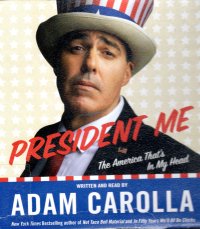
Technically, this is not a book report, as I listened to the book on CD. So I don’t count it toward the annual reading goal, but I do want to comment on it just to pad out your daily content allotment on this blog.
Adam Carolla, for those of you who might not know, is a comedian with 20+ years experience in the popular culture. He started doing bits in LA in the middle 1990s and scored a radio and later television show called Loveline followed by The Man Show in the late 1990s and has segued into books and a highly popular podcast in the 21st century.
This book presents a fantasy where he is elected President and what he does to the country. The chapters are grouped around Federal departments, and he uses this conceit to group some of his rant tales about hospitals, attending every function in your children’s schools, airports, and other things.
Carolla gets some notoriety for stating relatively plain truths in direct language, contradicting the prevailing orthodoxy of the times. He’s more coarse and vulgar than Dennis Miller and is less learned and erudite, but they cover the same ground at different times and for different audiences/generations.
So I agreed with a lot of the message, but I only got one or two chuckles out of the material. Maybe that’s me. I don’t really laugh at a lot of comedy these days; it’s high form if it even amuses me. Perhaps I’d be different in a comedy club, where the crowd’s reaction would be infectious.
Probably better than reading or listening to a polemic by a more straight-up commentator if only because of the refreshing and authentic fascination with boobies.
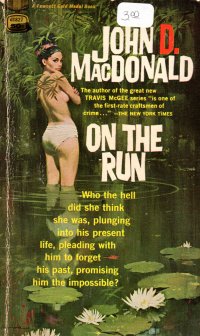
Ooops, I read it again. I first read this book in 2004, and in reviewing that particular review, I agree, fifteen years later with my earlier assessment.
The story: A young man, on the run from the mob, is found by a private detective working for the young man’s rich grandfather, who is dying and wants to see his progeny again. The grandfather sends his private nurse to retrieve the young man, and they fall in love as they drive from Texas to New England. The grandfather also invites the man’s brother, but the brother is in with the mob, and he comes with a plan to finger his brother for a hitman. Then a single violent night ends some lives and changes others.
I did flag this chapter beginning, though:
THE EXECUTIONER stood at the back of the bar of a roadhouse on Route 5 between Albany and Schendectady, nursing a bottle of ale.
What book am I reading here?
But given the turn of events at the end of the book, which sees a newly wealthy young man seeking violent revenge on the Mob, one wonders if this might be a precursor to the Don Pendleton series. Probably not, but you never know.
So twenty-four years ago last night, I was at work at a produce market in southwest St. Louis County. I was a year out of college, and when my student loans repayments kicked in, I found I needed a night job as my temporary Associate Editor position at an industry magazine wasn’t going to cover them much less gas money to get to the job, so I went back to slinging produce.
In those days, I was driving back and forth to Milwaukee frequently as I clung to my collegiate friendships as best I could. Probably a mix of I didn’t want to leave college yet and I don’t make friends easily. It allowed me to see my father, who had been diagnosed with lung cancer the summer after I graduated, and who completed a course of treatment and went into “remission” that lasted whole months.
My brother, on emergency leave from the Marines, had called the day before and told me that I should probably come home soon, so I made plans for the weekend to come up.
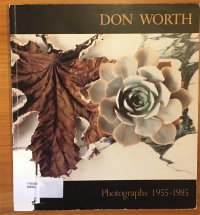
This is a collection of photographs from a mid- to late-twentieth-century photographer who focused (ba dum tiss) on close-ups of flowers and other flora who then moved into landscapes, male nudes, and still lifes during his career.
The introduction is one of the great artistic criticism sorts rather than the simple bio. Hal Fischer fits Don Worth into the great American tradition of nineteenth century landscape painters and Transcendentalists. So it is on that end of the spectrum of monograph intros, meaningful to serious students of photography but just blather to more casual appreciators of the art.
The photography itself is also a bit of a photography buff’s bag. It deals a lot with textures and shapes within the frame, where the content is important as photography more than telling a story or inviting the viewer to see something other than a photograph. So it’s a bit of modern art in that regard, and the introductory text writer favorably compares Worth to Jackson Pollock and Mark Rothko, so, yeah.
It doesn’t take you long to browse through it once you get through the introduction.
I know, with the blizzard of monography book reports, you’re wondering exactly how much football I watched this weekend. No more than nine hours. But I’m also watching some college football and playoff baseball. Which means I should make a real effort to get to the Friends of the Springfield-Greene County Library book sale to pick up more this month.
This collection of drawings’ introduction describes the life and times of Adolf Dehn without getting into the Importance of the artist in the milieu. It talks mostly about how the artist approached his work, which is by sketching a bit and then later interpreting his sketch and memory in the finished sketch.
For Dehn’s work is mostly pen and ink drawings (including some caricature) but also includes some watercolors, although the images in the book are black and white, so I cannot speak to how they would look in color.
However, the line drawings do not appeal to me. I mean, it’s like 2D comic art blended with some Degas or the other bad Impressionist or post-Impressionist influences. I mean, he’s no Matt Hirschfeld, that’s for sure.
Still, worth a browse during a football game just so I can continue to explore what I like and don’t like among the art world and art monographs.
Has the whole pink for breast cancer awareness thing run its course? I’m seeing remarkably less pink in the wild this month.
I was going to say something last week, but I thought I might be ahead of myself in making the assertion, but we’ve seen a weekend of NFL football without a pile of pink on the field. My martial arts school has, in the past, pushed pink belts and even, if I recall, pink gis, but this year it’s just decals.
Huh. Perhaps everyone is aware now, and the charities that existed to take in money, pay themselves, and raise awareness are finding themselves with tighter budgets.
You know, I used to be young and cynical back when I was more idealistic.
This book is an ex-library book from some unstated library that I picked up this spring at the Friends of the Springfield-Greene County Library book sale. I called it a comic art monograph, but it might be more akin to a self-published sketch book that I tend to avoid buying at local cons.
So, about the artist. He’s local, as I determine by the inclusion of posters advertising music shows in downtown Springfield. The book include some completed comic art that has the fully realized 3D modeling that’s unlike more cartoon-centric art like Rook City or Duel! as well as some other art, some digitally generated, that looks like it could fit into video games. The book also includes some sketches to show the preliminary work before the finished product.
An interesting browse during a football game, to be sure.
I felt a little bad for my children. My varied musical tastes pretty much outflank any genre of music that they could discover and try to play really loud to shock the parents.
Heavy metal? Come on. They tell me to turn it down.
Rap? I have Eminem on the playlist. And they think the Beastie Boys are dinosaur music.
Jazz/Big Band/Swing? We remember what happened at the art museum.
Country? They were stunned when they discovered I was familiar with country and western music, and we’ve got a preset on the car radios for a country and western station. And Dad knows all the tunes.
The Jack music (is that even the name anymore?) that is the greatest hits of the 80s, 90s, and today? Between an extensive collection of cassettes and CDs, Dad knows all the songs on the radio stations’ abbreviated playlists and most of them on the weekly reprise of Casey Kasem’s American Top 40 from the 1980s.
Electronica and dance music? Dad just bought a CD’s worth of songs by The Fat Rat, and their beautiful mom used to compose EDM.
Hip hop? I guess they could flank me here, as I don’t care for much of it, but I do have enough R&B to perhaps keep them away.
But you know what they found to annoy me?
Seventies folk music.
Apparently, inclusion in the video game Fallout 76 has revitalized John Denver’s “Take Me Home, Country Roads” and it now appears on the playlist at hockey arenas and whatnot.
Wait a minute, Brian J., don’t you own Their Greatest Hits Volume 1 by The Eagles? Well, yes, but they’re a band with California folk sound. I don’t know why the guy and a guitar folk rankles me so much.
What about all those Linda Ronstadt and Olivia Newton-John albums you own? True, and you could also bring up the Lynda Carter album as well. What do these have in common? Beautiful women who sing.
So the boys have discovered my beautiful wife’s John Denver albums and play them on the record player every morning and evening.
If they discover her Dan Fogelberg albums, I don’t know what I’ll do. Perhaps blow out my ears listening to heavy metal too loud on ear buds all the quicker, I suppose.
I left them such a small gap. And they exploited it.
 The second of the books I bought

 As I accurately predicted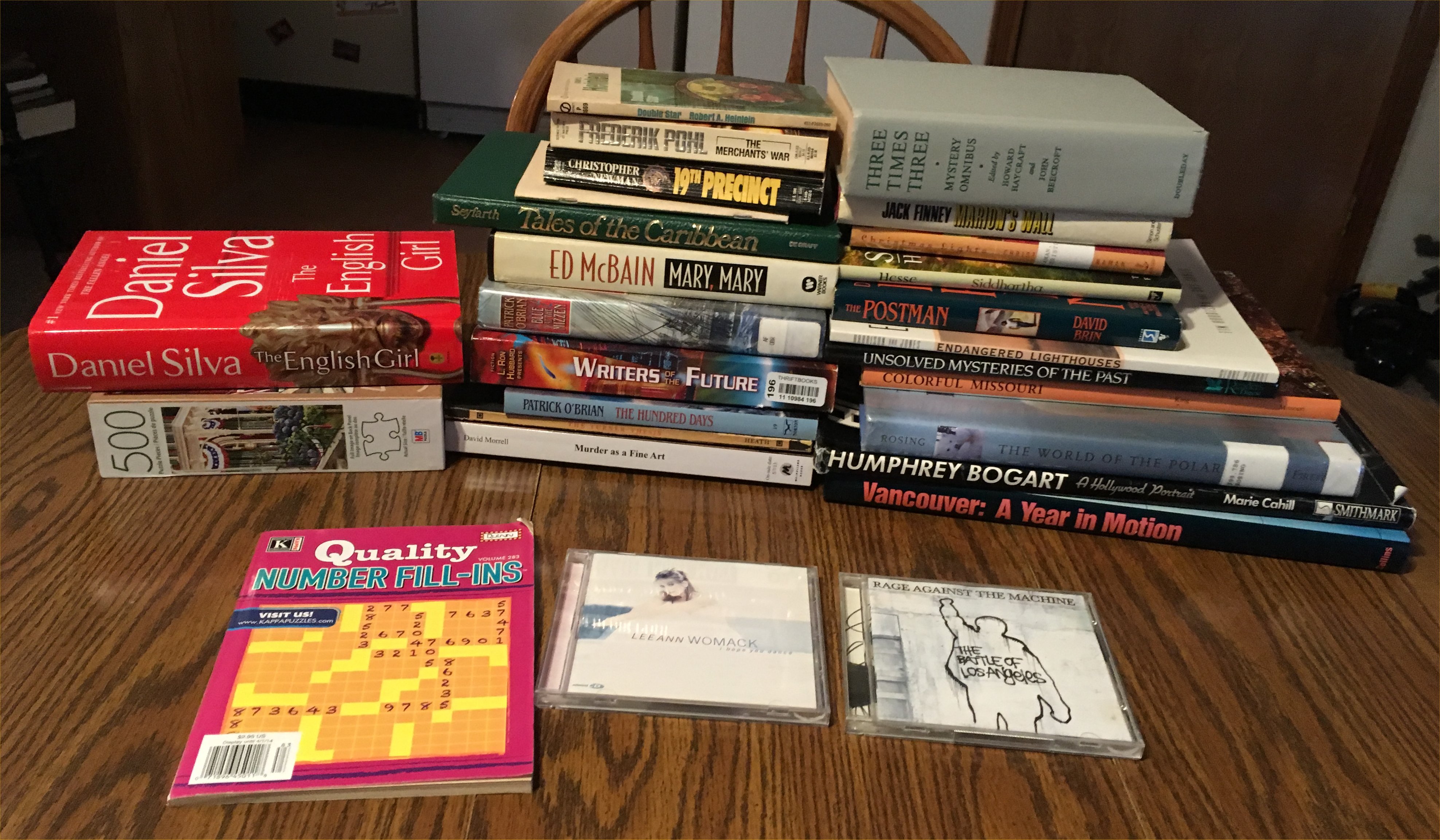
 Technically, this is not a book report, as I listened to the book on CD. So I don’t count it toward the annual reading goal, but I do want to comment on it just to pad out your daily content allotment on this blog.
 Ooops, I read it again. I first read this book
  This is a collection of photographs from a mid- to late-twentieth-century photographer who focused (ba dum tiss) on close-ups of flowers and other flora who then moved into landscapes, male nudes, and still lifes during his career.
 This collection of drawings’ introduction describes the life and times of Adolf Dehn without getting into the Importance of the artist in the milieu. It talks mostly about how the artist approached his work, which is by sketching a bit and then later interpreting his sketch and memory in the finished sketch.
 This book is an ex-library book from some unstated library that I picked up