Book Report: Monarch of Deadman Bay by Roger A. Caras (1969)

Book coverI guess after reading a couple volumes of Thoreau, I was in the mood for some additional nature-themed reading. And I prepared for just that occasion seventeen years ago when I bought this book at the book sale at the Jewish Community Center in St. Louis.

So this is a late 1960s naturalist, well, novel I guess. It talks about the life of a Kodiak bear from its birth to its death on Kodiak Island in Alaska some years later after it has grown to legendary size and is sought by hunters. It talks about the biology of the island, its history, and goes into detail but narratively unlike the Thoreau catalogs. It’s got a materialist, circle-of-life vibe to it but it presents Nature as red in tooth and claw (literally) in a nonjudgmental fashion. It does tut-tut hunters who come to the island to kill the big bears (and a couple get what’s coming to them courtesy of Monarch). And although it does say not to anthopomorphize animals, it does with Nature herself.

Written in the 21st century, the book would have been unreadable likely with the Message, but it’s not a bad read as it is.

The Bass Pro Shops headquarters here in Springfield has a stuffed Kodiak bear that is a bit of a photo op for visitors. I wondered if this was, indeed, Monarch of Deadman Bay, but it turns out he was not taken by a hunter (scientists tranquilize him to test him and tag him, and a rival bear attacks while he’s incapacitated–the ultimate irony that do-gooders did him in instead of hunters). I had thought of having my picture taken with it and this book, but, c’mon, man, you’re not here to see pictures of me. You’re here to see pictures of random actresses, not me. So no fun in that.

I guess Caras was a known animal/naturalist journalist with many television appearances (including being a regular host of the Westminster dog show) and has a pile of books to his credit, and some look to be in this line. If I see them, I will pick them up. Let that be my recommendation to you then.

Buy My Books!
Buy John Donnelly's Gold Buy The Courtship of Barbara Holt Buy Coffee House Memories

So What Did 20-Year-Old Brian Highlight in Walden?

I mentioned, gentle reader, that I picked up my college copy of Walden and Other Writings because I had just re-read Walden in an omnibus edition of The Maine Woods / Walden / Cape Cod and figured I would polish off the other shorter works in this volume, namely A Week on the Concord and Merrimack Rivers, “Civil Disobedience”, and some ephemera.

One thing I did notice when I turned past Walden in this volume is that I did a little “dialoging with the text.” In college, at least in the English classes, they recommend that you highlight things you find meaningful, relevant, or think will be useful for the final and to scrawl your notes in the margins. I didn’t really get into it that much–even then it seemed like it was defacing the book and selfish to boot. Some books that I get secondhand that have been used in college classes have so much highlighting and scrawl as to be nigh unreadable (which is probably an indicator that I should flip through the pages of classical literature and philosophy that I find at book sales much like I check record and video covers to make sure that they contain what they say).

At any rate, in case you’re wondering, as I was, what all I highlighted as I read it, here we go:

In the long run men hit only what they aim at. Therefore, though they should fail immediately, they had better aim at something high.

True, there are architects so called in this country, and I have heard of one at least possessed with the idea of making architectural ornaments have a core of truth, a necessity, and hence a beauty, as if it were a revelation to him. All very well perhaps from his point of view, but only a little better than the common dilettantism. A sentimental reformer in architecture, he began at the cornice, not at the foundation. It was only how to put a core of truth within the ornaments, that every sugar plum in fact might have an almond or caraway seed in it,—though I hold that almonds are most wholesome without the sugar,—and not how the inhabitant, the indweller, might build truly within and without, and let the ornaments take care of themselves. What reasonable man ever supposed that ornaments were something outward and in the skin merely,—that the tortoise got his spotted shell, or the shellfish its mother-o’-pearl tints, by such a contract as the inhabitants of Broadway their Trinity Church? But a man has no more to do with the style of architecture of his house than a tortoise with that of its shell: nor need the soldier be so idle as to try to paint the precise color of his virtue on his standard. The enemy will find it out. He may turn pale when the trial comes. This man seemed to me to lean over the cornice, and timidly whisper his half truth to the rude occupants who really knew it better than he. What of architectural beauty I now see, I know has gradually grown from within outward, out of the necessities and character of the indweller, who is the only builder,—out of some unconscious truthfulness, and nobleness, without ever a thought for the appearance and whatever additional beauty of this kind is destined to be produced will be preceded by a like unconscious beauty of life. The most interesting dwellings in this country, as the painter knows, are the most unpretending, humble log huts and cottages of the poor commonly; it is the life of the inhabitants whose shells they are, and not any peculiarity in their surfaces merely, which makes them picturesque; and equally interesting will be the citizen’s suburban box, when his life shall be as simple and as agreeable to the imagination, and there is as little straining after effect in the style of his dwelling. A great proportion of architectural ornaments are literally hollow, and a September gale would strip them off, like borrowed plumes, without injury to the substantials. They can do without architecture who have no olives nor wines in the cellar. What if an equal ado were made about the ornaments of style in literature, and the architects of our bibles spent as much time about their cornices as the architects of our churches do? So are made the belles-lettres and the beaux-arts and their professors. Much it concerns a man, forsooth, how a few sticks are slanted over him or under him, and what colors are daubed upon his box. It would signify somewhat, if, in any earnest sense, he slanted them and daubed it; but the spirit having departed out of the tenant, it is of a piece with constructing his own coffin,—the architecture of the grave, and “carpenter” is but another name for “coffin-maker.” One man says, in his despair or indifference to life, take up a handful of the earth at your feet, and paint your house that color. Is he thinking of his last and narrow house? Toss up a copper for it as well. What an abundance of leisure he must have! Why do you take up a handful of dirt? Better paint your house your own complexion; let it turn pale or blush for you. An enterprise to improve the style of cottage architecture! When you have got my ornaments ready I will wear them.

(Compare with Roark in The Fountainhead)

…but I would have each one be very careful to find out and pursue his own way, and not his father’s or his mother’s or his neighbor’s instead.

A man is not a good man to me because he will feed me if I should be starving, or warm me if I should be freezing, or pull me out of a ditch if I should ever fall into one. I can find you a Newfoundland dog that will do as much.

What is a course of history, or philosophy, or poetry, no matter how well selected, or the best society, or the most admirable routine of life, compared with the discipline of looking always at what is to be seen? Will you be a reader, a student merely, or a seer? Read your fate, see what is before you, and walk on into futurity.

(Emerson?)

…but they have, to my eyes, if possible….

(Must be transparent eyeball of Emerson)

So I highlighted a couple of passages that would have been inspirational to a young man in college, and I highlighted (or in the last case, circled in pen) a number of things that connected them to other things I’d read.

To be honest, that was my super power in college: taking a lot of philosophy, literature, and theology classes had me reading a lot of primary texts, and I could make impressive connections in papers and whatnot that impressed the professors.

A couple of such instances come to mind:

First, in a class on the Romantic poets, I expounded at length about how Percy Bysshe Shelley’s “Ode to the West Wind” drew heavily upon imagery and themes from the Bhagavad Gita. And after a very excited and passionate discussion contribution to that effect, Dr. Duffy said, “Yes, that’s in the footnotes.” But he looked and saw I was using a library copy of the book and not the edition sold in the book store for the class, he said, “But I see some of us have a different edition.” Suitably impressed with my insight, I hoped, gleaned because I had taken a class on Eastern traditions from the theology department and had read the Bhagavad Gita.

Second, in a class on playwright Ben Jonson, I wrote my paper on how in Sejanus: His Fall, the titular emperor did everything contra to what Machiavelli said a ruler should do in The Prince. Unbeknownst to me, the doctor running the class had written a whole book with a similar theme. The paper resulted in my getting an A in the class and made the final unnecessary, which meant that my crash course in catching up on the class readings–three or four plays in as many nights to prep for the final had all been in vain. Ah, well. I still have finished the two-volume set of Ben Jonson I have around here. Given how much time has passed, I should probably re-read the set.

At any rate: The fact that the yellow highlighting ends pretty early and the latter passage is circled in pen might indicate that I started out keeping up with the reading but didn’t finish Walden in the portion of the class where I was supposed to have read it. Which often happened as I was taking a full load of English and Philosophy, so my nightly reading load was 200+ pages atop working a full time job and riding a bus two to four hours to campus every day.

I guess it took, though, as I continue to intermittently read heady tomes. It’s just that I get less opportunity to make the cross-book references since modern paperbacks don’t allude to classical literature much.


Instead of highlighting passages now, I put a little post-it flag in the books by passages that strike me, and I sometimes remark upon those passages here on the blog. But if it’s just one flag, I’ll just take it out before shelving it.

This volume of Walden and Other Writings has three such flags. Let’s see what struck me now.

In A Week on the Concord and Merrimack Rivers:

Mencius says: “If one loses a fowl or a dog, he knows well how to seek them again; if one loses the sentiments of his heart, he does not know how to seek them again. . . . The duties of practical philosophy consist only in seeking after those sentiments of the heart which we have lost; that is all.”

You know, I’ve read some Confucius, and I bought a Penguin Classics edition of Mencius which has even odds of coming pre-highlighted eight years ago in Wisconsin. Although Thoreau quotes Mencius, his thought seems more Buddhist-influenced than Confucian with its urgings to respect authority. Maybe in the middle of the 19th century, Eastern thought was not as clearly delineated.

From “Civil Disobedience”:

As for adopting the ways which the State has provided for remedying the evil, I know not of such ways. They take too much time, and a man’s life will be gone. I have other affairs to attend to. I came into this world, not chiefly to make this a good place to live in, but to live in it, be it good or bad. A man has not every thing to do, but something; and because he cannot do every thing, it is not necessary that he should do something wrong. It is not my business to be petitioning the Governor or the Legislature any more than it is theirs to petition me; and, if they should not hear my petition, what should I do then? But in this case the State has provided no way: its very Constitution is the evil. This may seem to be harsh and stubborn and unconcilliatory; but it is to treat with the utmost kindness and consideration the only spirit that can appreciate or deserves it. So is all change for the better, like birth and death which convulse the body.

Definitely not Confucian. And a bit….stark. Who knew that Thoreau invented rage-clickbait?

From his journal:

Did God direct us so to get our living, digging where we never planted,–and He would perchance reward us with lumps of gold? It is a text, oh! for the Jonash of this generation, and yet the pulpits were as silent as immortal Greece [?], silent, some of them, because the preacher is gone to California himself. The gold of California is a touchstone which has betrayed the rottenness, the baseness, of mankind. Satan, from one of his elevations, showed mankind the kingdom of California, and they entered into a compact with him at once.

Perhaps I was merely flagging the last sentence to slag on California. But it also illustrates Thoreau’s opposition to industry, manufacturing, and probably capitalism which permeates his writing. Still more Buddhist than Confucian, and the use of Christian religious figures is atypical and probably just to reach the Christians and not representative of his religious faith.

At any rater (he said as its his second use of the transition in this post), that’s what I marked in the book. And now that I have remarked here, I can take those flags out and add this book to my “read” shelves and to my 20-year-old book database (which only contains the books I have completed plus reference works).

Oh, and lest I forget: Maybe I should read more classics, as they’re available on Project Gutenberg, and I can swipe and paste quotes instead of holding a book open and trying to touch-type the quote with sometimes ridiculous results. If you want to read Walden, “Civil Disobedience”, and A Week on the Concord and Merrimack Rivers, or if you just want to check my quotes, you can find them online here and here.

Buy My Books!
Buy John Donnelly's Gold Buy The Courtship of Barbara Holt Buy Coffee House Memories

Book Report: The Haw Lantern by Seamus Heaney (1987)

Book coverClearly, I sometimes go Last-In-First-Out when it comes to selecting books. In this case, for the poetry collection that I keep beside the readin’ chair, I picked out a book I just bought last month (well, actually, I brought out a couple when I was stacking them up) and of the couple, I started this one first. At some point, I thought “Isn’t this the guy who translated Beowulf?” Yes, it is, and I’m not sure how I knew that. It’s been a while since I read Beowulf–probably college–and Heaney’s version did not come out until 1999 to some fanfare. Perhaps I have a copy of it that I’ve been avoiding. But I delved into this book, and….

Well, it was all right. Some of the poems were interesting. The style tends to feature longer lines and completing thoughts, not just a couple of words dropped ponderously which the reader can imagine the poet saying and then pausing and looking around as though the two or three word lines were profound enough to warrant a pause much less a poem. But, gentle reader, I slag on modern poetry like that all the time.

Themeatically, he talks about love and whatnot, but half of the book is given over to The Troubles as he is Irish after all. So they didn’t speak to me as much as they would an Irishman or as much as they would to a literati who wanted to claim they speak to he/she/it.

But, some interesting rhythm wordplay and rhyme. Not a bad collection, and it makes me wonder how his earlier works were. By the time he published this book, he was teaching at Harvard and had a number of other books under his belt. One wonders if his earlier work was better, more real, than what might have come after he was a cause célèbre in poetical circles such as they were in the 1980s which is a far, far cry from what they might be in he 21st century.

Buy My Books!
Buy John Donnelly's Gold Buy The Courtship of Barbara Holt Buy Coffee House Memories

Book Report: Walden and Other Writings by Henry David Thoreau (1989)

Book coverAh, gentle reader, I won’t be taking the crown from Joe Kenney for the longest time between getting a book and reading it since I only got this book probably 31 or 32 years ago whilst in college and when I had a class for which I had to read Walden (although I cannot remember exactly which class that would have been–a philosophy class? A middle American literature class?). So I would have bought this at Waldenbooks (which would have been meta, would it not?) or B. Dalton’s at the Northridge mall (and not the university bookstore where it would have been for a few dollars more). So I read Walden in it and I started A Week on the Concord and Merrimack Rivers judging by the era-appropriate bookmark, but since I just read The Maine Woods / Walden / Cape Cod, I figured I might as well knock out this book as well. Originally, I’d thought that I’d pulled it from my read shelves when I tried to encourage my son or sons to read this book, but it is not in my read book database, so perhaps it has been on my to-read shelves for these thirty years.

At any rate, it contains a couple of things which I had not read before, including A Week on the Concord and Merrimack Rivers which Thoreau self-published. He had 1000 copies printed in the days way before print on demand, and he did not sell them all–this is the book about which he quipped about having a library of over 1000 books, 700 of which he wrote himself. It chronicles, in Thoreau’s fashion which means several years after the fact cherry-picking some bits from his journals and inserting some philosophy in them. It describes, theoretically, a boat trip he and his brother made down the local river to the port on the ocean (I was going to say sea, but can one ever pair those two in prepositional phrases again?), but it’s laden with his philosophical asides. I can see it as a precursor to Walden where he blends to two better. It’s not too long, though, and it was what Thoreau wanted to publish unlike posthumous works which were culled from his journals and not pored over or refined by Thoreau himself.

The book also contains, in addition to Walden (which I did not read in this volume this time, but I read it in this book in college and I read it in the other volume earlier this year, so no double-dipping), “On Civil Disobedience” and “Life Without Principle” as well as excerpts from The Maine Woods, Cape Code, and Thoreau’s journals. I read the essays and the excerpts from the journals, but not the excerpts from the things I’d already read.

So: “Civil Disobedience” is his diatribe against an overarching government that takes from citizens to do things that are not in their interests. Based on a single night he spent in jail for not paying a tax that supported the Mexican-American War (although his refusal to pay the tax was longer than the war itself), it really only documents that one night in a couple of pages near the end. The rest of it is pretty free-wheeling anti-government abolitionist almost stream of consciousness.

“Life Without Principle” is described as a talk or lecture he gave on several occasions but only was published the year after his death. I guess it sums up his philosophy as succinctly as possible where Walden did not. Basically, it’s about living life according to the individual’s needs, according to nature, and with minimal interference from government and society. It denigrates people who, getting and spending, lay waste their hours (to be honest, it does read a bit like Wordsworth themeatically) by actually earning a living and making money–which would provide for families, a problem Thoreau didn’t have, of course. He argues against many contemporaries and their tracts/books, but all the names are unfamiliar to us now (and given this is 2025 and not 1993, perhaps the name Thoreau is lost to most)

And the entries from Thoreau’s journal are a couple of paragraphs each, some nice little poetic moments capturing a bit of nature with the flair and philosophizing that is Thoreau at his best and are mercifully briefer than The Maine Woods.

So, now, at the end, what do I think of Thoreau?

As I have mentioned (I think), I can see why he hit differently in the mid-to-late 20th century, when the Baby Boomers were coming up through the college ranks. Thoreau was a Harvard man himself who never really grew up–he did not really have to work for a living nor support a family, so he was enabled to live the “life of the mind” and continue his concordance with nature up until his early death in his early 40s. His themes of non-conformance and the loss of the wild areas (which would have also, been metaphorically, youth to professors who did end up with families to support by professing) aligned with that fin-de-middle-siecle sense of the 1960s turning into the 1970s turning into the 1980s which would have been the lives my professors had known.

But aside from Walden, Thoreau is…. meh. “Civil Disobedience” wanders a bunch as does “Life Without Principle”. We get that Thoreau didn’t like the Mexican-American War. Or slavery. Or the Irish. Or most human development. And the other books and presumably the journals are really just fairly wordy catalogs of daily experience in great detail with some flourishes of interest but mostly just lists of flowers and trees seen in the wild.

So I won’t be getting the complete journals any time soon (unless they’re at the Clever branch of the Christian County Library later this month on bag day).

Ah, but Brian J., you might say. Are you not just slagging on Thoreau as a man-boy who never grew up and had to “adult” as the kids say these days who play-acted at living off the land but really just wanted to make a living from the “life of the mind” by writing his own ill-informed, twee sentiments and lightweight experiences as though they were profound, and that pretty much describes you with a blog twenty-two years on now? A fair cop, gentle reader. Perhaps even true: What I least like about Thoreau might be what I fear I share in common with him. But I’m not boring in detail of flora and fauna. I’m too dull to even know what those birds are in the tree in my back yard that seranade me evenings when I am in the pool. So I don’t even rise to the worst of Thoreau. Thanks for asking.

Oh, and lest I fail to mention it, this book provided me a Found Bookmark of my own. Stuck in the middle of A Week on the Concord and Merrimack Rivers, I found an index card with three names on it and the words, “Dues From.” This would have been my senior year, ainna, when I was the treasure of Marquette Writers Ink, the writing club at the university. One of the names is a girl (woman, I guess, but a young woman) who might have had a crush on me that I never suspected until the president of the club asked me if there was something going on, as she always came to me first at any event or gathering. Strangely enough, she’s the only one I’m nominally connected to as she showed up as a suggestion on LinkedIn some years ago, and I connected with her–she’s a copywrighter in Minnesota these days. Another, I had been thinking of because he would have been the only Indian-American I knew at the time, thirty-some years ago. Over at a blog I read, commenters disparagingly refer to Indians especially in the ever-growing number in the tech industry as Jeets, as this guy actually went by Jeet. He was at least second generation, though, as he had no accent. And he was a poet in English. I cyber-stalked him and found that he might be living in St. Louis these days. It didn’t catch me by surprise–so I might have looked him up before. I wonder if we overlapped there. I feel bad for JenBen, though, the other woman whose name is on the card: I don’t really think of her at all.

And: I have to say that this might not be the last of my collegiate acquisitions that I read. So I might read the book I picked up on the Chinese tradition of Buddhism sometime. I might actually finish George Steiner’s Real Presences, a textbook for Dr. Block’s class, on my third attempt (the last being about a decade ago). So I might very well have more Personal Records in laziness in reading books I buy to set yet.

Buy My Books!
Buy John Donnelly's Gold Buy The Courtship of Barbara Holt Buy Coffee House Memories

Book Report: A Dickens of a Cat and Other Stories of Cats We Love edited by Callie Smith Grant (2007)

Book coverI mentioned, gentle reader, that I’d started reading a book about cats on the aborted vacation last month, and this is that book. Apparently, I got it at Redeemed Books over on Republic Road in 2021, and that might have been the last time I was in that store. I’ve even been not going to ABC Books that much these days, which is definitely atypical. But I am getting pretty topped up on books with nowhere to go with new arrivals but the floor or the tops of the shelves in my office where they’re already blocking the cool bladed weapons and are getting a little precarious, where an exploring cat will likely knock a stack of them to the floor. So maybe I should be building the stacks on the floor so that the books atop the have less far to fall. But that is neither here nor there.

At any rate, this is a collection of stories about people adopting or finding cats. Given that it’s from Revell Publishing, it has just a blush of Christianity to it, with several of the writers mentioning God (but not Jesus). All of the stories have happy endings, especially the kittens-gone-missing stories. And most of them are anachronistic–although they don’t all talk about the eras in which the stories occurred, those that do mention it having been in the mid-20th century.

So: Well, you’re not going to get the “couple paragraphs of analysis” twee insights that I reserve for, say, Thoreau. But it was a pleasant read and almost led me to adopting a couple other rescue kittens. If you like cats and reading about cats, you’ll like the book. But it’s not as deep as Willie Morris or (probably) Cleveland Amory might try to be.

Buy My Books!
Buy John Donnelly's Gold Buy The Courtship of Barbara Holt Buy Coffee House Memories

Book Report: Westward the Tide by Louis L’Amour (1977, 1981)

Book coverI was thinking that I was tearing through these Louis L’Amour books that I bought a year ago in Clever (watch for the Good Book Hunting post for this branch’s book sale later this month!), but I guess I’ve only read three others: Hondo in September; Silver Canyon in October; and The Man from Skibbereen last month. Although four books by the same author in six months is, at the Nogglestead pace, tearing through.

In this book, a scout/gunslinger type, Matt Bardoul, sees the girl of his dreams in Deadwood, South Dakota. Her father is bringing her along on a wagon train planning to start a new town by Big Horn mountain where gold might have been discovered, but Bardoul has his doubts as other power brokers in the proposed trip are amassing a group of desperadoes, and Bardoul thinks that they’re up to something, perhaps killing and looting the wagon train when it’s out of the reach of civilization. Some events back this up, and then….

Well, the narrative differs from the other books for sure. L’Amour builds up some characters and develops some cross-purposes, but about two-thirds through the book, Bardoul is left for dead, and then he pursues the wagon train which has been completely hijacked by the bad guys, and he finds those developed characters and allies dead along the trail which seems an abrupt end to them. We get Bardoul’s dogged pursuit even after greivous wounds that would have left him dead or unable to operate but for his being the main character in a men’s adventure novel. We get a couple page monologue from an Indian decrying the white man that has no real purpose in the story. And…. Well, finis, eventually.

You know, I was probably influenced by the whole The World’s Best Selling Frontier Storyteller, the commercials for the book club back in the day, and A Trail of Memories: The Quotations of Louis L’Amour, and the fact that I started reading L’Amour with stronger titles (The Last of the Breed and Bendigo Shafter) which were heavily quoted in A Trail of Memories. But these books were just men’s adventure books set in the West, and L’Amour a talented workman, but he was churning them out at a great pace probably at least partially dictated by contractual obligations. So they’re all not going to be the pick of the litter. And this one is not.

Still, I might not seek out additional titles from what I already have accumulated. Aw, who am I kidding? If it’s bag day, they’re going in the bag.

Also, a housekeeping note: Although originally a paperback, this is in the library binding (it, too, a discard from the Nixa High School library thirty-some years ago). So it goes on the shelves with my hardbacks, not my mass market paperback read shelves. Which is good, as these last are now overflowing. Which, hopefully, will induce me to read more hardbacks or trade paperbacks amongst the cheap genre fiction.

Buy My Books!
Buy John Donnelly's Gold Buy The Courtship of Barbara Holt Buy Coffee House Memories

Book Report: A Collection of Poems and Stories by Jack Buck (2001)

Book coverAs I just read a volume of poetry by early 20th century radio man Bud Rainey (Jes’ Dreamin’), I thought about this book in 2008 when it was relatively fresh. And lost it in the stacks. But, coincidentally, it was also in the same section of the shelf from which I grabbed a stack of unrelated books so that I would have a wide selection of books to read on vacation (as with Homicide Near Hillsboro). These two books represent the only books I read on vacation, actually, although I started a couple more.

So: Well, it is a collection of Jack Buck’s poems and not short stories but rather a couple of anecdotes from the early part of his broadcasting career, many of which are a little more boozy or slightly salacious than one would expect from someone who was by the time the book came out an elder statesman of broadcasting (who decries trash radio in an address included in this book). The book itself is a fundraiser for the Cystic Fibrosis Foundation–apparently, Buck had a relationship with a fan suffering from the disease–and the book also includes an address given when he received an award from the foundation. In his addresses, he gives a little boilerplate politicking about being in favor of schools and also in favor of the government subsidies for Busch Stadium III (which was still in the negotiating stages at the time, as though the Cardinals would really move to Illinois). I see the state and the city of Kansas City are going through the same thing for the Royals now, but moving to Kansas City, Kansas, or Overland Park is not as big of a divider as moving to Illinois would be. So when it comes up again in a couple of years for the Cardinals again, call their bluff.

Eh. What about the poetry? Kinda like grandma poetry, but without God for the most part and with a more modern sensibility: shorter lines, less rhythm, and lesser vocabulary. I mean, I’m not knocking it; the guy was writing poetry, but it wasn’t as good as even the Rainey, but it was a way of expressing one’s self in a semi-disciplined fashion.

Full disclosure: In 2001, Jack Buck read one of his poems at the first Cardinals game (in Busch II) after the attacks on September 11. I was in the stands for it along with a couple of friends from Wisconsin who came to visit and helped me get a better sense of return to normalcy. That poem is not in the book which presumably came out earlier in the year. But St. Louis indulged Jack Buck his poetry because he was Jack Buck, not because the poetry was particularly compelling. But he was of maybe the last generation (or maybe it was early Boomers) who wrote poetry just because. And I don’t see the self-conscious efforts like the ones in the Springfield News-Leader‘s Poetry from Daily Life will change that much. But good on ’em for trying.

Buy My Books!
Buy John Donnelly's Gold Buy The Courtship of Barbara Holt Buy Coffee House Memories

Book Report: Homicide Near Hillsboro by James R. Wilder (2024)

Book coverAh, gentle reader, although this is a signed copy of James R. Wilder’s latest novel from last year, I did not get it personally inscribed at his book signing as I had something else going on at the time. Which is just as well, and probably for the better. When I attended the book signing for Death in Dittmer, I brought my beautiful wife along and then proceeded to spend an hour and a half standing there and talking with the author as the poor girl starved–I failed to see her behind the author table making time to go gestures, and she then sat in the car for a bit and was about to walk to a restaurant herself when I finally emerged from the book store. Well, I certainly avoided that this time. Although I do not see a Good Book Hunting report that mentions this book–my purchases at ABC Books have been very intermittent and small in scope of late–I am pretty sure I bought this about Christmas time last year. And it took me almost half a year to read it mostly because it was lost in the stacks until I gathered books by the handful from one particular shelf for vacation this year and it was there by chance.

Unlike the previous books, this book does not pick up the moment after the last ended, which is for the better for readers who get them out of order.

In it, the Chief of Police from Hillsboro, with whom Chet Harbison (of the “A Harbison Mystery” Harbisons) has butt heads in past books, is found dead under a covered bridge, mangled almost beyond recognition. His sergeant the bully expects to be made the chief of police instead. The Hillsboro sergeant friend of Chet, recently busted to corporal, are injured in a botched bank robbery, and the bully sergeant appears to beat Chet’s deputy friend Pete who has just taken down the inside man on the bank job. As Chet investigates, he finds that the police chief was not the war hero he portrayed himself as and is living a double life with a second wife. Meanwhile, the first wife and her cousin (some saphostry involved) are eager to get the insurance money and pressure the sheriff to find them innocent of suspicion. And as Chet (and crew) investigate, they find that someone in town was involved in planning the bank robbery, someone who knew the police chief often spent Wednesday nights away from Hillsboro with his second wife. Suspicion on the murder falls upon the brother of a local butcher, a ne’er-do-well who has disappeared with the brother’s truck. The ending resolves with a not unexpected twist and ultimate justice implied in an epilogue.

A pleasant read, but not without typos. I offered to proofread for him in 2023, but he thought I was offering expensive professional services. I should reach out to him and tell him I’ll do it for an advance copy of the book and maybe a retconned mention in the book.

Of course, I enjoy these books a little more because I lived in northwestern Jefferson County from seventh grade through high school and a little beyond, so I’m familiar with towns he mentions. In this book, for instance, he mentions that Chet meets Hillsboro town officials at the Russell House. Ah, gentle reader, I “just” ate at the Russell House myself (wherein “just” means in 2021 as part of our Desoto vacation). So little tidbits like that are especially meaningful and part of the reason I enjoy these books maybe more than comparable works.

Buy My Books!
Buy John Donnelly's Gold Buy The Courtship of Barbara Holt Buy Coffee House Memories

Book Report: The Maine Woods / Walden / Cape Cod by Henry David Thoreau (1993)

Book coverSo why did I read Walden earlier in the year? I’d gotten it in my head that it was for the 2025 Winter Reading Challenge–I said as much in another book report in April, but I didn’t actually slot it into any of the categories. Huh. Perhaps I was just reading it to race my youngest to whom I recently gave a copy and who might have had to read it for school. Regardless, I did not do a book report on it when I finished it because it’s in this omnibus three-books-in-one edition. And the omnibus only counts as a single book in the annual count because my rules are so arbitrary that Calvin has said to me, “Hey, how about a little consistent structure to your framework, buddy?”

At any rate, I’m not going to go into too much detail. This is a blog and not a paper for a college grade, gentle reader. But I will say something about each.

The Maine Woods chronicles several trips that Thoreau made into Maine; once to visit the largest mountain in the state and a couple other trips up and down the rivers and lakes just to take in the scenery and to enumerate and describe all the birds and the flowers and the trees found along the way. Actually, I found it tedious because that’s what it is. He tells about traveling by water, a little about the swamps along the way, and not much narrative flow. We get small asides about his philosophy, how man is changing the landscape, but the land is pretty wild and pretty much untouched except for logging. I mean, even events that could be exciting, such as a companion getting separated from the party overnight, is told pretty laconically. It was only 185 pages, but it took me a long time to slog through it. The book qua book was published after Thoreau’s death; I expect he would have tightened it if he meant it for print as a book. The book is structured in long chapters for each trip and subsections for days on the trip. Which is fitting, as people put it together from his journals after he died.

Walden chronicles the time that Thoreau spent in a small shack on Walden Pond (not On Golden Pond, which is different, you damned kids). Thoreau spent over two years there, but he condensed the journal entries into topical chapters and kind of made it seem like only a single year as he kind of follows the seasons–but the text is pretty clear that he’s talking about multiple years, so I’m not sure why current exegesists (current being late 20th century insist he pretended it was only a year.

At any rate, this is one of the two “books” that Thoreau published in his lifetime (the other, A Week on the Merrimack and Concord Rivers, was much shorter, so one might think it’s only a long essay). So it represents what Thoreau wanted published and a degree of refinement you don’t get in the posthumous works.

Themeatically, he muses on living the simple life, paring one’s needs down to the bare minimum, and rhapsodizes about nature and decries man’s progress in building things and destroying habitats and whatnot in the name of progress. It is strangely approachable not only because this was a theme popular even in the latter half of the 20th century, but the words he uses–cars for rail transportation, for example, or “”Who would live there where a body can never hear the barking of Bose.” (which is a brand of speaker and headphones today)–make it seem like he’s almost writing it in the middle 20th century and not the middle 19th century.

And I am sure it hit the Greatest Generation and early Boomers differently than someone today. I mean, they had exurban woods, at least in the north and northeast and parts of the south, where they rambled as kids which were developed for suburbs. So they knew what the loss of the wild places they played felt like. But here in the 21st century, kids have far diminished room to ramble even if they can be torn from devices long enough to do so. My boys played a bit in the wood break behind our house in the brief gap when they were old enough to play unsupervised and the time the oldest got his first phone because he was going into high school and might need to be in communication with his folks. And although I was kind of limited to the (big) block of the housing project or the trailer park or whatnot, my father told stories of hopping on a train as a kid with a gun to go hunting. So I knew what this felt like if only by proxy, the loss of those “wild” spaces (ours were not really wild, the old edges of the Army Reserve base in Milwaukee or the wooded hills above the trailer park or, it turns out, the toxic creek below it). But they’re gone now, too, lost in the past.

So it’s clear why it was a college favorite back then. It’s not a bad read; a bit more poetical in tone than what we would prefer today (or at least what I prefer in my paperback fiction selections). And it provides some things to think about. But more archaic now than it would have been in 1990.

Cape Cod is another book drawn from his journals and published after his death. It covers a trip that Thoreau and another took walking Cape Cod to Provincetown, a several week journey of 60+ miles. He talks about the sea, seamen, lighthouses, and living on this rural sandbar where not much grows. It starts of with a bang, a chapter on a shipwreck and the aftermath, talks about “wreckers” who gather jetsam and floatsam. And most of the wood for home fires comes from driftwood. Back then, the Cape did not have roads or rails, so they walked. An interesting excursion, and a little better than The Maine Woods, but still gets into the weeds, literally. At the end, they take the ferry back to the mainland. I was reading Jes’ Dreamin’ about the same time as this book-within-the-book, and I noted that both depict eras in areas which have been heavily developed since the authors wrote about them as bucolic and/or backwater rural areas.

SO: I guess the whole thing is worth reading if you’re in an English department somewhere focusing on mid-19th century American literature (c’mon, man, they’re still got to be one somewhere, maybe Hillsdale or something) and you need to read it for work and for your dissertation or continued non-perishing publishing. But these are not for everyone. I’m not even sure they’re for me in retrospect. But I’ve read this bonzer of a book, and it’s good for me to read bonzers of a book from time to time since I have so many, and reading them clears more space than paperback originals.

Oh, and Thoreau did not think much of the Irish. He dings them several times. So some small inclusions in the diamond of his thought. He was imperfect, and unfortunately undoubtedly the complete works of Thoreau, including, what, fourteen or fifteen volumes of a journal (not available at Nogglestead, and not on order), will undoubtedly prove it more clearly.

Buy My Books!
Buy John Donnelly's Gold Buy The Courtship of Barbara Holt Buy Coffee House Memories

Book Report: Jes’ Dreamin’ by Bud Rainey (1938)

Book coverI jes’ picked up this book earlier this month, and I brought it with a stack of other poetry books to the chairside table for some shorter reading after working my way through chapters of a longer book (The Maine Woods, Walden, and Cape Cod by Thoreau). And I guess I jumped on this one first.

So this is a self-published volume from 1938; apparently, Rainey was a radio personality in Connecticut. Presumably he read some of these poems on the air, and they definitely have the rhythm of a polished performer. Most of them are four to eight sestets or octets with mostly iambic buy with some anapaest thrown in for variety. Thematically, they’re Americana, not unlike what you might find in Ideals magazine, although Rainey writes an awful lot in the vernacular, not only dropping the final consonant of words but also using rural phonetic pronunciations like shadder for shadow. So some possible James Whitcomb Riley influence there (see the book reports for Little Orphant Annie and Other Poems and Old School Day Romances to see what I’m talking about).

I’m doing the math here, and somehow 1938 was seventy-seven years ago. That hardly seems correct, but I’m a manchild who still watches dumb movies, so I probably still think it’s 1980something when I do my default time calculations. Rainey would have been a contemporary of Edna St. Vincent Millay and Ogden Nash, but his poetry appears not to have been picked up by a major publisher. Perhaps he wanted to keep the rights for himself. Or maybe the collections of poetry were just a larf. As a result, the books look to be kind of rare.

What seems incongruous, or might, is that he was a broadcaster in Connecticut (WTIC, I believe, but I’ve closed the tabs and can’t be arsed to look it up again–oh, all right, I did verify it was WTIC–no point in me hallucinating like an LLM would please add aside in the self deprecating style of Brian J.). Which, in the 21st century, I think of as suburban or even urban because of its proximity to New York City (although I have never been to Connecticut, although my beautiful wife has). The Google map shows a lot of green which would indicate it’s not completely overdeveloped. So it was my mistake in thinking it was rural. The film Holiday Inn is set contemporaneously with when this book was written, roughly, and it depicts Connecticut as the height of yokels in the sticks. So I guess the incongruity was based on my misconception of Connecticut.

At any rate, if you like the kind of poetry that you find in old Ideals magazines with a touch of the Riley, you’ll probably enjoy these books. Nothing is going to really stick to your intellectual ribs–nothing in here compelled me to memorize it–but a better read than the current issue of Poetry magazine anyway.

Buy My Books!
Buy John Donnelly's Gold Buy The Courtship of Barbara Holt Buy Coffee House Memories

Book Report: The Official Baldknobbers Book of Jokes Volume I (1999)

Book coverAh, gentle reader. Even with the gluttonous trips to library sale bag days and more recent trips to estate sales and garage sales on the weekends, I still scout the free book cart at church for things to pick up. And last Sunday, I was particularly greedy, snatching up this book as well as a book about the book of Genesis. From the Bible. Which is more what the free book cart tends to proffer except when some of us sneak more secular works onto it. Like this one.

The Baldknobbers are a long-running show down in Branson, and this is probably a self-published book to include amongst their souvenirs. The copyright date is 1999, but they could very well have stock of it down there even now. Branson shows aren’t really my thing, Yakov excepted, so I don’t know if I’ll ever see them or the Presleys (both of which claim to be the first show in Branson, I think).

So of course I read it in a night or two as something else to read after finishing a chapter of the Thoreau omnibus I’m hoping to finish soon. It’s purportedly a list of jokes that the emcees have used over the years, so they’re very twentieth century equivalents of what you would find in Reader’s Digest. Not especially edgy humor, which is fine: I’m not too into crass, although the only joke that I actually laughed at dealt with bodily functions: One fellow is complaining to a friend that his wife is on a fiber kick, so he’s eating bran in the morning, bran in the evening, and bran at night. The friend asks, “But are you regular?” And the fellow says, “Regular? I’m thirty days ahead!” Probably complete with the exclamation point.

So, eh, it passed a little time in church before the service and a couple of minutes before bed a couple nights. And it was free, which was nice.

Buy My Books!
Buy John Donnelly's Gold Buy The Courtship of Barbara Holt Buy Coffee House Memories

I Am A Book Accumulator

Patrice Lewis posts Book hoarders? Oh please and links to a repost of a 2017 article 10 famous book hoarders.

Lewis tut-tuts the definition of book hoarder as someone who has over 1,000 books (she and her family have about 1,750, she estimates).

I don’t include hoarder on my scale of book ownership. I tend to think of the scale this way:

  • Normal person: Up to, what, 20 books? Although this normalcy is fading.
  • “Likes books”: A couple hundred. If they’re arrayed by color or to match the room, she’s a “decorator.”
  • Collector: A couple thousand, but carefully selected and thematic.
  • Accumulator: Up to 15,000, but far more eclectic.
  • Professor: 15,000+.

We’re definitely in the “Accumulator” range. I have 3000 books logged in my laggy Access-based desktop database from the year 2000 and more than that unread/unlogged; my wife has maybe five bookshelves of books plus two built-ins; my boys each have two bookshelves; I have a bookshelf full of practical books in the garage; and we have a couple boxes of children’s books for the next generation in the garage as well. So maybe 9,000 or 10,000 total.

The linked article mentions one of the “hoarders” accumulates 175 to 200 books per year. Ah, gentle reader, that is three or four book sale bag days for me.

The “hoarders” in the article also have dedicated libraries, and that’s still a dream of mine. Man, when we moved to Nogglestead lo, those many years ago, we had enough room to space out and organize our library. But that was several thousand books ago.

Buy My Books!
Buy John Donnelly's Gold Buy The Courtship of Barbara Holt Buy Coffee House Memories

Good Junk Hunting, Saturday, May 17, 2025

For a second weekend in a row, my youngest and I visited several sales. Unlike last week, though, we made an excursion of it, visiting an estate sale in Marshfield, Missouri, some forty minutes down I-44 (run by Circle of Life Estate Sales, who does a number of sales in the area) and a outside the bounds of north and east Springfield. We bought nothing in Marshfield, but it gave the young man the chance to buy a couple of boxes of Pokémon boxes at the Walmart since he has picked over all the Walmarts and Dollar Generals in southwest Springfield and southwest towns like Republic, Marionville, and Aurora.

We did find a couple of things at the other sales:

On the “junk” side (which I’m starting to include to explain why my garage is so cluttered):

  • A scroll saw with no blades but with the manual for $13.50. I got it home and plugged it in, and it bobs when turned on according to the speed set on the dial, so this might be a really good deal. Unless I cannot actually get blades for it, the blade attachment assembly is damaged, or 16″ is too small to be really useful. I don’t actually know yet how to really use a scroll saw, so I will learn someday. Maybe.
  • A portable car starter/compressor for $6.00. Since my boy(s) are traveling further afield these days, it would be useful to have one in each trunk. It did not come with a power cable; hopefully it will take a common form factor, or I might spend the rest of the amount to buy one new securing a power cable on the Internet. Or I’ll throw it in a donation box myself for another yard sale.
  • A Blu-Ray player for $5. Because sometime too soon, in five or ten years, these will be hard to come by cheaply. You might scoff, but just wait.
  • A 1950s Unique “Dependable” Typewriter which looks to be a little typewriter which does not have keys but a dial to set what character you want to appear. Looks to be going for $10 on the Internet which is what I paid for it. I think I’ll clean it up and put it on a shelf to display it, but more likely it will go into a closet or a cabinet until my estate sale. Although I envision a wall with shelving to display old oddities like this, c’mon, man: All walls of Nogglestead and beyond will be dedicated to books.

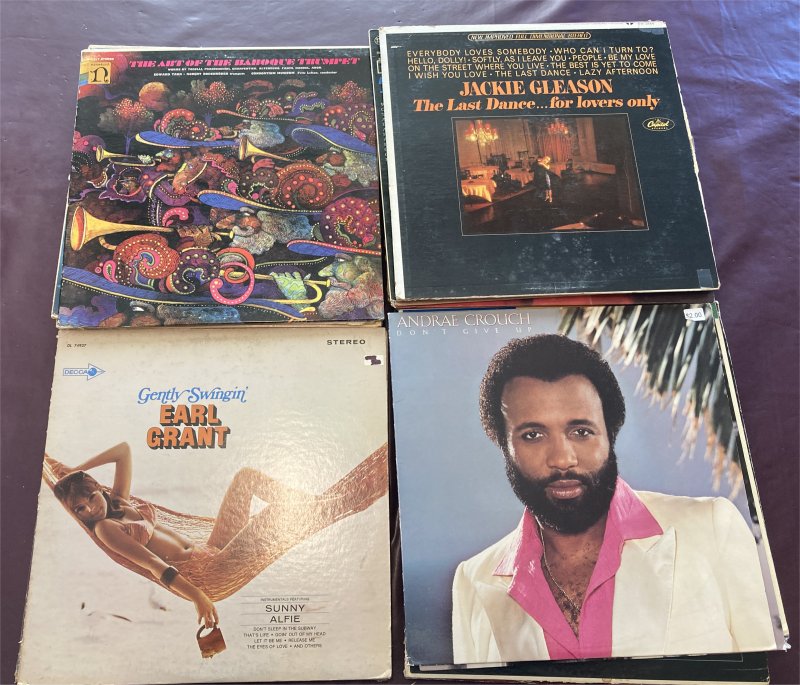
An estate sale outside of north Springfield yielded a couple of LPs: Two by the Alan Parsons Project, The Turn of a Friendly Card and Eve and some two-disc compilation called Love Italian Style which includes Frank Sinatra, so not Italy Italian but Italian American.

At the last sale, I expect a writer lived there as large book collection spread over counters and tables (nice bookshelves presumably sold already) included books not only including various Writers Digest books on writing mysteries but also recent books on computers and cybersecurity, pre-med and med, architecture, and more. I got a couple:

  • Art and Architecture: Venice, a thick almost 600 page book not only of pictures but also diagrams, so a serious architecture book.
  • That’s What She Said: Contemporary Poetry and Fiction by Native American Women edited by Rayna Green. Why? I don’t know.
  • Into Thin Air by Jon Krakauer. I saw it mentioned on a blog last week or so. I, of course, read a couple years back, and although I was not impressed with the theme, the writing wasn’t bad.
  • National Lampoon Jokes Jokes Jokes: Verbal Abuse Edition by Steve Ochs. Presumably, I will get some one-liners for when Finnish proverbs just won’t do.
  • Forensics: True Crime Scene Investigations, a college textbook that cost more than the dollar I paid for it.
  • Handmade Houses: A Guide to Woodbutchers Art by Art Boericke and Barry Shapiro. Which is a picture book and not diagrams.
  • The Language of Post-Modern Architecture by Charles Jencks. So I can better understand Lileks and Ed Driscoll’s infrequent architecture posts trashing pomo.
  • What My Cat Taught Me About Life by Niki Anderson. Will it be an anniversary gift since that’s coming up in mere days? Probably not!

I barely made it through the media section when someone backed a pickup truck to the back door and took all the rest away.

But I did get:

  • Lonesome Dove on VHS.
  • Meet the Spartans, a spoof movie.
  • The Last Samurai with Tom Cruise. We saw this in the theater back in the day, where I realize parts of the 21st century are “back in the day.”
  • The Expendables 3. I watched the first one in 2023 and just bought the second in April. Might as well complete the set.
  • National Lampoon’s Pledge This. I have been a sucker for National Lampoon-badged movies. So much a sucker for National Lampoon at all (see also the book above) that I invested in it when it was a publicly traded company. And lost all my money on it.
  • The Omega Man, the Charlton Hestin version of Robert Mathieson’s I Am Legend later remade into the Will Smith movie which I “recently” watched but not so recently that I wrote a report on it.

When we were checking out at that sale, the guy said if there was any book I was on the fence about buying, he would sell them to me for a quarter each. So I presume that the guys with the pickup truck bought the remaining videos at a discount to sell somewhere else. And I thought, man, if I ever open The New Curiosity Shop, I’m going to have to work out a deal with these estate sale guys.

So I spent about $60 total, which is not bad once you factor in the junk (and the fact that the records were $5 each, which is a lot for me to spend, but c’mon, Alan Parsons Project in decent covers).

I did not buy Arlo Guthrie’s Alice’s Restaurant, but I did show side 2 to my youngest to see if he noticed anything strange about it, but he did not. Quiz time, gentle reader: What would be different about side two of that LP?

The only thing the young man bought were some basketball cards he bought for fifty cents each. He looked one up on his phone and found it had some value, so he bought the lot. As we were walking out, he said that the first one he priced was some nobody Erving guy worth $1.75….

Julius Erving?” I asked. “Dr. J.? A nobody?”

Well, he is young. And he will never hear the end of this.

Buy My Books!
Buy John Donnelly's Gold Buy The Courtship of Barbara Holt Buy Coffee House Memories

The New Champion for Longest Time Between Acquiring and Reading Book

Joe Kenney reads a Death Merchant book forty years after acquiring it. And trying to read it for the first time.

You know, I’m not a fan of that series either; I read one in in 2012 and not another. But I’m not as dedicated to men’s adventures and contemporaneous paperback originals as Kenney is.

If I want to reclaim the crown, I’ll have to read some of the young adult fiction that my sainted aunt and godmother gave me when she gave me Captains Courageous which I read in 2010 after owning it for only 30 years.

I still have a number of (or all of) the books that my aunt gave us when I was, what, eight or nine? A couple of Hardy Boys books, maybe some Nancy Drew, a Power Boys mystery, maybe the paperback copy of Henry and the Clubhouse that I would have read in elementary school (Team Cleary all the way!)–I would have read those books in the late 1970s or early 1980s. But there were also a couple of mid-century kid-and-horse books and kid-and-dog book which I really wasn’t into at the time. And, to be honest, my boys never even got into the young adult mystery adventure stories at all.

I can probably read to reclaim the crown.

Sometime after I clear the current stack on the side table. I could reclaim the title and leave a book or two in reserve for if I ever have to reclaim it again.

Buy My Books!
Buy John Donnelly's Gold Buy The Courtship of Barbara Holt Buy Coffee House Memories

Book Report: Beyond These Hills: A Book of Eskimo Poems photographs by Guy Mary-Rousselière (1961)

Book coverI just bought this former library book from the Knoxville High School Library at the Friends of the Library book sale on May 3, and I jumped into it after the collection of Finnish proverbs.

This says it’s a book of Eskimo poems, but it’s really a book of photos of Eskimos and the great white north with poems as text. The photos are more interesting than the poetry, which mostly deal with the landscape and survival, and the photos show you why. The collection is 60-something now, and I wonder how different a 21st century edition of the book would look different. Many of the photos depict the outcome of a hunt, and one of the poems talks happily about having seal to eat. I mean, that’s life in the harsh environment, but people in New York who make books would likely blanche at the thought of it.

So a quick read. No poems I’m interested in memorizing and not even aphorisms or proverbs to quote to sound smart. But, wow, what interesting photographs.

Buy My Books!
Buy John Donnelly's Gold Buy The Courtship of Barbara Holt Buy Coffee House Memories

Good Junk Hunting, May 10, 2025: Estate and Yard Sales

Does this count as book hunting? Album hunting? Not really enough of either to be specific. I spotted signs for a nearby estate sale on Thursday and Friday, so I brought my youngest who wanted to look for collectibles like coins and cards (which would be long gone by Saturday, but he came along anyway). The southern campus of our church was also having a sale to raise money for the pre-school, and we discovered another church sale along the way.

And I got a couple things.

For books, I got:

  • Days of Our Lives: The Complete Family Album. While I was in college, my stepmother recorded the program (on VCR, young man, not Tivo) and I’d catch bits of it when she caught up on Friday nights. This was in the Fake Roman/John storyline era, so early 1990s. The student union common had a big television (a big deal in 1990), and it was tuned to this show during the lunch hour. I fantasized about striking up a conversation with a girl and talking about the show, but I never did. The only girl I ever struck a conversation with out of the blue was Brandy in my biology class my freshman year, which was like my first college class ever. But she was wearing a Billy Joel tour shirt, so clearly we had musical taste in common, although I would not see Billy Joel in concert for another decade.
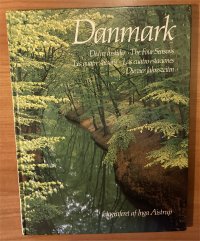
  • Danmark, a book about Denmark whose text is in four different languages. So the picture to reading will be slightly higher than otherwise.
  • A Garden Full of Love: The Fragrance of Friendship by Sandra Kuck. A collection not unlike an issue of Ideals.
  • Skipping Christmas by John Grisham. I recently saw the film Christmas with the Kranks where “recently” means 2023.
  • The Treasure Chest, a collection of quotes and poems grouped by them by Charles L. Wallis. It must have been a great gift in the 1960s, as Ebay shows a variety of editions at different price points (but not very high). The previous owner must have liked it, as it yielded three Found Bookmarks: A Christmas Card, a church service bulletin from 2001, and a Pick 4 lottery ticket from 1987. Which means the previous owner looked through it and/or marked things in at least two different decades.

I also got a Christmas record, Christmas Music from France; I’ve already played it, and only my beautiful wife, who is studying French, might be able to determine it’s Christmas music if she listened carefully.

I got a Kenny G CD, Miracles, which is also a Christmas album.

I got a little handheld Blackjack game for a buck which I didn’t have to wait to test at home as it has working batteries already (which might almost be worth the price I paid for the game). I also got a pack of Elvis trading card, apparently from 1992. The pack was partially opened, so my son pooh-poohed the purchase even though it’s the only thing like cards we saw today. I paid a buck for it and brought it home and learned (by, again, looking at Ebay) that Ebay is rife with unopened packs for $1. Which led me to a good lecture about the economics of collectibles. Namely, that when Boomers were hitting their play money years, they wanted things from their childhood–toys, baseball cards, comic books–which were scarce because they and their parents considered them to be disposable. So they were chasing after limited stock. But their splashing money around led to a bunch of new comic and trading card companies and sets springing up, and the Boomers were snapping them up not only enjoyment, but as a speculative investment. Which leads to a glut of unopened sets of Elvis cards in peoples’ basements or climate-controlled storage facilities and listed on Ebay for less than their inflation-adjusted original price.

He’s been buying a hella lotta Pokémon cards lately, hoping to find valuable cards in packs. I guess the company is not flooding the market but are consciously choosing some scarcity, but the biggest scores and highest prices in the secondhand market are going to be from the early sets of the cards from 30 years ago, when, again, they were a toy and were not expected to be investments.

I guess the way to hit it in that sort of collectible market is to find a commodity that everyone thought was disposable but where eventual scarcity might lead to value if anyone bothers to collect mementoes of their youth in their middle age. I’m not sure this will occur to generations beyond Gen X. Maybe early, early millenials (90s kids). What do the others have good memories of their youths? Interchangeable smartphones and tablets mostly.

Buy My Books!
Buy John Donnelly's Gold Buy The Courtship of Barbara Holt Buy Coffee House Memories

Book Report: Finnish Proverbs translated by Inkeri Väänänen-Jensen (1990)

Book coverI have dived right into the stack of “poetry”” that I purchased earlier this month partially because I have not been arsed to put them on my bookshelves yet, so they’re still on my (rather large) desk. Maybe I’m thinking with dedicated effort, I will read them all before I shelve them kind of like I’m hoping to watch all the movies atop the movie cabinet soon (but my night gig has restarted, so my reading and viewing time will be lessened for a couple of months).

The translator/editor is the child of Finnish immigrants, and this book was partially funded by a university where the translator works (or worked) in a Finnish fellowship or something, so the author has other presumably short works related to Finnish literature as well. But this book is but a collection of proverbs and sayings along with some line drawings of Finnish places and design elements. So it’s definitely a quick read–under an hour, for sure, and it has some little bits of wisdom, although some of the proverbs are not unique to Finns.

I marked a couple:

  • Better once too much than always too little.
  • You can fool others only once but yourself for a lifetime.
  • What you do not repair you destroy.
  • You do not reach Heaven in one jump.
  • Not all clouds bring rain.

I cannot wait to use them and announce they’re proverbs from the Finnish. You know I will.

I’m actually vicariously Finnish to a degree. One of my uncles is of Finnish lineage. His daughter is blonde and fair, but the son got the darker complection from the Noggle side of the family, so he has a Finnish last name but looks like a Mexican bandito. He, my cousin, has been to Finland to meet his relations several times and actually speaks a bit of Finnish. So I’m only vicariously Finnish, which is odd since I have lineage from just about every other European country.

So, yeah, worth the fifty cents I paid for it.

Buy My Books!
Buy John Donnelly's Gold Buy The Courtship of Barbara Holt Buy Coffee House Memories

Book Report: Sonnets and the Ballad of Alanna MacDale by Michael J. O’Neal (2019)

Book coverI mentioned when reading Fatal Interview that I was reading another collection of sonnets simultaneously; this is it. I bought this book last spring at the Friends of the Library book sale; it’s clear I haunt the dollar (fifty cents on half price day) poetry table.

So: This is a contemporary collection, only six years old, but it’s anachronistic as the poet tries to emulate medieval sonnets. Not only does the poet affect some middle English stylings, but the sonnets are English style as well (abab cdcd efef gg, with three samples and the couplet instead of the Italian sonnet which is 8 lines and a turn for 6 lines–which is what Edna St. Vincent Millay and I wrote back in the day). And the text of all poems is italic, perhaps to look more like handwriting, but that’s always a poor design decision as it slows reading down just a bit.

The poems? Eh, okay, I guess. The rhythm is fairly suspect–the poet does not stick to iambic pentameter much.

But, you know what? They’re earnest, and I have to say I developed a little…. well, maybe not affection for them–I won’t memorize any of them for open mic nights–but I did feel a little sympathy or camaraderie with the fellow. When I was in college, my poetry professor knocked my poetry for being like reproductions of antique furniture. My later sonnets had a more modern sensibility. Even Edna St. Vincent Millay’s hundred-year-old sonnets read a little more contemporary than this book.

So perhaps this poet will also evolve. But you really have to be in the mood for this kind of thing to take much from this volume.

Buy My Books!
Buy John Donnelly's Gold Buy The Courtship of Barbara Holt Buy Coffee House Memories

Book Report: The Buck in the Snow and Other Poems by Edna St. Vincent Millay (1928)

Book coverI am enjoying running through the stack of Edna St. Vincent Millay books I bought last autumn–I read Fatal Interview last month, and when I went to the book sale last week, I hoped to buy additional copies of Millay’s work so I could put them in my to-read stacks and read them again. But none were forthcoming, and I still have a few unread from last autumn. Or I could dig out my existing copies to re-read, but that’s not how I roll.

At any rate, this collection is not a collection of sonnets, but most of them have good rhythm and end rhymes anyway. The fourth part of the book does include some sonnets, though. And it’s not a series of connected works, unlike Fatal Interview, but you do get the usual Millay themes of love and longing and loss.

No penciled into the end papers, but it does have a book plate naming a previous owner (Reggie Johnson) and a label from the Personal Book Shop with two locations in Boston, Massachussetts. The book shop no longer seems open, and the style of the label indicates that it’s decades old, so. Someone, probably more than one person, enjoyed this book. Perhaps someday someone else will enjoy it when it passes from my hands.

Not much of a book report, but I can only gush about Millay as she is my favorite poet bar none.

Buy My Books!
Buy John Donnelly's Gold Buy The Courtship of Barbara Holt Buy Coffee House Memories

Book Report: The Man from Skibbereen by Louis L’Amour (1973, 1981)

Book coverTo break up the monotony of the paperback science fiction novels I’ve been reading (most recently Halo: The Fall of Reach), I picked up a paperback Western instead. Although this book is actually a paperback that’s been upgraded to the library binding (as it was in the library of Nixa High School in the early 1980s, with intermittent checkout stamps until 1988 which means while I was reading adult crime fiction from the volunteer library and Agatha Christie books from my school library, someone my age was already reading Westerns in high school). Someone else acquired this book and later donated it to the Friends of the Christian County Library book sale, where I bought it and other Westerns last June.

So: This is not one of L’Amour’s best.

In it, an Irish immigrant from the County Cork is heading west to work on the railroad; he has a disagreement with the conductor, he falls asleep on a layover and awakens to find the stationmaster missing (and later finds him wounded) as former Confederate soldiers hope to kidnap General Sherman from the train–but they end up with a colonel instead. The lovely daughter of the colonel wants to go looking for him, so the immigrant goes with her and has to learn the ways of the west as he goes.

So the book has many different foci: The kidnapping, the search, it turns into a boxing book in the middle as the immigrant gets a chance to box the conductor for money, then it’s back to a search and rescue and a big battle in the end and a brief one-on-one, and finis!

So a serviceable throwaway book, but not one heavy on the philosophy to quote in A Trail of Memories, although it had a few one-liners about proper manliness and self-reliance. So something to read if you’re looking for a Western, but not something to really pull you into appreciating the genre at its best if you’re not already a fan.

Buy My Books!
Buy John Donnelly's Gold Buy The Courtship of Barbara Holt Buy Coffee House Memories