Book Report: Post Scripts Humor from the Saturday Evening Post (1978)

Book coverAh, gentle reader. I have tasked my youngest with reading Walden this summer (unlikely), so I have started a re-read of it myself. What that means, though, is that you’re likely to see numerous short humor book reports before a report on the Thoreau.

I just picked this book up at the end of June, so it was on top of the stacks. Unlike The Best Cartoons from the Saturday Evening Post from 1998 and “One Moment, Sir!” Cartoons from the Saturday Evening Post from 1957, this book has not only cartoons but little gags from the one page of jokes that the Saturday Evening Post ran. Do they still? I am pretty sure I let my subscription lapse a decade ago by now, so I cannot speak to what the magazine offers now. But back then, it was increasingly left pablum, medical advances and ads for old people (older than I was then, and even still older than I am today), and the Post Scripts page.

Again, some of this material was inner chuckle-worthy, but it’s all dated by now and based on what would have been situations to poke fun at in the middle of the last century. So it’s probably best read by someone who would, you know, have read The Saturday Evening Post.

Aside from that, one noteworthy bit about this book is that a previous owner, perhaps Mr. Brengel who signed his name inside the front cover in 1979, marked the margin of some of the jokes and wrote some one-liners based on the gags in the margins. One must presume that he was mining this particular book for gags that he could include in his own talks, whether professional talks or his turn at the Toastmasters or something. I mean, he could just have highlighted the ones he particularly liked, but something about it suggests a more practical application. I’m not sure that it’s common practice any more to look to books for humor bits for talks, but back in the 20th century, a whole genre of books existed for it–I almost remember the name of one such series whose material often appeared also in Readers Digest. But that was a long time ago.

At any rate, something to fill a little time after reading a segment of Walden and going to bed.

Buy My Books!
Buy John Donnelly's Gold Buy The Courtship of Barbara Holt Buy Coffee House Memories

Book Report: Loot the Bodies (2015)
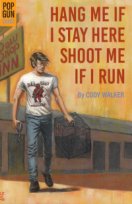
Hang Me If I Stay Shoot Me If I Run (2024)
by Cody Walker

Book coverBook cover

I bought these books last weekened at Rublecon where Cody Walker was the only author or comic book artist (actually, he’s both) present. And as I was done with The Emerald Elephant Gambit shortly thereafter, I delved into these books in fairly short order.

I dived into Hang Me If I Stay Shoot Me If I Run first. It’s a short (122 pages) book which includes the title novella along with a handful of short stories set in the fictional town of Pinhook, Missouri, which just happens to be up the road (Highway 13) a piece like Bolivar, Missouri. Where the author is from. In the novella, a kid from the area returns with a dead dog in his trunk and holes up in a local motel. He has just burglarized a home in the Rivercut neighborhood (just east of Nogglestead). He meets up with the housekeeper/night manager of the motel, a woman of her own ill repute, and they decide to rob a local church run by a preacher with a predilection for philandering and then the local fair run by a man whose money and influence comes from dodgy sources, including the manufacture of meth. When the final reckoning comes, though, the young man is willing to sacrifice himself for revenge. Other stories in the book deal with a gay couple trying to live their lives in secret in Pinhook; an older woman finds that strangers unburden themselves to her; a young woman deals with the attentions of young men and a skeevy uncle as she hopes for college acceptance which will take her away; an older man has had a health episode and is supposed to be resting, but he wants to go to the coffee shop to trade knives; and a young couple seeking to get married finds some resistance from the church.

I mean, I can see a little bit of Winesburg, Ohio in it, albeit with a bit more modern sensibility and them to it. It’s not poorly written, but it does lack a little depth to it that I’ve kind of alluded to before. Kind of like college level classwork or stuff you might find in a writing group. Of course, back in the day–the early part of the 20th century–they filled whole magazines with these kinds of stories.

Loot the Bodies is a collection of poetry. Interestingly, most of the poems are pretty short–maybe the longest clock in at under 30 lines–but the book is printed on very large paper and not in 4×6 size, which means there’s a lot of white space in the 88 pages of poems. The book also includes a couple of short stories at the end; again, slice-of-life material. The poems are okay. Better than Rupi Kaur instapoetry and better than the grandmother poetry I often read. Again, the sort of thing that you might have spotted in mid-century general interest magazines in the 20th century.

Which is odd because the author looked too young to have spent too much time in the last century.

At any rate, I have, what, six more of the author’s books from Rublecon? I’m not feeling compelled to read them all at once, but they’ll be pleasant enough when I get around to them.

Buy My Books!
Buy John Donnelly's Gold Buy The Courtship of Barbara Holt Buy Coffee House Memories

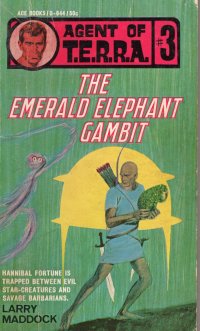
Book Report: Agent of T.E.R.R.A. #3: The Emerald Elephant Gambit by Larry Maddock (1967)

Book coverSince I just read the second volume in the Agent of T.E.R.R.A. series (The Golden Goddess Gambit), I figured it would be the best time for me to polish off the other volume in the series that I have. As the series total is four books, so I have now read half of the series, and I don’t own the others. Given that the series only lasted four books that came out in rapid succession (both books I read came out in 1967; the first came out in 1966 and the last in 1969 according to Fantastic Fiction), I probably won’t run across the remaining volumes in the wild, and I’m not inclined to order them.
So, in this book, a researcher embedded in Mohenjo-dara before the barbarian invasions is tasked with collecting information about the civilization for the home office. A couple of days before she is to leave because the barbarians are going to conquer and raze the village, a UFO appears in the sky, claiming to be Indra and offering to protect the village if the villagers will give up their gold and valuables as a sacrifice. The researcher calls for help, and Hannibal and Webley come to the past and uncover a plot from their enemies in the Empire to accumulate gold from the era. Hannibal has to put things back in order, including convincing Divodasa, the ruler of the barbarians, to settle down in the area as he did in the prime timeline.

So it’s an entertaining little yarn. It’s as though the author went through the first volumes of The Story of Civilization and poked his stories into the gaps in history. Well, not the Durants’ work; the book contains a for further reading section which does not include Our Oriental Heritage. But it could. Much of the book is adhering to the special rules of time travel, one of which is that a person cannot be present in the same time twice, which leads to some planning for jumping backwards and forwards for an hour or so.

Somewhere between rocket jockey juvies and men’s adventure fiction, but a quick fun read just the same.

Buy My Books!
Buy John Donnelly's Gold Buy The Courtship of Barbara Holt Buy Coffee House Memories

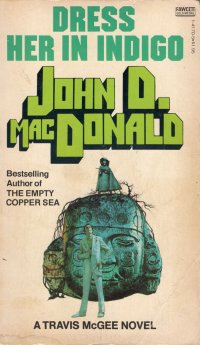
Book Report: Dress Her in Indigo by John D. MacDonald (1969)

Book coverI guess it has been nine years since I read a John D. MacDonald Travis McGee novel (three, actually, in A Tan and Sandy Silence and Two Other Great Mysteries which also includes The Long Lavender Look and Bright Orange for the Shroud) and five years since I’ve read McDonald at all (On the Run in in 2019). As I might have mentioned then, I’m pacing them out.

In this book, a wealthy businessman asks McGee and Meyer to go to Mexico to find out the circumstances in which his daughter was living before she died in an auto accident, perhaps while drunk or high. She had fallen into a bad crowd and had travelled to Mexico with them, and McGee and Meyer find layers of intrigue as they try to find her associates. The father of the other girl in the group has also come to Mexico to find his daughter and is also trying to find himself and get tuned into the youth culture. A wealthy woman emerged from seclusion, although the two girls were staying with her, to identify the body and has gone back into seclusion somewhere around the world. And the group itself descended into drug-fueled madness and free sex, culminating in a plan to use the dead girl’s savings to smuggle heroin into the United States. McGee and Meyer unpeel the layered plots over time with a lot of speculation taking pages along with the normal existential musings you get in MacDonald.

The plot and goings on might have been edgy and shocking in 1969, but you could set a similar story in a high school and play it out on a network television show (not even a cable or streaming show, although presumably if you did you’d get more skin and depicted violence). It has a few anachronisms, like presenting Mexico as a fairly safe destination for travelers and easy border crossings without a passport, but it’s still relatively timely to someone who lived in an era before cell phones and personal tracking devices became a thing. Access to these devices and their pings would have made a much simpler story indeed.

As you know, gentle reader, if you’ve been around long enough and remember previous MacDonald reviews, I like the man’s writing. He writes pulp with a depth of theme and depth of writing that was beginning to fall out of practice in the 1960s. I mean, Robert E. Howard’s work had depth to the writing (but not as much overt philosophizing thematics). Don Pendleton had a little philosophy, but his writing was not as thick and rich. Now, of course, you get length that has replaced depth. I wonder why the writing changed. The nature of the business? The difference between education in the eras? Something, for sure.

So I will continue to dabble in reading the MacDonald, although I have to think I have read most of the popular work, and it would take some doing on my part to figure out definitively what books I have read since I have started tracking my reading and books that I own (I have no way to be sure what I would have borrowed from the library when I was younger) and to seek out the ones I have not. And I have a bunch of projects ahead of me in the queue. So that’s a thing for another day. Meanwhile, I will probably continue to pick the books up when I see them and re-read them as I come across them in the stacks here at Nogglestead.

Buy My Books!
Buy John Donnelly's Gold Buy The Courtship of Barbara Holt Buy Coffee House Memories

Book Report: Agent of T.E.R.R.A #2: The Golden Goddess Gambit by Larry Maddock (1967)

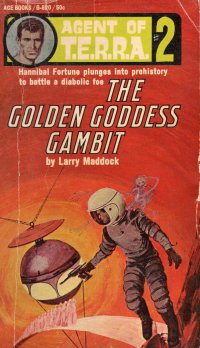
Book coverI picked up this little 1960s-era paperback almost 10 years ago at Pumpkin Daze. It’s the second of a brief series of four books featuring Hannibal Fortune and his alien symbiote protoplasmic partner as they try to protect the natural timeline from changes made by their enemies in a war where time itself is the battlefield.

In this volume, Fortune and Webley, his partner, go back to a continent that will be lost in the sea in the future to find out who Kronos is and why he was worshipped as a god there. They discover that Kronos has planted the seeds of a goddess-worshipping cult but whose queen/goddess figure might not want to share power when Kronos returns. Fortune and Webley foment a rebellion and look to restore the queen’s sister, the rightful heir to the throne.

It’s a short book–158 pages–and moves along pretty well. But I was amused to find myself, again, in prehistoric times on a continent/island that could be Atlantis. It fits in with the history books I’ve read recently (Ancient Mines of Kitchi-Gummi) as well as fiction (the Bucky and the Lukefahr ladies books Walking the Labyrinth and Songs of Three not to mention Robert E. Howard’s work such as The Cthulhu Stories of Robert E. Howard). I’m not even seeking out books that feature ancient Cypriot/Minoan/Celtic/Pictish books at this point, but I keep finding them anyway. Funny how that works.

As it happens, I picked up the third book in the series at the same time, and I’ll probably delve into it soon as well. Heaven knows with all the thick hardbacks in the Nogglestead to-read stacks that I will constantly pick up the small mass market paperbacks instead.

Buy My Books!
Buy John Donnelly's Gold Buy The Courtship of Barbara Holt Buy Coffee House Memories

Book Report: The Cthulhu Stories of Robert E. Howard by Robert E. Howard (2020)

Book coverFacebook must be reading my blog as it seems to know that I’ve read a pile of Howard this year (Tigers of the Sea, Conan the Invincible, and The Hour of the Dragon). So it’s been showing me a hella lotta Dungeons and Dragons suggested/sponsored posts. And, in June, an ad for this book, which I proceeded to order from Amazon.

The stories certainly do not have the flavor of Lovecraft’s stories of the mythos (or other writers who followed him). Instead, they only share some thematic elements, specifically that alien races preceded man on the Earth, including Atlantis which sank beneath the waves.

The book includes:

  • “The Shadow Kingdom”, a Kull the Conqueror novella wherein Picts help Kull to learn that an ancient shape-shifting snake people have infiltrated his palace.
  • “The Skull Face”, a novella wherein an ancient magician has laid plans in the shadows to unite non-white races to overthrow the white men around the world and establish his own global empire. The magician ensnares an opium-eater in London as his thrall, but the man recovers himself to ally with the authorities to try to stop the plot.
  • “The Children of the Night”, wherein a modern Englishman is hit in the head and regresses to a previous life where he was a barbarian hunting the Children of the Night, an ancient race of non-humans, and when he returns to the present day, discovers one of his cohort is a desendent of them. This story has elements of the mythos and refers to the Call of Chulhu and other texts shared across the mythos.
  • “The Gods of Bal-Sogoth”, a novella similar to the Wulfhere/Cormac Mac Art stories from Tigers of the Sea blended with Kipling’s “The Man Who Would Be King”. Two enemies are cast ashore on a remote island where the savage population has been ruled by a white woman who was their goddess until unseated by the practitioners of the old religion. She hopes to use the two to regain her throne.
  • “The Black Stone”, a story wherein a traveler in the back roads of Europe decides to visit a mysterious monolith and has a vision of an ancient race celebrating a black and eldritch ceremony in the distant past.
  • “People of the Dark”, wherein a modern man goes to a cave in a plot to kill his rival in a love triangle, but a blow to the head regresses him to a past life wherein he was Conan and entered the caves to capture a woman but has to unite with a rival to fight off a subterranean race. Then the modern man un-, de-, or re-regresses to the present day, he saves his rival and love from the remnant of the ancient race.
  • “Worms of the Earth”, a novella wherein Bran Mak Morn summons an ancient race to attack Romans who have crucified on of his citizens.
  • “The Thing on the Roof”, wherein an adventurer who has stolen a temple gem asks for help from an antiquarian to discover the meaning of its power in an old book.
  • “The Haunter of the Ring”, a story wherein a man’s newlywed bride seems to be trying to kill him, and it’s tied to a cursed ring given to her by a jilted lover.
  • “The Challenge from Beyond”, a story written in the round by many authors. C.L. Moore starts off with a conceit about a man finding a strange cube in the wilderness and gazing in it; A. Merritt extends the story; H.P. Lovecraft sets his stamp on it by setting up how it’s a mind transfer probe from a distant and ancient worm-like race to seek habitable planets to plunder and populate; and then Robert E. Howard and Frank Belknap Long turn it into one of their stories by explaining how the human mind transferred to the worm body conquers the worm planet due to the violence only human consciousness brings but rules as a benevolent despot. It’s funny how Lovecraft turns the story one way and Howard and Long turn it into one of their style stories at the end.
  • “The Fire of Asshurbanipal”, wherein two adventurers in the Middle East are pursued in the desert but seek refuge in an ancient city feared by the locals, and, in it, they discover a gem in an ancient idol. Before they can steal it, though, their pursuers find them, bind them, steal the gem for themselves, and deal with the deadly consequences.
  • “Dig Me No Grave”, wherein a man asks another man to help with a ritual that an old, old man who recently died tasks the man to perform on his death. It turns out to be an eldritch ritual releasing the man’s soul to the evil it had been promised.

So some of the stories have a modern-day setting to them that more closely aligns with stories in the Cthulhu mythos, but others are more straight-forward Howard stories.

I thought the book was a cheapo collection of public domain stuff, but it’s actually more than that: It’s part of the MFA program at Western Colorado University where students put together and publish a book. So it’s not riddled with typos and stuff (I saw one), and I have a couple of design notes I’d add. The page headers have the author’s name on left pages, but on right pages, they have the name of the novella if it’s a novella or the book title if the heading is on a short story. I’d have made it consistent, probably with the book title and story/novella title (the book title has the author name right in it). Also, the last chapter of the novella “Skull-Face” appears in the table of contents as its own short story (and the heading of the right pages does not have the novella title but the book title). Still, I have an eye for that.

I guess the program/publishing house has published a couple of other books, but I’m not going to run out and get them–I got this one just because I have been so much on a Conan/Howard kick this year. But binge reading them (if three or four books over six months is “bingeing”–) really highlights the tropes and repeated motifs that make the material seem less fresh. So I’ll likely put them down for a bit now.

Buy My Books!
Buy John Donnelly's Gold Buy The Courtship of Barbara Holt Buy Coffee House Memories

Book Report: The Last Best Hope by Ed McBain (1998)

Book coverI passed over this book which was on the outer rank of books in the hall for a number of years. Even when I’m in the mood for a McBain, which happens from time to time (such as when I am working on the Winter Reading Challenge), I pick up an 87th precinct book. This is a Matthew Hope book, the other series McBain did, about the attorney in Florida. I am sure I read a number of these when I was younger (the series ran from 1977 to this book in 1998), but I’ve only read one since I’ve been reporting on books for this humble blog (Rumpelstiltskin in 2004).

Matthew Hope is an attorney who has a team of investigators working for him; in this book, a woman hires him to find her husband who walked out on her and went up north. Presumably, she wants to divorce him or have him declared dead. So Hope and his team swing into action, and a corpse turns up with the husband’s wallet but is not, apparently, the husband, the start to unravel a complicated plot for a heist that involves a couple of different bisexual love triangles and plans to steal the heisted cup of Socrates from the original heisters.

The story occurs partly in real time and partly in flashbacks amongst the good guys and the bad guys and features a team-up with the detectives of the 87th Precinct as they look into what the husband did when he was up north in The City.

But, ultimately, although the good guys catch on at the end, it relies a little on coincidence to put Hope at the museum as the heist occurs, and a quick climax with bloodshed and finis!

Yeah, ultimately, I don’t like the Matthew Hope books that very much. I am pretty sure I have one or more amongst the to-read shelves here (including, likely, one or more that I have already read), but I will space them out. Maybe every twenty years or so.

Buy My Books!
Buy John Donnelly's Gold Buy The Courtship of Barbara Holt Buy Coffee House Memories

Book Report: Ancient Mines of Kitchi-Gummi: Cypriot/Minoan Traders in North America by Richard Jewell (2000, 2015)

Book coverAs I mentioned when I bought this book on June 20, I fully expected to read it fairly quickly as its premise matches that of the Bucky and the Lukefahr Ladies books I’ve read recently (Walking the Labyrinth and Songs of Three)–that is, that a Hittite travelled with Minoans to the Americas a couple millennia B.C.

Also, I actually read an academic book about the copper mining ancient peoples in Michigan back around 2008. I got the book through Inter-Library Loan at the Old Trees library from something I’d read in a History or Renaissance magazine; the volume I got was a numbered book out of a thousand published, and I forget from how far away it came. I pored through my book report archives here and did a quick search of the old Blogspot blog, but I cannot find a book report for it. Which is odd; I thought I did them all, but perhaps I did not do this one because it is not or was not available on Amazon, and there was a time when I thought I could monetize this blog (spoiler alert: no, and it hasn’t served as much of a spring board to book sales, either).

At any rate, that previous book was an academic work by a university professor, but this book is an amateur work, a labor of love, by a guy who’s had numerous jobs including working for the United States Forestry Service in the upper midwest which sparked his interest in this topic. He wonders where all the copper that the natives mined went and why they seemingly stopped mining it and regressed to hunters and gatherers about 1200 BC.

He lays out reasons why he believes the Minoans were able to sail beyond the Mediterranean, up the coast of Europe, to Britain and then Greenland and Iceland and beyond where they established trading posts and helped the natives to mine the copper which they then brought back to the Mediterranean. He refers to something called the Newberry Tablet, a stone tablet found under an uprooted tree (which also happens in Walking the Labyrinth) with cuniform writing as well as similarities between Algonquin written language and Cypro-Minoan script.

The book is not very well written; it repeats itself and is a bit stilted in spots, not like academic speak though. It’s a bit informed by cable television history, but you know what? This guy has done some research, and he has traveled to Europe and the Mediterranean to view artifacts in various museums. He says that the establishment does not take his theory seriously, and I believe that’s true whether his theory is true or not: The academy selects for people who will not rock the boat and will parrot the established narratives to ensure continued funding and employment.

So the book presents an interesting theory, one worth considering, even if it’s just to use the concept for a series of fantasy books that I’ll get back to by and by.

Buy My Books!
Buy John Donnelly's Gold Buy The Courtship of Barbara Holt Buy Coffee House Memories

Book Report: Last of the Breed by Louis L’Amour (1987)

Book coverAfter reading Songs of Three, the second Bucky and the Lukefahr Ladies book, I considered jumping into the next, but instead, I picked up this Louis L’Amour title that I bought in 2022 after reading A Trail of Memories: The Quotations of Louis L’Amour.

This book is not a Western; instead, it is an 80s-style thriller, sort of. It still has some Western tropes and overtones as befits the particular story.

Major Joe Makatozi is an Air Force pilot testing an experimental aircraft in Alaska when he his forced down in the Soviet Union and is taken prisoner to a camp in Siberia where he will be interrogated about American aircraft. However, Joe Mack is a full-blooded Sioux who grew up in the wilds of Idaho, so when he makes a plan to escape the camp, he has a better-than-usual chance. So he does make a break for it and lives off of the land with a plan to walk across Siberia to the Bering Strait and to cross it somehow as his ancestors did. He uses all the skills he learned in the wild to hunt, trap, and skin animals using mostly bow and arrow. He spends some time near a village of outcasts, falling for the de facto leader, a lovely woman whose father is a disfavored professor, but another of the outcasts betrays them, so he must flee without her to continue his journey alone.

The book cuts from his perspective (all third person perspective) to several others, including the colonel in charge of the camp and the program to kidnap and interrogate Westerners of note; the Yakut (native Siberian) tracker on Joe Mack’s trail; the colonel’s mistress, a woman on her way up in the party; a furrier who bought furs from the village that came to the attention of the colonel’s mistress because Joe Mack’s furs were better than the others; the woman from the village who flees with her father ahead of the Soviet raid; even the betrayer gets a couple of pages for his perspective. I mean, what’s a lengthy thriller without the jump cuts?

At any rate, it does run on a little long, with some of the characters’ introspection repeated (not word for word, but the same sentiments are reiterated several times). And the ending comes pretty abruptly; about page 300 or 310 of 364, I wondered how it would all get wrapped up, and to be honest, a bit quickly and ambiguously. Perhaps L’Amour thought about continuing it in another book but wrapped it up here instead. But although an enjoyable read, a little unsatisfying in the end.

Still, after reading it, I did pick up 11 other L’Amour books. So make of that what you will. An endorsement in action if not in a twee blog post.

Buy My Books!
Buy John Donnelly's Gold Buy The Courtship of Barbara Holt Buy Coffee House Memories

Book Report: Songs of Three by Shirley Gilmore (2018)

Book coverThis is the second book in the Bucky and the Lukefahr Ladies series; I read the first, Walking the Labyrinth, immediately before it.

So this book only clocks in at 584 pages before appendices, which is shorter than Walking the Labyrinth, so it’s got that going for it, which is nice. It’s also a little more soap opera than the preceding book.

In it, the people of Turn Back are having dreams of a cave. Secrets emerge as Bucky learns that her father, erm, fathered a child after a drunken encounter while on a book tour, and that the mother sent pictures of the baby until communications stopped when the baby was about a year old. In an amazing coincidence, that is the boy next door–the boy whose parents died when he was only one year old and is being raised by his great-grandmother, and it turns out that since he is Simon, the father’s son, the boy is not actually the great-grandmother’s blood relation. Meanwhile, Bucky, the 10-year-old girl, has dreams about her mother returning and trying to kill her. This comes to a head when the mother actually does show up, eight months pregnant and seemingly unaged since her disappearance. We learn about the two types of others who come from elsewhere and can cross over at mystical springs like the one at the old resort where they live, and they think Simon is a great Hittite who did them a good turn several thousand years ago. After a blow to the head, Simon starts having visions that he is such and that he and his wife and even Bucky have been intertwined through many incarnations. Things with the local fundamentalist preacher who has been harrassing Bucky and Simon come to a head in a sudden climax that should take him out of the picture in future books. And they find a cave with Minoan writing along with some Latin from later Spanish visitors. Oh, and I forgot to mention Ian, the boy next door, gets hurt near the cave and part of the book is his recovery.

I am not sure what to make of the reincarnation themes intertwined with the church-going. I wonder where that will lead.

But the book is thick with details and incidents of everyday life in Turn Back, and the plot events are few and scattered over the book’s length. I mean, the writing is easy to read and the pages fly by, but about page 300 of this book, I realized I was 1000 pages into the ongoing saga and not half done. So I will take a break from this series and read something else (besides poetry) for a while.

I think reading these big series is easier when they come out at a book a year; however, a shelf full of them and thousands of pages daunts me. Not just this series, but I have Stephen King’s The Dark Tower series (complete, I think). I read the first two right after college, but they got thicker as time went on, and I collected the rest, and there they sit behind me, thousands of pages. I’ve probably mentioned this when binge watching episodic comedies recently (Red Dwarf and Sledge Hammer!). They, too, were easier to watch back in the day in weekly installments rather than dedicating weeks of nightly watching to plow through them all. It’s a harsh realization as I have a lot of DVD sets and book series to somehow plow through. Perhaps here and there, a bit at a time, as they were intended.

That said, the books are pleasant and easy to read. I get the sense they’re more cozy fantasies for older ladies, who might be more interested in the geneology that plays heavily in it, the church events, and the cooking. I will get through the rest of the books I have from this author before long, and I’ll buy others in the series when I catch her at ABC Books. So let that be my endorsement.

Buy My Books!
Buy John Donnelly's Gold Buy The Courtship of Barbara Holt Buy Coffee House Memories

Book Report: Shin Splints by Dorothy Stroud (2012)

Book coverI got this book at the same time as I got The Way at the Friends of the Library book sale, and it make sense given my shopping habits there the last couple of years: Pore over the dollar records, pore over the dollar videos, pore over the dollar audio books, and then glance at the dollar poetry books and maybe literature section, and only sometimes do I make my way to the Better Books to look at old books, local interest, art monographs, and audio courses. This particular book was sold alone and not part of a tied set of chapbooks and pamphlets, which means I paid a whole fifty cents for the single volume. Was it worth it?

Well… It’s a two sets of poems totalling 57 pages. The first set deals with watching high school track meets, and the second set deals with school. The poet was a teacher, and her husband was a coach, so that’s where she got her ideas from. The poems are short, and the lines are very short–three to five words each most of the time, very action-oriented with a dash of imagery here or there. I mean, not bad, but not the best.

And you would think I would be the audience for this. Or sympathetic at least, as I have satten in bleachers this last spring cheering on my son who decided to do track in high school after a year off. The cover image is a track meet from field level with mountains in the background. Our photos are not as exciting. They’re from the cheap seats, and our perspective on our long-distance runner and a bit of the inner football field, maybe, is less descriptive than the photos of old. We can look back on them and say what school or gym they were in in middle school, but in the tightly focused shots this spring, they all look the same. Perhaps I shall try a wider focus next year. Oh, wait, this is a book report. Back to it….

The author has an acknowledgements page where she tells you that four of the poems had previously appeared in four different magazines/journals/zines/Web sites, and that’s nothing to sneeze at. Coffee House Memories has an acknowledgements section that is only slightly longer, and I was trying to be a poet at that time–and I really have no pub credits for poetry after like 1997, so perhaps I just don’t know what the market will bear.

Someone, though, thought enough of this book to buy it in 2012 from Amazon for $4.99 plus $3.99 shipping plus sales tax according the a paper folded inside the back cover. I cannot count this as a Found Bookmark; even though it’s a sales receipt, it’s not of a particular place or shop. It’s not even like pamphlets/flyers that came with some of the volumes of various mail-order collections which detail the book and so on. I think I’ll feed this into the shredder presently. Let that be a marker of what I think of Amazon packing lists in books I buy secondhand.

Buy My Books!
Buy John Donnelly's Gold Buy The Courtship of Barbara Holt Buy Coffee House Memories

Book Report: The Way by Salesian Missions (1983)

Book coverI got three of these little Salesian Missions poetry collections a year ago at the Friends of the Library Book Sale, and this is the first of them that I’ve found to read. Actually, I had it on the lamp table beside the sofa upstairs which became a minor book accumulation point after last summer’s vacation, where I carried the habit of lying on the sofa reading a book home. But a couple of collections of poetry (including this one) lingered there since autumn or winter as I’ve started a new tradition of reading a magazine in the chair in the bedroom as the final step-down to bedtime.

This book was a free giveaway to potential supporters in mail campaigns in the 1980s. I remember that one or more of them passed through our household, although I am not sure whether my sainted mother would have given money to them. After all, Salesian Missions is a Catholic charity; perhaps they had my father’s name on the envelope, as he was nominally Catholic.

This volume is 32 pages of grandmother poetry focusing on religious themes, but generic Christian religious themes–you get Jesus and you get God, but no Mary. The small pages are akin to Ideals magazine, with the poems set on pages surrounded by illustrations of homey and old-timey scenes and landscapes. Basically, the target crowd overlapped a lot with people who would subscribe to Ideals. They’re poems, too, not prayers; some are addressed to God, but most of them talk about God instead. Quality varies from meh to okay, but really, this is everyday poetry, the kind that people who were not academic poets or kept by patrons wrote. Normal people. I mean, jeez Louise, my father wrote poetry not unlike this. So it’s not designed to be profound, meaningful, or obscure to differentiate the Poet from the Rubes without advanced degrees in literature. So it was nice, and a quick read, and I suppose it could fit into one’s daily devotions if one were so inclined.

At any rate, it was a quick read, which I needed as I’ve been reading large tomes lately. And I kind of look forward to the little respites (and the incrementing of the annual blog total).

You know, I wish some of the charities wishing to entice me today would send out little books of poems. I get a lot of come-ons from Catholic charities (but not Salesian Missions) as a subscriber to First Things, Touchstones, and maybe The New Oxford Review. I get a lot of address labels, a couple of notepads, a coin from time to time, and a pin once, but no poetry. I guess the middle class of potential donors has moved on from reading for the most part, more’s the pity.

Buy My Books!
Buy John Donnelly's Gold Buy The Courtship of Barbara Holt Buy Coffee House Memories

Book Report: Walking the Labyrinth by Shirley Gilmore (2017)

Book coverI got this book and four others in its series and a related stand alone novel in July 2022 in a trip that was noteworthy as I had instructed my oldest on how to parallel park, and he drove us to ABC Books. Reading the book comes at a parallel time as my youngest is completing his instruction and needs to learn how to parallel park. Will we make it to ABC Books as well? Maybe not.

At any rate, this book is the first in the series about a 10-year-old girl who moves to a small town, Turn Back, in southeast Missouri. Her father, a famous and successful mystery author, has bought an old spring resort to keep her in seclusion because every time she cries, mysterious scars on her back open, and she bleeds. She might be his daughter, though, as the author’s daughter disappeared one night in her crib and someone else apparently took her place–a larger baby whom the author raised by himself as the wife disappeared shortly thereafter.

So they come to Turn Back and try to keep to themselves, but a neighbor boy about Bucky’s age is drawn to them, and they meet his great-great grandmother who is raising him, and they start to attend the local Methodist church which leads to Bucky beginning a “prayer walk” in the city park which leads to the participants sharing dreams, first of mastadons (which stop when flooding reveals a number of mastadon fossils) and about ships (which stop when they find an ancient stone with Hittite markings on it). Along the way, hints of a greater mystery are doled out: Did ancient seafarers reach the center of the United States? Why does the father keep calling Bucky Imala by accident? The major conflict, such as it is, is with a local firebrand preacher who torments the prayer walks as sinful and calls the father “the Devil.”

I am not sure that the cozy fantasy exists as a genre, but that would describe the book. It is just short of 700 pages, and for that bulk, not a lot of plot happens. To be honest, some of the characters outside the father and daughter are still kind of ciphers. But we get a lot of what it’s like living in a small town, going to church in a small town, and so on. We get chapters, chapters where the characters have dinner or hold a talent show, which doesn’t exactly drive the plot forward. But the writing is very good, and it carried me along so that I would read over a hundred pages or even two hundred pages in a sitting and only then think critically, “but what has happened?”

The book ends with a solution to one of the mysteries, but others remain for solution in future volumes.

So, gentle reader, what do you think: Will Brian J. jump right into the next volume or read something else in the interim? Stay tuned!

Buy My Books!
Buy John Donnelly's Gold Buy The Courtship of Barbara Holt Buy Coffee House Memories

Book Report: The Hour of the Dragon by Robert E. Howard (2008)

Book coverI was going to say that I just read this, but it turns out that “just” in this case means ten years ago as this title, the only Conan novel that Howard wrote, was included in The Bloody Crown of Conan.

In it, Conan has become king of Aquilonia, but the Zemedians hope to conquer Aquilonia and place a puppet on the throne, so a shadowy group resurrects a sorceror who has been dead several thousand years. When Conan arrays his forces against the invaders, a magic spell paralyzes him in his tent, so he sends out a friend in his armor to lead the battle. But the friend is killed by magic along with much of the cream of the Aquilonian forces, and Conan is captured. He escapes from his dungeon and has to go looking for a jewel that can thwart the sorceror so he can reclaim his kingdom. Along the way, he rejoins some of his colleagues from his corsairing days and has to outwit a vampire in an ancient temple while being stalked by assassins from the east.

So it’s a good yarn, but the whole get-the-sorceror’s-gem plot is very close to Conan the Invincible. So I’ll probably lay off the Conan and sword-and-sorcery titles for the nonce.

The book also contains “The Hyborean Age”, which is Howard’s accounting of the history of Conan’s world and ties it in as unknown history of our world in a forgotten age. But I bogged down in it. It was a lot like reading from The Story of Civilization but without the benefit of making progress in that set. And I just read it. Ten years ago.

Still, it’s nice to revisit these stories and re-read them.

I’ve also determined how much this particular pulp style has influenced my own writing style. I’ve found myself chaining prepositional phrases a bunch, and Howard does that, too. It adds a bit of rhythm to the in-your-head reading that the staccato of choppier sentences lacks. I’ve sometimes tried to iron that tendency out of my writing, but perhaps now I will embrace it a bit more. When I get around to writing any fiction or anything aside from this blog and the occasional LinkedIn post, that is.

Buy My Books!
Buy John Donnelly's Gold Buy The Courtship of Barbara Holt Buy Coffee House Memories

Book Report: Conan the Invincible by Robert Jordan (1982)

Book coverThis book is another of the paperbacks I bought in Berryville in 2021. Clearly, I’m all-in on the Conan/Robert E. Howard books this month (see also Tigers of the Sea and….well, the book I’m reading now, which we will get to by-and-by). This one was written by Robert Jordan who would later become known for his Wheel of Time series which I haven’t picked up, as large fantasy series daunt me these days when they’re mostly done and you can see the thousands of pages ahead of you sitting on a bookshelf. A bunch of Conan stories and novels, though….

At any rate, in this book, Conan is in town and is hired by a “merchant” to steal some jewels from the king. The merchant is actually a member of a circle of sorcerors looking to get his/its hands on a gem to use against a more powerful sorceror. Conan’s attempt is thwarted when he discovers five dancing girls in the palace wear the pendants. He plans to come back the next night and vows to rescue the girl whom he met, but as he prepares to depart, another group steals the gems and the girls, and Conan strikes out after them. Along the way, he rescues the red-haired leader of a band of raiders, keeps one step ahead of the soldiers looking for the raiders (whom they presume has stolen the gems), and confronts the very wizard who should not get his hands on the gem.

It’s a rip-roaring book, pulpy but more modern than Howard’s work, and something that would not be written today. I liked it and will consider picking up the other Jordan Conan books if I see them in the wild.

Buy My Books!
Buy John Donnelly's Gold Buy The Courtship of Barbara Holt Buy Coffee House Memories

Book Report: King Solomon’s Mines by Rider Haggard (1885, 1961)

Book coverI picked up this book, another Berryville score, simply because it was not a Robert E. Howard or Conan book. I’ve passed over Haggard’s She on a couple of occasions–it’s on the book shelves in the hall, which I have looked through when looking for something to read from time to time, but never seemed the right moment for it. This title, on the other hand, shares the title with one of the two Richard Chamberlain Allan Quatermain movies from the 1980s–which was on Showtime, so I saw it a bunch. So I picked it up first amongst the Haggard books. The two I have. As it turns out, this is the first Quatermain book and the book Haggard published before She, so I accidentally got the order right.

So: A British nobleman and a retired Navy captain engage Allan Quatermain, an old elephant hunter, to take them into uncharted Africa in search of the nobleman’s brother who sought to find the legendary mines of King Solomon. Quatermain comes up with a map from an explorer from several hundred years ago purportedly showing the way, and they take off, doing a little hunting along the way. They encounter difficulties crossing a desert and then the mountains, but they find Wakanda Kukuanaland, a hidden tribe in a fertile valley surrounded by mountains. It is ruled by a brutal warlord who deposed his own brother and who follows the advice of an ancient witch who encourages him to conduct annual purges of tribesmen to keep himself in power. Quatermain and party convince the natives that they’re from the stars, but when the warlord starts to doubt, the group helps the most noble of their porters, Umbopa, the son of the deposed king, to lead a rebellion. After which they are shown the mines by the witch, who dies trying to trap the men in the mines. They escape with but a couple pockets’ full of stones but with their lives, and they find the nobleman’s brother at an oasis on the way back to civilization.

So the film, which I saw over and over, differs greatly from the book as it was recast/recut into an Indiana Jones-style adventure (so common in the 1980s) with a female love interest and whatnot. Still, it made me want to watch the films again.

I was going to call this book a cross between Rudyard Kipling and Edgar Rice Burroughs, but that’s a bit dismissive. The book is credited with being the first of the “lost world” (not “hollow world”) genre, which means it spawned the whole type of adventure story that would influence Robert E. Howard and generations of pulp writers. And Rider Haggard and Rudyard Kipling were life-long friends.

The book might get knocked for its colonialism and portrayal of African natives by facile interpreters hungry for an A or tenure, but it, like so many works, provides a fairly balanced view of Africans as human with a variety of virtues and vices, but that they did not have the Gatling gun and organization that set the West apart at the time. It’s a shame that the work gets dismissed for academic clout and huzzahs. This is a Penguin edition, though, which meant that at least as late as the 1950s it was studied in school.

It reads like a piece of the time; the writing is vivid and has a great deal of depth, but it’s a little slower than pure pulp. Still, it’s not especially archaic, and it should be accessible to any literate person of our time.

So maybe I will get to She sooner rather than later, but I do have a lot of more pulpy works from Berryville which I will likely get to first especially as they have remained together instead of being scattered amongst the Nogglestead stacks.

Buy My Books!
Buy John Donnelly's Gold Buy The Courtship of Barbara Holt Buy Coffee House Memories

Book Report: Tigers of the Sea by Robert E. Howard / Edited by Richard L. Tierney (1979)

Book coverAh, gentle reader. You are forgiven if you think that I’ve not been reading much these days, but it’s sort of true. I’ve divided my evenings between watching DVD sets that I bought twenty years ago (like Red Dwarf) with reading, and in that reading, I have taken up the second volume of The Story of Civilization, The Life of Greece. I’ve been interspersing it with the old hardback Houghton Mifflin poetry primers like The Deserted Village and Other Poems and Longfellow’s The Courtship of Miles Standish and Elizabeth), but instead of 19th century writing, I picked up a volume of Alexander Pope from the 18th century which is harder to read and is not as compelling of a narrative. So I picked up this little paperback, part of my 2021 haul in Berryville, Arkansas, to intersperse with all of the above. And it was just what I needed.

This book collects a set of stories featuring Cormac Mac Art, a Gael, and Wulfhere, a Viking leader, in their various adventures in Britain not long after the Romans retreated. We’ve got four stories of how the odd couple and the ship which follow a fairly basic pattern of Cormac infiltrating and then the Vikings bringing the hammer, whether they’re tasked to rescue a princess or dealing with Picts or what have you. They’re fun reads, but they’re not going to stick with you. To be honest, I finished the book two weeks ago, and I could not easily nor quickly distinguish between the four stories by their titles (“Tigers of the Sea”, “Swords of the Northern Sea”, “Night of the Wolf”, and “The Temple of Abomination”) nor by a quick skim of the contents of the first. So a fun read, but nothing to stick to your ribs.

Still, this might be my reading pattern going into the summer: A little of the Durant, a little of the old-timey poetry, and then one of the Howard and Howard-related paperbacks from Berryville. There are worse things, and they’ll ensure that I keep slogging at the Durant.

Buy My Books!
Buy John Donnelly's Gold Buy The Courtship of Barbara Holt Buy Coffee House Memories

Book Report: The Deserted Village and Other Poems by Oliver Goldsmith (1894?)

Book coverAfter reading a century-old copy of The Courtship of Miles Standish and Elizabeth, I quickly picked up another one of these old, old elementary school (!) textbooks. This one bears the copyright date of 1894 but is likely newer. Although it has an owner’s name penciled in, it’s less legible and would likely yield a less interesting account of the previous owner.

So: Oliver Goldsmith is most known for The Vicar of of Wakefield, but these poems are what really put him on the literary map right about the time of the British Transcontinental Civil War Revolutionary War (we won, we call it what we want).

“The Deserted Village” is a response to the industrial revolution and how the rural areas were depopulating as people moved to the cities for work. Wow, this was a thing before the 20th century? Of course it was; but by not reading these things in school any more, we don’t need that perspective about how some things, themes, and sentiments or concerns precede the solutions that salesmen and politicians would offer us today for our completely novel troubles. “The Traveller” is a, well, travelogue of someone visiting the continent and comparing the different places and their foreigners to England (which is clearly the best). A couple of shorter poems appear to fill out the thin (96 page) volume.

These poems and The Vicar of Wakefield represent the bulk of Goldsmith’s work (although he had a couple plays put on and a couple other novels). But he was lauded in his time. We have forgotten so many of the people who were big literary stars in their time.

The poems are easy to read. Long lines and end rhymes, attention to rhythm. Meant to be read aloud, perhaps to friends, but that’s not how the party people do it these days.

So, again, suddenly I am enjoying these century-old poem collections, so don’t be surprised to see me pick up another in the future. So many of the ones I have, though, are Longfellow, so I will try to pace them out.

Buy My Books!
Buy John Donnelly's Gold Buy The Courtship of Barbara Holt Buy Coffee House Memories

Book Report: The Prophet by Khalil Gibran (1922, 1962)

Book coverI bought this book in 2007 (that’s right, seventeen years ago, when I was attending more than one book sale per weekend whilst living in Old Trees), and I picked it up now because I just read The Rubáiyát of Omar Khayyám, and I was prone to confusing the two. After all, both were Middle-Eastern-flavored collections of poetry and parables which were huge in their day and which were still found around middle class households in the late 70s and early 1980s. I am pretty sure that my “rich” aunt and uncle had a copy of this book if not both.

So: The frame is that a “prophet”–a wise man or hermit of some sort–has lived on the edges of an island’s society for some number of years, and a ship has come to take him to his native land. So as he makes his way to the docks, the people want him to make a speech, and he does: 90 pages of individual poems on the philosophy of various topics such as friendship, death, prayer, joy and sorrow, and so on.

To be honest, it kind of read like a garlic-infused Rod McKuen for the most part, but some segments hit me. Like this one:

You may give them [children] your love but not your thoughts,
For they have their own thoughts.
You may house their bodies but not their souls,
For their souls dwell in the house of tomorrow, which you cannot visit, not even in your dreams.

Day-um. As I mentioned, my oldest graduates high school next week. So, yeah, this rang true.

Also:

Your reason and your passion are the rudder and sails of your seafaring soul.
If either your sails or your rudder be broken, you can but toss and drift, or else be held at a standstill in mid-seas.

So to call it Lebanese Rod McKuen diminishes it too much. It’s lightweight poetry, easy to read, with aphorisms that will speak to a variety of readers spread throughout. It’s poetry that you could read aloud with the lyric and narrative rhythms to match. And with a taste of the exotic even though Gibran was Lebanese-American and not tenth century Persian (like Omar Khayyám). Still, the sum of these parts explain why the book was very popular; the hardback I have was the 67th printing, forty years after the book first appeared. I wonder if it’s still in print and still read–given that the author was a hyphenated-American, he would not have been eliminated from the curricula based on race.

As I mentioned, I picked up the musical version of it this weekend, and I will have to give it a listen soon. I bet it translates pretty well to music.

Buy My Books!
Buy John Donnelly's Gold Buy The Courtship of Barbara Holt Buy Coffee House Memories

Book Report: The Big Frame by The Gordons (1957)

Book coverTo be honest, I don’t know where I got this book. It doesn’t show up in almost twenty years’ worth of Good Book Hunting posts, and it has no distinguishing price marks. So did I pick it up before the turn of the century? Inherit it from my aunt? Who knows? All I know is that it is bound in the light brown Walter J. Black-esque cover used by book clubs that sent you books on subscription in the middle of the 20th century. This is, in face, a Doubleday Crime club selection. Only one book in the cover, though, unlike the three-in-one book club editions of which I have many.

At any rate. This is a police procedural, but it is more in the vein of what you would find in an Ed McBain novel than the one I read earlier this year (Blood Count, which is almost thirty years younger than this book but reads much older). The book has multiple plot lines: A police detective is hunting for a murderer in a case going cold, and he suspects a local private investigator/fixer is behind it. The PI’s current mistress suspects he is about to throw her over, so she has turned informant, but the PI suspects it. So one of his hard men is watching her, and the hard man hatches a plan for her to escape which involves killing and disfiguring another woman in her place. Meanwhile, the police detective is scheduled to testify before a state legislature hearing about corruption in the police department, and a local newspaperman dogs him in service of that syndicate to get him to change his testimony–even digging up the fact that the detective’s wife tried to be a prostitute before he arrested her and later married her after she’d gotten a real job.

I cannot help compare it to the disappointing Dell Shannon/Elizabeth Linington book. This one has a moving plot, maybe a little too complex in places, and the characters are for the most part well-developed. The book contains some series business–presumably the courtship/marriage/etc with the detective and his wife was mentioned in earlier books, and they have two adoptive children who probably played a part in earlier books. But it’s handled well and doesn’t overwhelm the main plot–actually, some of it actually influences or affects the main plot.

The end doesn’t quite resolve everything, but the main points/crimes are covered. Perhaps a little too patly, but one could say the same about one or more McBain novels. The location is never really identified clearly–it seems Californiaish but the places are not sharply identified, which is good as things would have changed in the last seventy years enough to make it dated.

I noted a couple of things in the book to comment on:

  • About the only hard facts in the case were that she had been shot twice in the left lung with a .32 between the hours of 10 P.M. and 4 A.M., and that she had been found by the ten-year-old around eleven the next morning.

    People were always getting shot with smaller caliber guns in old books; .25s and .32s. Nowadays, it’s .38, .45, or 9mm. You could also have told, in the old days, that I read a lot of old books because I thought my first handgun would be a .32.

  • He heard the record player spinning. Sarah Vaughn and Dave Brubeck.

    Perhaps these books seem less dated to me because this could be any night at Nogglestead in the current year.

  • He fired for the target his ears picked up, and again there was bursting and splintering of glass, explosive in the cavernous stillness. He heard two more blasts and lay suddenly quiet, mystified they had found no mark near him.

    He was still a long time, his hearing reaching out with such intensity he felt the ache in his head.

    After letting off a couple of rounds, even .38, I would suspect his hearing was not that acute.

  • Chico, only ten, was an I-NS case, a Mexican illegally in the country and scheduled to be shipped back any day now.

    All right, this dates the book. The boy is one of the adoptive children, a Jewish refugee who ended up in Mexico before coming to the US. It probably made more sense in the book in which it happened.

  • “Most of us have little pet tunes–and they often give our age away.”

    “Hearts” by Marty Balin and “The Pocket of a Clown” by Dwight Yochum aside, during the time I was reading this book, I might have sung or hummed any number of tunes that would give my age away. Although they don’t come to mind right now. Never mind.

  • He laughed, and then remembering what an iguana was, said, “Great Caesar’s ghost!”

    Which is funny, because last week, while I was reading this book (but before I got to the last page, where this quote appears), I said “Great Caesar’s ghost!” in a LinkedIn comment. I, of course, remember it from the old George Reeves Superman television show (which I did not see in first run, thank you very much) where Perry White, editor of the Daily Planet, exclaimed it once per episode (except the one where he sees Caesar’s ghost, of course).

At any rate, I took great comfort and courage in enjoying some mid-century crime fiction. I read a bunch of it when I was a kid, when it was but thirty years old, and I liked it. But some of the things I’ve read recently (recently might here mean “in the last quarter century”) have had me a bit down on it and reluctant to read more. Which is a problem, since I still have 42 of the 3-in-1 book club books that I bought in 2009 to go through. Slowly. But perhaps not as slowly as if this book had sucked, which it did not.

Buy My Books!
Buy John Donnelly's Gold Buy The Courtship of Barbara Holt Buy Coffee House Memories