A Home That Would Drive Me To Book Fairs

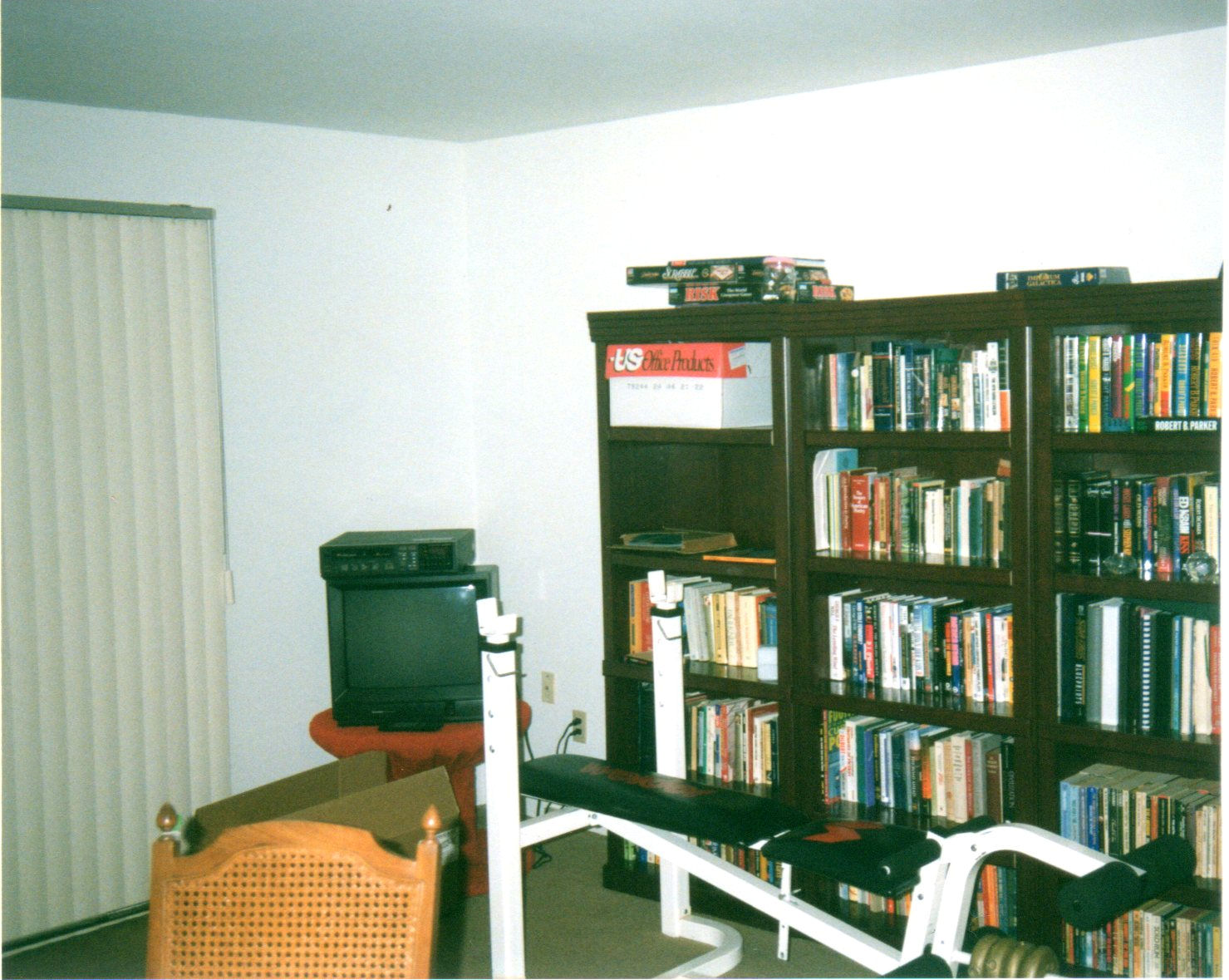
Eat Ants sends me a link to this house composed entirely of bookshelves and asks if that’s my dream house.

Probably not; I like having more traditional looking bookshelves or a classical library instead of modern Japanese urban design.

The above Web site is the architect firm’s Web site, I think, so the pictures are of the bookshelves empty. I’d rather see pictures with them full of books to get the real flavor.

Buy My Books!
Buy John Donnelly's Gold Buy The Courtship of Barbara Holt Buy Coffee House Memories

EPA Moves To Protect Rodents

Won’t someone think of the cute little vermin? Sure, the Environmental Protection Agency will:

To better protect children, pets and wildlife, the U.S. Environmental Protection Agency announced today that it is moving to ban the sale to residential consumers of the most toxic rat and mouse poisons, as well as most loose bait and pellet products. The agency is also requiring that all newly registered rat and mouse poisons marketed to residential consumers be enclosed in bait stations that render the pesticide inaccessible to children and pets. Wildlife that consume bait or poisoned rodents will also be protected by EPA’s actions.

That’s what happens when you commission an agency acting on orders to protect an amorphous concept like environment with lessening consideration for protecting people, citizens, individual liberty, civilization, or a host of other concepts that make environmental protection much less agency possible at all.

Link via Tam K., who envisions:

Maybe we can do for bubonic plague what we did for malaria!

Buy My Books!
Buy John Donnelly's Gold Buy The Courtship of Barbara Holt Buy Coffee House Memories

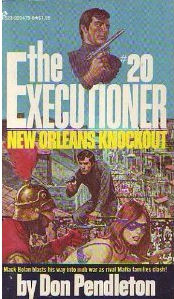
Book Report: Texas Storm by Don Pendleton (1974)

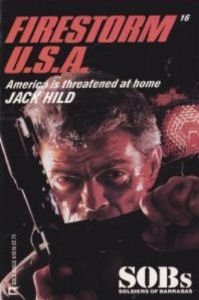
This book finds Mack Bolan, the Executioner, winging into Texas to take on the Mafia there. In this particular book, Mack rescues a hostage, buys an old fighter jet to hit important men with mob connections in three cities in rapid succession, and destroys what might be an attempt to create a new petro-state out of the former Republic of Texas. The books are very similar in the series, but each has its own plot and twists, so they definitely keep fresh. Also, they’re books on can tear through to make quota.

Books mentioned in this review:

Buy My Books!
Buy John Donnelly's Gold Buy The Courtship of Barbara Holt Buy Coffee House Memories

Perhaps I’m Unclear On The Concept Of “Door”

A sign on the window to the tiny balcony at our hotel in Kansas City:


Here's your sign

Perhaps I’m a little unclear on the concept of door, but it seems to me that a door in use is closed since the function of a door is to partition space with a variable setting of partitioning space or allowing passage. To me, the “on” setting actively partitions the space, whereas the inactive or “off” setting, that is the setting that would exist if the door was not even there, allows passage.

Ergo, I would not think you could lock a door when it is not in use, since a door not in use is open.

Of course, it is possible I overthink things.

Buy My Books!
Buy John Donnelly's Gold Buy The Courtship of Barbara Holt Buy Coffee House Memories

Book Report: Lord of the Rings trilogy by J.R.R. Tolkien (1972 ed.)

This year, I decided to bone up on my geek bona fides and read some geek lore that I’d previously skipped. Although my beautiful wife read the trilogy ten years ago when the films came out (I said TEN YEARS AGO, granpa!), I didn’t. I also missed out in my youth in the middle eighties to read these in the formative years where they’d have had the most impact and I’d be a slavish fanboy. As it is, I am not.

You know the plot, surely, so I won’t bore you with going into it. Instead, I’d like to point out the book that The Fellowship of the Ring (yes, I know, Tolkien himself called it the Company more than the Fellowship, blah blah blah. I did catch that) most reminded me of was Kim by Rudyard Kipling. They both feature very lush descriptions of exotic locations populated with strange (to us) people, and both feature someone who is elevated to play a big role in The Great Game/The War of the Ring. Both feature Roads which cut through the wilderness. I don’t know if any serious scholar has seen it and written a dissertation on it, but you could definitely put a deep comparison through the works.

That said, Lord of the Rings might be a touch too lush for optimum enjoyment. Its very populous cast of characters makes it hard to relate to a single person within it as the reader’s proxy. The best you can do is Sam Gamgee. Even Frodo is a cipher, really. And you need that proxy when running through dozens of pages of elaborate history/description/meeting of the minds to get to the next brief bit of action–although by the beginning of The Two Towers, we get to more action, but by splitting the Fellowship into two or three parts and giving us complete books without Sam, it can still be a slog to read.

Also, note I did not read the appendices which account for something like 200 pages of the final book. Seriously, more of the lush background and description with none of the action and, ultimately, none of the relevance to the story at hand? Maybe, as I say, this would have been more relevant had I grown up a decade earlier or read these books in my younger, more time to kill days.

That being said, I do have the rest of the Tolkien canon, and I will get to it eventually, but not right away. This stuff is rich and deep and dense–more so than Kipling himself–and I need to tear through some books to make sure I make quota this year.

So it’s worth reading if you fancy yourself a geek, and it is a 20th century classic that will probably be studied and relevant in the future when so much is not. But steel yourself. This is not a comic book nor a 20th century American thriller.

Books mentioned in this review:

Buy My Books!
Buy John Donnelly's Gold Buy The Courtship of Barbara Holt Buy Coffee House Memories

Book Report: Vintage Reading by Robert Kanigel (1998)

I read this book before I read The Well-Stocked Bookcase, and I liked the genre enough so that I decided to read the latter, too, in addition to checking another book of the type from the library (returned unread, as the completion of this book and then the aforementioned The Well-Stocked Bookcase sort of put me off of them for a while).

This book stems from a newspaper column for the Baltimore Sun, where he read and wrote book reviews on classic literature. The early part of the book deals with actual dyed-in-the-wool classics, and as I read his book reviews on them, it really made me want to go on to read the books themselves. Then, the chapters wander into more contemporary nonfiction and into lesser books by noted authors, and suddenly it veered into that “my stamp on classics” territory.

Still, a good read, and you’ve probably recognize the titles of most. I won’t enumerate them here to clutter up your skimming. Suffice to say, I have most of the classics he mentioned and don’t remember any of the non-classics he talks about.

Books mentioned in this review:

Buy My Books!
Buy John Donnelly's Gold Buy The Courtship of Barbara Holt Buy Coffee House Memories

Why Do You Think I Need To Know This?

Whenever the northeast, that is, New York City and Washington, D.C., get severe weather, Weather.com puts a banner atop my local weather to give me this relevant and ultraimportant news:


This just in: This won't affect you

Seriously, this won’t affect me. I don’t care what trials and hardships those in the corridors of rule suffer. Temperatures near 100 degrees? Here in Missouri, we call that summer. Tornadoes? Here in Missouri, we call that spring.

It’s just OMG! to people who have not traveled outside of the northeast. Seriously.

Buy My Books!
Buy John Donnelly's Gold Buy The Courtship of Barbara Holt Buy Coffee House Memories

Book Report: Jersey Guns by Don Pendleton (1974)

This book marks Pendleton’s return to the series after the one-off Sicilian Slaughter by Jim Peterson. By comparison, it’s a better book. Also, it’s clear that the book was planned to be number 16 in the series, as it mentions 15 different campaigns and begins the same way as 16, with Bolan wounded and needing attention. Instead of going to a bad doctor in Manhattan, though, he’s taken in by a brother and sister on a New Jersey farm. Actually, since Bolan was unwounded at the end of Peterson’s book, they had to graft a wounding into the first chapter. But it’s pretty clear what happened in the real world. Also, the back has a bio and photo of Pendleton to show he does exist and does not (yet) represent a stable of writers.

Bolan has to recuperate in hiding while the mob searches the countryside for him. He does, but his benefacting farmers are captured by the mob, so Bolan has to conduct a rescue instead of just hitting and gitting.

Contrasting a bad Bolan book with a Pendleton Bolan book really puts the latter into stark relief. The books often begin with epitaphs from famous poets and philosophers followed with a Bolan quote to spin it; the books also feature cast-off allusions to classical literature that one finds in a lot of WWII veteran-aged pulp writers that you don’t really see in modern popular fiction. Telling.

Books mentioned in this review:

Buy My Books!
Buy John Donnelly's Gold Buy The Courtship of Barbara Holt Buy Coffee House Memories

Department of Education SWAT Teams

If those words aren’t enough to make you vote for smaller government, perhaps the full headline will. Dept. of Education breaks down Stockton man’s door [This headline and story have been removed]:

Kenneth Wright does not have a criminal record and he had no reason to believe a S.W.A.T team would be breaking down his door at 6 a.m. on Tuesday.

The U.S. Department of Education issued the search and called in the S.W.A.T for his [estranged] wife’s defaulted student loans.

The federal Department of Education should be abolished and have all its cowboys lay down their arms.

Somehow, though, being a Tea Party conservative makes me a fascist, but supporting a regime that kicks in doors for debts incurred pursuing useless -Studies degrees is humanitarian or something.

UPDATE: An updated story doesn’t reassure me much:

U.S. Department of Education spokesman Justin Hamilton confirmed for News10 Wednesday morning federal agents with the Office of the Inspector General (OIG), not local S.W.A.T., served the search warrant. Hamilton would not say specifically why the raid took place except that it was part of an ongoing criminal investigation.

Hamilton said the search was not related to student loans in default as reported in the local media.

OIG is a semi-independent branch of the education department that executes warrants for criminal offenses such as student aid fraud, embezzlement of federal aid and bribery, according to Hamilton. The agency serves 30 to 35 search warrants a year.

My point remains: The Department of Education has no point busting down doors with its own SWAT team for any reason.

UPDATE II: My update tracks with Tam’s.

Buy My Books!
Buy John Donnelly's Gold Buy The Courtship of Barbara Holt Buy Coffee House Memories

Brian J. Recommends

Almost 20 years ago, I saw The Visit at the, uh, Milwaukee Repertory Theater when I was in college. What, you don’t believe me?

The Visit program from 1994

Sorry, I get confused sometimes. The PAC or whatever the heck they call it now down on Wells Street was a theater complex that had a number of plays running sometimes simultaneously. Was I at the Pabst? Was I at the Caberet? Which theatre was I at that night? I went to so many.

Damn you unbelievers! Even though I was a college senior at Marquette University, I was working 50 hours a week to pay tuition and to take women to the theatre. Why, my senior year of college, I saw The Norman Conquests, all three of them, with three different women. Actually, I saw Table Manners twice with two different women because I booked them incorrectly, as the Rep was rotating them nightly and I got my nights confused.

Damn you unbelievers! Even Marquette women would let me escort them to the theater (where many had never been) when I bought the ticket (with money I made between classes and extracurricular activities and invitations to the Rep by slinging produce for 50 or more hours a week as acting manager of the Produce section of a Shop Rite). Of them, only one was a freshman kind of impressed by the attention of a senior.

So you’ll excuse me a bit of triumph here if I can’t recollect exactly which of the women who thought I was good enough for a theatre ticket as friends with which I saw this piece performed lo, those years ago.

No, what is important is the comment I made to her as we walked out: “I hate fascism.”

Heavens to betsy lou! Was it Linda, the woman-girl with whom I’d exchanged notes in the Fall semester philosophy class and who, through some miscommunication, did not know my sorta interest until the Spring? After this play, we went to a bar, and she accused me several times of patronizing her until I said, “Well, it’s all over now, you might as well drive me home.” Could be.

Where was I?

Oh, yeah, this play about Fascism and what it (metaphorically) entails is being put on by the Stray Dog Theatre in St. Louis this month.

If I still lived in the area, I’d be all on that like a stray dog on…. Well, you fill in the metaphor.

Buy My Books!
Buy John Donnelly's Gold Buy The Courtship of Barbara Holt Buy Coffee House Memories

Book Report: Sicilian Slaughter by Jim Peterson (1973)

This book follows Panic in Philly, which I read way back in 2007. That book report contains the immortal lines:

Of all the series I’ve sampled this year, this is the least likely for a return visit; that’s not to say that it’s bad pulp, but it’s the worst of the pulp I’ve read this year.

Something changed by the time 2010 rolled around and I read Missouri Deathwatch and Arizona Ambush. Maybe I got better acquainted with pulp. But I changed my mind about the Executioner series.

But about this book: This book was not written by Don Pendleton; I read somewhere it was about a licensing dispute or something. So this take on Mack Bolan is more straightforward brutal than Pendleton’s philosphical (at times) hero. A couple of the set pieces involve Bolan killing people that I don’t think Pendleton’s Bolan would have, and in theatrical fashion with bad “numbers” (Bolan’s calculation of the odds, a recurring trope).

At any rate, wounded Bolan goes to NYC to get healed up after the Philadelphia adventure (and has to kill the doctor who helps him). He then decides to go to Italy to take out a training ground for mafia soldiers. He blows stuff up and whatnot. The end.

An relatively unsatisfying outing, but I guess Pendleton was refreshed after his brief hiatus, as the next novel (which I’m currently working on) is better.

Books mentioned in this review:

Buy My Books!
Buy John Donnelly's Gold Buy The Courtship of Barbara Holt Buy Coffee House Memories

Kind Words from Charles

C.G. Hill of Dustbury.com reviews John Donnelly’s Gold.

This really should not have worked as a novel: technical descriptions tend toward the mundane, and most of the techies I know are decidedly short on drama. What makes this worth your time is Noggle’s attention to detail: J. Random Noob will appreciate the extra exposition, and your local expert will nod, “Yeah, that’s exactly the way I’d do that. If I were going to do that, which of course I’m not.” There might be a hair too much geographical exposition — by the time you’re finished you should be able to hire on as a cab driver in St. Louis County — but no matter about that. The plot is more than sufficiently twisty; I’m pleased to report that I did not even come close to predicting the way it ended. And if the dialogue meanders a bit, hey, that’s the way these people talk. I’ve heard them, and so have you.

Buy My Books!
Buy John Donnelly's Gold Buy The Courtship of Barbara Holt Buy Coffee House Memories

Book Report: The Well-Stocked Bookcase by the editors of the Book-of-the-Month Club (1998)

This book updates an earlier edition of the book, wherein the editors of the Book of the Month Club got together to decide what a well-stocked bookcase should include and then included a couple paragraphs of why they think so. The subtitle limits the conceit to 72 Enduring novels by Americans published between 1926 and 1998. The analysis of each book is much shorter than in Vintage Reading, as they more likely reflect the blurbs in the BOMC newsletter than actual news reviews.

So what do they think should be on your bookshelves? (I have italicized those I know I own and have bolded those I have already read.)

Title Author Year
Accidental Tourist Anne Tyler 1985
Alias Grace Margaret Atwood 1996
All the King’s Men Robert Warren 1946
Angle of Repose Wallace Stegner 1971
Appointment in Samarra John O’Hara 1934
The Assistant Bernard Malamud 1957
Bastard Out Of Carolina Dorothy Allison 1992
Because It Is Bitter, And Because It Is My Heart Joyce Carol Oates 1990
The Bell Jar Sylvia Plath 1963
Beloved Toni Morrison 1987
The Bonfire of the Vanities Tom Wolfe 1987
Burr Gore Vidal 1973
Catch-22 Joseph Heller 1961
The Catcher in the Rye J.D. Salinger 1951
Cold Mountain Charles Frazier 1997
The Counterlife Philip Roth 1987
The Day of the Locust Nathaniel West 1939
Death Comes For The Archbishop Willa Cather 1927
Delta Wedding Eudora Welty 1946
Edwin Mulhouse Steven Milhauser 1972
A Fan’s Notes Frederick Exley 1968
A Farewell to Arms Ernest Hemingway 1929
A Flag for Sunrise Robert Stone 1981
From Here to Eternity James Jones 1951
Geek Love Katherine Dunn 1988
Gone with the Wind Margaret Mitchell 1936
The Grapes of Wrath James Steinbeck 1939
Guard of Honor James Gould Cozzens 1948
The Heart Is A Lonely Hunter Carson McCullers 1940
Heaven’s My Destination Thornton Wilder 1935
Invisible Man Ralph Ellison 1952
The Joy Luck Club Amy Tan 1989
The Last Hurrah Edwin O’Connor 1956
The Late George Apley John P. Marquand 1937
Libra Don DeLillo 1988
Lie Down in Darkness William Styron 1952
Light in August William Faulkner 1932
Little Big Man Thomas Berger 1964
Lolita Vladimir Nabakov 1958
The Lonely Passion of Judith Hearne Brian Moore 1956
Look Homeward, Angel Thomas Wolfe 1929
The Magic Christian Terry Southern 1960
The Maltese Falcon Dashiell Hammett 1930
The Man with the Golden Arm Nelson Algren 1949
The Mountain Lion Jean Stafford 1947
The Moviegoer Walker Percy 1961
The Naked and the Dead Norman Mailer 1948
Nickel Mountain John Gardner 1973
Other Voices, Other Rooms Truman Capote 1948
The Postman Always Rings Twice James M. Cain 1934
Rabbit, Run John Updike 1960
Ragtime E.L. Doctorow 1975
The Recognitions William Gaddis 1955
Seize the Day Saul Bellow 1956
The Sheltering Sky Paul Bowles 1949
Slaughterhouse Five Kurt Vonnegut, Jr. 1969
Song of Solomon Toni Morrison 1977
The Sound and the Fury William Faulkner 1929
Studs Lonigan James T. Farrell 1932, 1934, 1935
The Sun Also Rises Ernest Hemingway 1926
Tales of the City Armistead Maupin 1978-1989
Tender is the Night F. Scott Fitzgerald 1934
Them Joyce Carol Oates 1969
To Kill A Mockingbird Harper Lee 1960
The Transit of Venus Shirley Hazzard 1980
The Trees/The Fields/The Town Conrad Richter 1940, 1946, 1950
U.S.A. John Dos Passos 1930, 1933, 1936
The Wall John Hersey 1950
The Wapshot Chronicle John Cheever 1957
What Makes Sammy Run? Budd Schulberg 1941
That Which Springeth Green J.F. Powers 1988
The World According to Garp John Irving 1978

Apparently, my bookshelves are not well-stocked. I must find another book fair, stat! Although it would not surprise me if I did not own more of these titles hidden among my to read shelves and forgotten.

The only one on the list I read but do not own is Catch-22, which I read the summer before my freshman year of college when the big Swedish mechanic next door taunted me for not having read much literary literature and planning to be an English major. He recommended it. Thanks, Mark!

The thing about this sort of popularity contest is that the list tends to be stacked toward more recent books. Or, in this case, books recent to a decade ago. You end up with a lot more “Who?” responses the later you get; I think the “classics” portion of this list really stops about 1960, and anything after it is very suspect. I mean, two books by Joyce Carol Oates? Really?

At any rate, it’s a quick read and hopefully has brushed me up a little about contemporary serious literature, but I’m not sure I’m going to remember anything new except that Carson McCullers is the author of The Heart is a Lonely Hunter.

Books mentioned in this review:

Buy My Books!
Buy John Donnelly's Gold Buy The Courtship of Barbara Holt Buy Coffee House Memories

A Demographic Shift Noted In Macy’s Full Color Insert

It’s the Macy’s Father’s Day Sale. Who are the fathers who will receive gifts from Macy’s?

These guys:

Macy's Father
Macy's Father
Macy's Father

That’s 3 of 6 of the images that have a father and a small child in them. Note that roughly half of these fathers of small children in the Macy’s world have greying or white hair.

(Yes, I know that the second and third pix are of the same model.)

I’m making no value judgments here, just noting.

Buy My Books!
Buy John Donnelly's Gold Buy The Courtship of Barbara Holt Buy Coffee House Memories

A Small Sample Size Does Not Yield Good Predictive Results

The New York Times uncorked this fact, which I’ve seen repeated elsewhere:

No American president since Franklin Delano Roosevelt has won a second term in office when the unemployment rate on Election Day topped 7.2 percent.

Well, okay. But how many presidents have we since?

13. One of whom has yet to run for re-election.

So the 12 who have include:

  • Harry Truman
  • Dwight Eisenhower
  • John F. Kennedy
  • Lyndon Johnson
  • Richard M. Nixon
  • Gerald Ford
  • Jimmy Carter
  • Ronald Reagan
  • George H.W. Bush
  • Bill Clinton
  • George W. Bush

Of those, one died in office, so he could not run for re-election (John F. Kennedy for those of you who went to public school and are not a baby boomer).

Here are the election results and the unemployment rate in November of the re-election year:

Year as Incumbent Unemployment
Harry Truman 1948 3.8
Dwight Eisenhower 1956 4.3
Lyndon Johnson 1964 4.8
1968 3.4 Withdrew
Richard M. Nixon 1972 5.3
Gerald Ford 1976 7.8
Jimmy Carter 1980 7.5
Ronald Reagan 1984 7.2
George H.W. Bush 1992 7.4
Bill Clinton 1996 5.4
George W. Bush 2004 5.4

I’ve added LBJ in 1968 since he was sort of eligible to run again but he withdrew before the primaries, so maybe he would count as not winning a second full term in office (although he did win a second term, his first full term, in 1964).

So, who did not win reelection? Gerald Ford, Jimmy Carter, and George H.W. Bush. That’s three, and it is assured that the unemployment was over 7.2% on election day for those fellows, although in Bush’s case it was coming down. Of course, this statistic does not account for the 1992 candidacy of Ross Perot, who ran on a ticket of more fiscal conservatism than “Read My Lips” Bush.

Why the cutoff at “topped 7.2 percent”? Because in 1984, Ronald Reagan won reelection with that very figure.

By focusing strictly on the unemployment, the New York Times and its repeaters do disservice to other factors, including the mood in the country.

So this factoid is more of a “Huh.” kind of thing rather than something we should accept as a scientific truth.

Buy My Books!
Buy John Donnelly's Gold Buy The Courtship of Barbara Holt Buy Coffee House Memories

Whither Hollywood?

You know what I would pay to see twice? A film starring William Shatner and Shaquille O’Neal.

Shat and Shaq. What would beat that?

Since Hollywood is out of ideas and cannot probably think of something appropriately awesome, maybe a Lethal Weapon reboot with the colors reversed just so Shatner’s Murtaugh could say, “‘I’m getting too old for this s—,’ my dad says.”

Buy My Books!
Buy John Donnelly's Gold Buy The Courtship of Barbara Holt Buy Coffee House Memories

Book Report: Bite Size History by Hugh Westrup (1999)

This is the first book of trivia-stuff or fact-review things I picked up for my upcoming June adventure, and I chose wisely. If I was looking for a quick read, this juvenile book is it. I should start checking publishers so I don’t get snookered by Scholastic.

It’s a quick bit of paragraphs with history vignettes / trivium in it, but it’s not without some trepidation. Any time you run into something in a book that you know is not true, particularly in a trivia book, you have to wonder if any of it is true. In this particular book, the author explains that the origin of the term “jeep” is that soldiers named it after the Popeye cartoon character. Well, that’s one theory of many.

Regardless, if anything in here stuck in my head, hopefully it’s the right questions.

Books mentioned in this review:

Buy My Books!
Buy John Donnelly's Gold Buy The Courtship of Barbara Holt Buy Coffee House Memories