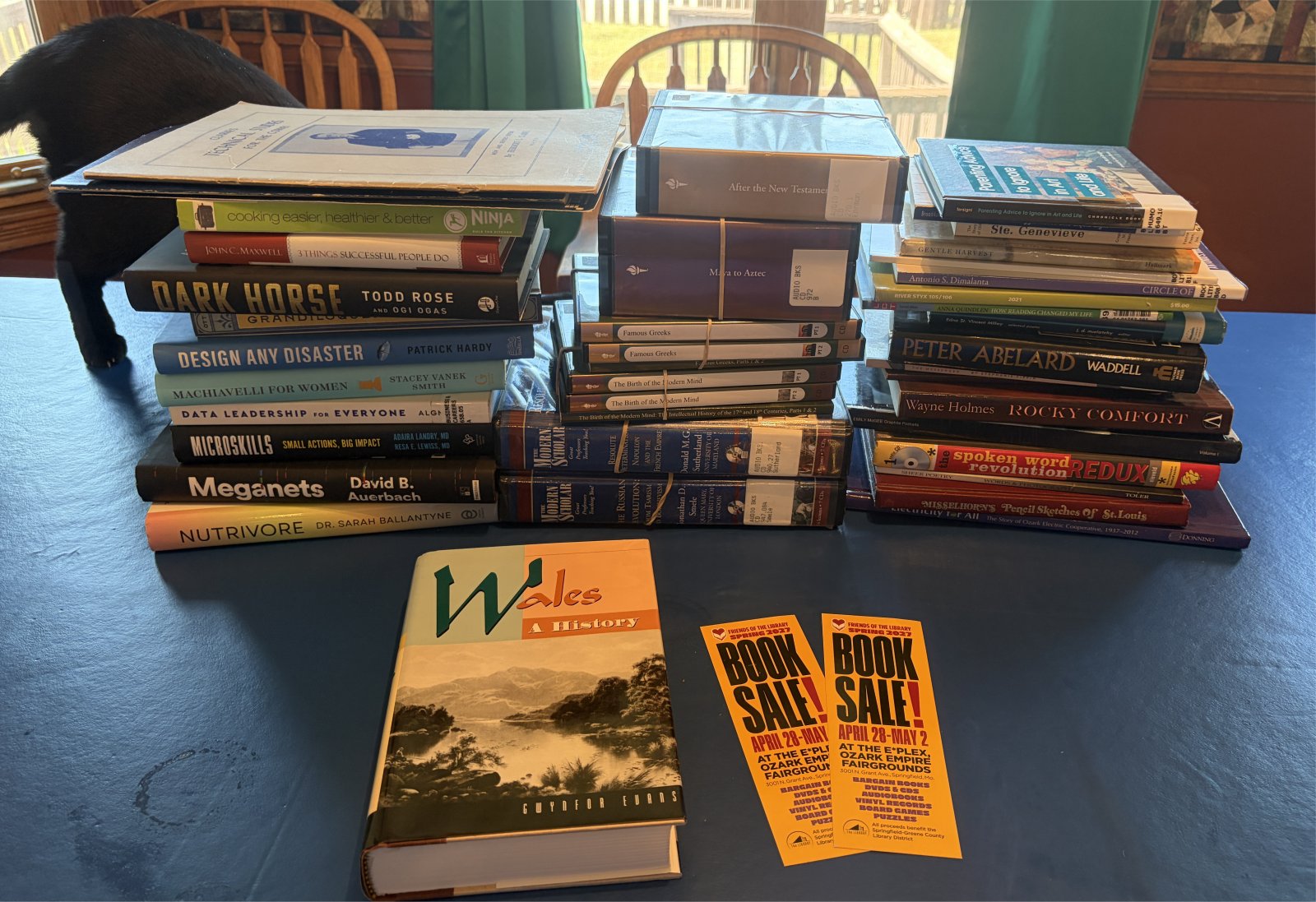
Checkov (Not Depicted)’s Post

I mentioned yesterday when I finished Great Authors of the Western Literary Tradition that I would do a roll-up post of the authors/works in the lecture series as a quiz style list to highlight which authors/works I’ve read (in bold) and whose works are in my stacks to read (underlined).

I will throw the list under the fold because it’s an 80+ bulleted list with some comment. Continue reading “Checkov (Not Depicted)’s Post”

Buy My Books!
Buy John Donnelly's Gold Buy The Courtship of Barbara Holt Buy Coffee House Memories

On Great Authors of the Western Literary Tradition Part VII with Professor James A. W. Hefferman (2004)

Book coverIt’s been a month weeks since I finished Part VI, and, with the completion of this binder, I have completed the whole series–84 lectures in all, gentle reader, started–well, I reported on the first two parts in February, so–earlier this year? Late last year? It seems like a long time.

This set is entitled “Modern Literature” and covers mostly early 20th century authors. Individual lectures include:

  1. Henry James
  2. Joseph Conrad
  3. William Butler Yeats
  4. Marcel Proust
  5. James Joyce
  6. Franz Kafka
  7. Virgina Woolf
  8. William Faulkner
  9. Bertholt Brecht
  10. Albert Camus
  11. Samuel Beckett
  12. Conclusion

As with Part VI, I would have expected to have not read many of the authors, but I’ve read Conrad, a poem or two of Yeats, Kafka, Woolf, Camus, and Beckett, and I have books by Faulkner, Joyce, and James which I might get to someday.

Professor Hefferman focuses on single works, for the most part, but gives biographical sketches and, across lectures, explains the development, particularly in the novels but also in the dramas and poetry, the evolution of modernism from what came before. It does tail off mid-century, but if it went much further, I would definitely not be able to report that I’d read the authors–Roth, Updike, and whatnot.

I cannot help but notice that Faulkner is the only American on the list, so no love for Fitzgerald or Hemingway here.

So: The conclusion talks more about themes that are constant in Western literature (love, the relationship with God or gods, and war) more than tracing the evolution of the forms, but I guess 82 of the lectures covered that.

Does it make me want to read the authors? Some of them, the ones I have/own, I suppose. Other, particularly French authors and playwrights, eh, probably not (although who knows what I might find for a dollar in the wild).

I think I’ll do a proper quiz-style post to brag about which ones I’ve read and which ones I have in the stacks to read on another day. Perhaps a day after I remove the CDs from the player in the vehicle (yes, gentle reader, the completion is that fresh: yesterday).

Buy My Books!
Buy John Donnelly's Gold Buy The Courtship of Barbara Holt Buy Coffee House Memories

At Least The Machines Are Reading Me

Ah, Rick and Friar, I don’t mean to demean your patronage here, but my primary “readers” (that is, data ingesters) continue to be clankers of one variety or another. Chinese LLMs consuming the blog hundreds of pages at a time or Facebook trying to “engage” me more.

Another data point for the hypothesis: yesterday, I post about a local Carnegie library. Today, Facebook shares a post about Carnegie branches all around the state:

Instead of showing me posts from, you know, people I’m connected to on Facebook. Because the machine is not making money showing me their posts.

Buy My Books!
Buy John Donnelly's Gold Buy The Courtship of Barbara Holt Buy Coffee House Memories

Book Report: Childhood by Bill Cosby (1991, 1992)

Book coverAh, gentle reader. As you know, I am a fan of Bill Cosby even now. I’ve read his books (Time Flies in 2004; Love and Marriage in 2004 and in 2011; Cosbyology in 2010; Fatherhood in 2010) and ‘ve watched his videos (including :49 last year, which indicates that the copy of Himself which I purchased in 2024 awaits viewing). And I know it is contemporinternetguache to still appreciate Cosby’s work, but I have expressed my concern about decades-later accusations of sexual impropriety in an post on Brett Kavanaugh when he was a nominee–therefore but for the grace of God go I, and you, too, gentle male reader.

So: This book tackles some stories from Cosby’s youth in the projects of North Philadelphia, when he ran with a group that those of us of a certain age would recognize as the models for the characters in Fat Albert and the Cosby Kids. The book was written after the long run of the cartoon series and after some of the stories likely appeared on Bill Cosby’s comedy records, so I guess in 1991, it might have seemed like recycled material. The anecdotes and their lessons deal with family, siblings, kids playing on the street and amusing themselves, and growing up. Cosby compares his youth to that of the contemporaneous kids (of the 1980s) who get bored and play a lot of Nintendo instead of roaming the streets, inventing their own games with their friends, and improvising amusements. His parents might have said it, but I am sure every generation since has said it, and it’s probably truer now than even in Cosby’s curmudgeonly parenting days.

One chapter, though, is a little, erm, poignant given his 21st century woes: It’s about the pubertyish proto-Junkyard Gang trying to score some Spanish Fly and to dose some of the young ladies of the neighborhood with it. It turns out they’ve bought cornstarch from a Navy sentry, so no hanky-panky occurs, but although in the 20th century, this bit would have been a boys-being-boys story, especially as the ploy did not work, in the 21st century it’s doubleplus ungood wrongthink–and, probably, such spirited hijinks have been trained out of our youth. But, Brian J., they could have poisoned and/or sexually assaulted those girls! Yeah, but they did not. And their failure to do so and the fact that they were taken advantage of makes it funny. Well, amusing.

Ah, never mind. If you’re offended, you’re probably not reading this anyway.

So I’ll watch Himself someday, and I’ll pick up his other books if I see them–it looks like I’m halfway through his written oeuvre, and the 21st century books might be lesser sellers and harder to come by. This particular book is a paperback, but it’s a Deluxe paperback, which means it has a stiffer cover. I thought it had flaps simulating dustjacket flaps for extra copy (as did Hour of Lead), but I was mistaken. Also, note the cover: Emmanuel Lewis, another 1980s sitcom star (Webster, which was an Alex Karras vehicle re-written and re-titled to focus on the adopted son, clearly to piggyback on the success of Gary Coleman’s similar show Diff’rent Strokes). He’s still alive, by the way, but his height and young looks have limited his options in acting, so he has become an entrepreneur over the years.

Buy My Books!
Buy John Donnelly's Gold Buy The Courtship of Barbara Holt Buy Coffee House Memories

Libraries: Little Convention Centers?

When we first moved to southwest Missouri, the branch library in the next town over was in a storefront just over from the Walmart. They were building a new branch, and it opened not long after we settled. I took my young boys to several story time activities there, and it was our home branch for a couple of years before their schooling and other activities took us into Springfield every day. Fifteen years on, the library system decided the town needed a new branch, so they built a new one to replace the still newish (fifteen years old for a library? C’mon, man, like a church building, that’s a pup that has not yet developed character–not that either is built with character any more). Whilst it was being built, I applied for a part-time job as a shelver at that branch, thinking maybe librarian might make a good second career choice for me–probably not, given what modern librarianing is. I was actually called in for an interview, but I demurred–a friend’s daughter also applied for the position, and I didn’t want to take it from her.

So after the grand opening of the new building, my beautiful wife had an (overdue) book to return, so we stopped by the new building which features an auditorium, a computer lab, meeting rooms, and…. One room with books, a small set of shelves which looked like it had fewer books than the previous small branch had.

Last week, as part of the Summer Reading Program, one of the activities was to go to a different branch of the library. I don’t know whether to count the small town (but growing rapidly town, he added to keep the Chamber of Commerce people happy) or the Springfield-Greene County mothership branch as my home branch–I generally choose the mothership as my “home branch” when I fill out the Winter Reading Challenge forms, but over the last couple of years, I’ve only gone into the library to either pick up or return a reading challenge form.

Our travels took us through the middle part of the city (as we went to ABC Books and a street mural, another activity for the summer reading challenge), and we stopped by the Midtown Carnegie Branch. Ah, Carnegie. So you know what you’re in for: An older branch with character. We visited this branch in the summer of 2017, when the boys and I visited all the library branches as part of our own summer challenge (including far-flung branches in the northern part of the county in Ash Grove and Fair Grove, which is in a room at the fire station). This branch has also had an expansion, a modern graft onto the brick and mortar front of the building. When we entered from the rear, we had options to go up or to go down, and I said to the employee/volunteer (?) at the desk inside the door that I wanted to go up to the books, and I went up to find…. Again, fewer books than previously. I went to the philosophy section which was a single shelf, about 20 inches of books–in my previous visit, I picked up Daniel Klein’s Every Time I Find The Meaning Of Life, They Change It (which I just listened to as an audio book in December, so you might have recognized the title). The section was mostly pop-philosophy (not that the Klein was any different), but the total stacks, again, were, what, 12 or 20 sets of shelves? Not a hella lot for a middle-of-the-city branch, and not a lot of primary sources in the mix (I think I’ve written a screed on this before, but I couldn’t find it quickly).

Ah, general reader. I am not a library scientist, but my understanding of history is that, back in the olden days of centuries past, when books became more available, people put together private groups that would trade books amongst them, or private lending libraries made them available, or you could subscribe to lending libraries for cash, and public libraries were designed to democratize access to books for the public.

Ah, but nobody reads now–not many people–and libraries seem to have cast around for new missions to keep, you know, their employees employed. Which is now budget-intensive things like computer labs, maker spaces, and larger and larger meeting rooms and auditoriums (as well as training programs and, let’s be honest, a capex hit on providing me with mugs I rarely use). I should note here that the mothership branch has a decent set of stacks, but it, too, recently underwent an expansion. Not for more room for books, of course, but rather a larger auditorium for programs and, I suppose, to let.

Which is why I draw the comparison to convention centers, at least in terms of the need to refresh (technology, at least) every couple of years. To keep up with modern needs. Which, I reiterate, does not seem to be books.

Is the public library really, really necessary in the 21st century if it is not there to have stately buildings, safe spaces, and books?

You know, I am a fan of privately run community libraries who, run by volunteers and stocked by donations, made books available to the public. However, the ones that I have supported over the years have become public libraries–eager for the certainty of funding and access to, well, funding. I haven’t been to them lately, but I wonder if they have fewer books now that they’re public libraries? To be honest, I think that the Community Library in High Ridge, which I frequented when I was in high school, might have had stacks on par with the branches I visited this month.

So perhaps librarian is not the new career I am looking for. Maybe Library Board would be a better fit, where I could say, Are you serious? and No a lot. Which I’ve already trained for in a long career in software quality assurance.

Buy My Books!
Buy John Donnelly's Gold Buy The Courtship of Barbara Holt Buy Coffee House Memories

Book Report: Hour of Lead by Anne Morrow Lindbergh (1973, 1986)

Book coverI got this book two years ago in a bundle for a buck at the Friends of the Springfield-Greene County Library book sale. So I didn’t pick it specifically, but the book was facing out, so I did not ignore the bundle on account of it.

As such, it is a 32-page gifting excerpt from an earlier, full-length book called Hour of Gold, Hour of Lead. This excerpt deals with handling grief; the title comes from an Emily Dickinson poem, one of the ones in my repetoire when I was doing open mic nights. I presume it is–this excerpt never mentions it, but Anne Morrow Lindbergh is a poet. A poignant story behind this particular book is that the space for gift-giving inscription is to Mom for Mother’s Day from Tracy in 1987, which might indicate a loss in the family in the spring or a little earlier.

Lindbergh, in addition to being a poet, was Mrs. Charles Lindbergh, and her 1973-ish musing on grief is based on the kidnapping of their child and discovery of its body. Hope, then dashed, and then the aftermath. The author find her journals from those days decades later and produced Hour of Gold, Hour of Lead from it.

A quick read, a bit helpful if you’re dealing with someone’s death. Better than A Very Easy Death by Simone de Beauvoir, maybe not as good as Love’s Legacy by Stephanie Dalla Rosa–but this book is but an excerpt, so maybe the whole thing is better or more broadly focused than these two.

But as a gift. On Mother’s Day. Man, I feel that.

Buy My Books!
Buy John Donnelly's Gold Buy The Courtship of Barbara Holt Buy Coffee House Memories

Don’t Tell Me I’ve Nothing To Do

My brother just “retired” with veteran’s benefits and disability, so I asked him on the third day of his retirement if he was making tick marks on his wall.

He mentioned counting flowers on the wall, and I asked him “Gatlin brothers or that other guy who is twenty or thirty years ago now?”

I was thinking of Eric Heatherly.

Ah, gentle reader: Before you ACKSHUALLY me (the semi-modern PDWL!), I have remembered via researching this post that it was the Statler Brothers who did it first.

Ai, they were both old when I was young (Eric Heatherly notwithstanding).

But when Sue F. came to visit us in our trailer in 1985…. I am pretty sure she said the bass Statler brother looked like an alcoholic, and I said he just looked fat. And then I swallowed the echo of my words, because she was overweight. Forty years later, I might be one, I might be both, or I might be neither.

But, no, the Gatlin brothers did not do that song.

Also, if you’re keeping track: Note that in 2000, I was listening to country and oldies. It would be decades before I got into metal, but a little less before I got into jazz.

Buy My Books!
Buy John Donnelly's Gold Buy The Courtship of Barbara Holt Buy Coffee House Memories

There’s Your Residual Benefit Of The AI Bubble

Some people comment that even if AI tech spending is a bubble, it will have the same benefit of leaving behind infrastructure like the dot-com bubble did. However, other critics indicate that LLM-hosting data centers will leave infrastructure designed pretty narrowly for LLM-hosting.

But here is what might be the lasting positive, should there be one–Meta is launching a $115 million training program for blue-collar workers to build AI data centers.

Those skills will be transferrable.

(Link via the Springfield Business Journal.)

Buy My Books!
Buy John Donnelly's Gold Buy The Courtship of Barbara Holt Buy Coffee House Memories

Book Report: The Rape of the Lock and Other Poems by Alexander Pope (1901?)

Book coverAfter listening to the fifth part of the Great Authors of the Western Literary Tradition lecture series, which included a lecture on Pope, and specifically on “The Rape of the Lock”. And, brother, did that come in handy.

Ah, Pope. The man is more the parts than his sum.

This collection has three poems: “The Rape of the Lock”, which is a poem in five cantos totaling almost 800 lines that depicts an aristocrat who takes a lock of hair from a young woman for his collection, but the poem seems given over to a very detailed description of a card game which is not a game I’m familiar with; “An Essay on Man” which is written to a Henry Bolingbroke (not the Shakespearean Henry Bolingbrokes, though, as Pope was writing in the first part of the 1700s which was 100 years after Shakespeare who himself was writing 200 years after the Henrys in question) and comprises about 1500 lines in four “epistles” which describe man’s nature, nature, and God and the interrelationships and proper places of each, including reason and instinct/passion/what have you; and “Epistle to Dr. Arbuthnot” is a shorter piece, 419 lines, and covers some of the same themes.

Pope writes in couplets, and many of them are eminently quotable. But the individual poems themselves are long, and you might wonder where it’s going–which is why the lecture helped. Pope helps himself by including a summary of the contents of each epistle in “An Essay on Man”, and footnotes by Pope himself and editors of various editions (the original and this edition, presumably) tell us the names of the contemporaneous people Pope is talking about, but that’s not exactly a help or driver into reading large stretches at a time. I exercised some discipline in reading sections, cantos, or epistles completely, much of the time, but this is mostly drawing room poetry to amuse or irritate aristocrats of the time. So while one might want to and actually quote Pope on occasion, it’s not something that many in the 21st century will read for pleasure (see also the complete works of Percy Bysshe Shelley, the second and longer part of The Complete Works of Keats and Shelley, set in a holding pattern behind a stack of literary magazines and Ideals).

At any rate, let’s see what I flagged during my slog.

  • Trough worlds unnumber’d though the God be known,
    ‘Tis ours to trace him only in our own.
    He, who through vast immensity can pierce,
    See worlds on worlds compose one universe.

    From “An Essay On Man”, early in Epistle I. Given all the headlines about UFOs in government files recently, one question is how religion would adopt. In the 18th century, Pope was nonplussed by it. I imagine the Judeo-Christian religions would adapt.

  • Who wickedly is wise, or madly brave,
    Is but the more a fool, the more a knave.

    I think I will put this on my business cards. If I ever order any again. The last batch has lasted almost 17 years, and the box is still half full, which is how a pessimist describes his box of business cards.

  • One from Grubstreet will my fame defend,
    And more abusive, calls himself my friend.
    This prints my Letters, that expects a bribe,
    And others roar aloud, “Subscribe, subscribe!”

    Shades of the modern Internet culture in penny publishing in the 1700s.

I had a couple other things flagged, but I didn’t remember what I wanted to say about them.

As you can see, the couplets are generally a little epigramatic, flow together, and as I was reading along, I was following; however, at the end of a piece, I was like, “What’s that all about” even though at a high level I knew what and I enjoyed a couple of couplets along the way, the whole did not strike me as greater than the sum of some of the couplets.

Ah, well, I am a product of my times, prefering short, punchy, and pointed poems.

Book coverAfter I read this book, I came upon, shelved just a couple of similar Riverside Literature Series down, “An Essay on Man” in a similar Maynard’s English-Classic Series edition. Unlike the Walter J. Black Classics Club editions, which were marketed to middle class adults, these editions were college textbooks, and it shows. The book I read has faded pencil notes on the front flyleaf, and “Rape of the Lock” has underlining and margin notes. Which, gentle reader, probably means that more than one student used this as I’m pretty sure “dialoging with the text” was not an early 20th century thing. An LLM indicates it was mentioned in an influential 1940 volume called How to Read a Book and became widespread in the 1960s, and this tracks with my experience–editions of classics I have starting in the 1960s start showing this juvenalia marginalia about then. Essay on Man, this other edition, does not indicate such.

I will just move this second book to the read poetry shelves with the one I read, and I’ll put it in by the old and mylar-wrapped complete works of Pope. I have a paperback copy of the complete works of Pope as well around here somewhere, but I won’t be in a real rush to read the rest now.

Buy My Books!
Buy John Donnelly's Gold Buy The Courtship of Barbara Holt Buy Coffee House Memories

The College Literary Magazines Take Me Back

Ah, gentle reader. Last September, in a haul of buck bundles of chapbooks and literary magazines, I got two copies of the Wingéd Lion, the literary magazine (at the time) from Missouri Southern State College (now MSSU) in Joplin.

The issues are dated Spring 1975 and Spring 1978. I would have expected the freshman and sophomores to be present in both, but we really only have a contribution from Sharon Rogers, a junior in 1975 and a senior in 1978 (a part-time student or a long-time student).

Oh, man, did they remind me of my high school literary magazine, Pen and Palette.


Both are landscape (11″ x 8½”) and are on heavy bond paper with heavy covers. The art styles match almost match–the 1970s ones are more in line with its times and the Pen and Palette art represented a lot of good art class projects. But I wondered if the style was shared with a lot of small college literary magazines–Mama Joy, the sponsor of the Northwest Writers club, would have been just about the age to have graduated college in the middle 1970s. After all, 1987, or first issue, was less than a decade after 1978. But, no. I checked the masthead to see if I knew any of the people in it, but also no, although one name, the woman who was both the junior and the senior, seemed familiar, but I couldn’t make a connection.

Ah, those literary journal days. I thought I could make it as a poet and a short story writer, maybe also a novelist, coming out of high school and going into college to write. Here are my contributions to Pen and Palette:

1987:
“A Model Murder”, a detective fiction short story.

1988:

  • “Fall”, a poem
  • “A Shocking Case of Murder”, another detective fiction short story. I had a bunch using the same characters with gimmick twists.

1989:

  • “Shepherd: For Hire: The Sharp Kidnapping”, a satiric short story about a high school student who thinks he’s a detective. Not a true story, but in middle school, I wanted to start an in-school detective agency. I was serious.
  • “Sonnet of Spring” which might have been my first sonnet, actually.
  • “Tyrone Jackson: The Search for Maynerd”, a short story that a group of us wrote in Creative Writing class. It was a story in the round sort of thing, where each group wrote a bit and passed it to the next group. We inserted Tyrone Jackson into all of the stories. I wrote our original story as it should be told, and eventually I wrote a whole collection about this character. I have, of course, told this story before. In 2004. Which is closer to then than it is to now. Man, I wish I still had that binder.

1990:

  • “Adventures and Exotic Places”, a short story with a real Walter Mitty vibe.
  • “Stopping of a Poem by a Thought”, a satiric poem making light of a Robert Frost poem.
  • “The Vigilante”, an unrelated crime short story.

I didn’t have anything in the 1991 or 1992 editions because I’d graduated by then–no three year gaps between my high school junior and senior years–but my brother was still in the writing group, and my sainted mother sponsored for two additional years.

My college, sorry, university, had a magazine which put out a literary “edition” which was a small separate digest in 1991 and 1992, but was rolled into the regular magazine as a supplement in the spring.

I had a poem in the 1991 edition (“a brash young man, ideas set…”) and a poem in the 1993 edition (“Listening to the Night”), but, boy, howdy, look at the table of contents in 1994:

Two of the three short stories (“An Aluminum Dream” and “Shepherd: At College” featuring the same character from the high school literary magazine). Six of the fifteen poems, including:

  • “Chance Encounter”
  • “Homecoming: A Collage”
  • “View from a Railcar”
  • “Upon the snowy pillow next to me…”
  • “Falling Snow”
  • “Third Floor Eyes”

Four sonnets, a long free verse narrative, and on general poem.

I did not win either of the cash prizes awarded–one for fiction and one for poetry–so maybe the lesson I should have taken from my experience is that it was easy to get published, but not so easy to get paid. Although I’m not finding it easy to get published these days in existing outlets that don’t have “Facebook,” “LinkedIn,” or “Musings from Brian J. Noggle” in the title.

Aside from that, though, the main thing (which will be far briefer in account than the lesser thing of Look at me! I coulda been somebody! is how we students were swinging for the fences. Trying different themes, trying different genres (well, everyone except me who stuck to detective fiction mostly), different rhyme schemes and forms for poems…. Reading college literary magazines these days don’t seem as freewheeling.

Or maybe I’ll change my assessment as I get into additional magazines in the stack upstairs–but most of them are college literary magazines where the contributions come from outside the student body (ahem–from people like me). So they might prove to be fairly homogenous and, well, common.

Maybe I should take up a new hobby of prowling for college literary magazine that might contain writers who went on to bigger things. Almost as interesting as collecting gentlemen’s magazines with Stephen King stories, but with a little less nudity. Which is its own reward even if the investment in obscurity does not pay out.

Buy My Books!
Buy John Donnelly's Gold Buy The Courtship of Barbara Holt Buy Coffee House Memories

Book Report: Heathcliff Triple Threat by Geo Gately (1984)

Book coverLike Look Who’s Here, the Family Circus collection I read before this book, I could not find the book listed in a Good Book Hunting report, and it is in really good shape, so I think I bought it for my boys a decade ago and they didn’t read it a bunch. Which is a shame: Heathcliff was fairly big in the 1980s–I remember watching the cartoon series, and we took the St. Louis Post-Dispatch which included it. So perhaps it was just big for me in that moment of my youth. Apparently, it’s still in syndication, although not in The Licking News, the only paper I took until recently which had a comics page.

Ah, gentle reader. Unlike The Family Circus, I’ve read a lot of Heathcliff collections over the years, including:

And the Heathcliff comic book I received for my birthday this year (not reviewed).

Although this book was published in 1984, the copyright dates and the dates on the comic panels themselves indicate 1976 and 1977, and we even have a couple bicentennial-themed panels. Which means that they’re fifty years old now, but aren’t we all?

If you know Heathcliff, you know what you’re going to get: He’s going to dump trash cans (which is what we used back then instead of wheeled bins); he’s going to woo Sonya; he’s going to fight Spike; he’s going to sing on the back fence; and so on. According to Wikipedia, the comic only started in 1973, so it’s very early in the run, so everything feels fresh and not dialed in. Of course, I’ve not read a collection of the paper cartoons in eleven years, so all the tropes would seem kinda fresh just because I’m older than the cartoon itself (aren’t we all? If not, do not taunt in the comments). I probably mentioned before in one of those other book reports that I favor Heathcliff over Garfield (although I have read a Garfield collection in my time) because Heathcliff is more of a Byronic hero than Garfield. Well, perhaps I’m trying too hard when I say “Byronic,” but he definitely was more dynamic.

Ah, gentle reader. That’s really all I have to say about that, and, good news/bad news: I have several more collections I will probably knock off in short order, which is good for the annual book count but I’ll probably have as little to say about them as I do about these last two.

Buy My Books!
Buy John Donnelly's Gold Buy The Courtship of Barbara Holt Buy Coffee House Memories

Brian J. and the Summer Reading Program

As you know, gentle reader, I have been doing the Springfield-Greene County Library’s Winter Reading Challenge for, what, six years now? Yes–2021 was the first year. Each summer, too, the library has a Summer Reading Challenge, but I’ve shied away from them because they weren’t a reading challenge–instead of reading five books in fifteen categories in two months (or in all fifteen categories, as I am a stretch goaler), you read five books in three months but do five activities as well. Kid-kinda activities, even in the adult program.

So I’ve avoided it. Except for this year.

My beautiful wife mentioned it in passing, and so I looked at the flyer for it.

Activities included going to a different branch of the library than you normally do, going to the First Friday Art Walk…. downtown, I think?, downloading the library app, attending a book discussion, going to the Missouri Institute of Natural Science, or doing you own activity (up to three out of five can be your write-ins).

I would have dismissed it again, but….

Well, a couple of things. First of all, my youngest is also at a loose end. He graduated from high school, separated from his high school job, has been slow to hunt for another job, and is prone to spending all day playing Minecraft unless someone shanghais him into leaving the house. I had just done the thing last week, and we went to the co-op to pay our electricity bill, when (second of all) we passed right by the Missouri Institute of Natural Science.

It’s a small museum of paleontology and geology; when a road crew blasted its way into a cave (in the 21st century), they found fossils and whatnot and decided to preserve them. When I say it’s a small museum, I mean two rooms, essentially. When the boys were young, one summer I had free reign (I mean reign)–I was between contracts, and they were out of school for the summer in a time before I was not between contracts, and they spent their summers in daycare “summer camps” at various churches and whatnot. So that summer (after they spent a month in their own school’s “summer camp”), I took them to a lot of local attractions, museums, hiking trails, and bowling–lots and lots of bowling. When we visited then, MINS was only a single room. Ah, but where has the time gone?

I dragged the boy man to MINS, briefly–our visit was but thirty minutes, maybe, and part of that was me swapping old man stories with the old man volunteer who lives nearby. I have, what, three pictures from the trip? Different from the first one, but our digital photography strategy has changed. When the boys were young, we copied all the photos from the digital camera and later from the iPhone. But now, we take a couple of photos when we remember to, and we save only the best to conserve space on gigabytes and terabytes of hard drives. Mostly to save space on the backup devices, which are likely a decade or so behind current storage, although with the trends in current prices, soon they’ll be parate again.

So I started my Microsoft Publisher document for tracking books and activities (Publisher will live long enough for me to finish this reading challenge, as Microsoft is sunsetting it and making it impossible for me to access 30 years of .pub documents–ask me how I feel–but you can probably guess). And then…

The next week, we took a trip to ABC Books (not that one, but the one we mentioned in it. Since we were going to that corner of the city, we could hit another branch of the library–we chose the Midtown Carnegie Branch (can you tell where it came from?). I checked out a book, to be reported on when I finish it. After that, we went to the baseball stadium in town, formerly known as Hammons Field but now called Route 66 Stadium (or is it?) to get a photo by the public mural on it. Bang! We were already three activities in!

Over the weekend, we went to the Pickwick Street Fair. Well, briefly. I finally got to see Kristi Merideth, whose CD I got in in 2016 and whom I mentioned in 2018 had a child in school with mine. I say briefly because the crowds agitated the oldest, and neither of them was impressed that their elementary and middle school colleague was on the stage. Also, they had no seating within the event boundaries to enjoy the music–although we could have gone to the coffee shop next door and sat on the patio, but they were ready to go.

That’s four already, and it’s only the second week of June. Strangely, I am further behind on the books than the activities. And we will finish the activities for the summer reading program this week, probably. Which means I will turn in my “game board” next week and get the unnamed prize.

I have encouraged my youngest to participate as well since I’m dragging him along to the events. And, you know what? I’ll probably find activities for the both of us to tear us away from the computer on the days until he gets a job, I get a job, or he starts his in-person college classes. It will be good for both of us. Mostly me, as it also allows me to return to a summer with two knockabout boys that we spent doing things together.

Now, what should we do today? Plant a summer flower (or flowers) together to complete the reading challenge? Go bowling and to the nature center, just like the old days but just the two of us? The summer reading challenge has suddenly prompted us to the possibilities.

Buy My Books!
Buy John Donnelly's Gold Buy The Courtship of Barbara Holt Buy Coffee House Memories

Book Report: Look Who’s Here by Bil Keane (1960, 1972)

Book coverI might as well macro this bit: I claimed this book when we culled the bookshelves in my youngest’s bedroom in January because I’ve delved into this well–which is a spot on my bookshelves where I’ve put all the cartoon books from that gleaning–several times (book reports forthcoming) and will indubitably do so in the future (to be clear: the book reports are coming, because I need to pad my book total for the year as we are in the month numbered 6, and I’m not in the book total of 50ish).

Sorry. Where was I? Oh, yes. Reporting on a book of cartoons. You know, this looks like it’s only the third Family Circus book I’ve read (the others being When’s Later, Daddy? in 2009 amd I’m Taking A Nap in 2013).

For those of you who don’t know or don’t remember, Family Circus is a daily single-panel cartoon which, Wikipedia informs me, is still running and is the most widely syndicated cartoon in the world. Although it’s a single panel with a single gag daily, some story arcs appear as the family travels to see family, Billy’s birthday is coming, Christmas is coming, et cetera.

And, you know what? I’m of a generation who can still appreciate the warmth and humor of the book, coming at that tail end of the middle century where although the nuclear families were disintegrating, they still dominated popular culture. So I get the tropes, even though these panels would have come out before I was born, but maybe my son would not have. Given how good of condition I found the book, it was not one that they read over and over again like some Lego titles.

So a pleasant couple of minutes. And another book entry for the annual total, which was looking a little anemic before I started knocking out cartoon books.

Buy My Books!
Buy John Donnelly's Gold Buy The Courtship of Barbara Holt Buy Coffee House Memories

On The Best of Benny Hill (1994)

Book coverI got this videocassette last August, so it was atop the second cabinet in the family room, and I’m kinda trying to reduce the overflow so that it only overtops the videogame cabinet and not all of the cabinets that make up our entertainment center and unwatched video library. I’m getting closer to that goal, but I’m always one book sale or garage sale away from buying twenty more videocassettes or DVDs.

At any rate, this is a 1994 collection of skits from his television program which ran from 1955 to 1989. It runs a little under an hour and a half, so to get a bunch in, it jump-cuts between bits. I might have caught a glimpse of it back in the early 1980s–did it run on cable somewhere? I remember my father liked it, as (I am told) did my father-in-law. I mean, it’s a human cartoon, a bit bawdy in places but not exclusively sexual humor, and this collection features only a couple of scantily clad ladies. Hill does a song or two, recites an off-color poem, but most of the bits are topical–a television talk show host having trouble with his guests, a man’s life in under a minute, some workplace humor, and one about the accent of a Chinese visitor to England who encounters–an Indian, I guess–in the customs line (that would definitely not fly today in the West). A lot of the bits use the sped-up or I guess “undercranking” technique to make the action seem cartoonish and jerky. So, I guess if you know who Benny Hill was, you know what you’re getting. But not boobs; this is not Showtime’s take on the short-lived Canadian equivalent Bizarre.

Ya know, some people credit Monty Python’s Flying Circus with bringing down British civilization, but maybe because the Monty Python crew, with their films offering greater exposure to American audiences, via their humor mocking institutions. But here’s Benny Hill, doing it for decades longer than Monty Python’s Flying Circus was on television, and…. No credit. Or maybe it’s because right around the end of the 1960s, the sketch comedy shows stopped focusing on mocking the powerful and instead started mocking one political side over the other. I am sure that dissertations were written along the lines of this argument, but I can’t be arsed to develop the thread more than that. And how would I know? The Smothers Brothers Comedy Hour only lasted two seasons and was off the air before I was born, but somehow it made its way into reruns and syndications that I could see them on television.

At any rate, this videocassette was amusing–moreso than Zombieland which was also an action-“comedy”–and, you know what? If I should come across a larger boxed set, which Ebay has shown me exists, I’ll pick them up. But not for $100 on Ebay.

UPDATE: I am remiss in mentioning that after I queued up this post, VodkaPundit mentioned Benny Hill on Thursday:

Doctor Who, Fawlty Towers, and even Benny Hill’s show soon followed. “Yakety Sax” and ample British décolletage took on improbably outsized roles during my tween years.

Don’t get me wrong. Even back then, I knew that Benny Hill was by far the least sophisticated of the British humor I’d fallen in love with. In fact, “sophisticated” and Benny Hill might never have appeared in the same sentence before this one and the one immediately preceding it. But if there was ever a middle-aged man who knew how to target humor at 12-year-old boys, his skills were nothing short of genius.

He, of course, did not mention reviewing the source material recently.

Buy My Books!
Buy John Donnelly's Gold Buy The Courtship of Barbara Holt Buy Coffee House Memories

Good Book Hunting, Saturday, June 6, 2026: ABC Books

I decided to go to the ABC Books because Mr. C. had a book signing up there–that’s what I told my family because the owner of one of our martial arts schools calls himself Mr. C. because his last name is hard for kids who were not born in Wisconsin to say. But it was not the kyoshi; it was some younger (but not young-young) guy whose books only say Mr. C..

The four books come in two series: The Downfall and The Revelation are zombie apocalypse books set in rural Missouri, and Never Trust Home and Drowning Angels are crime books about human trafficking and a non-profit whose undercover operatives help to gather information for law enforcement. They’re pretty barebone products, so I’d better keep them together and to remember which is which book in each series as the covers do not give that information.

I also picked up The Bible of Karate by Bubishi (?). Well, and on Thursday, June 4, 2026, I also visited ABC Books to buy a gift for my oldest son’s upcoming birthday and picked up a copy of Enoch’s Saga which I thought might be something about the biblical figure by its title, but it’s subtitled Horsepower to Satellite In a Single Lifetime by Enoch Thorsgard of Northwood, North Dakota. So instead of something apocryphal, I got a common man biography of the type I like (but I haven’t read one in a long time for some reason).

So maybe I’ll pick one of these up after I plow through the library book I checked out, the myriad cartoon books I liberated from my youngest son’s bookshelves, and the stacks of incomplete books at book accumulation points that I’m working to actually complete.

Buy My Books!
Buy John Donnelly's Gold Buy The Courtship of Barbara Holt Buy Coffee House Memories

Movie Report: The Cowboy Way (1994)

Book coverWell, since I’m apparently in the mood to watch Woody Harrelson play Woody Harrelson (see also Zombieland), why not pop this film, which I bought last April–not long before Zombieland, which explains why they were both on the top of the cabinets. Looking at what I bought at the same estate sale and yard sales, it looks like I’ve made pretty good progress on the films–maybe soon, they will only be stuffing one cabinet and atop only a single other! Although the Lutherans for Life sale is this year, and I might find Cool Hand Luke or any number of other films that I might want to watch someday. Which, sometimes, comes. After all, nothing particular triggered my desire to watch Zombieland and The Cowboy Way. But I had them, and the time was right.

So: In this film, Woody Harrelson plays Woody Harrelson as a rodeo cowboy who is estranged from his best friend (Keifer Sutherland) and rodeo partner for missing the national championships, which they might have won and which would have provided Keifer Sutherland with a chance to put a down payment on a ranch. A common friend tries to get them to reconcile, but they do not, and the friend goes to New York where human smugglers have brought his daughter from Cuba–and now a young man in the rackets wants more money. This young man is not only going behind the crime leader’s back but also might want to keep the daughter for himself. When the friend does not contact Keifer Sutherland for five days, Keifer gathers Woody, reluctantly, and they head to New York City to find what happened to their friend and to find the daughter.

So the two real cowboys head to the big city and use their country ways to save the day. Ernie Hudson makes a welcome appearance as a mounted police officer.

I guess the critics didn’t like it, but I thought it was okay. Definitely a piece from its time when these lower-level b-style movies could get made and released. If it had been on Showtime a decade earlier, I probably would have watched it over and over again. Will I watch this over and over again? Well, maybe, someday. Or if I’m flipping through channels when on vacation someday, if I come across it, I’ll linger.

Buy My Books!
Buy John Donnelly's Gold Buy The Courtship of Barbara Holt Buy Coffee House Memories

Movie Report: Zombieland (2009)

Book coverWhen I bought this at the Lutherans for Life garage sale last year, I mentioned that I really don’t like zombie movies. This film really didn’t make me change my mind.

The front says it’s Superbad meets Shaun of the Dead. Having seen both, I assure you it is not. In it, Jesse Eisenberg plays Michael Cera–no, wait, maybe he’s playing Jesse Eisenberg, and Michael Cera and Jesse Eisenberg are actually the same person. At any rate, he’s a neurotic loser who has survived a couple months into a zombie apocalypse. He meets up with Woody Harrelson playing Woody Harrelson, or at least a zombie survivor who acts like Woody Harrelson. They’re headed to that rumored place where the zombie apocalypse didn’t occur–but they’ve heard different things. So they head east, and they meet up with Emma Stone in dark hair and raccoon eyes (I thought, at a quick glance at the cover, that it was Aubrey Plaza) and her sister who are con artists who trick them into giving up their guns and vehicle so they can make a trip out west to an amusement park where, it’s rumored, there are no zombies. In California, they decide to bunk at Bill Murray’s mansion, and they find Bill Murray made up to look like a zombie–because, he says, the zombies don’t bother the other zombies. Oh, and zombies, zombies, climax at the amusement park where the survivally instinctive turn on all the lights and rides and attract the attention of all the zombies in the city.

Eh. It’s amusing once or twice, but not that funny, although Bill Murray makes everything better. It’s more cartoonishly gory, but only in spots–maybe in this second quarter of the 21st century, I am getting inured to gore. Apparently, they made a sequel to it 10 years later, because I guess that’s what you do with zombie movies. The plot and a lot of it don’t make sense if you think about it, but you’re probably not supposed to.

So, I’ve seen it, and I’ve told you about it. Look at me participating in the popular culture these days, neh?

Buy My Books!
Buy John Donnelly's Gold Buy The Courtship of Barbara Holt Buy Coffee House Memories

Book Report: Chi Walking by Danny Dreyer and Katherine Dreyer (2006)

Book coverYou know, gentle reader, for a long while the contents of ABC Books’ martial arts section included (and merely was often) two books on Chi Walking. I mention it on many occasions, and I have even mentioned buying/owning two books on Tai Chi walking, but history indicates that I bought the two remaining books in the martial arts section in 2022, which were this one book on Tai Chi walking and a book on mixed martial arts (Raw Combat) which I have yet to read. Which leaves a bit of a mystery: Do I have another book on Tai Chi walking in the stacks, or do I have two more that I bought later? Come to my estate sale early to find out!

So I started this book a couple years back because it could fill a category for a Winter Reading Challenge, but I bogged down for a long time in it (it was on the decommissioned living room book accumulation point for years). As part of a recent project to finish some of the books I’ve started (and which have accumulated on side tables), I decided to power the rest of the way through it.

Yeah, it’s a couple hundred pages of mindful walking practices. And although they have different names and “goals,” basically it’s monitor your breathing and walk. I’m not really the target market for the book–presumably, it was targeted to older or inactive people who had seen tai chi in the news or in the park or whatnot and wanted to get something out of it but didn’t fancy themselves martial artists. Man, do you remember when Tai Chi was a thing? It was everywhere for a while, what, twenty-five or thirty years ago? And now I don’t see it anywhere, in any news stories, et cetera. Did China actually finish stomping it out? I posed this question on Facebook for my friends, but I’m not sure my Facebook contacts have seen it.

I did get something out of this book, lo, those many years ago when I started reading it. It talks about posture when running, you know, leaning forward a bit (fun fact: I used to lean too far forward when sprinting, in college, which led to me perfecting my shoulder roll before studying bujitsu–I would run, topple over, roll over my shoulder, and come up still running until I learned not to do that). I mean, I do this when running outdoors (or did, when I ran, and ran outdoors). But when running on treadmills, I would keep my body vertical, maintaining distance from the controls of the treadmill, which was suboptimal. So I corrected that before an indoor triathlon–which also indicates this book was started but incomplete for years. I have not done a triathlon, indoor or out, for over a year now (the indoor ones are drying up, I think, and the outdoor ones are sprint length or longer). So: Maybe I am rapidly growing into the target market for this book after all.

Buy My Books!
Buy John Donnelly's Gold Buy The Courtship of Barbara Holt Buy Coffee House Memories

The Hat Accumulation Points of Nogglestead

I am not the Imelda Marcos of hats, gentle reader, but I have accumulated some in my time, and, at Nogglestead, they (and those owned by the other members of the family) tend to gather in two places.

One, the top of the video game in my office, is where my hats end up.

This is where I put hats which I do not wear often. A lot of times, these include hats I’ve bought on vacations to cover my balding head.

The collection includes:

  • A cheesehead.
  • The boonie hat I just bought in Florida last month.
  • The paper hat I bought in Arkansas in 2023.
  • Three (3) grey fedoras that I have bought at garage sales over the years before re-learning that grey is not really my color. One of these might actually be the first fedora I got while in college, which I wore when writing my first novel.
  • Two (2) black fedoras that were my daily wear fedoras before they wore out–one has a hole at the top of the crown at the front, where you grab a hat to take it off. The other does not seem to hold its shape.
  • Another straw hat with the Island Beach brand name on it, which probably indicates I also bought it in Florida.
  • A little Tyrolean (Alpine) hat which I bought at Friestatt’s Ernte Fest a couple years ago (maybe 4 now?).
  • Three (3) NRA caps which I got for renewing my memberships over the years.
  • A John Deere cap which probably came with my lawnmower–I cannot imagine actually buying one. Oh, I see the back says Owner’s Edition, so, yeah, I got that sixteen years ago when I bought the
  • A Canada cap which my mother-in-law bought for me as a souvenir on one of her driving trips probably fifteen years ago. Or twenty. They’re about the same when you reach a certain age.
  • A youth-sized Green Bay Packers cap.
  • A white Springfield Cardinals cap which I bought as part of a bundle at a silent auction or at the ballpark.
  • A Springfield Cardinals 2012 champs cap (ibid.).
  • A Milwaukee Brewers cap which I bought on one of the trips to the Dells–probably 2017. It was the go-to cap for a while, but it has gotten stained, so it’s in the… collection, I guess?
  • A St. Louis Blues hat which I bought back when we were DINKs who went to a lot of Blues games.
  • A Missouri State ball cap which I bought to wear to…. The one football game we went to a decade or so back? Or one of the two Ice Bears games we went to over the years (and widely spaced, which is unfortunate since the tickets are inexpensive).
  • A SparkCon hat I got as swag at the Walmart Cybersecurity Conference the first time I went. Pretty sure it was not this year.
  • The Confederate hat I got after my father died.

Jeez, Louise, that’s 24 hats. More than I expected when I started writing this post. They were not only atop the game but behind it, as the top of the video game was a frequent destination for the kittens (and the cats still hop up there from time to time). The hats need blocking, and they’re all covered with dust and cat hair. To be honest, if I’d written this post last week, many of them would have ended up in the Lutherans for Life rummage sale. Like the probably youth-sized bucket hat I’d hoped to take to Florida (but it was youth-sized, probably not shrunken via washing as I said earlier).

Atop the refrigerator, hats also accumulate.

This is where I put the hats I wear regularly, including:

  • My current black fedora.
  • The current paper hat, if any–currently, it’s the ladies resort hat I bought last month in Florida.
  • The Big Cedar Lodge cap I bought at our aborted vacation last year where it kept the rain off more than the sun.

The rest of the family keeps their caps up there as well. These include:

  • A Missouri State Pride Band cap that my beautiful wife got at one of their reunions.
  • A Dennis Hanks Chevrolet hat. That was my mother-in-law’s car dealer. Not sure if it came with the Chevy when she downsized or if she gave it to one of the boys at some time or another.
  • Two (2) tech company swag hats from conferences.
  • Two (2) tech company swag hats from my oldest son’s current employer, brought back from his time behind the booth in Florida last month.
  • A SparkCon cap with less cat fur on it than mine.
  • A tech company swag cap which is for my wife’s company. Not sure how many of those she got or if it was a free sample when she ordered other swag.

Ah, gentle reader. As with book accumulation points, sometimes hat accumulation points get decommissioned. Not depicted in this post: The pile of hats which had been in the garage.

For a long time, I had a pile of hats on the little desk in the garage which included:

  • The hat I wore to the range in 2008–what was that company’s name? Something-care–I know TimBob, Jack Straw’s friend and who visited this blog in those early days, where “early” means five years into it.
  • A Netscape hat whose logo was off-center.
  • The cap I got when visiting the bay area and which served as my painting cap for a multi-year turn around the fence.
  • A Queen City Roofing Materials cap which I bought when we first moved here. I guess I wanted to be more locally authentic or something.
  • Several (?) other straw or brush hats that I’d bought on various vacations and intended for gardening use.
  • A Dogwood Canyon cap bought on one of our trips to Big Cedar or Branson where we went further south for an expensive walk.

And probably a couple of others I forget.

As part of the multi-year garage cleaning project, I gathered them and boxed them for a donation–and they remained in a box or two awaiting an opportunity to donate them (which was this Monday, as I mentioned). I did wear some of the straw hats while gardening from time-to-time, but got into the habit of just putting on my most-recently-too-stained-for-going-out cap since the noise-canceling-but-music-blasting headset can fit over a ball cap but not a fully brimmed hat. My current cap is my previous Big Cedar Lodge cap. The garage might also have another cap stashed somewhere for the other lawnmower riders to use, but most of those aforementioned caps are in the Trinity Lutheran gym (or are in a dumpster nearby).

My goodness, that is a lot of hats. And an awful lot of words about the hats. But most of them are personal relics now, pointers to past events to cue my memories.

Buy My Books!
Buy John Donnelly's Gold Buy The Courtship of Barbara Holt Buy Coffee House Memories