Pardon me while I cash in on the outrage, but:
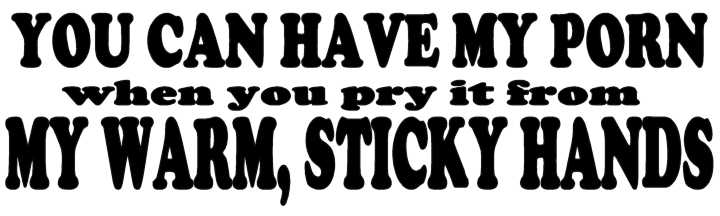
Available in t-shirts or bumper stickers at Cafe Press.
To be able to say "Noggle," you first must be able to say "Nah."
Pardon me while I cash in on the outrage, but:
Available in t-shirts or bumper stickers at Cafe Press.
Buy My Books!

My most beautiful wife and the light of my eyes and el fuego de mi corazón, I want to take a moment to explain this little scrip of paper before you find it on a dresser somewhere. It says, in my handwriting:
Melanie Thomas
(314) xxx-xxxx
meet Thurs. night
That’s Melanie at Thomas Construction regarding the work we’re about to have done. We should call her back to give her some additional information or to schedule an evening meeting.
(Am I the only spouse out there who preemptively explains his phone message shorthand when it involves a woman?)
Buy My Books!
Fark links to a story in the Fond du Lac Reporter about a woman whose water was cut off because a faulty meter underreported water usage for her late mother. It’s a pretty sad story, but what’s even sadder is the way the story sort of changes themes in the middle:
t was no April Fool?s joke when the tap went dry Thursday for a Fond du Lac woman who was left to pay a $1,200 water bill for her deceased mother.
Sonja A. Terry, said neither she nor her late mother, Maria Wittig, had an idea the utility bills were drastically less than they should have been. The problem with an outside meter was discovered only after Terry’s mother died in June 2003 and water utility officials cross-checked what they call the “actual” meter in the basement at 120 E. Second St.
Wittig had requested and purchased the outdoor meter so the reading could be taken outside her home. The outdoor meter had slowed drastically and may not have been working at all.
Terry agreed in December to pay $50 a month toward the $1,200 bill. When she failed to make the two initial payments, her water was shut off.
“I turned the faucet on and nothing came out,” Terry recalled.
Early last week, she was given another shut-off notice due to two more consecutive months of non-payment. The water was shut off Thursday. She agreed to pay $100 and the water was turned on a short time later.
“I can’t make those (extra payments),” Terry said. “They’re putting it on my regular (utility) bill.”
Terry said her most recent regular utility bill was $242. Another $150 was added to the bill ($50 repayment schedule for each of three months), bringing the total to nearly $400 for the quarter.
Before the error at the meter was discovered, Terry said her mother’s bill was $53. The amount is the monthly charge for vacant residences, according to water utility staff. The amount suggests that the outdoor meter wasn’t functioning at all.
“I hate doing this,” Fond du Lac Water Superintendent Dale Paczkowski said. “I don?t like it. (And) it?s time consuming for us to be putting (shut-off) notices on the door and sending letters.”
Paczkowski said the water was used — it ran through the actual meter.
“I agreed (in December) to $50, which I cannot do,” Terry said. “I thought I could (pay $50 per month toward the debt), and I had my back surgery, and I lieves headache and eases insomnia. It can be applied full strength to burns, rashes or psoriasis.
Lavender is a “must-have” in the home, Vores said.
* Lemon increases optimism and sense of humor, helps calm fear and increase memory, according to Vores? list of essential oil uses. In very dilute solution (1 or 2 percent) it is good for acne, he said.
* Peppermint is a mental stimulant, relieves headache and anxiety. It is good for congested sinuses and digestion as well as emotions.
* Tea tree oil builds strength before surgery, says a list of oils Vores has compiled. It?s a strong antiseptic that stimulates immunity.
Vores describes essential oils as the “lifeblood” of a plant, the part that is fragrant. “Pure” oil comes from a single source.
It’s some sort of content error, but it’s always interesting to note how far you go before you realize you’ve missed something.
Sometimes, when I am reading a particularly hard to follow text, I have been known to skip pages when the last words of one page and the first words of the page two pages ahead mesh in a manner no more confusing than the rest of the work. When reading, I admit I don’t slow down and understand each sentence or paragraph before moving on; I tend to gather the grasp of the whole, which is why I keep reading stuff I don’t understand as I am reading it. I expect to pick it up from context. As I have a philosophy degree, rest assured I have run into the situation where I accidentally skip a page and don’t immediately know it many times while contending with works of on the order of Heidegger, Sartre, Dostoyevsky, and others.
P.S. I didn’t get to the whole next paragraph in the above piece, unlike some works.
Buy My Books!
Free clue to banks, financial institutions, and my creditors: Online bill paying is not worth my time nor trouble.
The Washington Post‘s Leslie Walker muses on online bill paying, but she focuses on the glitzy side:
Some things you expect to be no-brainers online turn out to be as tricky as a Rubik’s cube. Bill payments fall into that category. Nine years after the Web went commercial, many large Internet players are still trying to piece together the electronic-bill puzzle.
The puzzle, I assume, is to do it effectively. Which would mean profitably, of course, but the people behind the online bill paying maelstrom need to remember an important thing: it’s got to benefit consumers as well.
America Online is the latest to believe it has found the answer. Launched on Tuesday, AOL Bill Pay lets AOL members pay 2,500 different billers from a single menu. The service is free to subscribers even though AOL is paying a partner, Yodlee Inc., an undisclosed sum to do the heavy lifting behind the scenes.
America Online, unfortunately, you are nothing but the mechanism through which the money would flow. You can pay 2,500 billers? Big whoop. My checkbook is virtually unlimited, as are the more secure money orders. The number of people you can pay are not the stumbling block.
Increasingly, online bill paying is becoming a strategic tool used by large businesses to reel in and retain customers, especially since it appeals strongly to folks with high incomes and lots of monthly bills. Banks and other financial institutions have been falling over one another in the rush to offer free online bill payments, based on a belief that customers who take the trouble to set up the accounts will remain more loyal than those who don’t. So far, one-third of the nation’s largest banks and brokerage firms offer free Internet bill payments, according to financial research firm TowerGroup.
Okay, so large businesses will accept bill payment through this medium as a means to reel in and retain customers. Hmmm. So what? What’s the advantage over cash, check, or money order? I reckon it might be cheaper or more instantaneous for the recipient who accepts online bill pay. After all, the money’s sucked from the payer’s account into your coffers immediately, without the need to hire a bunch of letter openers.
But what’s the benefit for me, the payer?
Let’s face it. As far as these online bill paying schemes go, the people whom I can pay are still limited. A user cannot necessarily pay everyone whom he wants to pay, and so the user is expected to make his life more complicated using a variety of different mechanisms through which he can settle his accounts.
As Walker points out in her piece, she doesn’t want to spread her secure financial information too much throughout the Internet–yet, the recipients, and the companies who play middlemen, all get the data. It’s a security risk multiplied by the number of payees and middlemen. Any one of them could get hacked and suddenly, I am buying computers for Romanians.
Worse, if anyone of these entities has a mere computer glitch, suddenly my bank account is empty and all other checks, debits, and withdrawals are bouncing, and my bank is charging me an extra $20 a day to remind me that my account is still empty. I have seen enough critical defects outside the financial industry to recognize how tenuous the Web is and to put my actual information–and my credit rating–on the line.
In exchange for assuming these risks, what do my creditors and the online bill-paying industry offer me? Convenience.
I say: Not good enough.
So as a consumer, I am expected to incur the risks of theft, identity theft, and defect-related (unreversible) Insufficient Funds notices for mere convenience, while the person I am paying gets instantaneous access to the cash at a lower cost to the creditor. Sometimes I can pay extra for these goodies, too. You know what? Maybe I am not high enough income to be a target for this scam, but I am damn happy to expend the cost of ink, eight cents for a check, and thirty seven cents of postage for my peace of mind.
So my question to my creditors is, “What’s in it for me?”
All of you in the online bill paying industry ought to come up with a better answer than “Convenience.” Paying bills is never convenient. Show me the money.
Buy My Books!
Which of the fourth-class junk mail envelopes that arrived for me today should I open first?
or
Perhaps I should do a reality-television like poll about it, but there’s always the chance you whacky, Kerry-loving “friends” would make me open the DNC one at all.
Buy My Books!
So I point my beautiful wife to this Fark photoshop contest because it’s about a cat and she likes cats. “That one with Natalie Portman isn’t bad,” she says.
My friends, do you see the unjust double standard at work here?
Picture of cat scratching scantily-clad Natalie Portman = not bad.
Picture of Brian scratching scantily-clad Natalie Portman = exhibit in State of Missouri vs. Heather Noggle capital murder trial.
I ask you, is that fair?
Buy My Books!
Good day, fellows.
I am back at the blogging bit after a brief vacation with my beautiful wife in southern Florida.
I’ve gotten a little tanned (or “sunburned” as we call it here in the Midwest) and have had a number of days of reading, loafing, and general laziness. I haven’t touched a computer in four days, friends.
You might not know this, friends, but it’s always summer in Florida. Whereas Missouri is about to start into spring, with buds and flowers springing forth after the brown and infrequent white of winter, the palms are always green in south Florida. Every time we visit, I remark that I cannot imagine what living without seasons must do to the psyche of Floridians, or what it would be like to grow up without the physical representations of the passage of time or the school year. Cannot do it.
And if you must know, if your personal commentator (me) has a single flaw, it must be a fear discomfort with air travel. I don’t know where this discomfort began; as you might guess, as a poor young man, I had few opportunities to fly when I was young. I flew took two trips via air in my first twenty-seven years of life. I took my third and fourth trips in 1999, but somewhere between there and 2002 I grew very leary of air travel. I don’t attribute it directly to the 2001 attacks. However, I did become very aware of how little control I have over the situation, and how few people survive mishaps.
To put it bluntly, Heather and I passed a car turned on its side on I-95 just north of Fort Lauderdale this morning on our way to the airport. She missed the physical manifestation of the accident (except the lane closures); I reported the car on its side and the people sitting beside it, on the median wall, looking sheepish that their parents might find out that they were driving their high-school-graduation present at unlawful speeds after a couple tablets and a couple drinks; in air travel, there are no sheepish survivors ashamed at their choice of transit or response times.
So laugh at me, or mock me, but every time those wheels chunk into their housings on takeoff or the engines change to idle to begin the descent, I notice and begin to sweat. Some people simply trust the professionalism and competence of untold score of personnel involved in the construction, maintenance, and operation of air travel equipment, and some of us can only (however actively) hope that those professionals handle their jobs more competently than some of us handle our household maintenance.
The quality of the library should not be judged by the gaudy nature of its bookends, though, and I had a wonderful time.
Buy My Books!
So I used to go to Realtor.com to look for the million-dollar homes for sale in the St. Louis and Milwaukee areas, preferably with some land to go with them. However, Ravenwood has shown me I am a piker, for I had not until now thought about buying my own island.
If only I were an entrepreneur, founding my own company that would lead me to wealth through hard work and a bit of self-made luck.
Buy My Books!
St. Louis denizens will tell you about the peculiar South St. Louis (County) accent that adds terminal Rs to non-terminal syllables, which turn wash into warsh and toilet into torlet.
So as I was in Lemay this morning, speaking with an aunt, she mentioned coming out of retirement to earn a few extra dollars. “But I don’t want another orffice job,” she said.
We in your family salute your decision, dear. Be forewarned we shall remind you of this decision into the unforeseeable future to make sure your commitment remains.
Thank you, that is all.
Buy My Books!
Snopes has a wonderful right up on the American Express Centurion card. It’s so exclusive, it’s by invitation only, and it carries a $2,500 annual fee.
I want one. Please hit the PayPal jar to the left. Thank you, hordes.
Buy My Books!
Here’s a new bit on Snopes:
Claim: Fecal matter sprayed by flushing toilets can collect on toothbrushes.
Geez, Mikkelson, thanks for the graphic details and the extreme tips, such as:
People tend to leave frequently-used articles where they are normally put to use, which means most of us unthinkingly deposit our toothbrushes on the sink or counter in the bathroom. A better strategy would be to place them in the medicine cabinet between brushings. It pays to keep in mind that while you may remember to close the lid before flushing, not everyone else in the household will always be as diligent.
Actually, there are numerous other tips, but I’m not going to implement them. I spend so much time being a paranoid neurotic that I don’t have any time to add another set of obsessive-compulsive tasks. Sorry.
Buy My Books!
In his Star-Tribune column, Lileks invokes some statistics, or rather alludes to an article which referred to a study that includes statistics about tall people earning more money:
Tall People are more likely to be paid more money. Each additional inch adds $789 annually to your paycheck. The natural conclusion: If you want a new car, figure out the payments, then head off to Tijuana for an illegal shin augmentation.
Pardon me while I add a hearty “You don’t say” to the conversation. Once you get beyond 6′ 4″, brother, you’re looking at actors, basketball players, and Michael Crichton. Undoubtedly, these fellows alone skew the averages quite upward. I am only 6′ 0″ and I can think of plenty of runts who make more than I do. Of course, I am in the IT industry, and everyone in IT makes more than the cheap QA help.
What was my point? Oh, yeah, read this guy Lileks. He’s an obscure Minnesotan columnist, but just because someone is from the upper Midwest and not Wisconsin is no reason to let him toil in his obscurity.
Buy My Books!
I’d call it a pet peeve, but both pet and peeve sound kinda cute, and what I’m about to explain represents more of a junkyard abhorrence; it’s got a spike collar and a low growl in the throat whenever the subject walks by.
Any time a writer, particularly a professional paid writer or journalist throws this amalgamation into a serious news article or essay, I question the credibility or maturity of the writer. No, I want to punch the johnker right in his or her stunted vocabulary.
So-called is alleged with a sneer, with a sense of condescension that intimates that we, meaning the liberally-educated author and his or her intelligent readership, understand the facade of the following noun for what it is, a cheap manipulation of truth built by the Orwellian right-wing/administration/conservative/techno/military/industrial/business/ (breath) /capitalist/Christian/Zionist/Machiavellian/fascist complex/conspiracy.
Get a thesaurus, pinheads, and leave the so-calling to the adolescents.
(This rant spurred by Roger L. Simon, who made the mistake of linking to Noam Chompsky’s op-ed piece in the New York Times.)
Buy My Books!
As my former officemate and my wife can attest, I like my gum (loud).
Brother Lileks intones:
Gum has CARBS, you know. And carbs are from SATAN.
So now you know, but I have already corrupted you, too. Only eighteen more people, and I fulfill my contract. Twenty-eight more people and I earn my first incentive bonus.
Buy My Books!
I saw a teaser for this woman on Effed Company, wherein it said:
Dudes, I married a hot chick because she had a cat named John Galt.
And she’s not even read, to the best of my knowledge, the The Early Ayn Rand.
Wait a minute. This woman is indicating that she read, in 31 days max:
Never mind, Objectivist bachelor straight friends and readers. She’s either prone to exaggeration, an outright liar, or a layabout who does nothing but read all day. You don’t need that.
Buy My Books!
I realize it’s probably the journalist adding drama to (that is, creating whole) an anecdote, but the lead from this SFGate story doesn’t portray the bastions of public safety in too good of a light:
Washington — Sitting at his home in Virginia Beach, Va., Joe Yuhasz almost reached for his wallet when an e-mail message popped into his inbox and told him America Online needed to verify his credit card information.
The site linked to the e-mail looked identical to AOL’s billing center, until Yuhasz noticed the domain name was a fake — a scam commonly known as phishing.
Almost reached for his wallet? Cheese, Louise, even my dear aunt knows better than that.
Maybe it’s part of a far-ranging ploy to lull the cyberbadguys into a false sense of superiority.
Buy My Books!
James Lileks, in his column in the Star Tribune, muses on a modern art exhibit:
Headline in last week’s paper: “Walker’s attendance falls by 30%; Official blames 9/11 for decline in tourism.”
I have a theory, and I’ll admit it might be controversial: It’s possible that no one wanted to see the exhibits.”
and offers his grand unified theory:
Well, you say, you just don’t like modern art. Not true. I hate modern art. No, that’s not right, either. I may be a philistine, but I am a learned one. I have a complex and nuanced response to modern art, be it the rigors of De Stijl, the furious assertions of Abstract Expressionism, the romantic angularity of Lionel Feininger, the anguished gashes of Clifford Still, the whimsical recontextualizations of Lichtenstein and other Pop Art painters; I understand the challenges that Action Painting made to the outmoded bourgeoise notions nurtured in the dusty attics of the beaux-arts mind-set, and I appreciate the connection between surrealism and post World War I disenchantment with rationality, why Dali was a bit of a poser, why Klee makes us nervous, why Bacon horrifies, and Beckmann can best be understood in the climate of Weimar. All this I know. And my opinion is simple: Eh. If it’s not ugly, it’s banal. If it’s not banal, it’s pretentious. If it’s not either, it’s pointless. Sometimes it’s good. Sometimes it’s great. (Like Feininger.) But in general:
Eh.
If you’re not cyber-stalking Lileks’ writings and reading the Back Fence (his column in the Star Tribune and his weekly Newhouse News syndicated column, you’re pathetic. I mean, you’re missing out on quality writing. I didn’t say pathetic.
Buy My Books!
Here’s an organization worth investigating: The Dollywood (yes, Dolly Parton) Foundation’s Imagination Library.
From the “About Us” page:
This program is one of the most important ways I know to improve the educational opportunities for children in your community.
When I was growing up in the hills of East Tennessee, I knew my dreams would come true. I know there are children in your community with their own dreams. They dream of becoming a doctor or an inventor or a minister. Who knows, maybe there is a little girl whose dream is to be a writer and singer.
The seeds of these dreams are often found in books and the seeds you help plant in your community can grow across the world.
I hope you’ll agree to become a champion of the Imagination Library in your community. You will be amazed at the impact this simple gift can have on the lives of children and their families. We have seen it work in our own backyard and I’m certain it can do the same in your community, too.
Here’s what the organization does:
Dolly Parton’s Imagination Library is all about inspiration and imagination. It was developed in 1995 by Dolly for her hometown of Sevier County, Tennessee. Dolly wanted every preschool child to have their own library of books. The effort received numerous awards and extraordinary media attention which generated interest from across the country. After much thought, Dolly decided to offer her Imagination Library for replication in any community that would support it.
Each month, from the day the child is born until his/her 5th birthday, a carefully selected book arrives at the mailbox. Kids across the country have shared the excitement of running to the mailbox to retrieve their book. More often than not, the child wants the book read to them now – not later, not tonight and not tomorrow. Right now!
As an attempted author, I can think of no better goal than to increase future readers. For the children!
Buy My Books!
The Professor, who like me has an intelligent and attractive wife, links to The Feathered-Back Hair Site.
Why do men like us him linger over sites like this?
Buy My Books!
My sophomore year in high school, I took a class in Creative Writing with Ms. Williams. It was Mrs. Williams, actually, much to the dismay of fantastic fifteen year-old boys. But I remember the class vividly. For an early exercise in creative writing, the delightful blonde nymph respected shaper of young minds, divided the class into groups. The assignment: to write a page of a short story. When the groups finished their segments, we passed the story to the group on our right, who would add a segment to the story, and so on, until each group had a turn with the story. Here, Tyrone Jackson was born.
Ah, Tyrone Jackson. The middle-aged rabbi from Thailand. Dan, Troy, Jim, and I concocted this character from the fevered imaginations of our adolescence, somewhere amid the giggling (which we would have called chuckling, but our voices were still changing, so it was probably giggling). We injected Jackson into every story passed to us. He suffered a number of untimely deaths and dismemberments once the group to our right determined what we were doing. At the end of the exercise, the groups had to rewrite their original stories using elements from the other groups’ contributions. So our group, ignoring the ignoble assaults on our hero, rewrote the story. Or Dan, Troy, and Jim did; I abstained, as they were not doing our hero justice. Although we got a passing grade turned on whatever they turned in, I was not satisfied. I had greater dreams for Jackson. Thus begat The Further Adventures of Tyrone Jackson.
My first book, hem, was a collection of short stories that chronicled how Tyrone Jackson would have infected all other stories and myths before him. However, each hero must have his arch-enemy, and Jackson discovered his when he met the leader of the Venusian invasion in the undersea base wherein the Venusians were keeping Jackson’s pet bunny Manerd.
“Lyndon LaRouche? You’re the dude from those dippy TV specials!”
Lyndon LaRouche became Tyrone Jackson’s archenemy. When Jackson consulted with his guru on Mount Everest, it was LaRouche sending the Soviet Spetsnaz after him….or James Bond….or maybe MacGyver, who happened to be mountain climbing at the time. When Tyrone Jackson stole Doctor Who’s Tardis, he uncovered Lin Don La Ru was the mortal enemy of Tai Ron Ja Sing in feudal Japan. LaRouche was the all-powerful Denfather in the alternate earth where the Cub Scouts had taken over. Like some archetype or eternal conflict, wherever Jackson encountered his match, it was LaRouche. Jackson always won, though, but LaRouche got away to fight another day… or in another time….
So when I went into the local polling place tonight, the collection of aged election judges asked me whether I what ballot I wanted. “Democrat,” I said. When I was alone in my voting stall and confronted with my allotment of possible choices, I voted for Lyndon LaRouche.
I admit, I have heard his commercials on KMOX radio comparing Ashcroft to Hitler. I have not seen any of his television specials, either, whether sixteen years ago or last week. But I voted for him anyway. Not because he’s got a chance of winning, and not because I think Joe has a chance of beating el Johnissimo. But for old times’ sake.
LaRouche has been a punchline of mine for almost twenty years. Who knows if I’d ever get a chance to vote for him again?
Somewhere, amid the hundreds of lost loose-leaf pages of Tyrone Jackson’s further adventures, undoubtedly Jackson is cursing the the villian’s luck once again. And tomorrow, when I review the election results, I shall recognize my vote among LaRouche’s handful.
Buy My Books!