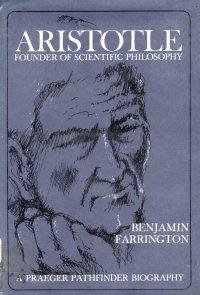
 I have no idea where I got this book–I don’t see it listed on a Good Book Hunting post, and they date back to March 2007. The library markings indicate it came from the University City Library, so I definitely probably bought it in the St. Louis area before then.
It’s a book targeted to the youth, or that is the youth of 1965 who read books and might have to do a report or paper on Aristotle. For school. Without construction paper, glue sticks, and scissors. Or, maybe, sometimes those kids were interested in the life of the mind. The past is a different place, even for those of us who came along not that long after.
The book is 109 pages, and it’s about half biography and then half digging into (as a survey or summary dig, which is not really digging, but let me sum up:) his thought and works–what we have of them as well as talking about some of the the mentions of other works of his which did not survive. So, you know, not a bad survey, reminding me that although I listen to audiocourses about him (see The Ethics of Aristotle, Aristotle, and Great Authors of the Western Literary Tradition, 2nd Edition), I’m not sure I have a lot of Aristotle source material available in the Nogglestead stacks. Certainly not multiple copies like I have of Alexander Pope (believe it or not, I have found another collection of Pope in the past two weeks) or Augustine. I’ll have to look for them.
Also, given that the other titles in this series deal with Charles Darwin and Mohammed, yeah, the set is probably left in nature. But you don’t get the straight-up Marxism of the comic books in the For Beginners series (Einstein for Beginners, Sartre for Beginners) or the modern Taylor-Swift-Loving British Pseudo-Stoic books. They were more even-handed in those days. Maybe even interested in knowledge for its own sake instead of as a tool to use to lever themselves to power (or to keep from the young so they, the They, could lever themselves to Marxist power).
At any rate, it is a decent primer akin to the aforementioned single-tape Aristotle (read by Charlton Heston) as an introduction. And it has a good bibliography for additional reading. For me, I need to look for anything in the wild, but where I go cheap book hunting these days, Aristotle is not.