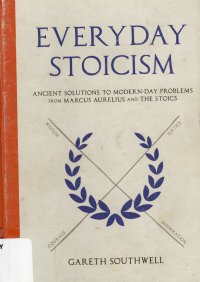
 I got this book from the diminished (in more ways than one, apparently) philosophy stack (not plural, and not much of a stack) at the Midtown Carnegie branch of the library recently. Oh, my. I am not sure if it’s a step up or a step down from the British Marxist comic book biographies I’ve read (Einstein for Beginners and Sartre for Beginners). Maybe a step up because it has quotations from the original sources, but maybe a step down because it–I was going to say “just misses,” but it misses on the side of Marxism and embrace of contemporary policies of a certain idealogical (and culturally suicidal) persuasion.
The book has chapters on a variety of topical matters, including life, money, work, happiness, beliefs, you, health, feelings, love, education, politics, and death. Each chapter is mostly the author’s summation of Stoic thought on the topic along with some compare/contrasts with other philosophies and/or religions, but without any actual quotes or citations to back up the assertions. The chapters are leavened by a couple of quotes from Stoic sources, almost exclusively Marcus Aurelius, Epictetus, and Seneca, with several paragraphs of the author explaining what the quote means. The chapters conclude with “Think About” thought exercises and “Going Further” which are ways to put (the author’s view on the) Stoics’ insights into practice.
I considered doing a thoughtful response to it, but I can’t be arsed, so here are some of the quibbles I have.
Ancient Athens was an intellectual melting pot, a Mecca for those who sought to imbibe philosophy at its source, and so drew students from far and wide.
Using Mecca as a metaphor for melting pot where all students are welcome seems, erm, dumb because in reality, Mecca is not those things. Only in common, uninformed idiom is (was) it viewed as a good thing, and generally as a point to aim for, like a North Star.
In her book The Life-Changing Magic of Tidying Up, Japanese author Marie Kondo askes that we apply the simple criterion (the KoriMari method) to each thing we own: is it either useful or does it ‘spark joy’? If neither, then we should discard it.
This is probably a useful exercise for us all, especially book hoarders (yes, I’m looking at you! Ahem…)….
Ah, the Marx/Kondo connection. Prepare your mind for having less. Not what he meant here, but, no, my books remain until a tragic fire or my estate sale, mate.
One of the benefits of wealth is that it allows us to help others. In 2009, the philosopher Peter Singer (1946-) published The Life You Can Save, which argued that people living in affluent Western countries have a moral duty to help those living in poverty around the world.
Again, the Stoic direction to non-attachment means send your money to nonprofits, have less, and Elon Musk should not be a trillionaire (implied, and probably on his Twitter feed even now). Citing Peter Singer is a nice touch.
Utilitarianism (at least, in its original form) is mainly concerned with happiness in terms of how certain outcomes make us feel.
Okay, cog. Serve others and die when your utility is spent. That should make you happy.
We should try to treat others fairly and live within established legal codes (justice).
Legal codes != justice. C’mon, man.
I don’t want to presume as to what views you currently hold as to the nature of life, the universe, and everything, and nor do I want to prescribe what those should be.
42, of course. But I’m pretty sure if he doesn’t want to prescribe justice via legal codes, he’d be happy to nudge you in a behavoral economics way to his preferred viewpoint.
But what do we do when we feel overwhelmed, or sense the creep of unwelcome anger, lust or depression [sic–he is so egalitarian that he doesn’t use the Oxford comma because it’s elitist, one presumes]? Aside from false judgements [sic–have an extra E in that word since there’s no room for a U], we should do our best to avoid, prevent or suppress the growth of the harmful passion. Your partner has left the toilet seat up (again) or done a shoddy jb with the dishes; your boss continues to ignore your worthwhile contributions while favoring the pretty new recruit; your racist auntie has again outlined her views on asylum seekers… you get the idea.
Strangely enough, like Marx, asylum seekers are mentioned more than once in a positive light. Stoics should love them!
The problems most of us face in the matters of love is that they often stir up negative emotions. Drawing upon and developing existing Greek concepts, Christianity divided love into four main types: érōs (sexual love), storgē (parental and familial love), philía (love for one’s friends), and agápē (unconditional love for God and one’s fellow humans). As you can see, apart from agápē, all the other forms involve potential conflict. Sexual desire can lead to lust, deviancy, jealousy and envy; familial relations between children and parents can lead to grief, betrayal, coercion, resentment; even friendship or a feeling of communal belonging can create rifts and internal disputes or animosity towards those we consider ‘other’ or outside our group or tribe. It is only selfless universal love that avoids these issues.
So, basically, a good Stoic is a liberal who prefers asylum seekers to his auntie.
What fooking balderdash, mate. Also, someone press him on what he defines as deviancy, and we’ll see whom he offends.
Applying this in more practical terms, we may break it down into two main concerns: conmtrolling the passions and eradicating prejudice. We must guard against the power of erotic love to overwhelm our reason and will, and we must try to extend our concern beyond the borders of our own family, tribe and nation.
You see, he meant it.
This wonderful quote reminds me of a Zen Buddhist parable, where the teacher is pouring a cup of tea for his student. When the tea reaches the top of the cup, the teacher continues to pour, causing the student to point this out. “It’s a bit like you, isn’t it?” says the teacher.
I came not to say “What an intellectual yob,” but to point out this is the third book this year that has included this parable. The other two were Be Water, My Friend and The Secret Power Within: Zen Solutions to Real Problems.
There are countless small ways in which a citizen might do this [help out in the polis]. Neighborliness is a good one–offering to mow the lawn of the old coule who live nextdoor, or pick up their prescriptions, helping someone mend a fence or move furniture. The same obviously applies to colleagues, friends, and family. You might write a letter of recommendation for your boss’s niece to help with her application to university, or volunteer to help an asylum seeker deail with intimidating government bureaucracy.
No, seriously, fook you auntie, mate.
All these incidents [Stoics falling on their swords] emphasize not only the Stoic belief that death is nothing to be feared, but also the idea that, if done at your own time and choosing, it is possible to have a ‘good death’ (which is the actual meaning of the modern term ‘euthanasia’).
All righty, then. Stoics thing Canada’s MAID idea is a good idea (perhaps especially for your auntie to make room for some asylum seekers).
Ah, gentle reader. This book almost let my passions rule me in my, erm, disagreement with the author (but, as he does not know me, he loves me more than I love him, I must acknowledge).
This book is unnecessary and probably counterproductive, seeking to introduce people who are curious about Stoicism into Stoicism as Liberal political thought. The original sources, at least in good translations, are easily accessible and don’t need exegesis, especially of this sort.
On the other hand, it did make me want to go back to the primary sources. My oldest and my mother-in-law have started working their ways through the Marcus Aurelius. And I did “just” (three years ago) score a paperback copy of Seneca’s Letters from a Stoic. I should definitely look for that once I get my current chairside accumulation of in-progress books under control.
And it did make “Taylor-Swift-Loving British Pseudo-Stoic” into my new go-to insult, and when I use it here in the United States, I fully expect it to be fighting words.