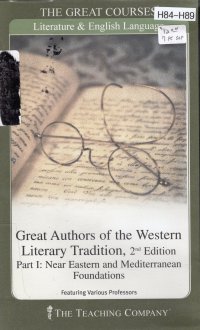
 I bought this bonzer of a collection in 2024; it’s 42 discs total, and it’s broken into 7 parts with 5 different instructors. It will take a little while for me to go through the whole thing, I decided I would break my “reports” of them into parts separated by lecturer.
The first part is Near Eastern and Mediterranean Foundations with these lectures:
- Near Eastern and Mediterranean Foundations
- The Epic of Gilgamesh
- Genesis and the Documentary Hypothesis
- The Deuteronomistic History
- Isaiah
- Job
- Homer–The Iliad
- Homer–The Odyssey
- Sappho and Pindar
- Aeschylus
- Sophocles
- Euripides
The second part is Literature of the Classical World with these lectures:
- Literature of the Classic World
- Herodotus
- Thucydides
- Aristophanes
- Plato
- Menander and Hellenistic Literature
- Catullus and Horace
- Virgil
- Ovid
- Livy, Tacitus, Plutarch
- Petronious and Apuleius
- The Gospels
- Augustine
Jeez, but not to be a braggart or anything, but a lot of this seemed familiar. But I have listened to courses on The History of the Bible: The Making of the New Testament Canon, The Bible as the Root of Western Literature: Stories, Poems and Parables, Socrates, Aristotle, e Aeneid of Virgil (by this same professor), Augustine: Philosopher and Saint, and Augustine. I’ve read Pindar (recently), Sophocles, Euripides, Aristophanes, and The Making of the Old Testament. I’ve got, certainly, Plutarch, Livy, Homer, Virgil, Ovid, plenty of Plato, Augustine, The Epic of Gilgamesh and maybe Tacitus, Aeschylus, and Horace around here somewhere for me to read sometime after the 2026 Winter Reading Challenge completes. So, look at me! I am a learnèd man! Or at least a guy with an English and philosophy degree he takes seriously.
But, as this course is moving chronologically, it does kind of put the authors in order and in their eras. So, briefly, I know when the Hellenisitc era begins and when it ends and the order in which the Greek tragedians wrote, and…. Well, no, their exact years are gone from my memory. I wasn’t taking notes, you know–I was driving (and sometimes taking the long way home to finish a lecture). But, yeah, I get more familiar with these things the more I listent to them, and if nothing else, they do make me want to dive into the original materials. Although that itself does not mean much–I’ve had a copy of Pamela only slightly read for probably five years since I listened to the audio course The English Novel in 2020 and bought the early epistolary novel in 2020 because it was mentioned in the book. But, oh, it moves so slowly. Slower than my reading of slow books even.
At any rate, I have five (5) more binders of CDs to listen to (I guess they’re really DVDs, so I could watch them in the house if I really wanted to), and that could well take me into the summer or autumn. Which, again, is why I’m going to report on them professor-by-professor. So I can enumerate what I’ve already read or already own, I guess, since I’m not sharing with you, gentle reader, much about the development of verse and prose from Ur to the fall of Rome. Which is: It did. A major turn from the old Greek tragedians who wrote epics with the gods in them to the new comedians who didn’t write so much about gods but more about every day people. Well, every day royalty or aristocrats, but still, more narrow in scope. Will I remember that next week? Maybe. Ask me then.