Book Report: Deadly Welcome by John D. MacDonald (1959, ?)

This book, one of John D. MacDonald’s paperback originals reprinted when his Travis McGee novels took off, covers a story of one Alex Doyle, former resident of Ramona Beach, Florida, and his return home. Back around the end of the war, orphaned Alex Doyle decided to join the military; on the night before his induction, he went drinking for the first time and awoke from his overindulgence with some cash stolen from his adopted family’s store in his pocket. Run out of town (but allowed to join the military instead of jail), Alex Doyle serves honorably and joins the State Department. But when the Department of Defense needs a scientist to return to the organization, they turn to Doyle to shepherd him back because the scientist married a Ramona Beach woman and settled there. To get the scientist back, Doyle promises to solve the scientist’s wife’s murder.

It’s a short novel, a paperback thriller. I liked it well enough. It lacks the depth of some of the Travis McGee series, but come on, it’s a paperback thriller.

Worth a couple quarters if you find it at a book fair, or a couple bucks if you’re a raving John D. MacDonald fan like me and find it in a used bookstore.

Books mentioned in this review:


Buy My Books!
Buy John Donnelly's Gold Buy The Courtship of Barbara Holt Buy Coffee House Memories

Town Councilchair Quarterbacks Go Three And Out

Sometimes when a municipality decides that its ideas about how to design and run the business are better than the business owner’s, the business owner decides not to play:

Menards has dropped plans to build a warehouse store at the east end of Grafton near the I-43 / Highway 60 interchange, saying village officials insisted on too many changes in the company’s plans, a Menards official said Monday.

“We just went as far as we could go revising the plans, and finally we said it wasn’t worthwhile,” said Marv Prochaska, the company’s vice president of real estate. “At some point, you have to operate your business, and it was beyond the point where the deal made any sense.

“It was just numerous, numerous small things that all added up to way too much, and it just didn’t make any sense,” he said.

Look on the bright side, Grafton! That’s sales tax revenue you never had, so you won’t have to worry about what to do if the location started making less year over year.

Buy My Books!
Buy John Donnelly's Gold Buy The Courtship of Barbara Holt Buy Coffee House Memories

Book Report: Puppet on a Chain by Alistair MacLean (1969)

I forget which book fair I bought this book at this year; I do remember thinking it was great to get a copy of a non-book club edition of Alistair MacLean’s work, but when the Book Fair Employee put this in the box, she tore the dustjacket almost completely. Swell.

I probably hadn’t read this book since high school. It’s centered around an Interpol narcotics investigator going to Amsterdam to sniff out a big, organized crime syndicate shipping heroin abroad. It’s interesting that it’s a commonplace crime handled as though it’s bigger than it is. Some of the response to the drug thing is over-the-top, but this was early in the war on drugs, before it became commonplace I suppose. The point of view is a little different from many MacLean books in that this is a storyteller first person. Unlike other first person points of view, where the I is supposed to play it straight, this storyteller withholds information and foreshadows later events to make a better story. I think it’s a good point of view, a bit of the double-effect narrator going on, and think I should try it again.

A good read, quick enough (a little over 2 nights for me) and probably readily available at book fairs or the link below if you’re interested.

Books mentioned in this review:


Buy My Books!
Buy John Donnelly's Gold Buy The Courtship of Barbara Holt Buy Coffee House Memories

Book Report: Ghosts by Ed McBain (1980)

This book, an 87th Precinct novel coming from the old tradition of hardback mysteries under 200 pages in length, is a throwback even at its publication date. The phone numbers within it appear as town plus five digits. In Isola. In 1980. So I guess it was on the shelf for a decade or so before publication.

In it, Carella investigates the murder of a known writer whose fiction books were so-so, but whose nonfiction book on ghosts was a runaway bestseller. The murderer also killed a woman outside the writer’s apartment building, and then moves on to kill the writer’s editor and try to kill the writer’s girlfriend, a medium–but the killer attacks the woman’s twin sister inadvertantly. In the course of the investigation, Carella encounters some actual ghosts, marking one of the few if not the only time the supernatural makes its appearance in these books.

It’s a decent enough thriller and a quick enough read.

Striking, though, is the back of the book which features two long paragraphs of praise for Ed McBain and this book from Stephen King. Ed McBain’s been plying his trade for 25 years, and the book company puts an endorsement from a relatively recent, although popular, upstart to sell more books. How Mr. Lombino must have felt. Of course, he probably sold more books on account of it, so he probably was okay with it, as he was a professional.

Books mentioned in this review:


Buy My Books!
Buy John Donnelly's Gold Buy The Courtship of Barbara Holt Buy Coffee House Memories

Answering My Wife’s Question About Transportation Budgets

The other day, I commented that Ronald Reagan allowed for a federal gas tax 25 years ago because of the state of the interstate highway infrastructure. I made the comment that transportation budgets are always diverted to other things, and she jumped on my “always.” However, I think I have a better insight into government nature than she does.

This column enumerates some of the ways transportation,that is, gas tax, money is spent that doesn’t involve maintaining roadways:

As recently as July 25, Mr. Oberstar sent out a press release boasting that he had “secured more than $12 million in funding” for his state in a recent federal transportation and housing bill. But $10 million of that was dedicated to a commuter rail line, $250,000 for the “Isanti Bike/Walk Trail,” $200,000 to bus services in Duluth, and $150,000 for the Mesabi Academy of Kidspeace in Buhl. None of it went for bridge repair.

And:

Minnesota spends $1.6 billion a year on transportation–enough to build a new bridge over the Mississippi River every four months. But nearly $1 billion of that has been diverted from road and bridge repair to the state’s light rail network that has a negligible impact on traffic congestion. Last year part of a sales tax revenue stream that is supposed to be dedicated for road and bridge construction was re-routed to mass transit. The Minnesota Department of Economic Development reports that only 2.8% of the state’s commuters ride buses or rail to get to work, but these projects get up to 25% of the funding.

Here’s how it works:

  1. Government get general tax revenue.
  2. Government spends tax revenue on shiny things, not maintaining core government services (law enforcement) or infrastructure (roads).
  3. Shortfall in core services funding becomes an emergency requiring raised taxes/dedicated taxes.
  4. Government gets dedicated tax revenue in addition to general tax revenue.
  5. Government spends general tax revenue on shiny things and new dedicated tax revenue on shiny things, not on core services or infrastructure.
  6. Shortfall in core services funding becomes emergency requiring raised taxes.

The problem does not lie in the amount the government is getting and spending; it lies in the things the government buys.

But don’t tell the government or our elected/unelected “leaders” that. They like shiny things.

(Link seen on Instapundit.)

Buy My Books!
Buy John Donnelly's Gold Buy The Courtship of Barbara Holt Buy Coffee House Memories

Sick Joke

What is the difference between Michael Vick (Falcons’ Vick Accused of Executing Dogs) and the city of Denver (Denver pit bull ban draws dog lovers’ ire)?

Michael Vick bought his own pit bulls and “executed” them, whereas the city of Denver seized other people’s pit bulls and “put them down” for the good of society.

Haha! No, I guess it’s not funny. It’s even less funny when you think of the lack of principles involved.

And you know what’s really cheesing me off about the dogfighting thing? It’s the perversion of the language. I mean, come on, a rape stand? That’s not the term by which you buy them in the catalog; it’s called a breeding stand, and it’s designed so that mating dogs don’t hurt each other during mating (or to hold the dog for grooming or whatnot). But the papers and the indignirati all use rape stand because rape is an automatic bad word above reproach. Like here’s Brian J. Noggle saying that rape isn’t rape when a breeding animal hasn’t given its consent to be bred.

Or Michael Vick “executing” dogs. I mean, seriously, executing them? We’ve used that term to refer to a procedural sort of killing by some sort of authority, not tossing kittens in the river. But, again, it’s an automatic bad word, worse than killing a dog, Michael Vick was executing them.

George Orwell would nod sadly but knowingly.

Buy My Books!
Buy John Donnelly's Gold Buy The Courtship of Barbara Holt Buy Coffee House Memories

Good Book Hunting: August 16, 2007

The Jewish Community Center in Creve Couer has been holding its annual book sale all week, and we picked the absolute worst night to go to it. The first night is preview night with a cover charge; Friday, today, is half-price day; Saturday, tomorrow, is bag day, where one can buy a bag and have everything that fits into it for five dollars. Last night, then, was the last day at full price, and hence the most picked over selection possible for the full price. Not that it stopped me from finding far too much:


August 16 Book Fair Results
Click for full size

We have:

  • A number of Perry Mason mysteries, including The Case of the Mischievous Doll, The Case of the Fiery Fingers, and The Case of the Horrified Heirs.
  • Several of the Classics Club books I’ve taken to collecting. New books include History of Plymouth by William Bradford; Selected Stories by Anton Checkov; The Way of All Flesh by Samuel Butler; and Seven Plays by Henrik Ibsen. I already had Selected Works by Cicero, but it was a different printing. This brings my collection to, what, 29 volumes in this set?
  • The Pathfinder by James Fennimore Cooper; I have most of the Leatherstocking books now. Perhaps I should read them.
  • Hallowe’en Party and The Mousetrap (a play) by Agatha Christie.
  • A collection of poetry by someone I’d never heard of, James Kavanaugh.
  • A “chapbook” by local poet Pam Puleo. I knew Pam when I was doing the open mike circuit about 10 years ago. This “chapbook,” which looks more like a school project and includes some loose poems tucked into it, looks like a school project. When I read these to the boy, I might try to imitate Ms. Puleo’s voice and delivery.
  • A bunch of Camus, including The Myth of Sisyphus and Other Essays and Caligula and Other Plays.
  • The Realm of Numbers by Isaac Asimov.
  • Star Trek: The Return because I’m interested to see how Shatner got them to resurrect Kirk.
  • The Lost City of Zork because I’m an old school geek.
  • Some philosophy books, including Basic Ethics, Dilemmas, Bertrand Russell’s The Problems of Philosophy, and A Casebook on Existentialism.
  • Open Net, George Plimpton’s hockey book.
  • Friday by Robert A. Heinlein.
  • A hardback copy of The Andromeda Strain by Michael Crichton.
  • The Closing of the American Mind by Allan Bloom. I am getting quite a collection from Bloom. Probably because I keep thinking he’s the guy who got a hand on Naomi Wolf’s thigh.
  • The Prophet by Kahlil Gibran.
  • A Death In China by Carl Hiaassen and some other guy. The Carl Hiaassen is what’s important.
  • Night Thoughts of a Classical Physicist, some musings of some science guy.

Brian, you say, that’s 30 books, meaning that you’ve picked up 62 this week. Isn’t that more than you read in a year?

Not this year, friends; I am at 72 total books and I’m going all the way! Although I’m not sure where that is, but if I can get there in my comfortable recliner, I am there.

Buy My Books!
Buy John Donnelly's Gold Buy The Courtship of Barbara Holt Buy Coffee House Memories

Book Report: The Parisian Affair by Nick Carter (1981)

This completes my recent reading of three great novels set in Paris (the others: The Three Musketeers and Hunchback of Notre Dame). This book, number 148 of about 260 featuring Killmaster Nick Carter, offers everything a growing boy needs. The action and the story are tied together. The story moves. The cover’s not as lurid as one would hope from a paperback original, but one can learn to accept.

Plot Summary / Spoiler Alert!

Nick Carter is ambushed, saves damsel, sleeps with damsel; Nick Carter is ambushed, kills a couple ambushers, one escapes; Nick interviews model who might be an expert assassin, sleeps with her; Nick is in building that explodes; Nick sleeps with woman he saved; Nick ambushes model, kills level bosses, discovers model is only a junkie; Nick finds another model, dead, declines to sleep with her; Nick drives Ferrari fast; Deus ex maquina encounter as Nick discovers big boss and kills him; Nick drives Ferrari fast, rescues his boss; book ends with more implied sleeping with damsel formerly in distress.

Fortunately, no trained goats tempted Nick, or it would have been a much different story.

Now, I can read some quality junk fiction to clean some from my shelves.

Books mentioned in this review:


Buy My Books!
Buy John Donnelly's Gold Buy The Courtship of Barbara Holt Buy Coffee House Memories

Book Report: The Hunchback of Notre Dame by Victor Hugo (1831, 193x?)

As you might have guessed, gentle reader, I’ve been on a French Lit kick for some reason lately; I guess it was because The Three Musketeers was good enough to warrant another look at a potboiler from France in the nineteenth century. Well, this book is not quite that fast of a read.

For starters, the first third to four ninths is mostly exposition. We’re introduced to some of the characters through a long and mostly meaningless scene depicting the titular cathedral during a festival of fools. Some extraneous ambassadors are in town, and Quasimodo, the bell ringer, is elected the king of fools. The poet/philosopher who wrote the main drama finds the audience’s attention continues to be diverted by all sorts of interruptions, comings, and goings, and ultimately he’s disappointed. Dejected, he wanders about Paris and ends up in the neighborhood frequented by the vagabonds, who’ll hang the intruder unless someone saves him by marrying him. Against all odds, the beautiful Esmeralda does.

Then, we get not one but two long essays on architecture and the way Paris looked in the time period in which the book was set. Remember, like The Three Musketeers, this novel was a historical novel when it was written, so the author must have felt the need to pad up 40 pages of exposition to educate his readers. But it really kills the pacing of the story.

To make a short story long, this book really collects a very brief number of scenes with a lot of words dedicated to them (much like other older books, I’ve noted). Ultimately, the author lavishes detail on characters that play minor roles in the action (although major roles in the story, I suppose; the action and the story being two different things here).

Spoiler alert!

So Esmeralda falls for a philandering captain of the guard; a repressed bishop fixates on Esmeralda; the poet/philosopher drops out of the book for a while as the bishop stabs the captain while he’s entertaining Esmeralda, framing the young pseudo-gypsy for the crime; as she’s sentenced to hang, the bishop offers to save her, which she rebuffs; the hunchback steals Esmeralda from the hangmen and takes her to Notre Dame, a sanctuary for criminals; the bishop meets the poet and gets him to foment a rebellion of the vagabonds so they–bishop and poet–can secret Esmeralda from Notre Dame; the bloody uprising occurs; the bishop and the poet steal Esmeralda and her trained goat from the church; when they reach the opposite shore of the Seine, the poet takes the goat instead of the alluring Esmeralda to whom he’s already wed by the laws of the vagabonds; the bishop again pleads for Esmeralda’s love, and she rebuffs him; and they all die, including the subplots, except for the captain of the guard, the poet, and presumably the goat.

I don’t know how you can turn that into a Disney film; I suppose it’s only American audiences’ lack of knowledge of the basics of the plot that allowed it to happen. I mean, Disney wouldn’t dare to try Hamlet. And the hunchback: not a nice guy.

So I’ve got one more French book to go and then I am thinking about knocking off some junk from my to-read shelves before the next book fair later this week.

Wish me luck.

Books mentioned in this review:


Buy My Books!
Buy John Donnelly's Gold Buy The Courtship of Barbara Holt Buy Coffee House Memories

Book Report: Poems of Flowers edited by Gail Harvey (1991)

As I mentioned, I bought this book at an estate sale this weekend. Since it’s one of those lite collections of poetry that came out in the early 1990s, printed by companies happy to have content from the public domain, I assume that Mr. Paul got it as a gift.

It contains 43 poems dealing with flowers. Irises, hawthorn, roses, and fields of flowers. Poets including Dickinson, Wordsworth, Longfellow, Herrick, and so on extol the virtues of blooming plants. Most of them are accessible even though many are hundreds of years ago. These are definitely middlebrow poems, written with cadence and rhyme for the enjoyment of all readers before the academy determined that poems should be inscrutible to the bourgeoisie.

So it’s a nice collection of fun little poems to read. A couple of insights into the human condition, but mostly various poets playing with words pleasingly.

Apparently, it’s not available currently on Amazon; I had not realized how much of a collectors’ item (hem) this was. I have provided a book search link below for your convenience, if you’re interested. You see, here at MfBJN, it’s all about your convenience, gentle reader, not my ability to make a couple quarters every couple of years from Amazon referrals. You illiterate sops.

Books mentioned in this review:

Poems of Flowers

Buy My Books!
Buy John Donnelly's Gold Buy The Courtship of Barbara Holt Buy Coffee House Memories

Good Book Hunting: August 11, 2007

We bought so many books yesterday, I should have a hangover. I almost do, but we’ll come to that bye and bye.

We decided, as it was a cool (only 90 degrees at 8:00am) morning, to walk to a couple nearby yard sales with the boy in the stoller. So we loaded up on all our spare cash and a couple vessels of water, and we headed southwest to the outlying small home subdivisions of Old Trees, Missouri.

We found a yard sale selling cassettes for a quarter, specializing in 80s music, so we loaded up on Barry Manilow and some country and western (Heather being the operative part of we here) and a couple of CDs (Billy Ocean’s Love Zone and Roxette’s Joyride) for fifty cents each. Then we passed through a couple small but well organized (Heather said) sales featuring kids stuff (how disorganized can you be with very little, I asked). Then we hit a nearby estate sale, and the gluttony occured.

Friends, the people handling the affairs of this gentleman had his books and cassettes priced at twenty-five cents each, at which point “Because we’re walking and you’ll have to carry them” doesn’t hold up as an excuse not to buy. I mean, we did have a cart/dolly since the boy could walk now. About time he starts learning how to walk for distance.

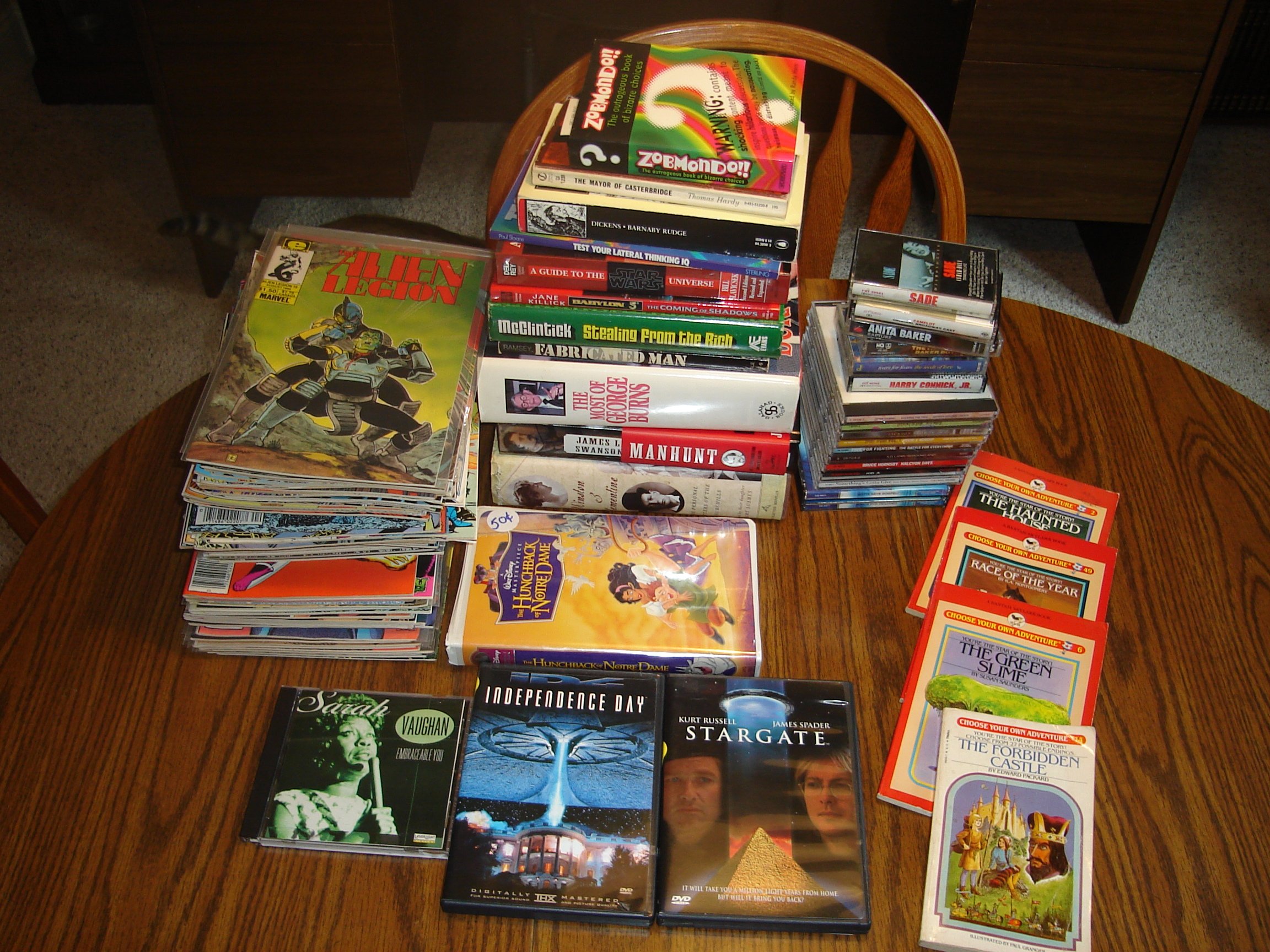
I mean, look at this haul:


August Estate Sale Purchases
Click for full size

The gentleman’s collection of music focused on Big Band and jazz, so while Heather helped herself to some Benny Goodman (or Benny Youngman–whichever was the musician and not the comedian), I got some Sarah Vaughn, John Pizarrelli, Ella Fitzgerald, Lena Horne, and Diana Schuur. The books included some serious literature, a pile of art books and some very nice and old art museum supporter giveaways, and a few conservative tomes. Of which, I acquired:

  • Lolita by Vladimir Nabakov. You know, that book mentioned in the Police song.
  • Five volumes by Ogden Nash.
  • Ariel by Sylvia Plath; I apologized to Jimmy Ray in advance for reading these at him.
  • Flowers of Evil by Baudelaire; I mean, if you have to have flowers.
  • Sonnets of Blood, a collection of poems written originally in Slovak and somehow made to fit an English rhyme scheme. That takes more than mere translation.
  • Dynamics of Faith by Paul Tillich; it will go along side the copy of Morality and Beyond and will probably remain so on my to-read shelves until the middle 2010s.
  • Poems of Flowers; we probably won’t be so lucky that these, too, are evil flowers, but they’ll break up the Dickinsonotony.
  • Tales of the Alhambra by Washington Irving, which talks about that famous building in Spain.
  • Down with Love, a movie tie-in; I can only assume that Mr. Paul owned it because of its tie to the song.
  • Gentleman: The William Powell Story by Charles Francisco; I don’t normally buy celebrity bios, but I just watched the documentary about him that came with the Thin Man DVD box set, so I was primed for this particular book.
  • The Confidential Clerk by T.S. Eliot; this is the first American edition of his verse play. For a quarter!
  • The Seduction of Hillary Rodham by that one guy who was a good guy and is now a bad guy or who was a bad guy and is now a good guy or however the mythology goes.
  • A boxed two-volume set from 1948 called The American Constitution.
  • Detectionary, a reference guide for early detectives in fiction; a special printing by the Hammermill paper company.
  • Couples by John Updike; a first edition for a quarter!
  • A Collectors’ Club edition of Edgar Allan Poe’s select tales and poems. I should put this on my read shelves, since I’ve already read everything from Poe in a complete edition, including the Narrative of A. Gordon Pym.
  • A single volume that collects Carl Sandburg’s Smoke and Steel, Slabs of the Sunburnt West, and Good Morning, America from the 1920s. I said so.
  • A play entitled Tiger at the Gates translated from the French.
  • The Meaning of the Creative Act, an early 20th century musing on creativity, translated from the German or from the Russian.
  • Resistance, Rebellion, and Death by Albert Camus; I’ll read this when I need a good pep talk.
  • Hardluck Ironclad, the story of a sunken Civil War vessel.
  • Time and Again by Jack Finney; a first edition! W00t!
  • A St. Louis County Geneology study of last names in the county in 1989-1990. Because I could.
  • Literary America, a study of American writers and photographs of the things/places about which they wrote.
  • Political Bestiary, a collection of political humor of some sort, I guess.
  • Collecting Nostalgia, a guide to things from the 1930s and 1940s to collect. Heather no doubt hopes I don’t get into collecting stuff from that era since I’m packing away enough clutter already with my narrow bands of material I seek.
  • Light of August, a William Faulkner book that got too close to my stack. Seriously. It was nearby, so Heather thought it fell from my stack and added it.

You can see Heather’s two books standing upright; if I had seen Varieties of Unbelief, I probably would have nabbed it for myself.

That’s 32 books for me, 2 for Mrs. Noggle, and a collection of audiocassettes for Heather to rip into digital format, ensuring that she’s not bored well into 2009.

So I better stop reading long classical works and take time to clear some of the shorter reads off of my shelves or I will face a space crunch. I mean, a greater space crunch than I have now.

And I carried the collection, some 45 pounds of it, the half mile or so home. You know, it used to be automatic that I could do that, but perhaps it’s because I’m aging or because I think I’m aging that I mentally pause before doing it (without actually pausing, you see, because that’s unmanly). As a result, my shoulders are a little tight today, but that only means they’ll look better tomorrow. Lots of books and ripped shoulders: this is possibly the best book sale ever.

Buy My Books!
Buy John Donnelly's Gold Buy The Courtship of Barbara Holt Buy Coffee House Memories

Caution: Do Not Eat In Dark

Watch for that warning label, coming soon thanks to this lawsuit:

A Morgantown man, his mother and his friend are suing McDonald’s for $10 million.

The man says he bit into a hamburger and had a severe allergic reaction to the cheese melted on it.

As a severely allergic man, he took every reasonable precaution to ensure his own safety:

Jeromy did his part to make it known he didn’t want cheese on the hamburgers because he is allergic, Houston said.

He told a worker through the ordering speaker and then two workers face-to-face at the pay and pick-up windows that he couldn’t eat cheese, Houston said.

“By my count, he took at least five independent steps to make sure that thing had no cheese on it,” Houston said. “And it did and almost cost him his life.”

After getting the food, the three drove to Clarksburg and started to eat the food in a darkened room where they were going to watch a movie, Houston said.

Jeromy took one bite and started having the reaction, Houston said. One of the three immediately called the McDonald’s to let restaurant employees know they had messed up the order, but had to cut the call short when Jeromy started having a bad reaction, Houston said.

That’s right, he told people he was allergic but didn’t take the precaution of actually checking his food. Afterwards, while he’s reacting, his friends call the McDonalds.

Sounds like someone is digging for some free money here.

On the other hand, here’s an encouraging sign from our health industry:

The lawsuit alleges Jeromy “was only moments from death” or serious injury by the time he reached the hospital.

. . . .

McDonald’s representatives offered to pay half of Jeromy’s medical bills — which totaled about $700. When Houston became involved, he said the company offered to pay all the medical costs.

The cost of saving someone only moments from death: $1400.

Good work, health care industry!

Buy My Books!
Buy John Donnelly's Gold Buy The Courtship of Barbara Holt Buy Coffee House Memories

Weird: Supply and Demand’s Limited Impact

Prices are going up for some commodities when the supply goes down and demand remains the same or goes up:

The wholesale price of cocaine has surged since December because of a shortage of the drug in 37 U.S. cities, including Milwaukee, according to a recent announcement by the White House Office of National Drug Control Policy.

Isn’t it stunning that this happens to drugs but not to petroleum, where price increases are always the result of mere greed on the part of the oil companies?

Buy My Books!
Buy John Donnelly's Gold Buy The Courtship of Barbara Holt Buy Coffee House Memories