You think that because I haven’t posted a good book hunting segment in a while that I have not been out there buying books? Hah! Think again.
Although January isn’t normally a good month for book fairs, this January 2009 proved to be fruitful indeed. We visited the following three book fairs.
St. Michael’s
The first book fair we visited was St. Michael’s in Shrewsbury. I think we missed this book fair last year; however, we saddled up our children and went to this one (a side benefit of having toddlers as big as horses is you can, in fact, ride them). St. Michael’s is tucked off a side street in Shrewsbury (St. Michael, for some reason).
The book fair is tucked into a small room to the left of the entrance. Small rooms with few people mean that toddling children can walk by themselves, exploring the books on their own. Our toddling child offers his own suggestions for purchase, not only in children’s books but also in adult books, but his determinations of his parents’ reading interests are more random than an Amazon algorithm. At any rate, here’s what we got:
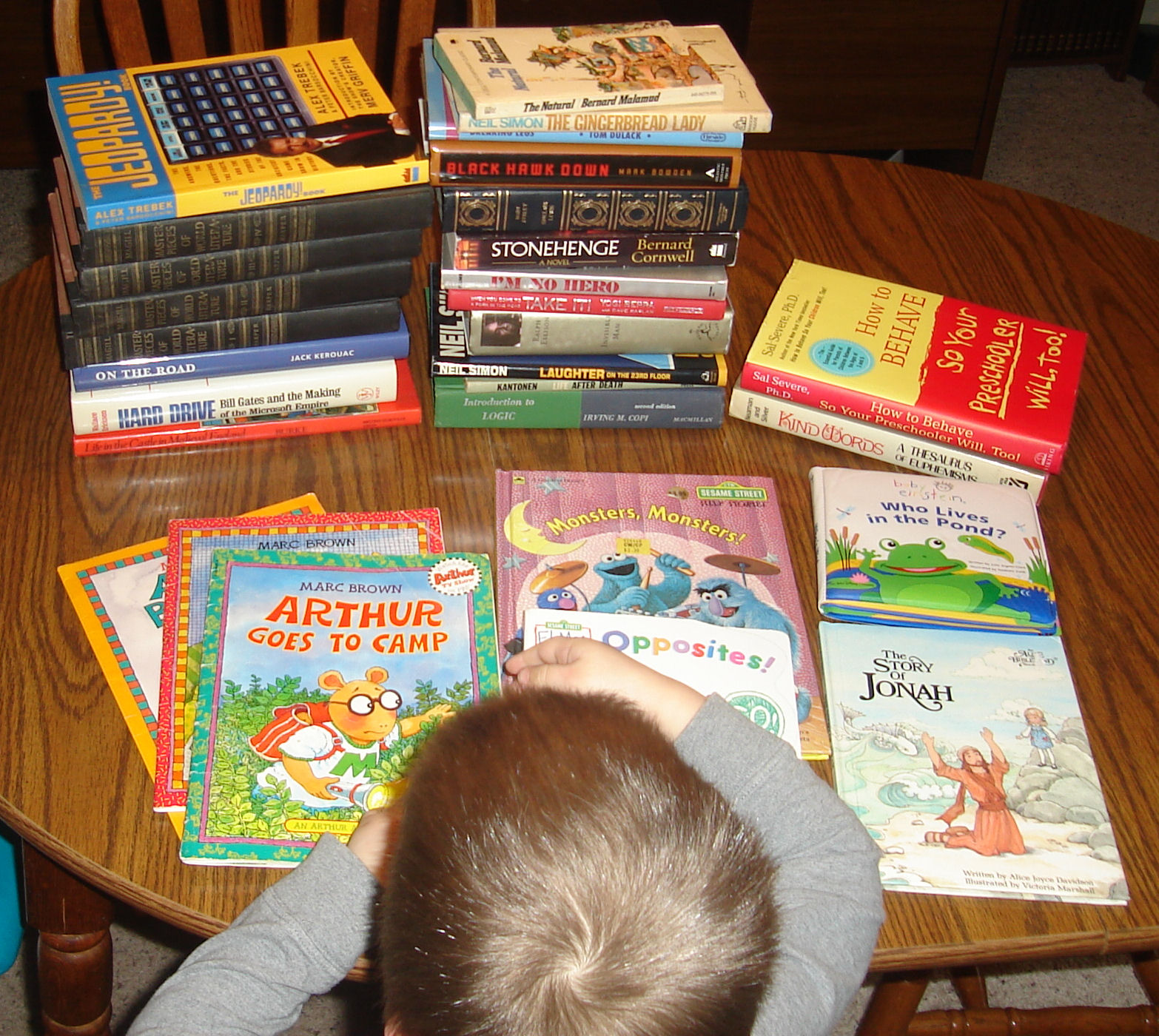
Click for full size
I got:
- The Jeopardy Book, a book based on the popular television game show.
- A four volume set of Masterpieces of World Literature, a reference work.
- On the Road by Jack Kerouac in bound, not scroll, form.
- Hard Drive, a book about Bill Gates and Microsoft. I’ll read it sometime, like I’ll read Softwar about Larry Ellison and Oracle sometime.
- Life in the Castle in Medieval England. Self-explanatory.
- The Natural, the book upon which the movie was based.
- Breaking Legs, a play.
- Blackhawk Down, the book about the Somalian excursion. I read the book serialized in the late 1990s, but I’ll probably want to read it again. You know, I think I saw the film, too.
- Main Street by Sinclair Lewis.
- Stonehenge by Bernard Cornwell. It doesn’t fit into the Sharpe series, so I didn’t blow it with all the people who will get me the series for my birthday.
- I’m No Hero. I forget who wrote this, or why he or she bothered to assert it. I guess I’ll find out sometime in 2019, unless I’m forced to burn the book for fuel first.
- If You Come To A Fork In The Road, Take It, a memoir by Yogi Berra.
- Invisible Man by Ralph Ellison.
- Laughter on the 23rd Floor, a Neil Simon play.
- Life After Death, a play by someone else.
- Introduction to Logic, as though I need another textbook on this deprecated subject.
That’s 19 books.
Heather got some books, and the toddler got some books that he can’t wait to read. And he hasn’t.
St. Mattias
We’d seen the signs for weeks, so when the time came, we had a babysitter lined up and went down to St. Mattias for its book fair. I entered a raffle for a quilt which I didn’t win. The fair was in the church’s gym, a bit bigger than we would have wanted to let the child run in anyway. I have totally given up pretense, and I grab a box right away when entering these affairs. You can see why:
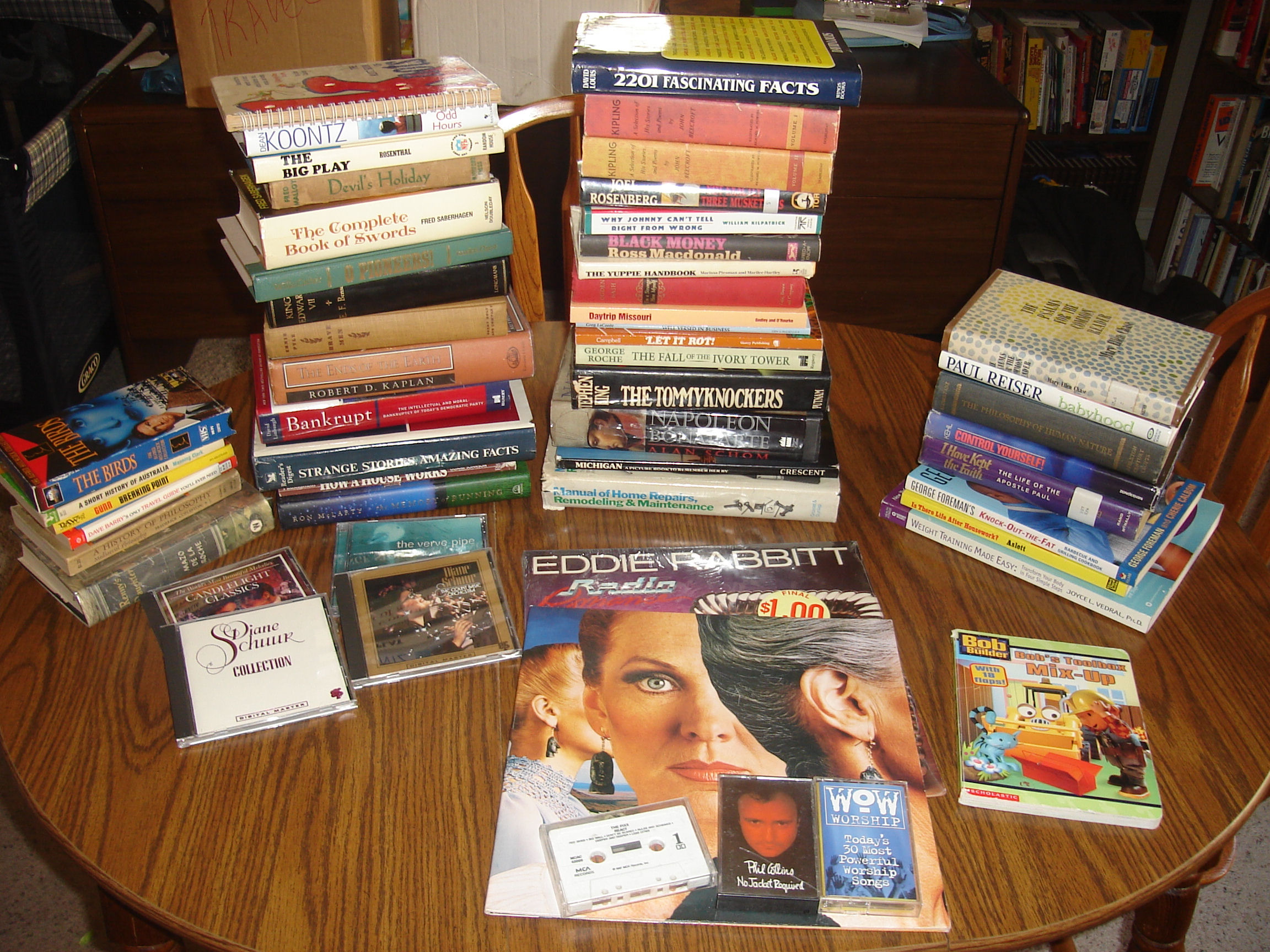
Click for full size
I got:
- The Birds on VHS. It was written by Evan Hunter, you know.
- A Short History of Australia because I don’t have a lot of time for a long history of Australia. Speaking of which, since Pluto is a dwarf planet, shouldn’t we also have a movement afoot to demote Australia to a dwarf continent?
- Breaking Point, a DAW paperback original science fiction thing. Just because.
- A volume in the History of Philosophy series. A duplicate, of course, but one of these days I’ll get lucky. Or I’ll get smart and list what I have so I don’t buy up all the duplicates in circulation.
- Renny’s Daughter, part of some series by Mazo de la Roche. I bought some others in the series. Why not get them all just in case I like them? Well, I guess the argument would be what if I don’t like them, but I can always burn them for fuel.
- The Klutz’s Guide to Knots, complete with strings to practice with. Should come in handy if I’m impressed onto a frigate.
- Odd Hours, by Dean Koontz. I already had a BOMC edition complete with erratum notice; this standard edition will replace it and provide my brother’s new birthday gift.
- The Big Play, an old collection of big NFL plays.
- Devil’s Holiday.
- The Complete Book of Swords. This had been in the history section, but I know better. The volunteers at St. Mattias appeared to be somewhat clueless since many books were classed according to the title and not the content.
- O Pioneers in the coveted Readers Digest edition no less.
- King Edward VII. A biography. Don’t know who he is? Someday I won’t be able to say that.
- Brave Men, a collection of works by Ernie Pyle.
- The Ends of the Earth by Robert Kaplan.
- Bankrupt: The Intellectual and Moral Bankruptcy of the Democratic Party. Get them before they’re banned!
- Strange Stories, Amazing Facts, a Readers Digest collection. These are such good sources for ideas. I have so many, I should put the good ideas to use sometime.
- How a House Works, a home repair thing. I have so many, I should repair my house sometime.
- A Memory of Running by Ron McLarty. He played Sgt. Frank Belson on Spenser: For Hire, you know. I didn’t need more reason than that.
- 2201 Amazing Facts, hopefully another idea source.
- 2 volumes of a collection of Kipling.
- Not Exactly the Three Musketeers, a Guardians of the Flame book by Joel Rosenberg. You know he’s a CCL instructor, right?
- Why Johnny Can’t Tell Right from Wrong, another screedish, no doubt, book.
- Black Money by Ross MacDonald. When you find a Ross MacDonald in the wild, you take it.
- The Yuppie Handbook. For times when I want to reminisce about being DINK and project myself into a city in the 1980s.
- I’m a Stranger Here Myself, poems by Ogden Nash. I shall have the whole set someday.
- Daytrip Missouri, a travel thing for Missouri.
- Well Versed in Business, poems about business.
- Let it Rot about composting.
- The Fall of the Ivory Tower, a screedish book a la The Hollow Men and ProfScam, I assume.
- The Tommyknockers by Stephen King.
- Napoleon Bonaparte. Man, if I ever start reading historical biographies, I will be set.
- Michigan, a picture book. Hopefully, it will skip Detroit (although I have looked at a picture book dedicated to that city in 2007).
- Manual of Home Repairs, Remodeling, and Maintenance. See comment above for the other home repair book.
Additionally, I bought some Diane Schuur CDs and the Verve Pipe CD with “The Freshmen” on it. Heather got some books and some LPs, including a Styx album whose cover creeps me out seriously. Seriously.
I’m only going by line numbers here in my HTML editor, but is that 32 books? That puts me at 52 purchased for the month before the deluge.
The JCC Mini Sale
This year, apparently the Jewish Community Center in Creve Coeur will renovate the building that houses its book fair, so they threw a mini-book fair for five days in January. We were going to go on Tuesday, the penultimate day, but a schedule conflict emerged, so we ended up going on the last day. Five dollar bag day. You know what that means.
I didn’t have too many books, but then I looked again at a large collection of Walter J. Black-printed three-mysteries-to-a-volume series, and thought, “Man, I could pick those all up for $10. So I did, and then some:
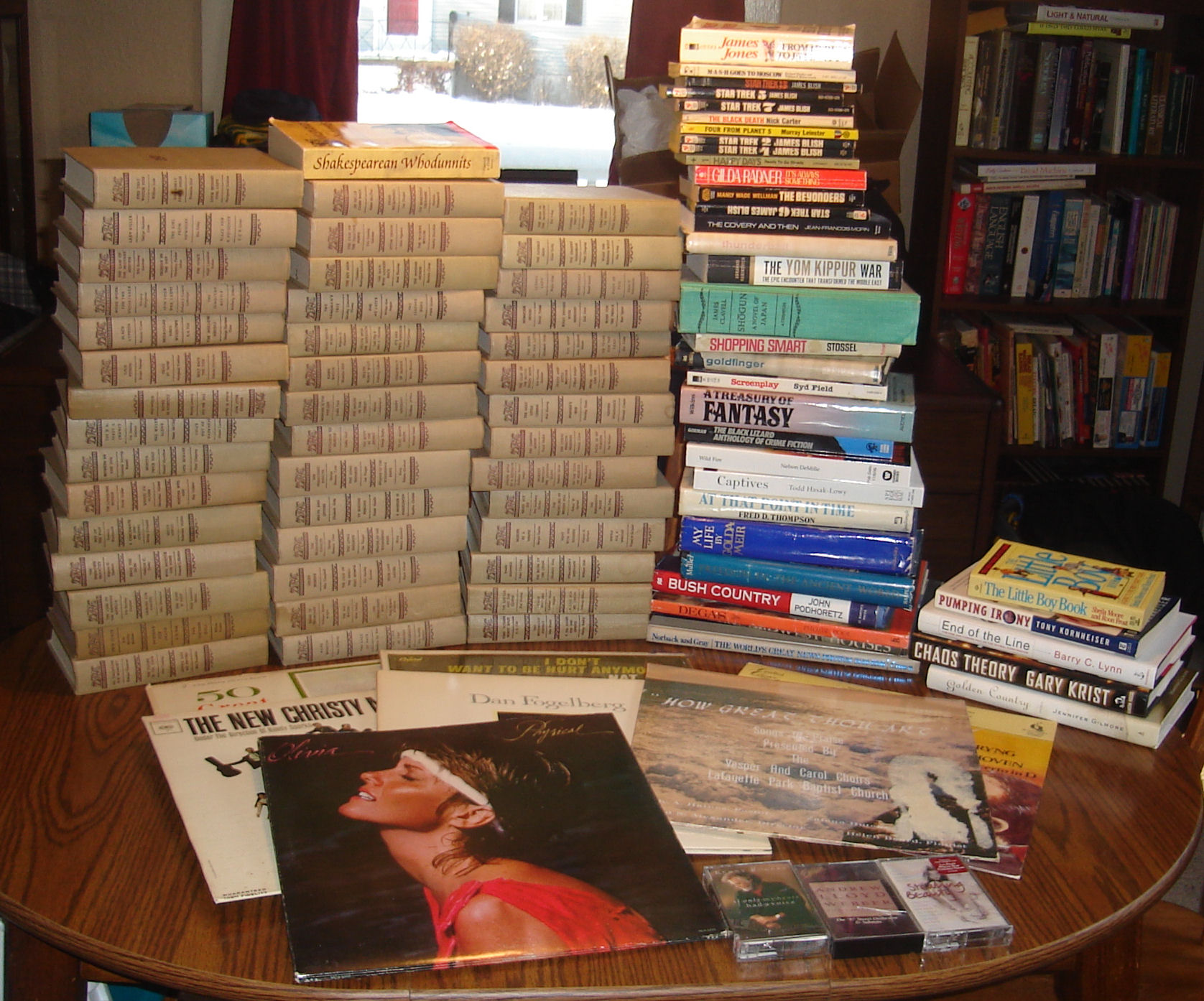
Click for full size
I got:
- 43 of the aforementioned mystery books, or 129 mystery novels total.
- Shakespeare Whodunnits, mysteries based on Shakespeare plays.
- From Here to Eternity by James Jones. I am on a WWII kick here. By “kick,” I mean buying a lot of WWII books.
- M*A*S*H Goes to Moscow, a book based on the television series.
- Star Trek 2-7. Some are dupes, but they all fit in the bag, dig?
- The Black Death by Nick Carter. Quality pulp.
- Four From Planet 5, a science fiction thing about kids from another planet.
- Happy Days: Ready to Go Steady, a book based on the television series.
- It’s Always Something, the autobiography of Gilda Radner.
- The Beyonders by Manly Wade Wellman. Probably not about the Secret Wars or Cosmic Cubes.
- The Covery and Then. I have no idea. I bought that?
- Thunderball, the James Bond novel.
- The Yom Kippur War, a historical account. The J is always good for Israeli history; what are the odds?
- Shogun. Remember the miniseries? I remember it was on. Sometime around the time Masada was on, too.
- Shopping Smart, an early book by John Stossel.
- Goldfinger, another Bond novel.
- Screenplay, a book about how to write screenplays? Hey, it fit in the bag.
- Wild Fun, a galley or ARC of a novel by Nelson DeMille. The J is also good for prepublication materials.
- Captives, a galley or ARC of another novel. Bought because it’s prepublication and hence worth more if anyone bothers collecting books in 20 years and this chap is any good. If not, it burns at a cozy 451 degrees.
- At That Point In Time, Fred’s book about Watergate.
- My Life by Golda Meir. I think I already have this in paperback, in which case the hardback is a replacement.
- Freedom in the Ancient World, a book that examines and, hopefully, rates the individual freedom in ancient societies.
- Bush Country, a pro-Bush screed.
- Degas, a picture book of the artist’s work.
- Historic Midwest Houses, a picture book of, well, you can guess.
- The World’s Great News Photographs 1840-1980
Heather got a couple of books and some music, as is her wont.
As you know, on dollar bag day (or $5 bag day in this case), you buy books by volume. Our collection was four bags, so $20. We didn’t even really try to stuff the bags. The selection wasn’t the best, as it was only a minibook fair and the last day of it to boot. Maybe I was a little gun shy about going nuts, too, knowing it was license to acquire too much. Because, you know, 73 books wasn’t too much.
Total: 124 new books.
That is, more than a year’s worth of reading bought in one month.
And it’s not even book sale season yet.