Book Report: Prairie Fire by “Don Pendleton” (1984)

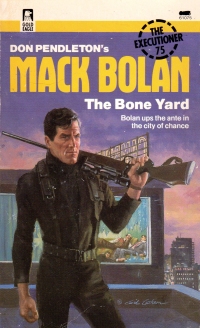
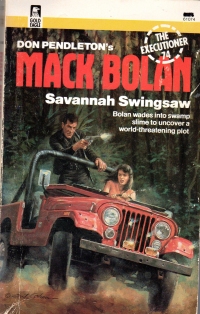
Book coverThis book starts with a running man ploughing through Nebraska cornfields as professionals pursue him. Through flashbacks, we find it is Bolan, who was investigating some off-page MacGuffin that led to his capture and escape from a crew hired to hit him by the KGB. Bolan hides in a barn of a small farm, but finds himself captured by the farm owners and held until they start to believe his story that they’re in trouble with him there.

So the book turns into a tower defense story, with Bolan and the family hardening the household to withstand a nighttime assault. And so they do. Spoiler alert: Bolan lives.

It’s an interesting twist of a plot, as Bolan is usually on the offense so we get to see him build a defense. But sometimes I wonder how little experience with guns, military assaults, and whatnot the authors of the books have as they go on. When booby-trapping the house, Bolan makes a small IED with some C4 he recovered from an attempted carbomb, but he makes it so the trigger requires him to hit a small mark with a .22 shot–from a gun for which he has extremely limited ammunition instead of, I dunno, a tripwire? Also, the book describes the report of a .22 rifle as a falsetto yapping. I suppose that’s a metaphor that might work, except it doesn’t, especially when you don’t trust the author.

So it’s an interesting twist, but there are some things that give you pause. I can suspend disbelief until I start thinking I could do as good of a job as the professionals in the book. But those moments pass, and we’re through the book with some enjoyment in spite of it.

I only have 47 Executioner titles remaining on my to-read shelves, not counting the other related titles. If I keep at it at the pace I have this year, I’ll be done in under four years. Woo! Unless I buy more, which is always a risk.

Buy My Books!
Buy John Donnelly's Gold Buy The Courtship of Barbara Holt Buy Coffee House Memories

Book Report: Misspent Youth by Peter F. Hamilton (2008)

Book coverThis book is a British science fiction novel from B.O. (Before Obama). The copy I have is an Advanced Uncorrected Proofs version that I picked up some time ago at a book sale along with other ARC and proof copies of books. Which explains some of the typos I found, although fewer than one might find in John Donnelly’s Gold or the similarly self-published Lightning Fall.

At any rate, the plot of it: About 40 years in the future, the elderly inventer of the storage mechanism that allows the Internet of the future is chosen by the European Union for a revolutionary therapy that rejuvenates a human to the age of about 25. The treatment takes about a year and a half, and at the end of it he has to accustom himself to his new youth and to reconnect with his eighteen-year-old son, the product of a marriage of convenience to a much younger woman who is now older than the formerly elderly engineer. The newly youthful fellow does all of this by nailing all the young women he comes into contact with: the granddaughter of a close friend; the trophy wife with whom he’d never actually had relations; girls in his son’s circle; and finally, the son’s infatuation and something of a girlfriend.

All this boffin goes on against a backdrop of English seperatists who want the UK to break away from the EU and are becoming increasingly violent in their insistence. The pseudoclimax of the book takes place at a major right in England where the father and son end up on different sides: The father is inside a heavily guarded conference center to present a paper, and the son is carried along to the riot by peer pressure. They reconcile, and then the father dies from an unforeseen and untreatable side effect of the treatment. The End.

Well, it’s certainly got a 1970s science fiction vibe from it along with some of that later Heinlein “Ew, put it away already!” I saw on Wikipedia that there are a couple other books set in this same universe, but I don’t expect I’ll revisit it.

What did it get right? Well, people access the voice-enabled computer by saying a word ahead of it. I guess they were doing it on Star Trek, but it’s much more relevant now that every second commercial on television is people talking to the cloud. What did it get wrong? Brexit by violence 40 years from now (hopefully).

I suppose the title means it’s a commentary on misspending your second chances by wasting the time as much you did when you were younger anyway. Or maybe that’s being to charitable, but it’s certainly a theme that has resonance and is probably defendible. Maybe we’ll see in 40 years.

Buy My Books!
Buy John Donnelly's Gold Buy The Courtship of Barbara Holt Buy Coffee House Memories

Rogue One Spoilers! Must Credit MfBJN!

Well, not actually. I tweeted these bad dogs and thought I’d do a two-fer with the content by recycling it for you, gentle reader.

Yeah, I saw it, but I wasn’t entranced with it. I wonder if the Star Wars movies and the Marvel movies will have diminishing returns as the decades become saturated with them.

Buy My Books!
Buy John Donnelly's Gold Buy The Courtship of Barbara Holt Buy Coffee House Memories

Book Report: Nora Bonesteel’s Christmas Past by Sharyn McCrumb (2014)

Book coverAs you might remember, gentle reader, I like to read a Christmas book about this time of year. This year, I chose this book because it was the first one I could find on my to-read shelves.

The bottom of the cover indicates this is a Ballad novella; the author has written many best selling books in this series taking place in the eastern mountains of Tennessee, but you don’t need intimate knowledge of them to enjoy this book.

It’s billed as a novella, but it’s really two unconnected stories in the Ballad mythos. The sheriff and a deputy are tasked with arresting a man in the backwoods on Christmas Eve for a hit and run accident that damaged the car of the wife of a Senator (hence the importance of arresting him on Christmas Eve amidst the threat of a heavy snowstorm). When they find what they think to be his home, he says he will go quietly if they just help prepare his home for his absence to make it safe for his wife. The second story deals with a couple of Floridians who have bought a second home that used to be the county’s best home, the place where an old judge and his family lived. They decide to stay for Christmas with their tacky Florida ways. When strange goings on go on, they come to Nora Bonesteel, an elderly local medium, to see if she can guess what is wrong. It seems a spirit of Christmas past is not pleased with a pink Christmas tree decorated with flamingos.

On the plot lines, it’s pretty thin gruel, but the writing is dense and pretty enough to carry you along. Thematically, it’s a little light on the Christmas spirit, too, lacking any religious element of it or particular generosity of spirit. No real changes of heart or reunions of family. But pleasant enough.

I saw one of the author’s Ballad novels on the mark down table at Barnes and Noble while Christmas shopping, and I didn’t grab one for $6. Perhaps I’ll grab one if I see it at a book sale in the future to see what happens in a non-Christmas themed novel from the author.

Buy My Books!
Buy John Donnelly's Gold Buy The Courtship of Barbara Holt Buy Coffee House Memories

Overheard at Nogglestead

I was reviewing a video that Mr. Hill posted when my beautiful wife walked into my office.

“Huh,” I said. “I didn’t realize Tim Curry charted a single.”

“I don’t know who that is,” she said.

“He was in The Rocky Horror Picture Show, National Lampoon’s Loaded Weapon I, and Clue,” I said. “And Legend as the Darkness.”

Blanks. My wife was not familiar with any of them. Which is odd, since I’m pretty sure I made her sit through National Lampoon’s Loaded Weapon I at some point, and she is repressing it.

“It’s a good thing you bring me along to trivia nights,” I said.

Buy My Books!
Buy John Donnelly's Gold Buy The Courtship of Barbara Holt Buy Coffee House Memories

Book Report: Ginger Snaps compiled by Dian Ritter (1976)

Book coverThis book is a middle 1970s collection of what we used to call proverbs, but by the mid to late 20th century had to be accompanied with some wry wit. Many of them are the sorts of things you’d find on Internet memes today, if Internet memes lasted longer than it takes to scroll past them on the social media sites. No, these proverbs of the pre-computer era would be photocopied with some cartoon and pinned to a cubicle wall or taped to a the breakroom cinderblocks.

Which is not to say they’re untrue or without their wisdom. As a matter of fact, this book includes lessons from Lao Tzu:

Give a man a fish, and you feed him for a day. Teach a man to fish, and you feed him for a lifetime.

We have Lord Whorfin (eight years early):

Character is what you are in the dark.

Aside from these, it’s got tweetable quotes like “I wish I were what I was when I wanted to be what I am now.” and “Be satisfied enough to improve, but satisfied enough to be happy.”

Given the time from whence it came, its proverbs promote hard work, character, skepticism of government, and trust in God. Which means modern people won’t be well versed in any, which might make the contents more unapproachable and archaic than they should be.

Buy My Books!
Buy John Donnelly's Gold Buy The Courtship of Barbara Holt Buy Coffee House Memories

Good Album Hunting: “Christmas Shopping,” December 16-17, 2016

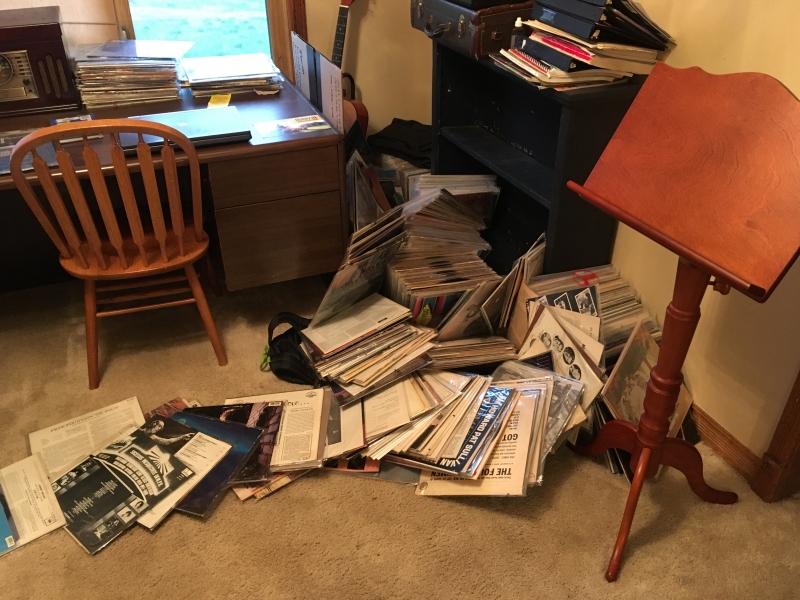
I needed a hard rock or heavy metal LP for a Christmas gift, so on Friday and Saturday, I hit the antique malls and thrift stores to find one.

It’s funny, but when I’m not looking for heavy metal LPs (which is most of the time, as I don’t tend to listen to hard rock on vinyl), I find a bunch of them. This time, nothing. Maybe I’m thinking of the Friends of the Springfield-Greene County Library book sale when I think of boxes of heavy metal.

But, strangely, I did find some things for myself.

I got:

  • Linda Ronstadt and the Nelson Riddle Orchestra, Lush Life and For Sentimental Reasons. I already had Lush Life, which has a special cover that comes in two parts. The copy I previously owned only has one of those parts, so now I have the complete cover. I think Linda Ronstadt’s work with the Nelson Riddle Orchestra is awesome, and I’m delighted when I discover there is another.
  • Linda Ronstadt, Linda Ronstadt.
  • Someone donated their entire Mareille Mathieu collection to Disabled American Veterans; I got Mirielle, Meine Träume, Bonjour, MM, and Rendezvous mit Mireille. She’s a French pop singer out of the 1960s.
  • The Melachrino Strings, Music for Faith and Inner Calm. Part of their Moods in Music series, or am I branching into other Melachrino Strings easy listening?
  • Maria Muldaur, Maria Muldaur. Which has “Midnight at the Oasis” which Mr. Hill mentioned when I got my first Muldaur album a year ago.
  • Frank Sinatra, Strangers in the Night.
  • Angela Bofill, Intuition.

To be honest, I thought I’d gotten the needed metal record on Friday night at Relics Antique Mall when I found a copy of Rubicon’s self-titled debut album. Tell me, doesn’t this look about as heavy metal as they come?

Well, not so much. Here’s their hit song from the album:

That is not metal, even in the 1970s.

Strangely enough, that is Jack Blades’ band before Nightranger, though. So I now have his work with three bands from three different decades. Which might make me a Jack Blades collector or something.

At any rate, the aforementioned music has offered a bit of a break from the Christmas music that has been spinning on the turntable for the last couple of weeks. But it also is impressing upon me the need to try to make some new record shelves for the parlor.

Buy My Books!
Buy John Donnelly's Gold Buy The Courtship of Barbara Holt Buy Coffee House Memories

Christmas Album Review: Christmas Album by Herb Alpert and the Tijuana Brass (1968)

Book coverThis album fits in with the mellow 1960s sound found on the other Christmas albums I’ve reviewed so far this year (you can find them here). As you might know, gentle reader, it was Herb Alpert and the Tijuana Brass that initially led me into collecting albums from the 1960s in the easy listening genre, and when I saw this album at an antique mall, I bought it. You can tell I’m serious because I paid $5.00 for it. You can really tell I’m serious about it because I paid $5 for the LP when I’d already received the CD as a Christmas gift. Or perhaps you know that I like to spin records at Christmas.

At any rate, the album features mostly secular winter-time songs associated with Christmas, but has “The Christmas Song” and a bit of a religous Bach piece called “Jesu, Joy of Man’s Desiring”.

The track list includes:

  • Winter Wonderland
  • Jingle Bells
  • My Favorite Things
  • The Christmas Song
  • Las Mananitas
  • Sleigh Ride
  • The Bell That Couldn’t Jingle
  • Let It Snow, Let It Snow, Let It Snow
  • Jingle Bell Rock
  • Jesu, Joy Of Man’s Desiring

You don’t tend to see “Las Mañanitas” on a Christmas record as it’s a traditional Mexican birthday song, but it could fit the Christ birth theme. “The Bell That Couldn’t Jingle” is a particularly nice bit with Herb Alpert on the vocals. Did you know Herb Alpert is the only artist to win a Grammy for an instrumental and a vocal performance? True fact. Not this song, though, although his gentle tones offer a mellow bit of encouragement.

I like this album plenty and play it a bunch, both on the turntable and on the CD when I’m not in my parlor. Let that be a ringing endorsement.

Album mentioned in this review:

Buy My Books!
Buy John Donnelly's Gold Buy The Courtship of Barbara Holt Buy Coffee House Memories

Bro Country Music: A Topical Analysis Minus The Pie Chart

At The Federalist, some kid writes Country Music Has Become A Huge Clichéd Joke:

I love these songs, not just because they’re fun to sing along with, but because they involved people living, loving, falling down, and getting back up again. Songs that talk about how attractive you find your kid’s mom after years of marriage, or working hard and never giving up, contrast sharply with pop songs about the sexual excitement of whips and chains or “the beauty of one-night stands.” It’s fair to say I love country music for the same reasons I dislike pop music.

But by the mid-2000’s, country music started to change. It was a slow metamorphosis, but artists like Trace Adkins, Brooks and Dunn, Kenny Chesney, and Allan Jackson [sic] can’t deny their handiwork in this change, singing less about family or daily life and more about having a “Good Time,” or a woman’s breathtaking heinie. By the end of the decade, up-and-comers had completely embraced “party country” to the point where it seemed the entire genre needed to check itself into rehab.

Gimlet thinks it reflects what I wrote here.

A quick analysis of the article linked above shows that the young man writing the article hearkens back to classic country a couple of times (a couple of 90s songs, the earliest being Garth Brooks’ “Papa Loved Mama” from 1992), but most of the songs he uses as good examples stem from after 2000.

Well, he does say he started listening to country in the car, and there have been very few stations playing classic country in the 21st century.

That said, let me offer this sampling of classic country, which is to say country which was new when I started listening to it, that the damn kids, and by damn kids I mean “Garth Brooks”, ruined:

(See also this post about the general state of music that I wrote in 2003.)

Buy My Books!
Buy John Donnelly's Gold Buy The Courtship of Barbara Holt Buy Coffee House Memories

Christmas Album Review: Merry Music Christmas by Dean Martin/Jackie Gleason (1973)

Book coverThis album represents the Reese’s Peanut Butter Cup of albums. As you might know, I have two Dean Martin Christmas albums (The Dean Martin Christmas Album and Winter Romance) as well as White Christmas by Jackie Gleason. So when I cannot decide which to listen to, I can drop this platter on the turntable and enjoy the best of both.

This album collects some of the Capitol songs of both from the aforementioned albums and mixes them together. So you have songs with Martin’s warm flair followed by instrumental big band numbers by Gleason’s orchestra.

The track list includes:

  • Baby It’s Cold Outside (Dean Martin)
  • Winter Wonderland (Dean Martin)
  • You’re All I Want For Christmas (Jackie Gleason)
  • I’ve Got My Love To Keep Me Warm (Dean Martin)
  • It’s Christmas Time All Over The World (Jackie Gleason)
  • Blue Christmas (Jackie Gleason)
  • The Christmas Song (Jackie Gleason)
  • Rudolph The Red-Nosed Reindeer (Dean Martin)
  • Snowbound For Christmas (Jackie Gleason)
  • White Christmas (Dean Martin)

Of the selections, most are standards, but “Snowbound for Christmas” is the new song, and “Rudolph the Red-Nosed Reindeer” might be from the original Winter Romance; it is not on either the reissue of Winter Romance I have nor The Dean Martin Christmas Album.

So it lies in the sweet spot between a compilation album of many different voices and a record with a single singer or group. It’s two acts I enjoy greatly, and I’m happy to have picked this disc up this year. I’d recommend it if you can find it for a couple of bucks out in the wild. Or, like I did, for a buck at a book sale.

Album mentioned in this review:

Buy My Books!
Buy John Donnelly's Gold Buy The Courtship of Barbara Holt Buy Coffee House Memories

Book Report: A Bullet for Cinderella by John D. MacDonald (1955, 1985)

Book coverThere’s no car crash in this book; instead, a Korean veteran and POW camp survivor returns to normal life a changed man. He cannot abide his former life, so he takes off to Hillston, the home of a fellow campmate who did not survive the POW camp. The dead man had told the narrator about some money he had embezzled from his brother’s business and hidden to run off with the brother’s wife, but the war intervened. The only clue he leaves as to the location of the missing money is that Cindy knows. So the narrator starts talking to people who knew the dead hero under the guise of writing a book. He finds that another person from the camp has already gotten there–a psychopathic former Marine who hasn’t found the money himself but is willing to let the narrator keep a cut if he finds it.

As the narrator digs, he finds evidence of murder, blackmail, and so forth and finds some redemption and/or clarity in falling for the dead man’s former girlfriend.

As a paperback original, this book runs about 170 pages, and none of them are wasted with convolutions, exposition, or technobabble, so it makes for a quick and satisfying little read. It holds up well, as does most of MacDonald’s stuff, if you can remember or imagine a world before pervasive computers in every pocket. Heck, I still imagine that world since I don’t have many apps on my phone and don’t feel compelled to look at it whenever I have a moment without noise.

Buy My Books!
Buy John Donnelly's Gold Buy The Courtship of Barbara Holt Buy Coffee House Memories

Book Report: Cry Hard Cry Fast by John D. MacDonald (1955)

Book coverI read Slam the Big Door in August, and it features a car crash (‘slam the big door’ refers to the sound of a car crash in the night on the backroads of Florida), and this book centers on a car crash. I wondered if this was from MacDonald’s CHiPs era.

But the books were published five years apart with many intervening novels. Perhaps he wrote them close together, or perhaps he rotated back into subject matter when it seemed fresh after the passage of time.

Unlike Slam the Big Door, this book centers on a big car wreck: it focuses on the individual stories of the people and families who are going to be involved in the car accident and the immediate aftermath for the survivors. We have a recent widower on a trip to recover from his grief (see also Slam the Big Door). We have a nuclear family with a domineering father and an attractive teenaged daughter; we have a couple trying to rekindle their marriage after the husband becomes cold and distant; we have an ace truck driver considering moving into management; and of course, we have a couple of bad fellows on the run from an armed robbery and the funtime girl they picked up at a roadside bar. It’s vintage MacDonald, slamming all these people together (literally) and seeing what erupts.

The first part of the book, before the accident, is better than the last bit after the accident, but it’s still a pretty good read.

As I mentioned, I have a number of MacDonald books on my shelves, and I’ve been reluctant to read them because once they’re gone, they’re gone. However, given my ability to re-read the Travis McGee books from time to time, perhaps I should seek more of them out since I enjoy them and I can re-read them when I’ve finished all of them. And, to be honest, finishing all the John D. MacDonald books is a better use of my time than reading all the Executioner books (that is, the Mack Bolan books, not The Executioner, which is a John D. MacDonald book).

Buy My Books!
Buy John Donnelly's Gold Buy The Courtship of Barbara Holt Buy Coffee House Memories

Christmas Album Review: Winter Romance by Dean Martin (1964)

Book coverThis album comes in two flavors: The original version, depicted below in the Amazon link, and the 1964 reissue depicted to the right, which is the edition I have. The two differ by a couple of tracks: The original includes “White Christmas” and “Rudolph, The Red-Nosed Reindeer” which makes it a more straight-ahead Christmas album. The reissue, on the other hand, has no explicit Christmas songs at all.

Instead, the songs are all about cold and the winter, but some are standard songs on Christmas albums and radio stations, including “Baby, It’s Cold Outside”, “Winter Wonderland”, and “Let It Snow”. Some are jazz standards that you hear all year round, like “I’ve Got My Love To Keep Me Warm” and “The Things We Did Last Summer” (although I hear them all year round because I listen to jazz standards throughout the year–if you don’t, you probably won’t).

In that regard, I can play the album well into January, although it’s not particularly cold here in southwest Missouri (especially for a Wisconsin native).

The track list includes:

  • I’ve Got My Love To Keep Me Warm
  • June In January
  • Canadian Sunset
  • A Winter Romance
  • Let It Snow! Let It Snow! Let It Snow!
  • Baby, It’s Cold Outside
  • The Things We Did Last Summer
  • It Won’t Cool Off
  • Out In The Cold Again
  • Winter Wonderland

As it is Dean Martin, it’s in pretty heavy rotation at Nogglestead as is Martin’s The Dean Martin Christmas Album.

And I’ll be honest, I’ll never be brave enough to try the sweater over a turtleneck look, but I’m not living in the past, just listening to the past.

Also note that now that I know it exists, I’ll be on the lookout for the original release with the more Christmas flavor. If nothing else, it will make yet another Christmas album review someday.

Album mentioned in this review:

Buy My Books!
Buy John Donnelly's Gold Buy The Courtship of Barbara Holt Buy Coffee House Memories

Christmas Album Review: White Christmas by Jackie Gleason (1970)

Book coverIf you like the mellow orchestral mood music sound of Jackie Gleason presents albums, you will love this album. It’s a welcome departure from the normal Christmas record orchestration, with the reliance on traditional choir, organ, and bells/chimes. These are swanky orchestrations for a holiday get-together or a nice bit of background music for baking. No snow required!

The track list includes:

  • White Christmas
  • Let It Snow, Let It Snow, Let It Snow
  • Jingle Bells
  • Blue Christmas
  • The Christmas Song
  • Winter Wonderland
  • Santa Claus Is Coming To Town
  • I’ll Be Home For Christmas
  • Have Yourself A Merry Little Christmas

It’s not my favorite Christmas album, and it’s not my favorite Jackie Gleason presents disc (that would be Music, Martini, and Memories or The Torch with the Blue Flame), but it’s an excellent addition to the rotation at Nogglestead. I’m glad I picked it up this year.

Album mentioned in this review:

Buy My Books!
Buy John Donnelly's Gold Buy The Courtship of Barbara Holt Buy Coffee House Memories

Christmas Album Review: A Christmas Sing with Bing by Bing Crosby and the Norman Luboff Orchestra (1958, 1973)

Book coverIt’s not really the Christmas season when it comes to record albums, ainna? It’s Bing Crosby season. So let’s get this year’s Christmas album reviews off to a proper start, with this album. It was recorded in 1955 and released as a record in 1956. It’s from a radio broadcast that Bing did on Christmas Eve, so it’s chock full of not only songs that he performs, but also bits recorded by others. Like many albums I’m planning to review this year, it features the spoken word–in this case, Bing’s introductions to the songs and the cutaways.

The album dates from 1956? 1958? But the pressing I got dates from 1973 or so. Reissued 25 years later. So you know there was a market for it. Whether there still is, I don’t know.

The track list includes:

  • Happy Holiday
  • Joy To The World
  • Hark The Herald Angels Sing
  • White Christmas
  • Adeste Fideles (Oh, Come All Ye Faithful)
  • We Three Kings Of Orient Are
  • The First Noel
  • Carol Of The Bells
  • What Christmas Means To Me
  • Good King Wenseslas
  • Jesus, Sweet Savior (Jesus Sauveur Adorable)
  • Angels We Have Heard On High (Gloria In Excelsis)
  • Away In A Manger
  • Thou Decendeth From The Stars (Tucendi De La Stelli)
  • Deck The Halls
  • God Rest Ye Merrie Gentlemen
  • Oh, Little Town Of Bethlehem
  • Silent Night
  • Happy Holiday (Finale)

Pretty stock stuff, but with some different bits in there (“Thou Descendeth from the Stars”, “What Christmas Means To Me”, “Jesus, Sweet Savior”).

The most interesting part, of course, is the recreation of an old time radio broadcast.

I like it a bunch, and I’ve got it on steady rotation this year so far.

Album mentioned in this review:

Buy My Books!
Buy John Donnelly's Gold Buy The Courtship of Barbara Holt Buy Coffee House Memories

Brian J.: Amazon Prophet

In my post earlier this year about Amazon Prime trying to go all-digital instead of being free shipping, I said:

But undoubtedly Amazon will offer ship-to-store for free someday, just like every other retailer does now (and did in 1990).

How ridiculous you might have thought it sounded. Amazon does not have physical stores!

But it’s December now, kids. Now we have Amazon Go:

Amazon Go is a new kind of store with no checkout required. We created the world’s most advanced shopping technology so you never have to wait in line. With our Just Walk Out Shopping experience, simply use the Amazon Go app to enter the store, take the products you want, and go! No lines, no checkout. (No, seriously.)

Although, don’t forget, IBM predicted Amazon Go years ago:

Buy My Books!
Buy John Donnelly's Gold Buy The Courtship of Barbara Holt Buy Coffee House Memories