Here are 18 Stunning Bridges From Around The World.
(Link seen on Dynamist Blog.)
To be able to say "Noggle," you first must be able to say "Nah."
Here are 18 Stunning Bridges From Around The World.
(Link seen on Dynamist Blog.)
Buy My Books!

As you might know, gentle reader, I am a great John D. MacDonald fan, and someday I hope to own all of these paperback originals. This one, written in the middle 1950s, deals with a bucolic Florida town near Tampa that has an old doctor who grew rich from land sales but kept the money, in cash, in his fortress like home. Word gets out, and some out of town hitters come looking for it at the same time as distant shirt-tail relations show up to sponge a bit and the niece-by-marriage hatches a plot to have the man committed.
The book switches points of view and really develops the individual characters in it. It seems slowly, almost, but it’s not; the book runs only 191 pages and really ramps up to a good climax as the individual storylines come to a focal point. MacDonald does this well in his paperback originals, some of which I’ve already reviewed in this space (use the search bar, I’m too lazy to do it for you).
This book is a good one in the set, and I’m eager for the next. Which will probably be in a couple of weeks.
Buy My Books!
A joke on Deb’s site that I shared easily with my mother and uneasily with my wife.
It doesn’t have talking dogs, but it’s funny never the less.
Buy My Books!
As a public service, I present to you the Apple II Video Display Worksheet for Graphics (GR) Mode:
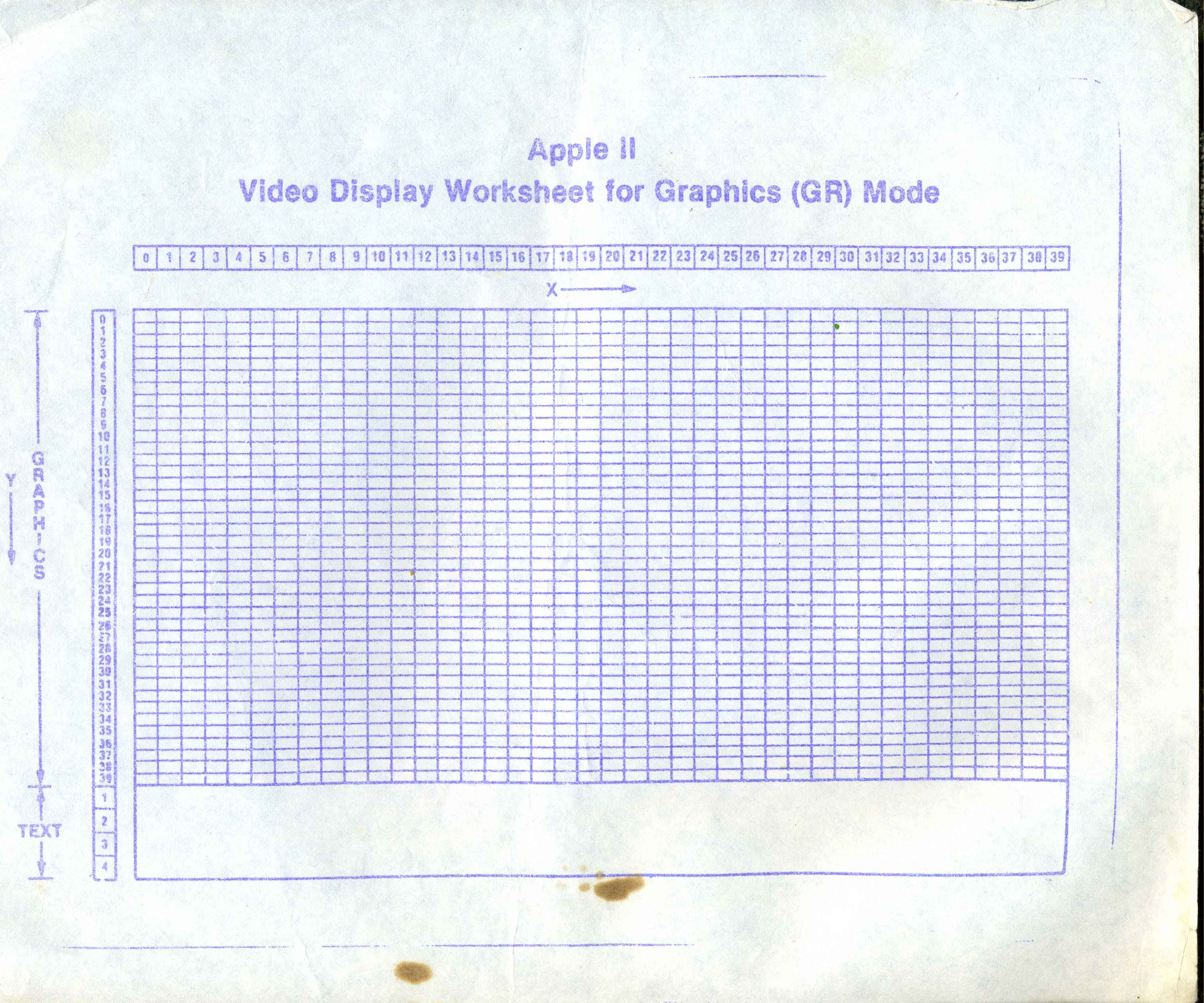
That should help make your design work go a little smoothly. Press your face against the screen. Can’t you just smell the mimeograph ink?
Additionally, I post for your amusement, the beginning of the source code for a game entitled Spies. No non-disclosure agreement required!
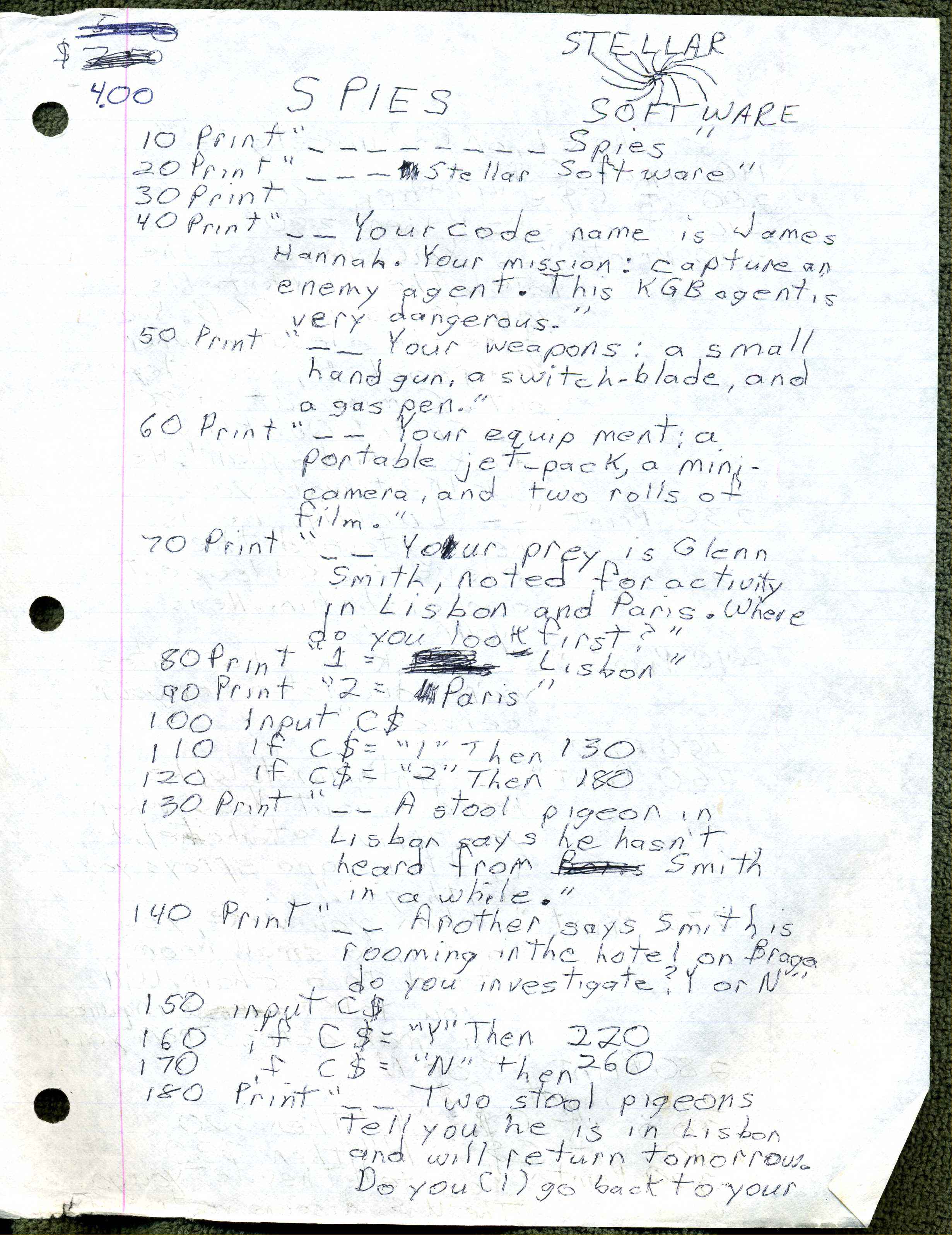
It’s not that we had to write the code by hand and put it through an optical scanner, you damn kids, it’s that we in middle school only got access to a computer during seventh hour but spent much of the other six handwriting the code because it was so exciting.
And just so you know, the schools had the Apples, but my first computer was a Commodore, so that’s where I turned off the path of geekanati and into the real world.
Buy My Books!
Southwest Airlines commercial becomes reality in Milwaukee:
After the opening, Weiland nearly lost the entire audience during the usual meet-and-greet interlude when he stuck his foot in his mouth and addressed the crowd “Chi . . . CA . . . go . . . ” He was met with a barrage of boos.
Yeah, if you’re playing a crowd in Milwaukee, you probably cannot go more wrong.
Buy My Books!
Rising food prices? How could that happen? Those darn cosmic forces aligning against us:
The underlying reasons for the skyrocketing prices are complicated, with roots in places as far away as Australia and as close as a newly planted acre of corn. Rising fuel prices are a main cause, but other factors, particularly a new government mandate for more corn-derived ethanol, are playing a role, too.
“It takes a lot of bad things happening at the same time, for the prices to go where they have,” said Pat Westhoff, co-director of the Food and Agricultural Research Policy Institute at the University of Missouri-Columbia.
We’ve got government mandates saying food should be burned as fuel and government prohibitions restricting nuclear power, new drilling, new pipelines, and new refining capacity. But mandates are made in the passive voice, and these things just happen.
Buy My Books!
Like The Dilbert Principle, this book is not a mere collection of Dilbert cartoons, although it includes a number. Instead, it’s a text derivative of the world inhabited by Dilbert, Dogbert, Catbert, Ratbert, Alice, Tina, Wally, Pointy-Haired Boss, Asok, and so on. This book takes the schtick of being a handbook for managers from Dogbert, the evil genius. Within, you find that it explicitly tells the executives reading how to behave as a Dilbert executive should.
Sadly, although the book is 12 years old, the behavior seems timeless. Fortunately, that means the humor is fresh, and you can laugh cynically. Or you can take it to heart and thrive as an executive.
Buy My Books!
March’s History Magazine is at your local bookstore now, chock full of it’s normal goodness and an article by me. It looks like this:

I didn’t make the cover, but it’s on page 47. Trust me.
Buy My Books!
When I lived in Jefferson County, I always assumed that the suspects in a gas station holdup were rednecks in flannel and pickup trucks. However, this description makes me wonder:
One man is described as heavy set and between 5’6″ and 5’9″ tall wearing a dark hooded jacket with black baggie pants and a sock cap. The other has a lighter complexion with dread locks or a pony tail wearing a light gray hooded jacket.
The inclusion of a lighter complexion makes me wonder if, perhaps, the high-minded St. Louis Post-Dispatch has left out a vital part of the description: the race of the perpetrators.
Because if they were white rednecks, that would mean that the lighter complexion refers to an albino or a mere pink neck.
Buy My Books!
This play details two Jewish brothers’ brief stay with their grandmother and aunt in Yonkers during World War II. The grandmother is of old German dictatorial stock, the aunt is daft, the father (who leaves the boys with his mother while he earns some money to repay a debt to a loan shark) is weak, and the uncle is a bag man for the mob who’s on the run. The boys, needless to say, aren’t thrilled and aren’t sure how to survive in this environment.
Not one of the Simon plays that I’ve found that speaks to me; I guess if I would have been Jewish in New York in World War II, it would have been more meaningful to me. It’s not a bad read, but I don’t know that the play is as driving and forward moving as a play ought to be.
Buy My Books!
The race for Matt Blunt’s successor as Republican candidate for Missouri takes an interesting turn as another government member amasses an army and leads it to Jefferson City:
“I’m in,” Kinder said Thursday. Asked if there was any scenario in which he would not run, Kinder replied: “No. Crossed the Rubicon.”
What, he’s not actually saying he’s started a civil war and an armed conflict to turn the Missouri Republic to the Missouri Empire? Those whacky politicians and their misunderstood metaphors!
(Full disclosure: I once was approached, sort of, to be a candidate to work on Kinder’s blog. Which is why my name crops up from time to time on his team’s blogroll. Obviously, I didn’t take it, which would have precluded me from snark like this.)
Buy My Books!
Forget whether the account conforms to the facts; this story isn’t even internally consistent:
The mother, Amy Fujarte, was in the house alone at the time of the fire, Svetanics said, and was taken to an area hospital and treated for smoke inhalation.
But:
Nickie Bequette, who lives across the street in the 9700 block of South Broadway, said she was enjoying a morning cup of coffee when she looked out a window and saw smoke pouring from the house and the mother escape out a side door with two children.
Which was it? Obviously, it wasn’t worth the reporter’s shoe leather.
Buy My Books!
Charter Communications is offering apologies —and $50 credits — to customers who lost e-mails when 14,000 accounts were cleared out by mistake.
Charter was doing routine maintenance Monday, clearing out old, unused accounts from the system, when the 14,000 active accounts were accidentally cleared as well, according to Anita Lamont, a spokeswoman for the Town and Country-based company. About 1,000 of those accounts were in Missouri and about 300 were in Illinois, she said.
The accounts should still be open to customers, but everything in them was deleted — and is gone for good.
Also, Charter tips a bit of its internal process regarding backups for client data. The part it reveals is the text “Why bother?” The font in which they wrote that particular piece of internal documentation remains secret, covered by an NDA no doubt.
Buy My Books!
In a stunning turn of events, developers who promised willingly gullible government officials the moon to get public dollars for development get the money and start managing expectations, i.e., backtracking on the promises they made:
For the first time, both development partners in the $387 million Ballpark Village are saying it’s unlikely that a significant portion of the project will be completed in time for the All-Star Game in July 2009.
Several months ago, one of the developers, the St. Louis Cardinals, acknowledged the possibility of delays on the downtown project. Now Chase Martin, director of development for the other co-developer, Baltimore-based Cordish Co., also is lowering expectations.
Who could have seen this coming?
Buy My Books!
I have read at least one other Shell Scott novel, since I own it, and might have read more than that courtesy of my local library when I was in high school. So although I’m not a particular fan of Prather, I’ve enjoyed his participation in a genre I enjoy.
The book is less earnest in its pulp and doesn’t really swerve into the campy, but the main character doesn’t take himself or his adventures too seriously. In this book, Shell Scott investigates the murder of a vice president of a Hollywood dish magazine and discovers, as the bodies of mobsters and starlets begin to fall all around him, a blackmail scheme behind it. He does some shooting, some fighting, some near-loving of said starlets, and uses a ruse in the ending to unravel the plot.
A quick read, good enough, and I’ll take more of these as they present themselves in the garage sales or book fair circuit. If you’re so inclined, there’s a link to this book below and you can put some dough in the coffers of Noggle, Inc. No, really, I mean dough; Amazon doesn’t pay pitiful referrers like me in real money.
Buy My Books!
Headline from AP on a story written by a woman:
Charlie Sheen, ex-wife in family court
A man might have titled it something more appropriate, like Denise Richards, Fool Who Preferred Prostitutes to Denise Richards in Family Court.
Buy My Books!
Lawbreaking St. Louis Post-Dispatch “investigators” name a member of the state execution staff. Why? Well, they rely on his misdemeanor criminal past–which does not render him ineligible to perform his duty according to state law–to justify it, but it’s really a way to limit capital punishment in the state, something that hasn’t yet been done legislatively or through the normal end-run means, the courts.
Instead, the Post-Dispatch searches its corporate heart and determines that it is compelled, compelled to put this fellow at risk. It’s against state laws to name these individuals for their safety, so the family, friends, or criminal associates of a condemned and executed party don’t get revenge on the executioners.
But the St. Louis Post-Dispatch doesn’t mind one or two executioners dying if it can A.) sell newspapers, B.) win valuable journalism prizes, or C.) impede the lawful performance of capital punishment through any means necessary.
It remains to be seen if Attorney General Jay Nixon, a candidate for governor and the preordained endorsed candidate of the St. Louis Post-Dispatch, will seek putative measures against the paper so that it might enjoy the consequences of its civil disobedience or whether its benefactor will come to its rescue, much like its inspiration Henry David Thoreau, received when he flouted the law to make a point and got out of jail through a deus ex maquina.
Buy My Books!
So we have this team representing New York and this team representing Massachussetts in one of the biggest contests of the year.
You don’t say.
Funny how “the officials” helped scuttle the hopes of the team from the Midwest that the whole country could have rallied around, ainna?
Buy My Books!
To stimulate the economy, Democrats in Washington want to provide another “rebate” to those who didn’t pay taxes to return:
Nearly 40 percent of Americans owed no federal income tax last year, though even low-income workers paid taxes for Social Security and Medicare. While Bush has refused to disclose specifics of his $145 billion plan, administration officials and Republican lawmakers favor a proposal that would offer rebates of up to $800 for individuals and $1,600 for families – but only if they paid that much in taxes last year.
…. Administration officials and Republican lawmakers say it only makes sense to give tax rebates to people who actually paid taxes. But Democrats are gearing up to fight that approach, arguing that a stimulus plan should put money in the hands of low-income people, both as a matter of fairness and because people who are struggling to make ends meet are most likely to spend any government payments quickly. For the purpose of jump-starting the economy, economists want people to spend extra money as quickly as possible.
A tax cut would be fair, but a facile and arbitrary distribution plan, that gets voters from those who receive free money from the rest of us courtesy of the Washingtonian tax centrifuge.
Buy My Books!
As you know, gentle reader, I prefer a book in my hand to all the wordsmithery of Internety. Maybe I’m invoking the wrong allusion for my point. Regardless, it explains why I buy books that collect writings that are freely available on the Internet. Like this volume, which collects a number of things from Slate’s first ten years (1996-2006). In a sad sort of way, my going through this book identified how I’ve turned away from reading mainstream general interest magazines in Slate’s 10 year history and why.
This book collects a couple pieces per year (the best, one would assume) and prefaces with a little about the magazine’s history at the time. However, a little after 2000, the “best” of Slate veers into Bush and Republicans sux! territory. Here’s the subject of the pieces:
I have bolded the pieces that explicitly knock Bush by name. The tone of the pieces begins to shift around 2000, too, to include snarky asides and tut-tutting of some conservative/libertarian principles. Suddenly, the periodical is no longer writing about interesting things that I don’t know about so much as writing about politics and attacking me and things I believe in.
You know, there was a day when I had subscriptions to Harper’s and the Atlantic Monthly. We even had our years with Newsweek and Time. I didn’t pay much attention to Slate, but I went to Salon every day and I even foolishly invested in it.
But come 2000, all of a sudden the magazines all shifted. In the news magazines, they belittled Bush every magazine. In the monthlies, they spent less time on general interest essays and more time trying to outdo each other in implicating Bush in a wide variety of churlish behaviours. Mostly churlish on the part of the magazine authors. As you might remember, I wrote a piece when I let my Harper’s subscription lapse after a decade.
Now I’m off of news weeklies, news monthlies, and general interest monthlies, and home/family magazines are coming next, now that they’ve shifted tone from saving energy saves money to go green to serve Gaia and preserve the environment for the future, where your descendents can live in substinence conditions to serve Gaia.
But, back to this book.
The essays that were what mainstream magazines did best–take one outside his or her daily existence into something, even just a different voice, outside the reader’s experience–were enjoyable. The snarky pieces about celebrities (O’Reilly) and successful business people (who then buy publications) were tolerable–but that’s not a compliment; I tolerated them, literally. However, the snarky pieces on the Bush administration were inexecrable. It took me three times to make it through best-selling author (that is, best selling quoter and inflater of Bush’s misstatements) Jacob Weisberg’s bit about how Bush chooses to be stupid and has an oedipal complex. I read the piece about the Republicans being bad parents and couldn’t believe that the author of that piece was serious.
But seriousness and its attendant earnestness explains why I don’t read Slate unless a blogger links to a specific piece (usually by Hitchens or Kaus), don’t take general interest magazines, and don’t even visit Salon any more (but cannot sell my stock since its sale price is less than the commission price for selling it).
Hard otherwise to capture personal historical reading trends as this book has done accidentally. So I guess it’s worth it for this long post I got out of it. And some of it is good, but when it’s bad, it’s horrid, to make another semi-appropriate allusion.
Buy My Books!