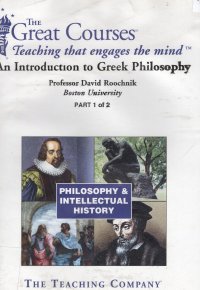
 Wow, it seems like I just finished The History of Ancient Egypt. When I finished it, I went looking for another course to listen to, and this particular one caught my eye but drove me a little batty because I could find only the first part of it. No matter; I’ll listen to the first half of it and then maybe look for the other half. It only took me about two weeks to listen to this binder of lectures, and as I finished up and thought about looking for the other half, I half-remembered that I might have bought only part 1 of a two part course at some time. Ah, yes, it was September 2024, and this was indeed the course. So I don’t get the whole thing, but I did get a lot of food for thought.
You know, a couple of years ago, I started reading Thomas Copleston’s History of Philosophy series, taking notes, jotting down the thinkers he mentioned and their main points. It was easy in the early days because only a few jottings from the early Greek philosophers survived until you get to Plato. So I had definitely read many of the names before (ah, gentle reader, my philosophy degree was the social philosophy track, not the history of philosophy track, so it was more a survey of “Here’s a problem, and here’s what a bunch of philosophers thought about it”), not to mention in other places: Great Authors of the Western Literary Tradition, which I listened to earlier this year; Socrates, which I listened to in 2021; reading several Plato dialogs a couple years ago, but not all of them in the Classics Club volume, so no book report; the various Greek playwrights and poets I’ve read in the past, like Pindar last October, Sophocles, well, I guess a decade ago, Euripedes in 2020, and Aristophanes in 2021; and hitting the Greek Periclean golden age section of The Life of Greece while listening to this course. So: Kinda familiar territory, lightly, thankfully, humblebraggingly.
Lectures include:
- A Dialectic Approach to Greek Philosophy
- From Myth to Philosophy–Hesiod and Thales
- The Milesians and the Quest for Being
- The Great Intrusion–Heraclitus
- Parmenides–The Champion of Being
- Reconciling Heraclitus and Parmenides
- The Sophists–Protagoras, the First “Humanist”
- Socrates
- An Introduction to Plato’s Dialogues
- Plato versus the Sophists, I
- Plato versus the Sophists, II
- Plato’s Forms, I
Man, it must have been a while since I read the Copleston as I only barely remember some of the pre-Socratics, but the lectures lay out how the philosophers approached the problems of how to describe being, whether existence is static and ultimately fire or water or earth or if it is ultimately reducible to nothing but change (becoming). You know, I’ve focused my thinking on the Plato versus Aristotle thing, thinking it was a matter of working from abstractions to concrete or abstracting from the concrete, but really the great divide in Western thought it ultimately between Plato and Aristotle and the Sophists/relativists on the other side. Which is still playing out today, and the good guys might not be winning at the societal level.
I guess it was only six hours over the course of this binder–the last two lecture series were bonzers, so I guess I expected this to be long as well. The professor, though, talks slowly and sometimes paused so long I thought the DVDs were having problems playing. And given that the lecturer repeats himself or reiterates things, I found my mind wandering as I listened, and when I snapped back, I don’t think I lost much.
At any rate, that’s what I thought of it. If you want deep insight into philosophy, go over to Blogdidact and join me in spitting on Protatogoras’s name.


1 thought on “On An Introduction to Greek Philosophy by Professor David Roochnik (2001?)”
Comments are closed.