Be On The Lookout For Albino With Dreadlocks

When I lived in Jefferson County, I always assumed that the suspects in a gas station holdup were rednecks in flannel and pickup trucks. However, this description makes me wonder:

One man is described as heavy set and between 5’6″ and 5’9″ tall wearing a dark hooded jacket with black baggie pants and a sock cap. The other has a lighter complexion with dread locks or a pony tail wearing a light gray hooded jacket.

The inclusion of a lighter complexion makes me wonder if, perhaps, the high-minded St. Louis Post-Dispatch has left out a vital part of the description: the race of the perpetrators.

Because if they were white rednecks, that would mean that the lighter complexion refers to an albino or a mere pink neck.

Buy My Books!
Buy John Donnelly's Gold Buy The Courtship of Barbara Holt Buy Coffee House Memories

Book Report: Lost in Yonkers by Neil Simon (1992)

This play details two Jewish brothers’ brief stay with their grandmother and aunt in Yonkers during World War II. The grandmother is of old German dictatorial stock, the aunt is daft, the father (who leaves the boys with his mother while he earns some money to repay a debt to a loan shark) is weak, and the uncle is a bag man for the mob who’s on the run. The boys, needless to say, aren’t thrilled and aren’t sure how to survive in this environment.

Not one of the Simon plays that I’ve found that speaks to me; I guess if I would have been Jewish in New York in World War II, it would have been more meaningful to me. It’s not a bad read, but I don’t know that the play is as driving and forward moving as a play ought to be.

Books mentioned in this review:


Buy My Books!
Buy John Donnelly's Gold Buy The Courtship of Barbara Holt Buy Coffee House Memories

Hail, Caesar!

The race for Matt Blunt’s successor as Republican candidate for Missouri takes an interesting turn as another government member amasses an army and leads it to Jefferson City:

“I’m in,” Kinder said Thursday. Asked if there was any scenario in which he would not run, Kinder replied: “No. Crossed the Rubicon.”

What, he’s not actually saying he’s started a civil war and an armed conflict to turn the Missouri Republic to the Missouri Empire? Those whacky politicians and their misunderstood metaphors!

(Full disclosure: I once was approached, sort of, to be a candidate to work on Kinder’s blog. Which is why my name crops up from time to time on his team’s blogroll. Obviously, I didn’t take it, which would have precluded me from snark like this.)

Buy My Books!
Buy John Donnelly's Gold Buy The Courtship of Barbara Holt Buy Coffee House Memories

Great Moments In Journalist Fact Checking

Forget whether the account conforms to the facts; this story isn’t even internally consistent:

The mother, Amy Fujarte, was in the house alone at the time of the fire, Svetanics said, and was taken to an area hospital and treated for smoke inhalation.

But:

Nickie Bequette, who lives across the street in the 9700 block of South Broadway, said she was enjoying a morning cup of coffee when she looked out a window and saw smoke pouring from the house and the mother escape out a side door with two children.

Which was it? Obviously, it wasn’t worth the reporter’s shoe leather.

Buy My Books!
Buy John Donnelly's Gold Buy The Courtship of Barbara Holt Buy Coffee House Memories

Charter Highlights Dangers of Hosted Applications, Web-Based Data Storage

Oops doesn’t cover it.

Charter Communications is offering apologies —and $50 credits — to customers who lost e-mails when 14,000 accounts were cleared out by mistake.

Charter was doing routine maintenance Monday, clearing out old, unused accounts from the system, when the 14,000 active accounts were accidentally cleared as well, according to Anita Lamont, a spokeswoman for the Town and Country-based company. About 1,000 of those accounts were in Missouri and about 300 were in Illinois, she said.

The accounts should still be open to customers, but everything in them was deleted — and is gone for good.

Also, Charter tips a bit of its internal process regarding backups for client data. The part it reveals is the text “Why bother?” The font in which they wrote that particular piece of internal documentation remains secret, covered by an NDA no doubt.

Buy My Books!
Buy John Donnelly's Gold Buy The Courtship of Barbara Holt Buy Coffee House Memories

A Stunning Turn of Events

In a stunning turn of events, developers who promised willingly gullible government officials the moon to get public dollars for development get the money and start managing expectations, i.e., backtracking on the promises they made:

For the first time, both development partners in the $387 million Ballpark Village are saying it’s unlikely that a significant portion of the project will be completed in time for the All-Star Game in July 2009.

Several months ago, one of the developers, the St. Louis Cardinals, acknowledged the possibility of delays on the downtown project. Now Chase Martin, director of development for the other co-developer, Baltimore-based Cordish Co., also is lowering expectations.

Who could have seen this coming?


Memo to the willingly gullible elected and unelected public officials: when a developer promises the moon, expect to see his backside.

Buy My Books!
Buy John Donnelly's Gold Buy The Courtship of Barbara Holt Buy Coffee House Memories

Book Report: Kill Him Twice by Richard S. Prather (1965, 1968)

I have read at least one other Shell Scott novel, since I own it, and might have read more than that courtesy of my local library when I was in high school. So although I’m not a particular fan of Prather, I’ve enjoyed his participation in a genre I enjoy.

The book is less earnest in its pulp and doesn’t really swerve into the campy, but the main character doesn’t take himself or his adventures too seriously. In this book, Shell Scott investigates the murder of a vice president of a Hollywood dish magazine and discovers, as the bodies of mobsters and starlets begin to fall all around him, a blackmail scheme behind it. He does some shooting, some fighting, some near-loving of said starlets, and uses a ruse in the ending to unravel the plot.

A quick read, good enough, and I’ll take more of these as they present themselves in the garage sales or book fair circuit. If you’re so inclined, there’s a link to this book below and you can put some dough in the coffers of Noggle, Inc. No, really, I mean dough; Amazon doesn’t pay pitiful referrers like me in real money.

Books mentioned in this review:

Buy My Books!
Buy John Donnelly's Gold Buy The Courtship of Barbara Holt Buy Coffee House Memories

St. Louis Post-Dispatch Endorses Criminal Retribution on Law Enforcement Officials

Lawbreaking St. Louis Post-Dispatch “investigators” name a member of the state execution staff. Why? Well, they rely on his misdemeanor criminal past–which does not render him ineligible to perform his duty according to state law–to justify it, but it’s really a way to limit capital punishment in the state, something that hasn’t yet been done legislatively or through the normal end-run means, the courts.

Instead, the Post-Dispatch searches its corporate heart and determines that it is compelled, compelled to put this fellow at risk. It’s against state laws to name these individuals for their safety, so the family, friends, or criminal associates of a condemned and executed party don’t get revenge on the executioners.

But the St. Louis Post-Dispatch doesn’t mind one or two executioners dying if it can A.) sell newspapers, B.) win valuable journalism prizes, or C.) impede the lawful performance of capital punishment through any means necessary.

It remains to be seen if Attorney General Jay Nixon, a candidate for governor and the preordained endorsed candidate of the St. Louis Post-Dispatch, will seek putative measures against the paper so that it might enjoy the consequences of its civil disobedience or whether its benefactor will come to its rescue, much like its inspiration Henry David Thoreau, received when he flouted the law to make a point and got out of jail through a deus ex maquina.

Buy My Books!
Buy John Donnelly's Gold Buy The Courtship of Barbara Holt Buy Coffee House Memories

Democrats Want Handout

To stimulate the economy, Democrats in Washington want to provide another “rebate” to those who didn’t pay taxes to return:

Nearly 40 percent of Americans owed no federal income tax last year, though even low-income workers paid taxes for Social Security and Medicare. While Bush has refused to disclose specifics of his $145 billion plan, administration officials and Republican lawmakers favor a proposal that would offer rebates of up to $800 for individuals and $1,600 for families – but only if they paid that much in taxes last year.

….

Administration officials and Republican lawmakers say it only makes sense to give tax rebates to people who actually paid taxes. But Democrats are gearing up to fight that approach, arguing that a stimulus plan should put money in the hands of low-income people, both as a matter of fairness and because people who are struggling to make ends meet are most likely to spend any government payments quickly. For the purpose of jump-starting the economy, economists want people to spend extra money as quickly as possible.

A tax cut would be fair, but a facile and arbitrary distribution plan, that gets voters from those who receive free money from the rest of us courtesy of the Washingtonian tax centrifuge.

Buy My Books!
Buy John Donnelly's Gold Buy The Courtship of Barbara Holt Buy Coffee House Memories

Book Report: The Best of Slate: A 10th Anniversary Anthology edited by David Plotz (2006)

As you know, gentle reader, I prefer a book in my hand to all the wordsmithery of Internety. Maybe I’m invoking the wrong allusion for my point. Regardless, it explains why I buy books that collect writings that are freely available on the Internet. Like this volume, which collects a number of things from Slate’s first ten years (1996-2006). In a sad sort of way, my going through this book identified how I’ve turned away from reading mainstream general interest magazines in Slate’s 10 year history and why.

This book collects a couple pieces per year (the best, one would assume) and prefaces with a little about the magazine’s history at the time. However, a little after 2000, the “best” of Slate veers into Bush and Republicans sux! territory. Here’s the subject of the pieces:

1996

  • Why flight attendants talk like they do.
  • Trying to overcome one’s aversions to certain foods.

1997

  • Sleeping in the same bed as kids is okay.
  • A man muses while watching couples pass.
  • Liberal versus conservatives (gardening philosophy, not political).
  • Che’s popularity is because he died young.

1998

  • Working in the ER when it’s a full moon on Friday the 13th.
  • A conversation exchange of posts thing.
  • The Farrelly Brothers’ popularity.
  • A baby sitting co-op as an economics lesson.

1999

  • The tele-tubby gay thing.
  • Jerry Falwell’s definition of the Anti-Christ describes the author.
  • The Supreme Court handles a stripper case.

2000

  • Presidential candidates tend to be blue-blooded Ivy Leaguers.
  • The stolen election told as a Grinch poem.
  • A couple’s interaction in a bar.

2001

  • Author tries Paxil for a month.
  • Bill O’Reilly is a poseur.
  • On defending bestiality (not actually defending bestiality).

2002

  • On shy urinators.
  • Soccer fans as nationalists.
  • Evolution of the Pledge of Allegiance.
  • Lewis and Clark celebrated inappropriately.
  • A former Marine at the WTC rubble finds survivors.
  • Spitting like a wine pro.
  • The 50/50 political split in America.

2003

  • Post exchange on miscarriage.
  • Goose stepping in parades.
  • A man awakens from being knocked out.
  • Low-rise pants.
  • Author acts as a street performer.
  • Hating Bush but loving his tax cuts.

2004

  • The Martha Stewart trial.
  • Rich men buying newspapers.
  • The end of the universe.
  • Bush is stupid on purpose.
  • Discovering a genetic deficiency in oneself that leads to breast cancer.
  • Michael Moore is a bad documentarian.
  • What did Bush know before we invaded 9/11?
  • I am a racist.
  • I love being in India.
  • Bush is a bad parent; Gore, Kerry, the Clintons are good parents.
  • In praise of misers.

2005

  • Reattaching severed body parts.
  • Rappers compared to bloggers.
  • In praise of Congress’s action on Terry Schiavo.
  • Pitying Prince Charles.
  • Proust and the madeleine cookie.
  • Impact of men watching their women give birth.
  • A Katrina evacuee gets help from the private sector.

I have bolded the pieces that explicitly knock Bush by name. The tone of the pieces begins to shift around 2000, too, to include snarky asides and tut-tutting of some conservative/libertarian principles. Suddenly, the periodical is no longer writing about interesting things that I don’t know about so much as writing about politics and attacking me and things I believe in.

You know, there was a day when I had subscriptions to Harper’s and the Atlantic Monthly. We even had our years with Newsweek and Time. I didn’t pay much attention to Slate, but I went to Salon every day and I even foolishly invested in it.

But come 2000, all of a sudden the magazines all shifted. In the news magazines, they belittled Bush every magazine. In the monthlies, they spent less time on general interest essays and more time trying to outdo each other in implicating Bush in a wide variety of churlish behaviours. Mostly churlish on the part of the magazine authors. As you might remember, I wrote a piece when I let my Harper’s subscription lapse after a decade.

Now I’m off of news weeklies, news monthlies, and general interest monthlies, and home/family magazines are coming next, now that they’ve shifted tone from saving energy saves money to go green to serve Gaia and preserve the environment for the future, where your descendents can live in substinence conditions to serve Gaia.

But, back to this book.

The essays that were what mainstream magazines did best–take one outside his or her daily existence into something, even just a different voice, outside the reader’s experience–were enjoyable. The snarky pieces about celebrities (O’Reilly) and successful business people (who then buy publications) were tolerable–but that’s not a compliment; I tolerated them, literally. However, the snarky pieces on the Bush administration were inexecrable. It took me three times to make it through best-selling author (that is, best selling quoter and inflater of Bush’s misstatements) Jacob Weisberg’s bit about how Bush chooses to be stupid and has an oedipal complex. I read the piece about the Republicans being bad parents and couldn’t believe that the author of that piece was serious.

But seriousness and its attendant earnestness explains why I don’t read Slate unless a blogger links to a specific piece (usually by Hitchens or Kaus), don’t take general interest magazines, and don’t even visit Salon any more (but cannot sell my stock since its sale price is less than the commission price for selling it).

Hard otherwise to capture personal historical reading trends as this book has done accidentally. So I guess it’s worth it for this long post I got out of it. And some of it is good, but when it’s bad, it’s horrid, to make another semi-appropriate allusion.

Books mentioned in this review:

Buy My Books!
Buy John Donnelly's Gold Buy The Courtship of Barbara Holt Buy Coffee House Memories

Book Report: Star Trek: The Return by William Shatner (1996)

Well, it surely comes as no surprise that I’ve been on a Star Trek kick lately. I’ve read a number of books in the last couple of months (see this, this, this, and this). Last week, on Tuesday through Friday nights, I watched Star Trek: The Motion Picture, Star Trek III: The Search for Spock, Star Trek IV: The Voyage Home, Star Trek V: The Final Frontier, Star Trek VI: The Undiscovered Country, Star Trek: Generations, Star Trek: First Contact, and Star Trek: Insurrection. 80% of current Star Trek cinema (yeah, these videocassettes).

So what do you think I picked up after finishing Heat? This paperback, which I purchased in August.

Now, this is the first “modern” Star Trek book I’ve read. The others noted above come from the early 1980s, and they run about 200 pages give or take. This paperback, published among 27 that year, runs 370 pages and comes with all the jump cuts, red herrings, and multiple points of view you’d find in a more recent piece of genre fiction. I won’t say that those characteristics make more modern novels better than the old school genre fiction, but they do make for richer reading.

This book centers on a plot by the Romulans to work with the Borg to defeat the Federation. Romulans, using Borg technology, reanimate Kirk after having found his grave on Veridian III (where he died in Star Trek: Generations). They brainwash him and send him to kill Picard, who’s on a mission to do something to the Borg and, well, it’s complicated. In a decent way. The best way would tie up loose ends and answer fundamental questions the books ask, but then again, I suppose that would prevent me from buying one of the 30 Star Trek novels that came out the next year to learn the truth, only to discover that the next ghostwriter for Shatner didn’t bother to read the preceding book to answer the questions.

Still, a pretty decent bit of fiction, set comfortably in a defined universe where I understand the markers. Similar to the John Norman series I delve into from time to time, although not as richly presented.

Books mentioned in this review:


Buy My Books!
Buy John Donnelly's Gold Buy The Courtship of Barbara Holt Buy Coffee House Memories

Not That You Asked

    I Am A: True Neutral Human Sorcerer (4th Level)

    Ability Scores:
    Strength-14
    Dexterity-13
    Constitution-15
    Intelligence-16
    Wisdom-11
    Charisma-10

    Alignment:
    True Neutral A true neutral character does what seems to be a good idea. He doesn’t feel strongly one way or the other when it comes to good vs. evil or law vs. chaos. Most true neutral characters exhibit a lack of conviction or bias rather than a commitment to neutrality. Such a character thinks of good as better than evil after all, he would rather have good neighbors and rulers than evil ones. Still, he’s not personally committed to upholding good in any abstract or universal way. Some true neutral characters, on the other hand, commit themselves philosophically to neutrality. They see good, evil, law, and chaos as prejudices and dangerous extremes. They advocate the middle way of neutrality as the best, most balanced road in the long run. True neutral is the best alignment you can be because it means you act naturally, without prejudice or compulsion. However, true neutral can be a dangerous alignment because it represents apathy, indifference, and a lack of conviction.

    Race:
    Humans are the most adaptable of the common races. Short generations and a penchant for migration and conquest have made them physically diverse as well. Humans are often unorthodox in their dress, sporting unusual hairstyles, fanciful clothes, tattoos, and the like.

    Class:
    Sorcerers are arcane spellcasters who manipulate magic energy with imagination and talent rather than studious discipline. They have no books, no mentors, no theories just raw power that they direct at will. Sorcerers know fewer spells than wizards do and acquire them more slowly, but they can cast individual spells more often and have no need to prepare their incantations ahead of time. Also unlike wizards, sorcerers cannot specialize in a school of magic. Since sorcerers gain their powers without undergoing the years of rigorous study that wizards go through, they have more time to learn fighting skills and are proficient with simple weapons. Charisma is very important for sorcerers; the higher their value in this ability, the higher the spell level they can cast.

    Find out What Kind of Dungeons and Dragons Character Would You Be?, courtesy of Easydamus (e-mail)

(Link seen on Dustbury.)

Buy My Books!
Buy John Donnelly's Gold Buy The Courtship of Barbara Holt Buy Coffee House Memories

Nickeled and Dimed by Corporate America

Sorry if I draw your mind to Barbara Ehrenreich; have a little toke or two to clear your thoughts. It’s what she would do.

Now, let’s reflect for a moment on how big service-based corporations suck the small change out of you every month for “fees” they made up to add to your bill.

My mother recently switched to digital cable because she mistakenly thought that analog cable (instead of analog broadcast) would be out the window next year. When she spoke with a sales person about getting a couple of aw-cute channels like Hallmark, the sales person told her it was included in the basic tier of digital service.

The technician shows up several hours late (and back times his service log to show that he was on time), and my mother, now digitally cabled, discovers she does not have the channels she was promised. A call to the consumer inquiries line indicates that they’re not really basic tier. But just because my mother took an extra effort, the company gave her what she was promised in the first place.

This anecdote led your humble narrator into a rather complete Leo Getz style They, erm, screw you with the customer service rant that touched on these fees.

Techdirt led me to this story that indicates that average consumers (according to a survey) spend almost $1000 a year paying little fees (regulatory cost recovery fees, number portability fees, and so on) that companies add on to their advertised prices.

If you’re making $40,000 a year, that’s 2.5% of your income, brah.

It irks the heck out of me that as the content and the Army of Davids thing makes the content cheaper and whatnot, that the people who control the infrastructure continue to combine and coalesce into large corporations that can levy these absurd and unethical surcharges leaving their customers, often contractually-bound customers, bound to pay the price since they have no alternative.

Now, don’t get me wrong, I think that the corporations often have a legitimate beef with the increased costs of regulatory compliance and the added costs of government layering on a couple more taxes. But we consumers give them too much latitude to slather us with additional costs when the last quarter came in a little light on Wall Street, too.

Buy My Books!
Buy John Donnelly's Gold Buy The Courtship of Barbara Holt Buy Coffee House Memories

Not a Pledge Rams Fans Wanted To Hear

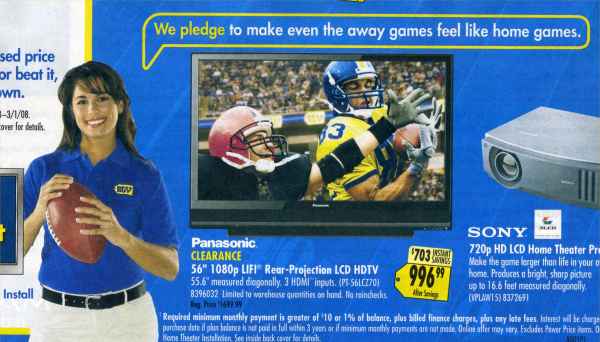
Best Buy makes a pledge that Rams fans might not like:


Best Buy threatens St. Louis football fans

We pledge to make even the away games seem like home games.

Best Buy threatens to make even the away games blacked out because they didn’t sell out.

Of course, St. Louis would probably be better off with three hours of Cops instead of watching Marc Bulger doing his impression of a side of beef in a Rocky movie. There might be children watching.

Buy My Books!
Buy John Donnelly's Gold Buy The Courtship of Barbara Holt Buy Coffee House Memories

Putting My Money Where My Blog Is

As you can tell by my sidebar, gentle reader, I support Fred Thompson’s bid for the presidency and probably will far after he’s either elected or withdrawn–I don’t update the sidebar much these days.

However, today I sent a check to the campaign for the first time, putting my money where my blog is.

It’s the first money I’ve sent since 2000, when I backed a candidate who was not nominated. I haven’t sent much to the Republican Party or its committees in recent years, no matter how much of a gold-card member they would like me to be. But I’ve sent money to Fred, and if/when I can scrape up any more extraneous cash, I will send more.

You can, too, using the sidebar or going to the Contribute page which has a credit card form and a poor PDF for mailing checks.

It’s more than this cross-dressing Klingon, apparently.

But let it be known my support has its threshold: I won’t work the phone banks for Fred or any campaign.

Buy My Books!
Buy John Donnelly's Gold Buy The Courtship of Barbara Holt Buy Coffee House Memories

Book Report: The Fred Factor by Steve Gill (2007)

You know, I don’t think I’ve ever picked up a book about or by a candidate while the campaign was going on (although I did read Ross Perot’s book some years after United We Stand was forgotten as a book and as a political force). Still, as part of the Christmas present for my two conservative uncles (mentioned here), I got them this book in addition to an anti-Clinton screed I knew would go over well (I forget which one I got them; there were so many from which to choose!).

I bought a copy of this book for myself so that I’d be familiar with it as well. I mean, you can tell by my sidebar that I support his run and all, so it’s preaching to the choir, really.

The book breaks down into three sections, really:

  1. Fred Thompson’s biography.
  2. Horserace handicapping ca last summer.
  3. A collection of Fred Thompson’s writing.

Additionally, there’s a bit thinking about whom Fred Thompson could select as a running mate. Both of the handicapping sections are weak, especially as time has rendered the possibilities impossible (that is, things didn’t fall the way the author presents as a best case scenario). However, the biography and the political essays by Thompson himself are nice, but are available on the Internet.

Ergo, the book’s best as a gift for someone whom you want to convince that Fred’s the man and to whom you want to give something more than a collection of URLs.

Books mentioned in this review:


Buy My Books!
Buy John Donnelly's Gold Buy The Courtship of Barbara Holt Buy Coffee House Memories