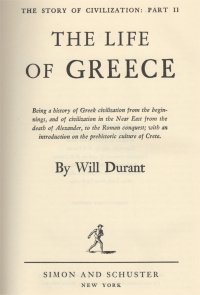
 Ah, gentle reader, I have done it. Again. After three years, I have completed The Life Of Greece, the second volume in The Story of Civilization series, most of which I picked up in 2019 (I finished the first volume, Our Oriental Heritage, in August 2023). At this rate, I will finish the eleventh volume in 2053 and will be able to move on to Churchill’s history series or Summa Theologiae.
The book covers the history of Greek civilization from roughly 3500 BC to the mid-first century BC. Early chapters deal with early civilization on Crete and the legendary period of Greece, including the events that would have triggered Homer’s epics and whatnot. The book really gets going with the formation of the city-states and the machinations of Athens and Sparta and the other states that rose and fell with some peaks only being decades–a lifetime. It talks a lot about individual personalities and their contributions, and a lot of the material overlaps with An Introduction to Greek Philosophy which I just listened to and the current, almost complete history of the philosophy of science course I’m listening to now. Plus I know some of the players from reading some Plato, not enough Aristotle, and as far into Copleston’s The History of Philosophy. So some of it was review. Not that I’ll remember too much of it except for that which was reinforced by the other things I’ve listened to recently, particularly the philosophical distinction between being and becoming which is something that has traded predominance in philosophy and science for decades.
The same thing I said about the first book I shall repeat here: Durant (or Durants) is (are) old school leftists, so a lot of asides in favor of socialism and throwing off the shackles of religion (in the Greeks’ case the old gods of mythology, but sometimes Christianity as well, but not the Greeks, although he does draw a line from Stoicism in its Greek roots to Christianity). He also has a tendency to go back and forth in time as he breaks eras and epochs into different silos, such as science, philosophy, painting, sculpture, and so on, so he’ll exhaust one silo and start back in another. Undoubtedly, this will become less of a problem when the individual volumes of the series compress into decades or centuries–the next one is Caesar and Christ which might only be a couple of hundred years (although who knows how far it might stretch if it includes the Byzantine empire), and others collapse into even smaller chunks of time. But in these first two books, where he covers millennia (and, in the first, the same or similar millennia spread across several cultures), the reader gets a little whiplash. Maybe the scholarly reader, or the merely educated before the 1970s reader, would not have the issue. But compared to educated men a hundred years before my birth, I’m a dunce.
So I have already placed Caesar and Christ on my chairside table, which defeats the purpose of my drive to finish off some of the thicker books on that table which have languished there for a long time. How long will Caesar and Christ remain there? I know, we’re all in suspense, gentle reader. Time will tell. But I will read some other books, or perhaps a couple of hundred, in the interim.
Oh, and I did flag some things for comment which I will displense periodically as From the Durant posts. Except this one:
Carneades of Cyrene, coming to Athens like a Greek Abelard about 193, made like bitter for Chrysippus and his other teachers by arguing with galling subtlety against every doctrine that they taught.
I bring this up because after I read Pope’s “Eloisa to Abelard” recently, I have seen or heard references to him several times, culminating in my picking up a biography of him last month. Which I might read before I finish Caesar and Christ or, at least, The Story of Civilization.