Book Report: The Case of the Cautious Coquette by Erle Stanley Gardner (1949)

This book contains not only the titular Perry Mason novel, but two other novellas featuring the sleuth. Theses stories are almost sixty years old, but Perry Mason stories are almost timeless. As a matter of fact, I used them as an example in the the March/April issue of The Writer’s Journal:

Are you writing a story with a short shelf life, or an allegory on human nature for all time? Regardless of what you intend to write, the details you include might inadvertently determine whether you’re an Erle Stanley Gardner; whose Perry Mason novels remain accessible and relevant decades after he wrote them, or a Justin Thyme, whose works connect with this year’s audience but will seem as dated as a Baltimore Orioles world championship in ten years….

How timeless are they? One of the suspects is an inventor:

“What does he invent?”
“Oh, lots of little gadgets. He’s made money out of some them.”
“What sorts of gadgets?”
“Well, right now he’s working on something in connection with infra-red rays. Before that, he worked out a device that opens and closes doors and does things like that.”
“What do you mean?”
“It works with invisible light, what I think they call black light. A beam runs across the room and as soon as some object corsses that beam it closes a circuit and does things–oh, for instance, like making electrical contacts so that the minute you walk into the house the elextric stove clicks on and starts cooking, the radio turns on, and lights come on, and … I don’t know, Mr. Mason, I think it’s just a gadget. So many of his things are scientifically fine, but impractical when you want to work on them.”

That’s not so far-fetched now, is it? We still don’t have those things commonly in homes, but they’re available and feasible. The language itself is more archaic than the plots or the characters, with all the talk of infra-red rays, black light, and lots of Gosh!

The stories are more whodunit than the most whodunit of the Lucas Davenport novels (recently reviewed here and here), but sometimes the plots have to be a bit contrived to get there. Within the brevity of these stories, it’s good.

A quick rundown of plots:

  • “The Case of the Cautious Coquette”: A simple hit and run tort case turns dangerous when two people “come clean” as the hit and run driver, and a woman named as a witness has her first husband inconveniently die of a gunshot wound in her garage.
  • “The Crimson Kiss”: A friend from Della’s hometown is going to be married, but is implicated in a murder of another Lothario.
  • “The Crimson Swallow”: A wealthy client comes to Mason to hire him to protect his new wife from whatever made her flee. A jewelry theft muddies the waters, as does the death of a potential blackmailer.

One thing these novels seem to indicate is divorce is bad for you. Ex-husbands die a lot.

Books mentioned in this review:


Buy My Books!
Buy John Donnelly's Gold Buy The Courtship of Barbara Holt Buy Coffee House Memories

Singing The Skip

Sometimes, when I’m singing along with my favorite songs on the radio in front of friends—good friends, mind you, the sort who don’t mind that I miss one note out of every three or two—I will further embarrass myself by not only missing the interval, or octave, but by missing a line or a lyric. Sometimes, a bridge or solo is shortened and the renewed vocalization catches me by surprise. After the song is over, I try to justify that portion of my pathological performance by saying that I am “singing the skip.”

Back in my formative middle 1980s, the cassette single was a novelty even as the era of the 45 record was fading. My mother owned a large number from her youth some twenty years previously, so my brother and I had plenty of oldies to load onto the console stereo in the living room. We cut our teeth on those, and when I went onto college, my endearment with the cheapening media form grew.

I found a music store in Milwaukee that offered juke box packs of records, a ten platter grab bag, for $1.99. I bought as many as I could, uncovering a large number of singles of dubious merit, but some I recognized. I also bought singles of contemporary or past hits for $2.49 each, and a number of used LPs to play on my shelf turntable.

There shall come a time when we’ll have to explain the oddities of records to children and young folk. You see, it was a disc like a compact disc, but it had these long grooves on each side. A needle rode in these grooves and the minute variation in the groove depth provided the sound. However, sometimes the records became scratched or damaged, and the needle would jump the edge of the groove. This skipping would advance the song a couple seconds, sort of like touching fast forward for a nanosecond.

Some of the inexpensive or used records I bought were imperfect, and even with the penny taped to the record needle, the songs sometimes skipped. Due to the nature of the imperfections, the songs skipped consistently; that is, the same line morphed into the second following line every time I played a particular song. So as I sang along in the darkness of my apartment, I began to skip, too.

The years of conditioning has paid off; I could sing to those songs and correctly account for the errata. Unfortunately, that special talent only works when I listen and sing along to the records I owned as a teenager and twentyager. When I’m confronted with the songs on the radio, on cassette, on CD, or in any of the current digital flavors of the month, I find myself a couple measures ahead at least once in the song.

So that’s my excuse, gentle reader and tolerant listener, for those odd moments where I run ahead of whatever I’m listening to and interpreting through my own rendition. It’s not a sign of my senility, but it is a sign of how we did things back in the old days when we flipped the discs or stacked them to play single-sides of albums in succession. We had to walk 2 mi—record store in the—we liked it!

Buy My Books!
Buy John Donnelly's Gold Buy The Courtship of Barbara Holt Buy Coffee House Memories

Bicyclists = Hooligans

Sure, at the same time as they loudly protest that motorists don’t treat them with equal respect even though they’re pedalling vehicles as entitled to the road as actual internally combusted or hybrid cars and trucks, they’re blowing through traffic control devices at their convenience. I could have told you that bicyclism breeds hooliganism, as became obvious in the cradle of loving-your-neighbor known as San Francisco when a mob of the two-wheeling thugs attacked a minivan containing a mother and two children:

Confusion, however, quickly turned to terror, she said, when the swarming cyclists began wildly circling around and then running into the sides of her Toyota van.

Filled with panic, Ferrando said, she started inching forward until coming to a stop at Post and Gough streets, where she was surrounded by bikers on all sides.

A biker in front blocked her as another biker began pounding on the windshield. Another was pounding on her window. Another pounded the other side.

“It seemed like they were using their bikes as weapons,” Ferrando said. One of the bikers then threw his bike — shattering the rear window and terrifying the young girls inside.

A mob, but a green-thinking mob lashing out against the global warming suburban mindset. Because that’s okay.

Buy My Books!
Buy John Donnelly's Gold Buy The Courtship of Barbara Holt Buy Coffee House Memories

The Real Jerky Boys

Corporate dischord, family infighting, and courtroom drama. Another nighttime soap? I wish. It’s my favorite dried meat manufacturer:

When Jack Link started his beef jerky business in the 1980s, it was his plan that his boys, then in their teens, would someday take over the company.

Unfortunately, that dream has turned into a nightmare that is being played out in Washburn County Circuit Court, in a lawsuit that pits Jack Link and son Troy against his elder son, Jay. The Links are battling over the ownership of Links Snacks Inc. in Minong, now one of the largest producers of beef jerky in the United States.

It’s a dispute that has ripped the family apart, with accusations of greed, jealousy, harassment of company officers, bullying of employees and a long list of bad business behavior.

If only there were some way I could stock up a dried meat product sold cheaply at Sam’s Club in case this battle destroys the company.

But my luck isn’t that good.

Buy My Books!
Buy John Donnelly's Gold Buy The Courtship of Barbara Holt Buy Coffee House Memories

I Do Not Think That Word Means What You Think It Means

From the mouths of assistant university police chiefs:

A man and a woman were shot to death in the University of Washington’s architecture building Monday morning in what may have been a murder-suicide, university police said.

Officers responded to reports of gunfire found the two in an office on the fourth floor of Gould Hall, Assistant University Police Chief Ray Wittmier said. He said a weapon was also found in the room.

“It’s quite possible that the suspect is one of the deceased,” Wittmier said. [Emphasis added.]

Is he confusing suspect with perpetrator, or is he being coy?

Buy My Books!
Buy John Donnelly's Gold Buy The Courtship of Barbara Holt Buy Coffee House Memories

It Wasn’t Supposed To Be A Punchline

Michelle Malkin is right, this is funny, unintentionally:

KIMBERLY SHRUM grips a Smith & Wesson .357 Magnum revolver and aims at a target 25 yards away.

Bang.

A hot shell casing hits the floor, joining hundreds of others littering the concrete at Jackson Arms Indoor Shooting Range in South San Francisco.

Update: Who am I to snicker? I once refered to the Springfield XD as the Springfield XP. So I am as ignorant as a journalist who either didn’t pay attention to or even attend the event she was covering or who decided to Hollywood up the experience.

Buy My Books!
Buy John Donnelly's Gold Buy The Courtship of Barbara Holt Buy Coffee House Memories

The Noggle Library: Update

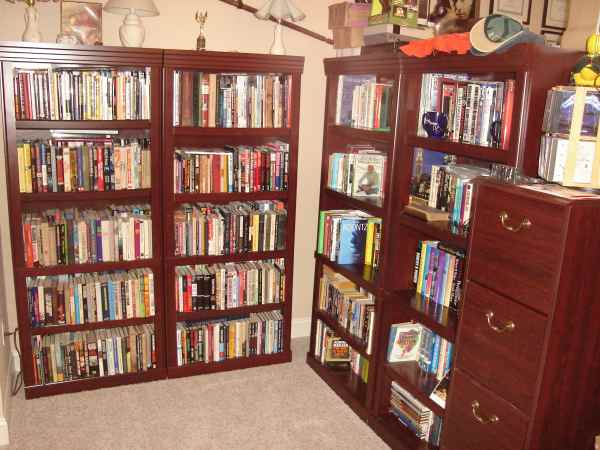
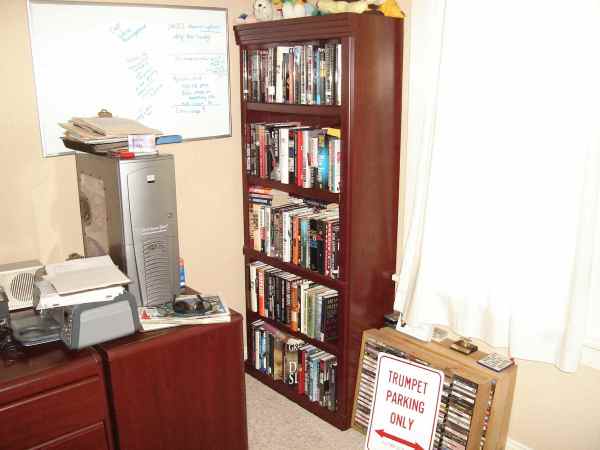
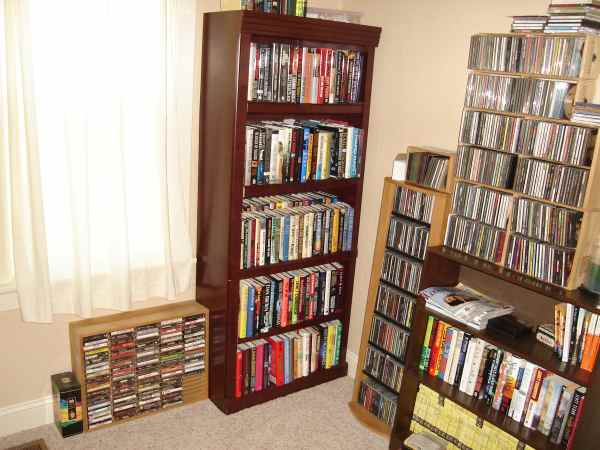
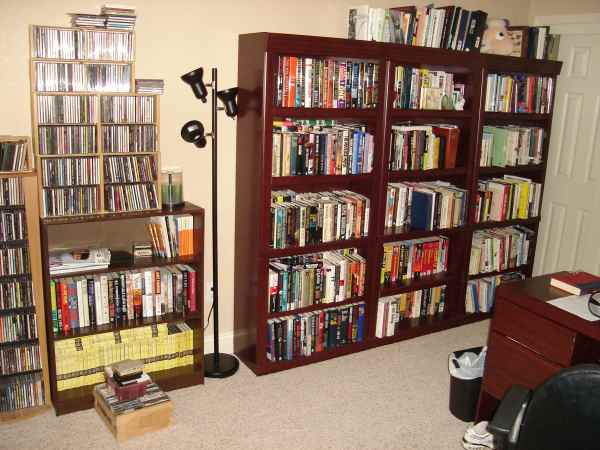
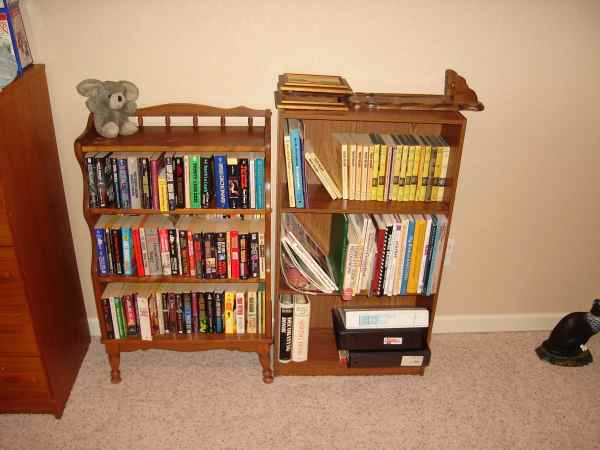
In September 2003, I posted pictures of the Noggle library. As some time has elapsed since then and we have found a replacement for Honormoor that allows us to house more books without displacing any cats, let me boast upon the bookshelves we have now.


Brian's read books

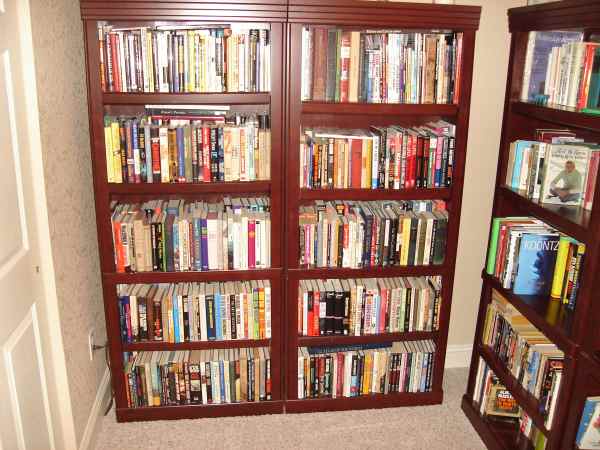
A long view of the hardbacks I have read. Good readers will spot books recently reviewed (Forever Odd by Dean Koontz and Come To Me In Silence by Rod McKuen). Yes, I have read those books, and they are a large portion of my 1200+ strong library of read volumes.


Brian's read hardbacks, shelves 1 and 2

Note that the first set of shelves are doublestacked with a miscellany of fiction and nonfiction, unsorted and shelved by maximizing the number I can fit onto the shelves.


Brian's read books, shelves 3 and 4

These shelves contain the recent fiction I’ve read and also represent the only segregation I have going on in my library. The top shelf on the left contains my Ayn Rand books, including early printings of Atlas Shrugged and The Fountainhead (as well as the copy of The Fountainhead I bought when I reread the book in 2005). On the second shelf of that bookshelf, I have all my poetry, from Edna St. Vincent Millay and Wordsworth to my mid-1990s chapbooks from local authors.

The left bookshelf contains my Robert B. Parker collection (first 3 shelves), my books about being a writer (4th shelf), and home improvement (bottom shelf).


Brian's unread books

These three shelves contain the volumes I have not read yet. Most shelves are doublestacked. You can see in the center bookcase how my collection of Classics Club books has grown (compared to the picture from 2003); I still haven’t read a single volume from the set. I don’t know how many books I have in here, but I hope it’s enough to tip my personal library to 2000. Jeez, I suck.


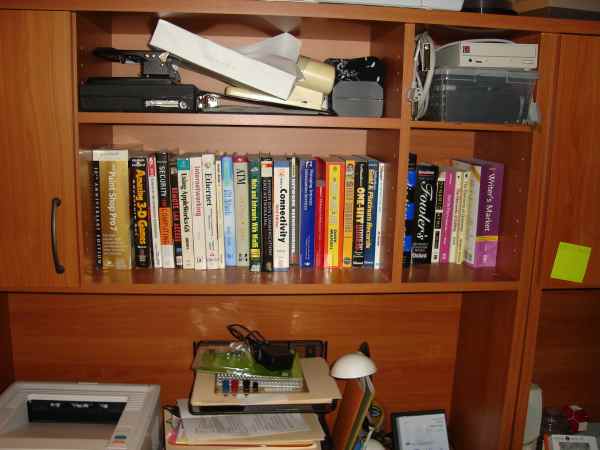
Some computer books

Here’s a shelf of computer books that I haven’t read, for the most part, but they will be handy reference guides when Windows 95 comes back into fashion. These shelves also contain some writing reference guides and some music reference guides.


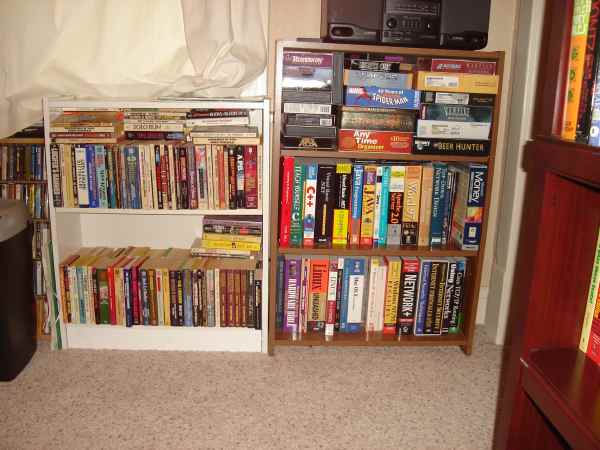
Paperbacks and such

To the left, we have many of my paperbacks, some of which I’ve owned for 20 years now and many of which are older than that. I don’t know that I ever went through a stage where I bought a lot of new paperbacks, although I have picked them up from time to time. Now that they’re ten bucks each, forget it.

This concludes my section of the tour.


A shelf of Heather's books

Some of Heather’s books.


More of Heather's Books

Another bookshelf whose contents belong to Heather.


Most of Heather's books

The bulk of Heather’s hardbacks. I don’t know her system or how she keeps track of what she’s read. I rely on my wrote system of “On the read shelves, I read; on the to-read shelves, I must read,” which has bitten me in the past. Maybe she just remembers.


Heather's cookbooks and textbooks

In our dining room, we have Heather’s cookbooks, textbooks, and volumes of poetry. As you can see, the shelves are no longer full, as Heather is on a spartanization binge. What happened to the woman I married?

An interesting note, the bottom shelf of the bookshelf to the right contains my Time-Life Old West series that I inherited from my aunt. This bookshelf is the only one in the house that contains books that belong to both Heather and I. I’m very obstinate in not conmingling our books.


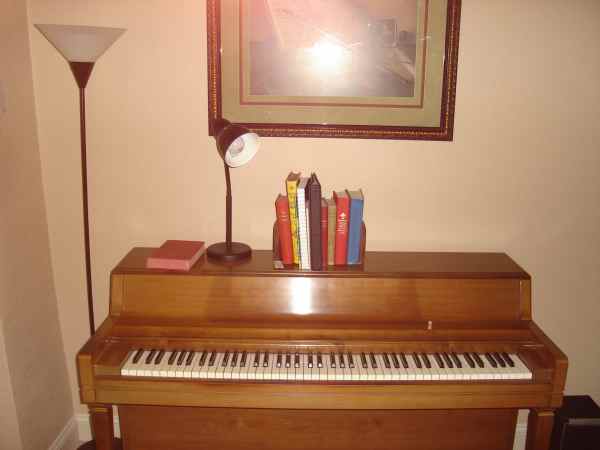
Heather's music books on the piano

\

Heather has also removed quite a few of her music books from the piano.


The guest room bookshelves

The guest room contains some of Heather’s paperbacks and sewing books. The sewing machine is also in the guest room. We keep hoping the guests will make themselves useful, but no. They just come and sponge off of us during the holidays (I am talking to you, Butler!).


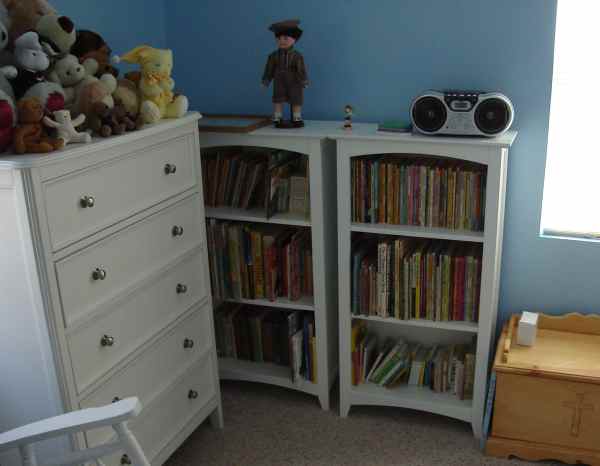
Jimmy's room

Finally, we have the boy’s collection. With this many amassed in only nine months, it’s obvious who will eventually have the biggest library amongst us.


How many bookshelves is that? I’ve lost count.

Buy My Books!
Buy John Donnelly's Gold Buy The Courtship of Barbara Holt Buy Coffee House Memories

Book Report: The Prize Winner’s Handbook by Jeffrey Feinman (1980)

As some of you know, I consider myself something of a Sweepstakes Bodhisattva. I’ve seen this book in different places since its inception, and when I saw it again on the table at one of last week’s book fairs, I knew I had to have it, if only to compare my knowledge to its.

This book was written in 1980 by the head of one of the independent judging organizations. He doesn’t hide it, but he does want to offer some insight into the fundamental honesty of the process as well as offering tips on how that sweepstakes contestants can take advantage of that process to have a slightly better shot at winning.

The book takes on sweepstakes, contests, lotteries, and bingo, with about half the book (it seemed) going to lotteries and bingo. There aren’t many ways to shade winning the latter, so there’s a bunch of history to pad the book out from pamphlet size.

Essentially, the tips are enter often and follow the rules. But if you’re interested in contests and sweepstakes, it’s worth a quick glance. It weighs in at 128 paperback pages, and I read the book in about an hour or so.

Books mentioned in this review:


Buy My Books!
Buy John Donnelly's Gold Buy The Courtship of Barbara Holt Buy Coffee House Memories

Feds Get Their Man

A reader (and by reader, I mean someone who found this site while googling Lou Sengheiser) sends along a helpful link to his federal indictment press release.

As you know, I’ve previously been sympathetic to Sengheiser (here and here). I’ll still stand on innocent until proven guilty, but it’s not looking good for him.

Least I can do, since his brother seemed like a nice guy and gave us a good rate on our wedding reception hall. The Shania Twain CD thing notwithstanding.

Buy My Books!
Buy John Donnelly's Gold Buy The Courtship of Barbara Holt Buy Coffee House Memories

Book Report: Forever Odd by Dean Koontz (2005)

My wife bought this book for Christmas last year (that is, Christmas 2005) because I’d liked Odd Thomas. As with the preceding book, the narrative voice of Thomas is exceedingly conversational, but this book at this time struck me as too much so. Odd Thomas, who sees silent dead people, gets a visit from the recently dead father of a friend. Someone has killed the father and has taken the son. Although early signs point to the first husband of the boy’s mother (and his birth father), it looks as though the boy is actually bait for the one person who can find him… Odd Thomas.

The book was a quick enough read and pretty engaging; however, some of the narrative voice seems like fluff, and I have to wonder whether this and its 2006 counterpart Brother Odd are merely one story stretched over two books; the ending of the book sure seems like a setup. That’s poor form.

Books mentioned in this review:


Buy My Books!
Buy John Donnelly's Gold Buy The Courtship of Barbara Holt Buy Coffee House Memories

Book Report: Broken Prey by John Sandford (2005)

After reading Winter Prey, I flashed forward 12 years in Lucas Davenport’s future. He’s married to the woman he met in Winter Prey, and their children and she are in London, leaving Davenport a psuedobachelor. Instead of watching movies all night, he has to deal with a serial killer who appears to mock the MOs of three serial killers institionalized in a single Minnesota hospital. Early indicators point to a recently-released inmate, but that wouldn’t have made a 300 page novel, would it?

I figured out whodunit pretty early, but I rode along with Davenport and his team as they went down one blind alley after another. But it’s the journey, not the destination, for the most part. I’ve got a couple more prey books on the shelves, and I should get through them and get my complete list together since Prey books are plentiful at book fairs.

Books mentioned in this review:


Buy My Books!
Buy John Donnelly's Gold Buy The Courtship of Barbara Holt Buy Coffee House Memories

That Government Is Best That Governs–Aw, Screw It, We Need Better Rates

St. Louis County government mandates its residents to partake of a private service so it can negotiate better rates for the service:

The county’s Waste Management Code, approved last year by the St. Louis County Council, provides for the county to establish “trash districts” throughout the unincorporated areas.

The code establishes a minimum level of service that must include once-a-week trash pick up, once-a-week recycling pick up and at least twice-a-year bulk waste pick up. The minimum level of service requirement applies to both unincorporated area and municipalities in the county.

However, recycling pick ups will not be required for municipalities that operate a drop-off recycling center.

Creating the trash districts would mean St. Louis County would negotiate a contract — hopefully at a price lower than what residents pay now — with a single waste hauling company.

It’s one thing to mandate some sort of minimum accummulation of detritus around one’s domicile for public health reasons, but it’s another to mandate a monopoly and to make all residents customers of the monopoly at the risk of breaking the law.

Conceptually, there’s no reason this is any different from the county council making cellular phones required and then ordering citizens to use Cingular because the county council members will get a better rate.

Buy My Books!
Buy John Donnelly's Gold Buy The Courtship of Barbara Holt Buy Coffee House Memories

Let The Nationalization of Industry Continue!

Illinois legislator channels Hugo Chavez:

Illinois government should get into the electricity business with a state-run, non-profit power agency, the leader of the Illinois House proposed Tuesday, in legislation that denounces Ameren and ComEd for recent rate hikes and service failures.

House Speaker Michael Madigan, one of the state’s most powerful Democrats, filed a bill Tuesday afternoon to create a publicly owned power authority that would use Illinois coal to generate and sell electricity to state residents at cost.

“Excessive costs of electricity (in Illinois) pose a serious threat to the economic well-being, health and safety” of residents, says the 47-page bill, which would establish the Illinois Power Authority Act.

Is there anything that government officials don’t think they can do better than private industry?

I didn’t think so.

Buy My Books!
Buy John Donnelly's Gold Buy The Courtship of Barbara Holt Buy Coffee House Memories

Fifth Floor Eyes

A compatriot and I at work often stand at the window and look down at Washington Avenue, five stories below, to take a break from our work. Once, when I was a young man, I wrote the following sonnet about a similar situation, watching the kids (women to me then, but we were all kids) walking along the college malls:

Fifth Floor Eyes

With bouncy strides of legs just lightly tanned,
you walk below my watching third floor eyes.
A gentle wind moves silently and dies;
you brush some wayward hair with careless hand.
Your lips, marooned with hasty morning care,
are framing hinted teeth in sudden joy
and move in greeting of some passing boy,
the words sweet notes unheard in summer air.
Your dark sunglasses never flash my way,
and you continue on toward a class,
or maybe to your dorm–I’ll never know.
For sixty stairs is much too far away,
so silently I let you swiftly pass,
invisibly about my way I go.

Whoa, we’ve got subtle allusions to Shelley and Blake in there, don’t we? I am a far distance away from reading those authors in my Romantic Poets classes and whatnot. I published that poem in my 1995 chapbook Deep Blue Shadows. My second chapbook came a year after the first (Unrequited, 1994), and altough I started mocking one up in the late 1990s (Flipside Id), I have yet to finish it.

Flipping through the chapbook, I note that it’s a hastily-composed bit designed when I was restless and worried that I wasn’t going anywhere as a poet. With its contents, I can see why, although in the period of 1996-1997 I would write some of my best work, yet unpublished.

Also, regardless of my merit in structured poetry, much of my free verse is crap. Which is par for that form.

Buy My Books!
Buy John Donnelly's Gold Buy The Courtship of Barbara Holt Buy Coffee House Memories

Rhetorical Legal Questions

  • Is it felony animal cruelty to pierce your cat’s ears?
  • Is it felony child abuse to make a set of eyes that light up when a remote control triggers them, place that set of eyes in the cold air return, and trip them when your newly-mobile baby crawls to the cold air return and starts tugging at the grate?

I ask not so much because I’m contemplating either action, but because I want to be the number one Internet resource for knowledge about both (or at least, a high search result for either question).

I mean, I need the traffic.

Buy My Books!
Buy John Donnelly's Gold Buy The Courtship of Barbara Holt Buy Coffee House Memories

Good Book Hunting: March 24, 2007

Even though we’ve gone to a couple smaller book fairs this year, yesterday really marked the beginning of the book fair season for us, as we hit three smaller fairs around the metro area.

We started bright and early with the Immaculate Conception Church in Arnold. It was a bright, sunny day and our trip to the hinterlands (some would have said the hindquarterlands) of St. Louis County was uneventful, but that’s only because the brakes on a pickup truck traveling on state highway 141 smoked but held when the minivan in front of it stopped for the red light at Arnold Church Road. The area around Arnold and that formerly unpopulated space between Arnold and Fenton is filling in with lush housing developments. Across the street from Immaculate Conception, they’re building a new VFW; fortunately for that organization, the WWII and Korean War vets have a great potential of new member infusion these days.

We parked in the lot between the church and the parish center, avoiding politely the spaces marked Reserved for Funeral Parking. The book sale itself was on the lower level of the Parish Hall, through the byzantine and curious corridors of another church. The hardbacks were a dollar unless marked differently, and the paperbacks were fifty cents. I found a couple books, including an Evan Hunter novel from 1972, a volume of selected John Donne (to read to the boy in between Rod McKuen and the complete works of Emily Dickinson), the complete works of Keats and Shelley (ditto), and the autobiography of Golda Meir (because she was from Milwaukee). Cumulatively, my wife and I spent $9.50. As we left, I politely avoided the mourners standing in the parking lot as I drove aimlessly, or at least poorly-aimedly, looking for the parking lot exit.

We then shot up 141 to Chesterfield, an enclave of the better-to-do residents of St. Louis County. Our destination was St. John’s United Church of Christ, one of the few churches in the St. Louis area that I’ve actually gone into. A former girlfriend and her family attended church there, and although I never worshipped with them, I’d gone there some decade ago to pick something up with the ex. So I looked furtively about as we entered and throughout my shopping, watching for the mother or the ex, because nothing ruins a morning of book shopping like getting shot dead.

The selection was good, and the prices good, too; the same dollar for hardbacks and fifty cents for paperbacks. As we browsed, though, the workers for the group holding the book fair (Neighborhood Houses) added books to the tables or moved them around. One thing that peeves me off at these things is workers moving or adding books while I’m browsing; I’m always afraid that they’re adding just the thing I am looking for after I’ve looked or that they’re putting the books from the tables I’ve already browsed onto the tables that I’ve yet to see so that I’m looking through the same books twice.

I found a number of books here as well: a Classics Club entry to go into my collection, the only such book on the tables (although Heather told me later there was a whole box of them on the floor; at a buck each, I could easily have bought the lot and passed out the ones I already owned) and a couple of Time-Life books about repairing Major Appliances and Home Electronics (the cover depicts a turntable), among others. Together, we spent $10. I would have picked up Around the World in 99 Beds, a self-published book written by the wife of a seminary student or professor detailing their year on a sabbatical, travelling the world and visiting missions and former students. I would have paid fifty cents for it, but the book had been autographed on the title page by the author, and someone cut the autograph out, leaving only a couple whorls of an inscription. I mean, who cuts the autograph of an unknown local author from a book? Except a local forger, I mean?

This sale also featured a collectible book table at the front, where really old books had a price tag justified a listing from an Internet book sale site. Most of the books were just old, listed on the Internet for $10-20 and for sale for half that. Two browsers brought their own research to the sale; one had a book price reference guide and another used his cellular phone to check prices on the Web. This strikes me as gauche; I mean, spend the dollar and take a chance on it not being worth more than a dollar, you twits. That’s what I did when I was an amateur eBay book dealer, but that’s also why I ended up with a closet full of unsalable books for years.

Our final stop of the day was the Knights of Columbus Ladies Auxiliary book fair at the St. Catherine Laboure Parish Hall in South County. The ladies polled us on how we heard about the sale (Heather is a fan of BookSaleFinder.com). The selection inside was so-so, but we hit the jackpot on the prices again: still one dollar for hardback unless marked and fifty cent paperbacks. The sale also included a silent auction of various and sundry materials whose starting bid was justified by computer print-outs of the items listed at the same Internet book sale site that the previous book fair used. One might expect this site is the most expensive of all Internet book sites.

The people were friendly, offering to get me boxes to help me carry my pickings (No thanks, I replied; the more painful they are to carry, the fewer I will buy–this is what passes for self-discipline in my book fair shopping). Regardless, I bought: a picture book for Detroit’s resurgence, ca 1985 (Heather couldn’t believe I picked this up and might have thought the people behind the table were slipping random unsalable books into purchasers stacks, but I picked it up to provide a compare and contrast with the inspirational prose in the official line in Detroit 1985 and the panting about the resurgent St. Louis in 2007); a couple of movie tie-in paperbacks (Back to the Future and Rooster Cogburn) even though I passed up Outland at St. John’s–because it was the last book sale of the day, the justification for buying lowered measurably; Quality Management, a collection of columns from the magazine Quality published in 1980; a collection of Khalil Gibran poetry because someone quoted that poet to me in an IM conversation last week; and so on. Total spent: $13.50.

So by 11:30, we’d spent $32.00 and probably fifty miles of gasoline. Here’s our body count for the day:


Book Fair Acquisitions, March 24 2007

That looks to be 20 for me (left stack) and 18 for Heather (right stack), or a total of 38 for Ajax (who thinks they’re all for him, much like he thinks everything is for him). Heather’s stack includes 3 hymnals she’ll present as gifts and one book on cultivating tomatoes that has already shown up on my desk. 21 books, then, or 1 fewer than my total reading so far this year. One can easily understand how I continue to lose ground in my library building habits.
Buy My Books!
Buy John Donnelly's Gold Buy The Courtship of Barbara Holt Buy Coffee House Memories

Book Report: Winter Prey by John Sandford (1993)

All it took as one mention in a Kim du Toit post to help me determine what to read next. Heather, knowing I’ve spoken fondly of John Sandford before (here, here, here, here, and here), gave me a number of Sandford’s books for Christmas, so I cracked into another one. Simply because I saw the author’s name in a blog post. Sometimes, I pick books for the slightest of reasons.

This one dials the clock back to 1993, early in the series, before Lucas Davenport was where he is today both in his personal and professional life (in Mortal Prey, for example, he’s getting married to the woman he meets in this novel; in between, they went steady, broke up, and then came together again). However, Sandford’s books are written so the current plot is central and the ongoing story of Lucas Davenport and crew are secondary, much like Ed McBain’s 87th Precinct series. You can read them in any order and enjoy them independently.

Unlike the 87th Precinct, though, Davenport is an investigator with a team, so some of the action is executive in nature. Somehow, that works.

In this book, Davenport is at his cabin in Wisconsin when the local sheriff needs help with a brutal triple murder. It’s northern Wisconsin in winter, with heavy snowfall choking the roads a snowmobile and snow shoes in every garage. Man, it made me homesick. Before it’s done, there are a number of brutal killings of innocents but Davenport gets his person.

A good page turner, and I’ve already segued a decade and a half almost into Davenport’s future with my current reading, which you’ll read about in a couple days.

Also, like Mortal Prey, which took place in St. Louis, this book features talk and visits to Milwaukee, my home town, so I got to play spot-the-inaccuracies. Just one obvious gaffe.

Books mentioned in this review:


Buy My Books!
Buy John Donnelly's Gold Buy The Courtship of Barbara Holt Buy Coffee House Memories