Book Report: First Blood by David Morrell (1972)

I bought this book recently because I already had Rambo: First Blood Part II, the novelization of the movie, and thought I should read them in order. Also, it was cheap. I knew the book differed from the film (mostly in that Rambo lives for a sequel in the movie). So I picked it up as an intermission from a longer piece of classical literature that I’m only half way through.

At the onset, I loved the book. Morrell creates the situation and makes both Rambo and Teasle, the police chief who runs him out of town a couple times without true rancor and with only a dash of Respect My Authoritah! Ergo, the confrontation takes on the dimensions of a natural disaster, albeit one at which one simultaneously wants Rambo to get away (even though he snapped and killed a cop) and wants Teasle to capture him.

Unfortunately, about halfway through, the book stalls. Suddenly, Rambo turns back to slaughter more of the cops. Then the injuries start to accumulate, and both Teasle and Rambo get 18/00 constitutions and great feats of holding their poor bodies to keep in the novel. Yes, I know you cannot get 18/00 constitutions (or you couldn’t in Second Edition rules, which is when I quit shelling out money for D&D), but Morrell invents it for the book. The climax carries on for 50 pages or so, dabbles in mysticism and the hunter and the hunted, whichever the order is, and then ends poorly.

I’ll have to take another look at the film to see which I prefer; however, although I leaned toward the book at the beginning, I’ll probably end up preferring the movie.

Books mentioned in this review:


Buy My Books!
Buy John Donnelly's Gold Buy The Courtship of Barbara Holt Buy Coffee House Memories

First Task: Rename It Mother Gaia University

When you take a religious educational institution and put a layman in charge, you end up with a secular institution. Next case in point: Cardinal Stritch University:

Cardinal Stritch University has chosen Helen C. Sobehart, associate provost and associate vice president at Duquesne University in Pittsburgh, to succeed Sister Mary Lea Schneider as its president, Stritch officials announced Tuesday.

Schneider, who announced her retirement last spring, will step down in June after leading the Franciscan university for 17 years. Sobehart, 60, will be Stritch’s first lay president since it was established in 1937.

Think I’m kidding? Check out the money quote:

“Reverencing creation,” she said, “is just another way to say sustainability and being green. And isn’t that the hot topic these days?”

Leaving aside an adminocrat who makes a word reverencing because it’s longer than revering, we’ve got someone who’s going to skip over the secularism and take this formerly Catholic university into the service of the Earth Mother.

Buy My Books!
Buy John Donnelly's Gold Buy The Courtship of Barbara Holt Buy Coffee House Memories

Public-Private Gasbag Leaks

When a downtown restaurant owner closes his business after 40 years so his location can become part of a parking garage for lofts, we get this blather:

But Jim Cloar, president and CEO of the Downtown St. Louis Partnership, said Dooley’s demise says less about the area than about how tough it is to be in the restaurant business.

Oh, spare us. St. Louis, like most municipalities these days, is eager to implement Central Planning and 10 Year Programs to dictate the local landscape and businessscape and doesn’t care that it has to steamroll individual, independent business owners who have organically grown the sort of businesses and location that the Urban Planners want to beam down from the planet Urtopia.

Buy My Books!
Buy John Donnelly's Gold Buy The Courtship of Barbara Holt Buy Coffee House Memories

St. Charles Judges Want To Dare Courthouse Shooters

St. Charles judges wonder if police should be armed in court:

Two St. Charles County judges have questioned the safety and fairness of police officers’ bringing their weapons with them to court.

Court security officers and bailiffs are armed, but other officers — some in uniform, and some in plainclothes — routinely enter the courthouse in St. Charles to testify, file paperwork or participate in their own personal cases. If they show their credentials, they are allowed to enter the courthouse armed. At a judges meeting earlier this month, Circuit Judge Jon Cunningham asked whether the policy should be changed.

Twits on the bench alert.

Buy My Books!
Buy John Donnelly's Gold Buy The Courtship of Barbara Holt Buy Coffee House Memories

This Just In: Centralized, Computerized Data Sometimes Accessed Inappropriately

UCLA workers snooped in Spears’ medical records:

UCLA Medical Center is taking steps to fire at least 13 employees and has suspended at least six others for snooping in the confidential medical records of pop star Britney Spears during her recent hospitalization in its psychiatric unit, a person familiar with the matter said Friday.

In addition, six physicians face discipline for peeking at her computerized records, the person said.

Questioned about the breaches, officials acknowledged that it was not the first time UCLA had disciplined workers for looking at Spears’ records. Several were caught prying into records after Spears gave birth to her first son, Sean Preston, in September 2005 at Santa Monica-UCLA Medical Center and Orthopaedic Hospital, officials said. Some were fired.

Forget the anti-totalitarianist spin of central data repositories for a moment, and reflect on the common basics of nosy human nature. When you build these databases, you make it possible for common people who have some access to it for real purposes to access a bunch of it for their own prurient interest.

It’s an unforeseen consequence, no doubt, of actions our legislators and leaders take. The consequences, like most, are only unseen by the actual people tasked with Doing Something! but are quite obvious to those of us who know the nature of the human animal.

Buy My Books!
Buy John Donnelly's Gold Buy The Courtship of Barbara Holt Buy Coffee House Memories

Lead Supports the Main Idea

The first paragraph of a story in the San Francisco Chronicle (linked on the site’s home page as THE FORGOTTEN WAR, as though the Iraq War has slipped anyone’s mind), sort of supports one of the reasons for going to war:

The war in Iraq has gone on for five years now, but there is almost no sign of it in the Bay Area, a region where 7 million people live.

Well, that was sort of the point of the flypaper strategy, wasn’t it?

The rest of the piece is a creative writing assignment about how nobody’s protesting or the nation isn’t rising up or something. It does, however, feature this wonderful simile:

Yet the war is a presence in the Bay Area, like an underground river, like a storm just off the coast, like a deadly illness that will not go away.

But deadly illnesses don’t go away until, I dunno, you die.

Sounds like staff writer Carl Nolte is really saying Death to America, ainna?

I guess you could defend him by saying he’s a bad writer.

P.S. I did include your name, Mr. Nolte, so you’d catch this mockery next time you google yourself. Consider yourself mocked!

Buy My Books!
Buy John Donnelly's Gold Buy The Courtship of Barbara Holt Buy Coffee House Memories

Good Book Hunting: March 15, 2008

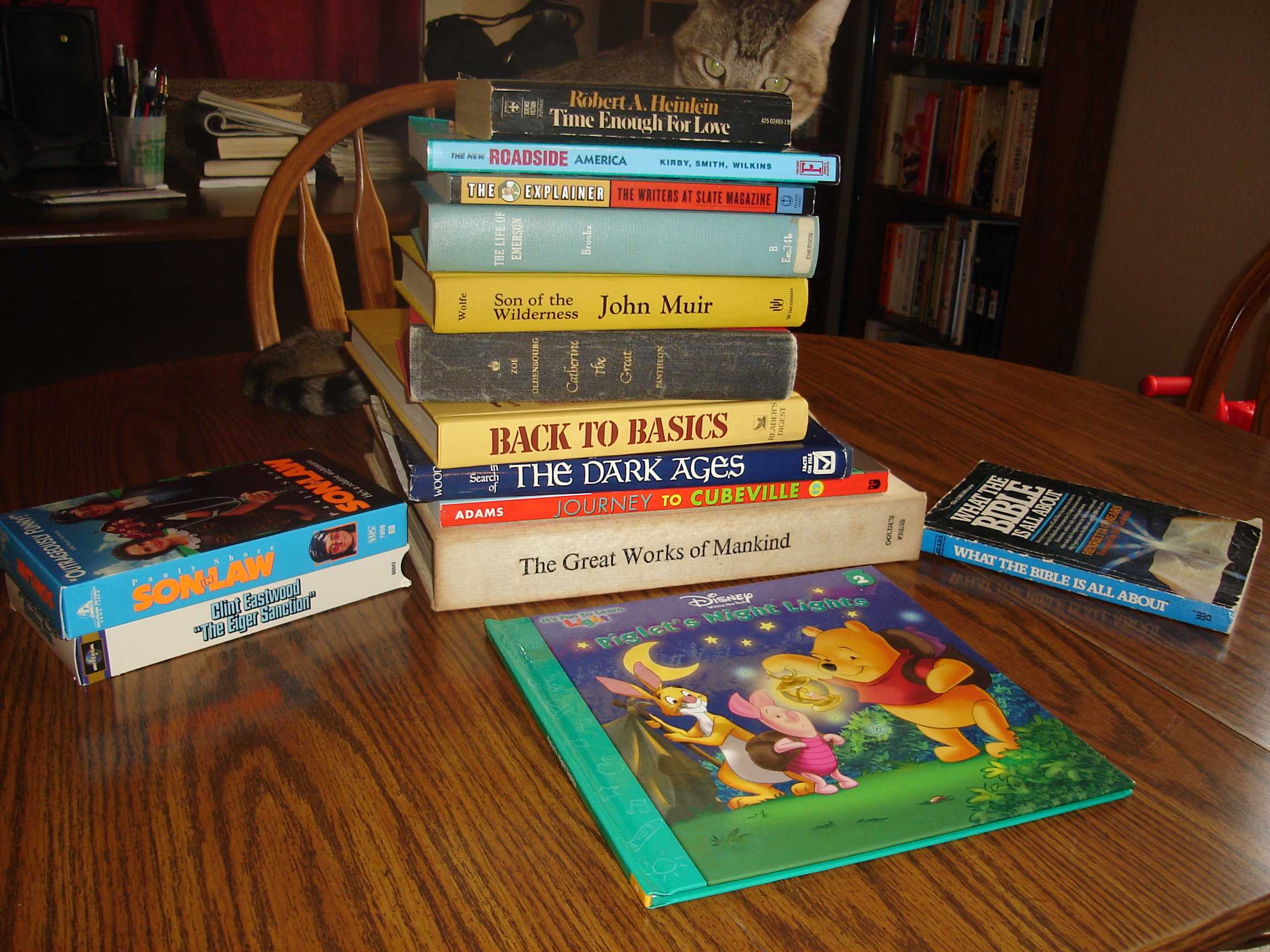
Beware the Ides of March, indeed. Not only did we attend two very disappointing school-based rummage sales, but it’s also the annual Eliot Unitarian Chapel book fair. This little affair takes place in the library of a little church in the next suburb over, but its hardbacks are $3.00 and other books are also priced over what I tend to spend. Unfortunately, I had cash in the wallet, a mostly entertained toddler, and the pent-up urge to acquire. So I got a couple books.

Also, since I fancy myself a history writer now with my recent publication in a magazine of that genre, I was looking for idea books or reference material. So I bought some historical biographies that I normally would not have.

Ides of March book fair purchases

I got:

  • Time Enough For Love by Robert Heinlein in paperback because I fear my shelves are low on the Heinlein, high on the Greg Bear.
  • Roadside America, a collection of old highway and small town tourist trapica. An idea book.
  • The Explainer, another Slate compendium.
  • The Life of Emerson, a biography of that transcendentalist.
  • Son of the Wilderness, John Muir, another historical biography. I read something about Muir not too long ago in a history magazine. Also, I have been to Muir Woods and wear the hat while walking said toddler.
  • Catherine the Great. Because I don’t have many Russian history books, I guess. I don’t know. I was pretty profligate at picking things up at this point.
  • Back to Basics, a Reader’s Digest compendium of basic skills. Not the Foxfire series by any stretch, but will prove useful if civilization collapses. Or if I get into the Renaissance festival lifestyle, I suppose. I don’t know which chance is greater.
  • The Dark Ages, which also might be helpful if civilization collapses, but mostly this is an idea book.
  • Journey to Cubeville, a Dilbert book to remind me of what it was like when I was a straight.
  • The Great Works of Mankind, a rather seasoned picture book of great buildings and whatnot. Also an idea book.
  • Son in Law, a movie with Paulie Shore. Which I have already seen. Take that for what it’s worth.
  • The Eiger Sanction, a Clint Eastwood movie I have not seen. Still, it’s only a buck, less than the DVD I would probably have bought eventually.

You can see Heather’s single book to the right and the boy’s book, Piglet’s Night Light. One of the workers at the book fair played me by asking if the lad might like to look at a book while we browsed. She gave him this one, which he flipped through while we pushed him through the tables. As if I was going to take it away from him where we ended. As a side note, he’s pretty good with the older children books, but we’ve begun the transition from board books by letting him flip through magazines so he could get the feel of the lighter paper pages and learn not to rip them or fold them. Helpful tip if you’ve got kids or books, I suppose.

So we spent like $25 dollars today, and I got 10 new books. As long as I only go to a book fair once every 2 months and stay away from the long science fiction novels or historical biographies, I’ll keep even with my purchases. On the other hand, look what I’m purchasing.

Buy My Books!
Buy John Donnelly's Gold Buy The Courtship of Barbara Holt Buy Coffee House Memories

What Dooley Wants You To Forget

When St. Louis County Executive Charles Dooley removed the sales tax increase to support Metro, the local mass transit agency, from the upcoming election ballot, here’s the kind of shenanigans he wants you to forget before he tries again to convince you to pay more to support more such shenanigans:

As its lawsuit against a team of contractors dragged for years, the Metro transit agency saw its legal bills balloon — at times topping $1 million per month.

Among the bills Metro paid was a $624-a-night hotel room, and group dinners at high-end restaurants that topped $300.

The agency covered more than $30,000 in lodging expenses for one of its law firms, including two rooms at the Crowne Plaza Hotel in Clayton that the firm used as a satellite office during the trial.

Agency leaders even paid out about $9,000 on a typo. That was the cost for a lawyer who billed for 76.9 hours of work — in one day.

The costs during the three-year legal battle soared to more than $21 million — shattering Metro’s own estimates of how much it would pay for the case. The Post-Dispatch reviewed many of the bills generated by the lawsuit.

The lawsuit, as you recall, was because Metro was shocked and embarrassed by how much cost overrun occurred on the recent extension of the light rail system. Funny, though, that Metro, with its seasoned professionals in mass transit and government teat-sucking, was astonished to discover the cost overruns whereas those of us who bash the government and its teat suckers were far less surprised that hundreds of millions of dollars disappeared into the ether.

Buy My Books!
Buy John Donnelly's Gold Buy The Courtship of Barbara Holt Buy Coffee House Memories

That’s Not MSN

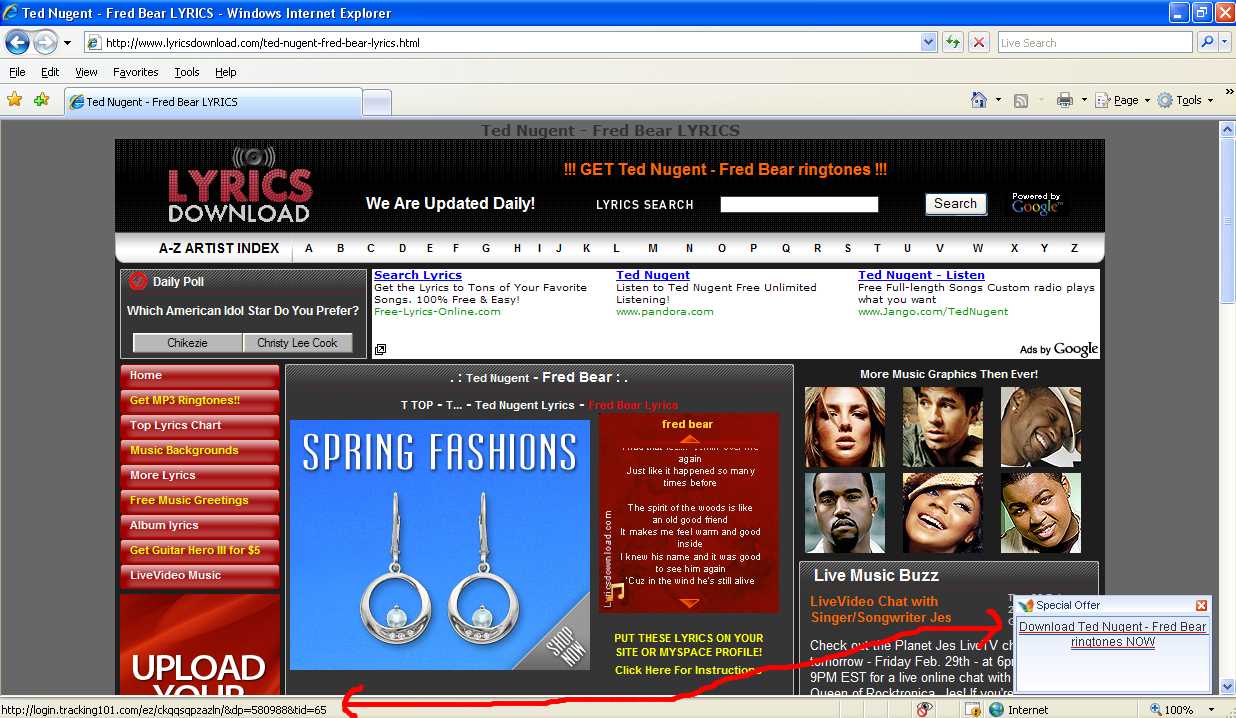
While looking up the lyrics for the song “Fred Bear” by Ted Nugent (referred to below), I saw something in the corner of my screen that I thought was a little….suspicious.

That's not really MSN
Click for full size

That little layer that pops up with the butterfly and offers you the opportunity to download ringtones based on the song you’re looking at has been crafted to look like a Windows / MSN Messenger alert, but it’s not; its target is login.tracking101.com, which is apparently some sleazy adware serving company.

You know, I’m duly suspicious of any ad that masks itself as a function of another program. Suitably so, in most cases.

Buy My Books!
Buy John Donnelly's Gold Buy The Courtship of Barbara Holt Buy Coffee House Memories

The City Is Backsliding, Backsliding the City

How many “signs” of the city of St. Louis’s Renaissance can you dispel at once? Well, at least two.

One:

A deal to bring Centene Corp.’s $250 million headquarters to downtown St. Louis is on shaky ground.

Two:

Centene’s development is supposed to be inside Ballpark Village, a seven-block entertainment and retail district that city leaders hope will be a cornerstone of downtown revitalization. It’s also uncertain when construction will begin on the $387 million first phase of Ballpark Village, co-developed by the St. Louis Cardinals.

Obviously, this will require a futile gesture on the part of the city, say a couple more million dollars of tax money, so the politicians and their unelected directorate of the expensive can protect their phoney baloney jobs. If you don’t mind my mixing pop culture references.

Buy My Books!
Buy John Donnelly's Gold Buy The Courtship of Barbara Holt Buy Coffee House Memories

Blast from the Past

In the year 1984, Julie Brown releases an EP with a song on it entitled “The Homecoming Queen Has Got A Gun”. School shootings do not immediately spike.


Would that make you think that perhaps the popular culture influence nor the availability of guns makes these things happen, but more a certain laxity of moral standards that would manifest itself in another decade? Or perhaps the inclusion of these incidents as major signifiers in the sweeping narrative told by popular media?

I got nothing, but I recall I thought the song was funny at the time, but given how times have changed, not so much any more.

Buy My Books!
Buy John Donnelly's Gold Buy The Courtship of Barbara Holt Buy Coffee House Memories

Book Report: The Forge of God by Greg Bear (1987)

I am such an easily led reader. The cool kids mention Heinlein, I read the Heinlein. Instapundit mentions Greg Bear, and I read one of the Greg Bear on my shelves. I think I bought both this book and its sequel, Anvil of Stars, from Downtown Books in Milwaukee some years ago because he has a lot of books, so if I liked the books, I could get a lot of books. Also, Ted Nugent sings about his brother, Fred Bear. So Instapundit mentioned the book, and it was like Pavlov ringing a bell.

That said, this book provided me with flashbacks of bad Niven, too present in my memory. The book covers an alien invasion whose first appearance is a couple of strange geological structures that appear out of nowhere. Then, a series of disconnected scientists hold a bunch of meetings and put together some papers about what might happen. Then, an alien appears that might or might not be a natural alien or just a biological construct. Then, pre-meetings, politickings, and a religious President who thinks the alien invasion–and probable destruction of the Earth–is punishment from God.

Seriously, the first 200 pages of this book are event, meetings, politicking, papers, hard science. The book cuts between disparate groups, some of whom I forget between their brief cut scenes. But the main characters are hard scientists, a science fiction writer, and politicians (sorry, national leaders). This is supposed to be hard science fiction, which I can take when it when the characters are good and the plot moves along. Unfortunately, with this book, I don’t really get into the characters, the plot drags, and ultimately the enemy who is destroying the Earth is so abstract that I can’t really get a mad-on. The author treats them like a force of nature. And there’s another group of aliens who are helping to save a few Earthlings–they cannot stop the inevitable destruction of the Earth. They, too, are unclear.

However, in the last 200 pages (slightly less), some of the good aliens possess–as in take over the wills of–some of the characters, and then the possessed characters work toward salvation of a small number in arks that will take them elsewhere. So that happens.

I guess that allows me to put a finger and pixels to another annoyance about the plot: The events happen to the characters. They don’t really influence the story, it just takes place and the people go along for the ride. Or die.

The book certainly bears a lot of influence from Lucifer’s Hammer; in the afterword or whatnot, the author thanks Niven himself. Sadly, it’s not as good as good Niven. It’s worst than bad Niven. Hard Science Bureaucracy Fiction.

Books mentioned in this review:


Buy My Books!
Buy John Donnelly's Gold Buy The Courtship of Barbara Holt Buy Coffee House Memories

Mel Carnahan’s Daughter Says People Who Vote With Fake Names on Voter Rolls Already Have Fake Picture IDs

Mo. politicians clash over photo IDs:

Missouri Secretary of State Robin Carnahan tells congressional lawmakers that requiring photo IDs for voters won’t do much to stop voter fraud.

She says photo identification only helps in rare cases when someone tries to impersonate another voter.

The Democrat claims a photo ID requirement would do more harm by disenfranchising elderly and poor voters who lack proper ID cards.

Considering how many dead people and underage voters apparently vote in Missouri (story), Robin Carnahan seems to imply that the state of Missouri, in which she is supposed to be Secretary of State but instead seems to have the title of Democrat Party Mole, has already issued photo identification to that same set of the “population,” and that Mickey Mouse would only be caught when he tried to vote as George Washington.

Issuing photo IDs to the dead, to toddlers, and to people whose names match celebrities or cartoon character, I have to admit, seems to be a bigger problem than mere voter fraud.

Buy My Books!
Buy John Donnelly's Gold Buy The Courtship of Barbara Holt Buy Coffee House Memories

Murphy Knows Kirkwood

Kevin Murphy reflects upon the Kirkwood shootings and sees beyond the handy racial template:

Kirkwood is suffering from a clash of aesthetics and has for a long time. All the big fights for the last 30 years (or more, I can only speak personally to 30 years) have all been over aesthetics. Usually its couched in terms of the effect on neighborhoods and property values but the majority of Kirkwood wants to keep the city a place of high end residential properties (nothing wrong with that) and if that limits what you do with your property, so be it. And that’s when the fighting begins – when you do something with your property that goes against the Kirkwood aesthetic. Tear down an old house to put up a new house – fine if the old house is one of the many old small ones and the new one fits in with the look and feel of Kirkwood. Tear down a charmer to put up a McMansion – Kirkwood explodes in red yard signs “Protect Historic Kirkwood”. Tear down a house to put in a parking lot – don’t even think about it Baptists.

Meachem Park has been thoroughly reconstructed since it’s annexation from Kirkwood. Law and order, and all that that entails, has been provided. And if the order that is imposed doesn’t conform to the locals desires, it does to the wider Kirkwood aesthetic. And no amount of jawboning about race, no amount of representation on the city council will change that.

Yes, but the handy racial template will keep the power-accumulating and power-abusing government officials from having to reflect on what they do that might make someone lash out violently. So they can go on, after the bread and circuses of racial harmony, stepping on the individual citizens.

Buy My Books!
Buy John Donnelly's Gold Buy The Courtship of Barbara Holt Buy Coffee House Memories

The Antithesis of Sharing

Someone gave my son a book, a book that that particular someone thought might have been a nice story about sharing or merely about fish. If that someone had cracked the cover of the book and had perused the book at all, I’d have to assume that someone wanted to co-opt my son into a world where all the altruistic bogeymen of Ayn Rand fiction are true. That book is The Rainbow Fish, and its author’s name might as well be Marx Pfister.
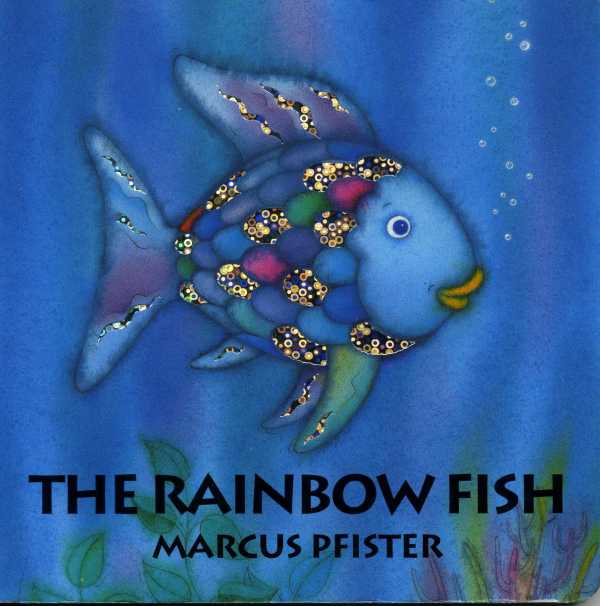
The Rainbow Fish cover

You see, the Rainbow Fish has colorful, reflective scales made of foil embedded within the sheets of the book. That differentiates the Rainbow Fish from the other fish in this fictive undersea world, too, making it more beautiful and, according to the value system espoused by the book, better somehow as the other fish value and covet those scales for themselves. Are they the villians? Of course not. The fish endowed by its creator is the villain because it recognizes the value in its scales and is unrepentant for having them:
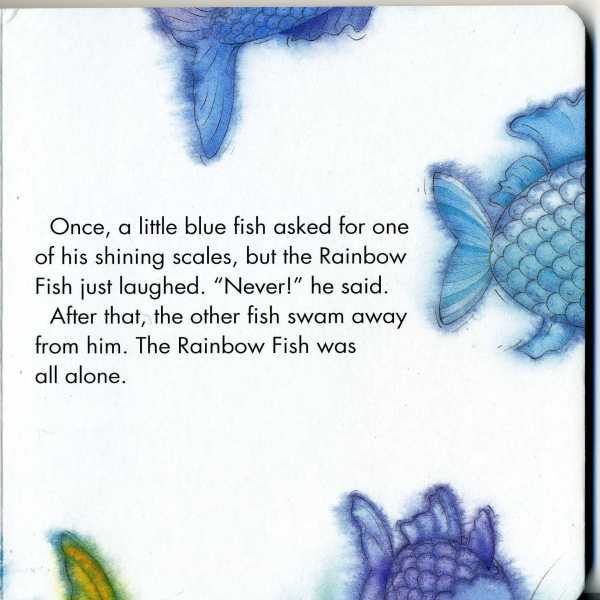
The other fish demand the Rainbow Fish give them its beauty

Okay, perhaps the Rainbow Fish is a bit impetuous. Perhaps a bit of a, erm, jerk. However, note the fish’s demand: Give me one of your scales. Part of your actual body that I find attractive. In the real world, if you ask a woman with pretty hair for a lock to keep and wear, she’ll pepper spray you, get a restraining order, and you’re the one ostracised, or so I have heard. In the Rainbow Fish universe, if you refuse, you are ostracised.

Brothers and sisters, I know something of sharing. Sharing occurs when someone with something says, “Hey, I have something, and someone has less or nothing. I shall give that person some of my something.” Instances that begin with someone having something and someone else demanding it are called “Robbery.” This book, then, seriously tries to inculcate urchins with the worst ad absurdums of Rand’s villainous thoughts: altruism, to give of yourself because other want you to give it up or because self-denial is a value. I mean, even Marx said From each according to his ability, which implied that ritual self-dismemberment or self-flaying was not required.

Unfortunately, the Rainbow Fish is weak and consults with a many-tentacled consultant who then tells him that he needs to give in, compromise, and everyone will love him. So the Rainbow Fish does:
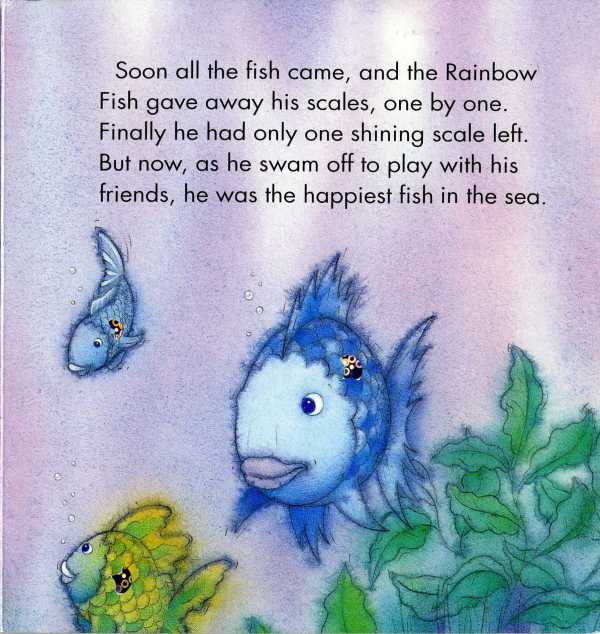
The happiest comrade in the commune

Now that they’re all equal in the ugly, asymmetrical single shiny scale, everyone loves him. Or at least Diana Moon Glampers would be. You see, in the Rainbow Fish undersea soviet, people love you for what you give them, not for what you are. And what you give them is the power to demean and diminish you for their own benefit.

Call it whatever you want, but it’s not a lesson in sharing. It’s a lesson in self-destruction for the pleasure of the masses.

You know, when the boy brings me this book to read to him, he gets a different story than the words tell him, and by the time he can read himself, Daddy might lose this book. Because, jeez, this is not what I want to teach my son, and it’s not what I want him to absorb from professionals because I’m not paying attention.

Sort of related thoughts from Rachel Lucas here, but she’s not a breeder like me, so it’s all theoretical on her part.
Buy My Books!
Buy John Donnelly's Gold Buy The Courtship of Barbara Holt Buy Coffee House Memories