Instead of making off with the rings and with the cash used to pay off the peripheral wedding personnel, I stayed and made this toast as best man:
To B—- and H—-. One a dreamer, one practical. Jane Austen would have called this a good match. Fortunately, we didn’t have to suffer through 300 pages of Victorian prose to celebrate with them today. Yesterday was the first day of summer, but today is the first day of their spring. May they have many seasons, many fruitful seasons, together.
Yeah, I know, Jane Austen was pre-Victorian. Nobody in the back of the bar in the middle of Wisconsin called me on it. Probably didn’t want to start an argument about Jane Austen on the big day.
Today J1 and my sainted mother and I hit some garage sales and estate sales because she desperately needs an Elvis on Velvet in the next week. The whole thing took on the feel of a weird MMORPG side quest, with this strange character wandering around asking all of the villagers about a Velvet Elvis, even when the people only displayed baby clothes and toys in their shops, as though the parser hearing the words would trigger them to tell my mother what cave to go to or would offer a special deal of the Elvis directly from their wall for a sum of silver. The only way it could have been more so, I suppose, was if she was asking for Velvet Elves.
Amid all of that and a bit of a spat between an estate sale “professional” and an estate sale buying aficionado over a mispriced bit of shelving, I found like four books for me and one for the Js inclusive:
Two books in the Isaac Asimov Foundation series, I think; as you know, I read a couple of these on my honeymoon, lo those many years ago. I’ve forgotten how far into the series I got, so I’m gathering a bunch on my to-read shelves because I’m afraid I’ll skip a book or read them out of order. Maybe when I have the whole set I can begin again.
A biography of Ian Fleming.
Old Possum’s Practical Book of Cats by T.S. Eliot. My wife informs me that she already owns a copy of that book. However, as you know, our books remain separate, so I don’t care what she owns. I own it now.
Additionally, for the youts, I got a book about the lesser evil of the Roosevelts.
Not a lot, but reading is at a slow pace these days (backed up books to report on disbursed rapidly could lead to a different impression).
Or maybe I am saving myself for the Carondolet Y book fair coming later this year.
No Velvet Elvis, though, so my mother is probably going to fail her quest. I think she ought to get some XP just for trying, though. Next week, the world will be lousy with them.
Fresh from reading The Legend of Sleepy Hollow and Other Tales, I jumped right into this book by another American author to see if my thesis that I could read American vernacular with more pleasure than the British was true. Apparently, it’s not unflinchingly true, as Hawthorne’s stories are more allegorical, high-faluting, and educational rather than enjoyable.
I read it slowly. At the beginning, I thought the style was overwhelming. Then, I amused myself in snickering at double entendres that would have made Hawthorne blush if he’d known how they’d sound to 21st century ears, such as the first paragraph of “The Maypole of Merry Mount“:
BRIGHT WERE the days at Merry Mount, when the Maypole was the banner staff of that gay colony! They who reared it, should their banner be triumphant, were to pour sunshine over New England’s rugged hills, and scatter flower seeds throughout the soil. Jollity and gloom were contending for an empire. Midsummer eve had come, bringing deep verdure to the forest, and roses in her lap, of a more vivid hue than the tender buds of Spring. But May, or her mirthful spirit, dwelt all the year round at Merry Mount, sporting with the Summer months, and revelling with Autumn, and basking in the glow of Winter’s fireside. Through a world of toil and care she flitted with a dreamlike smile, and came hither to find a home among the lightsome hearts of Merry Mount.
However, I eventually got acclimated to the book and got more into the tales, but they’re not really the sorts of things one reads for pleasure unless one gets pleasure out of saying, “I read Twice-Told Tales by Hawthorne for fun.”
So I guess I got some secondary pleasure out of it.
Less fun than the aforementioned Irving though, and only a bit more enjoyable than the Stallone but at greater investment.
You remember the movie with the L.A. Law guy? No? Damn kids. This is the novelization, essentially a recasting of the Perseus myth with a bit of modern (ca. 1981) costumery.
I like Alan Dean Foster, as you know, and he got a lot of this sort of work. He adds some allusions within the text not found in the movie, but some of the off-script scenes sound completely different, as though a couple pages of Rosencrantz and Guildenstern Are Dead were accidentally grafted into Hamlet.
Still, it serves its purpose: reminding me I need to watch the DVD of the film I bought some years ago. Actually, I think the real point was to make me go buy something related to the film to add to its bottom line, but I don’t think the lunchboxes still add to MGM’s bottom line 30 years later.
This is a Fawcett reprint of the original book, so you’ll have to forgive the back cover’s references to patterns of violence and evil lurking beneath the surface. Instead of a crime novel, this book depicts a decadent family in a milltown in New York that has a week wherein their lives break out of the rut into which they’d fallen. It’s a character study of each and the events that change them.
The patriarch, 50 something Ben, runs the mill he and the others inherited, but his progenitors allowed it to run down, so he’s barely holding it together. A major financier comes along to buy the mill, and Ben has to determine what’s best for the family.
Ben’s son Brock has been expelled from school after falling in with a bad woman and stealing from another student to support her. He has to deal with his father’s sanction, but he meets another girl who draws his attention.
Ben’s daughter Ellen is dating an older boy and hangs with some older kids, college students now, but she thinks that they’ve changed or she has.
Ben’s half-brother Quinn, a vice president at the mill, is intimidated by his robust and energetic wife. He doesn’t work for his salary and keeps a woman on the side.
Ben’s half-sister Alice married a construction man and deals with frigidity.
The construction man used to build good homes, but now speculates with his construction, cutting corners and using cheap materials.
The youngest brother of the family marries a strong woman in Mexico City, where both work for the State Department, and they return.
Over the course of the week, Alice has a sexual awakening of sorts, which causes the construction man to reevaluate his life and goals and stop doing shoddy work. Ellen’s boyfriend stumbles through a rape attempt, and she grows up. Ben tells off Quinn, who must be the evil guy as he engages in the pattern of violence–beating his girlfriend to death (he thinks) and then killing himself. Brock regains his father’s trust as he helps the patriarch with the crises. And Ben decides not to sell, even though it might drive him to an early coronary, because he likes keeping the mill–and the family–together ultimately.
A decent character piece, a bit awash in characters though, more like MacDonald’s business books than his crime fiction. But a good read nevertheless.
After almost winning an Academy Award for writing (Rocky, which ties Stallone with the number of almost Oscars as Roger L. Simon and puts him only one ahead of me), Stallone unleashed this book in bookstores before turning it into a film starring Stallone. Unlike Rocky, which dealt with boxing, this book deals with wrestling. And it’s set in the 40s, not the present day (then), so it’s completely different.
It’s wooden, it’s written pretty specifically in scenes for a movie, and it uses concrete poetry style arrangements of words to make points. But ultimately it didn’t suck as bad as some novels movies are based on or some novelizations of movies.
Plus, I get to say I read Stallone’s novel. It’s mixed in with Austen, Dickens, and Hardy this year, but jeez, any kid in college reads those. I alone read Stallone.
I passed up a couple of copies of this at the St. Charles Book Fair because I knew I had a copy of it at home. The copy I have is an ex-library copy, so because I wasn’t that attentive, I passed up a chance to upgrade. One of these days, I should really add my to-read shelves to my database and run a comprehensive report before I go so I know what to look for and what to buy. But that’s more organized than I pretend to be.
This book is a 1974 87th precinct book, which means you’ll not find it as easily in the wild (St. Charles Book Fair notwithstanding) as you’ll find the 80s-00s books, so I’m glad I got it regardless of the edition. One finds that McBain’s quality remained pretty steady throughout his career.
This book deals with an arson fire that destroys a shipment of toys, putting a company’s owner in a bind. Investigating leads the 87th Squad to find some dubious investment schemes and a series of related murders that indicate something more than toy selling was going on.
It’s a good book, and it’s dated a bit. I mean, pushers want bread, dig? But still a worthy read.
Here is one question: If the free market is the answer, how come gas at the pump is far, far cheaper in countries where governments run the oil business – Russia, Venezuela, Indonesia. Please, I am just asking a question. I am not a commie.
Just asking a question facilely; I thought journalists wanted answers, but not when the answers undermine their glib socialism. Since he’s not bothering to discuss the lifespan or quality of life of regular citizens in those countries, he’s really just pushing a commie viewpoint.
As some of you Atari Party attendees know, we have kept up with the Karaoke Revolutions series by Konami. I’m not a very talented singer, but I’m pleased that I have scored perfectly on two songs:
As I told everyone I saw this weekend, Milwaukee is very odd in that its metropolitan area is small and drops off abruptly into farmlands. You can drive from the south end of the area to the north end of the area in a little over 30 minutes on the freeway. In St. Louis, by contrast, just starting from downtown (which doesn’t include the eastern suburbs because they’re in Illinois and although they like to pretend they count, they don’t), you can drive for well over an hour one its freeways and still travel through well-developed suburbs.
However, in that sprawling farmland just beyond the reaches of Milwaukee’s metropolitan area, there are signs that the development juggernaut is coming. This photo, taken along US 60 just outside of Jackson proves it. I passed fields, tractors driving on the side of the road, tractors for sale, and a sign:
It isn’t the farmers moving into CONDOS in the middle of nowhere.
Based on my experience with the St. Louis area and how my former area in northwestern Jefferson County has grown, I expect the way of life of those people in Jackson and in Richfield and in Hubertus and around those parts will change drastically in the next 20 years. If Milwaukee has the population to support it.
It’s progress, I guess, but I’m still sad. Perhaps I should be like John D. MacDonald, Carl Hiaasen, et al, and write poetic crime fiction novels to lament it.
So I’m out in the backyard the other day, and I come across a strange sight that almost indicated I was suddenly in an alternate universe. I’ve lived in this house for over two years and have mowed the back yard at least twice in addition to various child play activities, gardening bits, and whatnot. So how come I never noticed this six foot strand of wire sticking up before?
Fortunately, it was not live, since I do have kids wandering around back there. But,seriously, where did that come from?
The back corner of the yard used to have a garage or workshop at one time; there’s still a bit of a gas pipe sticking up from heat or whatnot and I’m always digging stuff out of the ground nearby. But I can’t have not seen this six foot strip of wire in two years, can I?
The one end of it was firmly buried, and the other was kind of bent up and hanging out; it wasn’t there last Saturday when I mowed the lawn, and the sod is not chewed up as though it had recently been dug up. I mow it short, too, so I would have seen it if it was lying on the ground for two years.
So how does six feet of wire spout out of a hole in the ground all at once? Is it like a volcanic thing? Or was it really not an electric wire leading to the old garage, but a phone line, and if I’d hooked in a phone, I would have been the first to communicate with the great Underworld Land Of The Eternal Sun?
“These are the same guys who helped to engineer the distraction of the war in Iraq at a time when we could have pinned down the people who actually committed 9/11,” the presumed nominee told reporters aboard his campaign plane.
Funny, I thought the guys who actually committed it died in the plane crashes with their victims. But if Senator Obama’s foreign policy comic book indicates that the people who actually committed 9/11 somehow escaped through evil science or magic, he’s right that the United States better ramp up on that technique, stat.
You know, Garfield gets all the attention these days, but back in the old days, Heathcliff was the cat. Of course, his cartoon was a single panel, not a strip, so his humor had to get to the point, and it did. Instead of lazy, Heathcliff was a helion. Instead of liking lasagna, he eats the remnants from trash cans. In other words, he’s a scrapper where Garfield is a dilettante. No wonder I liked Heathcliff more when I was younger. Also, the daily we got had Heathcliff, but not Garfield, which could explain it. Heathcliff even had a cartoon before Garfield did.
This book collects a number of strips, mostly around the motif of Heathcliff’s love for Sonja. Given that, though, the book really identifies how Geo Gately used a limited number of ideas for a lot of cartoons. Another cat looks at Sonja, and Heathcliff does something to him; Heathcliff steals the fish; Sonja’s woman owner asks the man why he doesn’t do for her what Heathcliff does for Sonja; and so on. I hope that over the run of the series, the cartoonist spread these repeated bits out a little more than you can within a book limited by this theme.
Ultimately, I guess this might explain why Garfield would ultimately eclipse Heathcliff.
And although there’s no Heathcliff without Heathcliff blog (unlike Garfield, there is the Heathcliff Explained blog which echoes sentiments expressed above with some profanity and daily cartoons.
Can’t anyone else in the 21st century just enjoy the cartoons, or just look at them?
Saturday represented our third year in a row at the St. Charles Book Fair and our first attempt at a book fair with two strollers of children. This particular trip was disappointing because the combination of the crowd and keeping a grabby nigh-two-year-old from the books left me unable to effectively browse. Unless I’m in the right mood, I don’t go wild, and the factors didn’t put me in that gluttonous mood. As a result, the book purchases were far lower than I expected:
LA Secret Police, some sort of nonfiction bit that will fit right into my paranoia.
The Frumionous Bandersnatch by Ed McBain, a later 87th precinct book that I might not have already.
Shadows over Baker Street, a collection premised on a combination of Sherlock Holmes with H.P. Lovecraft. How could that go wrong?
50 Great Horror Stories, a collection, obviously, of horror, obviously.
Arson Detection and Investigation, a nonfiction book about police techniques regarding arson. The typeface indicates this manual might be out of date, so I expect it includes pyromancy or something.
K-Pax, the book that inspired the movie. Because I get those books, as you know.
Kim, by Rudyard Kipling. Now that I am looking for Reader’s Digest editions of these books, they’re unavailable at book sales. The only other volume they had was Twice-Told Tales by Nathaniel Hawthorne, which I almost finished at the time. Now that I have actually finished it, you’ll get the book report.
Homecoming by Bob Greene, which I probably already own.
The Choirboys by Joseph Wambaugh. First thing when I hit the first table, a volunteer asks me what I like. When I said McBain, he asked me if I’d read Wambaugh. Of course, the only Wambaugh I’d read was The New Centurions when I was in high school, and I said as much, so the volunteer pushed this book onto me. I don’t know what it was about this trip and the gabby volunteers or if a small child overcomes my normal prickly look, but I got into a lot of conversations (2) with the volunteers. The other started when I told my charge on wheels that the Romanian-English dictionary was almost tempting because I don’t own one; the volunteer stepped in to tell me about the languages her kids were taking for fun, and she not only tried to get me to buy the dictionary, but encouraged me to take on a couple of language on tape courses available with the audio goods. I declined both, but I got the Wambaugh. It was the first book I picked up, but it didn’t trigger the normal frenzy.
Something by John Stossel, which will be worth the read.
Great Books. I think I already have this one, too.
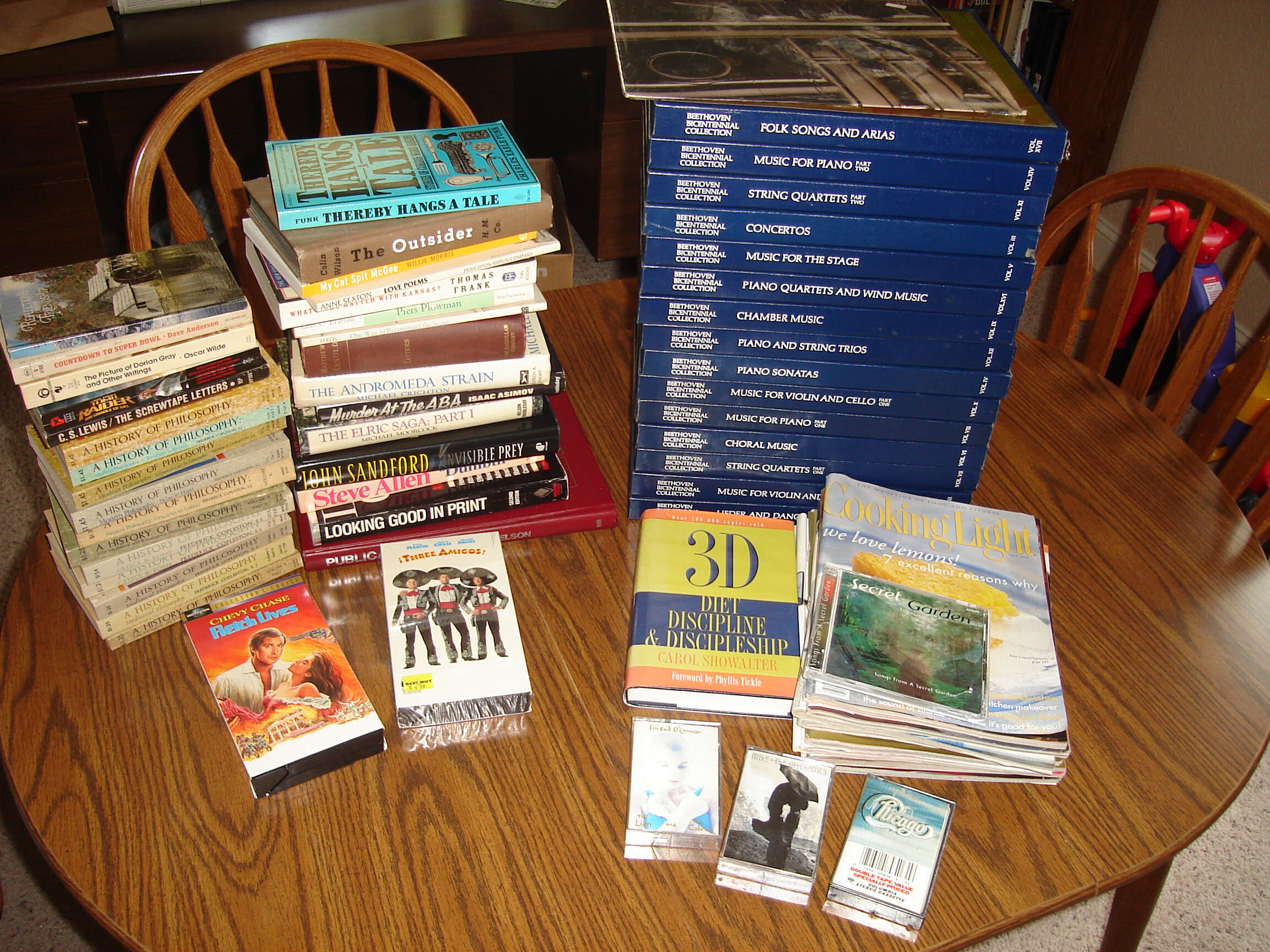
The other stack of books and the crazy number of cassettes (and 2 albums) were Mrs. Noggle’s purchases. Not depicted: the three board books I picked up to distract J1 while we browsed. One he ripped at the fair and another is one of his favorites today.
Sunday: Antiquarian inheritance from my aunt
On Sunday, I lamented about not buying many books, and my sainted mother took pity on me and gave me a stack of antiquarian books from my aunt, whose inheritance to me includes a number of titles already reviewed upon this blog.
My aunt bought these books, like so many of the others, at garage sales and was going to sell them online. Ergo, she bought them because they were old, not because of their subject matter.
Abridged Treasury of Prayers (unknown), which includes a postcard, a photograph, and a letter within as well as an inscription.
William Zorach: American Artists Group Monograph Number 15 (1945). Signed by the artist. Includes a newspaper clipping on the artist’s death in 1966.
The Science of Human Life or Eugenics (1920). The original textbook on it. As I said, my aunt bought this book because it is old, and I have this book because it was my aunt’s. So if you come to see it on my shelves, please understand why it’s there.
Gainsborough Masterpieces in Colour (unknown). A collection of works by the artist.
The Lilac Lady by Ruth Alberta Brown (1914).
We Came In Peace: The Story of Man In Space (1969).
Will I read them? Most of them, probably, maybe. They’re going on the to-read shelves anyway.
Instapundit links to a couple of The New Republic takedowns of the new M. Night Someguyan movie The Happening, saving me a couple bucks on seeing a film that ultimately would have cheesed me off. Go head, click here and here, read the spoilers, and know why I’d have been peeved.
However, in the biggest meta-twist of any career (and I’ll guess that Shyamalan’s career is officially over now), the finally movie suggests that the protagonists of his earlier films were actually the bad guys. That’s right: The Sixth Sense‘s burglar, Unbreakable‘s Mr. Glass, Sign‘s aliens, and that mermaid film’s anti-mermaid contingent were actually the good guys, doing the work of the Trees.
I mean, I’m from Wisconsin, but this young lady has altered the geographical center of my swearing accent.
That’s the kind of girl I would have gotten stupid over at age 20. Come to think of it, she does remind me a little about my high school crush. I only went out with her twice, as I got stupid about her my senior year and didn’t get the nerve to ask her out until spring. She then went on to date a close friend, which would become a recurring theme in my younger days, and after she graduated college, I hear she married a local boy known for impregnating his step-sister, whom he’d dated before their parents married. I am from Wisconsin, but by high school, I was in Jefferson County, Missouri, where such things are not unheard of.
But back to Taylor Swift. Blonde, pretty blue eyes, and a sweet voice, ruff.
Speaking of Taylors, here’s another from back in the day, also blonde here:
2. Hey, I’ve always liked Billy Ray Cyrus.
Actually, I was fortunate to get exposure only after the whole Achy Breaky thing, so that was something I had to forgive him for after I liked him. Here’s the current video, where he looks like a fat Garth Brooks as Chris Gaines, unfortunately:
Sadly, it’s from an album of country sings Disney which isn’t as bad as a Jimmy Buffett or Def Leppard duet, but I have to think Hank would not approve.
Here’s something from the olden days, his second album entitled It Won’t Be The Last. To some of his critics’ surprise, it wasn’t. You’ll have to click through to see “Some Gave All” because Universal Music doesn’t trust me with the embedded video because if you can see the video here for free, you won’t go buy a $50 Blu-Ray Billy Ray video collection.
What, country music videos in the middle of the night? Well, after four weeks of the late shift, I’ve gotten a bit tired of SportsCenter and Hannity and Colmes or Greta repeats, and sometimes the classic movie stations are running Hope Floats marathons. Watching the country videos makes me a bit nostalgic, as you can see.