Scenes from the Front Line in Homeland Security (II)

So I walked down to the Old Trees Recreational Complex to get a residency card so I can save $1 on ice skating sessions at the rink and save $10 on continuing education programs if I ever needed to learn how to line dance with the elderly. But that $1 per session, over the course of a year where I will go once, will save me a total of $1.

So I arrived with my new driver’s license because it has my new address and I thought that would be enough.

“Do you have a piece of mail with your current address on it?” the woman behind the counter said. “A utility bill?”

I looked through my wallet for anything else. I took out my Old Trees Library card.

“They don’t make you show anything with your address on it,” she said.

I don’t normally carry with me my current outstanding personal invoices for commodity consumption, so I had to walk away empty-handed.

But rest assured, America; even though I had to prove my current address to get this driver’s license with my Old Trees address upon it, that in and of itself was not enough to satisfy the demands of the vigilant public servant. We can all sleep easier knowing that it’s harder to get an Old Trees ID than a driver’s license, and that our ice arena and architecture tours are safe from terrorists who refuse to pay full price.

Buy My Books!
Buy John Donnelly's Gold Buy The Courtship of Barbara Holt Buy Coffee House Memories

Indecision of the Elderly

As some of you know, I have recently passed out of the meaningful demographic. In addition to getting the cold shoulder of marketers and television programmers everywhere, I’ve recently discovered some of the horrible, terrifying conundrums of this horrible age between youth and agedness. Such as:

Is that splotch a zit or melanoma?

Buy My Books!
Buy John Donnelly's Gold Buy The Courtship of Barbara Holt Buy Coffee House Memories

Scenes From the Front Line In Homeland Security

Espied as I waited for my driver’s license to print several weeks overdue because I’d sent off to the Great State of Wisconsin for a Certified Birth Certificate and paid $15 for the effort to comply with the Lesser State of Missouri’s new laws designed to thwart the malevolent forces in the world from obtaining driver’s licenses with fake credentials so they could wreak havoc upon this nation.

Woman: (Retrieving a photostat of a birth certificate that looked like it had been washed in the pocket of blue jeans with the stones to create that worn effect that is found by certain segments of young people to be so pleasing as to pay extra for) I’m sorry, I sent for a new one and haven’t gotten it.

22 year old license office employee with the ring in her nose: (Not glancing at but not unfolding the three pieces) Okay.

Woman: Can I change my address? I moved.

Employee: I need something with your new address on it. A utility bill, a check, or something.

Woman: (Rifling through purse) Oh, I don’t have anything. That’s okay, keep it the same.

Thank you, faceless license bureau employee with the ring in her nose. Your efforts have ensured that this potentially lethal agent of destruction could not change the address on her driver’s license inappropriately. Our nation is safer!

Buy My Books!
Buy John Donnelly's Gold Buy The Courtship of Barbara Holt Buy Coffee House Memories

Home Ownership Is Draining

As I age, I concern myself with subtle imperfections that I’ve ignored for the majority of my thirtysomething years. Blithely, throughout much of my youth, I skipped through life without taking care of things, without worrying how that indifference would lead to consequences later. Now that I am older, sadder perhaps, but wiser, I have learned the importance of proper drainage and water control around a domicile.

Some years ago, when I was an impertinent youth of but eight and twenty, my wife and I bought our dream house of the moment. It looked spectacular in the early spring, with the last traces of the winter’s snow decorating the lawn in the picture. When our realtor walked us through the building, we appreciated the vinyl hardwood-looking floors in the kitchen and foyer, the gas fireplace in the basement den, and the affordable lower Bobo price. Of course, our youthful zeal for home ownership and our overappreciation of the possibilities for the fourth bedroom, we didn’t fully appreciate the impact of a below-grade walkout basement at the bottom of a hill whose sliding glass doors were guarded by a single drain beneath two blossoming crab apple trees.

Fast forward and flashflood two years to a dark and stormy night, where a torrent of water tumbling down the concrete steps outside the basement doors made the exterior look like a leaking fish tank from inside that den with the fireplace. I kneeled in ankle-deep water to bail the blossoms and crabapples from the drain almost as fast as they collected at the base of the vortex. I sniffled in the torrenting chill, man against nature, while my wife frantically sopped the inside seepage with towels and blankets.

We weathered that particular storm with only an extremely damp carpet, and I have learned a lesson. I now spend a portion of each afternoon sweeping the deck above and the concrete steps and drain below free of leaves, cut grass, crab apples, and other assorted detritus. My efforts only ensure my comfort in the hour immediately following my sweeping. I’ll fidget and fuss during any heavy rainfall, looking through the doors frequently to scry how much might accumulate around the drain. Often, I will obsessively or compulsively venture into the rain to clear the drain, removing a crab apple or a palmful of leaves to ensure my own unease of mind.
Perhaps I would enjoy the romance of a good thunderstorm more if I only worried about the drain at the bottom of the basement steps. I also worry about the gutters.

One morning, circa 2:30 CDT, I awakened from a light slumber to hear the soothing—or so I thought then—prattle of rain through the downspout. As I listened to the gentle cascade of water, I realized that I heard a soothing cascade undimmed by exterior walls. I slapped glasses onto my nose and hastened to the dining room, where I encountered a stream of water pouring from the dining room window onto the vinyl, but hardwood-looking, dining room floor. For some reason, water rolling from the roof ignored the best-designed systems of man which proffered a downspout at the house’s corner. Instead, the water fell directly against the side of the house. The charming but energy-efficient sliding window track offered a handy cup to collect this water, and when the cup overflowed, it runneth over into the dining room. Once again arming my beautiful and sleepy wife with towels, I ventured into the maelstrom.

Climbing onto a stepladder, I discerned through trial and error, using the flashes of lightning for illumination and the crashes of nearby thunder as motivation for quick action, that the gutter had pulled from the house so that the water from the roof was streaming between the roof and the gutter. When I held the gutter up with my hands, the stream against the window abated. When I let go, the stream resumed. I pondered the prospect of holding the gutter against the house all night, but I remembered that I had a single stalk of wood in my personal lumberyard that I could prop against the window sill to hold the gutter in place and…. Success!

Of course, success in this case meant that I could dry off, but that I would spend the rest of a mostly sleepless night checking both the drain and the kludged gutter brace to ensure that most of my house remained dry. I took a personal day from work the next day to clean my gutters, to bolt the loose section to the house with the largest bolts I could muster, and to place gutter screens on the gutters beneath the two crab apple trees just to be thorough or just because I was in that aisle in the hardware store.

So as I age, and as I own a home, I pay greater attention to the weather and the water falling outside of my house. As Mr. Fix-It might have said in his book, water is a friend, but it’s also an enemy. Perhaps he didn’t say that, or perhaps he was talking about the copper piping through which we invite the beast into our home. Still, you can be sure that when my wife and I move to our next dream house, I will inspect the topography to ensure that the entire neighborhood does not funnel its watershed to my basement door. I’ll also resist the temptation to use the basement (if we don’t buy a home on a sweet, sweet slab of concrete) to store our extensive library or electronic equipment.

Until then, though, I will arm myself with brooms, buckets, and two-by-fours to prepare for the inevitable unexpected, which undoubtedly will require something other than brooms, buckets, or two-by-fours. Ultimately, though, I know I can do little but study the skies like a native, looking for signs that I have personally angered the rain gods.

Buy My Books!
Buy John Donnelly's Gold Buy The Courtship of Barbara Holt Buy Coffee House Memories

A Boy, A Camera, A Dog

It’s 1985, and you’ve just moved to Missouri from the great state of Wisconsin (Snow Be Upon It). You’ve spent a year in your rich relatives’ basement before your poor sainted mother could work her way off of the frozen onion assembly line into a typist (with typewriters!) position with the government and could afford to shelter you and your brother in a 12′ x 60′ trailer in a semi-rural Missouri trailer park. You’re not supposed to leave the trailer as a “latchkey kid,” and all you’ve got for amusement is the Polaroid Instant Camera you got for selling cards adverised on the back of comic books (thank you, Captain Olympic!), a film cartridge you might have earned with some months’ worth of fifty-cents-a-week allowance for cleaning the said trailer and cooking dinner every night, a stray dog herded from traffic into your household, and a kid brother. What do you do for fun?

You stage a set of photos illustrating how your dog is a genius. Just like she told you to.

Behold:

Cricket, The Genius

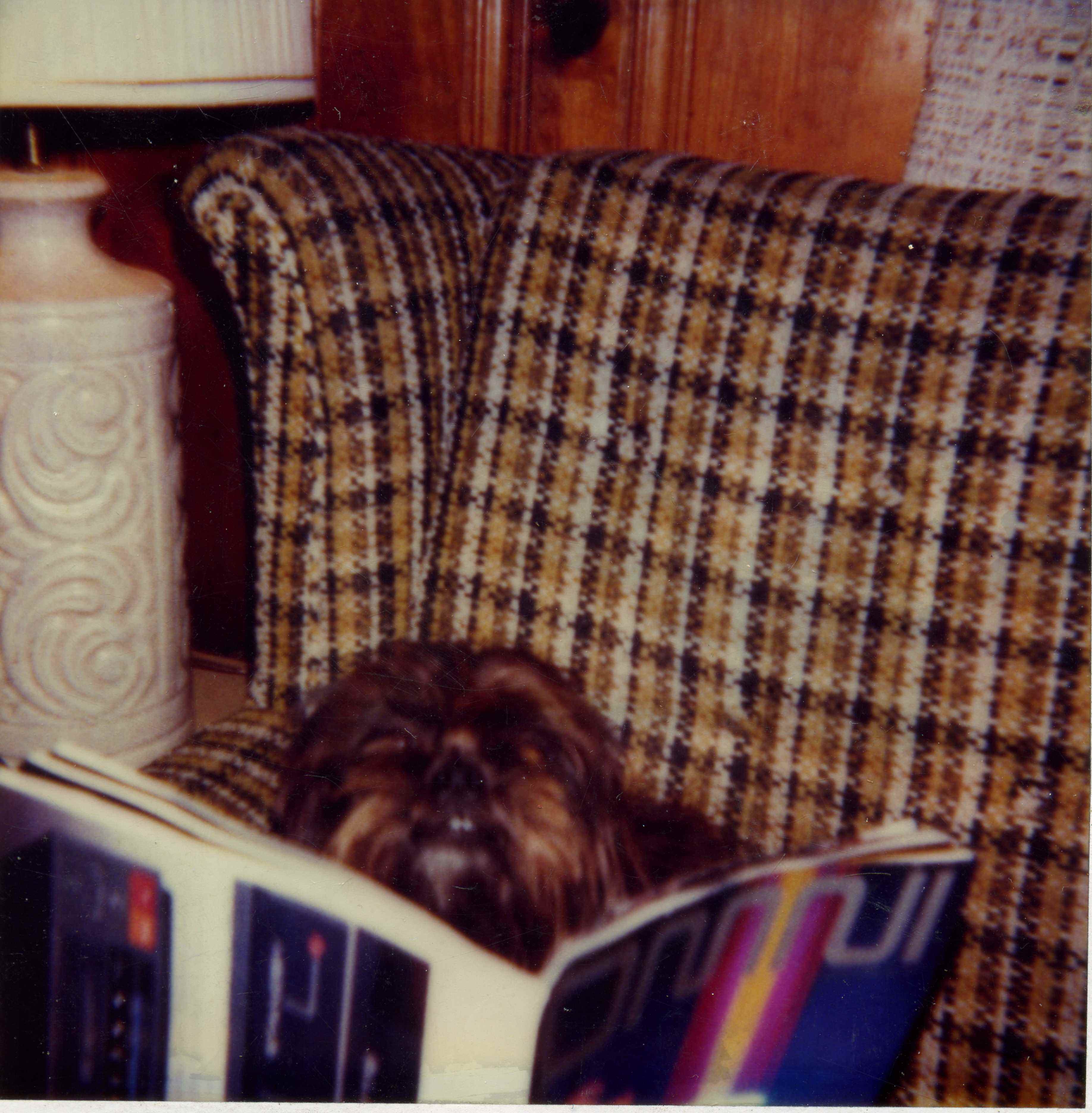
Cricket reading Omni
Cricket reading Omni on the sofa of our 1968 Star mobile home.

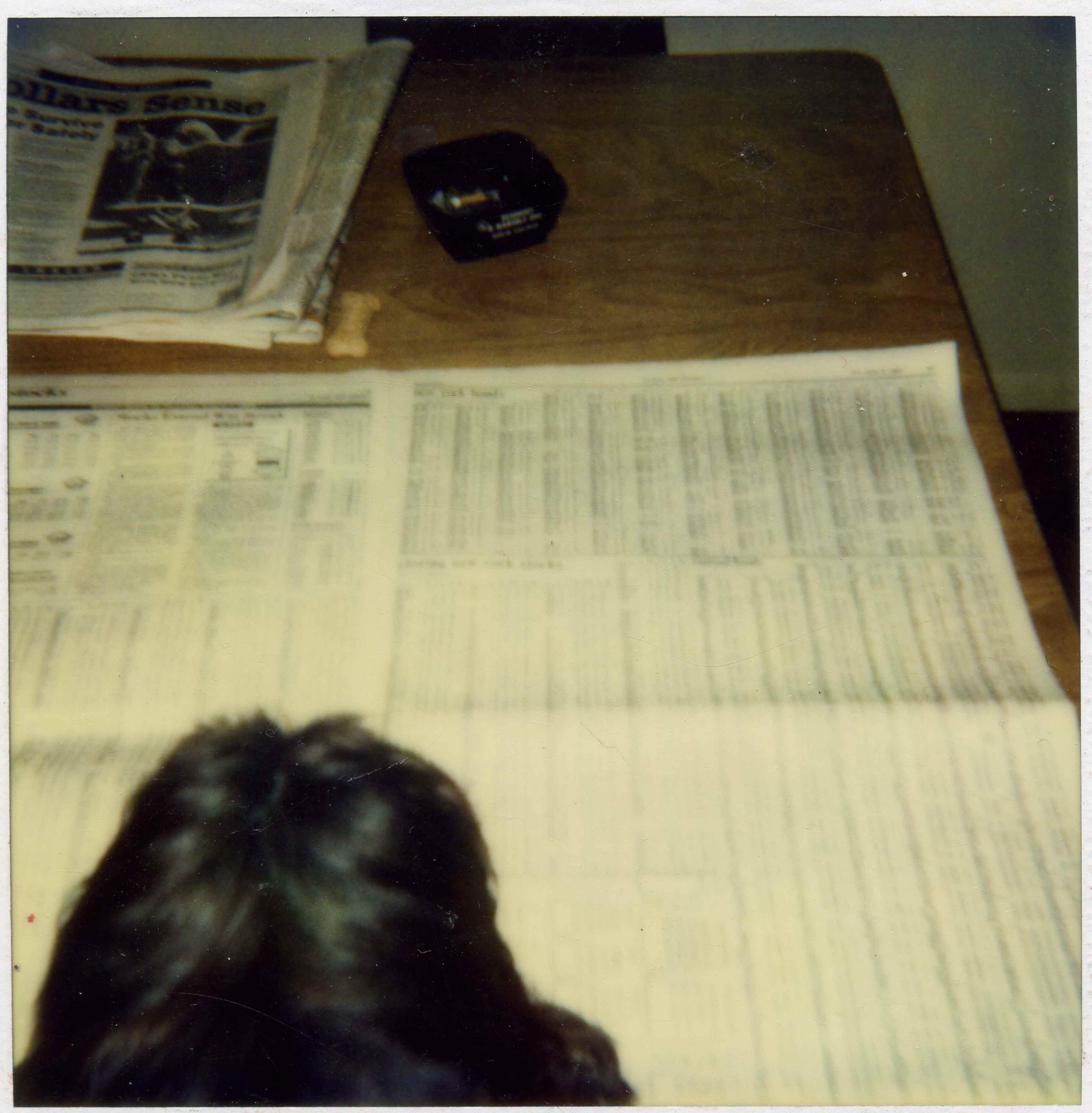
Cricket reading the financial pages
Cricket reading the financial pages at the table. The cookie there is for later, not to draw and hold the dog’s attention while the photograph was taken. It’s a real shame we didn’t take her advice and short everything in October 1987.

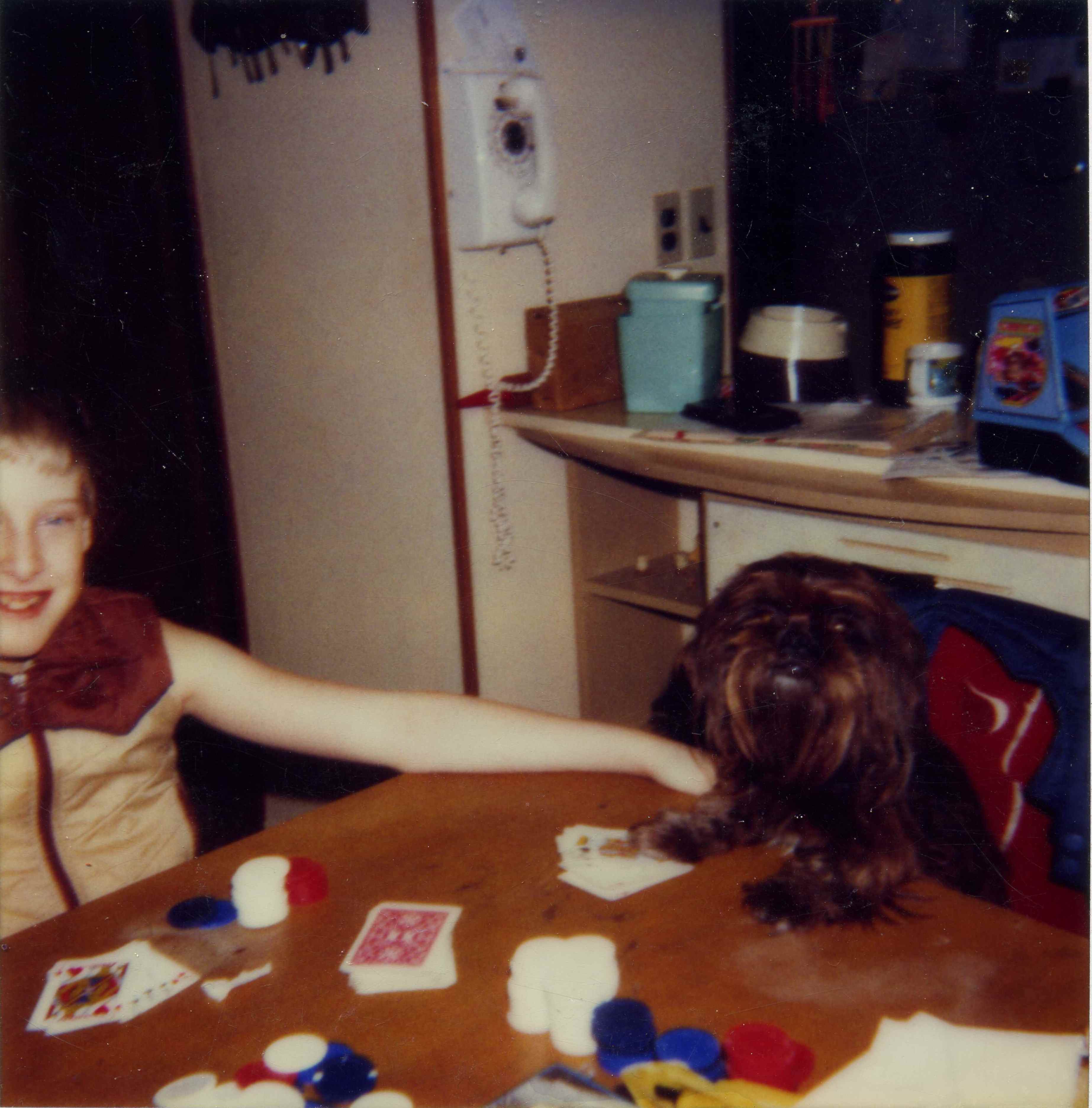
Cricket playing cards
Cricket playing my brother at cards, looking for her stake to short sell everything in October 1987. Unfortunately, preteen children from trailer parks rarely have the scratch needed to impress brokers.

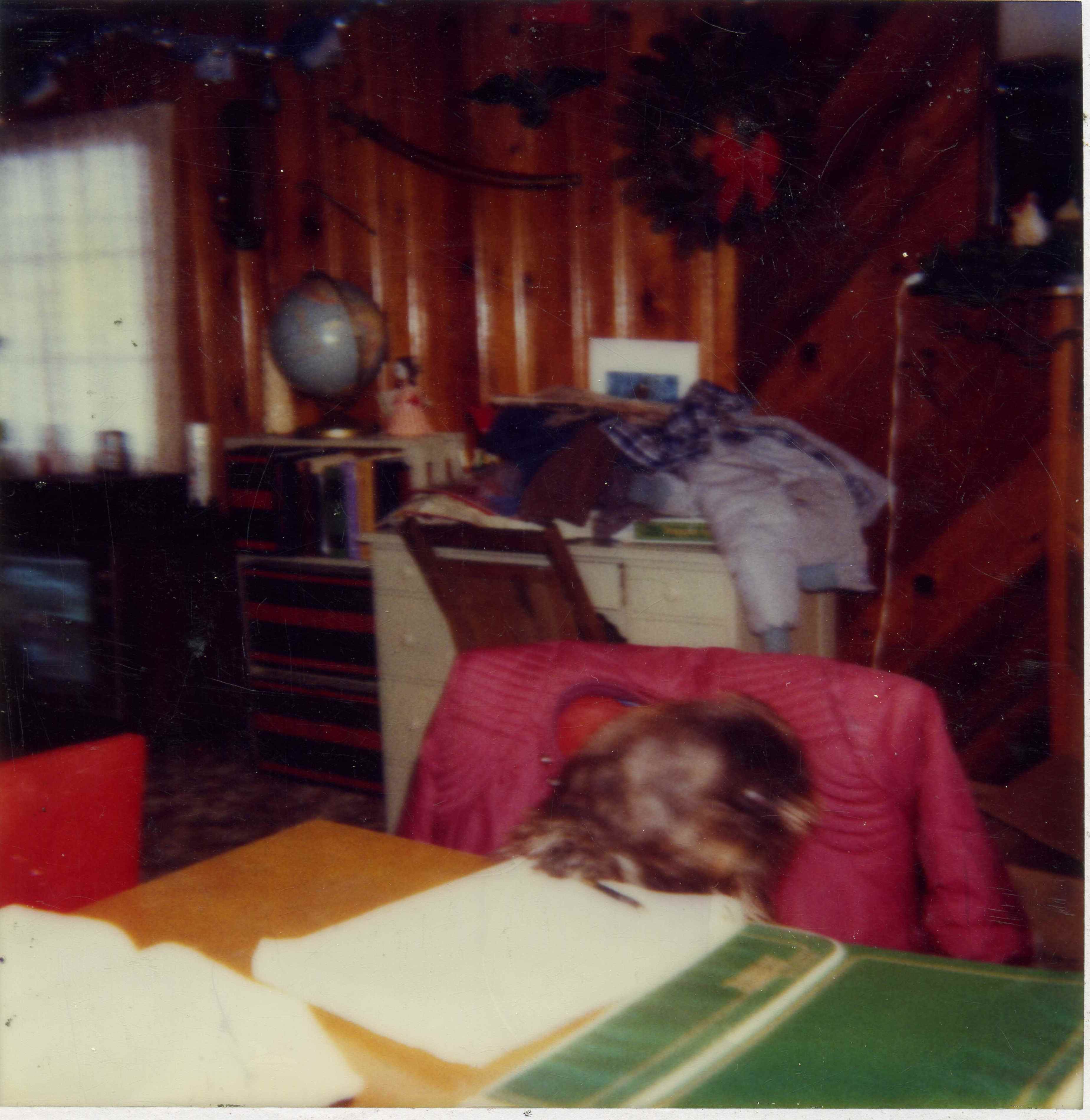
Cricket doing Kevin's homework
Cricket did my brother’s homework. Although she was smart for a dog, apparently she didn’t care much for elementary school social studies.

Cricket doing a crossword puzzle
Cricket loved crossword puzzles, but the ones in the St. Louis Post-Dispatch didn’t challenge her much.

One of my first short stories, written in middle school, was a little two page bit written from Cricket’s point of view. The short story was fittingly rejected by McCall’s in my first magazine submission. I’ve lost that rejection letter, which would otherwise be the pride of my extensive collection.

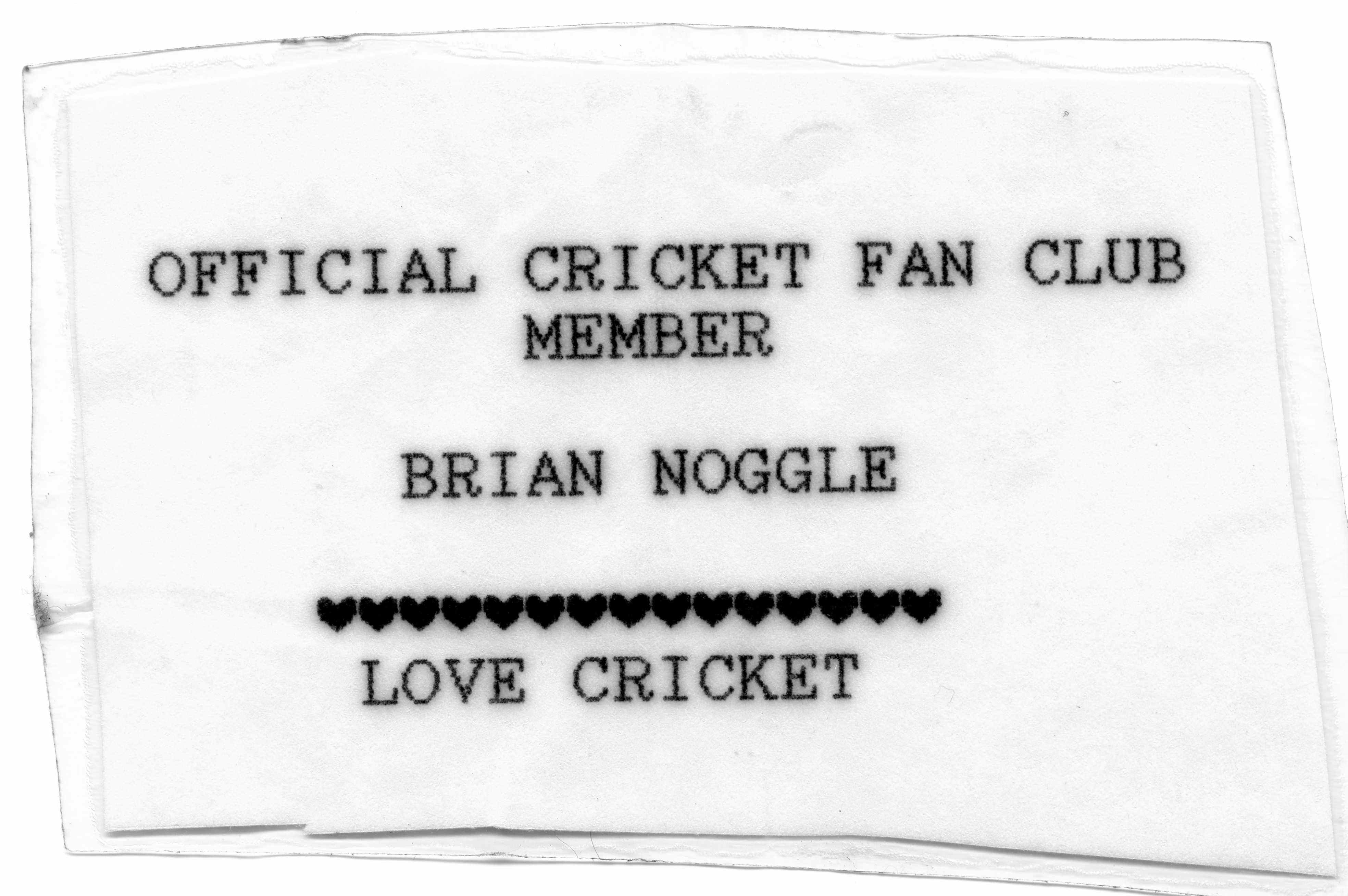
As a hare-brained money making scheme, I created the official fan club for that dog. For some princely annual sum, you would get a membership card printed on dot matrix, cut crookedly, and laminated with some sheets I bought at the flea market:

Cricket fan club membership

Wonder of wonder, I think I actually sold one of these to the kid across the street for a quarter. I even produced the first monthly Cricket fan club newsletter, but then it tailed off to some other projects.

This is where I add a snappy conclusion that leaves you with some bon mot to mull over. I don’t got one. All I have is a handful of cutesy dog pictures and a couple of memories to share. Make your own bon mot.

Buy My Books!
Buy John Donnelly's Gold Buy The Courtship of Barbara Holt Buy Coffee House Memories

Painted Days and Painted Nights

It’s Mardi Gras time here in St. Louis, which means Soulard is putting on its schizophrenic finery wherein it tries to celebrate in a family-friendly fashion the last minute drive to get in as much debauchery as possible before Lent and repentance came due. But that’s neither here nor there.

Fact of the matter is, I’ve worn face paint twice in my life, and neither time was for a sporting event. The first was, in fact, Mardi Gras 10 years ago. A couple of my friends and I decided to go down the Saturday before Fat Tuesday and take it all in. Familiar with the concept of the New Orleans Mardi Gras and its festivities, I said, “Hey, people paint their faces for Mardi Gras, right?”

“Sure,” my lifelong St. Louis resident friend said.

So I designed a concept for my motif: On one side, the happy drama mask, and on the other side, the unhappy drama mask. Done in black and white. We went to Johnny Brock’s and got some black and white facepaint so we could do the happy side in black on white and the unhappy side in white on black. Johnny Brock’s actually had colored hair spray, too, so I messed the hair up manically on the white side and patted it down flat on the black side. My friend and fellow displaced Wisconsinite Walter, an artist by self-definition, actually did the face painting (and signed his initials under my chin). Dressed in black and white completely and wearing a trenchcoat, my Mardi Gras garb was complete:

Drama masks; no, really, look closer

So my lifelong St. Louis resident friend put on purple mask, and off we went. Once we got to Soulard, I discovered the “Sure” had an asterisk on it. People paint their faces up for Mardi Gras.*

* In New Orleans and Brazil.

I was one of three people in face paint among the thousands thronging the streets and bars. People thought I was supposed to be The Crow, the Joker, or Ace Frehley. Only one young lady correctly identified it; she was a Webster University student and quite probably in the Theatre Department. Somewhere along the line, my lifelong St. Louis resident friend ditched his mask to better blend in with the “beads are the Mardi Gras costume” crowd.

But it was a good night. We drank liquor until the police chased us out of Soulard and ended up at the Venice Cafe, where a bunch of older (mid 40s) women hit on me and kissed on me to my chagrin. My lifelong St. Louis resident friend explained that, at the tender age of 25, I looked like a middle aged hottie. Needless to say, I haven’t spoken to that friend since before the turn of the century.

Wow, and I still wear that trenchcoat. Maybe it is time to get a new one.

As I mentioned, I’ve painted up twice in my life, and both were in that year: 1997. Perhaps one could read something psychoanalytical into that. But the second time, in the autumn, was at GenCon, the roleplaying game convention. My lifelong St. Louis resident friend from Mardi Gras, my best friend from college, and I drove up to Milwaukee to attend. Even though we all had jester costumes, something on the GenCon sales floor triggered my imagination; I think it was some press on fangs. Suddenly, I wanted to enter the costume contest. As the Weresmurf:

The Weresmurf

I bought some blue face paint and the aforementioned fangs, and my friend sacrificed a t shirt. I plunked down the entry fee and took my shot at fame. The contest featured a bit where you came on stage, and the MC introduced you. You could write your own intro and have the contest leader make special preparations for you. I asked them to lower the microphone and wrote out my introduction.

When my time came, the MC read my beautiful words: “When the moon ripens to fullness, something dark prowls Smurf villiage. It’s the Weresmurf?” Actually, I didn’t pen the rising inflection at the end, but the MC turned it into a question. With that, I leapt from behind the curtain, ran sniffing and hunched from one end of the stage to another, snarled at the MC, and ran up to the microphone, where I preceded to howl out the Smurf theme, finishing with a poignant “root rooooo!” I then leapt from the front of the stage, ignoring the stairs so carefully pointed out by the staff, and ran up the aisle snarling and sniffing until I was out of the spotlights.

At the time, I was a regular on the poetry open mike/slam circuit in St. Louis and had hopes I could get some kind of thing going where I’d give readings at colleges or whatnot (I’d seen the Nuyorican Poets Live that year, too, so it wasn’t out of left field–you know, like painting oneself blue for fun). But the largest crowd I ever performed in front of to that point–and let’s be honest, since–my only vocalization was a Smurf howl.

Adding salt to my pretentious wounds, the only national magazine exposure I’d gotten to that point (and, honestly, up until last month) was in the December 1997 issue of Inquest, which had a photo essay from GenCon:
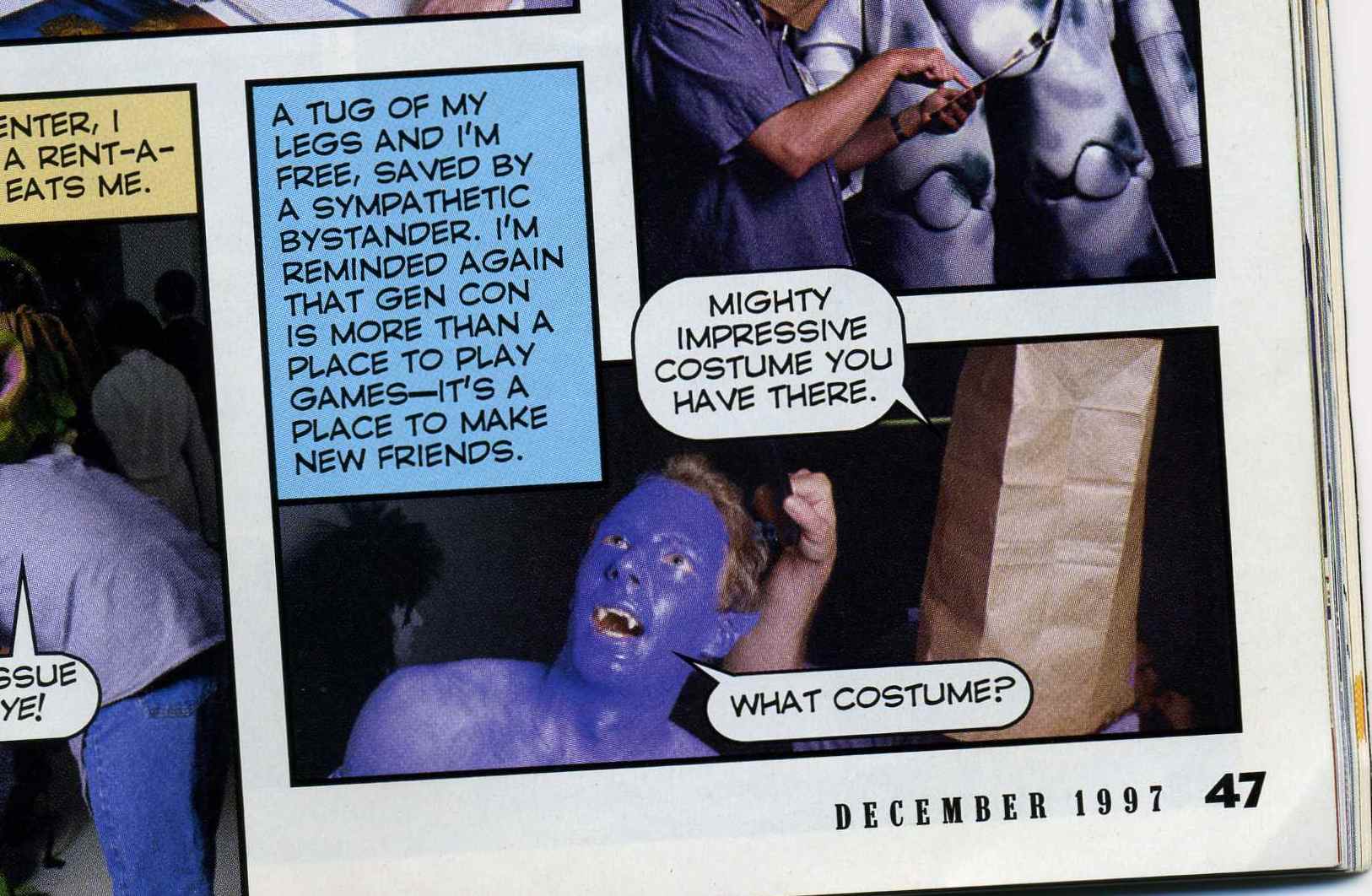
Brian J. Noggle in December 1997 Inquest Magazine

That’s right, it took me 10 years to get my name into a publication with a circulation rivaling that of my appearance in blue paint with a humorous dialogue balloon pointing at my mouth. But wow, blue paint really does bring out my blue eyes.

On the plus side, I did win my category, so I came home with a trophy dish and a pair of commemorative d6. Of course, the category was the equivalent of “everything else” and my only competition was a couple of teenaged girls who put bones in their hair and tried a sitcom skit about feuding vampire sisters. So perhaps my resounding victory isn’t a testament to my genius or proper sense of the absurd and only reflects that I wasn’t as bad as the kids.

But I got the trophy, and I got the Polaroid, and I got the two d6s. I’ve also got a scannerful of photographic memories of that brief moment in my youth where painting my face seemed like the right thing to do at the time. I don’t know that that time will ever come again, but I haven’t been to Lambeau Field, either.


Buy My Books!
Buy John Donnelly's Gold Buy The Courtship of Barbara Holt Buy Coffee House Memories

Margin For Error

The common assumption that you’re fairly safe if you’re worth more alive than dead to your peers and family overlooks a slight margin for error available in the equation. The incorrect equation:

Aw > Dw

that we think keeps us from being killed for our insurance benefits pits that value (Dead Worth, or Dw) against potential for future earnings and the future unrealized monetary value of the goods and services rendered as a friend or husband (Live Worth, or Lw) keeps us feeling pretty safe that we won’t get bumped off as long as we remain productive. However, this equation does not capture the slight margin of error represented by the transitional cost. Because we’re actually alive right now, a certain amount of fiscal impact would occur in the transition. That is, we need to add to the Aw a certain expense involved in the actual death, whether it’s $10,000 for a contract killing, a couple dollars for some poison, a couple cents for a bullet, or the trouble of changing the pillowcase after the smothering. Ergo,the correct formula should be:

Aw + CoK > Dw

That is, you can remain comfortably safe if your Dead Worth remains lower than your Alive Worth and the Cost of Killing you.

And that, my friends, is what passes for optimism some days in the mind of Noggle.

Buy My Books!
Buy John Donnelly's Gold Buy The Courtship of Barbara Holt Buy Coffee House Memories

Waiting For the Mail

Sometime in my younger days, when I was living with relatives in St. Charles, Missouri, I got it in my head that receiving mail was a grown up thing, and that it was prestigious to get something in the mailbox with my name on it. Particularly if it said “Mr. Brian Noggle” on it. My Uncle Jim got stuff all the time like that, and I hoped he was impressed when I did. Hey, I was twelve years old, and it was seemed like a good idea at the time.

I managed to mail away for some anti-abortion arm bands that Jerry Falwell was sending out, and once you’re on Jerry’s list, you can plan on being Jerry’s list for a long time. I also found a religious magazine, the Plain Truth, that mailed out free booklets on request, so I got a good helping of those sorts of things. For a while, I was reading quite a bit of religious material. Strange, when you look at my general lackadaisical religious attitude these days, that I was quite a conservative little guy, almost, at one time.

Well, through my various machinations and an abortive flirtation with subsidy publishers (I was going to send in my first volume of poetry by December 1984, I seem to recall–I was still twelve years old, but ambitious), I managed to get myself onto a number of mailing lists. Hopefully my uncle was impressed, but then I moved out of his house and my love of receiving mail followed me to Murphy, Missouri. I was still getting stuff from The Moral Majority, but eventually they realized I was broke and/or disinterested so their trickle ceased altogether. Somewhere along this time, I sent my first short story, “Cricket: A Dog’s Life” to McCall’s magazine, or maybe it was “A Walk in the Park” to Hitchcock’s, but the transition began.

Soon the only things coming in the mail were the usual money-bearing cards from relatives for holidays, but when I started to send my works into magazines, there started a new flow of –well, rejection slips for the most part, but with each article in the mail, there is always the hopes of publication, and those self-addressed stamped envelopes could be the bearer of wonderful news. The beauty of this, I suppose, is that the possibility of money from heaven (or at least the Postal Service) all year round, but then it is based on my ability and not the duty of relatives–and so far, the return has been so nil that I often question my ability. But, with each new piece and each new mailing, there is new hope, so I continue on.

There is a half hour to go until today’s delivery. What could it bring? Well, it is the end of the month, so at least there won’t be any bills–which, as a full adult, I have come to recognize as a majority of modern mailings. I even look forward to bills, probably for some deep philosophical reason that they affirm my objective existence or something. I could, in theory, get an acceptance letter from a magazine–I currently have several submissions on the wing, er, on the postman’s back. More likely than not I shall receive at least four rejection slips, which would be fine, too. I only have a rejection slip from one of the five magazines, and the other four would be wonderful additions to my rejection slip collection.

I could, in theory, get a letter from one of my friends or my brother in Hawaii, but I just visited Missouri in June of 1993, and so no one would be writing me this soon. The possibility exists, though, and anticipation is tickling my stomach.

I could also get some little catalogue of something strange and wonderful- -such as the Firebird Arts and Music Catalog that I get every season even though I have not actually purchased anything from them in five years or one of the computer catalogues that have discovered me. Probably, though, if I get anything, it will be a notification of the urgency of a sweepstakes entry or the application for an American Express card–if there is one constant through life, it is junk mail. It has lost its relevance in my life, but it keeps on coming.

But, I must say, it makes me feel like a grown up, and an objectively existent one at that.

Buy My Books!
Buy John Donnelly's Gold Buy The Courtship of Barbara Holt Buy Coffee House Memories

Name That Muzak

Heart, “Alone”, Bad Animals, uh, Capitol Records, 1987. No, I don’t think years of working in the retail industry has changed me at all. I mean, I have come up with maybe a few, A-ha, “The Sun Always Shines on TV”, Hunting High and Low, 1984, Warner Brothers, character tics.

Like playing Name That Muzak. I realize it might not be the sanest thing in the world, but I like it anyway. To relieve those long hours of tedious, repetitive hours of labor on a sales floor (unless, of course, my bosses are reading in which it was challenging and intellectually satisfying, of course), a couple of associates and myself might have taken to playing guess the song that’s piped in to the store.

Our store doesn’t have the variety with, “Passionate Kisses”, Mary Chapin Carpenter, lyrics, so it always poses just that little bit of mental work that gets us through the day. There’s nothing like hearing some strange thing done on a piccolo and determining it to be, “These Eyes”, The Guess Who, it’s on These Eyes, a re-release I own, a song you know. It impresses your friends anyhow.

The rules are simple. Just take, Denise Williams, “Let’s Hear it for the Boy”, Footloose soundtrack, the next song that comes onto the Muzak wherever you have to suffer through Muzak. It’s always better if there’s someone with you so that you don’t go babbling off titles to yourself in a crowd of strangers, though. Try and place the melody and name it.

The points are scored for naming the song, the artist, an, “Three Time Loser”, Dan Seal, album the song appears on, the year it was released, the record label, and any covers of the song since then. Points are also given on how well you lie if you don’t know any of the answers, but can quickly spiel off an answer that might really be it. Easy tips for this are to pick the song title or the artist’s name as the album title, and hitting one of the big players for the label. That way, “Life in the Fast Lane”, the Eagles, Hotel California, 1976, Asylum, you can get points and not even need to be right. A knowledge of music helps, but is not essential.

No points are scored during the Christmas season, however, because there are only so many Christmas songs to go around. Points can be scored, too, if you can name the artist that is doing the Muzakal rendition, but if I come across anyone that does, I won’t play. I can’t stand losing to people who are either that big into Muzak or who can lie that much better than me.

Contrary to popular belief, “You Belong to the City”, Glenn Frey, Miami Vice Soundtrack, this innocent pastime does not become a compulsion, and you will not find yourself blurting out random titles and singers in restaurants, elevators, malls, or other public places. Even if, “Don’t Fear the Reaper”, Blue Oyster Cult, it does, they can’t put you away for it.

Buy My Books!
Buy John Donnelly's Gold Buy The Courtship of Barbara Holt Buy Coffee House Memories

Home Depot Tries Jedi Mind Tricks On Its Customers

I caught the headline of the pad of entry forms as I stood in line to buy nine volt batteries, and I didn’t think it was legal, but closer examination told me that the Home Depot had it covered:

Home Depot Spend $100 and Enter Form

Spend $100 and Enter, No Purchase Necessary

Maybe that’s more Subliminal Man from Saturday Night Live. I don’t know. I do know, though, that Home Depot was hoping to push those $95 spenders into buying an additional hardback book or bunch of candy to make up for it. I feel bad for those taken in by it, particularly on the day I was in the Home Depot and saw the forms. February 4. Over a week after the contest ended.

Buy My Books!
Buy John Donnelly's Gold Buy The Courtship of Barbara Holt Buy Coffee House Memories

Morale Spy

Covertly Uncovering a Company’s Employee Morale During the Job Interview

When you go on a job interview, common advice reminds, you interview the company as much it interviews you. Remember, just as you might exaggerate that you have ten years’ experience developing .NET on Linux, the company might embellish its resemblance to a happy television family. Whether the company represents the Cosbys or the Bundys, participants in your four-hour interrogation will concur that the company represents the Panglossian best possible workplace. Managers want to fluff the company’s stock price. The proletariat wants more proletariat to share its burden. If the company demands twelve hour days or offers daily browbeatings, no one will tell an outsider. You would only learn true company morale after you started unless you conducted a little reconnaissance during your interview.

To gauge employees’ true attitudes toward a company and its working environment, you can reconnoiter two locations in the building: the kitchen and the bathroom. In most cases, no professional employee bears the task of cleaning these locations during working hour. Contrast these areas with conference rooms, such as the one wherein the company will grill you, which the company keeps fastidiously clean and presentable for interviewees, roving executives, and venture capitalists. The regular grunts in the trenches don’t spend that much time lounging in conference rooms. On the other hand, many non-executive employees use the kitchenette and the bathroom, and you can glimpse their corporate pride and morale in these utilitarian locations.

During your interview, ask for a tour wherein you can see the kitchen, or at least the coffeemaker alcove. If the company doesn’t offer a coffeemaker for employees, politely but quickly end the interview and flee. When the interviewer breezes you through the kitchen, pay attention to the counter around the coffeepot and the sink. Dirty dishes on the counter can indicate bad news. Coffee stains might indicate that the poor souls working for the company are too overworked to wipe up after themselves. The company has too few resources for what it does, and you better not have personal plans on Saturdays. Untended spills might also indicate that the employees here delegate cleaning to, or worse yet assume it will be done by, underlings or the new guy.

A clean kitchen indicates that the other employees handle their spills and mistakes. Or they want to make a good first impression on the employees who might wander in after them. Such ambition and drive is good. Or maybe they’re just decent, clean people. Regardless, a clean countertop bodes well.

You can apply the same observation to a bathroom used exclusively or predominately by employees. If the company has its own campus or building, look for a bathroom behind the receptionist’s desk to provide the best intelligence. Ideally, you could review such a facility before your official interview begins, but don’t be afraid to ask the HR person to whom you hand your official application about the nearest bathroom before he or she hands you off to the real interviewer.

While you’re straightening your tie or fixing your makeup, check for paper towels on the floor. They can indicate that employees have creases a little too tight in their pants to bend over and pick up what they drop. You can also examine the counters for excessive water/soap residue. If the employees don’t wipe up after themselves, who will? Look for graffiti on the stall walls, urine on the toilet seats or, worse, vice versa. If the employees show less concern for their workplace than for a tavern, they’ll probably show you the same tenderness they show a beer-scented conversationalist in that same tavern.

Regardless of the company line during the interview, nothing describes the other employees’ care and attention to detail, as well as their overall job satisfaction and pride, as how they treat those corporate spaces for which they have no direct responsibility but in which they can, and often will, make individual messes. Your surreptitious health inspections represent a quick and dirty way to find out how quick and dirty the company operates. The snap judgments you make are no less valid than the snap judgments that the company will make about you based upon the color of your slacks and the length of your hair.

Buy My Books!
Buy John Donnelly's Gold Buy The Courtship of Barbara Holt Buy Coffee House Memories

The Gift Schtick

Around gift-giving holidays and birthdays, a certain stress accumulates like northern plains snow, centered upon what others will think of our individual capacity to proffer the pretense of caring for people to whom we do not speak for the majority of the year. Did we send our high school guidance counselor a Christmas card this year? She surely sent one to us last year, proving she’s not yet dead. Did we get Janey’s son Bobby something suitably expensive for his birthday, more than we would spend on a real nephew, but not so much to indenture Janey for our birthday?

Internally, we process the possibilities like Christmas calculus and crunch the metrics of what we know about the gift recipient. We dredge memories for shared moments, hobbies, or insights into that person’s soul and spirit. We surf the intrapersonalnet, seeking the faintest rumors of needed household goods. When all else fails, we know that gift certificates offer the remote-controlled reminder of our relationship, but recognize that a gift certificate really emphasizes the obligation and not the emotion of gift giving. Gift certificates say, “We know we should get you something, but we don’t know you well enough to know what you want.”

Fortunately, amid the crush and bustle of the Christmas shopping season or the interspersion of gift-giving into our regular lives, we can honestly rely upon the honored tradition of the Gift Shtick to provide a default value for the drop-down lists of gift-giving.

The Gift Shtick represents a certain convenient gifting theme for a person that makes gift giving easy and gift reception safe. A person’s Gift Shtick offers a single collectible motif, a single hobby, decorative fetish, or offhand comment, that friends, family, and acquaintances can seize upon with infrequent fervor to provide semiannual gifts. A good Gift Shtick offers almost infinite variation, providing the potential for almost thoughtless thoughtfulness.

The Gift Shtick can be sports memorabilia. For my wife, my relatives and I have found safe haven in buying St. Louis Blues apparel or paraphernalia. Although her interest in hockey is beginning to wane, and although she can almost dress in Blues jerseys and sweatshirts every day of the week, she can look forward to more of the same. For anyone in the state of Wisconsin, Green Bay Packers dinner china makes a handsome and thoughtful gift.

My friend Brian likes Elvis Presley, a Gift Shtick you can easily satisfy. You can walk into any mall in America and find something Elvish. Whether I find a wall hanging, poster, or CD of Elvis’s first conversations recorded when he was three, I can give him something that says, “Dude, I didn’t think you had this important piece of trivial tangential material in your collection.”

I have an aunt who has a goose motif in her kitchen. I wouldn’t know; I’ve never been in her kitchen to know whether she has adequate goose salt and pepper shaker sets to serve a dozen diners, all eating from goose china. My mother, bless her, provides twin bird shticks: she decorates her living room with bald eagles and her kitchen with owls. The eagle shtick has been so successful in the past years that I am going to buy her a new wall for Christmas just so she can display them all.

I let my family and friends down because I don’t provide an easy Gift Shtick for them to employ. Each gift holiday, they must ask me what I want, and I am often at a loss. I rattle off a list of accoutrements that I don’t need or a whim that I can conjure instantly. Instead, I need to create a theme for my home office décor or take up a particular hobby that comes with a lot of optional paraphernalia. That way, when it comes to paper-tearing time, I can be assured a surprise, albeit a safe surprise well within a set of established parameters and limits.

It’s better to give than receive, everyone says, but it’s certainly not easier. Anyone who’s spent the last minute buying gifts from the end caps at Target knows the flutter of fear, of panic, and of an imminent gift certificate purchase. Whereas the Gift Shtick might not help the giver avoid a reluctant “Thenk yew” when the recipient opens the umpteenth throw blanket depicting a Bengal tiger, giving according to established or imagined predilections and peer pressure will allow you to escape the holidays with your sanity, and maybe even your inheritance, intact.

Buy My Books!
Buy John Donnelly's Gold Buy The Courtship of Barbara Holt Buy Coffee House Memories

The Sweepstakes Bodhisattva Speaks

I won’t start off by telling you that I’ve never won anything; no, I’ve had my small share of victories in various minor games of chance. In my youth, I won a couple of “Guess How Many x Are In The Jar” things for a number of trinkets and toylets. In my adulthood, I’ve won enough free tickets in state lotteries to merely lament wasting $999s of dollars instead of thousands of dollars. I even win a gift every year in the company’s gift swap. But I’ve never made the big score: the television, the car, the big decorative check.

I’ve completed sweepstakes forms. I’ve listened to the advice of innumerable bottle caps and have tried again. Five years later, I still visit iWon.com for my daily chances to win. I continue spending a latte’s worth of my salary every week on my futile bid for state-sponsored number-running millions. My current strategy relies upon repetition of normal behavior: I go to the same Web site, I go to the same courtesy counter every week and buy the same set of numbers (the random ones), or I fill out the enclosed form and mail it off. So I’ve decided to alter my methodology.

With a flash of neo-Buddhist insight, I realized that my sweepstakes and contest entries have all sought to win prizes that I actually want for my own personal gratification. Money, new home theaters, and new cars would enrich my personal life. I would use their fruits in my daily pursuit of physical and materialist ease and pleasure. As such, of course Fortune does not favor me with these presents. Instead, I need to seek those prizes which I could neither use nor enjoy; only then could I grow spiritually through the gifts of random chance.

For example, I don’t travel much; I’m a little edgy leaving the warmth and comfort of the Midwest. For me, a good vacation is a long weekend in Springfield, Missouri, or Milwaukee, Wisconsin—familiar cities where I have relatives and where I know the coffee shops in which to read. So when Clausthaler offered me the chance to win a trip to a golf resort, I filled out my vitals and spent a stamp to send off the entry. A trip thousands of miles to play a sport I’ve only tried once, badly, in my youth. Certainly, the Fates can frown on me with this grand prize.

To keep with the reluctant traveler motif, I’ve recently entered a sweepstakes for an African Safari, which includes hunting on the savannah. I’ve not been hunting since my youth, when I spent several scattered days in cold marshes at dawn to bond with my father. I’ve never actually hunted by carrying a gun. I don’t have a passport, my immunizations are not up to date, and I’m not eager to leave the country for the continent that inspired Heart of Darkness and Anaconda. The prize would actually inconvenience me. No doubt Nike—the goddess and not the company—is signing the appropriate forms on Olympus even now.

Aside from those big, and travelsome, prizes, I’ve started looking closer to home for smaller scores. When local restaurants offer fishbowls in which customers can drop their business cards for the chance at a free meal, I only drop my business card in if it comes with strings attached, such as an hour’s consultation with a financial consultant whose first lesson is There is no such thing as a free lunch. Certainly, I have a shot at that grand prize.

I’ll continue entering sweepstakes, including the Publishers’ Clearinghouse and Readers’ Digest contests. By not purchasing, I’m not hurting my chances to win, but I’m really hoping that by not wanting, I’ll bolster my chances. Ergo, when given the choice between the sports car and the minivan, I’m licking the minivan stamp every time. Someday in the future, should you find me tooling around in a Dodge Caravan, know that I am not only a winner, but I am learning a lesson in self-deprecation.

Buy My Books!
Buy John Donnelly's Gold Buy The Courtship of Barbara Holt Buy Coffee House Memories

Savor the Experience: Tips on Making Simple Household Projects Last All Day

Like many men, I try to demonstrate power tool prowess from time to time. The “to” interval represents something like a quarter, so each “time” follows the preceding “time” by about three months. I’ve derived many of the following tips the hard way; that is, I have learned much of what I know from the thin prose and disconnected photographs in tool pornography magazines such as Handy and The Family Handyman. I haven’t actually completed many useful household projects, since I get my satisfaction from flipping through the magazines and dreaming. I am the son and grandson of remodeling contractors whose talents have apparently skipped a generation, but I have, up to four times annually, applied myself and my vast knowledge to improving my household. Ergo, I proffer advice appropriately to help you, too, turn a simple household project into an all-day affair.

Perhaps you’ve decided to put up surround-sound speakers for your home entertainment system. You just need to add a stereo outlet behind your entertainment center and run stereo wire through the walls to outlets for the rear speakers behind your sofa. It sounds fairly simple. Cut a couple holes in the paneling, run some wire between them. You could do it in an hour, right? Follow these tips, and your simple project will change into a life-transforming, all-day event.

  1. Always take shortcuts which don’t, in fact, save time.
    Some people, such as those who excelled in shop class in middle school, might tell you to begin your work by measuring, diagramming, or at least thinking ahead about what you’re going to do to your den before you start. Balderdash! Planning wastes valuable time that you could better spend admiring your handy work and accepting the accolades of your family and friends. You’ve probably procrastinated this particular chore long enough for it to work its way into an Andy Rooney parable. Haste prevents wasted time, and once more make a breach, dear friends, once more.

    Besides, you only need a couple of holes and some speaker wire.

  2. Don’t worry about having the right tools; use whatever you have at hand.
    Civilization developed from Neanderthals who bound rocks to sticks as tools. Millennia later, we have screwdrivers and hammers. Either has innumerable uses, and combined they represent all possible combinations of tools. If you’re going to add a sunroom to your home, you only need a hammer, a screwdriver, and maybe a pocket knife. You waste money when you buy custom tools that you’ll only use once. You’ll then store them forever, or at least until a visitor to your estate sale tries to convince your disinterested heirs that your heirlooms aren’t worth two dollars each.

    You can drill through the paneling in your den like a manic mosquito with a ½ inch with 3/8 inch reduced shank proboscis until you’ve got big enough bits to pass the wire through. You can fish in the hole with a bent coat hanger or a string to pull the cable. You’re set. Drill! Drill!

    Except your drill holes don’t give you much room; you can’t fit a finger in to feel for a coat hanger or a string. Since you will cover the speaker outlet with a faceplate, you could cut a bigger hole. You need a special saw to cut into the wall. What do they call that again? Oh, yeah, a drywall saw.

  3. Make many trips to the hardware store.
    Sometimes, I hate to admit, the trifecta of fom toolery listed above won’t serve your needs. If you’ve followed tip number 1, you’ll discover this when you have removed a number of panels and have disconnected power to the entire house (just in case). You’ll need an Allen wrench, one of the more exotic drivers, or a special tool for cutting wallboard or sheet metal—oddly enough, no tool cuts both well, not even that Swiss machinist knife you just sharpened.

    You’ll need to trek to your local hardware store or home improvement supercenter. Personally, I find nothing compares to the self-assured manliness I enjoy in the hardware store when I know exactly what I need to perform a specific task. The experience puts me in touch with my ancestors and bonds me as an equal to burly men who even today have to work for a living by doing useful things.

    Remember, both the cavernous superstore and the local, struggling family hardware store offer a particular time-wasting strength. The cavernous superstore makes the search for a particular grommet exceedingly difficult as you forage through acres of eight-foot high shelving for a couple dollars’ worth of plastic and metal. Even if you ask for help, the second-year high-school sophomore will need a manager, who has already committed to help another customer unlucky enough to find a teenage wonder-aboutkund.

    If the family hardware store remains open for business when faced with the competition of the national super lumberyard-and-hot-dog-stand, it has only a sixty percent chance of stocking your grommet. Fortunately, though, a drywall saw is a fairly common grommet, so the family hardware store probably has one. Just one, though, so hurry before another reader gets there to buy it.

    Whichever you choose, you face at least a half hour in your car and in the checkout line. When you get home, after you have carefully unwrapped the product from its box or blister wrap and have studiously ignored and lost the instructions, you will discover its power source requires charging or inconveniently-sized batteries.

  4. Innovate, adapt, or just try something different.
    A true handyman is handy, and can adapt and jerry rig to obtain the desired result. Some might say that this displays a great degree of synthetic thought, where one applies experience and inductive reasoning together, but anyone who uses terms like “synthetic thought” and “inductive reasoning” probably hires a professional for his or her home upgrades.

    In our project, we might discover that our new drywall saw doesn’t pierce wood paneling. You’re supposed to punch it against drywall and saw, but the tip bends on paneling. Still, you’ve got the drill; you can easily drill a large hole in each corner of the square you want to cut and connect the dots with the saw. However, trying this leads to a time-consuming process which yields a jagged, unpredictable cut. A jigsaw would speed the process, but that would require another trip to the hardware store and further expenditure.

    On the other hand, you still have the hammer and screwdriver in reserve. Perhaps you don’t need the jigsaw. You can adapt your technique to the tools at hand. You can use the screwdriver to pry the paneling from the wall and run the wire that way. Like Hannibal Smith and MacGyver rolled into one, you love it when an innovation comes together.

  5. Throw at least one, preferably more, tantrum that sets you back.
    It’s not uncommon to feel a little twinge of frustration after hours of futility in performing a simple task that you know a professional could accomplish in twenty minutes while intoxicated. Carefully devised shortcuts have failed. Innovations prove as troublesome as replaced, obsolete methodologies. Also, it doesn’t help that you’ve opened a gash in your finger that bleeds enough to make you want to save the blood in a can in case the hospital needs to put it back.

    You’ve bent screwdrivers because you didn’t have a crowbar handy. You’ve gone back to the hardware store to purchase your brand new crowbar. When you pry with your new, label-yet-affixed crowbar, the wood panel doesn’t appreciate your deft, gentle, and soothing touch and splits. We, and by “we” I mean “at least I did, and I hope I am not alone,” might feel a little rage. Not murderous, but a pure rage worthy of expression.

    Curse and tug with a final, gamma ray burst of strength. Revel in your own destructive capability as the paneling not only splits, but pulls free from the wall, tearing out the light switch faceplate, the light switch, and the telephone jack. The picture you didn’t remove (to save time, of course), crashes to the floor and sprays glass nuggets onto the carpet and into the chair in which you’d expected to nap. The thrill of proving your point instantaneously transforms into remorse; the speed of the transition creates a thunderclap, or perhaps that’s just further cursing. Also, don’t touch that sparking wire.

  6. Do what the professionals do.
    At this point in my projects, when my cursing reaches other rooms and sweat obscures the tunnel of my vision, my wife appears to ask if there’s anything she can do, or perhaps to see what she can save. As she’s seen me in this state before, she knows what to ask. “What would a professional do?”

    “Quit and get a retail job,” you might want to respond, as I often do, but the question has its merit. Take a step back from your current situation, reflect upon what you’re trying to do, and assess it coldly in the terms of dollars and sense. Imagine you were a kid fresh out of high school, a pierced-and-tattooed fellow with no military or college prospects who got a job and has to get up at six in the morning no matter how late the concert ended last night. Now imagine how his foreman would look at the situation.

    A professional would only do as much work as needed to achieve the result required. To place surround sound speakers, the professional would understand that opening the walls would run the cost of the project up intolerably. He would simply staple the wires along the baseboard or crown molding and in the room’s corners to the speakers. Incidentally, a professional already owns the staple gun and would not have to make another trip to the Ace Hardware.

    A professional moves confidently, partly because he’s done this at least once before. He won’t move with the heightened timidity from which we suffer, the gingerliness that leads to the sudden explosion of frustration. No, the professional is one cool customer. His calmness stems from the certainty that if he errs, he can fix the error, or at least cover it up cheaply. He can patch the unnecessary holes and somehow disguise the splintered break in the paneling, no problem. Smug bastard.

With that final insight, and with thirty minutes of draping wire like Christmas garland, you have successfully, relatively, completed a project for which you no longer feel any pride. Night has fallen, and clean-up operations remain, which include rearranging the room to mask any extra holes in the walls.

You have learned a valuable lesson from the experience, though. If you’re like me, you’ll remember how inadept you are at this sort of thing for at least two months. Fortunately, this schedule will minimize the damage you can do to your home and the number of times you must call contractors for catastrophic repairs. It certainly helps me.

Buy My Books!
Buy John Donnelly's Gold Buy The Courtship of Barbara Holt Buy Coffee House Memories