What’s missing from this Google image?

Right. A leg of lamb.
To be able to say "Noggle," you first must be able to say "Nah."
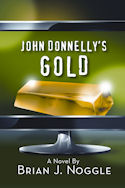
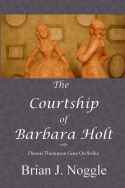
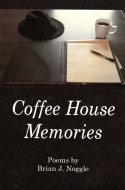
Buy My Books!
Rocket Jones leads me to contemplate:
What will today’s youth tell tomorrow’s youth in When I Was Your Ageisms?
My first shot:
When I was your age, radio came over radio waves.
Ah, I got nothing.
Buy My Books!
Well, it was okay book hunting. We hit some yard sales over in Kirkwood, where books were overpriced and lawns were cluttered with fascist lawn signs “No More Tear Downs” and “Preserve Our National Historic District” and “Taller than downtown” signs protesting an old folks home (that is, all your property rights belong to the communitariat, comrade).
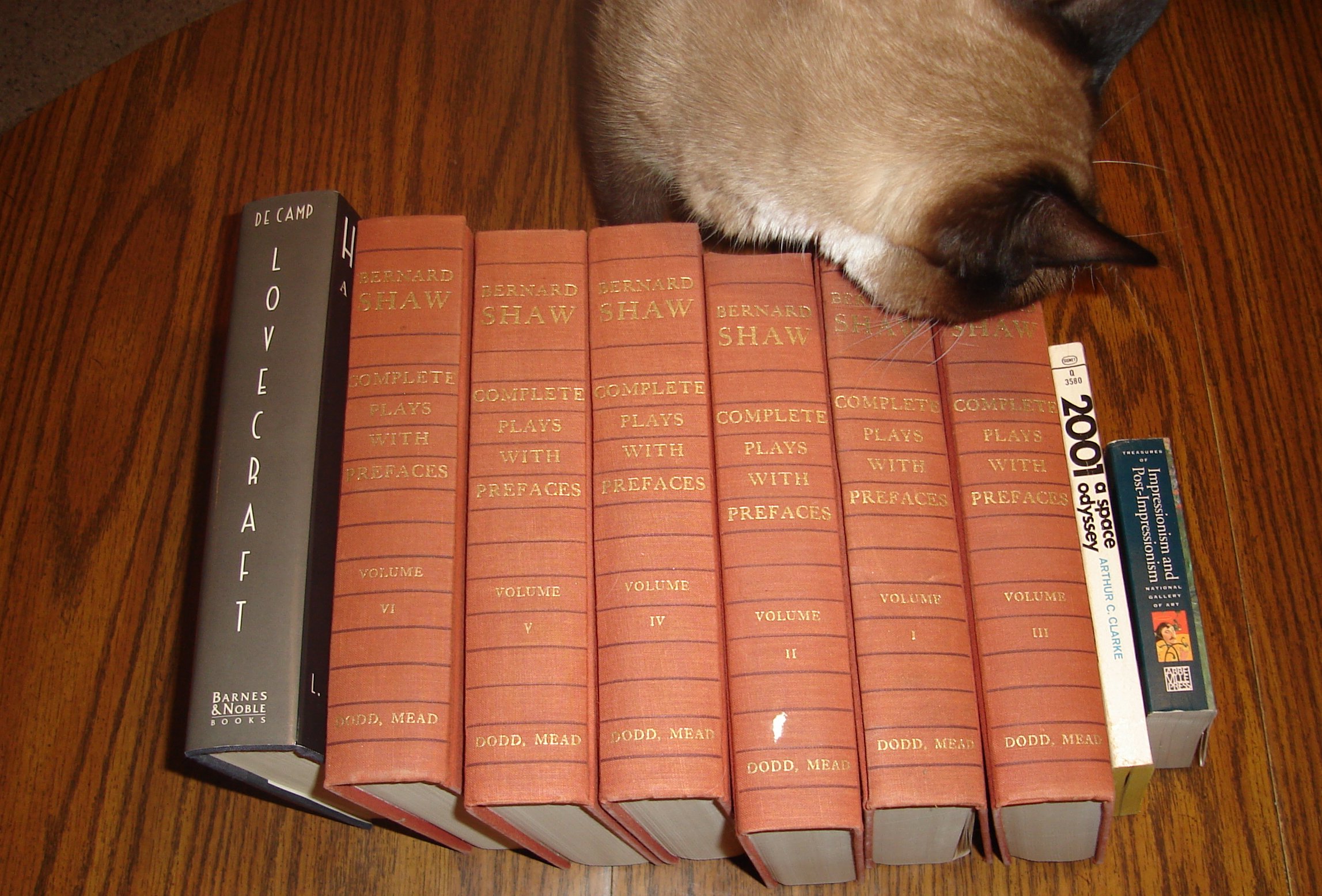
In a smaller, less historic neighborhood that housed those other people (the lower classes), where construction occurred without protest, I bought a six volume set of the complete works of George Bernard Shaw for $3 and a copy of 2001: A Space Odyssey for $.25 (as previously noted). At another yard sale holding a freshly minted English degree (selections included anthologies, paperback copies of classics, and Marxist theory textbooks), I bought the Barnes and Noble edition of a Lovecraft biography and a little book of impressionist and post-impressionist paintings. The capitalist pig wanted $2.50, but I offered the ultimatum of $2.00, higher than I would have normally paid but I know she’s got a hard life ahead of her with that sort of degree.
So here’s the results, $5.25 later:
I don’t expect we’ll race back to Kirkwood anytime soon for the pickings. Apparently, the communitariat is too busy protesting its neighbors to read anything worth reading.
Buy My Books!
Like the other MacLean books I’ve read this year (Puppet on a Chain and Santorini), this book represents more “modern” MacLean (that is, up to date when he wrote them; in this case, the late 1970s). Unfortunately, like the other modern books, this one is a little thin relative to the action in, say, The Guns of Navarrone or Where Eagles Dare.
This book details two MacLeanesque heroes who help out a rogue oil billionaire whose revolutionary oil platform, parked in the Gulf of Mexico, is under threat from a bad man employed by the traditional oil cartel. Weapons are fired. However, there really aren’t any plot twists to keep it going. It reads like a television or movie script.
Still, a bad MacLean book is average suspense, so it’s not as though it’s a bad book; it’s just not the best in the MacLean oeuvre.
Buy My Books!
I bought this book this weekend for a quarter, a super bargain since it’s a two-fer: It’s the first printing of the Signet movie tie-in edition (with the book review from the New Yorker cut out and tucked in as a bookmark), and I bought the next two books in the series last weekend, so I needed to get this book, too. I guess there’s a fourth in the series, but I might hold off buying that that until I see how the first three go. After all, he did ruin the Rama series.
The book, written in conjunction sort of with the screenplay for the Kubrick film, fills in a lot of the gaps of just what the heck was going on. It adds plenty of detail to the monkeys scene and to the ending to make sense of what only served as stunning images in the movie.
The plot revolves around the appearance of the monoliths, strange stones that man has found which have an age of 3 million years. When one is found near a moon base, it blasts a radio signal to Saturn (Jupiter in the movie). A ship is sent to it, and Hal the computer kills everyone on board. Even that is explained better in the book. And it’s all tied together.
I’ve seen the movie once and I saw 2010 a couple of times when it was on Showtime and I was stuck in rural Missouri in the 1980s, so I’ll be a little familiar with the continuing storyline.
Although I don’t know how much I’ll appreciate Clarke and his reputation after I am done. I mean, Childhood’s End was okay, this book was okay, Rendezvous with Rama was great until Clarke ruined it in the 1980s with its sequels. But that this fellow is held up with Asimov, Heinlein, and Niven as one of the greats in the field. Meh.
Buy My Books!
This year, I’ve read pulp novels from the Killmaster, the Enforcer, and Matt Helm series, so why not try one from the granddaddy, Don Pendleton’s The Executioner? It has the most books published about a single character, some 200 or 300 of them. So I found one at a book fair, cheap, and checked it out.
The other two series offered more depth. Sugar’s “The Enforcer” has weird sci-fi elements and Objectivist speeches; the Killmaster gets the chicks; and Matt Helm channels Dean Martin, whether intentionally or not. The Executioner just runs around and kills Mafia.
In this book, he goes to Philadelphia to take out a branch of the Family. He blows up a compound that used to be a bordello and then works his way into the home of the don. He kills a “specialist” that’s come to take care of the problem and then sets elements of the mob against each other while having a hand in, I dunno, 60 deaths? 70?
On a side note, The Executioner (one of the main inspirations for Marvel Comic’s The Punisher, by the way) was a Vietnam veteran. Many characters from the pulp of the era and television of the next decade involved Vietnam veteran characters who were not suicidal nutbars or whatnot; instead, they were tough, efficient crime fighters of one sort or another. Where are the veterans as honorable crimefighters these days in popular culture?
This book reads like a television script (and the book says they’re a major motion picture series coming!) with about that much depth of character (I know, it’s pulp, but this guy isn’t much more than a name holding various guns). I guess that’s what you get with a series written by dozens, but this is only #15, when Don Pendleton himself was writing them.
Of all the series I’ve sampled this year, this is the least likely for a return visit; that’s not to say that it’s bad pulp, but it’s the worst of the pulp I’ve read this year.
Buy My Books!
Now that Business 2.0 is going belly up (no word if they’ll transfer our subscription to Fortune or Sports Illustrated or will just forget about us), I’m tied with Charles Hill for number of magazines to which we have subscribed that have ceased publication this year.
One would think that magazines will purge us from their mailing lists for subscription come-ons designed to look like overdue invoices since we’re obviously a kiss of death.
Or perhaps one, me, would hope.
Buy My Books!
Green Bay Packers tied for first place in the NFC North!
Buy My Books!
This book rounds out the Brighton Beach trilogy, and although it’s been decades since I read Brighton Beach Memoirs, I read Biloxi Blues just this May. Ergo, I am sort of up on the characters and storyline. Bottom line? This play was probably the weakest of the bunch and only made its way onto stage and onto the television screen because Neil Simon was all that. As a stand alone drama, it’s a little lacking. You have to be invested in the characters already from the previous works to really care, and the piece doesn’t offer an overarching goal/conflict that needs to be resolved; instead, you’ve got a subplot in the chance Stan and Eugene have to make it as comedy writers, a subplot about the grandmother offstage moving to Florida, and a subplot about the breakdown of the Jerome parents’ marriage. Even lumped together, it doesn’t stick.
On a side note, I find that the actor who played Eugene Jerome in the movie Brighton Beach Memoirs, Jonathan Silverman, reprised the role for the Broadway debut of the play; however, in the made-for-television treatment (as opposed to the other two plays’ movie treatment), Silverman plays Stan Jerome, the older brother. He’s lost the part of Eugene to Corey Parker, who played Epstein in the film Biloxi Blues; as you know, Matthew Broderick played Eugene Jerome in both the Broadway and film versions of Biloxi Blues. Both Silverman and Broderick played Eugene Jerome on Broadway in Brighton Beach Memoirs; so when you’re watching the movies in order, you get some cast switching in odd ways. Kind of like when Lee Van Cleef was two different characters in For a Few Dollars More and The Good, The Bad, and The Ugly.
So it’s good to read the play if you need to close out the trilogy, but if it’s your only insight into the Jerome mythos, you might want to pass.
Buy My Books!
Ogden Nash didn’t take poetry too seriously; the verses are light things with rhymes and runon lines used to comedic effect. I don’t know what else to say about it; they were fun to read aloud and amusing, which is what Nash was no doubt going for. He tortures spellings to get rhymes and tacks on couplets with the punchline to long enumerations, but I liked them well enough to read more.
Which is a good thing, since I bought four volumes at once.
Buy My Books!
I saw this play staged in 1993 or 1994 in Milwaukee at the Milwaukee Rep or one of the subsidiary theatre groups that shares the space down on Wells; at the time, I thought it was the best drama I’d ever seen on stage. I still do, but unfortunately I’m not going to the theatre as much as I did when I was a poor college student making $6.60 an hour and paying tuition. I don’t know how that happened. So my experience hasn’t gotten much broader since the middle 1990s.
This book tells the story of a successful artist, Jonathan Waxman, who visits the home of his collegiate flame in England on the eve before the opening of his first European show. There, he finds a painting from his student period that captures something of his innocence before he became famous and rich and a self-made producer of commodity art. Or maybe it’s his meeting Patty again, a woman whom he dumped unceremoniously because she was not Jewish and who’s now married to an English archeologist whom she does not love.
The play is told in a series of scenes told non-chronologically and in as varied of places as the English house where Patty and her husband live; Jonathan’s boyhood home; the college where they went to school; and the opening itself. When the Milwaukee Rep staged it, I didn’t get the correct sense of the scenes between Jonathan and his German interviewer were at the opening, so I lost a bit from it.
But I got a bit out of reading it that I wouldn’t have if I hadn’t seen it first; perhaps that’s the way to do these plays, unlike movies. Watch them live first and read the book after to see what you’ve missed.
At any rate, I liked the play and I liked the book.
Buy My Books!
This book is a chapbook; that is, a small collection of poetry published probably at Kinko’s and often sold for a nominal fee. Back in 1994 and 1995, I did a couple of my own, although I forked out for the double-sided printing and the saddle stapling instead of the single-sided tape bound print job evidenced in this book.
Not too long after this book’s publication, I met Pam on the open mike circuit in St. Louis, so this represents I suppose the first time I bought a used book from someone I know and reviewed it herein. Ergo, I am going to offer a sunnier, more encouraging review than I’d give to someone I never knew. Be forewarned.
Puleo has a good sense of rhythm and sense for how words sound; I could read these aloud without stumbling or trying to determine the cadence in stride. She’s also fair enough with her eye for imagery.
However, this book shows her as an underachiever. She relies on too much repetition that provides little effect and enjambs a lot of lines that could have been better served with line breaks and punctuation.
She’s somewhere above Rod McKuen. Maybe tied with Sylvia Plath.
As a bonus, here’s a book review I wrote about her in 1995:
Bonus Book Report: St. Louis Jazz by Pam Puleo (1995)
This review first appeared in the Fall 1995 edition of the St. Louis Artesian, a free little pickup literary magazine I published 1994-1996. Puleo gave me a copy of the book, so I reviewed it because, frankly, the hardest part of putting out the magazine was coming up with enough literary stuff to fill it.
Pam Puleo titled her new chapbook St. Louis Jazz, and the title fits her style. Puleo’s well-developed voice binds her poetry like a slender thread woven throughout her works. The voice of wisdom, of been-there, done-that, somehow blends into a softer shade of poetry, into a velvet purple by her continued, although muted romanticism.
Puleo packs many songs into this volume, most describing the search for love in a world that is neither cold nor hot, but only room temperature. The poet’s brief epiphanies and occasional insights we can share as she grows older, grows wiser, but never grows hard not bitter.
Buy My Books!
After November, Kirkwood Public Library Director Wicky Sleight hopes duct tape won’t be needed to hold the aging library’s heating and air conditioning systems together.
On Nov. 6, Kirkwood voters will be asked to approve Proposition L, a 12-cent tax increase. The current residential tax rate, approved in August, is 16.7 cents per $100 of assessed valuation, down from 19 cents in 2006.
The Kirkwood Public Library Board of Trustees on Aug. 15 voted unanimously to place the tax levy before voters.
Residents Say District To Collect More Taxes Than Needed: School board OKs tax rate for year:
Despite concerns of some residents that the Kirkwood School District is not exhibiting fair financial practices, the Kirkwood School Board on Aug. 29 approved tax rates for the 2007-08 school year at $3.75 per $100 of assessed valuation.
In 2005, voters approved an operating tax levy ceiling of $3.85 per $100 of assessed valuation.
. . . . Board Member Ben Clark said the board could be shirking its responsibility by not taking the $3.85 limit set by the voters.
Each of the government’s priorities get siloed into independent taxes/tax districts and each of them want more, more, more. When it comes down to a single issue, who could say, “No, don’t fix the libraries; no, don’t give the police a retirement plan; no, don’t put air conditioners in the schools.”
Back in the old days, I think they had individual elected officials who made the decisions on the priorities for the town. Now each piece of the town sets its own priorities that never conflict with the priorities of other portions of the government. After all, they can always ask the residents to pay more taxes, even if it’s more than the government needs.
Buy My Books!
So have you ever gone into iTunes and typed anit because you wanted to listen to Anita Rosamond’s CD Timeless and found Ms. Rosamond in some odd company?
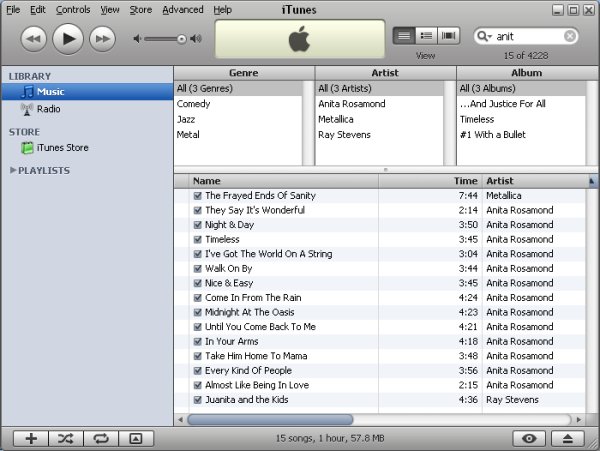
Or am I the only one this happens to?
Buy My Books!
This book collects some of the handwritten letters sent by Ronald Reagan during his presidency to people he knew, government officials, and the general public who wrote him. Apparently, the editors were noodling among the former president’s library and uncovered this collection written in his own hand, which they felt gave it a personal touch that would get to the heart of who Reagan was or something. They picked some of the best from each year, add an introduction to each year that details what was going on at that time, and let her rip.
Of course this book reflects the best of what remember from Reagan: his optimism, his faith, and his conservative beliefs. These letters, often written in response to common person critics who wrote to him, do reinforce the man’s impression. How cool is the thought, though, that if you had written Ronald Reagan, he might have dashed a couple lines off on his stationery in response. That’s fascinating.
I worked on this book for a month or so, which explains my recent acquisitiveness of Reagania.
I’ve only read two or three books of letters in my life; this, Raymond Chandler’s, and maybe Ayn Rand’s. This one is the most accessible because I have direct memory of the events to which he refers and because the letters are very brief.
Recommended.
Buy My Books!
City to fund part of office building repairs:
The owners of a downtown Milwaukee office building will receive city financing to help with repairs – even though the comptroller’s office questions whether the funds are needed, and even as some aldermen fret that their decision could encourage other building owners to ask for cash.
“We’re setting a very dangerous precedent,” said Ald. Michael Murphy, one of two aldermen who opposed the financing plan.
Supporters say the project will make one of downtown’s oldest office buildings more competitive, while also breathing new life into an adjacent building that’s been empty for several years.
Oh, for Pete’s sake. Correct me if I am wrong, but aren’t these sorts of “initiatives” coming faster and more frequently these days? Are our municipal leaders that eager to hasten the death spiral of their cities finances? Yes, as long as the ultimate crash comes after the municipal leaders have moved onto state or national leadership positions, where they can control bigger economies and initiate bigger five year plans.
Buy My Books!
Not that it’s a good standard, but a black comedian has been censured for using the word nigger:
A standup routine by black comedian Eddie Griffin was stopped after he repeatedly used the N-word, a magazine’s spokesman said Wednesday.
Griffin, who has appeared in movies such as “Undercover Brother” and “Date Movie” and the TV show “Malcolm & Eddie,” was performing at a Black Enterprise magazine event in the Miami suburb of Doral on Friday when he was cut off after using profanities and the N-word, said Andrew Wadium, a spokesman for the publication.
So I guess the whole black people say it and nothing happens canard is done, so everyone who used it instead of saying what’s the point in taking offense at a single word so much that it becomes a magic word? ought to feel vindicated. But they won’t. And they shouldn’t.
Buy My Books!
Good to see Missouri has its priorities in order.
Of the $387 million construction cost, public aid is projected to account for $116 million, with the state’s share at nearly $30 million and the rest coming from the city and special sales tax districts.
State highway officials have barred large trucks from a mid-Missouri bridge over the Osage River after an inspection prompted by the fatal Minnesota bridge collapse revealed a badly deteriorating steel beam.
. . . . The entire 1,000-foot bridge is scheduled to be replaced in 2010 at a cost of $9.4 million.
Buy My Books!
Well, I’m counting this as a book I read even though it really is a picture book. Aside from an introduction and an acknowledgments section, the book contains photographs, mostly taken by helicopter, of Detroit and its environs. The selections include a number of corporate headquarters (Ford, GM, K-Mart, American Motor Corporation), a couple of old churches, some of the new developments and high-rises constructed to handle the 1980s resurgence of Detroit predicted by Detroit boosters, a couple shots of Tiger Stadium (Home of the 1984 World Champion Detroit TIGERS!), one picture of the Pontiac Silverdome (where a football team and basketball team played, or so I hear), and a several shots of nearby farms/neighborhoods/and so on.
The only thing I’ll remember from this book, aside from the obvious lesson in urban “resurgence” promised year after year by urban moneyspenders, is a catch phrase. The book also sports a number of thumbnail photos of collections of vehicles taken from the helicopter which sport the phrase “as art.” A bunch of schoolbuses in a parking lot, a number of automobiles outside an automotive plant, a number of train cars in a train yard. The caption is “School buses as art” or “Transport containers as art.”
From this day forward, “as art” shall verily apply to any collection of common goods that I want to elevate to the heights of pretentiousness. Think of this blog, for instance, as “English words as art.”
A quick look at Amazon shows that the photographer did later editions of this book, perhaps with later photographs. But this is the 1985 edition, worthwhile not because the city of Detroit is worth anything, but because of the hysterical historical significance.
Man, I am glad this guy didn’t express his affection for Milwaukee this way; otherwise, I’d have to examine and review the book earnestly.
Buy My Books!
He’s Steve Jobs, bitch!
“But we want to make the iPhone even more affordable for even more people this holiday season,” Jobs continued. “So we’re going to do something about that today. We’re not going to sell it for $599 anymore.”
Instead, as a giant screen behind him vaporized first the 4GB version of the device, then the price of the 8GB model, he dropped the bomb. “We are going to price the 8GB iPhone at just $399.”
For being the first people on the block to have one, you’ve paid an additional $200. How do you like them Apples?
Buy My Books!