I Don’t Just Want To Cancel; I Want To Besmirch, Too

So I’ve mentioned that I’ve fallen back into the BOMC, buying a handful of the books so I could get some relatively recent titles for less than full price. Well, now. It required the commitment of buying one more book over the course of a year at regular club prices, and I ordered Robert Crais’s Chasing Darkness. Then I marked the next mailing “Cancel” because I’d completed my obligation, right?

Wrong!

The next mailing came yesterday and said I was still obliged to buy a book. So I called to see what was up, if maybe my payment for the Crais book hadn’t cleared. Oh, but no. The fellow politely explained that the book I bought was on a “promotion” price, not regular club price, so it did not count. I asked if this was all noted in the mailed catalog materials, and he said it was.

So I looked.

Oh, yeah, here’s where it says only books over $13.98 count:
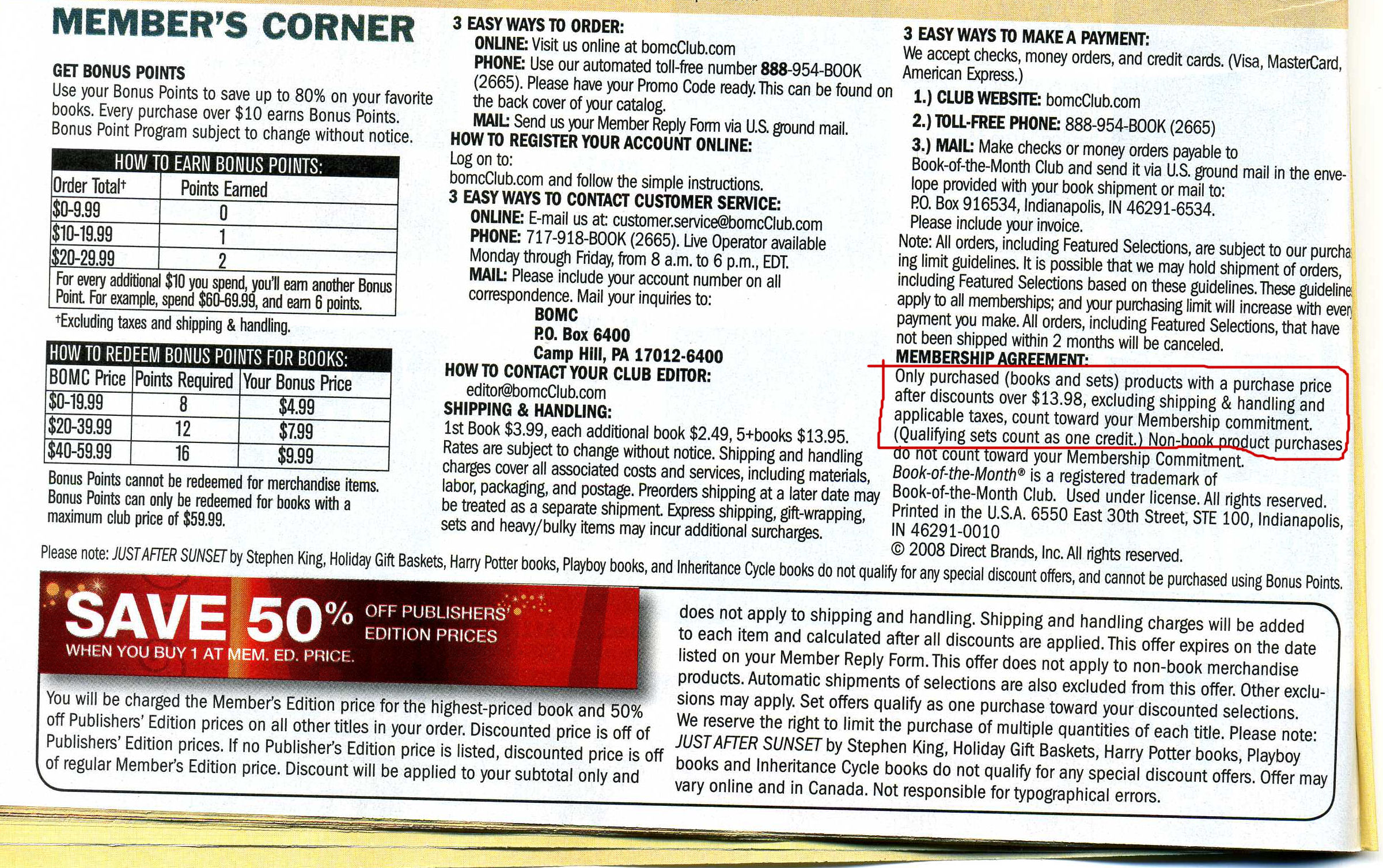


The BOMC fine print
Click for full size

It is right there. But the catalog could be a little more explicit, no? I mean, they call it “Member’s Edition” price regardless of whether it’s “Promotion” (doesn’t count) or regular (does count).

Here, let me illustrate some of the pages to identify for you what counts and doesn’t count. Since Book-of-the-Month Club does its bed to obfuscate it.

The new Spenser is out, and old ones are available, but do not count:
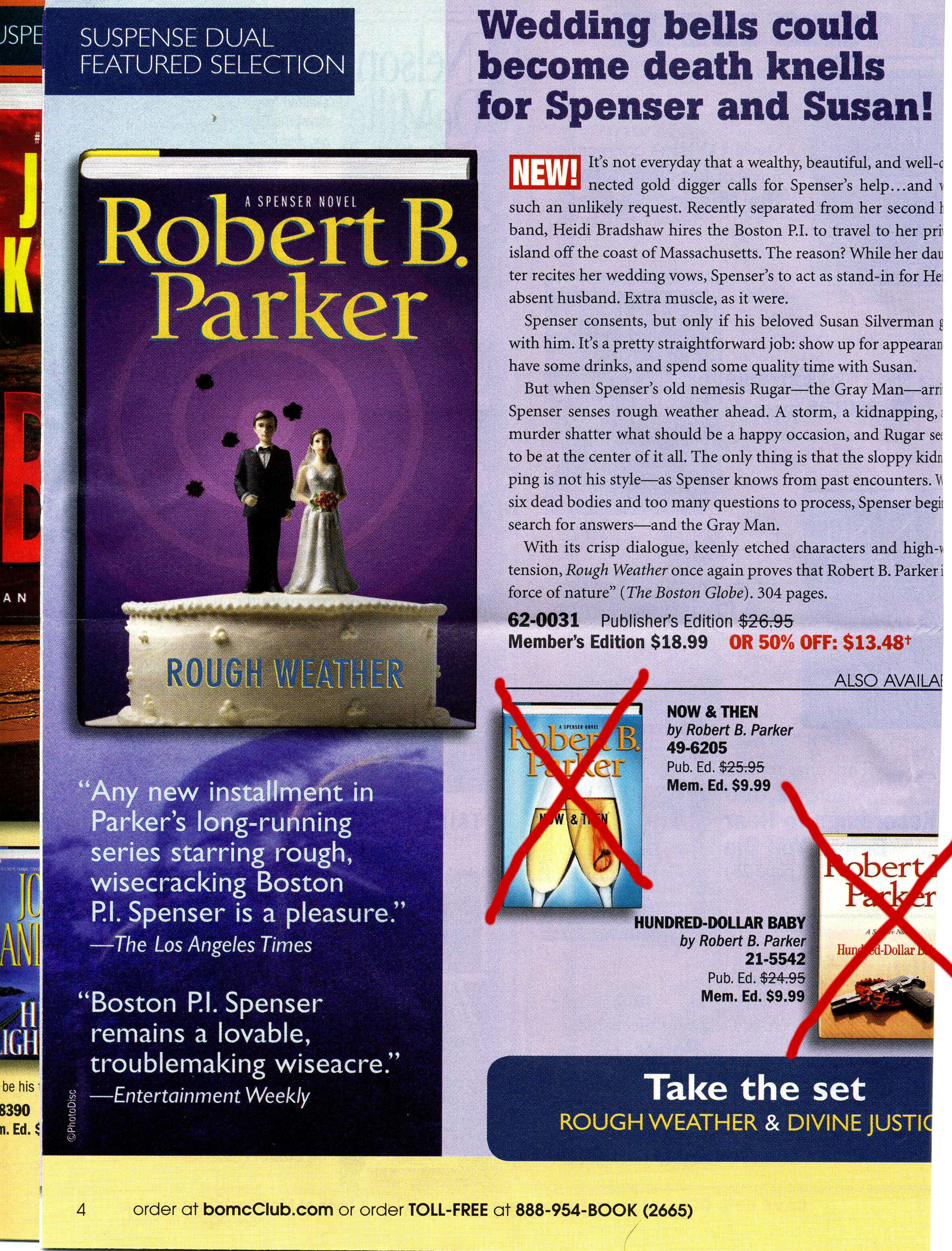


1 out of 3 ain't bad
Click for full size

The new David Balducci is out, but again, if you want the old ones, they don’t count unless you spend $14 on them:
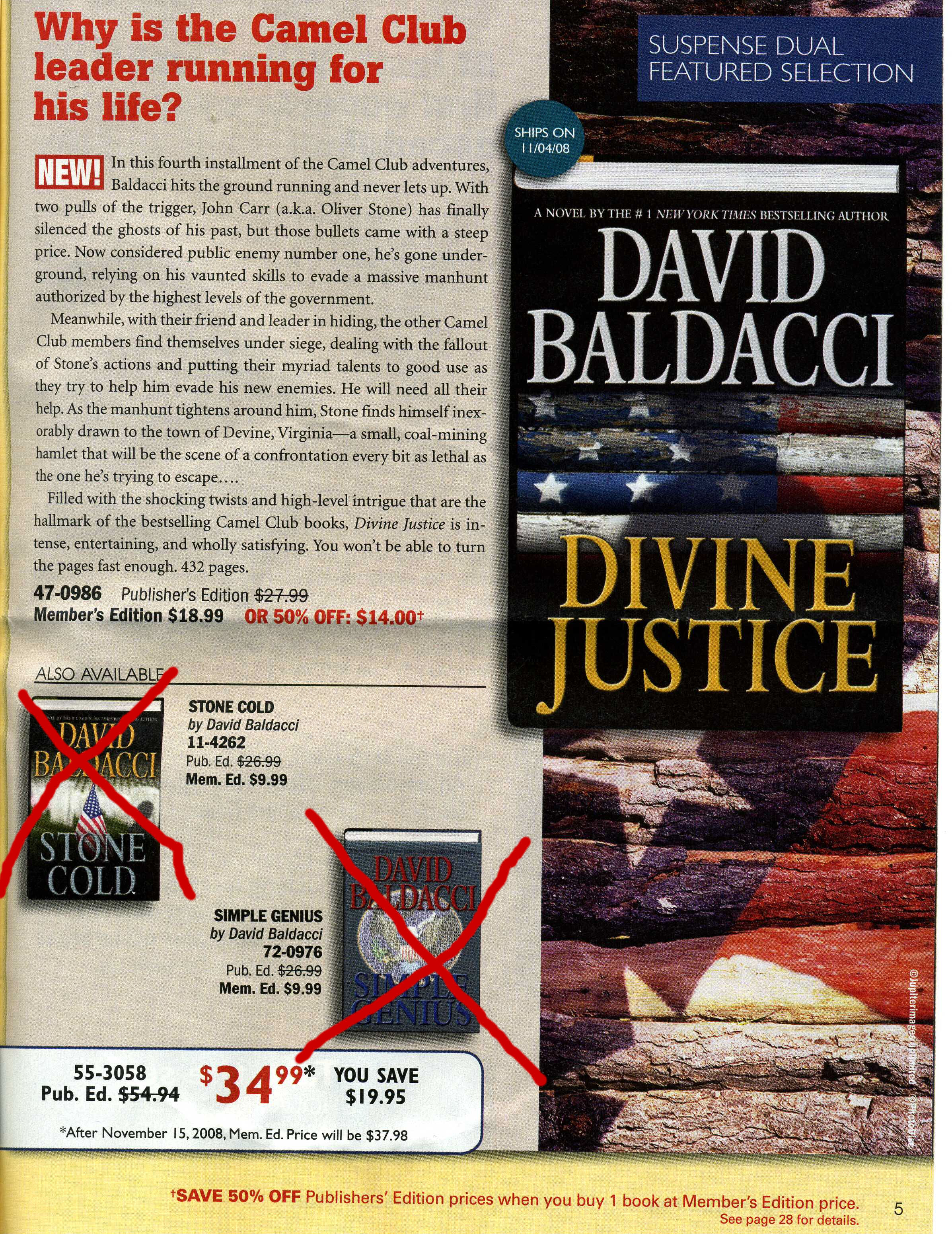


Balducci for suckers
Click for full size

Poor Anne Perry; none of her books fulfill the members’ obligations:
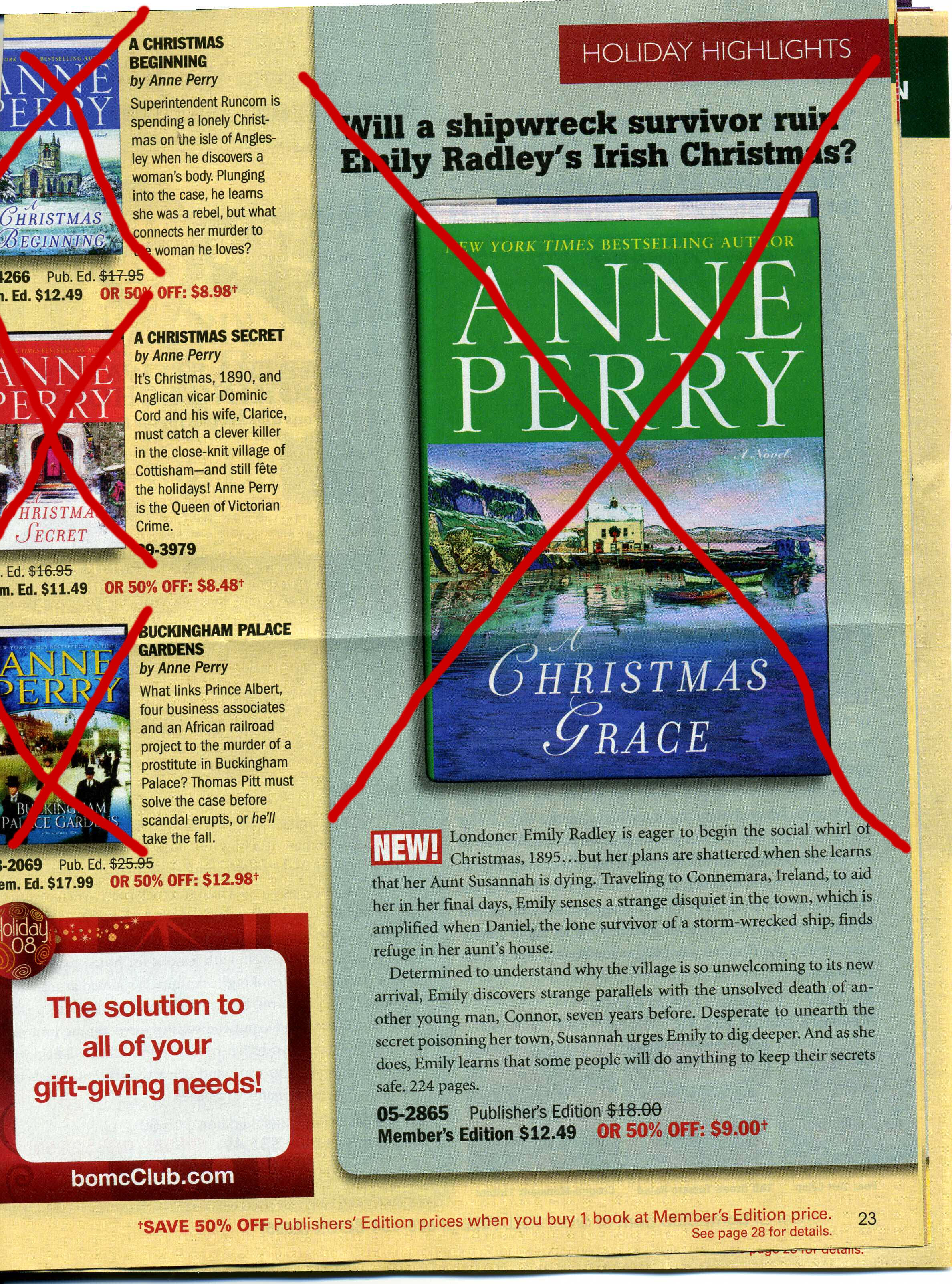


Perry doesn't fulfill BOMC obligations
Click for full size

And those books printed on the inside of the envelope? Good luck.
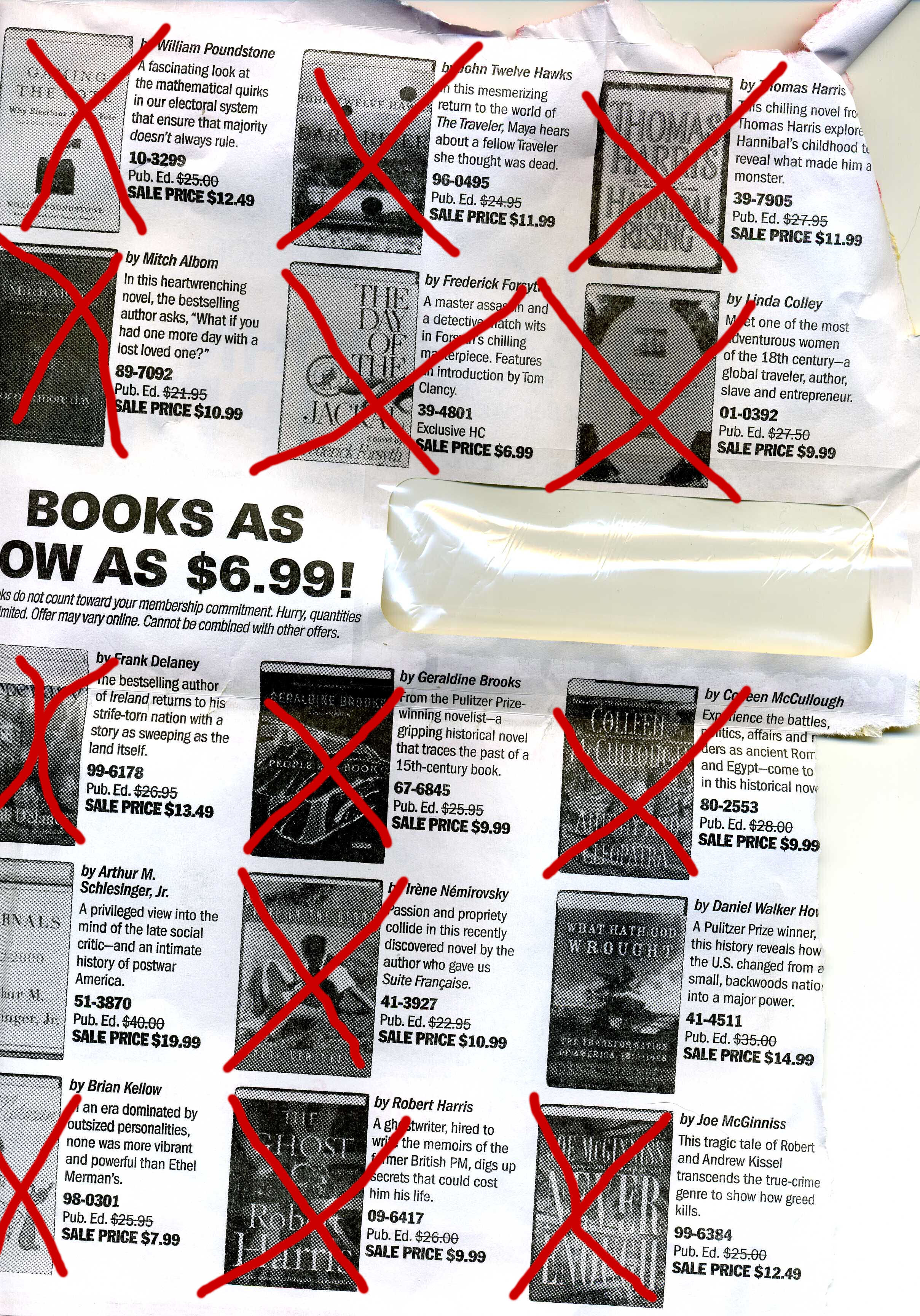


In case you're bored enough to actually look at what's inside the envelope
Click for full size

Of course, outside the BOMC News flier, your odds are probably worse.

Meanwhile, today I got the chastising letter that I’m trying to slip out of my agreed to obligations:
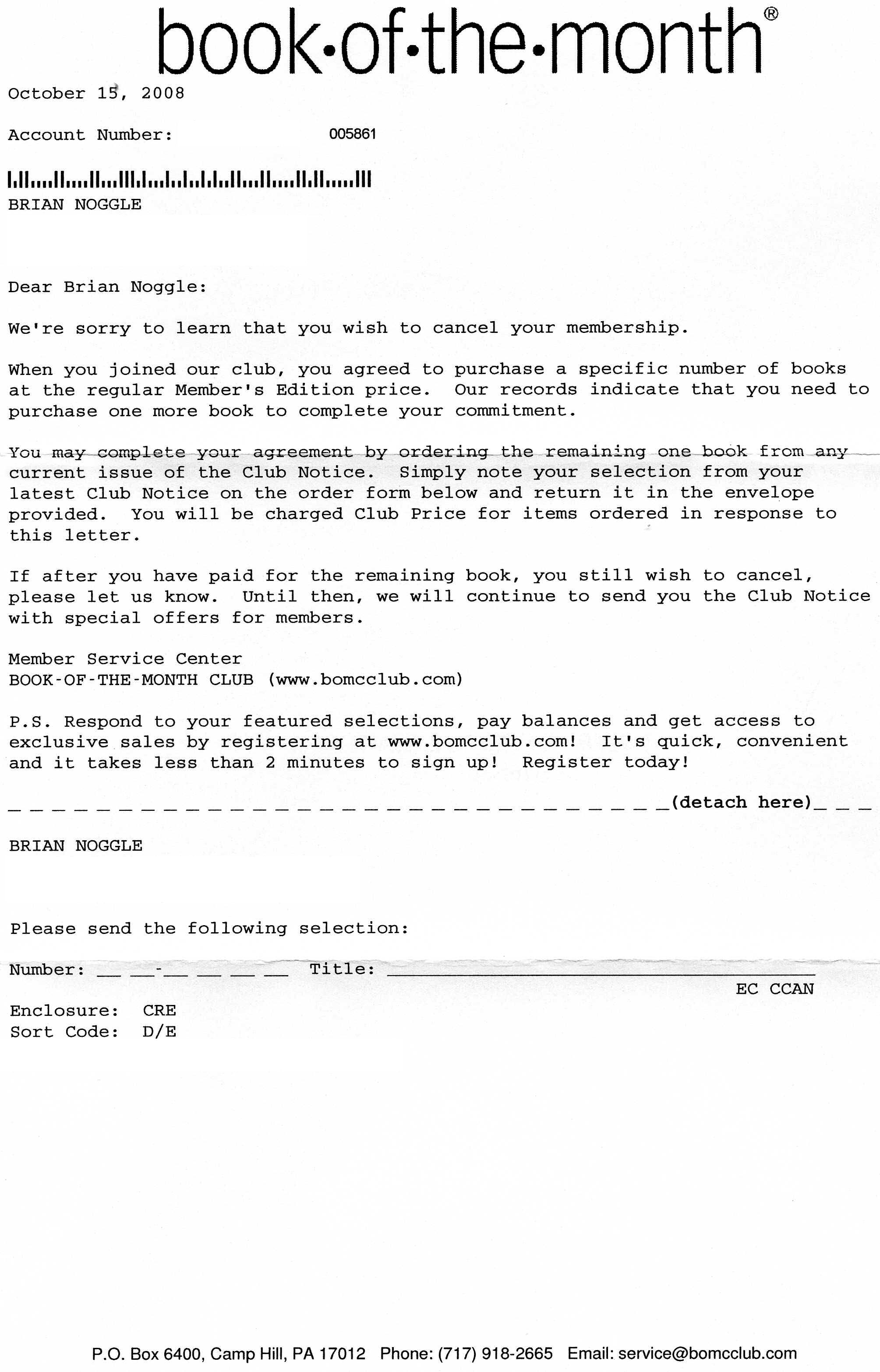


You, sir, are a Welsher
Click for full size

Don’t worry. I will fulfill my obligation now that I understand it. Also, note that I will never, ever play this game again. Increased deception-lite, cheaper books (newsprint pages, almost), and the double-gotcha “Dual Selections”–you can just continue faltering. Your business model has always been based on taking advantage of your customers, but I hate to see how much further you’ll go before collapsing under your own negative brand management.
Buy My Books!
Buy John Donnelly's Gold Buy The Courtship of Barbara Holt Buy Coffee House Memories

Book Report: Invisible Prey by John Sandford (2007)

This book tops the scales at 388 pages, and, frankly, it made me miss the days of one hundred and fifty page pulp books. Because let’s face it, this book has more akin to those crime thrillers than to more sweeping classical literature that covers more of the human condition and clocks in at a hundred more pages or less.

It’s a disappointing entry in the Prey series. The main plot revolves around an old woman who gets killed and robbed of a few expensive antiques that won’t be missed. It’s a pair of antique dealers doing this, you see, carefully across different states and whatnot. But it unravels when a young black man recognizes that some pieces are missing. I didn’t hesitate to tell you who did it because Sandford tips it pretty early, too, and then you see, via the narrative equivalent of split screen, what the bad guys do while the good guys try to figure it out. Sometimes it works, but given the other evidence, it cumulatively just looks sloppy.

To pad it out, Sandford spends a lot of time on a subplot, a Republican politician who is accused of sleeping with an underage girl. This subplot doesn’t deal with solving the crime, but how, politically, to deal with it. The Prey books have always had an element of this, but the book really throws this in and then combines the two plots as the antiques dealers use this as a red herring to throw Davenport off. When that doesn’t work, many pages later, the subplot doesn’t get mentioned again.

In the review of Phantom Prey, I wondered if sometimes Sandford didn’t know what he was talking about. Another couple bits within this book often sound tinny, as though Sandford didn’t really get into the context of the subcultures he’s writing about. For example, the young black man (I mean, high school student) goes to a hip hop club’s under 18 night on the night of the murder. He’s there with a couple of friends. A hip hop club, you understand. He takes mass transit down, but:

At ten o’clock, the mother of one of the kids picked up the boys in her station wagon and hauled them all back to St. Paul.
“What kind of car?” Lucas asked.
“A Cadillac SUV–I don’t know exactly what they’re called,” Lash said. “It was a couple years old.”

Maybe I’m splitting hairs here, but the Cadillac SUV is the obscure Escalade which, as far as I know, a couple of people in the hip hop industry drive. Sure, Sandford intimates that it’s a station wagon, which could mean the vehicle he has in mind is the Cadillac SRX, but the narrator shouldn’t crop that up, and I really think the boy would relate to the Cadillac SUV as either the Escalade or not. Not “I don’t know exactly what they’re called.”

Sadly, I think the series is drooping. Sandford might be phoning these in, and talking for hours while doing so.

Books mentioned in this review:

Buy My Books!
Buy John Donnelly's Gold Buy The Courtship of Barbara Holt Buy Coffee House Memories

Whither the Political Blogging, Noggle?

I know, some of you readers might be disappointed that I’m not daily dishing out snark about the election or mocking the mockery of a candidate thrown up by the Democrats for the position. However, let’s just say I’m feeling a little sanguine about the prospects for the future. So sanguine, I’m italicizing it even though it’s not a foreign word.

How sanguine? This describes my mood:

Listen to the words, children. Do not be confused by the pretty Starman like story. Remember Robert Hays for his excellent work in Airplane!.

If you want me, I’ll be in the back yard, burying copies of the Federalist Papers, Milton Friedman books, printed copies of Ace’s and Porch Girl’s blogs, and Sean Hannity’s Deliver Us From Evil, the last unwrapped and acting as fertilizer for my upcoming Wealth Spread Garden.

Buy My Books!
Buy John Donnelly's Gold Buy The Courtship of Barbara Holt Buy Coffee House Memories

Nonjudgmental

50 at Normandy High face HIV risk:

The HIV threat at Normandy High School has widened to include up to 50 students, health officials said Tuesday.

Health officials last week said “some” students may have been exposed to the virus that causes AIDS but recently refined their estimate to 50.

The local news has been running this story pretty hard, with dramatic meetings between school administrators and whatnot. Of course, just using the words “exposed to” spices it up. One might think a cafeteria worked didn’t wash her hands before returning to work or a lab experiment went awry. Um, still, no.

The most likely scenario for HIV exposure among teenagers would be sexual relations, but health experts say sharing contaminated needles for steroids, tattoos or drugs could also be the source.

The story’s only commenter gets to the meat in the sandwich:

I would like to know how those children were exposed to the HIV virus. It would benefit all the schools, and for that matter, any gathering of people in one place, to know how this happened. Of course, if it was something like a gang bang, then I am not worried because my community does not practice those sort of behaviors.

Indeed, by not elucidating on the mechanism of exposure, the media is really trying to gin up the panic without reminding the public that these young men and women acted in a way to expose themselves.

Buy My Books!
Buy John Donnelly's Gold Buy The Courtship of Barbara Holt Buy Coffee House Memories

Book Report: The Silencers by Donald Hamilton (1962)

This book is another in the Matt Helm series, the fourth (I think).

In it, Helm travels to Mexico, gets some secret information, and then walks into a trap on purpose to get to an agent known as The Cowboy who might be sabotaging a nuclear test. When he gets caught, as planned, Helm turns the tables on his captors and on the woman who has double-crossed him–as planned–even as they’ve fallen in love.

It’s not very complicated, but it’s a 60s paperback adventure. You get a handful of scenes, a female love interest of potentially duplicitious motivation, and then you get a sudden climax with a big explosion. A hundred and fifty pages, and you’re done. Man, I love these paperbacks.

Books mentioned in this review:

Buy My Books!
Buy John Donnelly's Gold Buy The Courtship of Barbara Holt Buy Coffee House Memories

Sign of the End Times

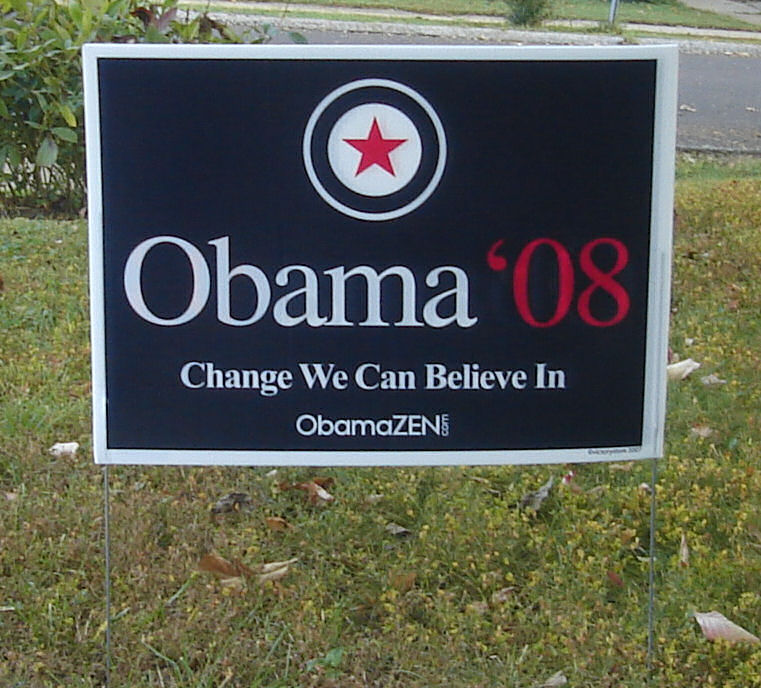
You know, that bumper sticker I made insinuating that Obama was a communist is one thing; another thing entirely are the line of official Barack Obama signs and whatnot with the freaking Soviet star on them:


Obama, the Soviet Star

What, you’re going to tell me that’s supposed to imply the Red Star Yeast logo because Obama is going to raise us all or the Macy’s logo because Obama wants to turn the government into the citizens’ department store, where they can get anything they want as long as it’s red.

Buy My Books!
Buy John Donnelly's Gold Buy The Courtship of Barbara Holt Buy Coffee House Memories

Book Report: Myths, Lies, and Downright Stupidity by John Stossel (2005)

This book takes on a number of media-promulgated myths and explains why most of them are false. As a reasonable, libertarian sort of fellow myself, I already knew most of them. The last chapter of myths covers parenting, and it’s the weakest one. Stossel is a consumer reporter, not necessarily a parenting reporter, so the book ends on a weak note.

Another book that goes along with what I believe, generally, so it didn’t challenge me much. Explaining common sense to someone with some common sense ain’t riveting reading. Sadly, like most political books, only people who agree with it will buy it/acquire it.

Speaking of which, since I just bought a hardback copy, I have a trade paperback to get rid of. Call it if you want it.

Books mentioned in this review:


Buy My Books!
Buy John Donnelly's Gold Buy The Courtship of Barbara Holt Buy Coffee House Memories

Would They Call Regular Fraud "Fundraising Efforts"?

The St. Louis Post-Dispatch‘s Washington “editor” weighs in on ACORN’s fraud problems by calling them something else: GOP attacking ACORN’s voter registration efforts:

Trailing badly in new-voter registration, Republicans are waging an aggressive campaign in Missouri and around the country against a group that claims to have added 1.3 million people to voter rolls since last year.

Let’s play a new game: whenever the Post-Dispatch identifies something as fraud, let’s see how they would spin it if it involved/indicted the Democratic Party.

Like this: GOP attacks Nevadan’s fundraising efforts

Or this: Republicans assail investor efforts.

I guess I am just naive; I didn’t think that Republicans were upset with voter registration efforts. I thought they were upset that ACORN people were systemically and nationally caught making things up out of whole cloth:


I guess that explains why I didn’t go into journalism; I don’t want to “help” people see the “truth” through my creative writing and pretending it was something other than a fictional narrative.

Buy My Books!
Buy John Donnelly's Gold Buy The Courtship of Barbara Holt Buy Coffee House Memories

Book Report: A Friend Forever edited by Susan Polis Schutz (1980, 1982)

This is a simple collection of “poems” and quotes about friendship from famous people taken from magazines. Think of Reader’s Digest‘s Quoted Quotables section, but with 70s pop art.

Again, it’s good to read some bad poetry to remind you what good poetry is like. And some of this is not very good.

The strangest thing, though, is that the copy I have is from the third printing. And the book cost 4.95. In 1982. And I guess someone was buying them.

And, on the other hand, the editor and author of many of the poems within founded the company that published this book and created BlueMountain.com, which they sold to Excite for $780 million. So she’s got that going for her. Me? I’ve published a couple of chapbooks and have a couple cool blogs.

Books mentioned in this review:


Buy My Books!
Buy John Donnelly's Gold Buy The Courtship of Barbara Holt Buy Coffee House Memories

Book Report: Do As I Say (Not As I Do) by Peter Schweizer (2005)

So I picked this book up for a quick mad-on for those who would rule us (those in the other party, I mean). It takes on the likes of Michael Moore, Nancy Pelosi, Noam Chomsky, and so on and details how their personal lives don’t match their public rhetoric. You know, I found most of these people odious to begin with, and I get enough of this sort of material from the blogs daily, so the book didn’t do much for me. The best I can say is that now I’m conflicted about buying Ravenswood wines because Pelosi owns a stake in them.

I guess this book works best for readers who don’t traverse the blog circuit regularly and instead buy books from advertisements in National Review or the conservative book club.

Books mentioned in this review:


Buy My Books!
Buy John Donnelly's Gold Buy The Courtship of Barbara Holt Buy Coffee House Memories

Book Report: The Man With The Golden Gun by Ian Fleming (1965)

This is the second book I’ve read recently that was set soon after the Cuban revolution, and Fleming didn’t think it would last (to the contrary, Brett Haliday thought it might be a good idea.) These things strike me.

This book deals with a post-brainwashing, post-trying-to-assassinate-M Bond unbrainwashed and assigned to kill a Caribbean hitter who used a goldern Colt .45 revolver and custom gold-loaded bullets. Bond goes down there, infilitrates, and gets his man.

I can’t remember how the Roger Moore Bond film of the same name worked, but I would guess it differed greatly from the book. It’s a pretty good read, an artifact of the times and of the medium (pseudo-pulp spy fiction, the good stuff before the epic, moral-grey-area stuff came on).

Books mentioned in this review:


Buy My Books!
Buy John Donnelly's Gold Buy The Courtship of Barbara Holt Buy Coffee House Memories

Book Report: Elephants Can Remember by Agatha Christie (1972)

This book, like the other book I’ve read most recently from Agatha Christie (By The Pricking Of My Thumbs) comes from Agatha Christie’s later works (remember, gentle reader, she started in 1920; this book is from 52 years later and is the penultimate book she wrote). Maybe I’m crazy, but I like the earlier works better, back before the main characters got old.

This book features Hercule Poirot and Mrs. Oliver trying to suss out the story behind a murder/suicide fifteen years earlier. A rarely-seen goddaughter of Mrs. Oliver is set to marry, but the groom’s mother worries about the goddaughter’s parents’ deaths. The protagonists puzzle it out based on reminisces and rumors from people only tangentally involved with the story. As a matter of fact, a main part of the story turns on the goddaughter not knowing her own family or forgetting things that happened at age 14.

So it’s not a very satisfying book in Mrs. Christie’s canon, but reading the book, I’m reminded that she had her own book club as late as the 1980s; one could join the club and get a different Agatha Christie book every month for several years if one was inclined. Wow. I remember Stephen King had one, too, and he’s the only author of our generation that I can recall having such. These days, nobody reads enough to rope them into something like that. And I notice the BOMC offers to send out two books automatically each month unless you send back the card. Just so they can soak the negligent double until they cancel, I guess.

Books mentioned in this review:


Buy My Books!
Buy John Donnelly's Gold Buy The Courtship of Barbara Holt Buy Coffee House Memories

When Famous Chickens Go Bad

We let our toddler watch football on Sunday, and during the commercials, he’s subject to many, many, er, disconcerting images. Terminator: The Sarah Connor Chronicles ads run in heavy rotation, featuring explosions and belligerent robots firing weapons of all sorts. Each new gory horror movie that opens runs its ads to catch the young (but not that young) male football viewer, so there’s always someone screaming and being dragged away by ghouls, demons, ghosts (not Gus) and whatnot. Additionally, he gets to see plenty of ads featuring Barack Obama’s plan for America, things which frighten me to no end.

We try to distract him with books, toys, or questions during the particularly malevolent commercials. When he’s seen them, though, he has remained unfazed because he’s too young, probably, to understand what the images depict. One commercial, however, caused him to burst into tears. This horror:


Man, I love that commercial because anything with an enraged Famous Chicken in it is hilarity encapsulated in 30 seconds. But the boy? Freaked out.

One thing he can imagine, poor guy, is stuffed animals coming to life and threatening violence.

By the way, if you cannot get enough of The Famous Chicken, here’s his official Web site.

Just don’t browse it with my son around.

Buy My Books!
Buy John Donnelly's Gold Buy The Courtship of Barbara Holt Buy Coffee House Memories

Book Report: Resolution by Robert B. Parker (2008)

Well, it’s a Parker Western. I picked it up because Appaloosa‘s movie version opened this weekend.

The moral bankruptness of the Parker universe progresses. In it, Cole, the marshal from Appaloosa, has left Appaloosa after his lover runs off with another man. Off-page, Cole hunts down the man and kills him simply for taking up with Cole’s interest. Then, when he joins Hitch in Resolution, the town of the title, Cole takes up with a married woman. Does he deserve to die for it? Apparently not, for some reason that might include he’s a gunman or the woman’s husband has beaten her (but she still loves him and returns to him at the end after the empowerment-through-adultery trope that Parker repeats lately).

Forget it. I’m not even wasting money on Book Club Editions of the new Parker books. I’ll pick them up at book fairs. Maybe.

Oh, for the plot of the book: Everett Hitch signs on as a lookout man at a saloon, and eventually Cole shows up and they navigate through a dispute amongst the homesteaders and their employer. The book meanders through a large number (70+) chapters-as-scenes with semi-unrelated fuguish subplots. Finally, when the word count is reached, Cole faces down the bad guys in a quick shootout. The bad man and his plot to build subdivisions (!) in the old West are thwarted.

Seriously. The man is running homesteaders off to build subdivisions.

On the plus side, unlike Ed McBain, Bush’s name isn’t invoked in his historical or contemporary works, not that I’ll know anymore until the election is way over. I’ve also avoided Parker’s new line of Young Adult novels, but part of me has a morbid curiosity to see how he injects adultery-as-affirmation thing into them.

And I now pose this question for debate, although none of you will debate it with me because you’re all wiser than I am and have avoided the collected works of Parker, but here it is: Which was more detrimental to Parker’s writing: whatever adultery occurred in the middle 1980s to make it the single biggest recurring theme in all of his subsequent work, or Parker’s work for the Spenser for Hire television show that subsequently turned all of his novels into chapters scenes with simple stage management but mostly dialog along with the reliance on recurring guest stars and formulaic endings?

Books mentioned in this review:


Buy My Books!
Buy John Donnelly's Gold Buy The Courtship of Barbara Holt Buy Coffee House Memories