I See CB and Raise Him

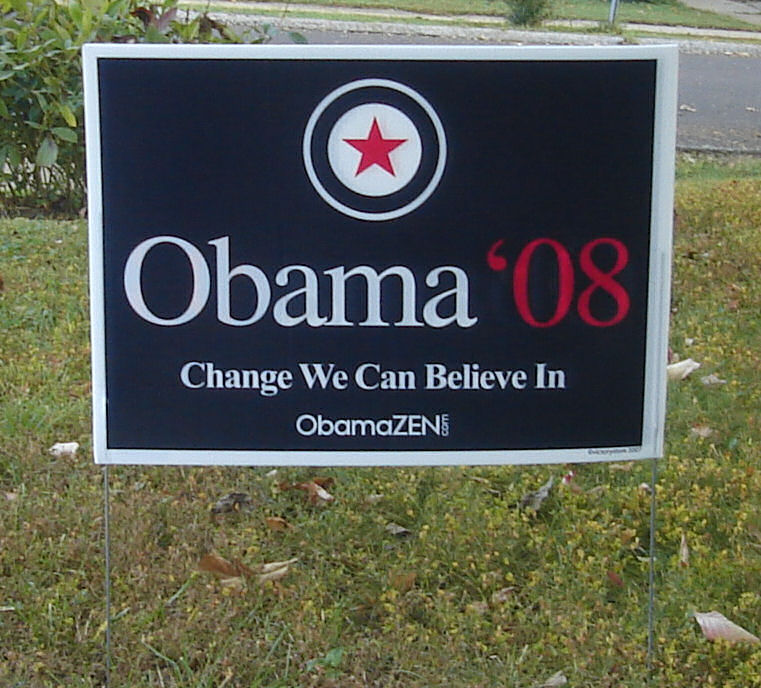
CB, because some of the people we know in common read this blog daily, thinks I have pull, so he keeps sending me tips like this:

my buddy’s blog he just created http://antiobamassiah.wordpress.com/

As though a mention on this blog will send torrents of readers his way.

Brother, I see your antiobamassiah and raise you Michelle Obama Suicide Watch.

(My link stolen from Ace, who, in his defense, is not my friend.)

Buy My Books!
Buy John Donnelly's Gold Buy The Courtship of Barbara Holt Buy Coffee House Memories

Government To Hinder Conversation On My Front Porch In 2025

We live next to an interstate highway, and the front yard is pretty loud; you need to speak up to be heard. However, I used to say that in 20 years, we wouldn’t hear that highway because the internal combustion engine would be out of style.

Fortunately, the government is working to save the endangered Noise Pollution:

Electric and hybrid vehicles may be better for the environment, but the California Legislature says they’re bad for the blind.

It has passed a bill to ensure that the vehicles make enough noise to be heard by visually impaired people about to cross a street.

Thanks, guys.

(Link seen at Porch Girl‘s.)

Buy My Books!
Buy John Donnelly's Gold Buy The Courtship of Barbara Holt Buy Coffee House Memories

Book Report: Love Sonnets selected by Louis Untermeyer (1964)

This is a small collection of sonnet’s greatest hits, sort of. About 25 of them, from Browning to Shakespeare and Petrarch.

Unfortunately, the poems appear in a handwritten font (calligraphy, the credits call it) and they have “illustrations” on the left page of each. The font hurt my eyes, and I ignored the illustrations totally.

Still, I enjoyed some of the poems (again, in many cases, as the major ones are anthologized everywhere else). A couple points:

  • Translated poems, especially those in tight forms like sonnets, probably come through very garbled from the original.
  • Based on these sonnets, I might have been one of the best sonneteers of the late 20th century before I retired. If I could get my two year old to illustrate the book, I could probably match this volume.

Overall, the volume probably isn’t worth your time unless you really dig eye-crossing simulated handwriting.

Books mentioned in this review:


Buy My Books!
Buy John Donnelly's Gold Buy The Courtship of Barbara Holt Buy Coffee House Memories

Noggle’s In The Driveway Again

Government making life more expensive for us in today’s Kirkwood-Webster Journal.

UPDATE: The link above is stale, so here’s the article for your reading pleasure:

In 2007, Congress passed the Energy Independence and Security Act of 2007. If you heard about this bill at all, a televised news bit might have said that it would help end American dependence on foreign oil. Maybe you read about the bill in the newspaper’s political sports pages as a box score in the perpetual pennant race between the Republicans and Democrats. Somehow, as it often happens with 300 page omnibus bills, you probably missed some costs that Congress has passed onto us without our notice.

In 2012, instead of going into your local store and picking up four 100-watt incandescent bulbs for $1.00 or $1.50, you will spend $4.00 for a single compact fluorescent light (CFL) bulb, $16.00 for four. The Energy Independence and Security Act bans the common incandescent bulb. With that simple action, Congress effectively raises the price of a light bulb from $.25 to $4.00 or more for every light, lamp, and ceiling fan in your home. The cost of replacing the 53 bulbs scattered around my home will go from $13.25 to $212.00 or more.

To be accurate, the Energy Independence and Security Act doesn’t explicitly ban incandescent bulbs. It only bans bulbs that use as much electricity as incandescent bulbs and allows only bulbs that are as energy efficient as CFL bulbs. If Congress outlawed cars with MPG ratings of lower than 30, it wouldn’t explicitly outlaw SUVs, trucks, and luxury sedans, but that would be the result.

I don’t oppose CFL bulbs; as a matter of fact, I use a couple for exterior lights that are on for long periods of time. However, CFL bulbs have additional costs and risks over incandescent bulbs. Since they contain mercury, breaking them can lead to toxic spills and death. Disposal is problematic, as you shouldn’t throw them away. Instead you should recycle them, but not with your recycling bin. To be responsible, you have to look for somewhere to drop them off or to send them. Some people probably won’t be responsible, dumping CFL bulbs and their mercury into landfills. CFL bulbs promise long lives and energy savings over several years, but you’re supposed to leave them on for more than five minutes at a time or risk shortening that lifespan. I don’t leave bathroom lights on for five minutes every time or spend five minutes minimum in my store room. Each short visit reduces the longevity of a CFL bulb and its value over its incandescent counterparts.

Congress often passes laws that provide immeasurable and possibly negligible benefit for the environment. With many of them, the costs to us remain indirect and somewhat obscured since they don’t impact sale prices. In 1995, the National Energy Policy Act mandated that toilets could only use 1.6 gallons per flush instead of the 3 to 7 gallons used previously. While that saves water, it also can lead to more drain blockage and quicker corrosion in household pipes since the lower flow of water doesn’t carry waste or sediments away as effectively. The Energy Independence and Security Act mandates that new washing machines and dishwashers use less water per washing cycle which also means less water carrying away the dirt and food particles and, potentially, leaving clothes or dishes dirty. Congress is not alone in making costly rules for us. In July, the Environmental Protection Agency released an Advance Notice of Proposed Rulemaking that calls for emissions regulation on lawnmowers. Catalytic converters and other emissions equipment will make lawnmowers more expensive, will increase maintenance costs, and cause the more complex machines to break down more easily.

The federal government has put most of these regulations into effect without attracting much attention. Since we consumers don’t see the costs directly, we’ve let this pattern continue without asking or debating whether the rules most effectively protect the environment and whether the total costs of the laws or regulations outweigh the anticipated, and sometimes measurable, benefits. Hopefully the coming light bulb shock of 2012 will draw some attention to the practice and spur debate in addition to sticking us with higher costs and prices.

Buy My Books!
Buy John Donnelly's Gold Buy The Courtship of Barbara Holt Buy Coffee House Memories

Journalist Says Your Bedroom Is Not The Right Place For You

In a story about a home invasion of Noah Herron, running back for the Packers, the journalist gives in to cliche and renders a judgement on whether the bedroom is actually the right place for you to be:

No, there was no message in this, only the fact that anyone can be in the wrong place at the wrong time. For Herron, it was innocently enough in his own bedroom one May evening while two burglars ended up pushing Herron into a corner, giving him no option but to fight back for his own life.

Brothers and sisters, the bedroom in your own home is not the wrong place at the wrong time.

The absolute right place to be in this situation is where your home defense weapon is. Unfortunately for Herron, this ended up being a bedpost, but fortunately it was enough.

Buy My Books!
Buy John Donnelly's Gold Buy The Courtship of Barbara Holt Buy Coffee House Memories

Here’s One Negative Impact Of AB-InBev, So I’ll Provide Another

James Durbin gives perspective on what the AB-InBev merger means to St. Louis IT in a post entitled The Effect Of The Anheuser-Busch Merger On The St Louis Staffing Market. He takes it from a macro approach, but let me tell you what it means to you, the individual IT drone: There are going to be a lot of former AB contractors chasing a smaller number of IT jobs in St. Louis.

But never mind that, let’s talk about the real impact on the rest of us: The commercials are going to suck. I mean, I’m not a fan of Budweiser, having only drunk a single Bud Light in my lifetime and only as part of Mardi Gras in Soulard where that’s all that was available from Red, the bartender from the Venice Cafe who was moonlighting on some balcony in Soulard proper. My dislike of the product aside, the commercials were often funny. I mean, almost ten years later, I say, “Willie, it’s go time,” and that’s from a non-campaign spot:


I watch a lot of sports, and this means I watch a lot of Bud and Bud Light commercials.

Have you ever seen a funny European beer commercial? Ever? They’re all so earnest at best, at worst they creep me out. Dudes, I have nightmares about this one:


Forget the local economy tanking. This is really where it’s going to hurt.

Buy My Books!
Buy John Donnelly's Gold Buy The Courtship of Barbara Holt Buy Coffee House Memories

Book Report: Shadows Over Baker Street edited by Michael Reeves and John Pelan (2003)

This book will cost you 1d6 SAN. You have Sherlock Holmes and related characters, the poster children for reason, thrust into the world of Lovecraft, where irrationality and things beyond reason rule. You really cannot reconcile the two; the things that go bump in the cosmos win, and it’s ultimately not comforting.

As a collection of short stories written by different authors using the same characters, the different treatments are jarring. In one, Holmes and Watson are action heroes, for crying out loud, having a shootout in the London sewers with a bad guy carrying an unmounted Gatling gun. That would have been kinda heavy, don’t you think?

Still, the book is worth a couple of bucks for the concept and the better stories, but ultimately, it’s not good Holmes and it’s not good Lovecraft.

Books mentioned in this review:


Buy My Books!
Buy John Donnelly's Gold Buy The Courtship of Barbara Holt Buy Coffee House Memories

Internet Geekery Lets Me Down

So I did an image search for cylon assimilated borg, and I don’t get a picture of an old school centurion with paraphernalia.

I thought that maybe, just maybe, someone would have created an image in 1997 or something that combined the two motifs, back before “cylon” was merely a hot chick in a tight dress or battle uniform. Oh, but no.

I hope you all feel ashamed of yourselves.

Buy My Books!
Buy John Donnelly's Gold Buy The Courtship of Barbara Holt Buy Coffee House Memories

Book Report: Conquest: Montezuma, Cortes, and the Fall of Old Mexico by Hugh Thomas (1993)

Porch Girl posted a This Day In History bit about La noche triste, a night where the Aztecs almost wiped out Cortes and his crew. Huh, I though, that’s not something I’m familiar with, and it’s definitely something begging a historical essay, so I ran right out and grabbed this 600 page academic tome about the conquest of the Mexica.

This is an excellent book on the subject. I mean, the author’s completely in the bag for the Aztecs (he saves his most poetic language for describing the glories of the human sacrifice, what he calls the “astonishing, often splendid, and sometimes beautiful barbarities” on p24) and he’s as pink as farm raised salmon (his previous books are The Spanish Civil War and The History of the Cuban Revolution, he makes a point of saying that winning wars without fighting are notable goals of Clausewitz and Lenin–but no mention of that Sun Tzu guy, and he muses that the conquistadores must have called each other comrade). But he merely weights things that support his idea; he includes a lot of detail and does not omit things which would counter his bias, so someone not like him–like me–could make other inferences from the data.

Now, onto the story.

Most history books mostly gloss over the conquest of Mexico, turning it into a very simple tale of Spain pillaging the New World again, this time swapping the name Cortes for Columbus or Pizarro. Still, the story is much more than a morality play where the Western power is bad and the natives are blissful.

The Mexica, as Thomas calls them, were a nation built on winning at wars and getting tribute from conquered tribes. They had conquered everything within a reasonable march from their capital excepting those pesky Tarascans who used metal in their weapons (the Aztecs used stone knives and spearpoints). Each leader, elected from a pool of aristocrats, got a bit more lavish with the lifestyle, and by the time Montezuma rolled in, the city of Tenochtitlan was huge and sprawling and, did I mention, totally dependent upon tribute from conquered tribes around them for its lifestyle. I’ll be frank, the picture Thomas paints shows me an empire on the edge of collapse, Spanish arrival or not. I think the Aztecs ended up being remembered, instead of the Olmecs or the Chichimecs or the Totonacs, because they got conquered by the Spanish.

And let’s not forget the human sacrifices. By the 1520s, the priests were killing ever-increasing number of war captives and people sent to the city as tribute. Maybe the gods were building up a tolerance or something. Thomas tries to tell us how the natives could think of no greater destiny than to die atop a pyramid and to have their bodies cast down the steps and how the subjects of the sacrifices ultimately weren’t in pain because they were whacked out on pulque or peyote.

Thomas, of course, points out that the Aztecs didn’t own slaves as such, and that all the tribesmen who carried the tribute hundreds of miles over mountains and through deserts were volunteers who just wanted to see Tenochtitlan. And maybe be sacrificed.

So that’s the situation when the Spanish show up. Which wasn’t sudden, mind you. Ships appeared off of the coast for years and even landed a couple times. By the time Cortes lands, a couple previous expeditions had visited Yucatan and even Aztec areas and had fought battles with the natives. But Montezuma didn’t prepare. When Cortes lands, Montezuma, the great Aztec leader, behaves like Hamlet, consulting astrologers, not acting, consulting priests, not acting, weeping because he’s doomed, sending gifts to the Spaniards but asking them to stay away from the capital, claiming he cannot meet with Cortes because he’s sick, and doing everything but planning to handle the Spanish expedition precisely.

On the other hand, the Spanish are a developed society with conscience decrying the treatment of the natives and legal mechanisms for control. Also, they work the iron. Thomas tries to place the two civilizations on equal footing (as do many historians, I wager). However, featherwork, a good calendar, and pretty colors painted on humans whose hearts are going to be ripped out are not really a match for the wheel and iron.

Contrary to the short shrift Cortes gets in more summary and cursory historical textbooks, the outcome of the expedition was potentially in doubt throughout. Cortes landed with only 300 men, after all, and not only had to contend with millions of natives, but also with courtly politics and the governor of Cuba who wanted to thwart Cortes. Cortes wanted to capture/dominate the city of Tenochtitlan without a battle and without destruction, perhaps introducing the Venice of the West to Christianity and certainly to exploit its riches. However, the initial plan doesn’t work, culminating in the death of Montezuma, la noche triste, and the assault on Tenochtitlan. Even then Cortes wanted to capture it intact and only ended up burning much of it as a last resort.

The book was quite the eye-opener and really was well done. As I said, even though Thomas favors the Aztecs a bit, he provides the data that can lead to other interpretations (unlike, say, the Oxford History of Mexico, which devotes only a chapter to the conquest, discards contemporaneous Spanish sources as biased, and uses its authors’ own “logic” to suss out the way it really happened almost five hundred years ago). The book lags when it gets into the courtly politics involved and goes into elaborate genealogies of everyone involved. But I cannot but recommend it if you’re interested in this event at all.

Also, personally speaking, this book re-energized my cultural chauvinism. The closer cultures are to American culture, the better. I mean, how can you defend a culture that does this?

What was necessary, in the meantime, was a suitable appeasement of Tlaloc, the rain god. He had to be given food, precious objects, people, chlidren (small, like the little Tlalocs who were believed to wait on the chief god of that name), in a series of festivals. The children had to cry, in order to indicate to the god exactly what was required; and to achieve this, their nails were often drawn out and thrown into the lake monster Ahuitzol, who usually lived from the nails of drowned persons. (Thomas 332)

Brothers and sisters, that’s a culture that needs to be put down. Heather informs me that, in biblical times, tribes like this were completely obliterated instead of conquered, introduced to superior technologies, and Catholicized. Remember, according to some theories of moral calculus, if it saves one child, it’s worth any price! so the conquest of the new world by the old was good.

That being said, one final note: in addition to making me want to read other accounts, including Bernal Diaz de Castillos contemporaneous account, I had the urge to watch Mel Gibson’s Apocalypto; since I don’t have that handy, I’ll have to settle for Firewalker, which, as a man, I must own. Also, the book gave me the urge to play Civilization IV so I could take a turn pasting the Aztecs, which I did.

Books mentioned in this review:


Buy My Books!
Buy John Donnelly's Gold Buy The Courtship of Barbara Holt Buy Coffee House Memories

Right-Wing Polemic Books Are Pornography; Left-Wing Polemics Are Michelangelo’s David

Broad-minded St. Louis Post-Dispatch blogger compares Obama Nation and Unfit Command to pornography, building a facile syllogism to support his metaphor.

No comment on McCain or Bush hatchet jobs, and the author says he doesn’t read the books because he doesn’t like peep shows, either.

Except that, of course, the books offer ideas instead of naked pictures. But the Post-Dispatch intelligentsia doesn’t need to actually read books to tut-tut the wrong thinking within them, doesn’t need to actually answer arguments when –hey! Look! Straw man!

I don’t care for the books myself because they tend to be facile and unconvincing. Kind of like Post-Dispatch analysis.

Buy My Books!
Buy John Donnelly's Gold Buy The Courtship of Barbara Holt Buy Coffee House Memories

Good Book Hunting: August 13, 2008

Oops, I did it again.

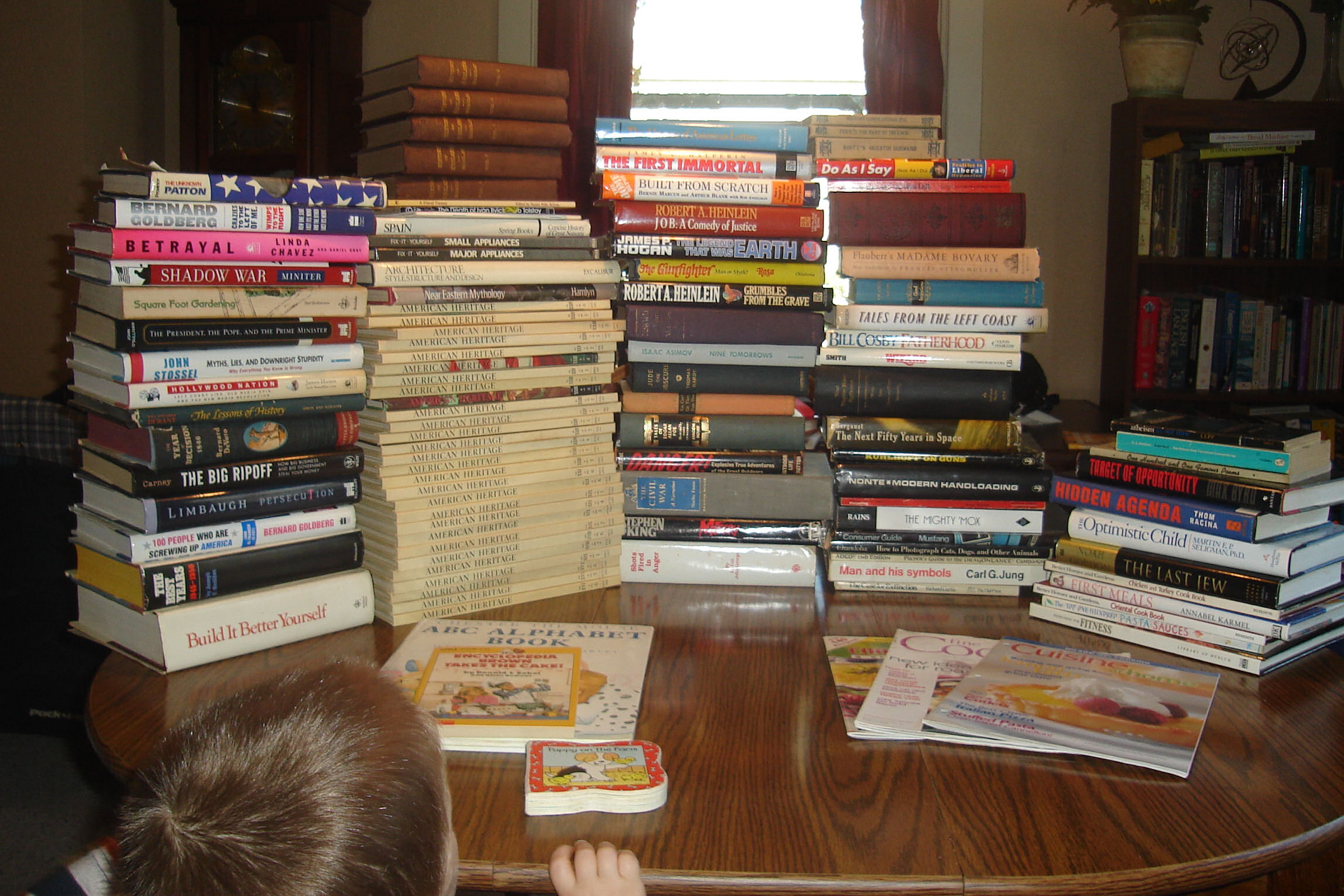
Today, the J had its book fair in the same room as in past years, but this year the room seemed dimmer. The books certainly were in great disarray, making it hard to browse quickly in the near-dark. However, I managed to find a few just fine:


J 2008 book fair results
Click for full size

I got:

  • The Good War by Studs Terkel, memories of men who served.
  • Back to the Future Part II, the movie tie in. I think I have the first already, but given this pile of books, who knows?
  • A CSI television show tie-in book. It’s a surprise gift for my mother. Don’t tell her.
  • True Grit, the novel upon which the movie was based or the novelization thereof. I just read Rooster Cogburn, don’t forget.
  • The Story of the Trapp Family Singers, the source for The Sound of Music.
  • Bill McCllellan’s book. He’s a communist for the St. Louis Post-Dispatch. Oops, did I slip Freudianly?
  • Wilderness Survival and the U.S. Army Survival Manual because that Georgia-Russian War is making me nervous.
  • World of Shakespeare: Plants, a book that alphabetically lists plants and their references in Shakespeare. You know you would have bought it, too.
  • History of the Franks, a paperback about the forebearers of the French.
  • The Wall by Sartre, a collection of short stories including the title piece.
  • Ontological Relativity and other essays, a couple of lectures by a philosopher I’d never heard of.
  • Two Essays on Analytical Psychology by Carl Jung. Since I’ve had another thin volume by Jung on my shelves for a decade, I thought maybe I’d get it company for the next decade.
  • Life in Medieval Times, one of those books that tries to tease out the day to day in a historical epoch.
  • An uncorrected proof of The Septembers of Shiraz, a book set in Iran near the revolution. Its, not ours.
  • Weeds of the North Central States so I know what I’m pulling.
  • This Way To The Stars, a juvenile book from the 50s or 60s talking about space. Probably launched many a dream and a couple of scientists or astronauts.
  • Foxfire 2, a book in the series about crafts and olden times. See Georgia-Russian War above.
  • Barton Fink and Miller’s Crossing, the screenplays by the Coen brothers.
  • Gracie: A Love Story by George Burns. I hope I don’t already have this one. With so many, I’m losing track.
  • Monarch of Deadman Bay, a book about an Alaskan Kodiak bear. As opposed to the Californian Kodiak, I suppose.
  • Free Market Environmentalism, a book about applying actual economic thought to environmentalism. Never heard of it? I suppose that means its arguments are valid.
  • In Search of History, Theodore H. White’s personal story of being an intrepid reporter.
  • Anglo-Saxon England. It leads right up to the conquest.
  • George F. Kennan’s Memoirs. I read his book American Diplomacy 1900-1950 in September, 2005.
  • The Wisdom of Confucious.
  • The Morning After, a collection of George Will columns from 1981-1986.
  • Frontiers II by Isaac and Janet Asimov. Asimov’s last nonfiction work details scientific breakthroughs ca. 1993.
  • Always the Young Stangers, prose by Carl Sandburg.
  • The Way Things Work volumes one and two.
  • Relativity by Albert Einstein.
  • Isaac Asimov’s Book of Facts.
  • Extraterrestrial Civilizations by Isaac Asimov. Musings on the likelihood of others being out there.
  • America: What Went Wrong. As its title suggests, it will probably offend me.
  • Jefferson Himself, a sort of autobiography of Thomas Jefferson.
  • Anybody’s Bike Book, a book about bike repair.
  • Dictatorship of Virtue, which takes multiculturalism to task.
  • America’s First Civilization, a book covering the Olmecs.

Heather’s 4 books are to the right and on the bottom of the stack. Apparently, the top 3 are not hers; instead, they were a stack on the checkout table too close to the gravitational field of our stack and came home with us.

Depicted to the left is my new copy of Conquest, which I am almost finished reading in a library copy. I liked it so much, I ordered one online.

Man, the book fair next week will probably be about all the books I’ll ever need. I was afraid of going to the J because I’m running out of space, seriously, on my shelves. My fears were well founded. I’m going to have to develop modular book-based furniture to fit more books into our home.

Buy My Books!
Buy John Donnelly's Gold Buy The Courtship of Barbara Holt Buy Coffee House Memories

Sang-Froid and Roy

Sorry, no post, but I just saw the expression sang-froid in a book and thought of all the wonderful puns I could use as post titles if possible. Since it’s looking impossible in the near term, I’ll just do a post dumping them for you:

Sang-Freud
Sang-Fraud

And rest assured I will use it in a sentence today. And a two-year-old will parrot it back, much to my delight.

Buy My Books!
Buy John Donnelly's Gold Buy The Courtship of Barbara Holt Buy Coffee House Memories

Good Book Hunting: August 9, 2008

So I was saying something about not taking children to book fairs or something, and suddenly I read that the People for the Ethical Treatment of People or the St. Louis Ethical Society or whatever the secular humanists, the moral subgroup of the loft people, call themselves was having its book fair. Last year, it was a pretty small affair but fruitful according to my acquisitive nature. This year, it proved smaller, small enough to go through before the children got too many stroller sores, but fruitful enough:


Ethical Society Book Fair II
Click for full size

I got:

  • Several volumes of the History of Philosophy paperback set. I already owned a number of them but couldn’t remember which ones I lacked, so I bought them all. Turns out I only added one to my collection and a large number of duplicates. Gimlet, if you want the dupes, they’re yours.
  • Reflections of Friendship, kind of like Be Happy!, but with only landscapes and not 70s people to mock.
  • Countdown to Super Bowl, a book about the time the Jets went to the Super Bowl with Joe Namath at the head. Uh oh, ultimately, this might be a heartbreaking harbinger.
  • The Picture of Dorian Gray and Other Writings by Oscar Wilde.
  • Tomb Raider: The Cradle of Life, the movie paperback. Because, well, you know me.
  • The Screwtape Letters by C.S. Lewis, even though Mrs. Noggle has assured me that it’s included in the compendium of C.S. Lewis writing that she gave me which I’ve obviously not paid enough attention to.
  • Thereby Hangs a Tale by Charles Earle Funk, a fun etymology book.
  • The Outsider by Colin Wilson.
  • My Cat Spit McGee, a book about a guy’s pet cat. Masculinity–.
  • Love Poems by Anne Sexton.
  • What’s the Matter with Kansas by Thomas Frank.
  • Piers Plowman.
  • One Way to Reconstruct the Scene. A slender volume of poetry, if I recall correctly.
  • Letters Volume I by Matthew Arnold. Brother, if you can buy a 100 year old book by a poet for a dollar, you just do it.
  • The Andromeda Strain by Michael Crichton. A second printing, it might replace another early printing if I can figure out which is older.
  • Murder at the ABA by Isaac Asimov. I read this, probably in middle school. Still, the man wrote himself into one of his mysteries, but only as a minor character. Amusing.
  • The Elric Saga Part I by Michael Moorcock. I think some people have said this is good. It has to be better than The Black Corridor or An Alien Heat. Doesn’t it?
  • Invisible Prey by John Sandford.
  • Dumbth by Steve Allen. A book about how America is dumbing down. By Steve Allen. So you know this isn’t a new concern.
  • Looking Good in Print and Publication Design text books about designing for print.

Additionally, I got The Three Amigos and Fletch Lives! on videocassette. Mrs. Noggle scored 15 sets of records in the Beethoven Centennial series, some Cooking Light magazines, another record with trumpet music, and some cassettes.

A good trip again this year, and brief, but not brief enough, really, for J2, who thinks the car seat is a torture device.

Buy My Books!
Buy John Donnelly's Gold Buy The Courtship of Barbara Holt Buy Coffee House Memories

Book Report: Phantom Prey by John Sandford (2008)

A bad John Sandford book is better than any Ridley Pearson book I’ve read. Of course, I’ve only read one Pearson book, and this isn’t a bad book, just not Sandford’s best. However, I got to deploy hyperbole, and that’s what matters to a Web log.

This book delves into Goth subculture, something mocked on Saturday Night Live when Will Ferrell was still on it, for crying out loud. When I founded a magazine in 1994, my art editor was a Goth. So he’s not exactly delving into a cutting edge subculture here. Now, death amongst the Disco Revivalist Cults, that would be cutting edge. So an old white dude delving into a subculture of whom I’ve known members sort of made me wonder if he knew what he was talking about in writing it. Then, of course, I thought maybe he knew more than I did since I only knew goths a long time ago.

Ah, well. I figured some of it out early, clued in by the fact that the person above suspicion and the suspect both had really good asses. Yes, that’s how they were described. This book struck me as more tawdry of Sandford’s work, wherein he enters Parkerian territory of the main character being irresistable to all attractive members of the opposite sex, he imagines it, and then he goes home to his significant other (wife in this case). But the discussion of sex and the bawdy talk sort of sticks out in this one.

So there looks like there’s going to be a plot twist, but ultimately it takes the Chandlerian plot turn into interconnected crimes of the rich and the insane, and the one saving twist I was expecting wasn’t there. Finally, we get to the end, where someone who could have gotten clear decides to kill Davenport, leading to the ultimate climax that also makes a major unrelated subplot relevant in that it explains how Davenport survives.

So it’s not the best of Sandford, but it’s good enough. It moves along and works in ways that Pearson does not, and sometimes an attempted writer (me) ought to see the good and the not good in stark relief like this.

And this book, since I got it from the book club, is fresh and it only cost me $.20 plus $30 shipping and handling, so it was a steal so long as I don’t do the math.

Books mentioned in this review:


Buy My Books!
Buy John Donnelly's Gold Buy The Courtship of Barbara Holt Buy Coffee House Memories

Slightly Adulterated

You know the song “Love Machine” by Smokey Robinson and the Miracles?

It just doesn’t sound right to me without sighing hens.