She quips:
Somewhere, Max Blumenthal is crying into his Zima.
Come on, Dana. Zima hasn’t been available domestically for a couple years. Let it go.
To be able to say "Noggle," you first must be able to say "Nah."
She quips:
Somewhere, Max Blumenthal is crying into his Zima.
Come on, Dana. Zima hasn’t been available domestically for a couple years. Let it go.
Buy My Books!


I thought I’d read a quick bit of drama to break up a larger multi-book volume that I’m also working on currently. A full evening play. You know, something you could read in a night. Ha. This one took me three nights.
It’s not a straightforward play, unlike the stuff I’ve read by Neil Simon recently or even this author’s own Rosencrantz and Guildenstern Are Dead. It’s a bit, erm, stylized, which requires a lot more attention reading and relies on some conceits and whatnot that you have to keep in mind to follow along.
For example, this book takes place in a future England from 1972, where England has landed on the moon, but tragedy struck there as the lander was damaged and the two landing astronauts fought each other to see who would survive, and the television audience back home saw the fight live. Fancy that: in 1972, they thought everyone would go to the moon.
Also, the government has been taken over by a totalitarian left (but I repeat myself) party that has rounded up the usual suspects and has replaced the Archbishop of Canterbury with some other government minister. The main characters are a philosopher who holds a chair at a university where the ultimate leader has a band of professors/acrobats (the titular jumpers) and his wife, a former musical actress who lost it singing a moon song after the above mentioned astronaut incident.
During a party, when the professor is working, the wife shoots one of the jumpers.
She deals with covering it up with the help of her “therapist” who does some strange things with her and might be schlepping her.
The professor works on a major presentation and tries to reconcile with the wife. Then an inspector, a fan of the wife, shows up. He might know something about the dead jumper, but he squelches the investigation for a chair at the university (open as said jumper is dead), maybe some autographs, and maybe some schlepping.
I think I’ve given you the nutshell of this piece. I don’t even remember how it ends. I certainly didn’t get the point.
On the whole, I think the nicest thing I can say for it is at least it’s not French drama.
Buy My Books!
I was eating breakfast with a magazine spread before me. This time, it was the new slick that the Wall Street Journal bundles with its paper. I’m looking at this story, somehow involving a woman and an exercise bike. I forget anything beyond that.
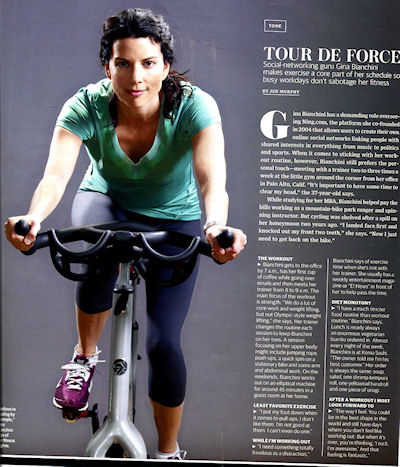
“What is she doing?” my three-year-old asks.
“She’s riding an exercise bike,” I reply.
“I think she’s in bed,” he says.
“Uh huh,” I respond in that recognition that he’s being imaginative and contrarian as three-year-olds are when they’re not sleeping and sometimes when they’re eating.
Then I glanced at the left hand page.
(UPDATE: John wants a NSFW label on this post. I initially didn’t put one on it because it was SFWSJ. However, in hope of getting more traffic, here it is: Potentially NSFW. That made you click the Read More link even faster, didn’t it?)
Buy My Books!
(Link seen on Hot Air.)
Buy My Books!
Here’s a headline in the Milwaukee Journal-Sentinel: Incorporation of Okauchee Lake area under study.
Which reminds me, I might be the only man in history to have used Okauchee Lake in a sonnet:
Okauchee Light
Across the dark Okauchee lake, a light,
the marker for the end of someone’s dock,
is strangely lit at nearly twelve o’clock
and breaks the solid black that is the night.
From here, across the chilling April lake,
through busy bar room glass I see that glow,
but life or rooms beyond I’ll never know.
One light does not a utopia make.
Quite like your smile, that single man-made star:
Up there, on stage, you flash a smile at me,
and crinkle eyes to give the gesture weight,
but like the dock-end light, you are too far;
your glow is there for someone else to see,
and now, for me at least, it is too late.
Back in the early 1990s, in my sonneting days, my friends and I followed a band called the Surf Boys from festival to festival in Milwaukee. The band was Nick, the lead singer, a guitarist named Dave, a keyboardist named Debbie, and a drummer. However, these backup players were not the original Surf Boys, and when they wanted to reunite, they cast off the other players. One night, we drove out to a bar on Okauchee Lake to see the Dave, Debbie, et al, in their non-Surf Boys incarnation. I ended up writing a sonnet about it. Not that I was that interested in Debbie, per se; she was cute, but I think I had a sum of one conversation with her throughout. But I thought the sonnet has a cool Great Gatsby vibe, and a musician on stage does offer a good unattainable woman conceit.
Buy My Books!
Pet hunger spurs idea for national food bank network:
The Mayor’s Alliance is working with the Petco Foundation, the philanthropic arm of the pet store chain, to build a national network of pet food banks supplied in part out of donation bins that Petco is putting in its stores.
Of course, there are those who lament starving people in the United States and then devote their energies to pampering animals. Because a generic person on the street has less worth than the generic dog.
I was going to say “objective” worth, but that’s not the case, is it?
Buy My Books!
Citizens have little faith in the elected government and more confidence in their military, and here’s a general considering a presidential run:
U.S. Gen. David Petraeus is being strongly suggested as the Republican presidential candidate to stand against Barack Obama in 2012.
Speculation is growing that the shrewd and articulate commander credited with turning around the Iraq war is contemplating a run for the White House.
Haven’t I heard a variation of this story before?
Buy My Books!
Another entry in a thought-provoking series designed to provoke support for government health care:
For nearly a decade, Paula O—-‘s brain tumor was kept at bay by a drug that was not approved to treat her condition.
Then Oertel did something she never imagined would jeopardize her good health. She moved. Less than 30 miles – from one county in Wisconsin to another.
The move triggered a review of her health insurance from Medicare, which eventually led to a loss of coverage, including the drug. And the tumor returned within four months.
A tragic story, but, um, that’s already government health care denying the coverage. Is this story supposed to be promoting health control reform or arguing against it?
Buy My Books!
After seven years of raising money, the Animal House Fund didn’t reach its goal of building a new city pound.
But organizers did know how to throw a party.
Young supporters donned their Hellenic best for a toga fundraiser in Soulard, while comedian Elayne Boosler emceed a gala at City Hall. Andy Warhol paintings —his dog portraits — provided the backdrop for another benefit at an area art gallery.
The photo opportunities were plenty. The direct benefit to the dogs and cats in the city’s dilapidated shelter, though, remains questionable.
The founder was the former head of the St. Louis city board of aldermen.
Buy My Books!
The story should say:
The White House is considering whether to create a honeypot of international terrorism suspects at a U.S. military base in Afghanistan, which would allow terrorists who escape or who are freed through an attack to return to battle immediately. The prison would replace Guantanamo Bay, which President Obama has promised to close and now seeks to put a small political bump ahead of real-world considerations.
It really says:
The White House is considering whether to detain international terrorism suspects at a U.S. military base in Afghanistan, senior U.S. officials said, an option that would lead to another prison with the same purpose as Guantanamo Bay, which it has promised to close.
The idea, which would require approval by President Barack Obama, already has drawn resistance from within the government. Army Gen. Stanley McChrystal, the top commander of U.S. and NATO forces in Afghanistan, and other senior officials strongly oppose it, fearing that expansion of the U.S. detention facility at Bagram air base could make the job of stabilizing the country even tougher.
I cannot tell if the administration really cannot see the actual implications and results of its actions or if it just doesn’t care. I understand the President is having trouble stopping smoking. The question is, what?
Buy My Books!
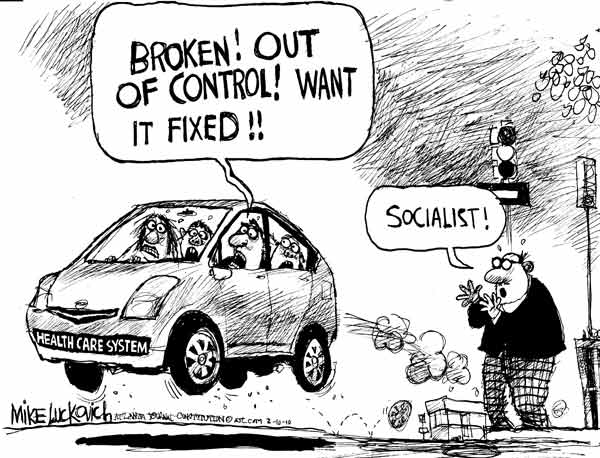
Mike Luckovich’s cartoon from March 10 nails the health care crisis in Congress:
Given that this cartoon was reprinted this morning in the Springfield News-Leader only two pages before the story entitled Runaway Prius tale in doubt:
Investigators with Toyota Motor Corp. and the federal government could not replicate the runaway speeding reported by a Prius owner who said his car’s accelerator stuck as he drove on a California freeway, according to a memo for a congressional panel.
The memo, obtained Saturday by The Associated Press, said the experts who examined and test drove the car could not replicate the sudden, unintended acceleration James Sikes said he encountered. A backup mechanism that shuts off the engine when the brake and gas pedals are floored also worked properly during tests.
Sikes, 61, called 911 on March 8 to report losing control of his 2008 Prius as the hybrid reached speeds of 94 mph. A California Highway Patrol officer helped Sikes bring the vehicle to a safe stop on Interstate 8 near San Diego.
One would have to assume, then, that Luckovich’s metaphor is that Congress has made a stunt of a crisis for its own gain, would one not? Because that’s spot on.
Buy My Books!
Even though Marquette University “technically” lost its game in the NCAA tournament, I still have hope they will take the title.
How? A controversial, infrequently used procedure called “Deem and Win.”
If you want your upsetted team to continue playing, call House Speaker Nancy Pelosi and tell her to make it so. After all, Congress already sees college athletics and broadcasting of professional sports as its balliwick. Why doesn’t it just get onto picking sports’ winners and losers like it does for big business’?
Buy My Books!
Mexico gunmen kill American consulate staff:
Gunmen in the drug war-plagued Mexican city of Ciudad Juarez killed two Americans and a Mexican linked to the local U.S. consulate, an attack U.S. President Barack Obama said “outraged” him.
An American woman working at the consulate in Ciudad Juarez, just over the border from El Paso, Texas, and her U.S. husband were fatally shot by suspected drug gang hitmen in broad daylight on Saturday as they left a consulate social event, U.S. and Mexican officials told Reuters.
Undoubtedly, the Mexican gangsters even now are wilting under the President’s outrage.
In the old days, that is, the beginning of the 20th century, American forces streamed over the Mexican border for this sort of thing. But we’re in a different world now, one where your American lives overseas are unprotected by the virtue of your being an American.
That said, do I think we should invade Mexico? Well, they do have oil. But it would be better if the Mexican government could take care of its own problems or ask for help from its militarily talented good neighbor to the north.
Buy My Books!
I got this book for Christmas from my beautiful wife. As I have moved to the Springfield area and actually live within walking distance of the Wilson’s Creek National Battlefield and along the old Wire Road where the troops marched, I figured I ought to read up on it, you know? Heaven knows I read enough history books about the suburb of St. Louis where I used to live.
This is a full on history book, researched meticulously from the records of the time, including correspondence from participants as well as news accounts in the participants’ home towns. And the home towns there were; both sides of the battle featured a large number of volunteer companies from places such as Kansas, Illinois, Iowa, Missouri, Louisiana, Texas, and so on, most of the companies representing individual towns. But when the call to arms came, many able men joined either to punish the traitors or to defend themselves from the treasonous. Note that unlike some of the history books I’ve read recently centering on a historical person and making that person somewhat heroic (see Scipio Africanus and Hannibal), this book is very evenhanded in treatment of both sides.
Now, for those of you unversed in your Civil War history, Wilson’s Creek was a very early battle. The second of the war, as a matter of fact, following the first Battle of Bull Run. In August 1861, west of the Mississippi, the two armies marched quite a ways from their logistical bases, kinda felt each other out for a while, and then had a battle. General Lyons of the Union side marched down from St. Louis, essentially, and General McCulloch marched up from Arkansas and hooked up with the Missouri State Guard headed by former governor Price. Both sides lacked in intelligence and constantly acted on rumors of major enemy concentrations and both sides had serious trouble keeping their armies fed and shod (see my post about selling shoes to the armies in the Civil War).
At any rate, one August morning, the Union army snuck out to catch the rebs by surprise and attacked from two sides. They might have wanted to forestall an attack on Springfield until the Union Army had a chance to retreat to Rolla or they might have thought they could beat the superior forces of Price and McCulloch. The battle started well for the Union side, but a couple twists of fate and they ended up retreating not only from the battlefield but also from Springfield. So, to make a short story long, the Federals lost.
But it’s a fascinating look at this battle and will probably be a gateway for me into the large collection of Civil War history books I inherited from my uncle-in-law.
It’s a real shame that a lot of people don’t read history any more. It really gives one perspective. And a lot of interesting stories to tell, particularly if the history occurred near where you live.
Buy My Books!
In the “city” of St. Louis, the alderman are happy spending taxpayer money renovating for-profit business:
Aldermen approved tax increment financing and other public assistance that could reach $28.7 million. The redevelopment area is comprised mainly of the 21-story Railway Exchange Building, which houses Macy’s, and the parking garage across Olive Street from the store.
Macy’s plans to downsize the store from seven to three floors. Much of the first phase of TIF funding — $8.4 million — will be used in the store remodeling, Young said. The company has yet to provide remodeling details.
Maybe I should call any business in downtown St. Louis “for-profit” with quotation marks since so much of the business model seems to be getting money and concessions from government entities instead of consumers. But what “consumers” want to go downtown, pay to park, and then pay almost 10% in sales tax to shop at Macy’s downtown when they can get the same thing at a suburban mall? Even the half dozen or so residents of lofts downtown pull the Mini out of the garage and go to the suburbs to shop.
Maybe I should have titled this post “businesses whose logos are red stars and governments whose should be.”
Buy My Books!
This book not only covers not only making necklaces with beads, but also how to make beads from different things such as clay, fabric, and papier-mache. As part of a series, the book focuses on necklaces and the projects include traditional bead stringing coupled with some wire work.
Projects include:
Each project offers a couple of photographic variations on the main project. They really do spark your imagination; I really enjoy most the books that go astray from basic beading techniques.
I do have a couple of notes about the book, though, that are less laudatory:
That’s not a single step.
Still, worth your time and trouble perusing it if you’re looking for some new ideas.
Buy My Books!
Given the weight of court rulings that police officers have no obligation to protect you, the individual citizen (see this for a list of relevant cases), will government doctors have a legal obligation to treat you, the individual citizen?
Buy My Books!
A congressman and his constituent were walking in the woods when they came upon a metaphorical bear representing the insatiable appetite of an unsustainable set out outlays and deficit spending extending decades into the future. The congressman sits down and starts putting on tennis shoes. “Hey, you cannot outrun a metaphorical bear,” the constituent says. The congressman replies, “I don’t have to outrun the metaphorical bear; I just have to outrun you.”
Update: Thanks to Tam for the link.
Buy My Books!
Iowa police seize really bad bogus bills
Weldon Spring passes fake pot ban; Foristell may be next
Not counterfeit pot, but rather K2, which has a sort of pot-like chemical in it. This is a sudden disaster, or at least it’s suddenly getting a lot of coverage in the press. Which makes it AN EMERGENCY:
The St. Charles County Council on Monday unanimously voted to ban K2 and other products containing synthetic cannabinoids, compounds that mimic the effects of marijuana.
The law immediately made it a misdemeanor to sell or possess the products throughout St. Charles County, including incorporated municipalities.
Enacted as an emergency measure affecting public health, the bill did not have to go through the typical process requiring at least two meetings for passage – one for a first reading and a second for the final vote.
Emergency is now defined down to anything the St. Charles County Council wants to act on quickly, in the heat of a media spotlight. Swell.
Buy My Books!
A tax designed to pay for the Milwaukee baseball stadium will not sunset on schedule:
New financial projections released Tuesday suggest the sunset year for the Miller Park stadium sales tax will be between 2016 and 2018, at least two years later than originally thought.
For several years, the Miller Park stadium district had relied on projections that the 0.1% sales tax could be retired in 2014. But in recent months, the effects of the economic recession have taken their toll: Sales-tax receipts in the five counties where the tax is collected plummeted 9.45% from 2008 to 2009.
It’s always something.
Buy My Books!